




NCERT Solutions for Class 10 Hindi: A Complete Guide to Kshitij, Kritika, Sparsh and Sanchayan
If you ask any Class 10 student which subject they take least seriously while preparing, there's a good chance Hindi will come up. Not because it's hard, but because it feels familiar. Students assume they already "know" Hindi, so they push it to the last week before boards and then panic when they realise that scoring well in Hindi is not about fluency in speaking the language — it's about how precisely you can analyse a poem, justify a character's behaviour, or frame a grammar answer the way CBSE examiners expect. That gap between knowing Hindi and scoring well in Hindi is exactly where NCERT Solutions for Class 10 Hindi become useful, and it's exactly what this guide is built to help you close.
At Myclass24, we've noticed a pattern over the years: students who treat Hindi as a scoring subject, rather than a "native language so I'll manage" subject, consistently end up with better percentages. Hindi is one of the few subjects where, with the right approach, securing 90+ marks is genuinely achievable for most students. The syllabus isn't overloaded with abstract theory. It's built around stories, poems, and grammar rules that, once understood properly, stay with you. This article walks you through everything — the structure of the NCERT Solutions for Class 10 Hindi syllabus, how each textbook is different, what kind of preparation actually works, and where to find NCERT solutions that match the way CBSE checks answer sheets.
NCERT Solutions for Class 10 Hindi Kshitij – Chapter-wise List
| Chapter No. | Chapter Name |
|---|---|
| Chapter 1 | Surdas Ke Pad |
| Chapter 2 | Ram-Lakshman-Parshuram Samvad |
| Chapter 3 | Aatmakathya |
| Chapter 4 | Utsah & Aat Nahi Rahi Hai |
| Chapter 5 | Yeh Danturit Muskaan & Fasal |
| Chapter 6 | Sangatkar |
| Chapter 7 | Netaji Ka Chashma |
| Chapter 8 | Balgobin Bhagat |
| Chapter 9 | Lakhnavi Andaaz |
| Chapter 10 | Ek Kahani Yeh Bhi |
| Chapter 11 | Naubatkhane Mein Ibadat |
| Chapter 12 | Sanskriti |
NCERT Solutions Class 10 Hindi — स्पर्श (Sparsh)
| Chapter No. | Chapter Name | View Solutions |
|---|---|---|
| Chapter 1 | Saakhi | View Solutions |
| Chapter 2 | Pad | View Solutions |
| Chapter 3 | Manushyata | View Solutions |
| Chapter 4 | Parvat Pradesh Mein Paavat | View Solutions |
| Chapter 5 | Top | View Solutions |
| Chapter 6 | Kar Chale Hum Fida | View Solutions |
| Chapter 7 | Aatmatran | View Solutions |
| Chapter 8 | Bade Bhai Sahab | View Solutions |
| Chapter 9 | Diary Ka Ek Panna | View Solutions |
| Chapter 10 | Tatara-Vamiro Katha | View Solutions |
| Chapter 11 | Teesri Kasam Ke Shilpkar Shailendra | View Solutions |
| Chapter 12 | Ab Kahan Dusro Ke Dukh Se Dukhi Hone Wale | View Solutions |
| Chapter 13 | Patjhad Mein Tooti Pattiyan | View Solutions |
| Chapter 14 | Karthus | View Solutions |
Understanding the Class 10 Hindi Syllabus Structure
Before jumping into chapter-wise preparation, it helps to understand how CBSE has structured Hindi for Class 10. Unlike subjects like Science or Maths, where everyone studies the same book, Hindi is split into two course options — Hindi Course A and Hindi Course B. Schools choose one for their students, and the textbooks differ accordingly.
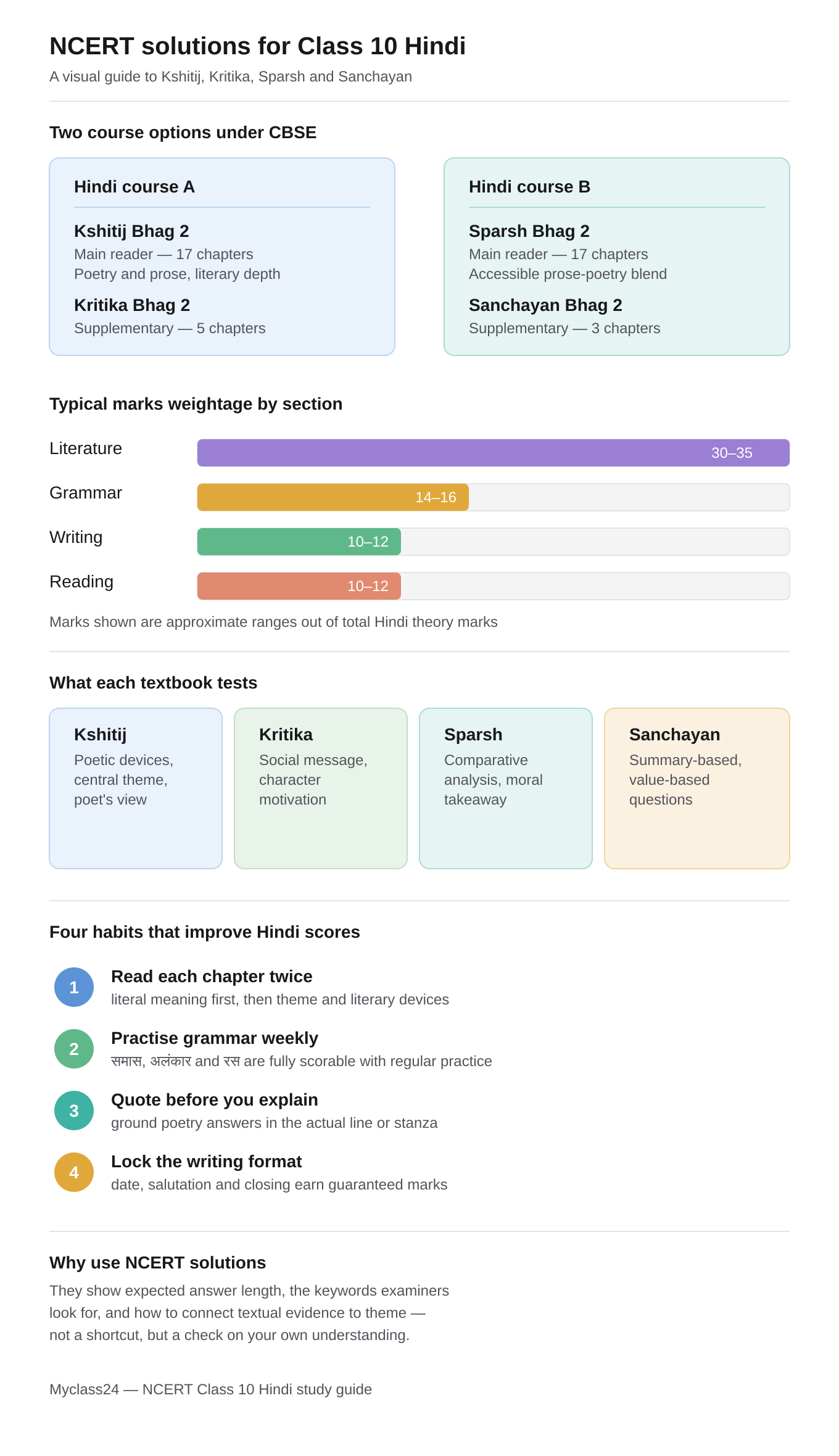
Hindi Course A is built around two books: Kshitij Bhag 2 (the core literature reader containing poetry and prose) and Kritika Bhag 2 (a supplementary book with shorter, theme-based chapters). Hindi Course B, on the other hand, uses Sparsh Bhag 2 as the main reader and Sanchayan Bhag 2 as the supplementary text. Both courses carry the same exam weightage and the same overall difficulty level — the difference lies purely in which set of literary pieces you're studying, not in how hard the subject is.
A lot of students get confused here, especially when switching schools or boards, so let's break this down clearly.
Table 1: Class 10 Hindi Textbooks at a Glance
| Course | Main Textbook | Supplementary Textbook | Approx. Chapters | Focus Area |
|---|---|---|---|---|
| Hindi Course A | Kshitij Bhag 2 | Kritika Bhag 2 | 17 (Kshitij) + 5 (Kritika) | Classical and modern poetry, prose with literary depth |
| Hindi Course B | Sparsh Bhag 2 | Sanchayan Bhag 2 | 17 (Sparsh) + 3 (Sanchayan) | Simpler prose-poetry blend, narrative-based learning |
Notice that the chapter count is fairly close in both courses. What actually differs is the tone and complexity of the writing. Kshitij leans more into classical Hindi poetry — poets like Surdas, Tulsidas, and Dev appear here — which means students need to get comfortable with slightly older vocabulary and poetic devices. Sparsh, in comparison, uses more contemporary language, which many students (especially those whose first language isn't Hindi) find easier to grasp initially.
Why NCERT Solutions Matter More in Hindi Than You'd Expect
Here's something most students don't realise until it's too late: in Hindi, marks are lost not because the answer is wrong, but because it isn't structured the way the examiner expects. A student might genuinely understand a poem's meaning but lose marks for not mentioning the specific अलंकार (figure of speech), not connecting the answer back to the poet's intent, or writing in a conversational tone instead of an exam-appropriate one.
This is where well-prepared NCERT solutions genuinely help — not as a shortcut to avoid reading the chapter, but as a reference for how an ideal answer should be framed. A good solution doesn't just give you "the answer." It shows you the expected length, the keywords examiners look for, and how to connect a textual reference to the broader theme of the chapter.
We've structured our approach to NCERT solutions around three things that genuinely move the needle for Hindi scores:
- Concept clarity over memorisation — Understanding why a poet used a particular metaphor matters more than memorising a "model answer," because CBSE often rephrases questions.
- Grammar integration — Many students treat व्याकरण (grammar) as a separate subject and ignore it until the final week. Solutions that tie grammar concepts back to chapter examples make recall far easier.
- Answer-writing discipline — Word limits, paragraph structure, and the use of connecting phrases (जैसे कि, इसके अतिरिक्त, परिणामस्वरूप) are small habits that examiners notice immediately.
How to Approach Each Book Differently
Treating all four Hindi textbooks the same way is a common mistake. Each one demands a slightly different study strategy.
Kshitij Bhag 2 is heavy on poetry, and poetry in Hindi isn't something you can cram. You need to read each poem at least twice — once to understand the literal meaning, and once to catch the emotional undertone and literary devices. Chapters by poets such as Surdas and Tulsidas often appear with questions on भक्ति भावना (devotional sentiment), so understanding the historical and cultural context behind the poem adds real depth to your answers.
Kritika Bhag 2, being a supplementary book, often gets the least attention — which is a mistake, because its chapters are shorter and significantly easier to score full marks in if prepared well. Since these stories are usually built around a clear social message, the safest strategy is to identify the core theme of each chapter early and revise it through that lens rather than trying to memorise the entire narrative.
Sparsh Bhag 2 mixes prose and poetry in a way that's more accessible language-wise, but examiners still expect depth in the answers. Don't mistake "simple language" for "simple expectations" — character analysis and theme-based questions here carry just as much weight as in Kshitij.
Sanchayan Bhag 2, much like Kritika, is compact but important. With only a handful of chapters, it's genuinely possible to master this book completely in a focused weekend of revision, provided you don't leave it for the very end.
Table 2: Subject-Wise Preparation Strategy
| Textbook | Question Type Commonly Asked | Recommended Study Approach | Time Investment (Suggested) |
|---|---|---|---|
| Kshitij Bhag 2 | Poetic devices, central theme, poet's perspective | Read twice — literal meaning, then literary analysis | High (core scoring book) |
| Kritika Bhag 2 | Social message, character motivation | Identify theme first, then revise narrative briefly | Medium |
| Sparsh Bhag 2 | Comparative analysis, moral takeaway | Focus on character and message clarity | High (core scoring book) |
| Sanchayan Bhag 2 | Summary-based, value-based questions | Complete in a focused short revision block | Low to Medium |
What Makes Kshitij and Sparsh Different in Practice
Since most schools default to either Course A or Course B, it's worth spending a moment on what actually separates these two main readers, beyond just the list of authors.
Kshitij's poetry section opens with bhakti-kaal poets, which means the very first few chapters ask students to engage with a form of Hindi that feels distant from everyday spoken language. This isn't a flaw in the book — it's deliberate, because understanding bhakti poetry builds the foundation for appreciating how Hindi literature evolved. Students who rush through these opening chapters to "get to the easier ones" often regret it later, because questions on poetic tradition and historical context tend to draw from exactly these early chapters.
Sparsh takes a more linear, narrative-friendly route. Its prose pieces are built around relatable situations — family relationships, social observations, everyday moral dilemmas — which makes the reading experience smoother. But this accessibility can create a false sense of security. Students sometimes read a Sparsh chapter once, feel like they've fully understood it, and skip a second close reading. That second reading is where you catch the finer details: a recurring image, a subtle shift in tone, or a line that the chapter's title is actually drawn from. These are the exact details that separate a 7-mark answer from a full 10-mark one.
Common Mistakes Students Make While Using Solutions
Having looked at thousands of Hindi answer scripts and solution patterns over the years, a few recurring mistakes stand out, and they're worth naming directly so you can avoid them.
The first is copying solutions word-for-word without adapting them to the actual question asked. CBSE rarely repeats a question exactly as it appeared in the textbook — it's often rephrased, shortened, or combined with a related sub-question. A student who has memorised a textbook-style answer can get thrown off by a slightly different phrasing, even though the underlying concept is identical. The fix is simple: practise rewriting the same answer in your own words a few times, so you're relying on understanding rather than recall.
The second mistake is ignoring the line or stanza references in poetry questions. When a question asks you to explain a specific couplet or stanza, examiners expect you to quote or paraphrase that exact portion before explaining it. Jumping straight to explanation without grounding your answer in the text loses marks even if your interpretation is correct.
The third, and possibly the most common, is treating grammar and writing sections as an afterthought compared to literature. Many students spend eighty percent of their revision time on Kshitij or Sparsh chapters and barely touch व्याकरण or लेखन until the final week. Since these sections together can account for a significant chunk of the total marks, this imbalance often costs students more than they realise.
Chapter Weightage: Where to Focus Your Energy
Not every chapter carries equal weight in the board exam, and recognising this early can save a lot of revision time. While CBSE doesn't publish a fixed marks-per-chapter breakdown, certain patterns repeat year after year based on previous question papers and the structure of the syllabus.
Table 3: Typical Marks Distribution in Class 10 Hindi (Course A/B Pattern)
| Section | Approximate Weightage | What It Tests |
|---|---|---|
| Reading (अपठित गद्यांश/पद्यांश) | 10–12 marks | Comprehension and inference skills, not memorisation |
| Grammar (व्याकरण) | 14–16 marks | Fixed-rule based, fully scorable with practice |
| Literature (पाठ्यपुस्तक एवं पूरक पाठ्यपुस्तक) | 30–35 marks | Theme, character, poetic devices, contextual understanding |
| Writing (लेखन) | 10–12 marks | Format accuracy, clarity, structured expression |
Looking at this table, two things become obvious. First, literature carries the heaviest weight, which is exactly why a chapter-by-chapter understanding (not just a summary-level reading) of Kshitij, Kritika, Sparsh, or Sanchayan pays off the most. Second, grammar and reading together form a substantial chunk that's almost entirely skill-based rather than content-heavy — meaning consistent practice, not last-minute revision, is what actually improves this score.
Grammar: The Section Students Underrate the Most
If there's one section where students consistently leave easy marks on the table, it's व्याकरण (grammar). Unlike literature, where interpretation can vary slightly, grammar questions in CBSE Hindi papers have fixed, objective answers — meaning every mark here is fully recoverable with practice. Topics like समास, अलंकार, रस, वाच्य, and पद-परिचय appear almost every year in some form, and yet many students revise them only once, right before the exam.
The smarter approach is to treat grammar as a running practice subject throughout the year rather than a last-minute topic. Spending even fifteen minutes a few times a week identifying समास or अलंकार in sentences from your own textbook chapters builds a kind of pattern recognition that's very hard to develop through cramming alone.
Writing Section: Letters, Essays, and Format Marks
The लेखन (writing) section — covering formal letters, essays, and sometimes notices or advertisements — is another area where format matters as much as content. CBSE evaluators are trained to check for the correct format first: date placement, salutation, subject line, and closing. A well-written letter with the wrong format will lose marks regardless of how good the content is. Practising the correct format until it becomes automatic is one of the simplest ways to lock in guaranteed marks before you even get to the quality of your writing.
A Realistic Study Plan for the Last Few Months
Many students ask us how to balance Hindi with four or five other subjects in the final stretch before boards. Our honest suggestion: don't treat Hindi as something you'll "pick up easily." Block out consistent, smaller study sessions rather than one long cram session. Read one chapter properly, attempt its textbook questions without looking at solutions first, then compare your answers against a well-structured solution to see what you missed — whether it's a literary device, a grammar concept, or simply a sharper way of phrasing the same idea.
Reading the original NCERT chapters carefully, before turning to any solution, also matters more than students assume. Solutions are most useful as a check on your understanding, not as a replacement for actually engaging with the poem or story. The students who score the highest in Hindi aren't the ones who memorised the most model answers — they're the ones who genuinely understood the chapters and used solutions to refine how they expressed that understanding on paper.
Hindi, when prepared this way, stops feeling like a subject you're "managing" and starts becoming one of the more comfortable, even enjoyable, parts of your Class 10 board exam preparation. With consistent reading, focused grammar practice, and disciplined answer-writing, there's no real reason it can't be one of your strongest scoring subjects.
FAQs on NCERT Solutions for Class 10 Hindi
NCERT Solutions for Class 10 Hindi play a significant role in board exam preparation because most examination questions are based directly or indirectly on the NCERT textbook. These solutions help students understand chapter meanings, literary devices, grammar concepts, and answer-writing formats. Hindi literature often requires interpretation and explanation, which can be challenging without proper guidance. By studying well-explained solutions, students learn how to present answers effectively and score better marks. Regular practice with these solutions also improves language skills, vocabulary, and comprehension. They serve as a reliable study resource for revising important topics before examinations.
Regular practice of NCERT Solutions offers several long-term benefits. It strengthens conceptual understanding, improves retention of important topics, and enhances answer-writing skills. Students who practice consistently are better prepared for class tests, periodic assessments, and final board examinations. Regular revision through solutions reduces exam stress because students become familiar with commonly asked questions and answer formats. It also helps identify weak areas early, allowing sufficient time for improvement. Over the academic year, continuous practice builds confidence, increases language proficiency, and creates a strong foundation for achieving excellent results in Class 10 Hindi examinations.
Some Hindi chapters contain complex themes, historical references, or literary language that can be challenging for students. NCERT Solutions simplify these topics by explaining concepts in a clear and systematic way. They break down difficult passages into understandable ideas and provide detailed answers to textbook questions. This helps students grasp the chapter’s central message without feeling overwhelmed. Solutions also explain important events, character motivations, and thematic elements, making learning easier and more enjoyable. By removing confusion and providing clarity, they encourage students to engage more actively with the subject and develop a deeper understanding.
Yes, NCERT Solutions are extremely useful during the final stages of revision. They provide concise and organized answers that help students quickly review important concepts, chapter summaries, and frequently asked questions. During revision, students often need a reliable source to refresh their understanding without rereading entire chapters. Solutions serve this purpose effectively by highlighting key points and explanations. They also help identify areas where additional practice may be required. When combined with short notes and previous revision work, NCERT Solutions become a valuable tool for strengthening confidence and improving readiness before examinations.
Scoring high marks in Hindi requires more than just reading chapters. Students need to understand themes, characters, poetic devices, and proper answer presentation. NCERT Solutions provide structured answers that reflect the expected examination pattern. They help students learn how to write concise yet complete responses. By practicing these answers regularly, students become familiar with important questions and improve their writing speed. Solutions also clarify difficult portions of prose and poetry, reducing confusion during exams. When combined with textbook reading and revision, these solutions can significantly improve performance and help students achieve excellent marks in Hindi.
For most students, NCERT Solutions are sufficient as a primary resource because the board examination is largely based on the NCERT syllabus. These solutions cover chapter explanations, textbook questions, and important concepts in detail. However, students should not rely only on memorizing answers. Reading the chapters thoroughly and understanding the context of stories and poems is equally important. Additional practice through sample papers and previous-year questions can further strengthen preparation. NCERT Solutions work best when used as a guide for understanding concepts rather than as a source for rote learning. This approach ensures better retention and exam performance.
Every chapter included in the prescribed syllabus is important because questions can be asked from any section. However, literary chapters that focus on major themes, character analysis, and poetic interpretation often receive significant attention in examinations. Poems are particularly important because they test students’ understanding of emotions, symbolism, and literary devices. Prose chapters may include long-answer and short-answer questions based on key incidents and messages. Instead of focusing only on selective chapters, students should prepare all lessons thoroughly. A balanced study plan covering prose, poetry, grammar, and writing skills is the safest strategy for board examinations.
The best way to use NCERT Solutions is to first read the chapter independently and try solving the questions on your own. After attempting the answers, compare them with the solutions to identify mistakes and improve understanding. Students should focus on understanding the reasoning behind answers rather than memorizing them word for word. Making short notes from the solutions can also help during revision. Repeated practice improves answer-writing skills and confidence. Using the solutions regularly throughout the academic year is much more beneficial than studying them only before examinations. Consistency leads to better learning outcomes.
Yes, NCERT Solutions are especially helpful for understanding Hindi poems because poetry often contains symbolic language, deeper meanings, and literary expressions. Many students find it difficult to interpret poetic themes independently. Solutions explain the central idea, emotions, literary devices, and important messages in a simple manner. They also clarify difficult words and expressions used by poets. This detailed understanding enables students to answer textbook and examination questions more accurately. By studying these explanations carefully, students develop a stronger appreciation for literature and improve their ability to analyze and interpret poetic texts effectively.
NCERT Solutions can contribute significantly to improving Hindi writing skills. They provide examples of properly structured answers, correct grammar usage, and appropriate vocabulary. By observing how answers are written, students learn effective sentence formation and presentation techniques. Regular practice also enhances comprehension and expression, which are important for descriptive and long-answer questions. Students gradually become more confident in writing their own responses. Additionally, exposure to quality Hindi language through explanations and answers helps strengthen overall linguistic ability. Consistent use of these solutions can lead to noticeable improvement in written communication and examination performance.