



NCERT Solutions are step-by-step answers to every question in NCERT textbooks, aligned to the CBSE syllabus. MyClass24 provides free, expert-reviewed solutions for Class 1 to 12, organised class-wise, subject-wise, and chapter-wise, available to read online or download as a PDF.
Free for all classes, Class 1 to 12, CBSE-aligned, chapter-wise PDFs, expert-reviewed
NCERT Solutions for Class 1 to 12 – Free PDF & Chapter-wise Answers
Select your class below to access free NCERT Solutions, chapter-wise content, and PDF resources. All solutions are updated for the CBSE academic year.
NCERT Solutions Class-1 to 12 | |
|---|---|
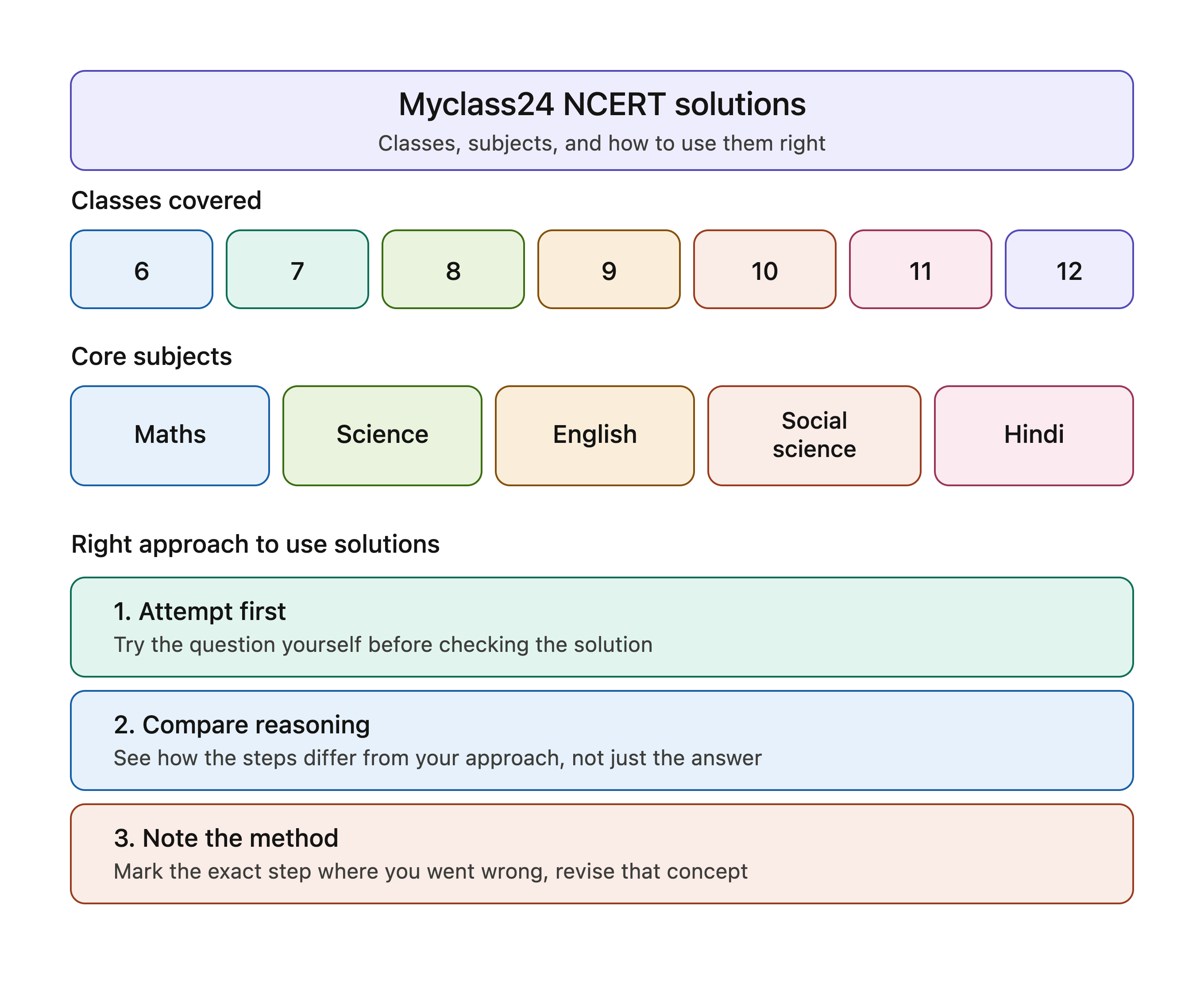
Subject-wise NCERT Solutions Class 1 to 12
Many students search directly by subject rather than by class. The sections below provide subject-wise entry points with links to the relevant class pages, making it faster to reach the exact solutions needed.
NCERT Solutions for Maths
Maths NCERT Solutions cover all exercises, examples, and in-text problems from Class 1 through Class 12. Each solution shows the complete working especially important for subjects like Geometry, Algebra, Trigonometry, and Calculus where method marks matter in exams.
NCERT Solutions for Science
Science NCERT Solutions for Classes 6 to 10 cover Physics, Chemistry, and Biology topics in an integrated format. Each chapter answer includes diagrams where needed and explanations suitable for CBSE exam answer writing.
NCERT Solutions for Physics Class 11 & 12
Physics NCERT Solutions for Classes 11 and 12 include numerical problems solved with SI units and formulas, theory answers with derivations, and MCQ-style in-text solutions. Highly useful for JEE and NEET foundational preparation.
NCERT Solutions for Chemistry Class 11 & 12
Chemistry NCERT Solutions explain reaction mechanisms, balancing equations, and numerical problems in Physical Chemistry. Organic Chemistry chapters include name reactions, reaction mechanisms and conversion pathways that are frequently tested in CBSE and NEET.
NCERT Solutions for Biology Class 11 & 12
Biology NCERT Solutions are among the most searched resources for NEET aspirants. Nearly 70–80% of NEET Biology questions come directly from NCERT textbook lines. Solutions include labelled diagram answers, one-mark responses, and longer descriptive answers.
NCERT Solutions for Social Science Class 6 to 10
Social Science NCERT Solutions cover History, Geography, Political Science (Civics), and Economics. Answers are written in board-exam format, structured, keyword-rich, and within the expected word count for each question type.
NCERT Solutions for English
English NCERT Solutions include prose comprehension answers, poem stanza explanations, grammar section solutions, and writing skill examples. Coverage spans all major English textbooks from Class 1 through Class 12.
NCERT Solutions for Hindi
Hindi NCERT Solutions include question-answer sets for all textbooks — Kshitij, Kritika, Sparsh, Sanchayan — with summaries, character analysis, and grammar explanations in clear Hindi.
NCERT Solutions for Commerce Subjects Class 11 & 12
Commerce NCERT Solutions cover Accountancy, Business Studies, and Economics — including journal entries, ledger problems, ratio analysis, and theoretical answer formats expected in CBSE board exams.
Why NCERT Solutions are Important for CBSE Students
NCERT textbooks are the prescribed resource for CBSE from Class 1 to Class 12. Most board exam questions are directly based on NCERT exercises, making these solutions the single most relevant study resource. Here is why students across all levels rely on them.
Benefit | How It Helps Students |
|---|---|
Concept Clarity | Step-by-step explanations break each answer into logical parts, helping students understand the "why" behind every solution — not just the final answer. |
CBSE Syllabus Alignment | Solutions are updated to match the current CBSE syllabus. Deleted chapters are not included; revised content reflects the latest textbook edition. |
Homework and Daily Practice Support | Students can verify their answers chapter by chapter, identify errors in method, and learn the correct approach before exams. |
Foundation for JEE, NEET, and CUET | Both JEE and NEET test NCERT concepts at their core. A strong command of NCERT Physics, Chemistry, and Biology is prerequisite before moving to advanced problem-solving. |
Effective Last-Minute Revision | Well-organised chapter-wise solutions allow students to revise key answers quickly before exams without having to re-read entire textbook chapters. |
How to Use NCERT Solutions Effectively
The most common student mistake is reading solutions before attempting questions. Passive reading does not build the problem-solving ability that exams test. Follow this structured approach instead.
Read the NCERT chapter first: Understand the theory, examples, and definitions before looking at solutions. The textbook is the source solutions are the verification step.
Attempt all questions independently: Try to write down answers or solve problems on paper before checking the solution. This identifies actual gaps not just areas that "feel familiar" from reading.
Compare your answer step-by-step: Do not just check the final answer. Compare each step. In Maths and Physics especially, the method carries marks a correct final answer by wrong method can score zero.
Note down mistakes and the correct approach: Maintain a small error notebook. Writing down recurring mistakes wrong formulas, skipped steps, misread questions reduces repeat errors in exams.
Revise using solutions before exams: Chapter-wise solutions serve as efficient revision material. In the last few days before an exam, they are faster to go through than re-reading the full chapter.
Combine with sample papers and PYQs: After completing NCERT exercises, practise with CBSE sample papers and previous year question papers to understand the exact format and difficulty of board exam questions.
How to Use NCERT Solutions for Different Subjects
Maths
Focus on the method, not just the answer. In Maths, steps carry marks. Verify each step of your working against the solution, and pay attention to how formulas are applied not just which formula is used.
Physics, Chemistry, Biology
For Physics and Chemistry, practise derivations and numerical methods. For Biology, read NCERT text closely alongside solutions NEET questions are often verbatim from the textbook paragraph, not just from exercise questions.
Social Science, History, Geography
Board exam answers in Social Science reward keyword-rich, structured responses. Study how solutions incorporate specific terms, dates, and causes and practise rewriting answers in the same structured format.
English and Hindi
For language subjects, read the comprehension question-answer format carefully. In Hindi literature, focus on theme-based and character-based answers. Grammar sections require additional practice beyond NCERT.
NCERT Books vs NCERT Solutions vs NCERT Exemplar
These three resources serve different but complementary purposes. Understanding the difference helps students decide which to use and when.
Feature | NCERT Textbooks | NCERT Solutions | NCERT Exemplar |
|---|---|---|---|
Purpose | Primary textbook with theory, examples, and exercises | Step-by-step answers to textbook exercise questions | Advanced and higher-order practice problems |
Who needs it | All CBSE students — mandatory reading | Students who need help understanding answers and methods | Students preparing for JEE, NEET, and competitive exams |
Content type | Theory, diagrams, in-text examples, exercise questions | Solved answers with method explanation | MCQs, short answer, long answer at higher difficulty |
Best used for | Learning new concepts | Verifying answers and understanding logic | Competitive exam preparation (JEE, NEET, CUET) |
Classes available | Class 1 to 12 | Class 1 to 12 (on MyClass24) | Class 6 to 12 (select subjects) |
Available on MyClass24 |
Common Mistakes Students Make While Using NCERT Solutions
Avoiding these five mistakes significantly improves how much students gain from NCERT Solutions.
Reading solutions before attempting questions: FixAttempt the question first. Close the solution page until you have written something down. Even a wrong attempt is more useful than passively reading the correct answer.
Memorising answers without understanding the method: FixAfter reading the solution, close it and try to reproduce the answer in your own words or steps. If you cannot, read it again and repeat.
Skipping diagrams and derivations: FixDiagrams and derivations carry direct marks in CBSE board exams. Practise drawing them separately, with labels, and time yourself on derivations so they become automatic.
Ignoring NCERT in-text examples: FixIn-text solved examples in NCERT textbooks are frequently asked directly in board exams especially in Science and Maths. Treat them as exercise questions.
Using NCERT Solutions as a substitute for the textbook: FixNCERT Solutions are a supplement to the textbook, not a replacement. The textbook has the theory, context, and examples that the solutions alone cannot give. Always read the textbook chapter first.
When Are NCERT Solutions Enough And When Is Extra Practice Needed?
This is one of the most practical questions students ask. The honest answer depends on the exam and the subject. NCERT is foundational for nearly all Indian academic paths, but the level of supplementation needed varies significantly.
Class 10 Boards
NCERT Solutions are largely sufficient. CBSE Class 10 board exams draw almost entirely from NCERT content. Adding CBSE sample papers and 2–3 years of previous year question papers completes the preparation. Extra reference books are not required.
Class 12 Boards
NCERT Solutions + sample papers = standard preparation. For most subjects, mastering NCERT exercises and practising board-format writing from sample papers is sufficient for 85–90% of questions. Commerce students may benefit from TS Grewal or DK Goel for Accountancy practice.
NEET
NCERT Biology is the single most important resource. Nearly 70–80% of NEET Biology questions come directly from NCERT textbook lines. For Physics and Chemistry, NCERT builds the conceptual base — but NCERT Exemplar and additional problem banks are needed for the higher-difficulty questions.
JEE Mains
NCERT is essential but not sufficient. Class 11 and 12 NCERT is the starting point for all three subjects. After completing NCERT exercises, students need NCERT Exemplar and reference books (HC Verma for Physics, reference guides for Maths) to handle JEE-level problem complexity.
Class 6–9
NCERT Solutions are fully sufficient for school exams in Classes 6 to 9. No extra books are needed. The goal at this stage is to understand concepts correctly and build the foundation for higher classes.
Frequently Asked Questions NCERT Solutions
NCERT Solutions are step-by-step answers to all questions exercises, in-text questions, and examples found in NCERT textbooks. They are prescribed by CBSE for Classes 1 to 12 and are widely used for school exams, board exams, and as the foundational resource for JEE, NEET, and CUET preparation.
Yes. All NCERT Solutions on MyClass24 are free to access online. No registration or sign-up is required. Solutions are organised class-wise, subject-wise, and chapter-wise. PDF downloads are available for selected subjects and classes.
Yes. The NCERT Solutions on MyClass24 are reviewed and updated to align with the CBSE 2025-26 syllabus. Where NCERT has revised content, removed chapters, or updated examples in the current edition, solutions reflect those changes.
Yes. Solutions are organised chapter-wise for all classes and major subjects. Students can navigate directly to the chapter they need rather than searching through entire subject pages. This is available for all subjects from Class 1 to 12.
PDF downloads are available for selected classes and subjects on MyClass24. Visit the relevant class page, select the subject, and use the "Download PDF" option where it appears. For subjects where PDFs are not yet available, solutions can be read online chapter-wise at no cost.
MyClass24 covers NCERT Solutions for Maths, Science, Physics, Chemistry, Biology, Social Science (History, Geography, Political Science, Economics), English, Hindi, Accountancy, Business Studies, and Economics across Class 1 to 12. Subject availability varies by class.
For Class 10 and Class 12 CBSE board exams, NCERT Solutions combined with CBSE sample papers and previous year question papers is the standard preparation framework. Students who consistently practise NCERT textbook questions, revise using solutions, and complete sample papers are generally well-prepared. Scores depend on consistency, accuracy, and exam-day performance.
Yes. NCERT is the required starting point for both JEE and NEET. For NEET Biology especially, a large proportion of questions come directly from NCERT textbook lines. For JEE, NCERT provides the conceptual foundation for Physics and Chemistry. Advanced competitive problem-solving requires NCERT Exemplar and reference books in addition to NCERT Solutions.
NCERT Solutions are answers to questions in the standard NCERT textbook the resource all CBSE students use for regular study and board exam preparation. NCERT Exemplar is a separate NCERT publication with higher-difficulty questions, including MCQs and advanced problems, primarily useful for competitive exam aspirants.
Yes. MyClass24 provides NCERT Solutions for all classes from 1 to 12. Primary classes (1–5) cover Maths, EVS, English, and Hindi. Middle classes (6–8) add Science and Social Science. Senior secondary (11–12) includes Physics, Chemistry, Biology, Accountancy, Economics, and more.
NCERT textbooks are the primary study material published by NCERT they contain theory, diagrams, examples, and exercise questions. NCERT Solutions are independently prepared answer guides to those exercise questions, with step-by-step explanations. The correct study method is: read the textbook first, attempt the questions, then use solutions to verify and understand.
No. MyClass24 NCERT Solutions are independently prepared and reviewed by qualified subject educators for learning support purposes. They are not an official publication of NCERT or CBSE. Official NCERT textbooks and publications are available at ncert.nic.in.