Important Questions for CBSE Class 8 to 12 – A Key to Scoring High
Preparing for CBSE exams from Class 8 to 12 requires a clear understanding of concepts and regular practice. One of the most effective ways to revise and prepare is by focusing on important questions. These are handpicked questions that are most likely to appear in exams based on previous years' papers, NCERT textbooks, and current CBSE guidelines.
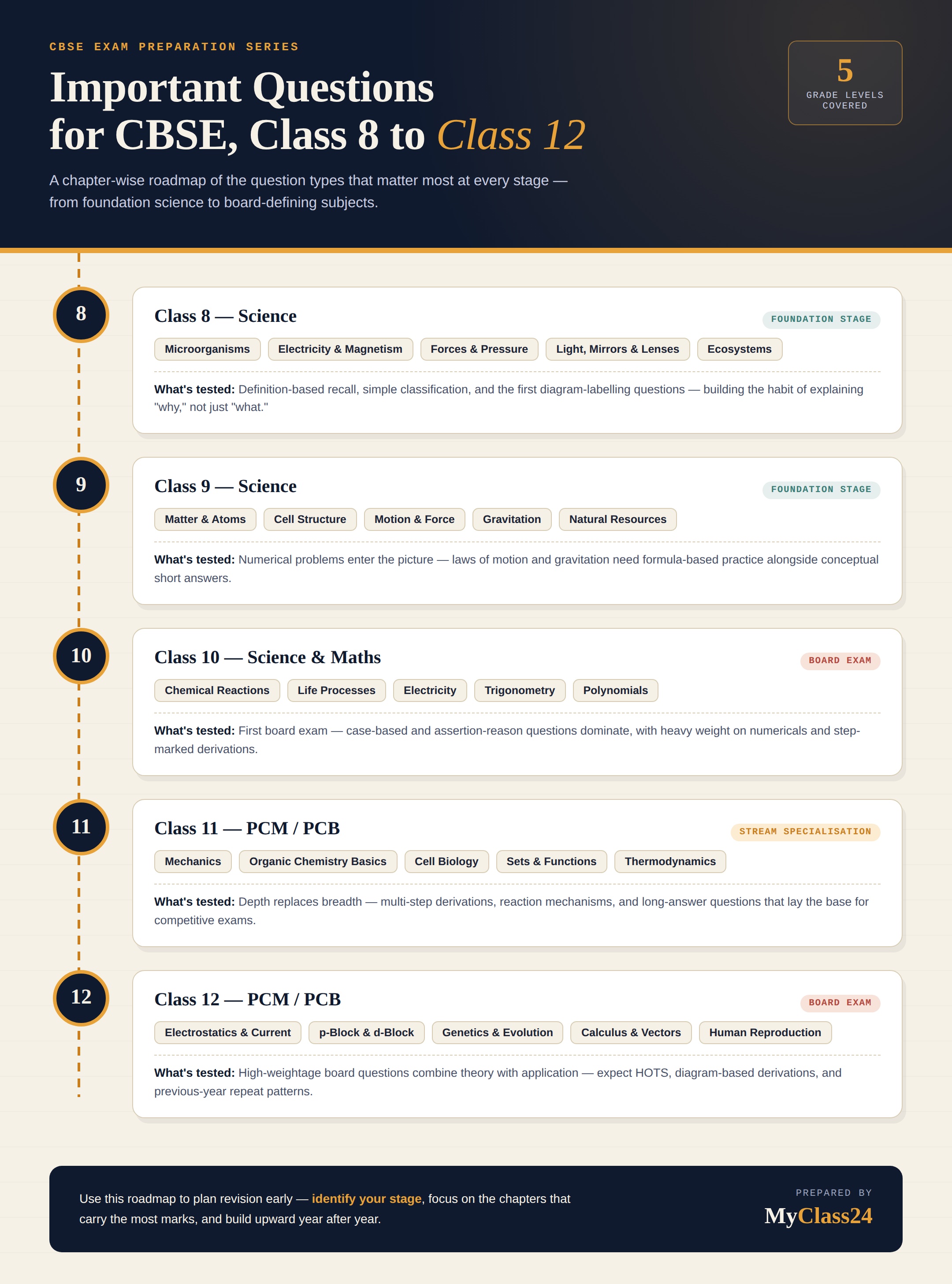
Important Questions – Class-wise Subject Structure
How to use this guide: Scan the table for your class and subject, then read the chapter-level breakdown. The questions highlighted are drawn from NCERT exercises, previous-year CBSE papers (2018–2026), and topics that CBSE's marking scheme consistently rewards.
Why Chapter-wise Important Questions Work Better Than Random Practice
The CBSE question paper design follows a defined blueprint — officially called the "Blueprint" or "Design of Question Paper." It allocates specific marks to units, and within those units, certain chapters carry a disproportionately high weightage year after year. Students who align their preparation with this pattern consistently score higher than those who attempt to cover everything equally.
For example, in Class 10 Mathematics, chapters like Real Numbers, Quadratic Equations, Triangles, and Statistics together account for nearly 45–50% of the total marks. Studying them at a deeper level — with special attention to proof-based questions and application problems — is simply more efficient than giving equal time to every chapter.
The same logic applies right from Class 8. Building strong conceptual clarity in the formative years (Classes 8 and 9) makes the high-pressure Classes 10 and 12 significantly more manageable.
Class 8 – Chapter-wise Important Questions Overview
Class 8 is where abstract thinking in Mathematics and conceptual Science truly begins. CBSE school examinations in Class 8 are internally assessed, but the question patterns set in this year often mirror what will appear in Class 9 and 10 board preparation. Getting these foundations right is non-negotiable.
Subject | High-Priority Chapters | Question Types to Focus On | Difficulty |
|---|---|---|---|
Mathematics | Rational Numbers, Linear Equations in One Variable, Squares & Square Roots, Mensuration | Word problems, application of properties, area/volume calculations | Moderate |
Science | Crop Production, Microorganisms, Combustion & Flame, Cell – Structure & Functions | Diagram labelling, difference tables, cause-effect questions | Moderate |
Social Science | Resources, The Indian Constitution, Land, Soil & Water | Short-answer definitions, map-based questions, source-based questions | Moderate |
English | Grammar (tenses, voices, reported speech), Comprehension passages | Passage-based MCQs, editing tasks, letter writing | Easy–Mod |
Class 8 Mathematics – Questions That Recur Most Often
In Rational Numbers, questions testing properties of operations — commutativity, associativity, and distributivity — appear almost universally. Students are expected not just to apply these but to identify which property is being used in a given expression.
Linear Equations in One Variable is the chapter where word problems dominate. Questions of the type "the sum of two numbers is 75 and one is 15 more than the other — find both" are deceptively simple but frequently attempted incorrectly due to equation-framing errors.
In Mensuration, the introduction of surface area and volume of cubes, cuboids, and cylinders requires students to carefully distinguish between lateral surface area, total surface area, and volume — three concepts that are often confused under exam pressure.
Class 9 – Building the Board Exam Foundation
Class 9 is the official entry point into the CBSE Secondary curriculum. While there is no board exam at this level (in most schools), the internal assessments and year-end examinations follow board-level question formats. More critically, the Class 9 syllabus is the direct precursor to Class 10 board material — in both Mathematics and Science, approximately 30–40% of Class 10 concepts are extensions of Class 9 chapters.
Chapter | Subject | Important Question Focus Areas | Marks Weightage (Typical) |
|---|---|---|---|
Number Systems | Maths | Rationalising denominators, locating irrationals on number line, laws of exponents | 6–8 marks |
Triangles | Maths | Congruence proofs (SAS, ASA, SSS, RHS), properties of isosceles triangles | 8–10 marks |
Matter in Our Surroundings | Science | Interconversion of states, evaporation factors, latent heat concept | 5–7 marks |
Motion | Science | Distance–time graphs, velocity–time graphs, equations of motion derivation | 8–10 marks |
Democratic Rights | Social Science | Fundamental rights with real-life applications, case studies | 4–5 marks |
Poverty as a Challenge | Social Science | Poverty Line definition, HCI, government programmes | 5–6 marks |
Examiner Insight: In Class 9 Science, the chapter on Work and Energy has consistently produced long-answer questions (5 marks) that combine numerical problems with conceptual explanations. Students who can derive the work-energy theorem and then apply it to a numerical problem in the same answer score the highest.
Class 10 – The Board Exam Blueprint
Class 10 board examination is the first national-level evaluation a CBSE student faces. The question paper follows a specific design: Multiple Choice Questions (1 mark), Short Answer I (2 marks), Short Answer II (3 marks), and Long Answer (5 marks), along with Case Study-based questions introduced post-2021.
The chapters below are consistently high-scoring — both in terms of frequency of appearance and marks allocated per chapter in past CBSE papers.
Mathematics – Chapter-wise Important Questions
Chapter | Must-Practice Question Types | Year of Appearance (Recent) |
|---|---|---|
Real Numbers | Euclid's Division Lemma proofs, HCF using prime factorisation, irrationality proofs | 2019, 2020, 2021, 2022, 2023, 2024 |
Quadratic Equations | Discriminant analysis, nature of roots, word problems (speed/time, area) | Every year – 3 to 5 marks |
Arithmetic Progressions | nth term, sum of n terms, real-life AP problems | 2020, 2021, 2022, 2023 |
Triangles | Basic Proportionality Theorem proof, similarity criteria, area ratio theorem | Every year – up to 5 marks |
Circles | Tangent from external point, equal tangents theorem, angle in semicircle | 2021, 2022, 2023, 2024 |
Statistics | Mean (direct/assumed), Median (cumulative frequency), Mode (grouped data) | Every year – 5 marks |
Science – Chapter-wise Important Questions
Class 10 Science is divided into Physics, Chemistry, and Biology sections. The following chapters have the highest question frequency across all sections:
Physics – Electricity
Ohm's Law numerical, series & parallel circuits, power calculation, heating effect of current. Expected: 8–10 marks total across paper.
Chemistry – Chemical Reactions
Balancing equations, types of reactions (combination, displacement, redox), activity series questions. Appears in every CBSE paper.
Biology – Life Processes
Nutrition, respiration, transportation, excretion — diagram-based 5-mark questions, especially on the human heart and nephron.
Biology – Heredity & Evolution
Mendel's laws, monohybrid & dihybrid cross (Punnett square), sex determination. Regular 3-mark and 5-mark questions.
Class 11 – The Real Turning Point
Class 11 is where the CBSE curriculum makes a significant leap in complexity. For Science stream students, the introduction of calculus-based Physics, organic Chemistry, and cellular Biology creates a steep learning curve. For Commerce students, Accountancy concepts like the Accounting Equation and Trial Balance demand procedural accuracy from day one.
Class 11 marks are used for JEE, NEET, and other competitive entrance eligibility in several states. More importantly, the chapters covered here are foundational for Class 12 — particularly in Physics (Laws of Motion → Work, Energy → Rotational Motion), Chemistry (Structure of Atom → Chemical Bonding → Organic Chemistry), and Mathematics (Sets → Relations → Functions → Limits).
Subject | Chapter | Key Question Areas | Why It Matters |
|---|---|---|---|
Physics | Laws of Motion | Free body diagrams, Atwood machine, friction problems, pseudo force | Direct link to Class 12 rotational dynamics |
Physics | Work, Energy & Power | Work done by varying force, elastic collisions, conservation of energy problems | High-frequency in annual exams |
Chemistry | Chemical Bonding | VSEPR theory, hybridisation, bond polarity, MO theory for diatomic molecules | Foundation for all of organic chemistry |
Chemistry | Thermodynamics | Hess's Law calculations, entropy, spontaneity, Gibbs free energy | Numerical questions appear every year |
Mathematics | Limits & Derivatives | Left-hand/right-hand limits, standard limit formulas, first-principle differentiation | Gateway to Class 12 Calculus |
Mathematics | Permutations & Combinations | nPr vs nCr problems, circular arrangements, division into groups | Appears in every internal exam |
Biology | Cell Cycle & Division | Mitosis vs Meiosis stages, diagrams, significance of each phase | Diagram carries 3–5 marks regularly |
Accountancy | Bank Reconciliation Statement | Adjusted vs unadjusted balance problems, error identification | Procedural marks — can score full marks with practice |
For Class 11 students: The biggest mistake is treating Class 11 as a "non-board year" and relaxing. Every concept you consolidate now directly reduces the revision load in Class 12. Specifically in Physics — understanding Newton's Laws deeply in Class 11 makes Electrostatics and Current Electricity in Class 12 far more approachable.
Class 12 – Board Exam Important Questions, Chapter-wise
Class 12 board examinations are, for most students, the most consequential academic event before college. The CBSE question paper for each subject is designed by a central committee and follows a strict marking scheme. Understanding the type of questions asked in each chapter — not just the content — is what separates a 75% student from a 95% student.
Physics – Chapter-wise Important Questions
Chapter | Important Questions / Topics | Marks Potential |
|---|---|---|
Electrostatics | Electric field due to a dipole (axial/equatorial), Gauss's Law application, capacitor energy | 8–10 marks |
Current Electricity | Kirchhoff's Laws (numericals), Wheatstone bridge derivation, potentiometer vs voltmeter | 8–10 marks |
Electromagnetic Induction | Faraday's Law, Lenz's Law, self-inductance, mutual inductance numericals | 5–7 marks |
Wave Optics | Interference (Young's Double Slit), diffraction pattern, polarisation by reflection | 5–7 marks |
Dual Nature of Radiation | Photoelectric effect (Einstein's equation), de Broglie wavelength, work function numericals | 5–6 marks |
Semiconductor Devices | p-n junction diode IV characteristics, Zener as voltage regulator, transistor as switch/amplifier | 5–6 marks |
Commerce Stream – Class 11 & 12 Important Questions
Commerce students face a different kind of pressure: subjects like Accountancy and Economics require consistent procedural accuracy alongside theoretical understanding. A single error in a ledger or a cash flow statement can cascade into multiple mark losses.
Subject | High-Weightage Chapters | Question Focus |
|---|---|---|
Accountancy (Cl. 11) | Journal entries, Ledger, Trial Balance, Bank Reconciliation | End-to-end practical problems — full marking for format + accuracy |
Accountancy (Cl. 12) | Partnership Accounts (Admission, Retirement, Dissolution), Cash Flow Statement | Revaluation of assets, goodwill treatment, cash flow from operations |
Economics (Cl. 11) | Collection of Data, Presentation of Data, Measures of Central Tendency | Diagram drawing (ogive, bar chart), numerical problems (mean, median, mode) |
Economics (Cl. 12) | National Income, Demand-Supply Analysis, Money & Banking | Numerical on GDP/NDP/GNP, diagram-based questions, short analytical answers |
Business Studies (Cl. 12) | Principles of Management, Marketing, Financial Management | Case-based scenario questions, 6-mark long answers with real-world application |
How to Identify Important Questions on Your Own
While curated lists help, the real skill is learning to identify important questions independently — so you can prioritise effectively even with new or reframed questions.
Here is what experienced CBSE toppers actually do: they cross-reference three documents for each chapter — the NCERT textbook exercises, the CBSE Sample Paper for that year, and at least three previous-year board papers. Any question type or concept that appears in all three sources is almost certainly going to appear in the actual exam in some form.
Additionally, the CBSE curriculum documents released each year contain a unit-wise mark distribution. Chapters within high-weightage units deserve proportionally more practice — even if some of those chapters personally feel "easier" to you.
A note on NCERT Exemplar: For Class 10 and Class 12 Science and Maths, the NCERT Exemplar is not optional reading — it is an extension of the standard textbook. Many CBSE questions in the 3-mark and 5-mark categories are directly lifted or slightly modified from Exemplar exercises. If you have not started the Exemplar yet, prioritise it above any third-party guide.
Closing Thoughts – Depth Over Breadth
One of the most consistent patterns observed across CBSE toppers from different schools, coaching backgrounds, and cities is this: they do not cover everything. They cover the right things, deeply.
A student who can solve every type of question in Real Numbers (Class 10 Maths) — including the tricky "prove that 3 + 2√5 is irrational" variety — will score higher than a student who has read every chapter superficially but panics when the question is phrased differently.
The chapter-wise important questions in this guide represent years of pattern analysis. But the bigger takeaway is the principle behind them: understand the question type, not just the topic. When you know that a chapter will produce a 5-mark proof question, you practise proofs. When you know a chapter tends toward numericals, you practise numericals — under time pressure.
CBSE examinations reward preparation that is structured, honest about priorities, and consistent over time. Begin chapter-by-chapter. Start with the chapters that carry the highest marks. Build from clarity, not from coverage.
FAQs – Important Questions for CBSE Class 8 to 12
Chapter-wise important questions help students focus only on high-priority topics instead of studying everything randomly. They guide learners toward exam-relevant concepts that are frequently repeated in board and school exams. By practicing these questions, students understand the exam pattern, marking scheme, and difficulty level better. It also saves revision time during exams. When students solve such questions regularly, their confidence improves and they become more accurate in writing answers. This method is especially helpful for Classes 8 to 12 because syllabus volume increases with each class, and smart preparation becomes more important than just reading textbooks.
Important questions improve scoring because they are based on commonly repeated concepts and exam trends. When students practice them, they are already prepared for similar questions in the actual exam. This reduces confusion during the paper and helps in writing structured answers. It also improves speed because students are familiar with question patterns. Instead of learning everything deeply, students can revise smartly using these questions. They also help in identifying weak topics that need more attention. Overall, they act as a shortcut to revision while still maintaining strong conceptual understanding and exam readiness.
Important questions are very helpful, but they should not be the only source of preparation. They are best used for revision and practice after completing the full syllabus. CBSE exams often include concept-based and application questions, so understanding the textbook is still necessary. Important questions guide students toward frequently asked topics, but complete preparation requires NCERT reading, sample papers, and mock tests. If used correctly, they can boost revision efficiency and improve performance significantly. However, relying only on them may leave gaps in understanding, especially for higher classes like 11 and 12 where concepts are deeper.
The best way to study important questions is to first understand the chapter thoroughly from NCERT or textbooks. After that, practice important questions without looking at answers. Try writing complete answers in exam format with headings, steps, and diagrams where needed. Revise them multiple times instead of just reading once. Group similar questions together so concepts become clear. Also, solve them under timed conditions to improve speed. Finally, review mistakes and rewrite weak answers. This method helps students retain information longer and improves exam performance in Classes 8 to 12.
CBSE does not repeat questions exactly word-to-word every year, but it often repeats concepts and question patterns. Many important questions are re-framed in different ways. That is why practicing them is useful, as students become familiar with the type of thinking required. For example, numerical problems in Maths or concept-based questions in Science often follow similar steps every year. Even in Social Science or English, themes and ideas are repeated. So while exact repetition is rare, understanding important questions helps students prepare for variations of the same core topics.
The number of questions depends on available time and syllabus completion. On average, students should practice 8 to 15 important questions daily per subject during revision time. Instead of rushing through many questions, it is better to focus on understanding each answer properly. For difficult subjects like Maths or Science, fewer questions with deeper practice are more effective. For theory subjects, writing structured answers is important. Consistency matters more than quantity. Practicing daily helps in building memory, improving writing speed, and strengthening exam confidence for Classes 8 to 12.
Yes, there is a clear difference. In Classes 8 to 10, important questions are mostly based on basic concepts, definitions, and direct problem-solving. In Classes 11 and 12, questions become more analytical and application-based. Higher classes require deeper understanding, derivations, and conceptual clarity. The difficulty level increases significantly in subjects like Physics, Chemistry, and Maths. Therefore, important questions for senior classes focus more on reasoning and board exam patterns. However, the purpose remains the same—to highlight key topics and improve exam preparation efficiency.
Yes, important questions are extremely useful for last-minute revision. Before exams, students often do not have time to revise the entire syllabus, so these questions help focus on key areas. They quickly refresh important concepts and improve recall during exams. Revising them helps students remember answer formats, formulas, and key points. However, last-minute revision should be balanced and not stressful. Students should revise only what they already studied earlier. Important questions act as a quick revision tool to boost confidence before entering the exam hall.
Reliable important questions are usually prepared based on NCERT textbooks, previous year papers, and official exam patterns. Teachers and academic experts often create them after analyzing trends. Students should always prefer structured study material aligned with CBSE syllabus. The best source is consistent textbook-based practice combined with sample papers. Reliable sets of questions focus on understanding rather than memorization. Students should avoid random or incomplete question lists and instead choose well-organized chapter-wise material that covers all major topics of Classes 8 to 12.
Yes, important questions often include numericals, diagrams, and application-based problems depending on the subject. In Maths and Science, numerical questions are very common and help in practicing formulas and problem-solving steps. Diagram-based questions are important in Biology, Geography, and Physics as they test conceptual clarity. Practicing these types of questions improves presentation skills and accuracy. Students learn how to label diagrams properly and solve numerical problems step by step. This makes them better prepared for both theory and practical-based board exam questions across Classes 8 to 12.