Important Questions for Class 10 – Subject-wise CBSE Board Exam
Class 10 is a turning point in every student’s academic journey, with board exams playing a crucial role in shaping future opportunities. To prepare effectively, students need focused and smart revision strategies. One of the most proven methods is practising important questions for Class 10, categorised by subject. These questions help students understand the exam pattern, master high-weightage topics, and improve their time management during exams. Subject-wise important questions help streamline your study plan. They are curated based on the CBSE syllabus, previous year papers, and chapter importance. Rather than revising the entire textbook, students can focus on key concepts and frequently asked questions, saving time and boosting confidence.
Also, solve questions from NCERT with the help of the NCERT Solutions for Class 10 and the NCERT exemplar solutions for Class 10.
Important Questions for Class 10 – Subject-wise
Class | Subject |
|---|---|
Class 10 | |
Class 10 | |
Class 10 |
Why These Questions Matter — and How They Were Selected
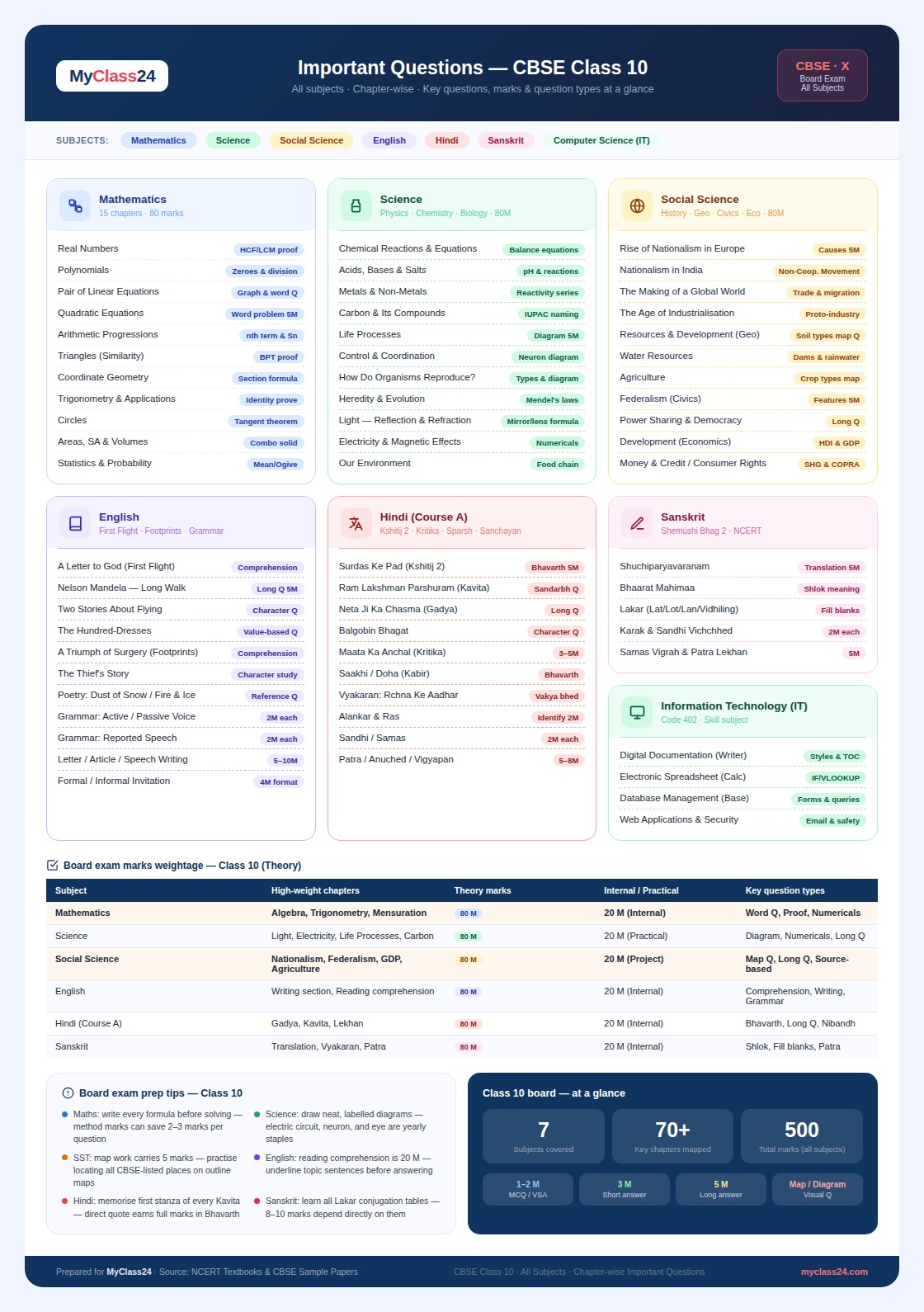
Class 10 board examinations set the foundation for a student's academic trajectory. With 80 marks of theory to cover in each major subject and a syllabus that spans entire textbooks, knowing what to prioritise is often the difference between a good score and a great one. The questions listed in this guide are not randomly pulled from textbooks. They are drawn from three reliable sources: the official CBSE sample question papers released between 2019 and 2024, the most recent Board examination papers, and pattern analysis across repeatedly tested concepts. Special attention has been given to questions that carry 3 or 5 marks — the segments where most students lose the maximum points. "Questions that appeared in board papers more than twice in the last five years carry an implicit signal — the board finds them central to the curriculum. Ignoring them is a statistical risk no prepared student should take." Each subject section below is structured to give you: the high-priority chapters, specific important questions with their typical mark allocation, and a subject-specific tip on how to frame answers for maximum scoring.
5 Core Subjects Covered
80 Theory Marks Per Subject
6 Years of Paper Analysis
100+ Curated Questions
Mathematics – Important Questions & High-Weightage Topics
Mathematics is often where Class 10 students experience the widest spread in performance. The difference between students scoring 60 and 90 usually comes down to two things: comfort with Real Numbers and Polynomials (which anchor Section A), and speed in Coordinate Geometry and Trigonometry (which dominate Sections B and C).
Chapter-wise Weightage Table
Chapter | Typical Marks | Question Types | Priority |
|---|---|---|---|
Real Numbers | 5–6 | MCQ, 2-mark proof | High |
Polynomials | 4–5 | MCQ, 2-mark | High |
Pair of Linear Equations | 6–8 | 2-mark, 3-mark graphical | High |
Quadratic Equations | 6–7 | 2-mark, 5-mark case study | High |
Arithmetic Progressions | 6–7 | 2-mark, 3-mark, 5-mark | High |
Triangles | 6 | Proof (3-mark), application | High |
Coordinate Geometry | 6 | 2-mark, 3-mark | Medium |
Introduction to Trigonometry | 6 | 2-mark identity proofs | High |
Some Applications of Trig. | 5 | 3-mark, 5-mark | Medium |
Circles | 5 | Proof (3-mark), MCQ | Medium |
Areas Related to Circles | 4 | 2-mark, 3-mark numerical | Medium |
Surface Areas & Volumes | 6–7 | 3-mark, 5-mark | High |
Statistics | 5–6 | 3-mark, 5-mark (Mean/Median) | High |
Probability | 4 | 2-mark, MCQ | Medium |
Must-Practice Questions
Arithmetic Progressions · 3 Marks
The sum of the first n terms of an AP is 3n² + 5n. Find the AP and hence find the 16th term.
Quadratic Equations · 3 Marks
A train travels 360 km at a uniform speed. If the speed had been 5 km/h more, it would have taken 1 hour less. Find the speed of the train.
Triangles · 3 Marks (Proof)
Prove that if a line is drawn parallel to one side of a triangle to intersect the other two sides in distinct points, the other two sides are divided in the same ratio.
Trigonometry · 2 Marks
Prove that: (sin θ + cosec θ)² + (cos θ + sec θ)² = 7 + tan² θ + cot² θ.
Surface Areas & Volumes · 5 Marks
A solid is in the form of a cylinder with hemispherical ends. The total length is 19 cm and the diameter of the cylinder is 7 cm. Find the total surface area. (Use π = 22/7)
Statistics · 5 Marks
The following table gives the distribution of the life-time of 400 neon lamps. Find the median life-time of a lamp using the median formula. (Class intervals given)
Scoring Tip: In the board exam, always write the formula before substituting values. Even if your final answer is wrong due to a calculation error, you earn step marks for the correct formula and setup — this alone can save 1–2 marks per question.
Science – Important Questions (Physics, Chemistry & Biology)
Class 10 Science is assessed across three disciplines in a single paper, with no choice between streams. This makes it simultaneously the most voluminous and most opportunity-rich subject — a student who balances all three can comfortably target 70+ out of 80.
High-Priority Topics at a Glance
Unit | Chapter | Expected Marks | Frequently Tested Concepts |
|---|---|---|---|
Physics | Light – Reflection & Refraction | 8–10 | Mirror/Lens formula, Ray diagrams, Magnification |
Physics | Human Eye & Colourful World | 4–5 | Defects of vision, Atmospheric refraction, Prism |
Physics | Electricity | 7–9 | Ohm's Law, Resistors in series/parallel, Power formula |
Physics | Magnetic Effects of Current | 5–6 | Fleming's rules, Electric motor vs generator |
Chemistry | Chemical Reactions & Equations | 5–6 | Balancing equations, Types of reactions |
Chemistry | Acids, Bases and Salts | 6–7 | pH scale, Common salts preparation, Indicators |
Chemistry | Metals and Non-Metals | 5–6 | Reactivity series, Ionic bonding, Corrosion |
Chemistry | Carbon and its Compounds | 5–6 | Homologous series, Functional groups, Ethanol vs Ethanoic acid |
Biology | Life Processes | 6–7 | Nutrition, Respiration, Transportation, Excretion diagrams |
Biology | Control & Coordination | 5–6 | Nervous system, Hormones, Reflex arc |
Biology | Heredity & Evolution | 5–6 | Mendel's laws, Monohybrid cross, Evolution theories |
Biology | Our Environment | 4 | Food chain, Trophic levels, Ozone depletion |
Frequently Repeated Questions
Physics · 5 Marks
Draw a labelled diagram of the human eye. Explain the defect of myopia and describe how it is corrected using a lens. State the lens formula used.
Physics · 3 Marks
An electric lamp of 100 Ω, a toaster of resistance 50 Ω and a water filter of 500 Ω are connected in parallel. The voltage across the combination is 220 V. Find the total current drawn from the supply.
Chemistry · 3 Marks
What happens when dilute H₂SO₄ is added to: (a) zinc granules, (b) iron filings, (c) copper turnings? Write the chemical equations for the reactions that occur.
Chemistry · 5 Marks
Explain the process of preparation of sodium hydroxide by Chlor-alkali process. What are the products formed? Write the equation and mention two uses of each product.
Biology · 5 Marks
Draw a diagram of the human excretory system and label any four parts. Describe the process by which urine is formed in the nephron.
Biology · 3 Marks
In a cross between pea plants with tall stem (TT) and dwarf stem (tt), what will be the ratio of phenotype and genotype in F₂ generation? Explain with a Punnett square.
Scoring Tip: Diagrams in Biology fetch separate 1-mark allocations. A labelled diagram of the nephron, reflex arc, or human digestive system — even if drawn quickly — guarantees marks that pure writing cannot substitute.
Social Science – Important Questions (History, Geography, Political Science & Economics)
Social Science is arguably the most underestimated paper in Class 10. Students who read for understanding rather than rote memorisation consistently outperform their peers by 10–15 marks — because the board increasingly tests application, cause-effect analysis, and map skills rather than plain recall.
The four disciplines — History, Geography, Civics (Democratic Politics), and Economics — each contribute roughly 20 marks to the 80-mark paper.
Topic-wise Importance Table
Discipline | Chapter / Topic | Marks | Question Focus |
|---|---|---|---|
History | Nationalism in Europe | 5–6 | Causes, French Revolution role, Unification of Germany/Italy |
History | Nationalism in India | 5–6 | Non-Cooperation Movement, Civil Disobedience, different groups' roles |
History | The Age of Industrialisation | 4–5 | Proto-industrialisation, Factory system, Indian textile industry |
History | Print Culture & Modern World | 3–4 | Gutenberg press, Print in India, Readership |
Geography | Resources and Development | 4–5 | Types of resources, Soil types, Conservation |
Geography | Water Resources | 4 | Dams, Rainwater harvesting, Watershed management |
Geography | Agriculture | 4–5 | Types of farming, Major crops and their distribution |
Geography | Minerals & Energy Resources | 4–5 | Distribution, Conventional vs Non-conventional energy |
Political Science | Power Sharing | 4–5 | Belgium vs Sri Lanka, Horizontal & Vertical power sharing |
Political Science | Federalism | 4–5 | Features, India as a federation, Decentralisation |
Political Science | Political Parties | 4 | Functions, Challenges, National vs Regional parties |
Economics | Development | 4 | National income, Per capita income, Human Development Index |
Economics | Money and Credit | 4–5 | Functions of money, Formal vs informal credit, SHGs |
Economics | Globalisation | 4 | MNCs, Trade barriers, WTO, Impact on India |
Must-Prepare Questions
History · 5 Marks
Explain the role of language and folk culture in developing nationalist sentiment in Europe during the 19th century. Why did the German Romantic movement consider folk tales and songs important?
History · 3 Marks
Describe the contribution of the peasants and plantation workers to the Non-Cooperation Movement of 1921–22. Why did Mahatma Gandhi withdraw the movement in February 1922?
Geography · 3 Marks
Compare the water scarcity problem in Rajasthan with that of Gujarat. How do traditional methods of rainwater harvesting address this problem?
Political Science · 5 Marks
Analyse the power-sharing arrangement in Belgium. How was it more successful than the approach taken in Sri Lanka? What does it teach us about accommodation in a democracy?
Economics · 3 Marks
Why is credit sometimes not beneficial for the borrower? Explain with an example of informal sector lending. How do Self-Help Groups help overcome this problem?
Map Skill · 3 Marks
On an outline map of India, locate and label: (a) the Sardar Sarovar Dam, (b) the Kudankulam Nuclear Power Plant, (c) the largest producer of mica in India.
Scoring Tip: For 5-mark History and Civics questions, structure your answer with a one-line introduction, three to four elaborated points with examples, and a brief conclusion. The board awards marks for structure and evidence, not just content recall.
English – Important Questions (Language & Literature)
English in Class 10 is evaluated across three sections: Reading (20 marks), Writing and Grammar (20 marks), and Literature (40 marks). The Literature section — often treated casually — actually carries the highest weight and rewards students who have read the texts carefully rather than relied on guides alone.
Literature Section – Chapter-wise Priority
Book | Chapter / Poem | Marks | Question Pattern |
|---|---|---|---|
First Flight (Prose) | A Letter to God | 3–5 | Character, theme, extract-based |
First Flight (Prose) | Nelson Mandela: Long Walk to Freedom | 5 | Extract + long answer |
First Flight (Prose) | Two Stories About Flying | 3–5 | Compare characters, theme of courage |
First Flight (Prose) | From the Diary of Anne Frank | 5 | Character & context |
First Flight (Prose) | The Hundred Dresses | 5 | Values, long answer |
First Flight (Poems) | Dust of Snow (Frost) | 3 | Extract + 3-mark question |
First Flight (Poems) | Fire and Ice (Frost) | 3 | Symbolism, theme |
First Flight (Poems) | A Tiger in the Zoo | 3–5 | Contrast, imagery, long answer |
First Flight (Poems) | Amanda! | 3 | Character of Amanda, tone |
Footprints Without Feet | A Triumph of Surgery | 3–5 | Character of Tricki, theme |
Footprints Without Feet | The Thief's Story | 5 | Character analysis, moral, extract |
Footprints Without Feet | Footprints Without Feet | 3–5 | Humour, extract-based |
Footprints Without Feet | The Making of a Scientist | 3–5 | Character of Richard Ebright |
Must-Prepare Questions
Prose · 5 Marks
Describe the character of Hari Singh in 'The Thief's Story'. What transformation does he undergo and what role does Anil play in that change?
Poetry · 3 Marks
The tiger in the poem 'A Tiger in the Zoo' is described in two contrasting settings. What does this contrast convey about captivity and freedom? How does the poet use imagery?
Prose · 5 Marks
How does Nelson Mandela's understanding of freedom evolve from his childhood to the moment he becomes President? What twin obligations does he speak about?
Writing · 5 Marks
Write a letter to the editor of a national newspaper expressing concern about the increasing use of plastic in your locality and suggesting measures to curb it.
Grammar · 2 Marks
Complete the dialogue using correct verb forms (passive voice and reported speech transformation exercises — the most commonly tested grammar types in CBSE 10).
Prose · 3 Marks
Why did Wanda Petronski stop coming to school? What was the significance of her drawings in the story 'The Hundred Dresses'? What message does the story convey?
Scoring Tip: For extract-based questions, always refer to the passage before answering — even for texts you know well. Examiners specifically reward answers that quote or closely paraphrase the extract rather than relying on background knowledge alone.
Hindi – Important Questions (Course A & B)
Hindi is the most-scoring subject for students comfortable with the language, yet consistently underperforms for those who treat it as an afterthought. The paper is divided into Apathit Gadyansh/Kavyansh (unseen passages), Vyakaran (grammar), and the Pathya Pustak section covering Kshitij, Sparsh, Kritika, and Sanchayan.
The Literature section carries the heaviest weight, and within it, the questions from Kshitij (poems and prose) recur most predictably.
पुस्तक (Book) | पाठ / कविता (Chapter/Poem) | अंक (Marks) | महत्त्वपूर्ण पहलू (Key Aspects Tested) |
|---|---|---|---|
Kshitij (Prose) | Bade Bhai Sahab – Premchand | 5 | Character, message, humour in irony |
Kshitij (Prose) | Sana Sana Haath Jodi | 3–5 | Travelogue style, environmental message |
Kshitij (Prose) | Aatmakatha ki Samasya – Hazari Prasad Dwivedi | 3–4 | Essay style, author's argument |
Kshitij (Poetry) | Ram-Lakshman-Parashuram Samvad – Tulsidas | 5 | Character of Lakshman, extract-based |
Kshitij (Poetry) | Utsah / Ant Nahi Aata – Suryakant Tripathi Nirala | 3–5 | Imagery, theme of courage |
Kshitij (Poetry) | Yeh Daant – Sumitranandan Pant | 3 | Symbolism, nature imagery |
Kshitij (Poetry) | Atmakatha – Jaishankar Prasad | 3 | Theme, literary devices |
Kritika / Sanchayan | Maa Ka Aanchal | 5 | Childhood, relationship, narrative style |
Kritika / Sanchayan | Sapnon Ke-Se Din | 5 | School life, character contrast |
Vyakaran | Vachya (Voice) | 4 | Transformation: Kartri → Karm → Bhav Vachya |
Vyakaran | Pad Parichay | 4 | Grammatical analysis of words in sentences |
Vyakaran | Ras (Poetic Sentiment) | 4 | Identify Ras from a given stanza |
Scoring Tip: Vyakaran (grammar) questions — especially Vachya Parivartan, Pad Parichay, and Ras — are the most consistent 12-mark block in the Hindi paper. Mastering these three grammar topics alone can significantly raise your total score with minimal time investment compared to Literature revision.
Last-30-Day Revision Strategy for Class 10 Boards
Having a subject-wise question list is only useful if paired with a structured revision timeline. The final month before board exams is not the time for learning new concepts — it is the time for consolidation, practice, and mental calibration.
Week-by-Week Plan
Week | Focus | Daily Target | Self-Assessment |
|---|---|---|---|
Week 1 | Revise all HIGH-priority chapters across all subjects | 2 subjects per day, notes + formulas | Solve 10 MCQs per subject each evening |
Week 2 | Solve CBSE Sample Paper 2024 and 2023 under timed conditions | 1 full paper per day | Self-check using answer keys; identify weak areas |
Week 3 | Targeted revision of weak areas; practice 3/5-mark Qs | 20 descriptive questions across subjects | Check for structure, completeness, diagram quality |
Week 4 | Light revision, formula revision, mental preparation | Revise short notes only; sleep 8 hrs | Quick MCQ sets; no new topics |
The students who perform best in Class 10 boards are rarely those who studied the most in the final week. They are those who managed their time across two months and arrived at the exam hall well-rested and confident.
Subject-Specific Quick Wins
Mathematics
Revise all construction steps (Tangent to a circle, Similar triangle) — these 3-mark questions are fully predictable and almost always appear.
Science
Practise drawing and labelling at least 8 key diagrams: eye, nephron, reflex arc, neuron, lens ray diagrams (both types), electric motor, generator, heart.
Social Science
Practise map work daily — locate 10 places on the India outline map each morning. This 5-mark section is the easiest to score if you practise consistently.
English
Write out 2 formal letters and 1 notice per week. Grammar errors here are the most common score-reducers in an otherwise strong paper.
Hindi
Learn the definition and one sher/example for each of the 9 Ras — boards have asked "identify the Ras and explain" in 5 of the last 6 years.
All Subjects
Attempt at least one CBSE Sample Paper per subject. The board's own samples reflect the actual paper's difficulty level more accurately than any guide.
In Closing – Prepare Smart, Not Just Hard
The questions listed across this guide are not guarantees — no one can predict an exam paper. But they represent the concentrated wisdom of years of board paper analysis, and they reflect what the Central Board of Secondary Education has consistently found worth testing. Work through each subject's high-priority section first, reinforce with sample papers, and resist the urge to keep opening new chapters in the final fortnight.
Class 10 board results matter, but more than the number on the marksheet is the habit of systematic, purposeful study that these exams — if approached correctly — help you build. Good luck.
FAQs on Important Questions for CBSE Class 10 All Subjects
Important Questions for CBSE Class 10 All Subjects are carefully selected questions that cover the most important concepts, topics, and learning outcomes from the latest syllabus. These questions are prepared to help students revise effectively by focusing on concepts that are frequently tested in board examinations. They include multiple-choice questions, short-answer questions, long-answer questions, case-based questions, and competency-based problems across Mathematics, Science, Social Science, English, Hindi, and other subjects. Regular practice improves conceptual understanding, analytical thinking, and answer-writing skills. Since Class 10 is a board examination year, solving important questions helps students become familiar with the exam pattern and marking scheme. It also builds confidence, improves revision efficiency, and increases the chances of scoring excellent marks in every subject.
Important Questions are highly valuable for revision, but they cannot replace textbooks. Textbooks provide detailed explanations, solved examples, activities, diagrams, and exercises that develop conceptual understanding from the beginning. Important Questions reinforce learning by highlighting the most significant concepts and improving answer-writing skills. Students should combine textbook study, classroom notes, formula revision, diagram practice, sample papers, and important questions for complete preparation. This integrated approach ensures that no concept is left uncovered while strengthening exam readiness. Students who balance conceptual learning with regular practice of important questions develop better analytical skills, stronger confidence, and a greater ability to perform well in the Class 10 Board Examination.
Students should practise Important Questions regularly throughout the academic year rather than waiting until the final weeks before the examination. After completing each chapter, they should solve chapter-wise important questions to reinforce learning immediately. Weekly revision sessions help maintain consistency and improve long-term retention. During the final revision period, students should revisit all important questions while focusing more on chapters they find difficult. Maintaining a separate notebook for mistakes and challenging questions allows quick revision before examinations. Consistent practice improves speed, accuracy, confidence, and time management. Students who regularly revise important questions generally feel more prepared and perform better during board examinations.
Students should always complete the textbook before attempting Important Questions. Reading the chapter carefully, understanding concepts, solving textbook exercises, and revising notes provide the necessary foundation for effective learning. Important Questions should then be used to test understanding and strengthen conceptual clarity. This approach encourages meaningful learning rather than memorizing answers. After completing the full syllabus, students should solve all important questions again during revision to improve retention and confidence. Difficult questions should be practised multiple times until they become comfortable. Following this sequence ensures thorough preparation, better recall, improved answer-writing skills, and stronger performance in the Class 10 Board Examination.
Social Science requires understanding concepts, remembering facts, and presenting answers in a structured manner. Important Questions help students revise History, Geography, Political Science, and Economics efficiently by highlighting key topics from every chapter. Regular practice improves answer presentation, analytical thinking, and map-based skills. Students learn how to organize answers using relevant points, examples, and explanations that match the marking scheme. Revising important dates, constitutional features, geographical concepts, and economic principles becomes easier through repeated practice. These questions also improve writing speed and confidence during examinations. A systematic revision plan using chapter-wise important questions helps students recall information accurately and score well in Social Science board examinations.
Science includes conceptual learning, experiments, diagrams, numerical problems, and application-based questions. Important Questions help students revise essential concepts from Physics, Chemistry, and Biology while improving their understanding of scientific principles. They encourage students to think analytically instead of relying on memorization. Practising these questions strengthens diagram labelling, chemical equations, numerical calculations, and explanation-based answers. Students also become comfortable with competency-based and case-study questions introduced in modern examinations. Regular revision helps retain formulas, scientific definitions, and important reactions more effectively. By solving important questions after every chapter, students identify weak topics and improve overall preparation. This approach builds confidence and enhances performance in both theoretical and practical Science assessments.
Practising Important Questions helps students prepare strategically for the Class 10 Board Exams by focusing on high-priority concepts from every chapter. Instead of revising randomly, students can strengthen topics that are commonly assessed in examinations. Regular practice improves writing speed, accuracy, presentation, and time management while reducing examination stress. These questions also expose students to different question formats, including competency-based, assertion-reason, case-based, and application-oriented questions. Solving them repeatedly allows students to identify weak areas and revise them before the examination. When combined with textbook study and sample paper practice, important questions provide complete revision support. This balanced preparation develops confidence and helps students perform consistently well in both internal assessments and final board examinations.
Important Questions for CBSE Class 10 cover all major subjects prescribed in the curriculum. Students can practise chapter-wise questions for Mathematics, Science, Social Science, English, Hindi, Sanskrit, and other optional subjects offered by their schools. Mathematics includes formula-based, competency-based, and application-oriented problems. Science covers Physics, Chemistry, and Biology concepts with numerical, diagrams, and reasoning questions. Social Science contains History, Geography, Political Science, and Economics questions. English includes literature, grammar, reading comprehension, and writing skills, while Hindi focuses on literature, grammar, and creative writing. Subject-wise preparation enables students to revise every chapter systematically, improve conceptual clarity, and strengthen their performance across the complete Class 10 syllabus.
Chapter-wise Important Questions are among the best revision tools because they help students master each chapter individually before moving to the next. However, they should not be the only study resource. Students should first understand textbook concepts, complete all exercises, revise classroom notes, and practise diagrams, formulas, and important definitions. After finishing chapter-wise revision, students should solve full-length sample papers and mixed-question practice sets to improve time management and exam readiness. Reviewing mistakes and revising weak chapters regularly further strengthens preparation. Combining textbooks, sample papers, previous exam patterns, and important questions creates a complete revision strategy that improves confidence and prepares students thoroughly for the Class 10 Board Examination.
Mathematics requires continuous practice, logical reasoning, and conceptual understanding. Important Questions help students revise formulas, theorems, algebra, geometry, trigonometry, coordinate geometry, statistics, and probability in an organized way. Students should solve every question step by step instead of memorizing answers. Regular practice improves calculation speed, reduces errors, and develops confidence in handling different question types. Difficult questions should be revised multiple times until the solution becomes clear. Reviewing mistakes and understanding alternative solution methods also strengthens mathematical thinking. Along with textbook exercises and sample papers, important questions help students build strong problem-solving abilities. Consistent practice enables students to write accurate, well-presented solutions and perform confidently in the Mathematics board examination.