myclass24
myclass24your class. your pace.

IUPAC Nomenclature Mastery in 6 Days

Master the complete IUPAC nomenclature system in just 6 days with step-by-step lessons, shortcut techniques, daily practice, and exam-oriented questions for CBSE, JEE & NEET.

JEENEETCBSEICSEClass 11IUPAC Nomenclature
3.01 students
Beginner Hindi 6 Days Certificate
Your path to the goal
  1. EnrolInstant access
  2. Read notesNotes & PDFs
  3. Watch lessonsVideo lessons
  4. PracticeMCQ tests
  5. Achieve your goalGet certified
The 6-day plan

A day-by-day difficulty map

Every course claims a "day-wise plan." This one shows how the load actually moves — the harder days are marked, and lighter days are kept visible so you can see where practice replaces new material.

Day 1Day 2Day 3Day 4Day 5Day 6Day 1: – Foundations of IUPAC — 1h 7m · 5 tasksDay 1 · Light1h 7m · 5 tasksDay 2: – Mastering IUPAC Nomenclature — 1h 29m · 5 tasksDay 2 · Light1h 29m · 5 tasksDay 3: – IUPAC Nomenclature of — 1h 19m · 5 tasksDay 3 · Medium1h 19m · 5 tasksDay 4: – IUPAC Nomenclature of — 1h 9m · 5 tasksDay 4 · Medium1h 9m · 5 tasksDay 5: – IUPAC Nomenclature of — 1h 19m · 6 tasksDay 5 · Hard1h 19m · 6 tasksDay 6: – Comprehensive IUPAC Nomenclature — 3h 9m · 8 tasksDay 6 · Hard3h 9m · 8 tasksdifficulty
DAY 01

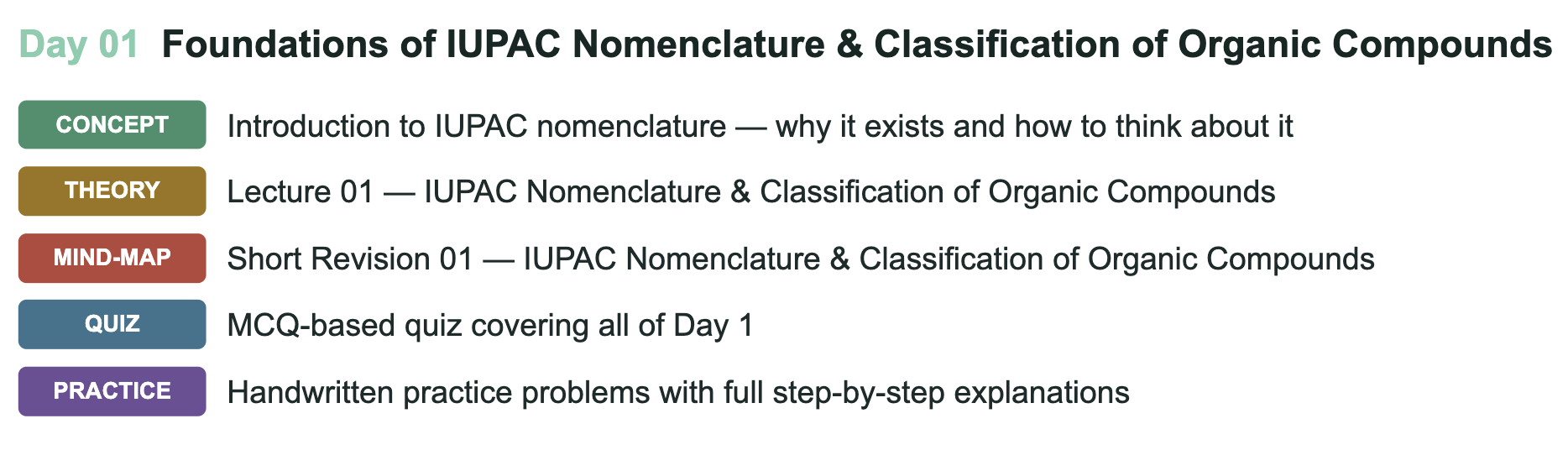
Day 01 – Foundations of IUPAC Nomenclature & Classification of Organic Compounds

1h 7m · 5 tasks

DAY 02

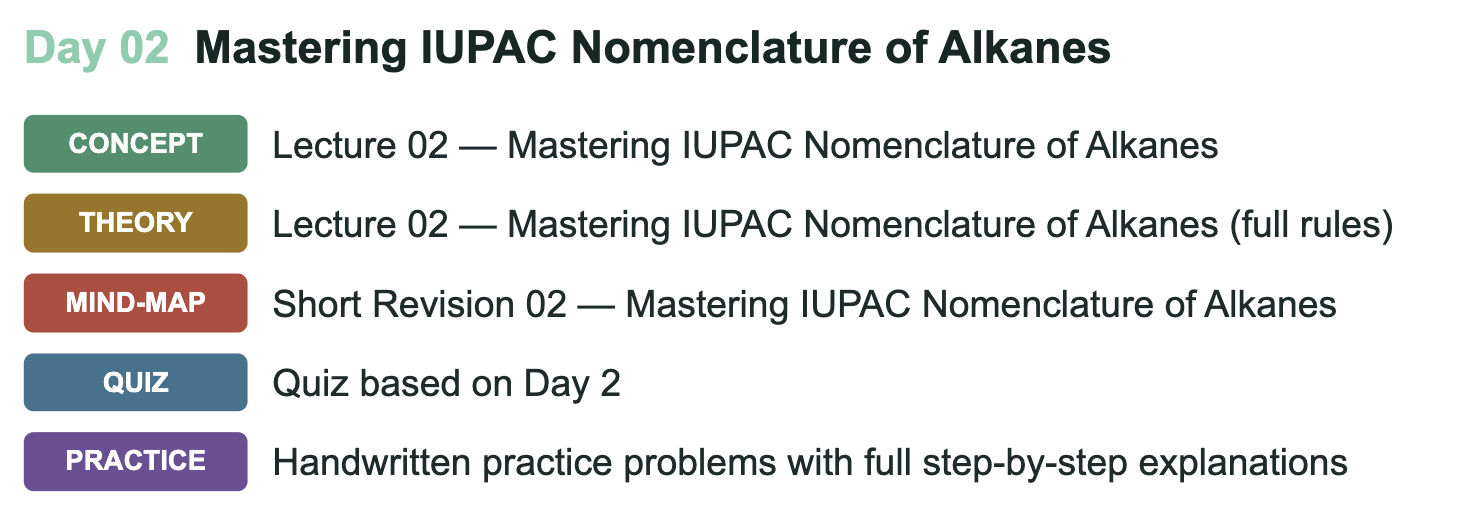
Day 02 – Mastering IUPAC Nomenclature of Alkanes

1h 29m · 5 tasks

DAY 03

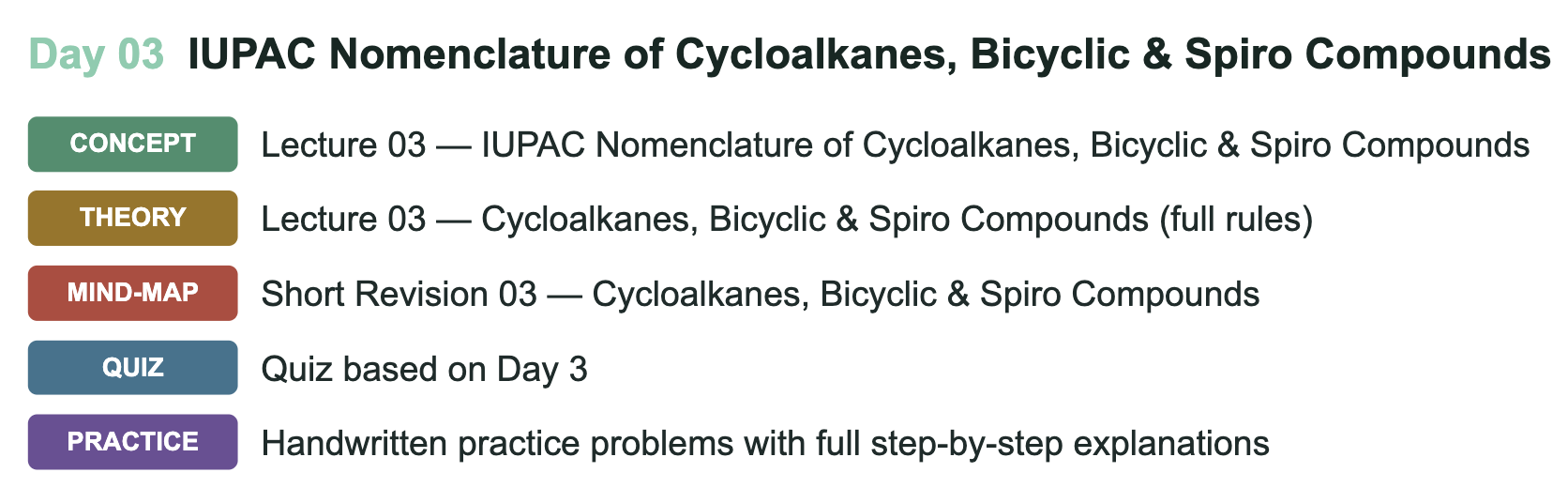
Day 03 – IUPAC Nomenclature of Cycloalkanes, Bicyclic & Spiro Compounds

1h 19m · 5 tasks

DAY 04

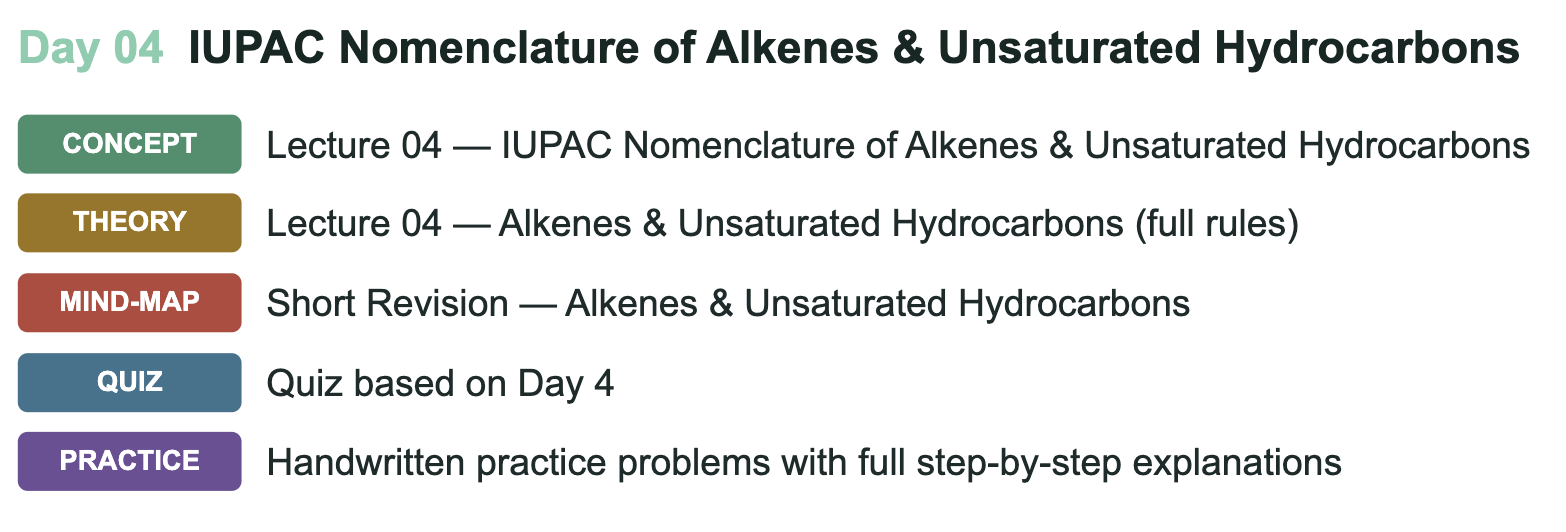
Day 04 – IUPAC Nomenclature of Alkenes & Unsaturated Hydrocarbons

1h 9m · 5 tasks

DAY 05

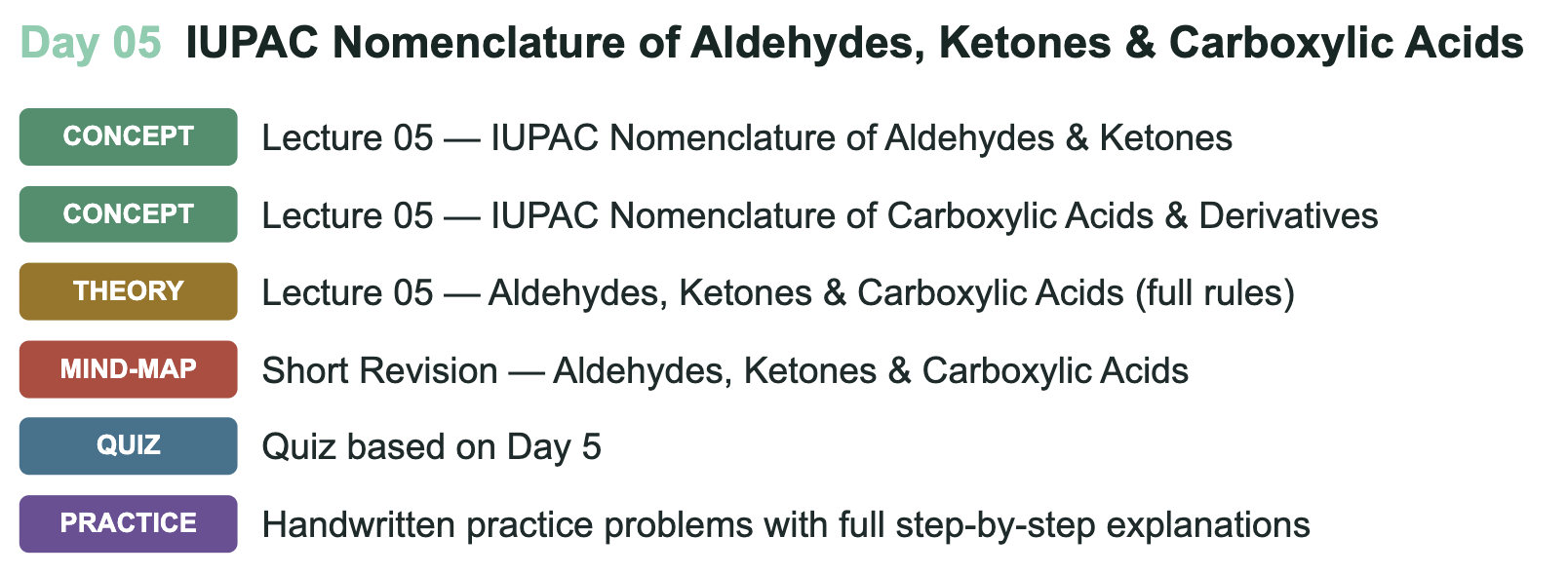
Day 05 – IUPAC Nomenclature of Aldehydes, Ketones & Carboxylic Acids

1h 19m · 6 tasks

DAY 06

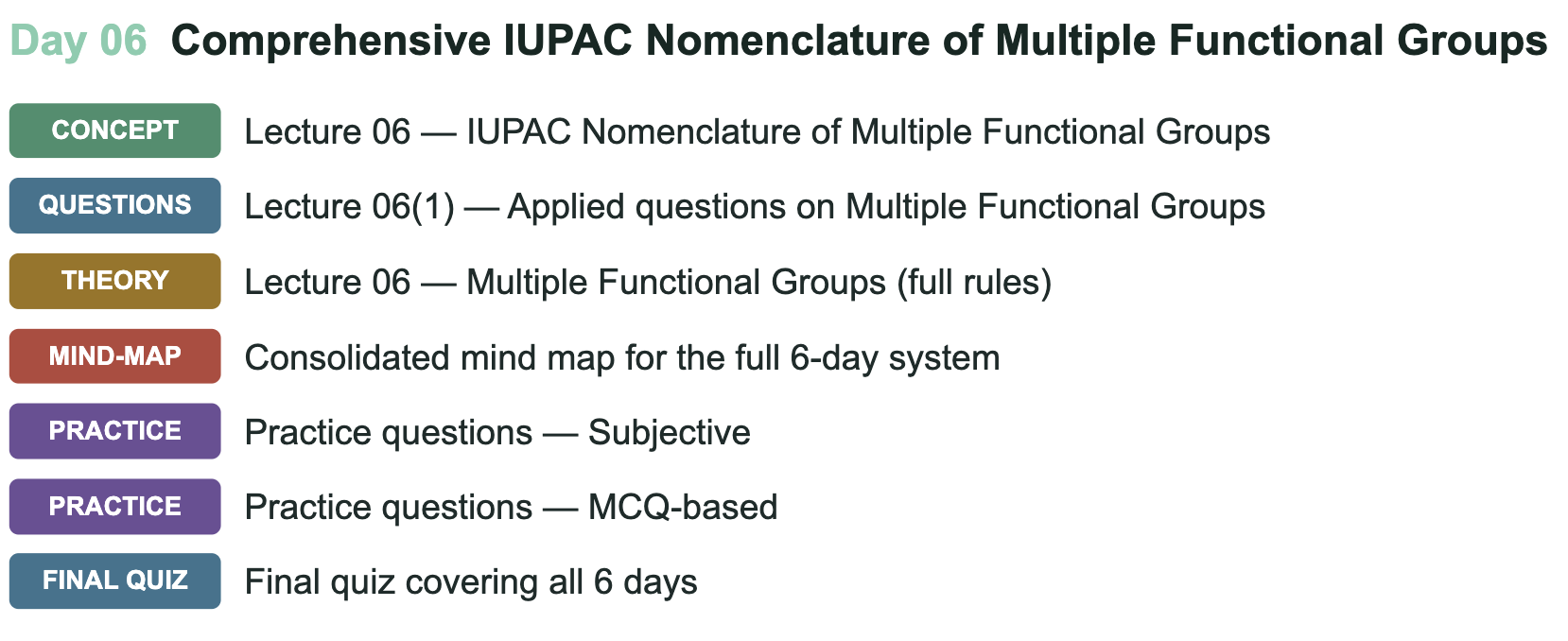
Day 06 – Comprehensive IUPAC Nomenclature of Functional Groups

3h 9m · 8 tasks

light daymedium dayharder day

What you'll learn

  • Understand the complete IUPAC nomenclature system from basic to advanced concepts.
  • Name and identify organic compounds accurately using the latest IUPAC rules.
  • Master nomenclature of alkanes, alkenes, alkynes, alcohols, aldehydes, ketones, carboxylic acids, amines, and aromatic compounds.
  • Apply priority rules, numbering, functional group selection, and substituent naming with confidence.
  • Solve JEE, NEET, CBSE, and Olympiad-level IUPAC nomenclature questions with ease.
  • Complete your IUPAC mastery journey in just 6 days with a structured, step-by-step learning plan.

Course content

Your progress0 of 34 items · 0%
  • Task-1 Video Lecture of IUPAC NomenclatureVideoFree
    27 Min
  • Task-2 (Theory) Lecture-01-IUPAC Nomenclature & Classification of Organic CompoundsPDF · NotesFree
    15 Min
  • Task-3 (Mind-Map) Short-Revision-01- IUPAC Nomenclature & Classification of Organic CompoundsPDF · StarterFree
    10 Min
  • Task-4 (Practice-Questions) Hand-Written Questions for Day-01 With ExplanationPDF · PracticeFree
    15 Min
  • Task-5 Quiz Based on Day-01MCQ TestFree
    10 questions

Course Details

IUPAC Nomenclature Mastery in 6 Days

Stop memorising names — start building them. In six focused days, learn to name alkanes, cycloalkanes, alkenes, carbonyls, and multi-functional compounds with total confidence.

6- Structured Days

33-Guided Tasks

6-Mind Maps

8+-Quizzes & Practice Sets

Why This Course Works

Nomenclature only feels hard because it's usually taught backwards. This course teaches the logic first, so rules become obvious instead of arbitrary — and they stick.

"I mix up the parent chain."

Learn a repeatable method for spotting the longest chain before any naming rule is introduced.

"Numbering rules never stick."

Locant selection is drilled daily, from simple alkanes to multi-substituted rings, until it becomes instinct.

"Functional groups throw me off."

By Day 6, you'll name molecules with several competing functional groups — the skill most courses skip.
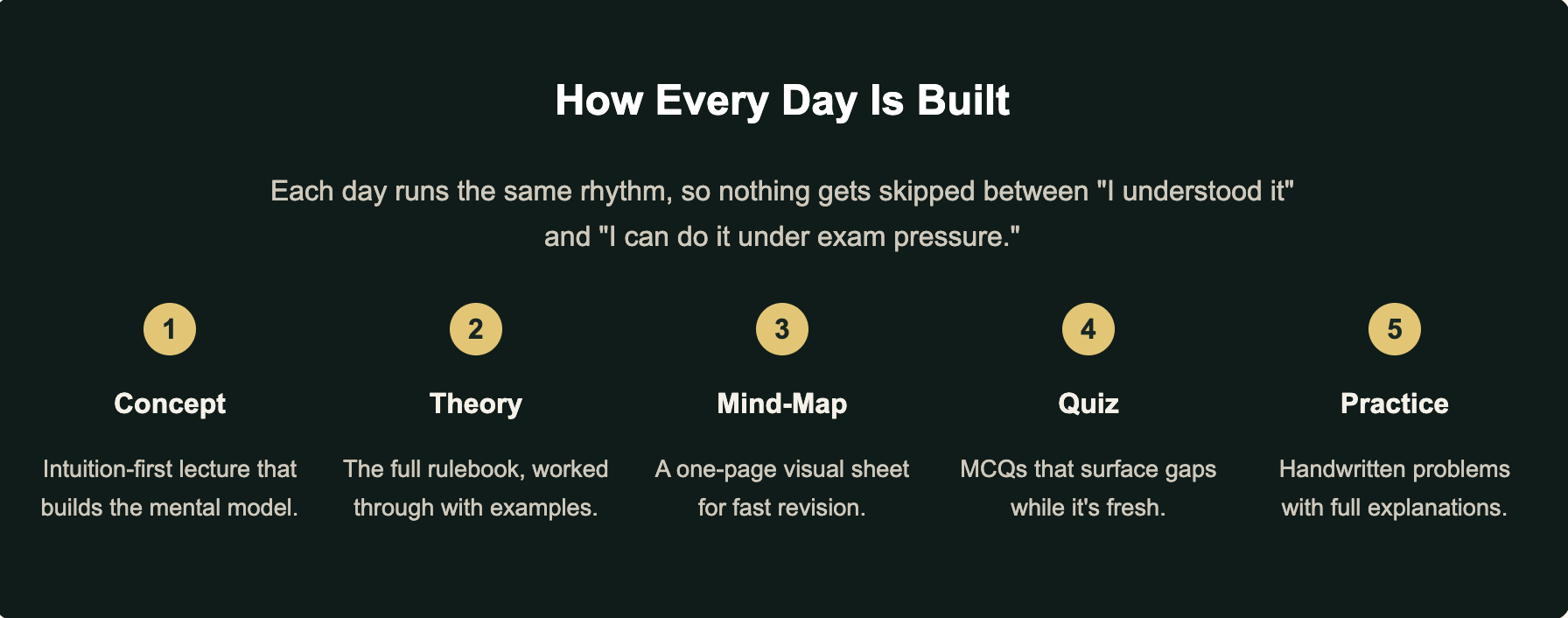
The Full 6-Day Curriculum

Every lecture, quiz, and practice set — laid out day by day.
What You Walk Away With

  • Identify the correct parent chain or ring system in any structure, including bicyclic and spiro frameworks, without second-guessing.

  • Apply lowest-locant rules confidently across alkanes, alkenes, and multi-substituted systems.

  • Name aldehydes, ketones, carboxylic acids, and their derivatives using the correct suffixes and priority order.

  • Handle molecules with several competing functional groups by ranking seniority correctly.

  • Recall the entire rule system fast, using six compact mind maps built for last-minute revision.

Built For

  • Class 11 & 12 students studying organic chemistry

  • JEE, NEET, and board-exam aspirants who lose marks on naming questions

  • Undergraduate students who need a fast, structured refresher

  • Anyone who can draw a structure but freezes when asked to name it

Six Days. One System. Nomenclature Solved for Good.

Everything above — every lecture, mind map, quiz, and handwritten practice set — is included from Day 1.

Enroll Now

Full 6-day curriculum · lifetime access to materials

  • 6 concept + theory lecture sets

  • 6 mind maps for rapid revision

  • 8+ quizzes, including a final comprehensive quiz

  • Handwritten practice problems with full explanations, every day

Description

Master IUPAC Nomenclature in 6 days for JEE, NEET & CBSE. Learn organic naming rules with practice, quizzes, and exam-focused strategies.

Instructor

Dr Pawan Kasu

Course instructor

Dr Pawan Kasu

Ratings & reviews

0.0

0 ratings

Sign in and enrol to rate this course.

Loading comments…

Frequently asked questions

IUPAC nomenclature is the internationally accepted system for naming chemical compounds in a clear and systematic manner. It ensures that every organic compound has one unique name that is understood by students, teachers, researchers, and scientists worldwide. Learning IUPAC nomenclature removes confusion caused by common names and helps students identify the structure of compounds from their names. It is one of the most fundamental topics in organic chemistry and forms the basis for understanding reaction mechanisms, functional groups, and advanced concepts. A strong command of IUPAC rules also improves accuracy in school examinations and competitive entrance tests.