Jawaharlal Nehru was the first Prime Minister of India. He took office on 15 August 1947, the day India gained independence from British rule, and served until his death on 27 May 1964 a tenure of 16 years and 286 days. No other Prime Minister in Indian history has served as long.
Who Was India's First Prime Minister?
Jawaharlal Nehru, born on 14 November 1889 in Allahabad, was a lawyer, freedom fighter, and one of the most prominent leaders of the Indian National Congress. He stood alongside Mahatma Gandhi during the independence movement and became the natural choice to lead the newly independent nation.
His appointment as Prime Minister wasn't just symbolic. Nehru shaped the very architecture of modern India its democratic institutions, its foreign policy, and its economic direction.
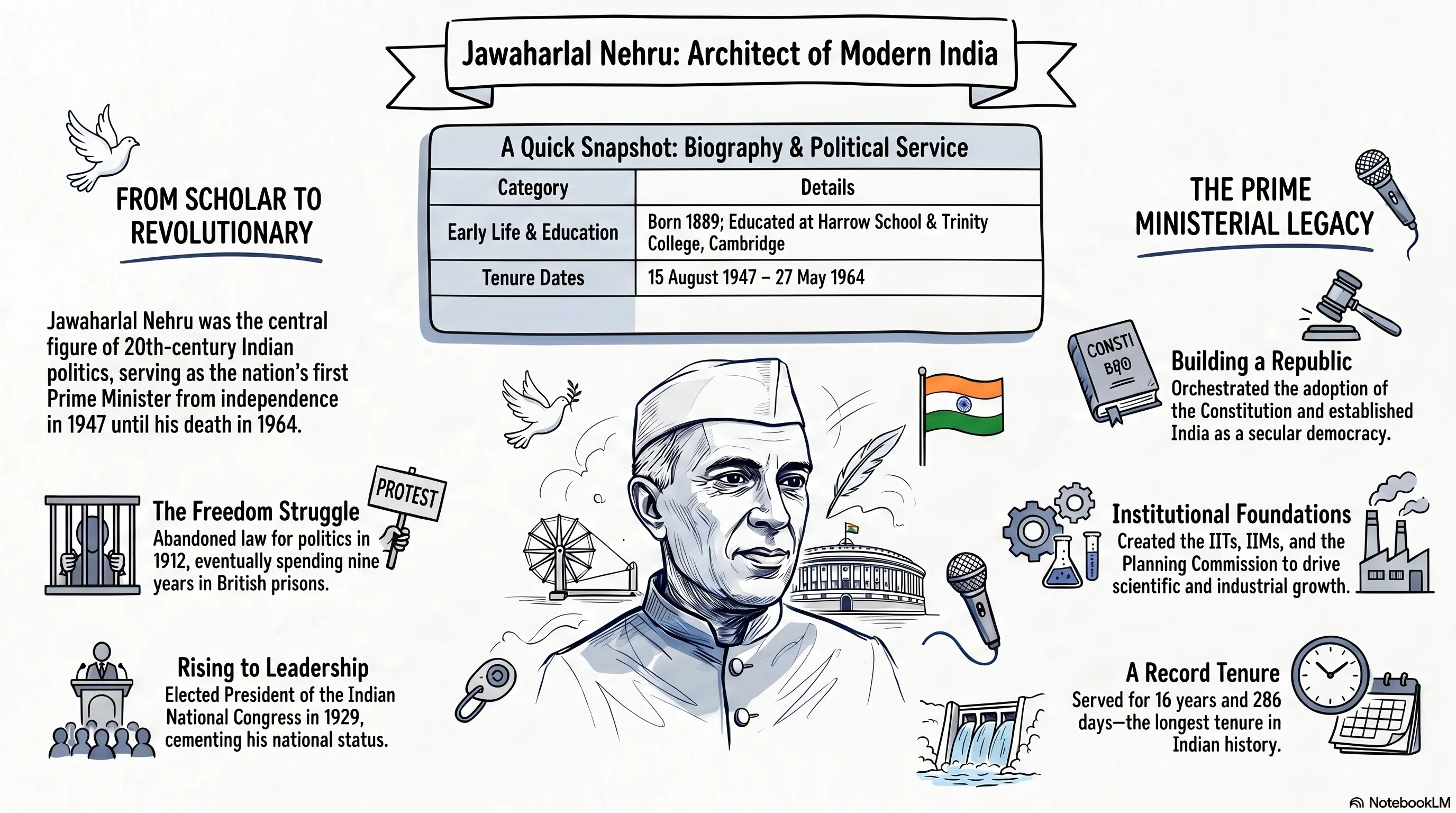
Jawaharlal Nehru – Early Life and Rise to Power
Nehru came from a privileged background. His father, Motilal Nehru, was a successful barrister and a founding figure of the Indian National Congress. Jawaharlal studied at Harrow School in England, then read natural sciences at Trinity College, Cambridge, before training as a barrister at the Inner Temple.
He returned to India in 1912 and gradually moved from law into politics, drawn in by the growing independence movement. By the 1920s, he was deeply embedded in the Congress party and working closely with Gandhi. He was jailed nine times by the British spending nearly nine years in prison in total.
By 1929, Nehru was elected President of the Indian National Congress. He was re-elected to that role multiple times, cementing his position as the leader most likely to head an independent India.
Nehru's Tenure as Prime Minister (1947–1964) – Key Highlights
Nehru's 17-year tenure was the longest of any Indian Prime Minister. Here's what defined it:
- Framing the Constitution: India adopted its Constitution on 26 January 1950, becoming a sovereign democratic republic. Nehru played a central role in guiding the Constituent Assembly's work.
- Five-Year Plans: He introduced centralised economic planning through the Planning Commission, modelling India's development strategy on Soviet-style five-year plans, with a focus on heavy industry.
- IITs and IIMs: Nehru established India's premier technical and management institutions, laying the foundation for the country's future in science and technology.
- Non-Aligned Movement: He co-founded the Non-Aligned Movement in 1961 alongside Yugoslavia's Tito and Egypt's Nasser, keeping India out of the Cold War blocs.
- Indo-China War (1962): The conflict with China over the Himalayan border was a significant blow to Nehru's foreign policy legacy. India was caught unprepared, and the defeat shook public confidence in his leadership.
- Death in office: Nehru died on 27 May 1964, reportedly weakened by illness following the 1962 war. He remains the only Indian Prime Minister to have died while in office.
What Made Nehru's Leadership Significant?
Nehru's significance goes beyond dates and policies. He was steering a new nation of 350 million people — deeply diverse in language, religion, and culture toward a unified democratic state. That wasn't guaranteed to work.
He chose parliamentary democracy when many newly independent nations were sliding toward authoritarianism. He built secular institutions at a time when religious tensions were running dangerously high after Partition.
Critics point to his mixed economic record, the 1962 China war, and his handling of Kashmir. Supporters credit him with the democratic framework that has held India together for nearly eight decades. Either way, his impact on the country's political identity is hard to overstate.
Complete List of All Prime Ministers of India
| # | Name | Party | Tenure (From–To) | Years Served | State |
|---|---|---|---|---|---|
| 1 | Jawaharlal Nehru | Indian National Congress | 15 Aug 1947 – 27 May 1964 | ~16 years | Uttar Pradesh |
| 2 | Gulzarilal Nanda (Acting) | Indian National Congress | 27 May 1964 – 9 Jun 1964 | 13 days | Punjab |
| 3 | Lal Bahadur Shastri | Indian National Congress | 9 Jun 1964 – 11 Jan 1966 | ~1.5 years | Uttar Pradesh |
| 4 | Gulzarilal Nanda (Acting) | Indian National Congress | 11 Jan 1966 – 24 Jan 1966 | 13 days | Punjab |
| 5 | Indira Gandhi | Indian National Congress | 24 Jan 1966 – 24 Mar 1977 | ~11 years | Uttar Pradesh |
| 6 | Morarji Desai | Janata Party | 24 Mar 1977 – 28 Jul 1979 | ~2.5 years | Gujarat |
| 7 | Charan Singh | Janata Party (Secular) | 28 Jul 1979 – 14 Jan 1980 | ~5 months | Uttar Pradesh |
| 8 | Indira Gandhi | Indian National Congress | 14 Jan 1980 – 31 Oct 1984 | ~4.5 years | Uttar Pradesh |
| 9 | Rajiv Gandhi | Indian National Congress | 31 Oct 1984 – 2 Dec 1989 | ~5 years | Uttar Pradesh |
| 10 | V. P. Singh | Janata Dal | 2 Dec 1989 – 10 Nov 1990 | ~11 months | Uttar Pradesh |
| 11 | Chandra Shekhar | Samajwadi Janata Party | 10 Nov 1990 – 21 Jun 1991 | ~7 months | Uttar Pradesh |
| 12 | P. V. Narasimha Rao | Indian National Congress | 21 Jun 1991 – 16 May 1996 | ~5 years | Andhra Pradesh |
| 13 | Atal Bihari Vajpayee | Bharatiya Janata Party | 16 May 1996 – 1 Jun 1996 | 13 days | Uttar Pradesh |
| 14 | H. D. Deve Gowda | Janata Dal | 1 Jun 1996 – 21 Apr 1997 | ~10 months | Karnataka |
| 15 | I. K. Gujral | Janata Dal | 21 Apr 1997 – 19 Mar 1998 | ~11 months | Punjab |
| 16 | Atal Bihari Vajpayee | Bharatiya Janata Party | 19 Mar 1998 – 22 May 2004 | ~6 years | Uttar Pradesh |
| 17 | Manmohan Singh | Indian National Congress | 22 May 2004 – 26 May 2014 | 10 years | Assam |
| 18 | Narendra Modi | Bharatiya Janata Party | 26 May 2014 – Present | 10+ years | Gujarat |
Prime Ministers Who Served Multiple Terms
Several Prime Ministers held office more than once:
- Indira Gandhi served two separate terms: 1966–1977 and 1980–1984. She's counted as both the 5th and 8th Prime Minister depending on how you list the terms.
- Atal Bihari Vajpayee served three times: a 13-day stint in 1996, then a 13-month term from 1998–1999, followed by a full term from 1999–2004.
- Gulzarilal Nanda served as acting Prime Minister twice, briefly, following the deaths of Nehru and Shastri.
India's Shortest and Longest Serving Prime Ministers
Longest serving: Jawaharlal Nehru, with approximately 16 years and 286 days in office (1947–1964).
Shortest serving (full appointment): Atal Bihari Vajpayee's first term in 1996 lasted just 13 days. He assumed office on 16 May 1996 but resigned on 28 May 1996 after failing to prove a majority in the Lok Sabha.
Prime Ministers and Their Political Parties
Indian National Congress Prime Ministers
The Congress party dominated Indian politics from independence through the 1980s. Its Prime Ministers include Jawaharlal Nehru, Lal Bahadur Shastri, Indira Gandhi, Rajiv Gandhi, P. V. Narasimha Rao, and Manmohan Singh.
BJP Prime Ministers of India
The Bharatiya Janata Party has produced two Prime Ministers: Atal Bihari Vajpayee (1996, 1998–2004) and Narendra Modi (2014–present).
Other Parties
The Janata Party era of the late 1970s and the coalition governments of the 1990s brought several Prime Ministers from other parties including Morarji Desai, V. P. Singh, and H. D. Deve Gowda.
Notable Firsts in India's Prime Ministerial History
- First Prime Minister: Jawaharlal Nehru, 15 August 1947.
- First Female Prime Minister: Indira Gandhi, 24 January 1966 only the second female head of government in the world at the time. She remains the only woman to hold the office.
- Youngest Prime Minister: Rajiv Gandhi, who became PM at 40 years old on 31 October 1984 following his mother's assassination.
- First PM from a Non-Congress Party: Morarji Desai, who led the Janata Party government from 1977. He was 81 when he took office also making him the oldest person to become Prime Minister.
- First Sikh Prime Minister: Manmohan Singh (2004–2014), widely regarded as one of India's foremost economists and the architect of the 1991 economic liberalisation as Finance Minister.
- First PM to win three consecutive Lok Sabha majorities: Narendra Modi, following BJP-led victories in 2014, 2019, and 2024.
Frequently Asked Questions about Complete List of All Prime Ministers
Jawaharlal Nehru was India's first Prime Minister. He took office on 15 August 1947 when India gained independence from British colonial rule. He served continuously until his death on 27 May 1964.
Nehru served as Prime Minister for approximately 16 years and 286 days, from 15 August 1947 to 27 May 1964. This makes him the longest-serving Prime Minister in Indian history. He died in office due to illness.
Indira Gandhi was India's first and only female Prime Minister. She first took office on 24 January 1966 and served two separate terms 1966 to 1977, and 1980 to 1984. She was assassinated by her bodyguards on 31 October 1984.
Narendra Modi is the current Prime Minister of India. He has served since 26 May 2014 and was sworn in for his third consecutive term in June 2024 following the BJP-led National Democratic Alliance's victory in the general election.
Rajiv Gandhi was the youngest Prime Minister of India, taking office at age 40 on 31 October 1984 after the assassination of his mother, Indira Gandhi. He served until December 1989 and was himself assassinated in May 1991 during an election campaign.
Atal Bihari Vajpayee served the shortest term as a formally appointed Prime Minister just 13 days in May 1996. He resigned after failing to win a confidence vote in the Lok Sabha.
India has had 14 individuals serve as Prime Minister. If you count each separate term as a distinct entry, the number reaches 18. Both Indira Gandhi and Atal Bihari Vajpayee served multiple separate terms.
Dr. Manmohan Singh was Prime Minister before Narendra Modi. He served two full terms from 22 May 2004 to 26 May 2014, representing the Indian National Congress-led United Progressive Alliance government. He's widely credited with continuing India's economic reform agenda.