Important Questions for CBSE Class 8 – Subject-Wise Guide
Class 8 is the year when school syllabi quietly get harder. Maths moves from arithmetic into algebraic generalisation, Science splits properly into Physics, Chemistry, and Biology strands, and Social Science starts asking "why" instead of just "what." Students who sail through Class 6–7 on memory alone often hit a wall here, because Class 8 question papers reward understanding over recall.
This guide pulls together the most exam-relevant Important questions for Maths, Science, Social Science, and English, organised chapter-by-chapter, the way most CBSE and state board papers are actually set. Instead of generic "revise everything" advice, you'll find the specific question types that appear year after year, why students lose marks on them, and how to approach each one. Also, solve questions from NCERT with the help of NCERT Solution for class 8 and NCERT exemplar solutions for class 8.
Important Questions for Class 8 – Subject-wise
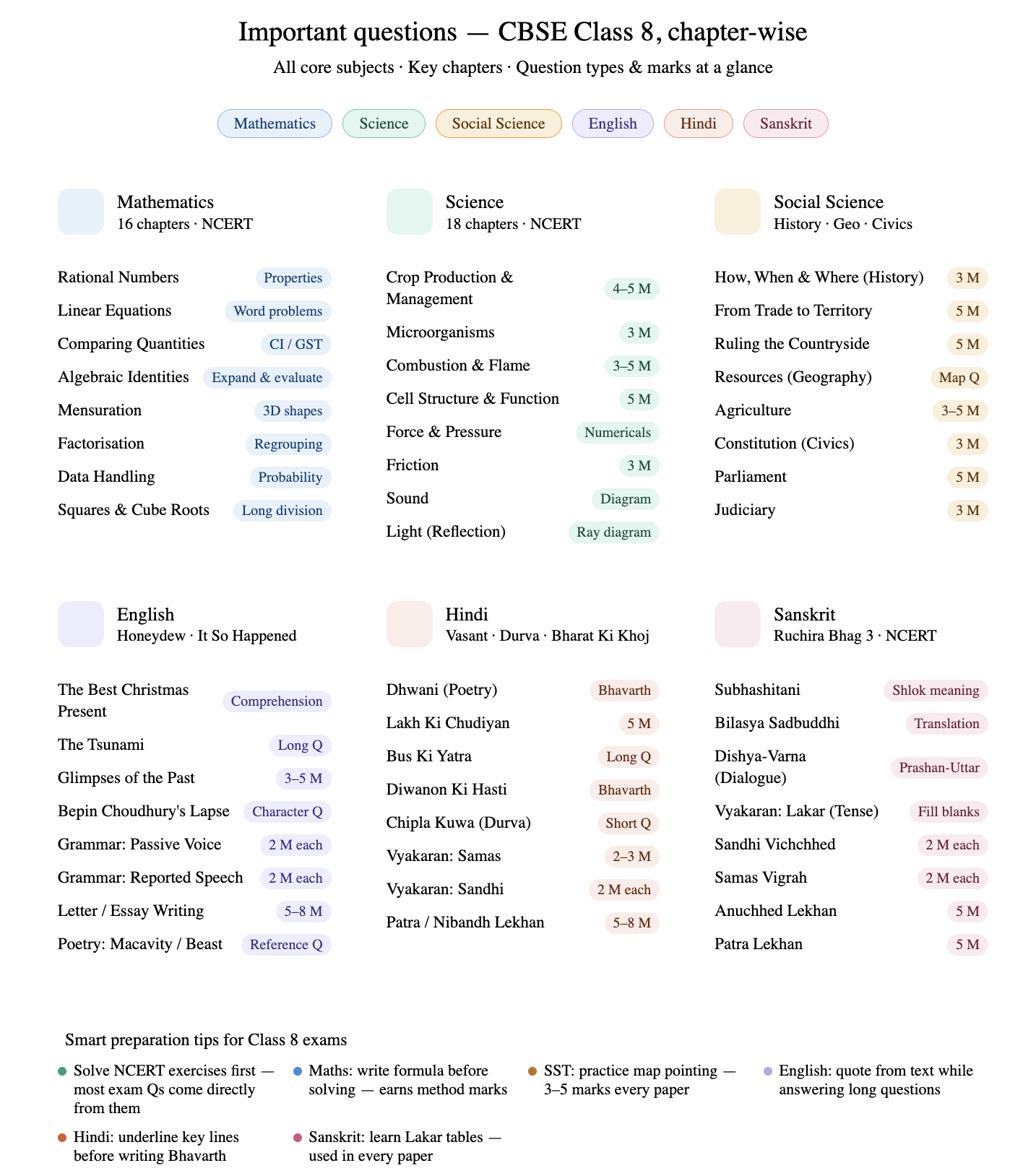
Class | Subject |
|---|---|
Class 8 | |
Class 8 | |
Class 8 | |
Class 8 | |
Class 8 | |
Class 8 | |
Class 8 |
How Class 8 Exams Are Actually Weighted
Before jumping into subject questions, it helps to know where marks are concentrated. Most Class 8 annual papers follow a fairly predictable pattern across boards:
Question Type | Typical Weightage | Where Marks Are Lost |
|---|---|---|
Very Short Answer (1 mark) | 15–20% | Sign errors, missed units |
Short Answer (2–3 marks) | 35–40% | Incomplete steps, skipped reasoning |
Long Answer (4–5 marks) | 25–30% | Poor structure, missing diagrams |
Application/HOTS-based | 10–15% | Concept not linked to real situation |
Map/Diagram-based | 5–10% | Labelling errors, scale issues |
Keep this table in mind — it explains why the "important questions" below are weighted toward short and long-answer formats rather than just one-liners.
Mathematics: Chapter-Wise Important Questions
Class 8 Maths (NCERT and most state boards) covers Rational Numbers, Linear Equations, Understanding Quadrilaterals, Practical Geometry, Data Handling, Squares and Square Roots, Cubes and Cube Roots, Algebraic Expressions and Identities, Mensuration, Exponents and Powers, Direct and Inverse Proportions, Factorisation, and Introduction to Graphs.
Rational Numbers
This chapter is deceptively simple — students know the rules but forget to apply them under pressure.
State and verify the closure property of rational numbers under addition and multiplication, using two negative rational numbers as examples.
Find the rational number that lies exactly midway between two given rational numbers, such as −3/5 and 4/7.
Represent a rational number like −7/3 on a number line, and explain the method used to locate fractional points accurately.
If a rational number's additive inverse equals its multiplicative inverse, find the number (this tests whether students confuse the two inverse concepts).
Linear Equations in One Variable
Word problems dominate this chapter, and most marks are lost in translating English into algebra, not in solving the equation itself.
A number decreases by 7 when 3/5 of it is subtracted from itself; find the number (classic transposition problem).
The digits of a two-digit number differ by 3. If the digits are interchanged and the resulting number is added to the original, the sum is 143. Find the number.
Sum of three consecutive multiples of 8 is 888. Find the multiples (tests setting up variables correctly).
A father's age is three times his son's age. Ten years later, he will be twice his son's age. Find their present ages.
Understanding Quadrilaterals
Prove that the sum of all exterior angles of any polygon, formed by producing the sides in order, is 360°.
ABCD is a parallelogram. Find the measure of angle B if angle A is 70° more than twice angle B (angle sum + parallelogram property combined).
Distinguish between a rhombus and a square using their diagonal properties — this comparison appears almost every year in some form.
Squares, Square Roots, Cubes, and Cube Roots
Concept | Sample Question Pattern |
|---|---|
Pythagorean triplets | Write a Pythagorean triplet whose smallest member is 14 |
Square root by long division | Find the square root of 7744 using the long division method |
Smallest number to make a perfect square | Find the smallest number by which 1620 must be multiplied to get a perfect square |
Cube roots by prime factorisation | Find the cube root of 13824 using prime factorisation |
Number of digits | Without calculating, find the number of digits in the square root of 65536 |
Algebraic Expressions, Identities, and Factorisation
Using a suitable identity, find the value of 297 × 303 without direct multiplication (tests application of (a+b)(a−b)).
Factorise: 4x² + 12xy + 9y² (recognising a perfect square trinomial).
Divide the polynomial 6x³ + 11x² − 39x + 20 by (3x − 4) using long division of polynomials.
Find the product (2x − 1)(2x + 1)(4x² + 1) and identify which identity simplifies the calculation.
Mensuration
This chapter is where diagrams matter as much as formulas.
Find the area of a trapezium whose parallel sides are 1 m and 1.2 m, with the distance between them being 0.8 m.
A cuboid is 12 cm long, 9 cm wide, and the total surface area is 360 cm². Find its height (working backward from a formula, common in HOTS questions).
How much canvas is needed for a conical tent of base radius 6 m and height 8 m, given canvas costs ₹100 per sq m? (combines slant height calculation with cost application).
Exponents, Direct/Inverse Proportions, and Graphs
Express 0.000000000947 in standard form and explain why negative exponents are used.
If 36 men can complete a piece of work in 15 days, how many men are needed to finish it in 9 days? (inverse proportion application).
Plot the points (2, 3) and (−1, −2) on a graph and find the equation of the line passing through them — graph-reading questions are increasingly common in newer papers.
Science: Chapter-Wise Important Questions
Class 8 Science covers Crop Production, Microorganisms, Synthetic Fibres, Materials, Coal and Petroleum, Combustion, Conservation of Plants and Animals, Cell Structure, Reproduction in Animals, Force and Pressure, Friction, Sound, Chemical Effects of Current, Light, Stars and the Solar System, and Pollution.
Physics Topics
Chapter | High-Value Question |
|---|---|
Force and Pressure | Explain why a sharp knife cuts better than a blunt one, using the concept of pressure and area |
Friction | A football player wears studded shoes while playing on grass. Explain the role of friction here, and give one method to reduce friction in machine parts |
Sound | Explain how sound is produced and propagated, distinguishing between amplitude and frequency with the help of a labelled diagram |
Chemical Effects of Current | Why does an LED glow only for one direction of current flow during the electrolysis test for current passage in liquids? |
Light | Differentiate between regular and irregular (diffused) reflection of light, with one real-life example of each |
Explain Newton's idea connecting force and motion using the example of a moving ball gradually slowing down due to friction.
Why do we sometimes hear a thunder sound a few seconds after seeing the lightning flash? (tests understanding of sound vs light speed, a frequently asked HOTS question).
Draw a labelled diagram showing the formation of an image by a plane mirror and state its characteristics.
Chemistry Topics
Why should we avoid the use of synthetic detergents for washing clothes near a river or pond? (Combustion/pollution chapter — environment-linked questions are high-yield).
Differentiate between a fuel's calorific value and the term "ideal fuel," and name two characteristics of an ideal fuel.
Explain why coal and petroleum are called fossil fuels, and why they are non-renewable.
What happens when a magnesium ribbon burns in air? Write the word equation and explain why this reaction releases a dazzling white light.
Define rusting and corrosion. Suggest two methods to prevent the rusting of iron objects used in daily life.
Biology Topics
This is usually the highest-scoring section if students focus on diagrams and labelled processes.
Draw a neat, labelled diagram of an animal cell and a plant cell, and list three structural differences between them.
Explain binary fission and budding as modes of asexual reproduction, with one example organism for each.
What is metamorphosis? Describe the life cycle of a frog, mentioning each stage in correct sequence.
Why are some microorganisms called "friendly" while others are harmful? Give two examples of each category with their use or harm explained.
Explain the role of nitrogen-fixing bacteria in maintaining soil fertility, and name the process by which they convert atmospheric nitrogen.
Describe three ways in which human activities are leading to the depletion of forest cover, and explain why conserving the Red Data Book species matters.
Agriculture and Environment
Explain the difference between manure and fertilisers, listing one advantage of each.
What is crop rotation, and how does growing a leguminous crop after a cereal crop benefit the soil?
Describe the process of pollination and explain why some plants depend on insects for it.
Social Science: History, Civics, and Geography
Social Science is often underprepared because students assume it's "just reading," but boards now ask source-based, map-based, and reasoning questions heavily.
History — How, When, and Where & Colonial India
Topic | Important Question |
|---|---|
Sources of History | How do census records help historians understand changes in Indian society over the colonial period? |
Tribal Societies | Explain how the lives of tribal groups like the Gonds and Santhals changed under British rule |
Ruling the Countryside | What was the Permanent Settlement, and why did it create long-term problems for both peasants and zamindars? |
Weavers and Industrialists | Why did Indian textile producers face a crisis after the arrival of machine-made cloth from Britain? |
Civilising the Native | Explain the British justification for introducing Western education in India, and how Indian reformers responded |
1857 Revolt | Identify three causes of the Revolt of 1857 and explain why it failed to achieve its objectives |
Explain the system of indentured labour. Why did Indian labourers migrate to colonies like Mauritius, Fiji, and the West Indies?
How did the British policy of deindustrialisation affect Indian handicrafts and traditional industries during the 19th century?
Why is the period after 1857 often described as the beginning of "direct Crown rule" in India, and what changes did it bring administratively?
Civics — The Indian Constitution and Democracy
Why is the Constitution often called the "supreme law" of the land? Explain with reference to the Fundamental Rights it guarantees.
Distinguish between the Legislature, Executive, and Judiciary, and explain why separation of powers is important in a democracy.
What is the Right to Constitutional Remedies, and why is Dr. B.R. Ambedkar's description of it as the "heart and soul" of the Constitution significant?
Explain the difference between a unitary and a federal system of government, using India as an example of the latter.
Why do marginalised communities sometimes need special safeguards under the law? Illustrate using one example from the chapter on Marginalisation.
What is public interest litigation (PIL), and how has it strengthened the role of the judiciary in protecting citizens' rights?
Geography — Resources, Land, and Industries
Theme | Sample Question |
|---|---|
Resources | Distinguish between renewable and non-renewable resources, giving two examples of each found in India |
Land, Soil, Water | Explain three methods of soil conservation suitable for hilly and plain regions respectively |
Agriculture | Compare the conditions required for growing rice and wheat in India under separate headings |
Industries | Why is the iron and steel industry called a "basic industry," and how does it support other industries? |
Human Resources | Explain why population distribution in India is uneven, citing physical and economic factors |
Why is water considered a renewable resource in theory but is becoming scarce in practice? Suggest two conservation measures.
Explain the difference between agglomeration and dispersal of industries, and the factors influencing the location of the cotton textile industry in India.
What is meant by "human resource," and why is investment in education and health considered investment in human capital?
English: Grammar, Literature, and Writing Skills
English question papers reward structure as much as content. The questions below reflect the format most frequently tested.
Grammar — High-Frequency Areas
Grammar Topic | What Examiners Actually Test |
|---|---|
Tenses | Converting between simple, continuous, and perfect forms in context, not isolated rules |
Modals | Correct usage of must, should, might, can in given situations (advice vs obligation vs possibility) |
Reported Speech | Converting direct speech with mixed tenses and question forms into indirect speech |
Active/Passive Voice | Changing sentences with modals and continuous tenses, which trips up most students |
Determiners | Choosing between a/an/the/some/any correctly in a gap-fill passage |
Clauses | Identifying noun, adjective, and adverb clauses within compound sentences |
Rewrite the sentence in passive voice: "The committee will announce the results by Friday."
Change into indirect speech: "Have you finished your homework?" the teacher asked the students.
Fill in the blanks with appropriate modals: "You ___ apologise to her; it was your mistake." (testing obligation vs suggestion).
Combine the following sentences using an appropriate connector: "She was tired. She finished the project on time."
Literature — Prose and Poetry Comprehension
Most boards test literature through unseen passage analysis as well as questions from the prescribed reader. Common question types include:
Reference-to-context questions that ask students to identify the speaker, the situation, and the meaning of a quoted line.
Character-based questions analysing motivations and changes in a character across the story (commonly asked for chapters like "The Best Christmas Present in the World" or "The Tsunami" type narratives, depending on the board's prescribed book).
Theme-based long answers asking students to connect the central message of a poem or story to real life — for instance, questions on courage, environmental responsibility, or human relationships frequently appear as 4–5 mark answers.
Poetic device identification: locating and explaining the use of simile, personification, or repetition within a given stanza.
Writing Skills
Format | Key Structural Points Examiners Check |
|---|---|
Formal Letter | Correct address format, subject line, formal closing |
Informal Letter | Appropriate tone, personal greeting and sign-off |
Notice Writing | Box format, bold heading "NOTICE," date, issuing authority |
Story/Diary Writing | Logical sequence, consistent tense, a clear concluding thought |
Paragraph/Article Writing | Clear topic sentence, supporting points, a summarising conclusion |
Write a formal letter to the editor of a newspaper expressing concern about increasing noise pollution in your locality.
Draft a notice for your school notice board informing students about an upcoming inter-house debate competition.
Write a short story in about 150 words that ends with the line: "...and that is how I learned the value of honesty."
A Smarter Way to Revise These Questions
Simply reading through a list of important questions rarely converts into exam marks. A more effective approach, used by toppers across subjects, looks like this:
Sort questions by chapter weightage first, not by how recently you studied them. Chapters like Algebraic Identities, Cell Structure, the Indian Constitution, and Tenses/Voice tend to appear in some form every year — prioritise these.
Practice the "why" behind every formula or rule, since most Class 8 papers now include at least one HOTS question per chapter that tests application rather than recall.
Write answers, don't just read them. For Social Science and English especially, the difference between a 3-mark and a 5-mark answer is almost always structure — clear points, examples, and a conclusion — not extra facts.
Use diagrams wherever the question allows, particularly in Biology (cell structure, life cycles) and Physics (mirror images, force diagrams), since labelled diagrams often carry dedicated marks independent of the written explanation.
Revisit map and graph-based questions separately, as these are frequently skipped during regular revision but appear consistently in Geography and Maths papers.
Used this way, the question sets above aren't just a revision checklist — they map directly onto how Class 8 papers are actually designed, chapter by chapter, across Maths, Science, Social Science, and English.
FAQs on Important Questions for CBSE Class 8 All Subjects
Important Questions for CBSE Class 8 All Subjects are carefully selected questions that cover the key concepts, topics, and learning outcomes prescribed in the latest CBSE syllabus. These questions are prepared after analyzing chapter weightage, frequently tested concepts, and the types of questions generally asked in school examinations. They help students revise the complete syllabus efficiently without missing essential topics. Practising these questions improves conceptual understanding, problem-solving ability, writing skills, and confidence before exams. Since they include objective, short-answer, and long-answer questions, students become familiar with different question patterns. Regular practice also helps identify weak areas and strengthens overall preparation. Solving important questions consistently enables students to perform better in periodic tests, half-yearly examinations, annual examinations, and various school assessments.
Important Questions help students focus on concepts that have greater academic importance and are commonly assessed during examinations. Instead of revising every topic repeatedly, students can concentrate on questions that strengthen their understanding and improve answer-writing skills. These questions encourage logical thinking, proper presentation, and step-by-step explanations wherever required. Practising them regularly increases speed, accuracy, and confidence while reducing examination stress. Students also become familiar with different difficulty levels and learn how to manage time during exams. Along with textbook study, solving important questions provides balanced preparation and minimizes last-minute confusion. Consistent revision through these questions enables students to recall concepts quickly and write well-structured answers that can lead to better scores across all Class 8 subjects.
Important Questions are excellent revision resources, but they should not replace textbooks. Textbooks introduce concepts, explanations, examples, illustrations, activities, and exercises that build a strong academic foundation. Important Questions work best after students have understood the chapter thoroughly. They reinforce learning, improve answer-writing skills, and prepare students for examination patterns by covering significant concepts. Students who combine textbook study with regular practice of important questions usually develop deeper conceptual understanding and stronger problem-solving abilities. Revising notes, practising diagrams, learning formulas, and solving important questions together creates a complete preparation strategy. This balanced approach helps students perform confidently and achieve excellent results in all CBSE Class 8 subjects.
Students should practise Important Questions regularly throughout the academic year instead of waiting until the final examination. Solving chapter-wise questions immediately after finishing each lesson reinforces learning and reduces the burden of revision later. Weekly revision sessions help maintain consistency and improve long-term memory. During examination periods, students should revise previously solved questions multiple times while focusing on weaker chapters. Maintaining a notebook of difficult questions and reviewing it periodically can further strengthen preparation. Daily practice for even a short duration develops better writing speed, accuracy, and confidence. Consistent revision through important questions ultimately leads to stronger subject knowledge and improved performance in school examinations.
Social Science consists of History, Geography, and Civics, making it important for students to revise facts, concepts, maps, dates, and explanations systematically. Important Questions simplify this process by highlighting major topics from every chapter. Students learn to write structured answers with relevant points, examples, and proper presentation. Regular practice improves memory retention and analytical thinking while helping students connect historical events, geographical concepts, and constitutional principles. Map practice and timeline revision become easier when combined with chapter-wise questions. These questions also prepare students for both objective and descriptive examinations. Continuous practice builds confidence, improves writing quality, and enables students to answer questions more effectively within the allotted examination time.
Students should first study the textbook carefully to understand concepts, examples, definitions, and exercises. Once they complete a chapter, they should immediately practise Important Questions to evaluate their understanding and identify areas requiring improvement. This sequence ensures that students apply their knowledge instead of memorizing answers. After completing all chapters, solving important questions again serves as an effective revision strategy before examinations. Students should also review incorrect answers and revise weak topics regularly. This learning cycle strengthens conceptual clarity, improves retention, and develops confidence. Following this structured approach helps students prepare more efficiently while ensuring comprehensive coverage of the Class 8 syllabus across all subjects.
Science requires conceptual understanding along with the ability to explain observations and scientific principles clearly. Important Questions help students revise definitions, diagrams, experiments, reasoning-based concepts, and practical applications in an organized manner. Regular practice strengthens understanding of topics such as force, energy, microorganisms, materials, pollution, plants, and human body systems. Students also improve their ability to answer assertion, explanation, and descriptive questions using scientific language. Revising important diagrams and labelling them correctly further enhances exam performance. Solving these questions repeatedly increases confidence in handling both theoretical and application-based questions. As a result, students develop stronger analytical thinking and achieve better performance in Science examinations.
Important Questions for CBSE Class 8 generally cover all major academic subjects, including Mathematics, Science, Social Science, English, and Hindi. Each subject contains chapter-wise questions designed to strengthen conceptual understanding and improve exam preparation. Mathematics includes numerical and application-based problems, while Science focuses on concepts, diagrams, reasoning, and experiments. Social Science contains history, geography, and civics questions that improve analytical and descriptive writing. English includes grammar, literature, reading comprehension, and writing practice, whereas Hindi covers literature, grammar, and writing sections. Preparing subject-wise important questions allows students to revise every chapter systematically without leaving any major topic. This comprehensive approach ensures balanced preparation and better confidence before school examinations.
Students should first understand the concepts and formulas taught in each Mathematics chapter before attempting Important Questions. Begin with basic questions to build confidence and gradually solve higher-order and application-based problems. While practising, write complete solutions step by step instead of only calculating the final answer. Regular revision of formulas, identities, constructions, and properties is equally important. After completing each chapter, solve mixed questions to strengthen problem-solving skills. Reviewing mistakes and understanding why errors occurred helps avoid repeating them in exams. Consistent practice also improves calculation speed and accuracy. By solving important questions regularly, students develop logical reasoning and confidence needed to perform well in Class 8 Mathematics examinations.
Chapter-wise Important Questions provide an excellent revision strategy because they help students complete one chapter thoroughly before moving to the next. This method strengthens conceptual clarity and improves long-term memory. However, students should also revise textbook exercises, classroom notes, definitions, formulas, diagrams, maps, and examples alongside important questions for complete preparation. After completing all chapters individually, students should solve mixed revision questions and sample papers to improve time management and overall performance. Combining chapter-wise revision with regular practice helps identify weaker topics that need extra attention. A balanced revision plan ensures students retain concepts more effectively and feel well-prepared for every section of the examination without unnecessary pressure.