Important Questions for Class 11 — Subject-wise
Class 11 is a transitional phase where students dive deeper into their chosen academic streams—Humanities, Commerce, or Science. The syllabus becomes more advanced, making it essential to adopt smart study strategies. One of the most effective ways to prepare for exams is by practising important questions for Class 11, organised by subject and stream. These questions help focus revision, improve concept clarity, and enhance exam performance. Important questions are handpicked from chapters with high exam weightage, frequently asked topics, and previous year papers. They align with the CBSE and other board syllabi, helping students study smarter, not harder. Subject-wise practice ensures efficient preparation without getting overwhelmed by vast syllabi.
Also, solve questions from NCERT with the help of the NCERT Solution for class 11 and the NCERT exemplar solutions for class 11.
Covers: Physics · Chemistry · Mathematics · Biology · Accountancy · Economics · Business Studies · English · Political Science
Important Questions for CBSE Class 11 – Subject-wise
Class | Subject |
|---|---|
Class 11 | |
Class 11 | |
Class 11 | |
Class 11 | |
Class 11 | |
Class 11 | |
Class 11 | |
Class 11 | |
Class 11 | |
Class 11 | |
Class 11 | |
Class 11 |
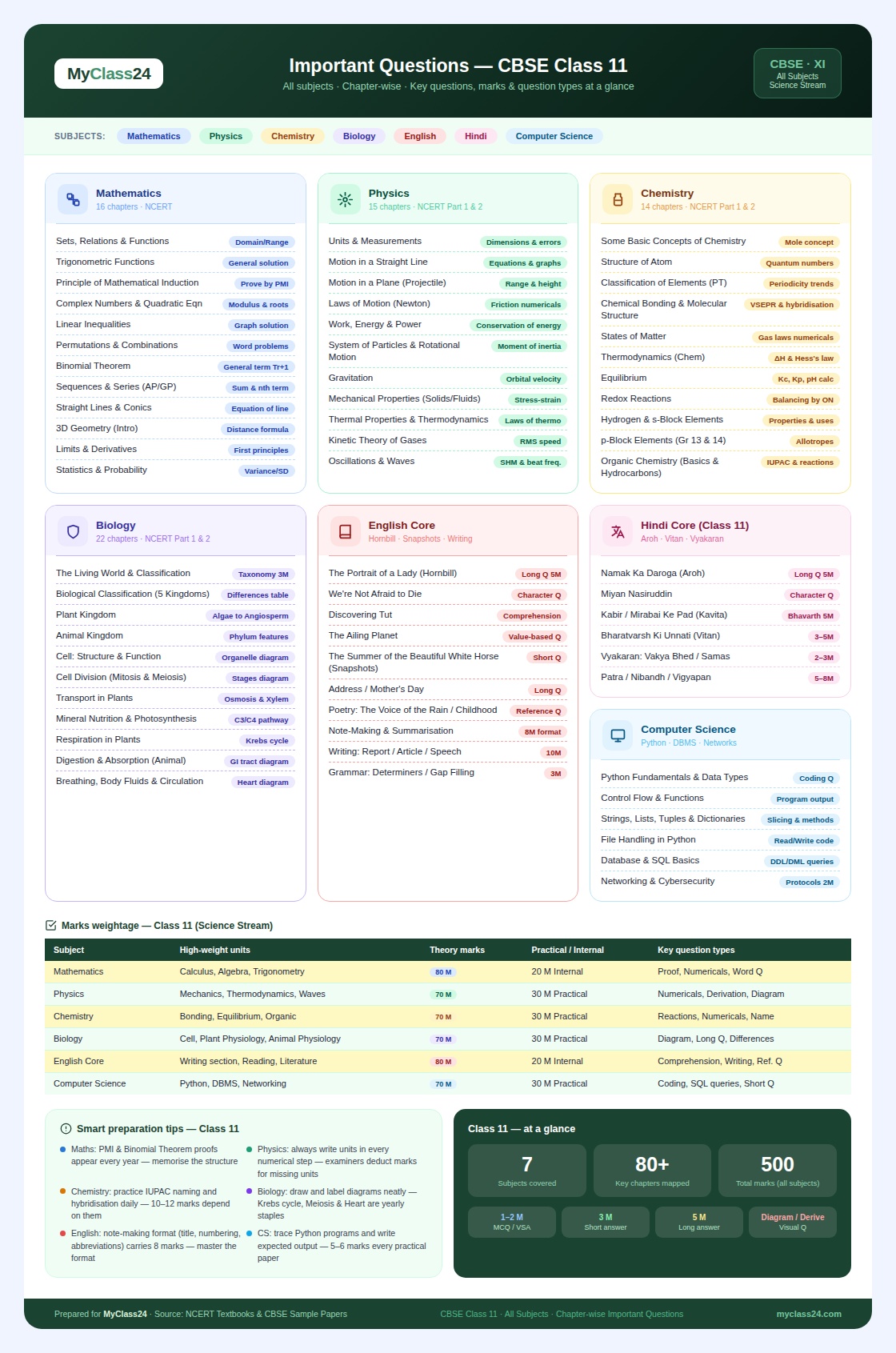
Class 11 sits at an unusual intersection. It is not a board year — so many students underestimate it. But it is also the year that determines everything that follows: your preparation for Class 12 boards, your readiness for JEE, NEET, CA Foundation, or CUET, and your genuine understanding of subjects you will carry into college. The annual examinations in Class 11 are designed and conducted by individual schools, but the best schools follow the CBSE sample paper pattern almost exactly. The question types — MCQs, assertion–reason, short answer, long answer, case study — mirror what CBSE uses in Class 12 boards. This guide gives you the subject-wise important questions for Class 11 based on actual CBSE question paper design, NCERT exercise patterns, and the concepts that surface most consistently in school examinations across India.
Who this guide is for: Class 11 students preparing for their annual examinations, mid-term assessments, and competitive entrance tests (JEE Main, NEET, CUET) simultaneously. The questions and topics listed here are drawn from NCERT textbooks, CBSE sample papers, and patterns observed across schools affiliated with CBSE.
Physics – Important Questions, Class 11
Class 11 Physics is structured around three interconnected pillars: Mechanics (Units 1–5), Thermodynamics (Unit 6), and Waves & Oscillations (Units 9–10). The third pillar — modern introductions like Kinetic Theory — bridges directly into Class 12. Students who struggle in Class 12 Electrostatics or Optics can almost always trace the problem back to shaky foundations in Class 11 Mechanics and Thermodynamics.
The questions listed in the table below represent the highest-frequency topics across CBSE-affiliated school examinations. Chapters left out of this table are not unimportant, but these are where examiners consistently allocate 5-mark and 3-mark questions.
Chapter | Important Question Areas | Question Type | Max Marks |
|---|---|---|---|
Units & Measurement | Dimensional analysis, error propagation, significant figures | Short answer, numerical | 3–5 |
Motion in a Straight Line | v-t and x-t graph interpretation, equations of motion derivation, relative velocity | Numerical + graph-based | 3–5 |
Laws of Motion | Free body diagrams, Atwood machine, angle of friction, pseudo force in non-inertial frames | 5-mark numerical + derivation | 5 |
Work, Energy & Power | Work-energy theorem proof, elastic/inelastic collision, potential energy curves | Derivation + numerical | 5 |
System of Particles & Rotational Motion | Moment of inertia (MI) of standard objects, angular momentum conservation, rolling without slipping | 5-mark long answer | 5 |
Thermodynamics | First law application, isothermal vs adiabatic processes, Carnot cycle efficiency | Derivation + conceptual | 3–5 |
Oscillations | SHM energy derivation, spring-mass system, time period of a simple pendulum | Numerical + derivation | 3–5 |
Waves | Standing waves on strings, beats, Doppler effect (all cases), resonance column | Numerical + formula derivation | 5 |
Recurring Exam Question — Laws of Motion
A block of mass 5 kg is placed on a rough inclined plane (μ = 0.3, θ = 30°). Find the acceleration of the block as it slides down. Also, find the force required to push it up the incline at constant velocity. Draw a labelled free-body diagram for each case.
Examiner Pattern Alert: In almost every Class 11 Physics paper, the chapter on Rotational Motion produces either a derivation of the moment of inertia of a solid sphere/disc using integration, or a problem combining angular momentum conservation with a numerical calculation. Students who skip this chapter's derivations leave 5 marks exposed.
Chemistry – Important Questions, Class 11
Class 11 Chemistry is divided into Physical, Inorganic, and Organic branches — and all three carry roughly equal weight in school examinations. The trap most students fall into is over-preparing Organic Chemistry (which is more intuitive) and under-preparing Physical Chemistry numericals, where marks are most reliably scored with practice.
Chapter | Key Question Focus | Exam Format | Priority |
|---|---|---|---|
Structure of Atom | Bohr's model calculations (radius, energy), quantum numbers, electronic configuration of exceptions (Cr, Cu) | Numerical + short answer | Very High |
Chemical Bonding & Molecular Structure | VSEPR shapes + bond angles, hybridisation, MO theory for O₂/N₂/NO/F₂, resonance structures | 3–5 marks, diagram-based | Very High |
States of Matter | Gas laws derivations, van der Waals equation, real vs ideal gas deviations | Numerical + conceptual | High |
Thermodynamics | Hess's Law calculations, ΔG = ΔH − TΔS, spontaneity criteria, bond enthalpy problems | 5-mark numerical | Very High |
Equilibrium | Kc and Kp relationship, Le Chatelier's principle applications, buffer solutions, pH calculations | 3–5 marks | Very High |
Redox Reactions | Oxidation number method, balancing by ion-electron method in acidic/basic medium | 3-mark short answer | High |
Hydrocarbons | IUPAC naming, addition reactions of alkenes (Markovnikov, anti-Markovnikov), aromaticity, ozonolysis products | 3–5 marks | Very High |
p-Block Elements | Anomalous behaviour of N and O, allotropes of sulphur/phosphorus, ozone vs oxygen | Short answer, 3 marks | High |
Recurring Exam Question — Chemical Bonding
Draw the MO energy level diagram for O₂. Find its bond order, magnetic character, and compare its stability with O₂⁺ and O₂⁻. Why does N₂ have a higher bond dissociation energy than O₂ despite having a similar molecular orbital configuration?
In Equilibrium, pH-calculation problems involving weak acids (using the approximation method) and buffer systems appear with striking regularity. The Henderson–Hasselbalch equation, while not explicitly stated in NCERT Class 11, is derivable from first principles — and questions that require its application are standard in CBSE-pattern school exams.
Mathematics – Important Questions, Class 11
Class 11 Mathematics is where the curriculum transitions from computation-heavy school Maths to proof-based, conceptual Mathematics. Sets, Relations & Functions, and Complex Numbers establish the language of higher Mathematics. Calculus — introduced through Limits and Derivatives — demands logical rigour that many students encounter for the first time here.
Sets, Relations & Functions
Venn diagram-based problems, types of relations (reflexive, symmetric, transitive, equivalence), domain and range of functions, odd/even function identification. Questions here appear as 1-mark MCQ, 2-mark, and 3-mark consistently.
Trigonometric Functions
Proving identities using compound angle formulas, principal value range, general solutions of sinθ = k / cosθ = k / tanθ = k. Typically 3–5 marks. The product-to-sum and sum-to-product identities are frequently tested.
Complex Numbers & Quadratic Equations
Argand plane representation, modulus-argument form, De Moivre's theorem applications, cube roots of unity. Nature of roots using discriminant. Expect 3–5 marks on complex numbers almost every year.
Permutations & Combinations
Distinction between nPr and nCr in word-problem context, circular permutations, selection with restrictions, distribution problems. This chapter is a consistent 5-mark long-answer source.
Binomial Theorem
General term, middle term, independent term, greatest binomial coefficient. Questions on finding the coefficient of xⁿ or a specific term recur every year in 3–5 mark slots.
Limits & Derivatives
Evaluation of standard limits (sinx/x, (aˣ-1)/x), L'Hôpital-style algebraic limit problems, first-principle differentiation. Gateway to Class 12 Calculus. One 5-mark question almost guaranteed.
For JEE aspirants in Class 11: Mathematical Induction and Sequences & Series (specifically the sum of AP, GP, and special series like Σn², Σn³) appear in JEE Main almost every year and are directly covered in Class 11. Do not treat these as "school only" chapters.
Chapter | Question Type That Appears Most | Typical Marks | Difficulty |
|---|---|---|---|
Straight Lines | Finding angle between lines, distance of a point from a line, family of lines passing through intersection | 3–5 | Moderate |
Conic Sections | Deriving equations of ellipse/hyperbola from standard form, locus problems, finding eccentricity | 5 | High |
Sequences & Series | Sum to n terms (AP, GP, AGP), sum of infinite GP, sum of special series | 3–5 | Moderate |
Statistics | Mean deviation, variance and standard deviation for grouped/ungrouped data, coefficient of variation | 5 | Easy–Mod |
Probability | Event types, addition theorem, conditional probability (basic), mutually exclusive events | 3–5 | Moderate |
Biology – Important Questions, Class 11
Class 11 Biology is often treated lightly by students who assume it is "just memorisation." That assumption consistently costs marks. CBSE Biology questions — even at Class 11 — test understanding of why a structure exists, not just what it looks like. Diagrams in Biology are not decorative; a correctly labelled diagram of a mitotic cell, an ovule, or a nephron can independently carry 3 marks.
1- Cell: The Unit of Life — Structure of prokaryotic vs eukaryotic cell, differences in ribosomes, cell wall composition, endomembrane system. Expect a 5-mark diagram question on cell organelles (especially Golgi apparatus and ER) or a 3-mark comparison table.
2-Biomolecules — Structure of ATP, enzyme kinetics (Km, Vmax concept), induced fit vs lock-and-key model, primary/secondary/tertiary protein structure. Questions here often combine a diagram with a conceptual explanation.
3-Cell Cycle & Cell Division — All stages of mitosis and meiosis with labelled diagrams, significance of meiosis I (reductional) vs meiosis II (equational), chiasmata and crossing over. This chapter alone can account for 5–8 marks in an annual paper.
4-Morphology of Flowering Plants — Root system modifications, leaf venation and phyllotaxy, floral formula and diagram for Solanaceae, Fabaceae, Liliaceae. Formulae-based questions appear in 3-mark and 5-mark slots.
5-Anatomy of Flowering Plants — T.S. of dicot root vs monocot root vs dicot stem — labelled diagrams are mandatory here. The differences between primary and secondary growth are a recurring short-answer topic.
6-Breathing & Exchange of Gases — Mechanism of breathing (pressure changes), respiratory volumes (TV, IRV, ERV, RV), role of carbonic anhydrase, oxyhaemoglobin dissociation curve and its shift. Regularly produces 5-mark long-answer questions.
7-Excretory Products & Elimination — Structure of nephron with labelled diagram, counter-current mechanism, role of ADH and aldosterone, disorders (anuria, uremia, renal failure). This chapter is a diagram + application favourite of examiners.
For NEET aspirants: The chapters on Biological Classification (Kingdom Monera, Protista, Fungi), Plant Kingdom (alternation of generations in Bryophyta, Pteridophyta, Gymnospermae), and Animal Kingdom (phylum-level characteristics and examples) contribute a disproportionately high number of NEET MCQs. Do not sacrifice these chapters for "less boring" units.
Accountancy – Important Questions, Class 11
Accountancy is the subject in the Commerce stream where marks are most directly linked to practice, not understanding alone. A student who understands double-entry bookkeeping conceptually but has never practised a full Journal → Ledger → Trial Balance exercise under timed conditions will lose marks to avoidable procedural errors.
Chapter / Topic | Important Question Types | Common Mistakes to Avoid | Marks |
|---|---|---|---|
Journal Entries | Compound journal entries, opening/closing entries, rectification entries | Reversing debit/credit for discount allowed vs discount received | 6–8 |
Ledger & Trial Balance | Posting from journal to ledger, balancing accounts, extracting trial balance | Missing the closing balance entry; incorrect carry-forward | 8–10 |
Bank Reconciliation Statement | Preparing BRS from cash book balance or bank statement balance, error identification | Adding/subtracting in wrong direction when starting from bank balance | 6–8 |
Depreciation | Straight-line vs diminishing value method, change of method, disposal of asset | Forgetting to adjust depreciation in year of disposal | 6 |
Financial Statements (without adjustments) | Trading Account, Profit & Loss Account, Balance Sheet preparation | Placing gross profit in wrong statement; confusing direct/indirect expenses | 12–15 |
Financial Statements (with adjustments) | Closing stock, outstanding expenses, prepaid expenses, bad debts, provision for bad debts | Entering an adjustment only once instead of twice (dual effect) | 12–15 |
Economics – Important Questions, Class 11
Class 11 Economics consists of two distinct textbooks: Statistics for Economics and Indian Economic Development. Many students treat Statistics as the harder part and rush through Economic Development — when in reality, Indian Economic Development tends to produce more marks in analytical long-answer questions that test opinion alongside facts.
Book / Chapter | High-Frequency Questions | Format | Priority |
|---|---|---|---|
Statistics: Collection of Data | Primary vs secondary data, sampling methods (random, stratified, systematic), questionnaire design | 3–4 marks, short answer | High |
Statistics: Presentation of Data | Drawing ogives (less than and more than), frequency polygon, histogram interpretation | 4–6 marks, diagram + calculation | Very High |
Statistics: Measures of Central Tendency | Arithmetic mean (direct, assumed, step deviation), median from ogive, mode from histogram and formula | 4–6 marks, numerical | Very High |
Statistics: Correlation | Karl Pearson's coefficient, Spearman's rank correlation, scatter diagrams | 4–6 marks | Very High |
Eco Dev: Indian Economy 1950–1990 | Objectives and failures of Five Year Plans, Green Revolution impact, industrial licensing policy | 4–6 marks, analytical | High |
Eco Dev: Liberalisation, Privatisation, Globalisation | Objectives of LPG, WTO role, impact on agriculture and employment, critical evaluation | 6 marks, long answer | Very High |
Eco Dev: Human Capital Formation | Education and health as investment vs expenditure, HDI components, brain drain | 4–6 marks | High |
Business Studies – Important Questions, Class 11
Class 11 Business Studies lays the conceptual foundation for the Class 12 paper, which is significantly more application-based. The important questions here are almost always definition + explanation + example structured answers. The chapter on Forms of Business Organisation is the most reliably tested — differences between a partnership firm and a company, types of partners, merits and demerits of each form — appear as 6-mark long answers with unfailing regularity.
Sources of Business Finance is the chapter where students must understand equity vs debt, different types of shares (equity and preference), debentures, and retained earnings — the distinctions here form the backbone of Class 12 Financial Management. The Small Business and Entrepreneurship chapter produces short-answer questions on the role of MSMEs, government schemes, and problems faced by small businesses.
English Core – Important Questions, Class 11
English Core in Class 11 is often the subject where students either score very high (85+) or surprisingly low (60s) — rarely in between. The variance comes almost entirely from writing skills: the ability to write a structured, coherent long-form response in the Notice, Article, Letter, or Essay format.
Reading Comprehension
Unseen passage (factual or literary) with inference-based questions. Vocabulary in context, title suggestion, and summary questions. 20 marks in most papers. Practice diverse passage types — science, social issues, biography.
Writing Skills
Notice writing (concise, formal), Article/Speech (opinion-based, 250–300 words), Letter to the Editor, Report writing. Format carries 2–3 marks independently — a student who gets the format right scores even with average content.
Literature – Hornbill & Snapshots
Long-answer questions (6 marks) on character analysis, theme, and central idea from prose chapters. Poem questions focus on figures of speech, tone, mood, and central meaning — not just summary.
Grammar (Applied)
Gap-filling (tenses, articles, prepositions), sentence transformation (active/passive, direct/indirect), editing passages. These sections are fully scorable with pattern practice — zero ambiguity in marking.
Political Science – Important Questions, Class 11
Class 11 Political Science (Political Theory) is a conceptual subject where the ability to explain ideas with relevant examples determines the quality of a long answer. Important questions consistently cluster around the following:
1 Freedom — Negative vs positive liberty, Isaiah Berlin's distinction, constraints on freedom. Long-answer questions often ask students to evaluate whether absolute freedom is desirable.
2 Equality — Natural vs social equality, formal vs substantive equality, affirmative action debate. Case-study format questions use Indian reservation policy as context.
3 Rights — Sources of rights, types (civil, political, economic, cultural), Universal Declaration of Human Rights. Questions here ask for both definition and real-world examples.
4 Justice — Rawls' theory of justice, distributive justice, social justice vs formal justice. This chapter produces the most 6-mark analytical questions.
5 Secularism — Western vs Indian model, criticism of secularism, communalism. Important for source-based questions involving constitutional provisions.
Marks tip for Humanities: In Political Science and Sociology, the 6-mark long answer is where the difference between a 70% and a 90% student is made. The structure matters as much as content: a definition, an explanation with two or three points, a relevant example (preferably Indian), and a concluding sentence is the format that earns full marks consistently.
Expert Preparation Strategy for Class 11 Annual Exams
✓ Start with NCERT, end with NCERT. Every single question in CBSE-pattern school exams is either directly from NCERT exercises or conceptually derived from NCERT explanations. Third-party guides are useful only after the textbook is thoroughly covered.
✓ Identify your high-weightage chapters immediately. For Science: Laws of Motion, Thermodynamics (both Physics and Chemistry), Chemical Bonding, Cell Cycle. For Commerce: Financial Statements, Correlation, Partnership Accounts. Prioritise these first — they consistently carry 15–25% of total marks.
✓ Practise derivations and proofs as writing exercises. In Physics and Maths, a derivation earns step-by-step marks. Write them out fully — not mentally rehearsed — at least three times each before the exam.
✓ For Biology, draw every diagram at least five times. Labelling speed and accuracy under exam conditions comes only from repeated practice. Nephron, cell cycle stages, T.S. of dicot stem — all must be muscle memory.
✓ Solve the CBSE sample paper for Class 11 (or Class 12 equivalent). Schools with good academic tracks set their Class 11 papers close to the CBSE Class 12 pattern. Familiarise yourself with the format, the time pressure, and the marking scheme.
✓ Do not start new chapters 10 days before exams. This is the most common mistake. Starting unfamiliar material close to the examination creates anxiety without yielding proportional marks. Consolidate what you know and practise full papers instead.
The Bigger Picture — Why Class 11 Questions Matter Beyond School Exams
The chapters that produce important questions in Class 11 are not arbitrary. They are selected because they underpin everything that comes next: the Class 12 board syllabus, the JEE and NEET question bank, the CUET general aptitude sections, and even first-year college curricula. A student who genuinely understands why Laws of Motion matter (not just the formulas, but the logic of inertia, force, and action–reaction in real physical systems) will find Class 12 Rotational Dynamics and even Engineering Mechanics in college significantly less daunting. A student who genuinely understands Chemical Equilibrium will not need to memorise Le Chatelier's principle — they will derive the logic from the underlying thermodynamics. That is the standard to aim for in Class 11: not coverage, but genuine conceptual ownership of the high-priority chapters listed in this guide. The questions will vary; the underlying concepts will not. Prepare for the concepts, and the questions become almost predictable.
FAQs on Important Questions for CBSE Class 11 All Subjects
Important Questions for CBSE Class 11 All Subjects are carefully selected questions that cover the most significant concepts, theories, formulas, and topics from the latest CBSE syllabus. These questions help students revise efficiently by focusing on areas that are frequently tested in school examinations. They include objective questions, short-answer questions, long-answer questions, case-based questions, numerical problems, and application-oriented questions across subjects like Physics, Chemistry, Mathematics, Biology, English, Accountancy, Business Studies, Economics, History, Political Science, Geography, Psychology, and more. Since Class 11 introduces advanced concepts that form the base for Class 12, practising important questions regularly improves conceptual clarity, analytical thinking, and confidence. A consistent revision strategy using these questions helps students prepare effectively for periodic tests, half-yearly exams, annual examinations, and competitive entrance preparation.
Important Questions are powerful revision tools, but they should never replace textbooks. Textbooks provide detailed explanations, examples, illustrations, derivations, activities, and exercises that build strong conceptual understanding. Important Questions are meant to reinforce learning by highlighting the most significant topics and improving examination readiness. Students should combine textbook study, classroom notes, formula revision, diagram practice, practical work, and important questions for complete preparation. This balanced approach ensures comprehensive syllabus coverage while strengthening analytical thinking and answer-writing skills. Students who follow this strategy generally develop deeper conceptual knowledge, perform better in examinations, and build a solid academic foundation for Class 12 and future competitive examinations.
Students should make Important Questions a regular part of their study routine throughout the academic session. After completing each chapter, they should immediately solve chapter-wise important questions to reinforce learning. Weekly revision sessions help improve long-term retention and reduce the burden of studying before examinations. During the final revision period, students should revisit previously solved questions while focusing more on difficult chapters. Maintaining a notebook containing mistakes, formulas, and frequently revised questions can further improve preparation. Regular practice increases confidence, enhances writing speed, improves conceptual clarity, and develops better problem-solving abilities. Consistency is the key to achieving excellent performance in Class 11 examinations.
Students should always study the chapter thoroughly before attempting Important Questions. Reading textbook explanations, understanding concepts, solving textbook exercises, and revising classroom notes provide a strong academic foundation. Once students understand the chapter, important questions can be used to evaluate learning and identify areas requiring additional revision. This method encourages conceptual understanding instead of memorizing answers. During final revision, students should solve all important questions again to improve retention and increase confidence before examinations. Repeating difficult questions strengthens recall and improves writing speed. Following this study pattern ensures complete preparation while helping students perform more effectively in school examinations.
Commerce and Humanities subjects require conceptual understanding, logical explanation, and well-structured answers. Important Questions help students revise accounting principles, business concepts, economic theories, historical events, political systems, geographical concepts, psychological principles, and other essential topics systematically. Practising these questions improves analytical thinking and answer presentation while strengthening writing skills. Students learn to organize answers using proper headings, examples, and relevant explanations that match examination expectations. Regular revision also improves memory retention and reduces last-minute stress before examinations. By solving chapter-wise important questions consistently, students develop confidence, improve subject knowledge, and perform better in descriptive as well as analytical questions across Commerce and Humanities subjects.
Class 11 is considered one of the most important academic years because it builds the conceptual foundation for higher studies and competitive examinations. Practising Important Questions helps students identify the most relevant topics from every chapter while strengthening conceptual understanding. Regular practice develops problem-solving skills, logical reasoning, answer-writing ability, and confidence. Students become familiar with different question formats, including competency-based, numerical, analytical, and descriptive questions. Solving important questions after completing each chapter also helps identify weak areas that need further revision. Combined with textbook study and classroom learning, these questions improve retention and make revision more organized. Students who practise regularly generally perform better in school examinations and gain confidence for future academic challenges.
Important Questions for CBSE Class 11 are available for all major Science, Commerce, and Humanities subjects. Science students can prepare Physics, Chemistry, Mathematics, Biology, and English. Commerce students can practise Accountancy, Business Studies, Economics, Mathematics, and English. Humanities students can revise History, Political Science, Geography, Economics, Psychology, Sociology, English, and other optional subjects. Every subject includes chapter-wise important questions designed to strengthen conceptual understanding and improve examination performance. Subject-wise preparation helps students revise systematically without missing any important topic. It also enables them to allocate more time to challenging chapters while maintaining balanced preparation across all subjects. This organized revision strategy improves confidence and academic performance throughout the year.
Chapter-wise Important Questions are one of the most effective revision resources because they help students master individual chapters before moving to the next topic. However, they should not replace textbook study, classroom notes, solved examples, or practical work. Students should first understand the concepts thoroughly, solve textbook exercises, and revise important formulas, diagrams, and definitions. After completing each chapter, practising important questions strengthens understanding and improves answer-writing skills. Once the syllabus is complete, students should solve mixed revision papers and full-length practice tests to improve time management. Combining textbook learning with chapter-wise important questions creates a comprehensive preparation strategy that builds conceptual clarity and boosts examination confidence.
Mathematics in Class 11 introduces advanced topics that require conceptual understanding and continuous practice. Important Questions help students revise algebra, trigonometry, calculus basics, coordinate geometry, statistics, probability, and other essential chapters in a structured manner. Students should solve each problem step by step instead of memorizing solutions. Regular practice improves logical thinking, calculation speed, and accuracy while reducing common mistakes. Reviewing difficult problems repeatedly strengthens confidence and develops better analytical skills. Important Questions also expose students to different difficulty levels and application-based questions that may appear in examinations. Along with textbook exercises and revision, these questions prepare students to solve complex mathematical problems efficiently and perform better in school examinations.
Science subjects in Class 11 introduce several advanced concepts that require deep understanding rather than memorization. Important Questions help students revise theories, derivations, numerical problems, chemical reactions, diagrams, experimental concepts, and biological processes efficiently. Practising these questions strengthens analytical thinking and improves the ability to apply concepts in different situations. Students also become familiar with competency-based and application-oriented questions that require conceptual clarity. Regular revision improves memory retention of formulas, equations, diagrams, and scientific principles. Solving important questions after completing each chapter helps identify weak areas early, allowing students to revise effectively. This systematic approach improves confidence and prepares students for both school examinations and higher-level competitive studies.