Important Questions for Class 12 CBSE – Subject-Wise Guide for Board Exams
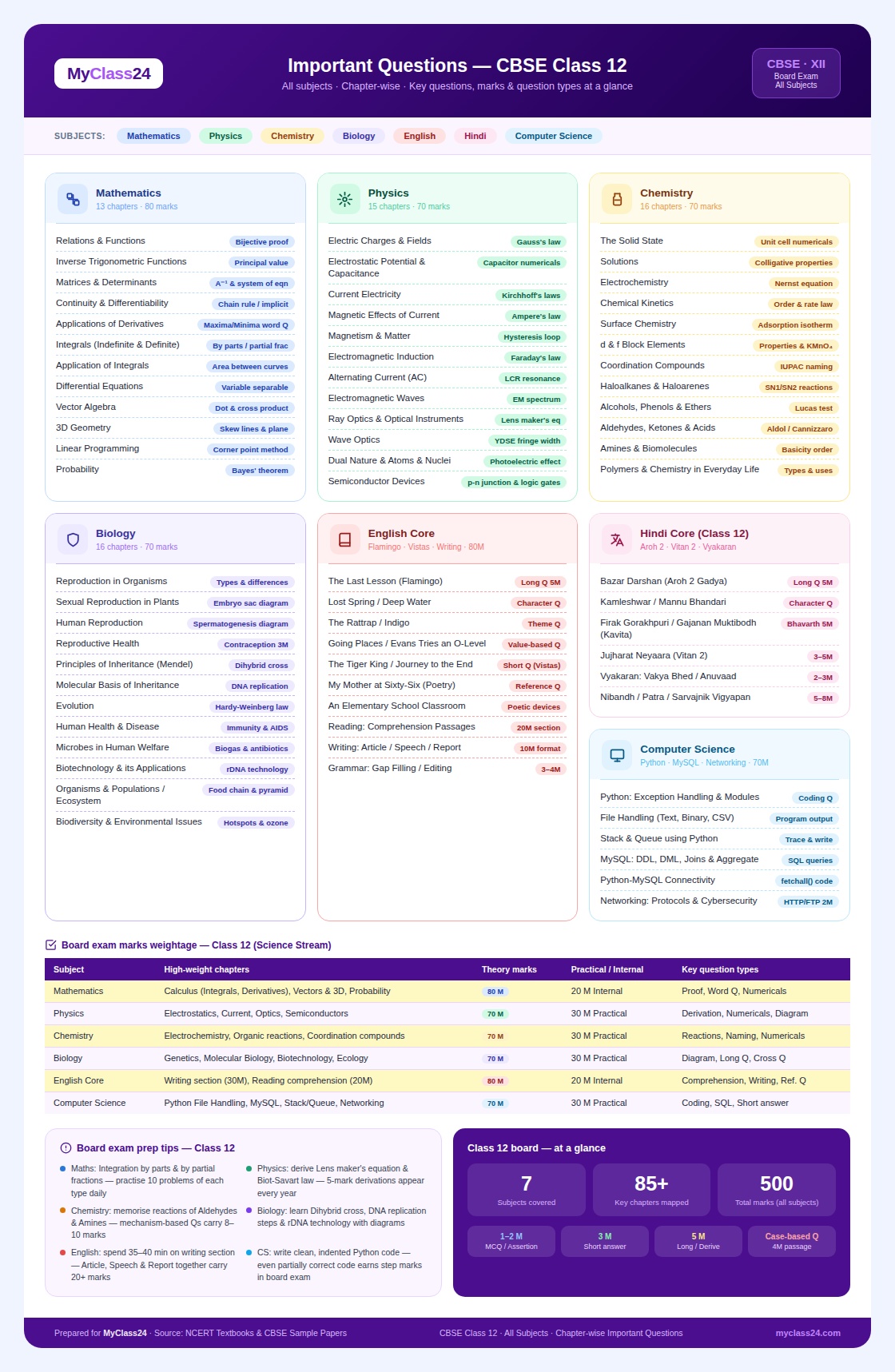
Class 12 is the most critical year in a student’s school life, as CBSE board exam results directly impact college admissions and career choices. With a vast syllabus and intense competition, students must prepare strategically. Practising subject-wise important questions for CBSE Class 12 is one of the most effective ways to revise smartly, score better, and reduce exam stress. Important questions are carefully selected based on CBSE’s latest syllabus, previous year papers, sample papers, and key concepts that appear frequently in board exams. They help students focus on high-weightage topics, understand marking schemes, and enhance problem-solving skills. These questions are especially useful for last-minute revision and self-assessment. Also, solve questions from NCERT with the help of the NCERT Solution for class 12 and the NCERT exemplar solutions for class 12.
After going through several years of CBSE question paper patterns and marking trends, one thing stands out: most students don't lose marks because they don't know the topic. They lose marks because they don't know how CBSE wants the answer written. This guide covers chapter-wise important questions for Physics, Chemistry, Mathematics, Biology, Business Studies, Accountancy, and English Core — the subjects that make up the bulk of Science and Commerce stream combinations in CBSE schools. Each section reflects the actual weightage pattern and question style examiners use, not a generic topic dump.
Important Questions for CBSE Class 12 – Subject-wise
Class | Subject |
|---|---|
Class 12 | |
Class 12 | |
Class 12 | |
Class 12 | |
Class 12 | |
Class 12 | |
Class 12 | |
Class 12 | |
Class 12 | |
Class 12 | |
Class 12 |
Understanding the CBSE Class 12 Marking Pattern First
Before revising subject-wise, it's worth knowing where marks are actually distributed, because this changes how you should allocate revision time.
Question Type | Typical Marks | Common Mistake |
|---|---|---|
MCQ / Assertion-Reason | 1 mark each | Misreading "Reason" as independently true |
Very Short Answer | 2 marks | Writing one-line answers where 2 points are expected |
Short Answer | 3 marks | Missing one of three required sub-points |
Long Answer | 5 marks | Skipping diagram or derivation steps |
Case-Study Based | 4–5 marks | Not reading the passage carefully before answering |
CBSE has steadily increased case-study and competency-based questions since 2020, which means rote answers without contextual application now cost marks even when "technically correct."
Physics: Chapter-Wise Important Questions
Class 12 Physics is split into Electrostatics, Current Electricity, Magnetism, Electromagnetic Induction and AC, Electromagnetic Waves, Optics, Dual Nature of Matter, Atoms and Nuclei, and Semiconductor Electronics. Derivation-based and numerical questions dominate the paper.
Electrostatics and Current Electricity
Derive an expression for the electric field at a point on the equatorial line of an electric dipole, and explain why it falls off faster than the field along the axial line.
Two charges of +4 µC and −4 µC are placed 20 cm apart. Calculate the electric field at the midpoint and explain the direction using vector addition.
State Kirchhoff's voltage and current laws, and use them to derive the condition for a balanced Wheatstone bridge.
Define drift velocity and derive the relation between current and drift velocity in a conductor, explaining why drift velocity is surprisingly small despite fast electron motion.
Magnetism, EMI, and AC Circuits
Topic | High-Value Question |
|---|---|
Moving Charges | Derive the expression for force on a current-carrying conductor placed in a magnetic field |
EMI | State Lenz's law and explain how it is consistent with the law of conservation of energy |
AC Circuits | Derive an expression for impedance in a series LCR circuit and explain resonance condition |
Transformers | Why is a transformer core laminated, and how does this reduce eddy current losses? |
A coil of N turns and area A rotates with angular velocity ω in a magnetic field B. Derive the expression for the instantaneous EMF induced, and sketch its variation with time.
Explain self-inductance and mutual inductance with the help of a labelled diagram, and derive the expression for energy stored in an inductor.
Optics and Modern Physics
Derive the lens maker's formula for a thin convex lens, stating all assumptions clearly.
Using Huygens' principle, prove the laws of refraction at a plane interface.
Explain the photoelectric effect and why it could not be explained by the wave theory of light, leading to Einstein's photon theory.
State Bohr's postulates for the hydrogen atom and derive the expression for the radius of the nth orbit.
Draw the energy band diagrams for a conductor, insulator, and semiconductor, and explain the difference in conduction behaviour.
With a circuit diagram, explain the working of a half-wave rectifier using a p-n junction diode, and sketch the input-output waveforms.
Chemistry: Chapter-Wise Important Questions
Class 12 Chemistry splits clearly into Physical, Organic, and Inorganic sections, and CBSE distributes marks fairly evenly across all three — students who focus only on Organic often underperform overall.
Physical Chemistry
State Henry's law and explain its application in deciding the solubility of gases in liquids with increasing pressure, citing one real-life example (such as soda bottles or deep-sea diving).
Derive the relationship between the degree of dissociation and van't Hoff factor for an electrolyte that dissociates into n ions.
Explain the terms "order of reaction" and "molecularity" with one example each, and state why they are not always the same.
Using the Arrhenius equation, explain how temperature affects the rate constant of a reaction, and define activation energy.
Differentiate between primary and secondary cells, and explain why a Daniel cell stops working after prolonged use.
Organic Chemistry
Reaction/Concept | Common CBSE Question |
|---|---|
Haloalkanes | Why is the C–X bond length in haloalkanes shorter than expected, and how does this affect reactivity? |
Alcohols & Ethers | Distinguish between Lucas test results for primary, secondary, and tertiary alcohols |
Aldehydes & Ketones | Explain why aldehydes are generally more reactive than ketones in nucleophilic addition reactions |
Carboxylic Acids | Arrange the following acids in increasing order of acidic strength and justify using inductive effect |
Amines | Explain why aniline is a weaker base than methylamine, with reference to resonance |
Write the mechanism of the SN1 and SN2 reactions, and explain the conditions under which each is favoured.
Distinguish between optical isomerism and geometrical isomerism, with one suitable organic example for each.
Explain the iodoform test and how it is used to identify compounds containing the –CH(OH)CH3 or –CO–CH3 group.
Inorganic Chemistry
Explain why transition metals show variable oxidation states, and why this property is linked to their catalytic behaviour.
Account for the lanthanoid contraction and explain its consequence on the chemistry of the elements following the lanthanoids.
Describe Werner's theory of coordination compounds, and explain the difference between ionisable and non-ionisable ligands using [Co(NH3)6]Cl3 as an example.
Why does the d-block show a higher melting point compared to the s-block elements? Relate your answer to metallic bonding.
Mathematics: Chapter-Wise Important Questions
CBSE Class 12 Maths covers Relations and Functions, Inverse Trigonometry, Matrices and Determinants, Continuity and Differentiability, Applications of Derivatives, Integrals, Differential Equations, Vectors, Three-Dimensional Geometry, Linear Programming, and Probability.
Calculus (Highest Weightage Section)
If y = (sin x)^x + sin⁻¹(√x), find dy/dx (mixed function differentiation — a recurring 5-mark pattern).
Find the intervals in which the function f(x) = 2x³ − 9x² + 12x + 30 is strictly increasing or strictly decreasing.
Evaluate ∫ (x² + 1)/(x⁴ + 1) dx using a suitable substitution (a classic integration-by-substitution favourite).
Solve the differential equation: (1 + x²) dy/dx + 2xy = 1/(1 + x²), identifying it as a linear differential equation in y.
Using integration, find the area of the region bounded by the curve y² = 4x and the line x = 3.
Algebra and Vectors
Topic | Sample Question Pattern |
|---|---|
Matrices | If A is a square matrix such that A² = A, find (I + A)³ − 7A |
Determinants | Using properties of determinants, prove a given determinant equals zero without expansion |
Vectors | Find a unit vector perpendicular to both given vectors a and b using the cross product |
3D Geometry | Find the shortest distance between two skew lines given in vector form |
Linear Programming | Formulate and solve an LPP to minimise cost given two constraints and a feasible region |
Find the equation of the plane passing through three given points, and then find the distance of a fourth point from this plane.
Show that the relation R defined on a set is reflexive, symmetric, and transitive — equivalence relation proofs remain a near-certain 3-mark question.
Probability
A bag contains 5 red and 4 black balls. Two balls are drawn one after another without replacement. Find the probability that both are of the same colour (classic conditional probability setup).
State Bayes' theorem and use it to solve a problem involving two machines producing defective items at different rates.
A random variable X has a given probability distribution; find its mean and variance (a recurring case-study-style question in recent papers).
Biology: Chapter-Wise Important Questions
For students taking Biology instead of Maths, CBSE Class 12 covers Reproduction, Genetics and Evolution, Biology in Human Welfare, Biotechnology, and Ecology — with Genetics consistently carrying the highest weightage.
Reproduction and Genetics
Explain the process of spermatogenesis with the help of a labelled flowchart, and name the hormones involved at each stage.
State and explain Mendel's law of independent assortment using a dihybrid cross between two heterozygous traits.
Explain the molecular basis of Down's syndrome, and how it differs chromosomally from Turner's syndrome.
Describe the process of DNA replication, explaining why it is termed "semi-discontinuous."
What is genetic drift, and how does it differ from natural selection as a mechanism driving evolution?
Biotechnology and Human Welfare
Topic | Frequently Asked Questions |
|---|---|
Recombinant DNA | Explain the role of restriction endonucleases in genetic engineering, with one named example enzyme |
Biotechnology Applications | How is Bt cotton genetically modified to resist insect pests? Explain the mechanism |
Human Health | Differentiate between active and passive immunity, citing one example of each |
Microbes in Welfare | Explain the role of Lactobacillus in curd formation, describing the biochemical change involved |
Explain the working principle of ELISA and PCR in the diagnosis of diseases, and why early diagnosis improves treatment outcomes.
What are transgenic animals? Explain with the help of one example how they have contributed to biological research.
Ecology
Explain the concept of ecological pyramids, and why the pyramid of energy is always upright regardless of the ecosystem.
Describe the process of biological magnification using the example of DDT in an aquatic food chain.
What is the difference between in-situ and ex-situ conservation? Give one Indian example of each.
Business Studies: Chapter-Wise Important Questions
Class 12 Business Studies splits into Principles of Management and Business Environment (Part A) and Business Finance and Marketing (Part B), with case-study questions now forming a substantial portion of the paper.
Explain the principle of "Unity of Command" given by Fayol, and discuss one situation where its violation can create confusion in an organisation.
Differentiate between formal and informal organisation, and explain how informal communication channels (grapevine) can sometimes help formal structures function better.
What is meant by "Span of Management"? Explain the factors that determine whether a wide or narrow span is appropriate for a given department.
Explain the process of recruitment and distinguish it clearly from selection, since CBSE often penalises answers that merge the two.
Discuss the financial and non-financial incentives used to motivate employees, with one example each relevant to a manufacturing business.
Function of Management | Common Case-Study Angle |
|---|---|
Planning | Identifying which planning premise (internal/external) failed in a given business scenario |
Organising | Drawing a simple organisation chart based on a described company structure |
Staffing | Distinguishing internal vs external sources of recruitment from a case |
Directing | Identifying the leadership style used by a manager described in the passage |
Controlling | Explaining how a given deviation from standard would be corrected |
Explain the concept of "Trading in Goods" as a business activity and distinguish it from "Trading in Services," using examples relevant to e-commerce.
What is meant by capital structure? Explain the factors that determine an appropriate debt-equity mix for a company.
Describe the steps involved in the marketing management process, and explain why "product mix" decisions come before pricing decisions.
Accountancy: Chapter-Wise Important Questions
Class 12 Accountancy is heavily numerical, and the partnership and company accounts sections together account for the largest share of marks.
Partnership Accounts
A, B, and C are partners sharing profits in the ratio 3:2:1. They decide to share future profits equally. Calculate the sacrificing and gaining ratio, and pass the necessary journal entry for adjustment.
Explain the treatment of goodwill when a new partner is admitted, distinguishing between the premium method and the revaluation method.
On the retirement of a partner, how is the retiring partner's share of goodwill computed when goodwill does not appear in the books?
Prepare a Realisation Account given a list of assets, liabilities, and settlement details on the dissolution of a partnership firm.
Company Accounts
Topic | Frequently Tested Pattern |
|---|---|
Share Capital | Journal entries for the issue of shares at a premium, including forfeiture and reissue |
Debentures | Calculating interest on debentures and recording it through the Debenture Interest Account |
Financial Statements | Preparing a Comparative or Common-Size Balance Sheet from given figures |
Ratio Analysis | Calculating Current Ratio, Debt-Equity Ratio, and interpreting what the result indicates about solvency |
A company forfeited 500 shares of ₹10 each, ₹8 called up, for non-payment of the first call of ₹3 per share. Pass the journal entries for forfeiture and subsequent reissue at ₹9 per share fully paid.
Explain the difference between Cash Flow from Operating Activities and Cash Flow from Investing Activities, and classify three given transactions accordingly.
From the given Statement of Profit and Loss, calculate the Operating Profit Ratio and comment on what it indicates about the company's core efficiency.
English Core: Reading, Writing, and Literature
CBSE English Core has moved heavily toward unseen passage-based and case-study assessment in recent cycles, alongside the prescribed Flamingo and Vistas texts.
Reading and Note-Making
Read the given unseen passage and answer inference-based questions that require linking two separate lines of the passage, not just locating a single sentence (this is the most commonly underprepared skill).
Prepare notes on the given passage using appropriate headings, sub-headings, and abbreviations, followed by a summary within the prescribed word limit.
Writing Skills
Format | What CBEE Specifically Checks |
|---|---|
Notice | Box format, word limit, issuing authority and date placement |
Formal Letter/Email | Subject line, formal register, and a clear single purpose per letter |
Report Writing | Factual tone, byline, and a structured beginning-middle-end |
Article/Speech | A clear stance supported by 2–3 developed arguments, not just listed points |
Write a formal email to the editor of a national newspaper highlighting the problem of irregular waste collection in your residential area.
As the head boy/head girl, draft a speech to be delivered in the school assembly on the importance of mental health awareness among teenagers.
Write a report in 120–150 words on a recent cultural event organised in your school, including the date, key highlights, and outcome.
Literature — Flamingo and Vistas
Reference-to-context questions from poems like "The Last Lesson" or "Keeping Quiet" are usually framed around identifying the poetic device and explaining the underlying message in the poet's own historical or emotional context.
Character-based long answers frequently ask students to trace the change in a character's perspective across the story — common with chapters like "Lost Spring" or "Deep Water," where personal experience drives the central theme.
Value-based questions connect the text's theme to a real-world issue, such as child labour, courage, or environmental consciousness, and CBSE specifically rewards answers that cite a line or incident from the text rather than a purely generic moral statement.
A Revision Strategy That Actually Matches CBSE's Marking Pattern
Knowing the right questions is only half the work. The way you revise them determines whether that knowledge survives exam-day pressure.
Separate derivation-heavy chapters from concept-heavy ones, and revise them differently. Physics derivations and Maths proofs need repeated writing practice, not just reading; Biology and Business Studies need clear point-wise structuring.
Practice case-study questions specifically, since CBSE has steadily increased their share across Business Studies, Biology, and English. These are scored on comprehension of the given passage combined with syllabus knowledge — skipping practice here is the single most common reason capable students underperform.
Time-bound mock attempts matter more than untimed revision in the final month, particularly for Maths and Accountancy, where calculation speed directly affects how many questions get attempted.
Keep a one-page formula and reaction sheet for Physics and Chemistry that you revise daily in the last two weeks, rather than re-reading entire chapters.
For subjective subjects (Business Studies, Accountancy, English), write at least one full-length answer per important topic under exam conditions, since CBSE evaluators consistently reward structured, point-wise presentation over a single dense paragraph carrying the same information.
Treated this way, the question sets above stop being just a list to memorise — they become a working map of exactly how CBSE structures its Class 12 board papers, subject by subject, chapter by chapter.
FAQs on Important Questions for CBSE Class 12 All Subjects
Important Questions for CBSE Class 12 All Subjects are carefully selected questions that cover the most significant concepts, formulas, theories, case studies, and topics from the latest CBSE syllabus. These questions are designed to help students focus on the areas that carry the highest academic importance in board examinations. They include multiple-choice questions, assertion-reason questions, case-based questions, short-answer questions, long-answer questions, and numerical problems across Science, Commerce, and Humanities subjects. Regular practice helps students strengthen conceptual understanding, improve answer-writing skills, and become familiar with the latest examination pattern. Since Class 12 marks play a crucial role in higher education admissions and competitive examinations, solving important questions regularly enables students to revise effectively, manage time efficiently, and approach board examinations with greater confidence.
Important Questions are excellent revision resources, but they cannot replace textbooks. Textbooks provide detailed explanations, solved examples, derivations, activities, diagrams, practical concepts, and exercises that build strong conceptual understanding. Important Questions reinforce learning by highlighting the most significant topics and improving examination readiness. Students should combine textbook study, classroom notes, formula revision, derivation practice, diagrams, sample papers, and important questions for complete preparation. This balanced approach ensures that every important concept is covered while strengthening analytical thinking and answer-writing skills. Students who follow this comprehensive revision strategy generally perform better in board examinations and develop a stronger academic foundation for higher education and competitive entrance examinations.
Students should practise Important Questions consistently throughout the academic year rather than depending only on final revision. After completing each chapter, they should solve chapter-wise important questions to strengthen conceptual understanding immediately. Weekly revision sessions help improve long-term retention and reduce examination stress. During the final months before the board examination, students should revise all important questions multiple times while paying extra attention to difficult chapters. Maintaining a notebook of mistakes, formulas, derivations, and frequently revised questions further improves preparation. Regular practice develops confidence, increases writing speed, improves accuracy, and enables students to manage examination time more effectively during the board examination.
Students should first complete the textbook before attempting Important Questions. Reading the chapter thoroughly, understanding concepts, solving textbook exercises, revising notes, and practising diagrams or derivations create a strong conceptual foundation. Important Questions should then be used to evaluate learning and strengthen understanding of key topics. This sequence promotes meaningful learning instead of memorization. During the final revision period, students should solve all important questions again to reinforce concepts and improve recall. Difficult questions should be revised repeatedly until they become comfortable. Following this approach ensures complete syllabus coverage, better answer-writing skills, and improved confidence before the Class 12 Board Examination.
Commerce and Humanities subjects require conceptual understanding, critical thinking, and effective answer presentation. Important Questions help students revise accounting concepts, business principles, economic theories, historical developments, political systems, geographical concepts, psychological theories, and sociological ideas systematically. Practising these questions improves writing skills by teaching students how to organize answers with relevant points, examples, and logical explanations. Regular revision also strengthens memory retention and develops analytical thinking. Students become familiar with case-based and competency-oriented questions while improving time management during examinations. Consistent practice enables students to present structured answers confidently, making it easier to achieve higher marks in descriptive and analytical board examination papers.
Science subjects in Class 12 require a strong understanding of concepts, derivations, numerical problems, diagrams, chemical reactions, and biological processes. Important Questions help students revise all these areas efficiently while improving conceptual clarity. Regular practice strengthens numerical solving skills, diagram labelling, derivation writing, and application-based reasoning. Students also become familiar with competency-based and case-study questions introduced in modern board examinations. Revising important formulas, equations, reactions, definitions, and experimental principles alongside these questions improves long-term retention. Solving chapter-wise important questions after completing each lesson helps students identify weak areas and revise them effectively. This systematic preparation increases confidence and improves performance in both theory and practical examinations.
Mathematics requires conceptual understanding, logical reasoning, and regular practice. Important Questions help students revise calculus, algebra, vectors, three-dimensional geometry, probability, linear programming, and other important topics systematically. Students should solve every question step by step rather than memorizing solutions. Repeating challenging problems strengthens analytical thinking and improves confidence in solving application-based questions. Regular practice increases calculation speed, reduces errors, and enhances answer presentation. Reviewing mistakes and learning different solution methods further develops mathematical skills. Along with textbook exercises, formula revision, and sample papers, Important Questions provide focused practice that prepares students for different difficulty levels commonly seen in board examinations. Consistency in solving these questions significantly improves Mathematics performance.
Important Questions for CBSE Class 12 are available for all major subjects across Science, Commerce, and Humanities streams. Science students can practise Physics, Chemistry, Biology, Mathematics, and English. Commerce students can revise Accountancy, Business Studies, Economics, Mathematics, and English. Humanities students can prepare History, Political Science, Geography, Economics, Psychology, Sociology, English, and other optional subjects. Each subject includes chapter-wise important questions designed to strengthen conceptual understanding and improve examination performance. Subject-wise preparation allows students to revise the syllabus systematically while dedicating additional time to challenging topics. This organized revision strategy ensures balanced preparation across all subjects and helps students perform confidently in both school assessments and board examinations.
Chapter-wise Important Questions are one of the most effective revision resources because they help students master each chapter individually before attempting complete syllabus revision. However, they should not replace textbooks, classroom notes, practical records, or sample papers. Students should first understand concepts thoroughly, complete textbook exercises, revise formulas, diagrams, derivations, and practical applications. After completing chapter-wise revision, students should solve full-length sample papers and mock tests to improve speed, time management, and examination confidence. Revisiting weak chapters regularly further strengthens preparation. Combining textbooks, practical work, sample papers, and important questions creates a comprehensive revision strategy that prepares students effectively for the Class 12 Board Examination.
Class 12 Board Examinations are among the most important academic milestones for students. Practising Important Questions helps students revise high-priority concepts systematically while strengthening conceptual understanding and analytical thinking. These questions expose students to competency-based, application-oriented, numerical, and descriptive question formats that are commonly included in board examinations. Regular practice improves writing speed, answer presentation, accuracy, and time management during exams. Students can also identify weaker chapters early and revise them before the examination. Important Questions complement textbook learning by providing focused revision without overwhelming students. When practised consistently alongside sample papers and textbook exercises, these questions significantly improve confidence and increase the likelihood of achieving excellent scores in board examinations.