




NCERT Solutions for Class 10 Maths — Your Complete Guide to Board Exam Success
Introduction: Why NCERT Solutions for Class 10 Maths Matter
Class 10 is one of the most important academic milestones in a student's life. The CBSE Board Examination for Class 10 largely draws its questions directly from the NCERT textbook, making it the single most important resource for your preparation. Understanding NCERT Solutions for Class 10 Maths is your gateway to scoring above 90 in board exams.
At Myclass24, we believe that every student deserves access to high-quality, step-by-step solutions that are easy to understand — no matter where they live or what their academic background is. Our NCERT Solutions for Class 10 Maths are crafted by experienced educators, aligned with the latest CBSE curriculum, and designed to build both speed and conceptual clarity. For full marks and effective Revision do enrolled in the Mission 100 revision course by Gaurav Sir.
NCERT Solutions for Class 10 Maths – Chapter-wise List
Chapter No. | Chapter Name |
|---|---|
Chapter 1 | |
Chapter 2 | |
Chapter 3 | |
Chapter 4 | |
Chapter 5 | |
Chapter 6 | |
Chapter 7 | |
Chapter 8 | |
Chapter 9 | |
Chapter 10 | |
Chapter 11 | |
Chapter 12 | |
Chapter 13 | |
Chapter 14 |
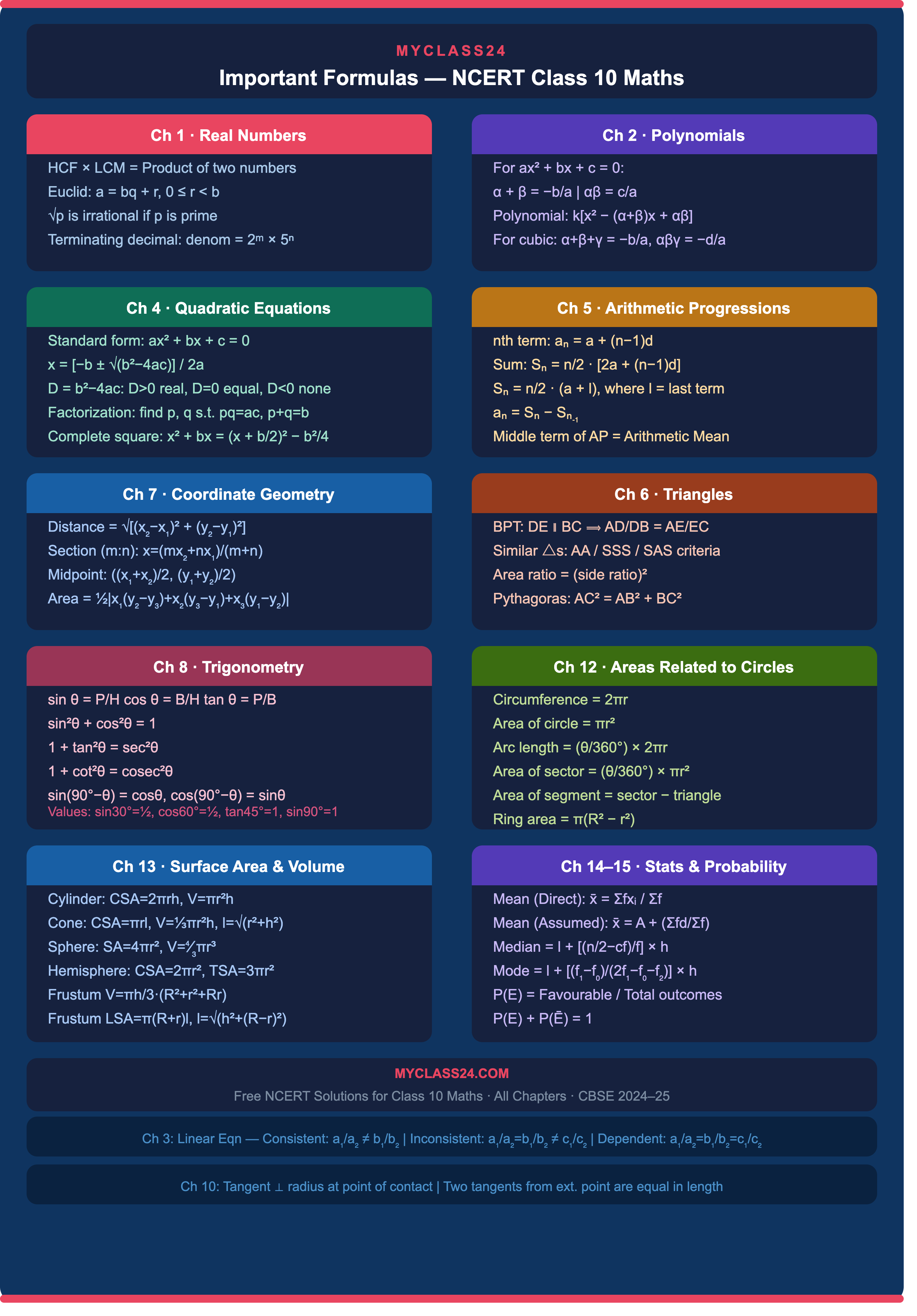
Important Formulas Used in NCERT Solutions for Class 10 Maths
Chapter | Topic | Important Formula |
|---|---|---|
Real Numbers | Euclid's Division Lemma | a = bq + r, where 0 ≤ r < b |
Polynomials | Quadratic Polynomial | α + β = -b/a, αβ = c/a |
Pair of Linear Equations | General Form | a₁x + b₁y + c₁ = 0 |
Quadratic Equations | Quadratic Formula | x = [-b ± √(b² − 4ac)] / 2a |
Quadratic Equations | Discriminant | D = b² − 4ac |
Arithmetic Progressions | nth Term | aₙ = a + (n − 1)d |
Arithmetic Progressions | Sum of n Terms | Sₙ = n/2 [2a + (n − 1)d] |
Coordinate Geometry | Distance Formula | √[(x₂ − x₁)² + (y₂ − y₁)²] |
Coordinate Geometry | Section Formula | (mx₂ + nx₁)/(m+n), (my₂ + ny₁)/(m+n) |
Introduction to Trigonometry | sin θ | Perpendicular / Hypotenuse |
Introduction to Trigonometry | cos θ | Base / Hypotenuse |
Introduction to Trigonometry | tan θ | Perpendicular / Base |
Areas Related to Circles | Area of Circle | πr² |
Areas Related to Circles | Circumference | 2πr |
Surface Areas & Volumes | Cylinder Volume | πr²h |
Surface Areas & Volumes | Sphere Volume | (4/3)πr³ |
Statistics | Mean | x̄ = Σfi xi / Σfi |
Probability | Probability Formula | P(E) = Favourable Outcomes / Total Outcomes |
Probability | Complementary Event | P(E̅) = 1 − P(E) |
About NCERT Solutions for Class 10 Maths
NCERT Solutions for Class 10 Maths are an essential study resource for students aiming to strengthen their mathematical concepts and perform well in school and board examinations. Mathematics is a subject that requires regular practice and a clear understanding of formulas, theorems, and problem-solving techniques. These solutions provide accurate, step-by-step answers to all questions included in the latest NCERT textbook, making learning easier and more effective. Read all Maths formulas before solving the exercise.
The Class 10 Maths syllabus covers a wide range of topics, including Real Numbers, Polynomials, Pair of Linear Equations in Two Variables, Quadratic Equations, Arithmetic Progressions, Coordinate Geometry, Trigonometry, Circles, Areas Related to Circles, Surface Areas and Volumes, Statistics, and Probability. Each chapter builds important analytical and logical reasoning skills that are valuable not only for examinations but also for higher studies.
Well-explained solutions help students understand the correct method of solving problems and reduce confusion while studying independently. By practising chapter-wise questions regularly, students can improve their speed, accuracy, and confidence. These solutions also help in revising important concepts before tests and board exams.
What Are NCERT Solutions for Class 10 Maths?
NCERT Solutions for Class 10 Maths are detailed, step-by-step answers to every exercise and example problem given in the official NCERT Mathematics textbook prescribed by the Central Board of Secondary Education (CBSE). These solutions:
- Follow the exact CBSE marking scheme
- Are written in simple, student-friendly language
- Cover all exercises, examples, and optional questions
- Are structured to help students understand "why" not just "how"
NCERT Solutions for Class 10 Maths: All Chapters at a Glance
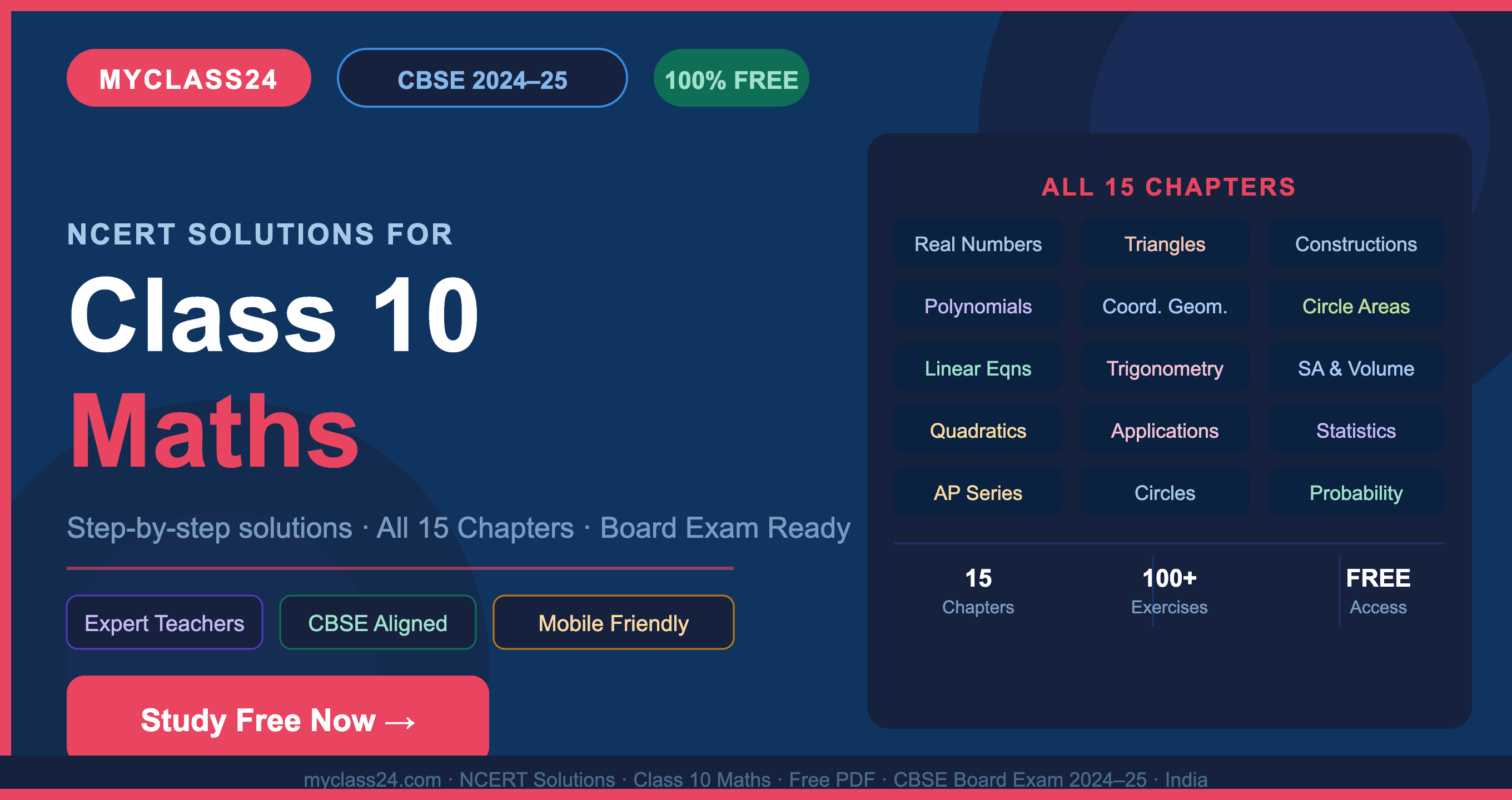
The Class 10 NCERT Maths textbook consists of 15 chapters that are carefully structured to progress from foundational number concepts to statistics and probability. Here is a complete chapter-by-chapter overview:
Chapter 1: Real Numbers
Key Topics: Euclid's Division Lemma, Fundamental Theorem of Arithmetic, Irrational Numbers, Decimal Expansions
Real Numbers is typically the first chapter tackled in Class 10, and it lays the logical foundation for higher mathematics. A common exam question involves proving that √2 or √3 is irrational — a concept our solutions explain through contradiction-based proofs in simple steps.
Important Concepts to Master:
- Euclid's Division Algorithm to find HCF
- Prime factorisation to find LCM and HCF
- Proving irrationality of numbers
- Terminating and non-terminating decimals
Myclass24 Tip: Focus on understanding Euclid's Lemma intuitively. Board exams frequently ask 2–3 mark questions on HCF using the division algorithm.
Chapter 2: Polynomials
Key Topics: Zeroes of a Polynomial, Relationship between Zeroes and Coefficients, Division Algorithm for Polynomials
Understanding polynomials is essential because the concept carries forward into higher grades. This chapter covers quadratic and cubic polynomials with graphical representations.
Important Concepts to Master:
- Finding zeroes of quadratic polynomials from graphs
- Sum and product of zeroes (α + β and αβ)
- Forming a quadratic polynomial when zeroes are given
- Polynomial division using the remainder theorem
Myclass24 Tip: Memorise the relationships α + β = –b/a and αβ = c/a — these appear in nearly every exam paper.
Chapter 3: Pair of Linear Equations in Two Variables
Key Topics: Graphical Method, Substitution, Elimination, Cross-Multiplication, Reducible Equations
This chapter introduces students to solving real-world problems by setting up equations with two unknowns. It is a highly application-based chapter and one of the most scoring in board exams.
Important Concepts to Master:
- Consistent, inconsistent, and dependent pairs
- Graphical interpretation of solutions
- Algebraic methods: substitution and elimination
- Word problems (age, speed, mixture, money)
Myclass24 Tip: Practice at least 10 word problems per week. Board exams always include one 3-mark or 4-mark application problem from this chapter.
Chapter 4: Quadratic Equations
Key Topics: Standard Form, Factorisation, Completing the Square, Discriminant (D = b² – 4ac)
Quadratic Equations is a chapter that connects algebra to real-world scenarios like projectile motion and area problems. The quadratic formula and nature of roots are essential board exam topics.
Important Concepts to Master:
- Solving by factorisation
- Solving by completing the square
- Using the quadratic formula
- Nature of roots: D > 0, D = 0, D < 0
Myclass24 Tip: Don't skip "completing the square" — it helps you understand where the quadratic formula comes from and may appear as a derivation question.
Chapter 5: Arithmetic Progressions (AP)
Key Topics: nth Term, Sum of n Terms, Arithmetic Mean
Arithmetic Progressions is one of the most formula-heavy chapters and also one of the most scoring. Students from across India consistently rank it among their favourite chapters due to the pattern-recognition involved.
Important Concepts to Master:
- General term: aₙ = a + (n – 1)d
- Sum of n terms: Sₙ = n/2 [2a + (n – 1)d]
- Finding the number of terms
- AP-based word problems (savings, rows of seats, etc.)
Myclass24 Tip: If you are given Sₙ, remember that aₙ = Sₙ – Sₙ₋₁. This trick saves time in board exams.
Chapter 6: Triangles
Key Topics: Similar Triangles, Criteria for Similarity (AA, SAS, SSS), Basic Proportionality Theorem (Thales' Theorem), Pythagoras Theorem
Triangles is a high-weightage geometry chapter and regularly contributes to long-answer (5-mark) questions. Proofs are a core component here.
Important Concepts to Master:
- Basic Proportionality Theorem and its converse
- Criteria for similarity of triangles
- Areas of similar triangles
- Proof of the Pythagoras Theorem
Myclass24 Tip: Learn the proofs for Thales' Theorem and Pythagoras' Theorem thoroughly. Board examiners frequently ask for these as 5-mark proofs.
Chapter 7: Coordinate Geometry
Key Topics: Distance Formula, Section Formula, Area of a Triangle
Coordinate Geometry bridges algebra and geometry by placing geometric shapes on a number plane. It is extremely formula-driven and very scoring.
Important Concepts to Master:
- Distance between two points: √[(x₂ – x₁)² + (y₂ – y₁)²]
- Section formula (internal and external division)
- Midpoint formula
- Area of a triangle using coordinates
Myclass24 Tip: Sketch a rough diagram before solving any coordinate geometry problem. It helps you avoid sign errors.
Chapter 8: Introduction to Trigonometry
Key Topics: Trigonometric Ratios, Reciprocal Identities, Trigonometric Ratios of Standard Angles, Complementary Angles
Trigonometry is a cornerstone of Class 10 Maths. Students preparing in cities like Surat, Nagpur, Visakhapatnam, and Coimbatore often find this chapter challenging, but with the right approach and consistent practice, it becomes one of the most manageable.
Important Concepts to Master:
- sin, cos, tan, cosec, sec, cot and their relationships
- Values at 0°, 30°, 45°, 60°, 90°
- Complementary angle identities
- Proof-based identity questions
Myclass24 Tip: Create a table of trigonometric values and paste it where you study. Daily revision of these values will make the chapter significantly easier.
Chapter 9: Some Applications of Trigonometry
Key Topics: Heights and Distances, Angle of Elevation, Angle of Depression
This chapter applies the trigonometric ratios learned in Chapter 8 to practical, real-world scenarios involving angles of elevation and depression.
Important Concepts to Master:
- Setting up the correct right-angled triangle from a word problem
- Using tan θ for height/distance problems
- Problems with two angles of elevation or depression
- Shadow and ladder problems
Myclass24 Tip: The most common mistake here is confusing angle of elevation with angle of depression. Always draw a diagram first.
Chapter 10: Circles
Key Topics: Tangents to a Circle, Number of Tangents from a Point, Theorem on Equal Tangents
Circles introduces elegant geometric theorems that require logical reasoning and proof. It is a compact yet high-scoring chapter.
Important Concepts to Master:
- Tangent is perpendicular to the radius at the point of tangency
- Lengths of tangents drawn from an external point are equal
- Proof-based questions involving tangents and chords
Myclass24 Tip: Practice all NCERT proofs from this chapter. Board questions almost always pick from the theorem-proof exercises.
Chapter 11: Constructions
Key Topics: Division of a Line Segment, Construction of Tangents to a Circle
This chapter requires practical skills. Students are expected to use a compass and ruler to construct geometric figures accurately.
Important Concepts to Master:
- Dividing a line segment in a given ratio
- Constructing a triangle similar to a given triangle
- Drawing tangents to a circle from an external point
Myclass24 Tip: Practice each construction at least 5 times. Accuracy and labelling carry marks in the board exam.
Chapter 12: Areas Related to Circles
Key Topics: Perimeter and Area of Circles, Sector, Segment, Combination of Figures
This is a practical application chapter where students calculate areas of sectors, segments, and combined figures involving circles and polygons.
Important Concepts to Master:
- Area and perimeter of a sector
- Area of segment = Area of sector – Area of triangle
- Problems involving rings, paths, and combination shapes
- Using π = 22/7 or 3.14 as directed
Myclass24 Tip: Always check whether the question asks for the minor or major segment. Mixing these up is a very common error.
Chapter 13: Surface Areas and Volumes
Key Topics: Combination of Solids, Conversion of Solids, Frustum of a Cone
This is one of the most formula-intensive chapters and carries significant weightage in CBSE board exams. Students from Tier-1 and Tier-2 cities alike often cite this as a chapter where they lose marks due to formula confusion.
Important Concepts to Master:
- Surface area and volume of combination solids (cone + hemisphere, cylinder + cone, etc.)
- Conversion of one solid to another (e.g., a sphere melted into small spheres)
- Frustum: volume and lateral surface area
- Word problems involving real-world contexts (water tanks, toys, etc.)
Myclass24 Tip: Make a formula sheet for all 3D shapes. Refer to it every day for two weeks before the board exam.
Chapter 14: Statistics
Key Topics: Mean, Median, Mode of Grouped Data, Cumulative Frequency, Ogive
Statistics is a data-heavy chapter that is also highly practical. It teaches students to interpret and analyse real-world data — a skill increasingly important in today's world.
Important Concepts to Master:
- Mean by direct, assumed mean, and step-deviation methods
- Median using the formula and ogive (less than / more than)
- Mode of grouped data
- Drawing and interpreting cumulative frequency curves
Myclass24 Tip: Practice drawing ogives accurately. A 5-mark question from Statistics almost always involves the cumulative frequency graph.
Chapter 15: Probability
Key Topics: Classical Probability, Complementary Events, Cards, Dice, Coins
Probability is the final chapter and a favourite among students because it involves straightforward logic and everyday scenarios.
Important Concepts to Master:
- P(E) = Number of favourable outcomes / Total outcomes
- P(E) + P(Ē) = 1
- Problems based on playing cards, dice, marbles, and coloured balls
- Understanding impossible and certain events
Myclass24 Tip: Learn the complete structure of a standard deck of 52 cards. Almost every board exam includes at least one card-based probability problem.
NCERT Solutions for Class 10 Maths: Chapter-wise Marks Weightage
Understanding how marks are distributed helps you prioritise your preparation effectively.
| Unit | Chapters | Marks |
|---|---|---|
| Number Systems | Chapter 1 | 06 |
| Algebra | Chapters 2, 3, 4, 5 | 20 |
| Coordinate Geometry | Chapter 7 | 06 |
| Geometry | Chapters 6, 10, 11 | 15 |
| Trigonometry | Chapters 8, 9 | 12 |
| Mensuration | Chapters 12, 13 | 10 |
| Statistics & Probability | Chapters 14, 15 | 11 |
| Total | 80 |
Note: Internal Assessment (SA + Portfolio + Practical) carries 20 marks separately.
How Myclass24 NCERT Solutions for Class 10 Maths Are Different
At Myclass24, we don't just reproduce textbook answers. Here's what makes our solutions stand out:
Conceptual Clarity First: Every solution begins with a brief explanation of the concept being applied, so students understand the "why" behind each step.
CBSE-Aligned Step Marking: Our solutions follow the exact step-marking pattern used by CBSE evaluators. This helps students write answers in a way that maximises their score.
Multiple Methods Where Applicable: For chapters like Quadratic Equations and Linear Equations, we provide alternative methods (e.g., both factorisation and quadratic formula) so students can choose the approach that suits them.
Error-Prone Areas Highlighted: Our educators have identified the most common mistakes students make in each chapter and have added special notes to help you avoid them.
Accessible for Students Across India: Whether you are a student in a metropolitan city or a small town, Myclass24's digital solutions are accessible anytime, anywhere — on mobile or desktop.
Tips to Score 90+ in CBSE Class 10 Maths Board Exam
Scoring high in Class 10 Maths is entirely achievable with a structured plan. Here are research-backed strategies used by top scorers:
Start with NCERT, End with NCERT: The CBSE board paper is almost entirely based on NCERT. Master every exercise in the textbook before moving to supplementary material.
Solve Previous Years' Papers: Practice the last 10 years of CBSE Class 10 Maths board papers. This gives you familiarity with question formats and frequently tested topics.
Create a Formula Notebook: Maintain a dedicated notebook for formulas, theorems, and important identities. Review it every morning.
Practice Proofs Daily: Geometry and trigonometry proofs require consistent daily practice. Write them out by hand — don't just read them.
Manage Time During the Exam: Allocate time per question based on marks: 1-mark questions should take under 1 minute; 4-mark and 5-mark questions should not exceed 6–8 minutes each.
Attempt All Questions: CBSE rewards step-wise marking. Even a partially correct answer earns you marks. Never leave a question blank.
Why Students Across India Trust Myclass24
Myclass24 has become a trusted learning companion for Class 10 students across Indian states including Uttar Pradesh, Maharashtra, Rajasthan, Tamil Nadu, Karnataka, West Bengal, Madhya Pradesh, Gujarat, Bihar, Andhra Pradesh, and more. Our platform is designed keeping in mind the diverse academic backgrounds of Indian students — from English-medium to regional-medium CBSE schools.
Our growing community of students who have used Myclass24 NCERT Solutions for Class 10 Maths consistently report improved confidence, better understanding of concepts, and higher scores in both internal assessments and board examinations.
Conclusion: Start Your Class 10 Maths Journey with Myclass24 Today
NCERT Solutions for Class 10 Maths are not just a revision tool — they are the foundation of your board exam preparation. With 15 well-structured chapters covering Number Theory, Algebra, Geometry, Trigonometry, Mensuration, Statistics, and Probability, the NCERT textbook provides everything you need to excel.
Myclass24 is committed to helping every student — whether in a big city or a small town, from any board school across India — access high-quality, exam-ready NCERT Solutions for Class 10 Maths absolutely free.
FAQs for NCERT Solutions for Class 10 Maths
NCERT Solutions for Class 10 Maths are important because they help students understand every concept exactly as prescribed in the syllabus. Most board examination questions are directly or indirectly based on NCERT exercises and examples. These solutions provide step-by-step methods that make complex topics easier to understand. Students can learn the correct approach to solving problems, improve calculation accuracy, and develop confidence before examinations. Regular practice with NCERT solutions also helps in identifying weak areas and strengthening fundamentals. Since Mathematics requires consistent practice, well-explained solutions become a reliable resource for revision, homework, and final exam preparation.
Yes, NCERT Solutions are especially useful for students who struggle with Mathematics. The step-by-step explanations make difficult questions easier to understand and reduce fear of the subject. Weak students often benefit from seeing how a problem is solved from the beginning rather than only viewing the final answer. This gradual learning process helps build confidence and strengthens basic concepts. By practicing one chapter at a time and reviewing solutions carefully, students can improve steadily. Consistency is more important than speed. With regular effort and proper guidance from NCERT Solutions, even challenging topics can become manageable.
Revision frequency depends on individual learning needs, but most students benefit from completing at least three thorough revisions. The first revision focuses on understanding concepts and solving exercises. The second revision helps strengthen memory and improve speed. The third revision should concentrate on weak areas, formulas, and frequently asked question types. During the final weeks before examinations, students can revisit important examples and difficult problems. Multiple revisions reduce the chances of forgetting concepts and increase confidence. Mathematics rewards regular practice, and repeated exposure to NCERT Solutions helps students enter the examination hall feeling well-prepared and confident.
Speed in Mathematics comes from understanding concepts and practicing them repeatedly. NCERT Solutions show efficient methods for solving questions, helping students avoid unnecessary steps. By studying these approaches and practicing regularly, learners become familiar with standard problem patterns. This familiarity reduces hesitation and improves calculation speed. Solutions also teach students how to organize their work systematically, which saves time during examinations. As confidence grows, students can solve questions more quickly without compromising accuracy. Over a period of consistent practice, the combination of conceptual understanding and repetition significantly enhances overall problem-solving efficiency.
Students often lose marks due to calculation errors, incorrect formula usage, skipped steps, and misunderstanding of questions. Many also rush through problems without checking their answers. In geometry chapters, inaccurate diagrams and incomplete reasoning can lead to mistakes. NCERT Solutions help by presenting the correct format and logical sequence of steps. By comparing their work with detailed solutions, students can identify recurring errors and improve their approach. Developing the habit of verifying calculations and revising formulas regularly can prevent many avoidable mistakes. Careful practice remains one of the most effective ways to improve accuracy.
For most students, mastering NCERT Solutions provides a strong foundation for achieving excellent marks. The majority of board examination questions are based on NCERT concepts, exercises, and examples. However, scoring full marks requires more than reading solutions. Students should solve problems independently, practice regularly, revise formulas, and work on time management. It is also helpful to attempt sample papers and previous-year questions to become familiar with examination patterns. NCERT Solutions serve as a guide for learning correct methods, but consistent practice is what transforms understanding into high scores. Combining both can significantly improve examination performance.
The best way to use NCERT Solutions is to first attempt questions independently. Students should try solving every exercise without looking at the answers. After completing a question, they can compare their approach with the solution and identify errors. This method encourages active learning and improves retention. Simply copying answers does not enhance mathematical skills. It is also useful to maintain a notebook of frequently made mistakes and important formulas. Revisiting solved questions after a few days strengthens memory and builds confidence. Effective use of NCERT Solutions turns them into a learning tool rather than just an answer source.
Quadratic Equations often seem difficult because they involve multiple solving methods such as factorization, completing the square, and using the quadratic formula. Students may become confused about which method to apply in a given situation. NCERT Solutions simplify the learning process by demonstrating each method step by step. They explain how to identify the most suitable approach and verify the final answer. Regular practice of solved examples helps students recognize patterns and develop confidence. Once the basic concepts become clear, students find it easier to tackle higher-level problems and avoid common mistakes during examinations.
Many students find certain mathematical concepts challenging because textbooks often provide limited explanation beyond examples. NCERT Solutions bridge this gap by presenting detailed steps for each question. They explain how formulas are applied, why specific methods are chosen, and how answers are derived logically. This structured approach reduces confusion and improves conceptual clarity. Students can compare their own methods with the correct solution and identify mistakes. Over time, this process strengthens analytical thinking and problem-solving ability. Instead of simply obtaining answers, learners gain a deeper understanding of mathematical principles, making future topics easier to grasp.
Although the exact distribution may vary, chapters such as Quadratic Equations, Arithmetic Progressions, Triangles, Coordinate Geometry, Circles, Surface Areas and Volumes, and Probability generally contribute a significant number of marks. These chapters test both conceptual understanding and problem-solving skills. Students should focus on understanding formulas, derivations, and applications rather than memorizing answers. High-weightage chapters often include questions of varying difficulty levels, making thorough practice essential. However, students should not ignore lower-weightage chapters because board examinations usually assess knowledge from the entire syllabus. A balanced preparation strategy ensures better performance and minimizes the risk of losing marks in easier sections.