NCERT Solutions for Class 12 Biology: Chapter-wise Explanations, Key Concepts & Exam Strategy
Target Grade: Class 12 (CBSE) | Subject: Biology (Code: 044)
Why NCERT Solutions for Class 12 Biology Are Non-Negotiable
Class 12 Biology is not just a subject — it is a gateway to careers in medicine (NEET), biotechnology, pharmacy, agriculture, and life sciences research. Yet many students treat NCERT as a textbook to read rather than a solution manual to master. The difference between scoring 85 and 95 in CBSE Board exams often comes down to how deeply you have worked through NCERT in-text questions, exercises, and exemplar problems.
At Myclass24, our NCERT Solutions for Class 12 Biology are written by subject matter experts who have mapped every answer to CBSE's marking scheme. This guide gives you chapter-wise insights, concept tables, formula references, and a clear understanding of how marks are distributed — so you walk into your board exam fully prepared.
NCERT Solutions for Class 12 Biology – Chapter-wise List
Chapter No. | Chapter Name |
|---|---|
Chapter 1 | |
Chapter 2 | |
Chapter 3 | |
Chapter 4 | |
Chapter 5 | |
Chapter 6 | |
Chapter 7 | |
Chapter 8 | |
Chapter 9 | |
Chapter 10 | |
Chapter 11 | |
Chapter 12 | |
Chapter 13 |
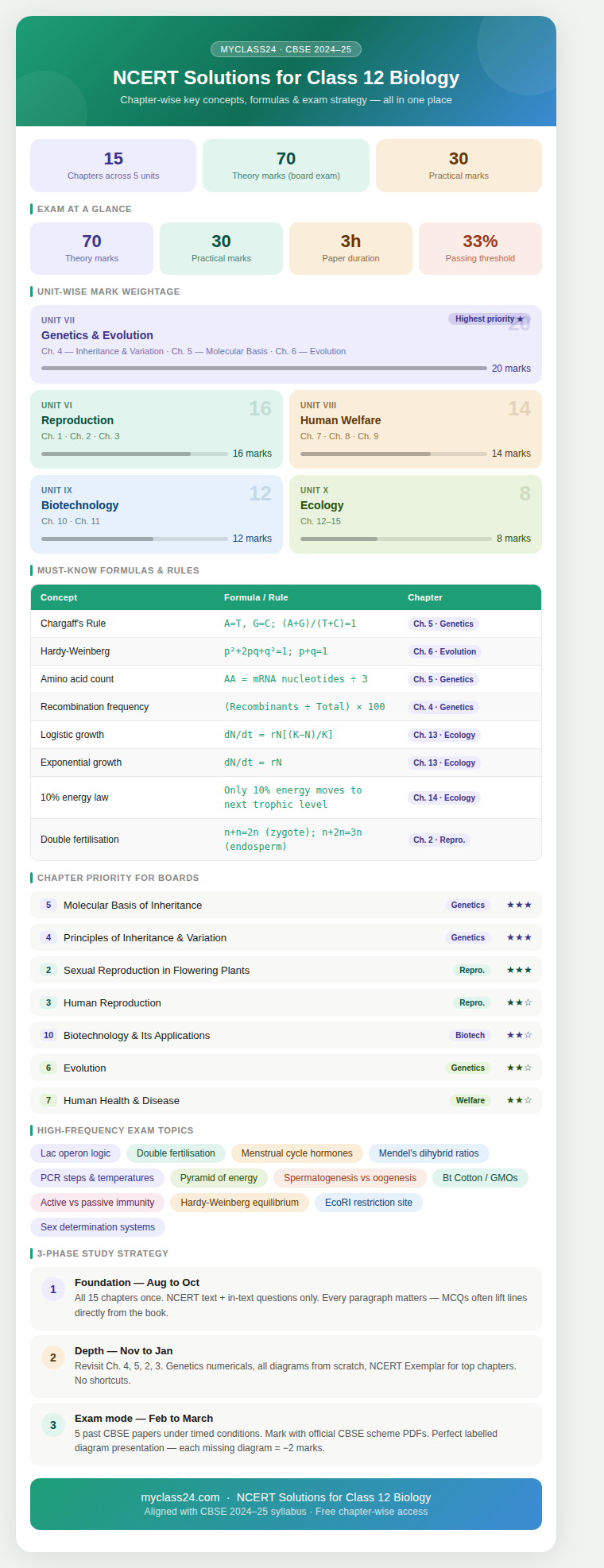
CBSE Class 12 Biology: Exam Pattern & Mark Distribution
Paper Structure at a Glance
| Section | Question Type | Number of Questions | Marks per Question | Total Marks |
|---|---|---|---|---|
| A | Multiple Choice Questions (MCQ) | 16 | 1 | 16 |
| B | Very Short Answer (VSA) | 5 | 2 | 10 |
| C | Short Answer (SA) | 7 | 3 | 21 |
| D | Long Answer (LA) | 3 | 5 | 15 |
| E | Source-based / Case-based MCQ | 3 sets (4 MCQ each) | 1 | 12 (approx.) |
| — | Total | — | — | 70 (Theory) |
Practical Examination: 30 marks | Total: 100 marks
Duration: 3 hours | Passing marks: 33% aggregate
Unit-wise Weightage (Theory — 70 Marks)
| Unit No. | Unit Name | Chapters Covered | Marks Weightage |
|---|---|---|---|
| VI | Reproduction | 1, 2, 3 | 16 |
| VII | Genetics & Evolution | 4, 5, 6 | 20 |
| VIII | Biology in Human Welfare | 7, 8, 9 | 14 |
| IX | Biotechnology | 10, 11 | 12 |
| X | Ecology | 12, 13, 14, 15 | 8 |
| — | Total | 15 Chapters | 70 |
Tip from Myclass24: Units VII (Genetics & Evolution) carries the highest weightage at 20 marks. Prioritise Chapters 4, 5, and 6 above all else.
Chapter-wise NCERT Solutions: Key Concepts & What Each Chapter Demands
Unit VI — Reproduction
Chapter 1: Reproduction in Organisms
This chapter builds the vocabulary of reproduction — asexual vs. sexual, vegetative propagation, and the significance of the reproductive phase in an organism's life cycle. CBSE frequently asks 2-mark definitions here.
Key terms: Oestrus cycle, Menstrual cycle, Parthenogenesis, Budding, Fragmentation, Sporulation
Most-asked NCERT Exercise Questions: Q1 (modes of asexual reproduction), Q4 (advantages of sexual reproduction), Q9 (vegetative propagation examples)
Chapter 2: Sexual Reproduction in Flowering Plants
One of the most diagram-heavy chapters. CBSE dedicates 3–5 marks every year to labelled diagrams of embryo sac, pollen grain T.S., and seed development.
Critical Diagrams to Master:
- T.S. of Anther (young and mature)
- Structure of Ovule / Megasporangium
- Female gametophyte (7-celled, 8-nucleate embryo sac)
- Double Fertilisation diagram
Process Summary:
- Microsporogenesis → Pollen grain (2-celled or 3-celled)
- Megasporogenesis → Embryo sac (Polygonum type)
- Double fertilisation: Syngamy (n + n = 2n zygote) + Triple fusion (n + 2n = 3n endosperm)
Chapter 3: Human Reproduction
This chapter is high-yield for NEET as well as boards. Hormonal control of the menstrual cycle, spermatogenesis vs. oogenesis, and placenta functions are board favourites.
Hormonal Cascade — Menstrual Cycle:
| Phase | Days | Dominant Hormone(s) | Event |
|---|---|---|---|
| Menstrual | 1–5 | Low E & P | Shedding of endometrium |
| Follicular | 6–13 | FSH → Oestrogen ↑ | Follicle maturation, endometrium repair |
| Ovulatory | 14 | LH surge | Ovulation (Graafian follicle ruptures) |
| Luteal | 15–28 | LH → Progesterone ↑ | Corpus luteum active, endometrium thickens |
Abbreviations: FSH = Follicle-Stimulating Hormone, LH = Luteinising Hormone, E = Oestrogen, P = Progesterone
Unit VII — Genetics & Evolution (Highest Weightage: 20 Marks)
Chapter 4: Principles of Inheritance & Variation
This is the backbone of the entire genetics unit. Mendel's laws, deviations (incomplete dominance, codominance, epistasis), chromosomal theory, sex-linked inheritance, and pedigree analysis — all are exam regulars.
Mendel's Laws — Formula Reference Table:
| Cross Type | Genotypic Ratio | Phenotypic Ratio | Example |
|---|---|---|---|
| Monohybrid (F2) | 1 : 2 : 1 | 3 : 1 | Tall : Dwarf pea |
| Dihybrid (F2) | 9 : 3 : 3 : 1 | 9 : 3 : 3 : 1 | Round-Yellow : Round-Green : Wrinkled-Yellow : Wrinkled-Green |
| Incomplete Dominance (F2) | 1 : 2 : 1 | 1 : 2 : 1 | Red : Pink : White (Snapdragon) |
| Codominance (ABO) | — | I^A I^A / I^A i = A; I^B I^B / I^B i = B; I^A I^B = AB; ii = O | Blood groups |
| Test Cross | — | 1 dominant : 1 recessive | Identifies genotype |
Sex Determination:
- XX–XY system (humans, Drosophila)
- ZW–ZZ system (birds, butterflies)
- XO system (grasshoppers)
- Haplodiploidy (bees)
Linkage & Crossing Over: Morgan's work on Drosophila; recombination frequency = (recombinants / total offspring) × 100
Chapter 5: Molecular Basis of Inheritance
This is arguably the most conceptually dense chapter in Class 12 Biology. DNA structure, replication, transcription, translation, and the lac operon are all 3–5 mark questions.
DNA vs. RNA — Structural Comparison:
| Feature | DNA | RNA |
|---|---|---|
| Sugar | Deoxyribose | Ribose |
| Bases | A, T, G, C | A, U, G, C |
| Strands | Double-stranded (usually) | Single-stranded (usually) |
| Location | Nucleus, mitochondria, chloroplast | Nucleus + cytoplasm |
| Function | Genetic information storage | Protein synthesis |
| Stability | More stable (no –OH at 2' C) | Less stable |
Key Numerical Concepts:
- Chargaff's Rule: A = T, G = C; therefore (A+G)/(T+C) = 1
- Base pair calculation: If % of Adenine = x, then Thymine = x, Guanine = Cytosine = (50 – x)
- Translation: Each codon = 3 nucleotides; number of amino acids = (total nucleotides in mRNA) ÷ 3
- Hershey-Chase Experiment: ³²P labels DNA (phosphate backbone); ³⁵S labels protein (sulphur in amino acids)
Lac Operon (E. coli):
- Inducible operon — active in presence of lactose (inducer)
- Components: Regulator gene (i) → Repressor → Operator → Structural genes (z, y, a)
- Glucose absent + Lactose present → Operon ON
- Glucose present → Catabolite repression → Operon OFF (even if lactose present)
Chapter 6: Evolution
Evolution questions often appear as 2-mark conceptual answers or 5-mark long-answer comparisons (e.g., Darwinism vs. Neo-Darwinism).
Theories Comparison:
| Theory | Proposed by | Core Idea | Limitation |
|---|---|---|---|
| Lamarckism | Jean-Baptiste Lamarck | Inheritance of acquired characters | Disproved experimentally |
| Darwinism | Charles Darwin | Natural selection; survival of fittest | Did not explain mechanism of variation |
| Neo-Darwinism (Modern Synthesis) | Fisher, Haldane, Wright, Dobzhansky | Natural selection + Genetics + Mutation | Most accepted theory |
| De Vries's Mutation Theory | Hugo de Vries | Mutations cause speciation | Evolution is gradual, not saltational only |
Hardy-Weinberg Principle:
- p² + 2pq + q² = 1 (genotype frequencies)
- p + q = 1 (allele frequencies)
- Equilibrium disrupted by: Gene flow, Mutation, Genetic drift, Natural selection, Non-random mating
Unit VIII — Biology in Human Welfare
Chapter 7: Human Health & Disease
CBSE loves application-based questions here — life cycles of Plasmodium, immunity types, and drugs of abuse.
Immunity Types:
- Innate (Non-specific): Skin, mucus, interferons, natural killer cells, inflammation
- Acquired (Specific): Active (own antibodies) vs. Passive (borrowed antibodies)
- Active Immunity: Natural (infection) or Artificial (vaccination)
- Passive Immunity: Natural (maternal IgG via placenta) or Artificial (antiserum injection)
Antibody Structure: Y-shaped glycoprotein; 4 polypeptide chains (2 heavy + 2 light); 5 types — IgG, IgA, IgM, IgD, IgE
Chapter 8: Microbes in Human Welfare
Often underestimated, this chapter is a reliable source of 2–3 mark questions on fermentation products and biogas composition.
Microbes & Their Applications:
| Microorganism | Product / Role | Application |
|---|---|---|
| Lactobacillus | Lactic acid | Curd formation, food preservation |
| Saccharomyces cerevisiae | Ethanol + CO₂ | Bread, beer, wine production |
| Aspergillus niger | Citric acid | Food industry |
| Acetobacter aceti | Acetic acid | Vinegar production |
| Penicillium notatum | Penicillin | First antibiotic; bacterial infection |
| Trichoderma polysporum | Cyclosporin A | Immunosuppressant (organ transplant) |
| Monascus purpureus | Statins | Blood cholesterol reduction |
| Clostridium butylicum | Butyric acid | Industrial solvent |
| Anabaena, Nostoc | Nitrogen fixation | Biofertiliser in paddy fields |
| Rhizobium | Nitrogen fixation | Root nodules in legumes |
Chapter 9: Biotechnology — Principles and Processes
The chapter introduces restriction enzymes, recombinant DNA technology, vectors, and PCR. Numerical questions on gel electrophoresis (DNA migration) appear frequently.
Restriction Enzymes (Type II Endonucleases):
- Recognize specific palindromic sequences (4–8 bp)
- EcoRI cuts at G↓AATTC (creates sticky ends)
- HindIII, BamHI, SalI — commonly cited examples
- Sticky ends vs. Blunt ends: Sticky ends allow more efficient ligation
PCR Steps: Denaturation (94°C) → Annealing (50–65°C, primers bind) → Extension (72°C, Taq polymerase adds dNTPs)
Unit IX — Biotechnology and Its Applications
Chapter 10: Biotechnology and Its Applications
Genetically Modified Organisms (GMOs) — Exam Table:
| GMO | Gene Inserted | Trait Conferred | Benefit |
|---|---|---|---|
| Bt Cotton | cry genes from B. thuringiensis | Insect resistance (bollworm) | Reduced pesticide use |
| Golden Rice | Phytoene synthase + lycopene cyclase | β-carotene in endosperm | Vitamin A deficiency prevention |
| Flavr Savr Tomato | Antisense gene for polygalacturonase | Delayed ripening | Extended shelf life |
| Rosie the Cow | Human α-lactalbumin gene | Protein-enriched milk | Infant nutrition |
| ADA-deficient patients | ADA gene via retrovirus vector | Adenosine deaminase production | First gene therapy success |
Unit X — Ecology (8 Marks)
Chapters 12–15: Organisms & Populations, Ecosystem, Biodiversity, Environmental Issues
Ecological Pyramids:
- Pyramid of numbers can be inverted (parasitic food chain)
- Pyramid of biomass can be inverted (aquatic ecosystem — phytoplankton < zooplankton)
- Pyramid of energy is always upright (10% law — only 10% energy transfers to next level)
Population Growth Models:
- Exponential: dN/dt = rN (unlimited resources); J-shaped curve
- Logistic: dN/dt = rN[(K–N)/K] (limited resources); S-shaped (sigmoid) curve
- K = Carrying capacity; r = intrinsic rate of natural increase; N = population size
Biodiversity Hotspots in India: Western Ghats & Sri Lanka, Himalaya, Indo-Burma, Sundaland — India has 3 of the 36 global hotspots (Western Ghats, Himalaya, and Indo-Burma overlap)
Chapter-wise NCERT Solutions Summary (All 15 Chapters)
| Ch. | Chapter Name | Unit | Key Topics for Boards | Typical Mark Questions |
|---|---|---|---|---|
| 1 | Reproduction in Organisms | VI | Asexual modes, terminology | 2-mark definitions |
| 2 | Sexual Reproduction in Flowering Plants | VI | Microsporogenesis, double fertilisation | 3-mark diagrams, 5-mark process |
| 3 | Human Reproduction | VI | Gametogenesis, menstrual cycle, placenta | 3-mark + 5-mark |
| 4 | Principles of Inheritance & Variation | VII | Mendelian ratios, sex-linkage, pedigree | 3-mark + 5-mark numericals |
| 5 | Molecular Basis of Inheritance | VII | DNA replication, transcription, translation | 5-mark long answers |
| 6 | Evolution | VII | Theories, Hardy-Weinberg | 2-mark + 5-mark comparison |
| 7 | Human Health & Disease | VIII | Immunity, Plasmodium cycle, AIDS | 2-mark + 3-mark |
| 8 | Microbes in Human Welfare | VIII | Fermentation, antibiotics, biogas | 2-mark applied questions |
| 9 | Biotechnology — Principles | IX | PCR, restriction enzymes, vectors | 3-mark process questions |
| 10 | Biotechnology — Applications | IX | Bt crops, gene therapy, GMOs | 3-mark + 5-mark |
| 11 | Organisms & Populations | X | Population interactions, growth models | 3-mark |
| 12 | Ecosystem | X | Energy flow, nutrient cycling, pyramids | 3-mark |
| 13 | Biodiversity & Conservation | X | Types, hotspots, extinction threats | 2-mark + 3-mark |
| 14 | Environmental Issues | X | Pollution types, ozone, biomagnification | 2-mark factual |
Note: Class 12 Biology now follows the rationalised NCERT syllabus (2023 onwards). Chapters on Reproductive Health (formerly Ch. 4), Strategies for Enhancement in Food Production, and Microbes in Human Welfare have been restructured. Always verify your current CBSE curriculum PDF before starting revision.
Myclass24's Smart Study Strategy for Class 12 Biology
Phase 1 — Foundation (August to October)
Cover all 15 chapters once. Focus only on NCERT text, in-text questions, and exercise answers. Do not skip any paragraph — CBSE often picks lines directly from the text for MCQs.
Phase 2 — Depth (November to January)
Revisit high-weightage chapters (Ch. 4, 5, 2, 3). Practice numericals from Genetics. Learn all diagrams from scratch on blank paper. Begin NCERT Exemplar for Chapters 4 and 5.
Phase 3 — Exam Mode (February to March)
Solve 5 previous years' CBSE papers under timed conditions. Focus on answer presentation — CBSE awards marks for labelled diagrams, flow charts, and tabular comparisons. Use the official CBSE marking scheme PDFs to self-evaluate.
Common Mistakes Students Make (And How Myclass24 Helps You Avoid Them)
- Writing vague definitions: CBSE expects precise, term-specific language. Our solutions model exact phrasing.
- Skipping diagrams in answers: A 5-mark question in Chapter 2 or 3 expects a diagram — no diagram = minus 2 marks.
- Ignoring in-text questions: At least 3–4 board questions come directly from in-text questions every year.
- Memorising without understanding lac operon: If you understand the logic (repressor–operator–structural gene), you can answer any variation asked in boards or NEET.
- Not practising Hardy-Weinberg calculations: These are 3-mark guaranteed questions in Genetics.
About Myclass24 NCERT Solutions
All NCERT Solutions on Myclass24 are:
- Aligned with the latest CBSE syllabus and rationalised NCERT textbook
- Written as model answers — structured the same way a top-scoring student would write in an exam
- Paired with stepwise explanations, labelled diagrams, and memory tips
- Updated after every CBSE circular or syllabus revision
- Available chapter-wise for free access on the Myclass24 platform
Whether you are preparing for CBSE Board Exams, NEET UG, or entrance tests for BSc Agriculture and Pharmacy, Myclass24's Class 12 Biology NCERT Solutions give you the structured, exam-ready preparation.
Last updated: June 2026 | Prepared by the Myclass24 Academic Team | Subject Expert: Biology (CBSE)
FAQs for NCERT Solutions for Class 12 Biology
Diagrams play a crucial role in Biology because they help students visualize complex structures and biological processes. NCERT Solutions often include explanations related to important diagrams such as DNA structure, reproductive organs, biotechnology techniques, and ecosystem interactions. Studying these diagrams improves conceptual understanding and makes learning more interesting. In examinations, properly labeled diagrams can fetch additional marks and enhance answer quality. They also help students remember scientific concepts more effectively compared to text alone. Regular practice of drawing and labeling important diagrams improves presentation skills and accuracy. As a result, students become more confident in explaining biological concepts during examinations and practical assessments.
Genetics and Biotechnology are among the most challenging topics in Class 12 Biology. NCERT Solutions simplify these chapters by explaining concepts such as inheritance patterns, DNA replication, gene expression, genetic engineering, and biotechnology applications in a step-by-step manner. These solutions help students understand scientific terminology and the sequence of biological events involved in genetic processes. Complex topics become easier through detailed explanations and examples. Students also learn how biotechnology is applied in agriculture, medicine, and environmental conservation. Regular study of these solutions improves conceptual clarity and helps students answer both theoretical and application-based questions confidently. This strong understanding is valuable for both board examinations and competitive entrance tests.
Every question in NCERT Biology is designed to reinforce important concepts and improve understanding of the subject. Practicing all questions helps students cover the complete syllabus and become familiar with different question patterns. Many examination questions are directly inspired by NCERT exercises and examples. Solving every question strengthens conceptual clarity, improves recall ability, and develops confidence. It also helps students identify areas that require additional revision. Consistent practice improves answer-writing skills and teaches students how to present information effectively. Students who complete all NCERT questions are generally better prepared for examinations and can handle both short-answer and long-answer questions more efficiently.
NCERT Solutions are excellent tools for revision because they organize information chapter-wise and concept-wise. Students can begin by revising important topics, definitions, and diagrams from each chapter. After reviewing concepts, they should attempt questions independently before checking the solutions. This method helps identify weak areas and improve understanding. Preparing short notes from NCERT Solutions can also make last-minute revision easier. Regular revision strengthens memory and improves recall during examinations. Biology contains many scientific names and processes, so repeated revision is essential. Students who consistently revise using NCERT Solutions are generally able to remember important concepts more effectively and answer examination questions with greater confidence and accuracy.
NCERT Solutions can be highly effective for scoring excellent marks when used consistently and thoroughly. Most board examination questions are based on NCERT concepts, diagrams, and explanations. Students who study every chapter carefully, understand important terms, and revise regularly often achieve strong results. However, high scores also depend on answer-writing skills, presentation, and proper revision. Students should practice labeling diagrams correctly and writing concise yet complete answers. Revising important definitions and biological processes multiple times further improves performance. While additional reference material may help some students, mastering NCERT Solutions remains the most important step toward achieving high marks in Class 12 Biology examinations.
Several chapters in Class 12 Biology are considered highly important because they frequently appear in examinations and competitive tests. Molecular Basis of Inheritance, Principles of Inheritance and Variation, Biotechnology and Its Applications, Human Reproduction, Reproductive Health, Evolution, and Ecosystem are among the most significant topics. These chapters carry substantial weightage and require thorough understanding. Students should pay special attention to diagrams, definitions, scientific terms, and biological processes explained within these units. Regular revision and practice help in mastering these chapters. Understanding these important topics not only improves board examination performance but also provides a strong foundation for higher studies and entrance examinations related to medicine and life sciences.
NCERT Solutions improve conceptual understanding by explaining biological processes and scientific principles in a logical and organized manner. Instead of encouraging rote learning, they help students understand the reasons behind various biological phenomena. Topics such as DNA replication, reproduction, evolution, and ecosystem functioning become easier when concepts are broken down into simple explanations. Students learn how different biological systems are connected and how theoretical concepts apply in real life. This deeper understanding improves memory retention and helps students answer both descriptive and application-based questions effectively. Regular use of NCERT Solutions also helps students identify important concepts and strengthens their ability to explain biological processes using correct scientific terminology during examinations.
Yes, NCERT Solutions for Class 12 Biology play a significant role in NEET preparation because a large portion of NEET Biology questions are based on NCERT concepts. These solutions help students build a strong foundation in topics such as Molecular Basis of Inheritance, Biotechnology, Evolution, and Human Physiology. By understanding every chapter thoroughly, students can improve conceptual clarity and reduce confusion while solving objective questions. The solutions explain complex biological processes in an easy-to-understand format, making learning more effective. Students who regularly study NCERT and revise important diagrams, definitions, and examples often find it easier to handle NEET-level questions. Therefore, NCERT Solutions serve as a strong starting point for both board examinations and medical entrance preparation.
NCERT Solutions for Class 12 Biology are extremely important because they cover every concept prescribed in the syllabus in a clear and systematic manner. Biology is a theory-based subject that requires conceptual understanding along with accurate presentation of answers. These solutions help students understand important topics such as Genetics, Biotechnology, Ecology, Reproduction, and Human Health in a simplified way. Regular practice improves retention of scientific terms, diagrams, and definitions that are frequently asked in examinations. Since many board examination questions are based directly on NCERT concepts, studying these solutions helps students prepare effectively. They also provide structured explanations that make revision easier and help students develop confidence before examinations, leading to better performance and higher scores.
Students can avoid common mistakes by focusing on conceptual understanding rather than memorising answers blindly. Reading questions carefully before answering is essential because Biology often requires precise terminology. Regular revision of definitions, diagrams, scientific names, and important processes reduces confusion during examinations. Students should practice writing answers in a clear and organised manner with proper headings and points wherever necessary. Labelling diagrams accurately and maintaining neat presentation can also improve scores. Time management is equally important, as rushing may lead to missed details. Consistent study of NCERT Solutions helps students understand concepts thoroughly and minimises errors, allowing them to perform confidently and effectively in Class 12 Biology examinations.