




About NCERT Solutions for Class 9 Maths
NCERT Solutions for Class 9 Maths provide a comprehensive and structured approach to mastering mathematical concepts. These solutions, designed by experts, follow the CBSE curriculum and help students grasp complex topics with ease. Covering essential chapters like Number Systems, Polynomials, Coordinate Geometry, Linear Equations, and Probability, these solutions explain each problem step-by-step, ensuring clarity. One of the biggest advantages of using NCERT Solutions is their exam relevance. Since CBSE follows NCERT textbooks strictly, using these solutions increases the chances of scoring high marks in exams. Additionally, the logical and analytical approach in these solutions strengthens problem-solving skills, preparing students for competitive exams like JEE and Olympiads.
Mathematics in Class 9 lays the groundwork for every higher-level concept students will encounter in Classes 10, 11, and 12. From number systems to statistics, each chapter builds reasoning skills, formula application, and problem-solving speed that are essential for board exams and competitive exams alike. On this page, you will find a complete, easy-to-follow guide to NCERT Solutions for Class 9 Maths, organised chapter-wise, along with the most important formulas, definitions, and preparation tips you need to master the subject truly — not just memorise it.
Why NCERT Solutions for Class 9 Maths Matter
NCERT textbooks form the backbone of the CBSE Class 9 syllabus, and most exam papers are designed directly around the questions given in these books. However, many students struggle not because the concepts are difficult, but because they don't have a clear, structured walkthrough of each problem. That is where well-explained NCERT Solutions for Class 9 Maths become valuable — they help students understand the reasoning behind each step rather than just the final answer.
Using accurate, simplified solutions allows students to:
Understand the logical method behind solving each problem, not just the answer.
Identify common mistakes early and correct their approach before exams.
Build a strong foundation for Class 10 Maths, where many Class 9 concepts reappear in an extended form.
Revise efficiently before tests using clearly listed formulas and key points.
Improve speed and accuracy through repeated practice of NCERT-pattern questions.
Class 9 Maths Chapter-Wise Overview
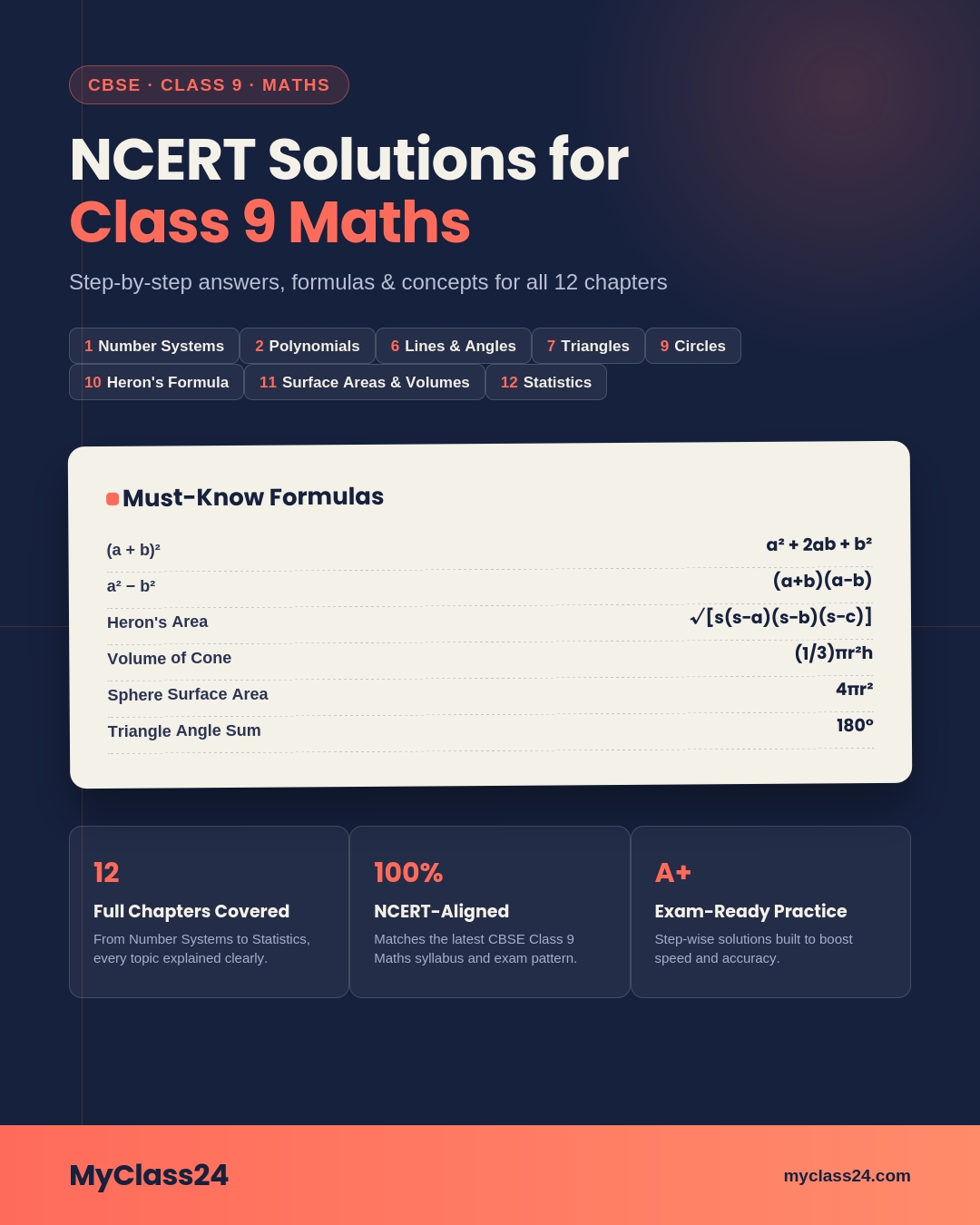
The Class 9 Maths NCERT textbook is divided into 12 chapters, covering Algebra, Geometry, Coordinate Geometry, Mensuration, and Statistics. Below is a quick reference table of all chapters covered in the NCERT Solutions for Class 9 Maths.
Chapter No. | Chapter Name |
Chapter 1 | Number Systems |
Chapter 2 | Polynomials |
Chapter 3 | Coordinate Geometry |
Chapter 4 | Linear Equations in Two Variables |
Chapter 5 | Introduction to Euclid's Geometry |
Chapter 6 | Lines and Angles |
Chapter 7 | Triangles |
Chapter 8 | Quadrilaterals |
Chapter 9 | Circles |
Chapter 10 | Heron's Formula |
Chapter 11 | Surface Areas and Volumes |
Chapter 12 | Statistics |
Chapter 1: Number Systems
This chapter introduces the real number system, including natural numbers, whole numbers, integers, rational numbers, and irrational numbers. Students learn how to represent irrational numbers on a number line, rationalise denominators, and apply laws of exponents for real numbers. A common challenge here is simplifying expressions involving surds — practising NCERT Solutions for Class 9 Maths Chapter 1 step by step helps build confidence with these operations.
Chapter 2: Polynomials
Polynomials covers definitions of polynomials in one variable, degree of a polynomial, zeroes of a polynomial, and the Remainder and Factor Theorems. Algebraic identities, listed in the table below, are extremely important here as they are reused throughout higher classes.
Identity | Expanded Form |
(a + b)² | a² + 2ab + b² |
(a − b)² | a² − 2ab + b² |
a² − b² | (a + b)(a − b) |
(a + b)³ | a³ + b³ + 3ab(a + b) |
(a − b)³ | a³ − b³ − 3ab(a − b) |
a³ + b³ | (a + b)(a² − ab + b²) |
a³ − b³ | (a − b)(a² + ab + b²) |
(a + b + c)² | a² + b² + c² + 2ab + 2bc + 2ca |
Chapter 3: Coordinate Geometry
This chapter introduces the Cartesian plane, with concepts like the x-axis, y-axis, origin, and the four quadrants. Students learn to plot points using ordered pairs (x, y) and understand how the sign of coordinates changes across quadrants. This chapter is foundational for graphing linear equations and later for coordinate geometry in Class 10 and 11.
Chapter 4: Linear Equations in Two Variables
Here, students study equations of the form ax + by + c = 0, learn to find multiple solutions, and represent linear equations graphically. A key skill developed in this chapter is connecting algebraic equations with their geometric representation as straight lines on a graph.
Chapter 5: Introduction to Euclid's Geometry
This chapter covers Euclid's definitions, axioms, and postulates, forming the logical basis of geometry. Although it has fewer numerical problems, understanding the five postulates is essential for proving theorems in later chapters.
Chapter 6: Lines and Angles
Students explore types of angles, linear pairs, vertically opposite angles, and properties of parallel lines cut by a transversal. The angle sum property of a triangle, introduced here, is used repeatedly throughout geometry.
Chapter 7: Triangles
This chapter focuses on triangle congruence rules (SSS, SAS, ASA, AAS, and RHS), along with properties of isosceles triangles and inequalities in triangles. Mastering congruence criteria is critical, as these rules form the basis of geometric proofs in Class 10 as well.
Chapter 8: Quadrilaterals
Students study the properties of parallelograms, rectangles, rhombuses, squares, and trapeziums, along with the Mid-Point Theorem. This theorem — stating that the line segment joining the midpoints of two sides of a triangle is parallel to the third side and half its length — is a frequently tested concept.
Chapter 9: Circles
This chapter covers the properties of chords, arcs, and angles subtended by them, along with the relationship between equal chords and their distances from the centre. Concepts like the angle subtended by an arc at the centre being double the angle subtended at any point on the remaining circle are commonly tested.
Chapter 10: Heron's Formula
Heron's Formula allows students to calculate the area of a triangle when all three side lengths are known, without needing the height. This is especially useful for scalene triangles where the height isn't directly given.
Chapter 11: Surface Areas and Volumes
This chapter deals with the surface area and volume of solid shapes such as cubes, cuboids, cylinders, cones, spheres, and hemispheres. These formulas are essential not only for Class 9 exams but also for many real-life and competitive exam applications.
Concept | Formula |
Area of a triangle (Heron's Formula) | √[s(s − a)(s − b)(s − c)], where s = (a+b+c)/2 |
Area of an equilateral triangle | (√3/4) × side² |
Sum of angles in a triangle | 180° |
Sum of interior angles of a quadrilateral | 360° |
Curved surface area of a cylinder | 2πrh |
Total surface area of a cylinder | 2πr(r + h) |
Curved surface area of a cone | πrl |
Total surface area of a cone | πr(r + l) |
Surface area of a sphere | 4πr² |
Curved surface area of a hemisphere | 2πr² |
Volume of a cylinder | πr²h |
Volume of a cone | (1/3)πr²h |
Volume of a sphere | (4/3)πr³ |
Volume of a hemisphere | (2/3)πr³ |
Chapter 12: Statistics
The final chapter introduces data handling concepts such as collection, organisation, and graphical representation of data using bar graphs, histograms, and frequency polygons. Students also learn to calculate the mean, median, and mode of ungrouped data.
Term | Definition / Formula |
Mean | Sum of all observations ÷ Number of observations |
Median | Middle value of data arranged in ascending or descending order |
Mode | Observation that occurs most frequently in the data set |
Class mark | (Upper limit + Lower limit) ÷ 2 |
Range | Highest value − Lowest value |
How to Use NCERT Solutions for Class 9 Maths Effectively
Simply reading solutions is not enough — students need an active study strategy to retain concepts long-term. Here is a step-by-step approach that works well for most learners:
Attempt the question on your own first, without looking at the solution, to identify your current understanding.
Compare your method with the NCERT solution to check whether your approach matches the expected steps.
Note down the formula or theorem used in each problem in a separate formula notebook for quick revision.
Revisit incorrect or skipped questions after 2–3 days to reinforce memory through spaced repetition.
Practice similar problems from exercises and previous year question papers to build exam-level speed.
Important Tips for Scoring Well in Class 9 Maths
Focus on understanding derivations rather than memorising final formulas blindly.
Practice graph-based questions from Linear Equations and Coordinate Geometry regularly, as small errors in plotting are common.
In Geometry chapters, always draw a neat, labelled diagram before attempting a proof — it often reveals the solution path.
Keep a separate list of algebraic identities and mensuration formulas, since these are reused across multiple chapters.
Solve NCERT exercise questions multiple times instead of jumping straight to extra reference books.
Time yourself while solving sample papers to improve speed without compromising accuracy.
Common Mistakes Students Should Avoid
Many students lose marks not due to lack of knowledge, but because of small, avoidable errors. Some frequent mistakes include:
Forgetting to rationalise the denominator when simplifying expressions with surds in Number Systems.
Misapplying algebraic identities, especially confusing the signs in (a − b)² and (a + b)².
Skipping the 'given, to prove, construction, and proof' format in geometry, which is often required for full marks.
Using the wrong formula for surface area instead of volume (or vice versa) in mensuration problems.
Not arranging data in ascending order before calculating the median in Statistics.
Benefits of Practising Chapter-Wise NCERT Solutions Regularly
Consistent practice with structured NCERT Solutions for Class 9 Maths offers compounding benefits over the academic year. Students who revise chapter-wise solutions regularly tend to develop stronger conceptual clarity, better retention of formulas, and improved problem-solving speed during exams. This approach also reduces last-minute exam stress, since revision becomes a continuous process rather than a one-time effort before tests.
Additionally, since many Class 9 topics — such as polynomials, triangles, and surface areas — reappear in more advanced forms in Class 10, building a strong base now makes future learning significantly easier. Students preparing with MyClass24 are encouraged to combine solution practice with regular self-assessment to track their progress across all 12 chapters.
Conclusion
Class 9 Maths might initially feel like a mix of many new topics, but with consistent practice and the right approach, it becomes one of the highest-scoring subjects in the CBSE curriculum. By using clear, step-by-step NCERT Solutions for Class 9 Maths, focusing on core formulas, and avoiding common mistakes, students can build both confidence and competence for board exams and beyond. Make these chapter-wise solutions and formula tables a regular part of your study routine, and you will notice steady improvement in both understanding and exam performance.
FAQs for NCERT Solutions for Class 9 Maths
NCERT Solutions for Class 9 Maths play a key role in helping students build a strong foundation for higher classes. The Class 9 syllabus introduces many new mathematical concepts that are continued in Class 10 and beyond. Well-explained solutions help students understand every step involved in solving problems instead of simply memorizing answers. They also improve logical thinking, analytical ability, and problem-solving skills. By practicing these solutions regularly, students become more confident in tackling textbook exercises as well as school examinations. MyClass24 provides chapter-wise solutions in simple language, making it easier for students to clear their doubts independently and strengthen their conceptual understanding for better academic performance.
MyClass24 is designed to support students with reliable, easy-to-understand, and exam-focused learning resources. Every NCERT Solution is prepared in a step-by-step format that simplifies even complex mathematical questions. The explanations emphasize conceptual learning instead of rote memorization, helping students solve similar questions independently. The content is organized chapter-wise for convenient study and quick revision before examinations. Students can improve their homework performance, classroom understanding, and overall confidence through regular practice using these solutions. By combining accuracy, clarity, and student-friendly explanations, MyClass24 provides an effective learning companion that helps Class 9 students build strong mathematical fundamentals and achieve better academic results.
Revision should be a regular part of mathematics preparation rather than an activity reserved for examinations. Students should revise recently completed chapters every week while also reviewing older topics periodically to maintain conceptual clarity. Practicing important questions, formulas, and theorem-based problems repeatedly improves memory and reduces mistakes during exams. Keeping a separate notebook for formulas and commonly used methods also helps during quick revisions. MyClass24 encourages systematic revision through organized chapter-wise NCERT Solutions that allow students to revisit important concepts easily, strengthen weak areas, and build lasting confidence in solving mathematical problems accurately.
Yes, NCERT Solutions form an excellent foundation for many competitive examinations conducted at the school level. Most entrance tests evaluate conceptual understanding rather than memorized formulas, making NCERT practice extremely valuable. Topics such as algebra, geometry, number systems, and statistics frequently appear in various aptitude and scholarship examinations. Students who thoroughly understand NCERT concepts find it easier to solve advanced problems later. Regular practice also improves logical reasoning, calculation accuracy, and time management. MyClass24 helps students master textbook concepts through detailed explanations, enabling them to strengthen their fundamentals before moving on to higher-level mathematical questions and competitive exam preparation.
Many students find mathematics difficult because they struggle to understand the steps involved in solving problems. NCERT Solutions simplify each question by breaking it into smaller, logical steps that explain the complete solving process. This method helps students recognise patterns, formulas, and mathematical reasoning more effectively. Instead of relying on memorisation, learners gradually develop conceptual clarity and confidence. As they practice regularly, difficult topics become easier to understand and solve independently. MyClass24 provides carefully explained solutions that encourage students to think logically, improve analytical skills, and develop a strong mathematical foundation that supports success in higher classes and competitive examinations.
MyClass24 focuses on making mathematics simple, understandable, and student-friendly. Every solution is prepared with detailed step-by-step explanations so learners can easily understand the reasoning behind each answer. The solutions follow the latest NCERT textbook pattern and explain mathematical concepts using clear language suitable for Class 9 students. Instead of presenting only final answers, each problem is solved logically to improve conceptual understanding. This approach helps students complete homework confidently, revise effectively before exams, and strengthen their basics for future classes. MyClass24 aims to reduce students' fear of mathematics by providing accurate, easy-to-follow, and well-organized learning resources that support independent learning.
NCERT Solutions help students prepare systematically by covering every question given in the official textbook. Since most school exams and many competitive examinations are based on NCERT concepts, practicing these solutions ensures complete syllabus coverage. Every answer follows a logical sequence, helping students understand the correct method rather than only the final answer. Regular practice also improves calculation speed, reduces mistakes, and increases confidence during examinations. Students can identify weak topics and revise them effectively. MyClass24 presents easy-to-understand explanations that simplify complex mathematical concepts, enabling learners to prepare thoroughly and perform well in periodic tests, half-yearly examinations, annual exams, and future competitive assessments.
Every chapter in Class 9 Maths is important, but some topics generally require additional practice because they involve multiple concepts and calculations. Chapters such as Polynomials, Coordinate Geometry, Linear Equations in Two Variables, Triangles, Quadrilaterals, Circles, Surface Areas and Volumes, and Statistics demand regular problem-solving. Students should first understand the underlying concepts before attempting numerical questions. Solving different types of exercises helps improve accuracy and confidence. Consistent revision is equally important because many later chapters depend on earlier concepts. MyClass24 provides chapter-wise NCERT Solutions that guide students through each question step by step, making even difficult chapters easier to understand and master through continuous practice.
Yes, for most CBSE school examinations, NCERT Solutions are sufficient when studied thoroughly. The majority of examination questions are directly or indirectly based on NCERT textbook concepts and exercises. Students should focus on understanding every example, solving all exercise questions, and revising important formulas regularly. Instead of memorizing answers, they should learn the reasoning behind each solution. Once they gain confidence with NCERT problems, they can practice additional questions for better speed and accuracy. MyClass24 provides detailed explanations that help students understand concepts clearly, avoid common mistakes, and develop strong mathematical skills required for scoring excellent marks in school examinations.
Students should begin by studying the theory and solved examples from their textbook before attempting exercise questions independently. After solving a question, they can compare their approach with the NCERT Solution to identify mistakes and understand the correct method. Rather than copying answers directly, students should analyze each step carefully and learn the concepts involved. Daily practice of even a few questions improves confidence and calculation speed significantly. Regular revision of previous chapters also strengthens long-term retention. MyClass24 offers structured chapter-wise solutions that make daily study more organized, helping students build consistency and gradually improve their mathematical problem-solving abilities throughout the academic session.