About NCERT Solutions for Class 12 Maths
Step-by-step solutions for all 13 chapters, key formulas, mark-wise chapter breakdown, and board exam strategy — everything you need in one place.
Why NCERT Solutions Are Non-Negotiable for Class 12 Maths
NCERT Solutions for Class 12 Maths are an essential resource for students preparing for their board exams and competitive entrance tests like JEE, CUET, and NEET (for mathematics-related sections). Mathematics at the Class 12 level is advanced and involves concepts like calculus, algebra, probability, and three-dimensional geometry, which form the foundation for higher studies in engineering, data science, economics, and other fields.
These solutions are designed to provide clear, step-by-step answers to every exercise in the NCERT textbook. They help students not only in solving numerical problems but also in understanding the underlying concepts. Each chapter is explained in a simple and structured way, allowing learners to follow the logic and reasoning used in problem-solving. This approach boosts conceptual clarity and improves problem-solving speed, which is crucial during examinations.
NCERT Solutions for Class 12 Maths – Chapter-wise List
| Chapter No. | Chapter Name |
|---|---|
| Chapter 1 | Relations and Functions |
| Chapter 2 | Inverse Trigonometric Functions |
| Chapter 3 | Matrices |
| Chapter 4 | Determinants |
| Chapter 5 | Continuity and Differentiability |
| Chapter 6 | Application of Derivatives |
| Chapter 7 | Integrals |
| Chapter 8 | Application of Integrals |
| Chapter 9 | Differential Equations |
| Chapter 10 | Vector Algebra |
| Chapter 11 | Three-Dimensional Geometry |
| Chapter 12 | Linear Programming |
| Chapter 13 | Probability |
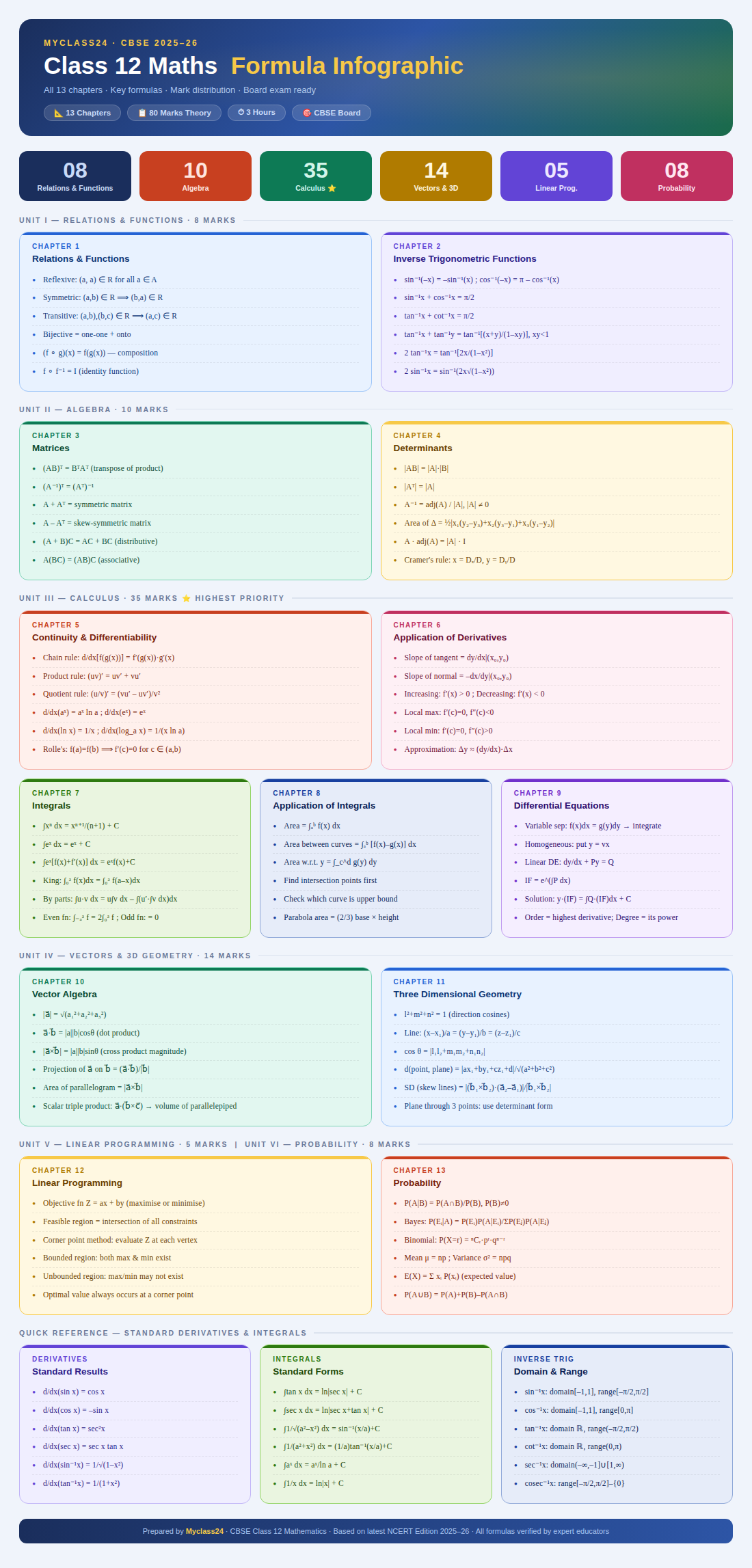
NCERT Solutions for Class 12 Maths – Chapter-wise Overview
Chapter 1: Relations and Functions
This chapter builds on the concepts of relations and functions introduced in Class 11 and takes them to an advanced level. The subtopics include types of relations such as reflexive, symmetric, transitive, and equivalence relations, which are important in understanding the properties of sets and mappings.
Students also study functions like one-to-one, onto, and composite functions, along with the concept of invertible functions. Questions in this chapter generally involve proving the properties of given relations, verifying whether a relation is an equivalence relation, and solving problems based on the composition of functions. Higher-order questions may ask students to apply these concepts to real-life examples, such as functions in mathematics and computer science. The NCERT Solutions guide students step by step in handling proofs and logic-based questions, ensuring clarity of concepts. By practising these solutions, learners build a strong foundation that is later used in topics like inverse trigonometric functions, calculus, and vector algebra.
Chapter 2: Inverse Trigonometric Functions
This chapter introduces inverse trigonometric functions, which are essential for calculus and higher mathematics. The subtopics include principal values of inverse trigonometric functions, domain and range restrictions, and basic properties of inverse trigonometric functions. Students also learn how to express trigonometric identities in terms of inverse functions. Questions in this chapter are usually based on proving identities, simplifying expressions, and evaluating exact values using inverse trigonometric properties.
Some problems also require students to apply concepts of restrictions and ranges while solving. The NCERT Solutions provide detailed steps to simplify tricky identities and proofs, helping students avoid common mistakes. Graphical representation of inverse trigonometric functions is another important area where students learn to visualise the functions and their restricted domains. This chapter plays a key role in integral calculus, as inverse trigonometric functions frequently appear in integration formulas. Practising NCERT Solutions ensures accuracy, logical reasoning, and a strong command of this topic.
Chapter 3: Matrices
The chapter on matrices introduces one of the most powerful tools in mathematics with applications in engineering, computer science, and economics. The subtopics include types of matrices, equality of matrices, addition, subtraction, scalar multiplication, and multiplication of matrices. Special focus is given to properties of matrix operations, which often appear in exam questions.
Students also learn about the transpose of a matrix, symmetric and skew-symmetric matrices, and elementary operations used for solving equations. Higher-level problems include verifying algebraic properties and solving questions involving matrix transformations. The NCERT Solutions break down every operation into simple steps, making it easier for students to master the calculation process. Word problems and application-based questions test logical application of matrix properties in real-life contexts. This chapter also serves as a foundation for determinants, where matrices are used to solve systems of linear equations. Regular practice with NCERT Solutions helps students strengthen both conceptual understanding and computational accuracy.
Chapter 4: Determinants
Determinants are an extension of matrices and are crucial in solving systems of linear equations, geometry, and higher mathematics. This chapter covers the definition and properties of determinants, minors, cofactors, and the process of finding the adjoint and inverse of a matrix using determinants. Subtopics also include applications of determinants in solving linear equations through Cramer’s rule. Students practice questions involving expansion of determinants, the verification of properties like row and column operations, and proving identities involving determinants. Higher-order questions may include applying determinant properties to simplify algebraic expressions or solve geometric problems.
The NCERT Solutions provide step-by-step explanations of these operations, making it easier for students to apply them in exams. Another important part of this chapter is the use of determinants in calculating the area of triangles and testing the collinearity of points, which often appear in board exams. Mastering determinants prepares students for topics like vector algebra and three-dimensional geometry, where such concepts are applied frequently.
Chapter 5: Continuity and Differentiability
This chapter introduces the advanced concepts of calculus, beginning with the continuity of functions and moving to differentiability and derivatives of functions. Subtopics include algebra of continuous functions, exponential and logarithmic functions, derivatives of composite, implicit, and inverse trigonometric functions.
The concept of differentiability at a point and the relationship between continuity and differentiability are also covered in detail. Students also learn the chain rule, derivatives of parametric functions, and second-order derivatives. Questions in this chapter range from proving continuity at a specific point to solving complex differentiation problems. NCERT Solutions guide students through logical steps, helping them understand tricky problems like limits involving trigonometric functions or derivatives using first principles. Advanced questions prepare students for applications in optimisation, integration, and curve sketching. This chapter builds the groundwork for the calculus portion of competitive exams, where accuracy and speed are essential.
Chapter 6: Applications of Derivatives
Applications of derivatives take the abstract concept of differentiation and apply it to practical situations. The subtopics include rate of change of quantities, increasing and decreasing functions, tangents and normals, approximations, and maxima-minima problems. Students solve a wide variety of questions ranging from proving monotonicity to finding points of tangency and normal equations for curves.
Word problems include real-life applications, such as maximising profit, minimising cost, and optimising dimensions of geometrical figures. The NCERT Solutions provide detailed steps to help students approach problems systematically, especially optimisation questions that require proper use of the first and second derivative tests. Exam questions usually test problem-solving ability with graphical interpretation and logical reasoning. This chapter not only plays a major role in Class 12 board exams but also has high importance in entrance exams like JEE, where calculus forms a major portion of the question paper. With practice, students gain both conceptual clarity and practical application skills.
Chapter 7: Integrals
This is one of the most important chapters in Class 12 Maths, as it introduces integration, the reverse process of differentiation. The subtopics include integration as an inverse process of differentiation, methods of integration such as substitution, partial fractions, and integration by parts. Students also learn to integrate trigonometric functions, exponential functions, and rational functions. Another major focus is on definite integrals, their properties, and their application in evaluating limits.
Questions in this chapter range from simple integrals to complex multi-step problems requiring the use of multiple techniques. NCERT Solutions explain each step clearly, ensuring students understand how to choose the right method for solving an integral. Definite integrals also involve questions on applying properties to simplify calculations. This chapter is highly important for board exams and entrance tests like JEE, where integration carries significant weightage. Mastery of integrals sets the stage for applications in areas like probability, physics, and engineering.
Chapter 8: Applications of Integrals
After learning the techniques of integration, students move to applications in real-world contexts. This chapter deals mainly with finding areas under simple curves, areas between two curves, and areas bounded by a curve and the coordinate axes. Subtopics include the use of definite integrals in calculating these areas. Typical questions involve evaluating definite integrals to find the area enclosed by standard curves like parabolas, circles, ellipses, and straight lines. Word problems are also included, where students apply integration to geometric and real-life situations.
NCERT Solutions guide students through diagrams and detailed steps, making visualisation easier while solving. This chapter connects calculus with geometry, helping learners see the practical use of integration beyond just symbolic manipulation. Board exam questions often come directly from solved examples and exercises, while competitive exams may present slightly twisted versions of the same concepts. Practising these solutions ensures speed and accuracy while strengthening conceptual clarity.
Chapter 9: Differential Equations
Differential equations form the foundation for many applications in physics, engineering, and economics. This chapter covers the definition of a differential equation, order and degree, and general and particular solutions. Subtopics also include methods of solving differential equations of the first order and first degree, such as variable separable, homogeneous equations, linear equations, and equations reducible to linear form. Higher-level problems involve forming differential equations based on given conditions and solving them to find particular solutions.
Students also practice application-based questions like modelling real-life situations using differential equations. The NCERT Solutions systematically explain the solving process, helping students avoid confusion while applying different methods. This chapter requires strong algebraic manipulation and logical reasoning, as problems often involve multiple steps. Board exam questions typically ask for general and particular solutions, while competitive exams focus on applications and shortcuts. Mastery of this topic gives students an edge in both school and entrance exams.
Chapter 10: Vector Algebra
Vector Algebra introduces students to one of the most powerful mathematical tools used in physics, engineering, and computer science. The chapter begins with the basics of vectors, including types of vectors such as zero, unit, collinear, and coplanar vectors. Subtopics include operations on vectors like addition, subtraction, and multiplication by scalars, along with properties of these operations. Students also learn about the scalar (dot) product and vector (cross) product of two vectors, which are essential for solving problems in geometry and physics.
Questions often involve proving properties of vectors, calculating magnitudes, and finding angles between vectors using dot and cross product formulas. Application-based problems include verifying collinearity, computing work done, and determining areas of parallelograms and triangles using vector methods. NCERT Solutions provide step-by-step explanations for each operation, making complex vector manipulations simpler. Board exam questions frequently test the application of dot and cross products, while entrance exams focus on problem-solving involving multiple vector concepts. This chapter prepares students for 3D geometry and strengthens their logical reasoning with algebraic-geometric connections.
Chapter 11: Three-Dimensional Geometry
This chapter extends the study of coordinate geometry into three dimensions, where students learn about lines, planes, and the distances between geometric elements in space. Subtopics include direction cosines, direction ratios of a line, equation of a line in 3D, angle between two lines, shortest distance between skew lines, and equations of planes. Students also study angles between a line and a plane, distance of a point from a plane, and the intersection of lines and planes.
Typical questions require finding equations, verifying perpendicularity or parallelism, and solving problems involving distances and angles. NCERT Solutions simplify these calculations by breaking them into manageable steps. Diagrams are often used to improve visualisation, helping students understand the geometry of three-dimensional space. This chapter has high importance in board exams, where most questions are application-based. For competitive exams, 3D geometry combines with vector algebra to test problem-solving skills in physics-related contexts. Mastering this chapter enhances both spatial reasoning and algebraic manipulation.
Chapter 12: Linear Programming
Linear Programming (LPP) introduces optimisation techniques widely used in business, economics, and operations research. The chapter focuses on problems involving inequalities that form a feasible region on a coordinate plane. Subtopics include formulation of linear programming problems, graphical methods of solving LPP, and finding optimal solutions using corner point methods.
Questions typically require forming inequalities from word problems, plotting feasible regions, and determining maximum or minimum values of an objective function. Application-based problems may involve maximising profit, minimising cost, or optimising resources under given constraints. NCERT Solutions provide clear diagrams and step-by-step explanations, ensuring that students understand both the graphical interpretation and logical reasoning behind the solution. While board exam questions are mostly based on direct applications, competitive exams often test quick interpretation of constraints and logical formulation of inequalities. This chapter helps students connect mathematics with real-world scenarios, making it one of the most practical topics in the Class 12 syllabus.
Chapter 13: Probability
Probability in Class 12 deals with advanced concepts that extend beyond the basics introduced earlier. The chapter covers conditional probability, multiplication theorem of probability, independent events, Bayes’ theorem, and random variables with probability distributions. Students also learn about the mean and variance of random variables, which are crucial in statistics and real-world applications. Questions often involve finding conditional probabilities, solving problems using Bayes’ theorem, and calculating probabilities in multi-step experiments.
Higher-order problems focus on applying probability rules in real-life contexts like card games, dice, and selection-based questions. The NCERT Solutions provide detailed explanations for each type of question, ensuring clarity in using formulas and logical reasoning. This chapter is very scoring in board exams, as most questions are direct applications of theorems and properties. In competitive exams like JEE and CUET, probability problems are designed to test both speed and accuracy. By practising NCERT Solutions, students can handle complex probability models confidently and apply them to advanced fields such as data science, machine learning, and finance.
CBSE Board Exam: Chapter-wise Mark Distribution
CBSE divides the Class 12 Maths syllabus into six units. Knowing how many marks each unit carries helps you prioritise your revision intelligently. The theory paper is for 80 marks and internal assessment carries 20 marks, making the total 100 marks.
| Unit | Chapters Included | Marks (Theory) | Priority Level |
|---|---|---|---|
| Unit I – Relations & Functions | Ch. 1: Relations and Functions Ch. 2: Inverse Trigonometric Functions | 08 | Moderate |
| Unit II – Algebra | Ch. 3: Matrices Ch. 4: Determinants | 10 | Very High |
| Unit III – Calculus | Ch. 5: Continuity & Differentiability Ch. 6: Application of Derivatives Ch. 7: Integrals Ch. 8: Application of Integrals Ch. 9: Differential Equations | 35 | Highest Priority |
| Unit IV – Vectors & 3D Geometry | Ch. 10: Vector Algebra Ch. 11: Three Dimensional Geometry | 14 | Very High |
| Unit V – Linear Programming | Ch. 12: Linear Programming | 05 | Moderate |
| Unit VI – Probability | Ch. 13: Probability | 08 | High |
| Total (Theory) | 13 Chapters | 80 | — |
Exam Strategy Tip: Calculus (Unit III) alone carries 35 out of 80 marks — that is 44% of your theory score. Never underestimate chapters 5 through 9. Even students who find calculus difficult should focus on securing marks from standard integration techniques and application of derivatives.
Question Paper Pattern (Theory – 80 Marks)
| Section | Question Type | No. of Questions | Marks Each | Total Marks |
|---|---|---|---|---|
| Section A | MCQ + Assertion-Reason | 20 (18 MCQ + 2 A/R) | 1 mark | 20 |
| Section B | Very Short Answer (VSA) | 5 | 2 marks | 10 |
| Section C | Short Answer (SA) | 6 | 3 marks | 18 |
| Section D | Long Answer (LA) | 4 | 5 marks | 20 |
| Section E | Case-based / Source-based | 3 | 4 marks | 12 |
| Grand Total | 80 | |||
Master Formula Sheet: All Chapters at a Glance
This consolidated formula table covers the most frequently tested formulas across all 13 chapters. Bookmark this and revise it daily in the last 30 days before your board exam.
| Chapter | Key Concepts & Formulas | Common Question Type |
|---|---|---|
| Inverse Trig Functions (Ch. 2) | sin⁻¹(–x) = –sin⁻¹(x) | sin⁻¹(x) + cos⁻¹(x) = π/2 tan⁻¹(x) + cot⁻¹(x) = π/2 | 2tan⁻¹(x) = tan⁻¹(2x/(1–x²)) tan⁻¹(x) + tan⁻¹(y) = tan⁻¹((x+y)/(1–xy)), xy < 1 | Simplification, principal value, MCQ |
| Matrices & Determinants (Ch. 3–4) | |AB| = |A|·|B| | A⁻¹ = adj(A)/|A| Area of Δ = ½|x₁(y₂–y₃) + x₂(y₃–y₁) + x₃(y₁–y₂)| (AB)ᵀ = BᵀAᵀ | (A⁻¹)ᵀ = (Aᵀ)⁻¹ | Matrix inverse, system of equations, area |
| Continuity & Differentiability (Ch. 5) | d/dx[uv] = u·v' + v·u' (Product Rule) d/dx[u/v] = (v·u' – u·v') / v² (Quotient Rule) d/dx[f(g(x))] = f'(g(x))·g'(x) (Chain Rule) d/dx[aˣ] = aˣ ln a | d/dx[ln x] = 1/x Rolle's Theorem: f(a)=f(b) ⟹ f'(c)=0 for some c ∈ (a,b) | Finding derivatives, continuity proofs, theorems |
| Application of Derivatives (Ch. 6) | Slope of tangent = dy/dx at the point Slope of normal = –dx/dy at the point Increasing if f'(x) > 0 | Decreasing if f'(x) < 0 Second derivative test: f''(c) > 0 → local min; f''(c) < 0 → local max | Tangent/Normal, maxima-minima (5-mark problems) |
| Integrals (Ch. 7) | ∫xⁿ dx = xⁿ⁺¹/(n+1) + C | ∫eˣ dx = eˣ + C ∫(1/x) dx = ln|x| + C | ∫sin x dx = –cos x + C ∫eˣ[f(x) + f'(x)] dx = eˣf(x) + C ∫₀ᵃ f(x)dx = ∫₀ᵃ f(a–x)dx (King Property) Integration by Parts: ∫u·v dx = u∫v dx – ∫[u'·∫v dx] dx | Indefinite integrals (3-mark), definite integrals (3–5 mark) |
| Differential Equations (Ch. 9) | Variable Separable: f(x)dx = g(y)dy → integrate both sides Homogeneous: put y = vx, then dy/dx = v + x·dv/dx Linear: dy/dx + Py = Q; IF = e^∫P dx Solution: y·(IF) = ∫Q·(IF) dx + C | Forming & solving DEs (5-mark) |
| Vectors (Ch. 10) | |a⃗| = √(a₁² + a₂² + a₃²) a⃗ · b⃗ = |a||b|cos θ | a⃗ × b⃗ = |a||b|sin θ n̂ Projection of a⃗ on b⃗ = (a⃗ · b⃗)/|b⃗| Area of parallelogram = |a⃗ × b⃗| | Dot/cross product, angle between vectors |
| 3D Geometry (Ch. 11) | Direction cosines: l² + m² + n² = 1 Line: (x–x₁)/a = (y–y₁)/b = (z–z₁)/c Angle between lines: cos θ = |l₁l₂ + m₁m₂ + n₁n₂| Distance of point (x₁,y₁,z₁) from plane ax+by+cz+d=0: d = |ax₁+by₁+cz₁+d| / √(a²+b²+c²) | Equations of lines/planes, shortest distance (5-mark) |
| Probability (Ch. 13) | P(A|B) = P(A∩B)/P(B) Bayes' Theorem: P(Eᵢ|A) = P(Eᵢ)·P(A|Eᵢ) / ΣP(Eⱼ)·P(A|Eⱼ) Mean of Binomial: μ = np | Variance: σ² = npq P(X=r) = ⁿCᵣ · pʳ · qⁿ⁻ʳ (Binomial distribution) | Bayes' theorem (5-mark), Binomial distribution |
Power Tip from Myclass24 Experts:Write these formulas on index cards and revise them every morning. Research in learning science shows that spaced repetition of formulas leads to near-perfect recall during exams — far more effective than reading chapters repeatedly.
How to Use NCERT Solutions Effectively — Not Just for Copying Answers
Most students make a critical mistake: they read the NCERT solution and move on. Effective study means something very different. Here is the approach our top-scoring students at Myclass24 follow:
- Attempt first, refer second. Try to solve the problem on your own. Only look at the solution if you are stuck or want to verify your method. This habit builds problem-solving instinct — critical for 5-mark board questions.
- Understand the method, not just the answer. CBSE gives step marks. A correct answer via wrong method gets zero. Our solutions label each step — "applying chain rule," "integrating by parts," etc. — so you understand the logic.
- Do examples before exercises. The solved examples in NCERT are frequently asked directly in CBSE papers. Students who skip examples miss easy marks. Treat them as mini practice tests.
- Solve Miscellaneous Exercises. These are harder but appear in board exams more than many students realise. Chapters 5, 7, and 13 have miscellaneous exercises that test combined concepts — perfect exam-level practice.
- Revisit weak chapters in mock test mode. Use our chapter-wise mark distribution table above. If Calculus gives you 35 marks, spending 40% of your revision time on Chapters 5–9 is mathematically the wisest investment.
- Write, don't just read. Maths is a performance subject. Reading solutions builds recognition memory; writing them from scratch builds recall memory. Board exams require recall.
High-Priority Topics: What to Revise First
Based on the last 10 years of CBSE Class 12 Maths board papers, certain topics appear consistently every year and often in high-mark questions. This table helps you rank your revision priority.
| Chapter | Must-Revise Topic | Appeared in Last 10 Years | Expected Marks |
|---|---|---|---|
| Ch. 3 & 4 – Matrices & Determinants | Finding inverse using elementary row operations, solving 3×3 system via matrix method | Every year | 5 marks |
| Ch. 5 – Continuity & Differentiability | Finding value of k for continuity, parametric differentiation, second-order derivatives | Every year | 2–3 marks |
| Ch. 6 – Application of Derivatives | Maxima/Minima word problems (box, cylinder, revenue optimisation) | Every year | 5 marks |
| Ch. 7 – Integrals | Integration by partial fractions, ∫eˣ[f(x)+f'(x)]dx, definite integrals using properties | Every year | 3–5 marks |
| Ch. 9 – Differential Equations | Linear DE (Integrating Factor method), formation of DE from a curve family | Every year | 5 marks |
| Ch. 11 – 3D Geometry | Equation of plane through 3 points, shortest distance between two skew lines | Every year | 5 marks |
| Ch. 13 – Probability | Bayes' Theorem, mean and variance of Binomial distribution | Every year | 4–5 marks |
| Ch. 2 – Inverse Trig | Simplification of expressions, proving identities | 8 out of 10 years | 2 marks |
| Ch. 12 – Linear Programming | Corner-point method, maximise/minimise objective function | Every year | 5 marks |
| Ch. 8 – Application of Integrals | Area bounded by curves, parabola and line, two curves | Every year | 5 marks |
Scoring Strategy:The 10 topic-types listed above collectively account for roughly50–55 marksin a typical CBSE board paper. Mastering just these topics — through NCERT exercises and Myclass24 practice questions — puts a score of 65+ well within reach even before touching other topics.
CBSE Class 12 Maths Board Exam: Complete Information
Exam Structure
The CBSE Class 12 Maths examination follows a well-defined structure that has remained largely stable with minor refinements in recent years:
- Timing: The board exam is typically held in February–March each year. Practical/internal assessments are conducted by schools between January and February.
- Theory Paper: 80 marks, 3 hours duration. No overall choice — internal choices are provided in Sections B, C, D, and E.
- Internal Assessment: 20 marks, consisting of a Mathematics Activity File (10 marks), a Term Test/Internal Exam (5 marks), and a Speaking/Listening activity or project (5 marks).
- No Negative Marking: Unlike competitive exams like JEE, CBSE board papers do not deduct marks for wrong answers in MCQs. Attempt every MCQ.
- Calculators: Not permitted. All calculations must be done manually. Practice mental arithmetic for recurring values like sin 30°, cos 45°, √2, √3.
- Drawing: Graphs in Linear Programming must be drawn accurately using a scale. Graph paper is typically provided or a rough-grid section is available on the answer sheet.
- Time Management: Section A (MCQ) should take no more than 25–30 minutes. Long answer questions (Section D) need roughly 10–12 minutes each. Case-based questions (Section E) are often the most time-consuming — budget 8–10 minutes per case.
Passing and Excellence Criteria
To pass:A student must score at least 33% in theory (≥27/80) and 33% aggregate (≥33/100).
To score 90+:Target full marks in Sections A and B, and aim for near-perfect answers in at least 3 out of 4 long-answer questions. Chapters 6 (Maxima/Minima), 11 (3D Geometry), and 13 (Probability) are the most reliable sources of full-mark long answers.
For 95+/100:Zero careless errors in calculation, neat and clearly structured solutions, and complete miscellaneous exercise practice across Chapters 5, 7, and 13.
What Changes From Class 11 to Class 12 Maths
If you have a strong Class 11 Maths foundation — particularly in Trigonometry (for Inverse Trig), Functions (for Continuity and Differentiability), and Coordinate Geometry (for 3D Geometry) — Class 12 Maths becomes significantly more accessible. Students who struggle in Class 12 usually lack clarity in these Class 11 prerequisites. Myclass24 solutions include prerequisite refreshers in chapters where Class 11 concepts are directly applied.
Why Choose Myclass24 for NCERT Class 12 Maths Solutions
There are many sources of NCERT solutions available online, but not all are created equal. Here is what sets Myclass24 apart:
- 100% CBSE-Aligned: Every solution follows the exact method and notation that CBSE examiners expect. No JEE-level shortcuts that confuse board exam evaluators.
- Step-marking Optimised: Our experts know how CBSE awards partial marks. Solutions are written to ensure you score even when a final answer goes wrong.
- Accessible Across India: Whether you study in Delhi NCR, Tamil Nadu, Maharashtra, West Bengal, Karnataka, Rajasthan, or any other state under CBSE, our content is relevant to your exact syllabus.
- Annually Updated: Solutions are reviewed and updated every academic year based on the latest NCERT edition and any CBSE syllabus modifications.
- Expert-Verified: All solutions are prepared and peer-reviewed by qualified Mathematics educators with years of CBSE board result experience.
FAQs on NCERT Solutions for Class 12 Math
NCERT Solutions for Class 12 Maths are considered one of the most reliable study resources because they closely follow the latest syllabus and examination pattern. Most board examination questions are directly or indirectly based on NCERT concepts and exercises. These solutions help students understand step-by-step methods for solving mathematical problems, making complex topics easier to grasp. They also improve accuracy and reduce mistakes by teaching the correct approach to each question. Regular practice of NCERT solutions strengthens conceptual understanding, boosts confidence, and enhances problem-solving speed. Students who thoroughly complete all NCERT exercises often find it easier to tackle both board examination questions and competitive exam problems. This makes NCERT Solutions an essential part of Class 12 Maths preparation.
Yes, NCERT Solutions for Class 12 Maths provide a strong foundation for competitive examinations. Topics such as Calculus, Matrices, Determinants, Probability, and Vector Algebra are important in many entrance exams. NCERT solutions help students understand fundamental concepts before moving to advanced-level questions. When students master the basics through NCERT exercises, they develop better analytical and logical thinking skills. These solutions also teach systematic problem-solving techniques, which are useful in time-bound examinations. While additional practice may be required for higher-level questions, NCERT remains the starting point for understanding key concepts. Many teachers recommend completing NCERT thoroughly before referring to advanced study materials because a strong conceptual base often leads to better performance in competitive exams.
NCERT Solutions improve problem-solving skills by teaching students a structured approach to mathematical questions. Every solution is presented step by step, helping learners understand the logic behind each calculation. Instead of memorizing answers, students learn how formulas and concepts are applied in different situations. Regular practice develops critical thinking and improves the ability to identify suitable methods for solving problems. As students solve more questions, they become familiar with various question patterns and learn to avoid common mistakes. This process increases confidence and accuracy. Over time, students develop the habit of analyzing questions carefully, selecting the correct strategy, and arriving at solutions efficiently, which are essential skills for both academic and competitive success.
Although every chapter is important, some topics generally require more practice due to their complexity and weightage. Calculus, including Continuity and Differentiability, Applications of Derivatives, Integrals, and Differential Equations, often demands extensive problem-solving. Vector Algebra and Three-Dimensional Geometry also require consistent practice to build visualization and calculation skills. Probability can be challenging because it involves multiple concepts and formulas. Matrices and Determinants need accuracy and careful calculations. Regular revision and repeated practice of these chapters help students gain confidence and improve speed. By solving a variety of questions from these topics, students become familiar with different approaches and reduce the chances of making errors during examinations.
NCERT Solutions can play a major role in achieving high marks if studied thoroughly and consistently. Most board examination questions are based on NCERT concepts, examples, and exercises. Students who understand every chapter, solve all exercises, and revise regularly often perform well in examinations. However, scoring exceptionally high marks may also require additional practice, especially for application-based and higher-order thinking questions. Students should focus on understanding concepts rather than memorizing solutions. Revising formulas, practicing previous examination questions, and improving calculation speed can further enhance performance. A disciplined study routine combined with complete NCERT preparation significantly increases the chances of obtaining excellent marks in Class 12 Maths.
NCERT Solutions are extremely useful during revision because they provide clear and organized explanations of all important concepts. Students can revise chapter summaries, formulas, and solved examples before practicing exercise questions. During revision, it is helpful to first attempt questions independently and then compare answers with the solutions. This approach helps identify mistakes and weak areas. Regular revision strengthens memory and improves concept retention. Students can also create short notes based on frequently used formulas and methods. Revising NCERT solutions multiple times before examinations increases familiarity with question patterns and boosts confidence. Consistent revision ensures that concepts remain fresh and can be recalled quickly during examinations.
Step-by-step solutions help students understand the complete process of solving a problem rather than focusing only on the final answer. Each step explains how formulas, rules, and mathematical concepts are applied. This detailed approach helps students identify where mistakes occur and learn the correct method. It also improves conceptual clarity, making it easier to solve similar questions independently. Stepwise solutions are particularly useful for topics like Calculus and Probability, where multiple calculations are involved. By studying each stage carefully, students develop a logical approach to problem-solving. This not only improves examination performance but also builds confidence in handling complex mathematical questions with greater accuracy.
Calculus is often considered one of the most challenging sections of Class 12 Maths. NCERT Solutions simplify Calculus by breaking down complex concepts into manageable steps. Students learn how to apply differentiation and integration techniques through detailed explanations and solved examples. These solutions demonstrate the correct methods for handling formulas, substitutions, and applications. Regular practice helps students understand the relationship between concepts and improves calculation accuracy. By solving a variety of questions, students gain confidence in tackling different problem types. Consistent use of NCERT Solutions also strengthens conceptual understanding, which is essential for both board examinations and higher-level mathematics studies. This makes Calculus more approachable and less intimidating.
Every exercise question in NCERT Maths is designed to strengthen a particular concept or skill. Solving all exercise questions ensures complete coverage of the syllabus and exposes students to different problem types. Many examination questions are inspired by NCERT exercises, making them highly relevant for preparation. Attempting every question improves conceptual clarity, calculation accuracy, and problem-solving speed. It also helps students discover their strengths and weaknesses. When students solve all exercises consistently, they develop confidence and become familiar with the application of formulas in various situations. This comprehensive practice reduces examination stress and increases the likelihood of achieving better results in Class 12 Maths.
Avoiding mistakes in Class 12 Maths requires careful preparation and regular practice. Students should focus on understanding concepts instead of memorizing procedures. Revising formulas frequently helps prevent errors during calculations. Practicing NCERT questions multiple times improves accuracy and familiarity with question patterns. During examinations, students should read questions carefully, show all calculation steps, and verify answers whenever possible. Time management is also important because rushing often leads to mistakes. Maintaining neat and organized work makes it easier to review solutions. Consistent practice, thorough revision, and attention to detail significantly reduce common errors and help students perform more confidently in the examination.