




About NCERT Solutions for Class 12 English Flamingo
Board Exam Focused | CBSE Curriculum Aligned | Prepared by Expert Educators
For millions of Class 12 students across India, the NCERT English Flamingo textbook is more than just a school subject — it is a window into the finest literary traditions of both Indian and global writing. Published by the National Council of Educational Research and Training (NCERT), the Flamingo textbook is the prescribed course material for CBSE Class 12 English Core and forms the backbone of the annual board examination. Read the subject-wise NCERT solution for class 12 and the NCERT solutions for class 12 English
At MyClass24, we understand the pressure students face when preparing for their board exams. Flamingo contains a rich and sometimes challenging mix of prose and poetry — from poignant human stories to philosophical reflections — and students often need more than the textbook itself to fully grasp these pieces. That is why our team of experienced English educators has compiled these comprehensive NCERT Solutions for Class 12 English Flamingo, designed to walk you through every chapter with clarity, depth, and exam-readiness.
Whether you are revising just a week before the board exam or beginning your preparation early in the academic year, this resource will serve as your trusted companion throughout.
NCERT Solutions for Class 12 English Flamingo – Chapter-wise
Section | Chapter No. | Chapter Name |
|---|---|---|
📖 Flamingo – Prose | ||
Prose | Chapter 1 | |
Prose | Chapter 2 | |
Prose | Chapter 3 | |
Prose | Chapter 4 | |
Prose | Chapter 5 | |
Prose | Chapter 6 | |
Prose | Chapter 7 | |
Prose | Chapter 8 | |
✍️ Flamingo – Poems | ||
Poem | Chapter 1 | |
Poem | Chapter 2 | |
Poem | Chapter 3 | |
Poem | Chapter 4 | |
Poem | Chapter 5 | |
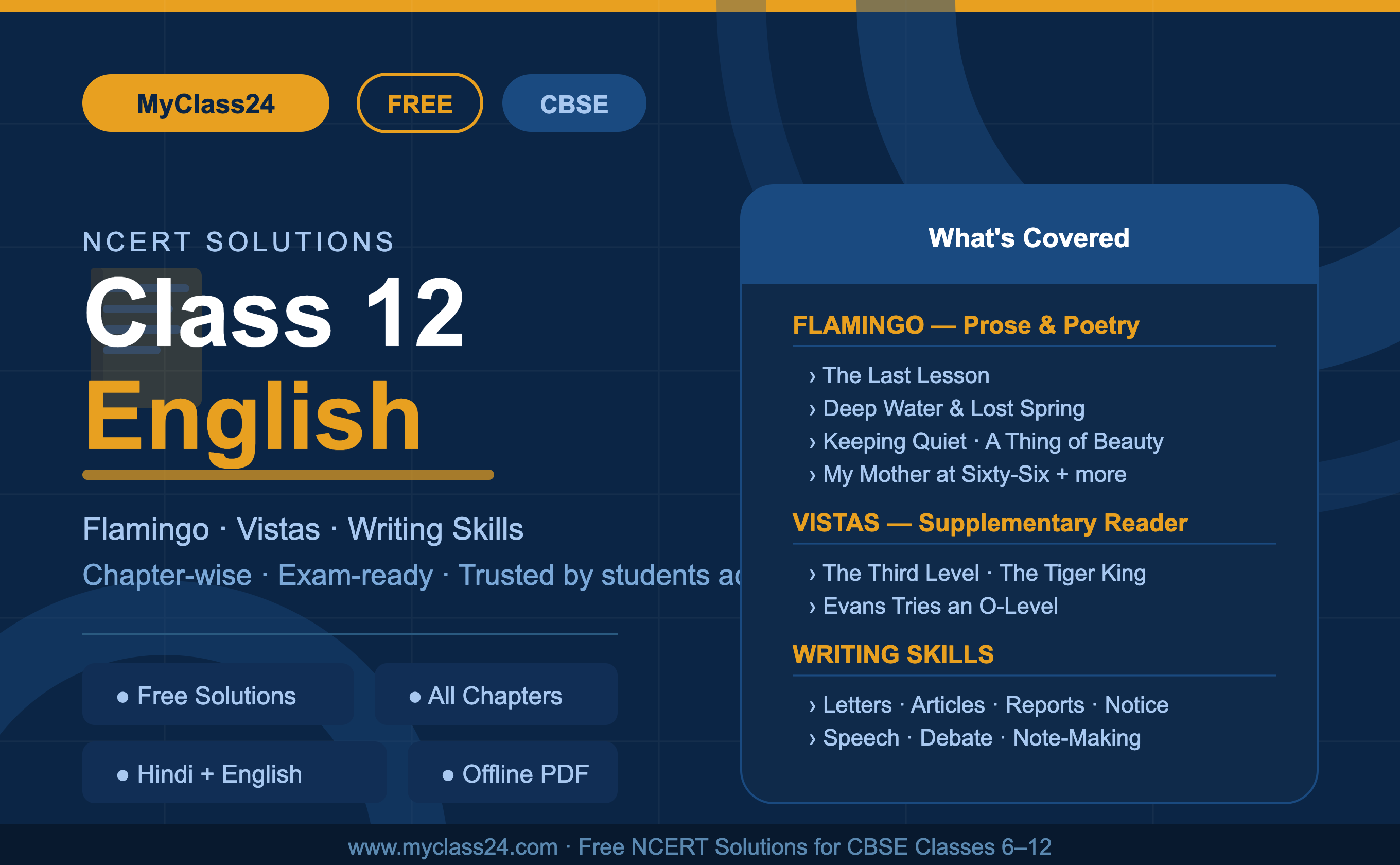
Chapter-Wise Overview: Flamingo Prose and Poetry
The Flamingo textbook is divided into two major parts — Prose (short stories and memoir-style essays) and Poetry (a curated selection of poems). Below is a quick-reference table of all chapters:
PROSE SECTIONS
Chapter | Title & Author |
Chapter 1 | The Last Lesson — Alphonse Daudet |
Chapter 2 | Lost Spring — Anees Jung |
Chapter 3 | Deep Water — William Douglas |
Chapter 4 | The Rattrap — Selma Lagerlof |
Chapter 5 | Indigo — Louis Fischer |
Chapter 6 | Going Places — A.R. Barton |
POETRY SECTIONS
Poem | Title & Poet |
Poem 1 | My Mother at Sixty-Six — Kamala Das |
Poem 2 | An Elementary School Classroom in a Slum — Stephen Spender |
Poem 3 | Keeping Quiet — Pablo Neruda |
Poem 4 | A Thing of Beauty — John Keats |
Poem 5 | A Roadside Stand — Robert Frost |
Poem 6 | Aunt Jennifer's Tigers — Adrienne Rich |
Chapter-Wise NCERT Solutions and Key Insights
Prose: Detailed Solutions
Chapter 1 — The Last Lesson by Alphonse Daudet
This story, set against the backdrop of the Franco-Prussian War, follows young Franz on the last day German is taught in Alsace. The narrative is deceptively simple but carries a powerful message about the value of one's mother tongue and the loss that comes with cultural erasure.
Theme: Patriotism, love for language, and the tragedy of losing cultural identity under foreign rule.
Key Character: M. Hamel, the French teacher, who delivers an emotionally charged final lesson, symbolizing the spirit of resistance.
Exam Tip: Questions often ask about the significance of the title and the change in Franz's attitude. Focus on the transformation from indifference to appreciation.
Chapter 2 — Lost Spring by Anees Jung
A deeply moving piece of narrative journalism, 'Lost Spring' explores the lives of children robbed of their childhood — Saheb, a rag-picker from Seemapuri, and Mukesh, a bangle-maker's son from Firozabad. The author contrasts dreams with harsh socioeconomic realities.
Theme: Child labour, poverty, generational cycles of oppression, and stolen dreams.
Key Line: The phrase 'Lost Spring' itself is a metaphor for the lost childhood of these children — spring being the season of youth and new beginnings.
Exam Tip: Be prepared to compare Saheb and Mukesh. Discuss what 'lost spring' signifies and how both characters represent different facets of poverty in India.
Chapter 3 — Deep Water by William Douglas
This autobiographical piece by renowned American jurist William O. Douglas traces his traumatic experience of nearly drowning in a YMCA pool as a child, and his determined effort to overcome his fear of water through professional swimming lessons.
Theme: Conquering fear, resilience, and the triumph of will over psychological barriers.
Key Idea: Douglas uses a quote by Roosevelt — 'All we have to fear is fear itself' — to underline his central message that fear, not the danger itself, is the true enemy.
Exam Tip: The chapter blends personal narrative with philosophical reflection. Students should be ready to explain how Douglas finally overcame his fear and the significance of the climax at Lake Wentworth.
Chapter 4 — The Rattrap by Selma Lagerlof
A Swedish short story translated into English, 'The Rattrap' follows a vagabond peddler who sells rattraps and sees the entire world as one. When he steals from a generous old crofter and is later welcomed by the ironmaster's daughter Edla, the experience of genuine kindness transforms him.
Theme: Redemption, the power of compassion, and how human goodness can reform even the most cynical soul.
Symbolic Core: The rattrap is a powerful metaphor — the world's riches are baits, and those who fall for temptation get trapped just like rats.
Exam Tip: Focus on Edla's role as the moral centre of the story. Her trust and warmth are the catalysts for the peddler's transformation.
Chapter 5 — Indigo by Louis Fischer
Drawn from Fischer's biography of Mahatma Gandhi, this chapter recounts Gandhi's involvement in the Champaran movement of 1917, where he fought for the rights of indigo farmers exploited by British planters. It is a landmark moment in India's freedom struggle.
Theme: Civil disobedience, justice, empowerment, and Gandhi's unique approach to political activism.
Historical Significance: Champaran was one of the first successful applications of Satyagraha in India, proving that non-violent protest could yield real results.
Exam Tip: Understand Gandhi's step-by-step method — arriving in Champaran, building a case through testimonies, negotiating with planters, and educating the poor. Board questions often ask what Champaran taught Gandhi and what it taught India.
Chapter 6 — Going Places by A.R. Barton
This contemporary short story explores the psychology of teenage daydreaming and hero worship through the character of Sophie, a young girl from a working-class English family who fantasises about a glamorous future and convinces herself she has met her idol, footballer Danny Casey.
Theme: Fantasy vs reality, the escapism of youth, and the conflict between aspiration and circumstance.
Key Character Contrast: Sophie and her brother Geoff represent two different responses to limitations — while Sophie escapes into fantasy, Geoff quietly accepts his world while remaining curious about others.
Exam Tip: Expect questions on whether Sophie's encounter with Danny Casey was real. The story is deliberately ambiguous, and the answer lies in textual evidence and contextual clues.
Poetry: Detailed Solutions
Poem 1 — My Mother at Sixty-Six by Kamala Das
One of the most emotionally resonant poems in the Flamingo syllabus, this piece captures a daughter's fear of losing her aging mother during a drive to the airport. Das uses a stream-of-consciousness style to juxtapose images of youth and decay.
Poetic Devices: Simile ('pale as a late winter's moon'), contrast (young trees vs. the mother's face), and repetition for emotional emphasis.
Exam Tip: Analyse the final lines carefully — the daughter's farewell masks a deeper dread. Explain what the recurring imagery of 'young trees' and 'merry children' signifies in contrast to the mother's image.
Poem 3 — Keeping Quiet by Pablo Neruda
Translated from Spanish, this poem is a call for universal stillness and introspection — a pause from the relentless cycle of aggression and destruction. Neruda imagines a moment of collective silence as a path to mutual understanding.
Theme: Peace, self-reflection, ecological consciousness, and the idea that stillness is not death but renewal.
Exam Tip: Students frequently misinterpret the poem as advocating inaction. Clarify that Neruda is not calling for permanent silence but for a conscious pause to break the habit of harm.
Poem 4 — A Thing of Beauty by John Keats
An extract from Keats' longer work 'Endymion', this poem celebrates beauty as a source of eternal joy. Keats believes that every beautiful thing — a tree, a stream, a tale of valour — leaves a permanent impression on the human soul and provides comfort against suffering.
Key Idea: Beauty is not fleeting — it is a 'joy forever' that never fades but grows and grows in its power to heal.
Exam Tip: List the things of beauty mentioned in the poem. Explain the phrase 'bower quiet' and what Keats means by beauty 'removing the pall from our dark spirits'.
How to Score Full Marks in Class 12 English Board Exam
Board exams test not just knowledge but the ability to express ideas clearly and confidently. Here is a proven strategy from the MyClass24 team to help you maximise your score:
Read every chapter at least twice — once for the story and once analytically for themes and devices.
Memorise 2-3 key quotes from each prose chapter and 4-5 poetic lines from each poem — these elevate your answers.
Practice long-answer questions (6 marks) using the structure: Introduction → Analysis → Examples → Conclusion.
For poetry questions, always mention poetic devices with examples — examiners reward technical awareness.
In comprehension passages, underline keywords before writing. Never copy sentences verbatim; paraphrase intelligently.
Revise the MCQ-based questions from past CBSE papers — they often test vocabulary in context, tone, and inference.
Time management: Allocate 40 minutes to reading comprehension, 30 minutes to literature, 40 minutes to writing, and keep 10 minutes for revision.
Why Choose MyClass24 for NCERT Solutions?
With hundreds of education websites offering study material, what makes MyClass24 different? The answer lies in our approach: we do not simply reproduce textbook answers. Every solution on MyClass24 is crafted to build the student's understanding from the ground up — explaining the 'why' behind every answer, not just the 'what'.
Expert-Prepared Content: Our solutions are written by experienced CBSE English teachers with a deep understanding of board exam patterns.
Original & Plagiarism-Free: All explanations and model answers are freshly written — not copied from other sources.
Student-Friendly Language: Complex themes are broken down into simple, clear language without oversimplifying the academic content.
Exam-Focused Approach: Our solutions are specifically tailored to answer common board exam question types — short answers, long answers, and extract-based questions.
Accessible Anytime, Anywhere: Whether you are in Delhi, Mumbai, Chennai, Patna, or any city across India, MyClass24 is available 24x7 on any device.
Free and Trustworthy: All NCERT solutions on MyClass24 are freely accessible — no hidden fees, no subscriptions.
Additional Topics to Strengthen Your Preparation
Character Sketches
Character sketch questions are common in board exams and carry 3-4 marks. Practice writing compact, evidence-backed character sketches for Franz (The Last Lesson), Gandhi (Indigo), the peddler (The Rattrap), Sophie (Going Places), and Saheb and Mukesh (Lost Spring). Always support your points with references to specific events in the chapter.
Thematic Essays
Examiners often ask thematic questions such as 'How does the chapter highlight the importance of education?' or 'What does the poem convey about the relationship between humans and nature?' Practise answering such questions by identifying the central theme, developing it with textual evidence, and offering a thoughtful conclusion.
Value-Based Questions
CBSE has increasingly incorporated value-based questions into the exam pattern. These require students to connect literary themes with real-world values such as compassion, courage, justice, and environmental responsibility. Chapters like Deep Water (overcoming fear), Indigo (justice and courage), and Keeping Quiet (peace) are particularly relevant here.
Start Your Preparation with MyClass24 Today
The NCERT Class 12 English Flamingo textbook is one of the most rewarding parts of the CBSE curriculum — and also one of the most scoring, if approached correctly. With clear thinking, consistent practice, and the right study resources, you can confidently walk into your board exam knowing you have done justice to every chapter.
MyClass24 is committed to being your academic partner through every step of this journey. Bookmark this page, revisit the solutions chapter by chapter, and use our exam tips to sharpen your answers. With the right preparation, a perfect score in English is well within your reach.
FAQs on NCERT Solutions for Class 12 English Flamingo
NCERT Solutions for Class 12 English Flamingo are an essential study resource because they explain every chapter and poem in a clear, structured manner. Since CBSE board examinations are based primarily on the NCERT textbooks, understanding the prescribed content thoroughly is crucial. These solutions help students interpret themes, literary devices, character traits, and the author's message while presenting answers in the format expected by examiners. They also improve comprehension and writing skills by demonstrating how to frame concise yet meaningful responses. Regular practice with these solutions enables students to build confidence and perform better in both school assessments and board examinations.
Teachers recommend NCERT Solutions because they closely follow the prescribed syllabus and provide accurate, well-structured answers for every textbook question. These solutions help students understand the expectations of the board examination while improving comprehension, vocabulary, and writing skills. They also encourage conceptual learning by explaining themes, character motivations, and literary elements in a simple yet effective manner. Regular practice with these solutions enables students to write better answers, avoid common mistakes, and develop confidence, making them a valuable resource throughout the academic session.
Regular revision is essential for long-term retention and examination success. Students should revise each chapter immediately after completing it in class and revisit important questions every few weeks. During the final month before board exams, they should revise all chapters and poems multiple times while solving sample papers and previous years' questions. Frequent revision improves memory, strengthens conceptual understanding, and enables students to recall information quickly during the examination. A consistent revision schedule also reduces stress and builds confidence before the board exams.
Absolutely. NCERT Solutions are especially beneficial for students who prefer self-study because they explain difficult concepts in simple language. They provide step-by-step answers that help learners understand the meaning of the text, literary devices, character analysis, and important themes without requiring constant guidance. Students can evaluate their own answers, recognize mistakes, and improve their writing style by comparing them with well-structured solutions. With regular practice and disciplined revision, these solutions become an effective companion for independent learning and board exam preparation.
High-quality NCERT Solutions should offer more than direct answers. They should explain the context of each question, simplify difficult vocabulary, discuss literary devices, analyze characters, and highlight the central message of every chapter and poem. The language should be easy to understand while maintaining examination standards. Accurate grammar, logical organization, and concise explanations are equally important. Such comprehensive solutions help students understand concepts deeply instead of relying on rote memorization, ultimately improving both academic performance and confidence in English literature.
Yes, NCERT Solutions are highly effective for quick revision before examinations. They present important questions and answers in an organized format, allowing students to revise key concepts, themes, characters, and literary devices without reading every chapter again. This saves valuable time during the final stages of preparation. Students can quickly identify frequently asked topics and reinforce their understanding of difficult sections. Combining these solutions with chapter summaries and sample papers helps strengthen memory and improves confidence, making last-minute revision more focused and productive.
Students should first read the chapter or poem carefully to understand its storyline, characters, and central theme. After attempting the textbook questions independently, they should compare their responses with the NCERT Solutions to identify mistakes and improve answer presentation. Rather than memorizing every sentence, students should understand the reasoning behind each answer and practice writing in their own words. Revising important questions regularly and discussing themes with classmates or teachers further strengthens comprehension. This approach develops analytical thinking and ensures better retention for examinations.
Yes, comprehensive NCERT Solutions for Class 12 English Flamingo cover every prose chapter and poem included in the latest syllabus. Each solution explains textbook questions with detailed yet simple answers, helping students understand important themes, literary techniques, character development, and central ideas. In addition to exercise questions, quality solutions often clarify difficult passages and explain the context behind important events. This complete coverage ensures students are well prepared for classroom discussions, periodic tests, and the CBSE board examination without missing any significant topic from the textbook.
NCERT Solutions provide a strong academic foundation because they focus on the prescribed textbook and explain every question thoroughly. However, scoring excellent marks requires a balanced preparation strategy. Students should also practice unseen passages, improve grammar, revise writing skills, and solve previous years' question papers. Reading chapter summaries and understanding important themes instead of memorizing answers further strengthens preparation. When used consistently along with regular revision and writing practice, NCERT Solutions significantly improve conceptual understanding and help students achieve high scores in the Class 12 English board examination.
One of the biggest advantages of NCERT Solutions is that they teach students how to present answers effectively. They demonstrate the appropriate structure, language, and level of detail expected in board examinations. Students learn to identify the key idea of a question, organize their thoughts logically, and write precise answers without unnecessary information. The solutions also introduce suitable vocabulary and improve sentence formation, making responses more polished and accurate. By comparing their own answers with these model solutions, students gradually develop better writing habits and gain confidence in tackling descriptive and analytical questions.