




NCERT Solutions for Class 12 English | Flamingo & Vistas – Complete Chapter-Wise Guide
Subject: English Core (Code 301) | Board: CBSE | Academic Year: New
Books: Flamingo (Prose + Poetry) | Vistas (Supplementary Reader)
NCERT Solutions Class 12 English is one of the most scoring subjects in the CBSE board exam — yet many students underestimate it. They race through Science and Mathematics revision and leave English preparation for the last week. That is a costly mistake. With 40 marks riding on literature alone, and another 40 on reading and writing skills, a structured approach to NCERT Solutions for Class 12 English can comfortably push your score above 90.
This guide on Myclass24 gives you everything in one place: chapter-wise summaries, exam mark distribution, writing skill formats, and a clear plan to tackle both Flamingo and Vistas with confidence.
NCERT Solutions for Class 12 English Flamingo – Chapter-wise
Section | Chapter No. | Chapter Name |
|---|---|---|
📖 Flamingo – Prose | ||
Prose | Chapter 1 | |
Prose | Chapter 2 | |
Prose | Chapter 3 | |
Prose | Chapter 4 | |
Prose | Chapter 5 | |
Prose | Chapter 6 | |
Prose | Chapter 7 | |
Prose | Chapter 8 | |
✍️ Flamingo – Poems | ||
Poem | Chapter 1 | |
Poem | Chapter 2 | |
Poem | Chapter 3 | |
Poem | Chapter 4 | |
Poem | Chapter 5 | |
NCERT Solutions for Class 12 English Vistas – Chapter-wise
Chapter No. | Chapter Name |
|---|---|
Chapter 1 | |
Chapter 2 | |
Chapter 3 | |
Chapter 4 | |
Chapter 5 | |
Chapter 6 |
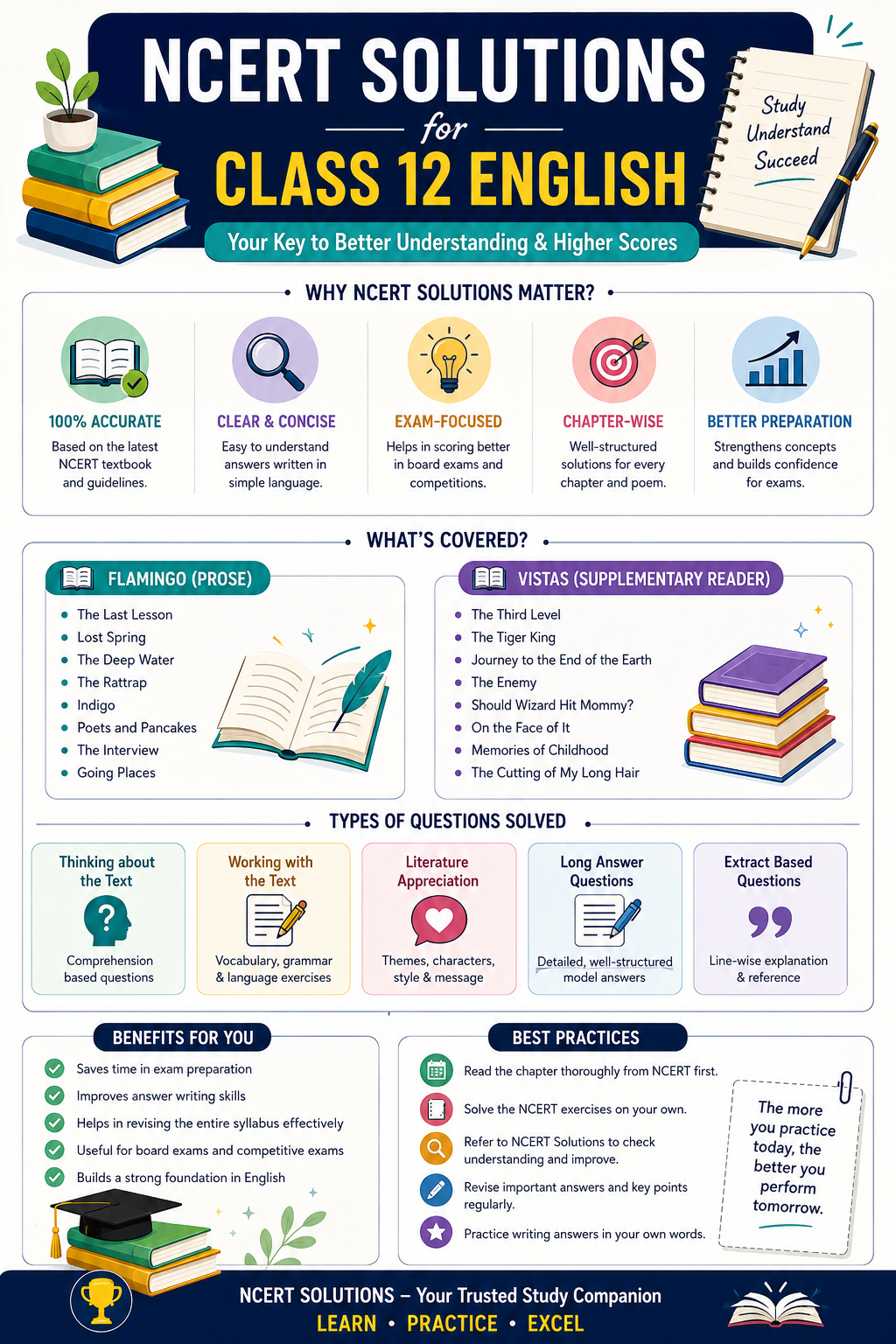
Why NCERT Solutions Matter for Class 12 English Board Exams
CBSE designs its question paper directly around the NCERT textbooks. Unlike subjects where reference books add significant value, Class 12 English board questions are almost entirely traceable to Flamingo and Vistas. The unseen passage section tests skills you build by reading NCERT prose carefully. The literature section tests your ability to interpret, analyse, and express ideas from the same NCERT chapters.
NCERT Solutions give you three concrete advantages:
- They show you how to frame answers the way CBSE expects — not too brief, not unnecessarily padded
- They highlight themes, symbols, and literary devices that appear in extract-based questions
- They train your writing muscle for both short-answer (3–4 marks) and long-answer (6 marks) questions
CBSE Class 12 English Exam Pattern
The written exam carries 80 marks and runs for three hours. The internal assessment — which includes listening, speaking skills, and project work — carries 20 marks, bringing the total to 100 marks.
The paper is divided into three sections: Reading Comprehension (Section A) worth 22 marks, Creative Writing Skills (Section B) worth 18 marks, and Literature from Flamingo and Vistas (Section C) worth 40 marks.
Table 1: CBSE Class 12 English Core – Mark Distribution (Theory Paper, 80 Marks)
| Section | Component | Marks |
|---|---|---|
| Section A – Reading Skills | Unseen Passage 1 (Comprehension, vocabulary, inference) | 12 |
| Unseen Passage 2 (Case-based with charts/data/visuals) | 10 | |
| Section B – Creative Writing Skills | Notice / Invitation & Reply | 4 |
| Letter (Formal / Application) | 5 | |
| Article / Report / Speech | 5 | |
| Long Writing Task (Feature / Debate) | 4 | |
| Section C – Literature | Extract from Prose (Flamingo) | 4 |
| Extract from Poetry (Flamingo) | 4 | |
| Short Answer Questions – Prose & Poetry | 8 | |
| Long Answer – Flamingo (Value-based / thematic) | 6 | |
| Extract from Vistas | 4 | |
| Long Answer – Vistas | 6 | |
| Long Answer – Flamingo or Vistas (Choice-based) | 8 | |
| TOTAL (Theory) | 80 |
Table 2: Internal Assessment Breakdown (20 Marks)
| Component | Marks |
|---|---|
| Listening Skills (ASL – Assessment of Speaking & Listening) | 5 |
| Speaking Skills | 5 |
| Project Work / Seminar Activity | 10 |
| Total | 20 |
Myclass24 Tip: Internal assessment marks are often left to chance. They are not — project work and ASL activities are evaluated on specific rubrics. Prepare a neat, well-researched project and practice speaking clearly in complete sentences.
Prescribed NCERT Textbooks for Class 12 English Core
CBSE prescribes two NCERT books for English Core: Flamingo, which serves as the main reader and contains both prose and poetry, and Vistas, which is the supplementary reader with longer, thematically rich stories.
Flamingo contains 8 prose chapters and 5 poems. Each story explores different themes, characters, and narrative styles, while the poetry section exposes students to diverse literary techniques from classic and modern poets.
NCERT Solutions for Class 12 English Flamingo – Prose Chapters
Chapter 1: The Last Lesson – Alphonse Daudet
This short story is set during the Franco-Prussian War. A young student named Franz arrives at school expecting his usual French lesson only to discover it is the last one — the Prussian government has ordered all schools in Alsace to teach German instead of French.
Central Theme: The relationship between language, identity, and nationhood. M. Hamel's emotional farewell drives home the idea that a people's language is a symbol of their freedom.
Key Literary Device: Irony — Franz, who always neglected French, suddenly feels its immense value on the day it is taken away.
Important Questions:
- What did Franz notice unusual about the school that morning?
- What did M. Hamel mean when he said French was the most beautiful language in the world?
Chapter 2: Lost Spring – Anees Jung
Anees Jung writes with journalistic precision about two children — Saheb, a ragpicker from Seemapuri on the outskirts of Delhi, and Mukesh, a young boy from Firozabad whose family has worked in the bangle industry for generations. Both children are trapped in cycles of poverty that leave them with no real spring of youth.
Central Theme: Child labour, the politics of poverty, and the failure of the system to protect its most vulnerable.
Key Literary Device: Contrast — between the glittering bangles the children make and the darkness of their own lives.
Important Questions:
- What forces prevent Mukesh from following his dream of becoming a motor mechanic?
- Why is the story titled "Lost Spring"?
Chapter 3: Deep Water – William O. Douglas
American jurist and author William O. Douglas recounts his lifelong fear of water after a near-drowning experience at a swimming pool as a child. He describes, with remarkable psychological honesty, how he eventually hired an instructor and conquered this terror.
Central Theme: Fear and the courage to overcome it. The chapter is also a meditation on self-determination.
Important Questions:
- How did the instructor help Douglas overcome his fear of water?
- What does Douglas mean when he says he was "handicapped" even after learning to swim?
Chapter 4: The Rattrap – Selma Lagerlöf
A Swedish tale about a peddler who sells rattraps and views the entire world as a rattrap that entices people with bait before snapping shut. After being shown unexpected kindness by the daughter of an ironmaster, the man is transformed.
Central Theme: Compassion and redemption. Human dignity, even in those society has written off, can be restored through genuine warmth.
Key Literary Device: Extended metaphor — the rattrap as a symbol for the temptations of the material world.
Chapter 5: Indigo – Louis Fischer
This chapter, an excerpt from Louis Fischer's biography of Gandhi, narrates the Champaran episode of 1917 — Gandhi's first major civil disobedience movement in India. It tells how Gandhi fought to free indigo farmers in Bihar from the exploitation of British planters.
Central Theme: Non-violent civil disobedience as a political tool. The power of solidarity and moral courage.
Important Questions:
- How did Gandhi resolve the conflict between the lawyers and the farmers?
- What was the significance of the Champaran movement for Indian independence?
Chapter 6: Poets and Pancakes – Asokamitran
A behind-the-scenes look at Gemini Studios in Chennai during the 1950s, written with gentle humour. The narrator describes the elaborate make-up room, the hierarchy at the studio, and eventually the visit of a British writer whose speech nobody understood — yet everyone applauded.
Central Theme: The absurdity of bureaucracy and the strange workings of the film world. Asokamitran's satire is light but pointed.
Chapter 7: The Interview – Christopher Silvester (Part 1) + Umberto Eco (Part 2)
This two-part chapter examines the interview as a literary form — its history, ethics, and influence — before presenting a real interview with the Italian semiotician Umberto Eco about his novel The Name of the Rose.
Central Theme: The nature of creativity and the power of conversation. Eco's insights on being both an academic and a storyteller make this chapter especially interesting.
Chapter 8: Going Places – A. R. Barton
A teenager named Sophie fantasises about meeting her football hero Danny Casey. The story explores the nature of adolescent fantasy and the gap between aspiration and reality in the life of a working-class family in England.
Central Theme: The psychology of escapism. Sophie's daydreams are her way of coping with a life that offers her few real choices.
NCERT Solutions for Class 12 English Flamingo – Poetry Section
Poem 1: My Mother at Sixty-Six – Kamala Das
One of the most emotionally resonant poems in the syllabus. The poet, sitting beside her ageing mother in a car, is struck by the fear of losing her. The poem moves between the mother's pallid, sleeping face and the bright, living world outside the window.
Key Poetic Devices: Simile (mother's face compared to a corpse, later to a late winter moon), imagery, enjambment.
Poem 2: Keeping Quiet – Pablo Neruda (Translated)
Neruda calls for a moment of universal silence — a pause from activity, noise, war, and aggression. He argues that this stillness is not death but a form of life that allows people to reconnect with themselves and with each other.
Key Poetic Devices: Paradox, repetition, apostrophe. The poem carries a powerful anti-war message.
Poem 3: A Thing of Beauty – John Keats
Drawn from Keats' epic poem Endymion, this extract argues that beauty is a permanent source of joy and consolation. Beautiful things — the sun, the moon, rivers, trees — remove the burden of suffering from human lives.
Key Poetic Devices: Imagery, alliteration, metaphor. Keats' Romanticism is on full display.
Poem 4: A Roadside Stand – Robert Frost
Frost writes about a small roadside stall set up by rural people hoping to earn some money from city tourists passing by. The tourists mostly ignore the stand. The poem is a meditation on economic inequality and the indifference of the privileged.
Key Poetic Devices: Irony, contrast, social commentary through everyday observation.
Poem 5: Aunt Jennifer's Tigers – Adrienne Rich
Aunt Jennifer stitches a panel of tigers — bold, proud, free-moving creatures — while she herself is weighed down by the burdens of a difficult marriage. After her death, the tigers she created will continue to prance, proud and unafraid.
Key Poetic Devices: Symbolism (tigers = freedom, courage), contrast between the tigers and Aunt Jennifer herself, feminist subtext.
NCERT Solutions for Class 12 English Vistas – Supplementary Reader
Vistas adds variety to the curriculum through thought-provoking and engaging stories that complement the thematic range of Flamingo.
Chapter 1: The Third Level – Jack Finney
A science fiction story in which a man named Charley discovers a mysterious third level at Grand Central Station that takes him back to 1894. The chapter raises questions about escapism, nostalgia, and the desire to flee from a world full of insecurity.
Chapter 2: The Tiger King – Kalki
A satirical tale about the Maharaja of Pratibandapuram who receives a prophecy that he will be killed by a tiger. He embarks on a mission to kill a hundred tigers. The story mocks authoritarian arrogance and the follies of the powerful.
Chapter 3: The Enemy – Pearl S. Buck
Set in Japan during World War II, a Japanese doctor finds a wounded American prisoner of war and must choose between his patriotic duty and his medical oath. A deeply humanistic story about the conflict between institutional loyalty and individual conscience.
Chapter 4: On the Face of It – Susan Hill
A dramatic piece about an old man named Mr. Lamb who has a tin leg and a boy named Derry who has a scarred face. Both are social outcasts who form an unexpected friendship. The play asks us to question how society defines normalcy and disability.
Chapter 5: Memories of Childhood (Two Parts)
Part 1: The Cutting of My Long Hair by Zitkala-Sa
A Native American woman recalls the trauma of having her hair forcibly cut at a boarding school — an act that stripped her of her cultural identity.
Part 2: We Too Are Human Beings by Bama
A Tamil Dalit woman recounts childhood experiences of caste discrimination. After watching an elder carry a packet without touching it due to caste pollution rules, she begins to understand the oppression her community faces.
Both accounts explore colonisation, identity, and resistance from marginalised perspectives.
Table 3: Chapter-Wise Themes and Important Exam Topics
| Chapter / Poem | Book | Core Theme | Likely Exam Focus |
|---|---|---|---|
| The Last Lesson | Flamingo Prose | Language & Identity | Long answer, extract question |
| Lost Spring | Flamingo Prose | Poverty & Child Labour | Short answer, value-based question |
| Deep Water | Flamingo Prose | Fear & Courage | Short answer |
| The Rattrap | Flamingo Prose | Compassion & Redemption | Character analysis |
| Indigo | Flamingo Prose | Civil Disobedience | Long answer, factual recall |
| Poets and Pancakes | Flamingo Prose | Satire & Irony | Short answer |
| The Interview | Flamingo Prose | Creativity & Communication | Short answer |
| Going Places | Flamingo Prose | Fantasy vs Reality | Long answer |
| My Mother at Sixty-Six | Flamingo Poetry | Love & Loss | Extract, poetic devices |
| Keeping Quiet | Flamingo Poetry | Peace & Introspection | Extract, thematic question |
| A Thing of Beauty | Flamingo Poetry | Beauty & Joy | Extract, poetic devices |
| A Roadside Stand | Flamingo Poetry | Inequality & Indifference | Thematic question |
| Aunt Jennifer's Tigers | Flamingo Poetry | Gender & Freedom | Extract, symbolism |
| The Third Level | Vistas | Escapism & Nostalgia | Short answer |
| The Tiger King | Vistas | Satire on Power | Long answer |
| The Enemy | Vistas | Humanity over War | Value-based question |
| On the Face of It | Vistas | Disability & Society | Character sketch |
| Memories of Childhood | Vistas | Identity & Resistance | Comparative question |
Writing Skills Section – What CBSE Expects (Section B)
The writing section tests students on notice writing (up to 50 words), formal and informal invitations and replies, letter writing, article writing, report writing, and speech writing. Each format has a fixed structure that carries dedicated marks for format, content, and accuracy of spelling and grammar.
Formats You Must Know:
- Notice: Heading (NOTICE), date, title, body (within 50 words), name and designation of the issuer
- Formal Letter: Sender's address, date, receiver's address, subject line, salutation, body (3 paragraphs), complimentary close
- Article: Title, byline, introduction, body with subpoints, conclusion
- Report: Heading, byline, dateline, body with facts and quotes, conclusion
- Speech: Salutation, introduction (hook), body, conclusion with call to action
Myclass24 Tip: CBSE awards marks under three heads for writing tasks — Format (1–2 marks), Content (2–3 marks), and Accuracy of Language (1–2 marks). Even if your content is average, near-perfect grammar and format can earn you a comfortable score.
Reading Comprehension – How to Score Full Marks
The Reading Skills section tests comprehension, interpretation, analysis, and evaluation. The first passage may be factual, descriptive, or literary in nature, while the second passage is case-based and may include visual inputs like charts or statistical data.
Practical Strategies:
- Read the questions first — this helps you read the passage with a purpose
- Identify keywords in the question and scan the passage for the corresponding paragraph
- Do not lift full sentences verbatim — CBSE values your ability to paraphrase and restate
- Vocabulary questions (synonyms, antonyms, contextual meaning) are answered from the passage itself, not from memory
Deleted Chapters — What Not to Study
For the 2025–26 session, the poem "An Elementary School Classroom in a Slum" by Stephen Spender has been removed from Flamingo. Additionally, "Should Wizard Hit Mommy" and "Evans Tries an O-Level" have been removed from Vistas. Students should ensure they are not wasting revision time on chapters that will not appear in the exam.
Exam Day Strategy for Class 12 English
Time management inside the 3-hour paper:
- Section A (Reading) — 40–45 minutes. Do not over-read.
- Section B (Writing) — 40 minutes. Plan your letter or article for 3 minutes before writing.
- Section C (Literature) — 90 minutes. Attempt extract questions first, then long answers.
Answer writing tips:
- Begin every answer with a contextual sentence that shows you understand the question
- Use words from the chapter (character names, settings, specific incidents) to make answers precise
- In poetry questions, always name at least one poetic device and explain its effect
- Value-based long answers (6 marks) must connect the chapter to a broader human value — honesty, compassion, justice, perseverance
How to Use NCERT Solutions Effectively on Myclass24
NCERT Solutions are not meant to be memorised. They are meant to be understood and then rewritten in your own words. Here is a three-step method:
- Read the chapter first — without looking at solutions. Note your own understanding of the story or poem.
- Check the NCERT Solution — compare your thoughts with the model answer. Identify what you missed.
- Write your own version — close the solution and write the answer independently. This is the only technique that actually works in a board exam.
For poetry chapters, spend additional time on:
- Central idea of the poem
- All similes, metaphors, and symbols
- The mood and tone of the poet
- Two or three important lines with their explanation
Quick Reference: Scoring Chapters to Prioritise
Based on past CBSE question papers and frequency of questions, these chapters and poems carry the highest exam value:
Must-prepare chapters (Prose): The Last Lesson, Lost Spring, Indigo, The Rattrap, Going Places
Must-prepare poetry: My Mother at Sixty-Six, Keeping Quiet, Aunt Jennifer's Tigers, A Thing of Beauty
Must-prepare Vistas: The Tiger King, The Enemy, Memories of Childhood, On the Face of It
English is not about cramming answers. It is about understanding stories, connecting ideas, and expressing them clearly. The students who score 95+ in Class 12 English are not those with the best vocabulary — they are the ones who read every NCERT chapter carefully, practised writing formats consistently, and managed their three hours intelligently on exam day.
FAQs on NCERT Solutions for Class 12 English
NCERT Solutions for Class 12 English are highly valuable because they help students understand the themes, characters, literary devices, and important messages presented in the chapters and poems. English is not only about reading texts but also about interpreting ideas and expressing them effectively in answers. These solutions provide clear explanations that make complex stories and poems easier to understand. Students can learn how to write well-structured answers that meet examination requirements. Regular study of NCERT Solutions improves comprehension, vocabulary, and writing skills. Since many board examination questions are based on the prescribed textbook, understanding each chapter thoroughly through these solutions helps students prepare confidently and perform better in examinations.
NCERT Solutions help students develop answer-writing skills by demonstrating how to present ideas clearly and logically. The solutions explain important questions in a structured format, showing students how to introduce, explain, and conclude their answers effectively. This helps learners understand the expected writing style in board examinations. Students also learn how to support their answers with relevant examples from the text. Regular practice improves sentence formation, grammar, and clarity of expression. Over time, students become more confident in writing both short and long answers. Strong answer-writing skills not only improve examination scores but also enhance overall communication abilities, which are valuable for higher education and future careers.
Yes, NCERT Solutions for Class 12 English significantly improve comprehension skills by helping students understand the deeper meaning of stories, poems, and prose chapters. These solutions explain themes, symbolism, character development, and literary techniques in simple language. Students learn how to analyze a text rather than merely reading it. This develops critical thinking and improves the ability to interpret passages accurately. Better comprehension also helps students answer unseen passage questions more effectively. Regular reading and revision of NCERT Solutions increase confidence in understanding complex texts and improve overall language proficiency. Strong comprehension skills are essential for scoring well in English examinations and for effective communication in everyday life.
Students should focus on all sections of the syllabus, but some areas require extra attention due to their importance in examinations. The prose and poetry sections often contain questions related to themes, character sketches, literary devices, and important messages. Supplementary chapters are also significant because they frequently contribute to long-answer questions. Additionally, writing skills such as notices, invitations, reports, articles, and letters require regular practice. Reading comprehension passages should not be ignored, as they contribute substantially to overall marks. Consistent preparation across all sections ensures balanced performance and reduces the risk of losing marks in any particular area of the examination.
NCERT Solutions provide a strong foundation for scoring high marks because they cover all prescribed chapters and important questions in detail. Students who thoroughly understand the textbook content and practice writing answers regularly often perform well in examinations. However, achieving excellent marks also requires improving grammar, vocabulary, comprehension, and writing skills. Students should read chapters carefully, revise important themes, and practice different writing formats. Consistent revision and self-assessment help identify weak areas that need improvement. When combined with regular reading and answer-writing practice, NCERT Solutions can play a major role in helping students achieve outstanding results in Class 12 English examinations.
NCERT Solutions are highly effective for revision because they summarize key concepts, themes, and important questions chapter-wise. Students can revise chapter summaries, character sketches, and central ideas before examinations. Attempting questions independently and then comparing answers with the solutions helps identify mistakes and improve understanding. Creating short notes from important explanations can make last-minute revision easier. Revising literary devices, important quotations, and writing formats regularly strengthens preparation. Consistent revision helps students retain information and recall it quickly during examinations. Using NCERT Solutions systematically ensures comprehensive coverage of the syllabus and improves confidence before the final examination.
Poetry can sometimes be challenging because poets often use figurative language, symbolism, and deeper meanings. NCERT Solutions simplify poems by explaining their themes, emotions, literary devices, and messages in an easy-to-understand manner. Students learn the significance of metaphors, imagery, personification, and other poetic techniques. These explanations help readers appreciate the poet’s ideas and understand the context more effectively. By studying the solutions, students gain confidence in answering questions related to poetic interpretation and critical analysis. Regular revision of poem summaries and important themes also improves retention and helps students perform better in examinations.
The supplementary reader is important because it contains stories that develop critical thinking, moral understanding, and analytical skills. Many examination questions are based on the themes, characters, and events presented in these chapters. NCERT Solutions help students understand the central message and important details of each story. They also explain character motivations and significant incidents that may be asked in examinations. By studying these solutions, students can prepare comprehensive answers and develop a deeper appreciation for literature. Thorough preparation of the supplementary reader contributes significantly to overall performance in Class 12 English examinations.
Practicing all textbook questions ensures that students understand every important aspect of the chapters and poems. These questions are designed to test comprehension, interpretation, and analytical thinking. By solving all questions, students become familiar with different answer formats and examination patterns. Regular practice improves writing speed, accuracy, and confidence. It also helps students identify important themes and recurring concepts across different chapters. Since many board examination questions are based on textbook content, practicing all questions thoroughly increases preparedness. This comprehensive approach enables students to answer examination questions more effectively and achieve better results.
Students can avoid common mistakes by reading questions carefully and understanding exactly what is being asked before writing an answer. Answers should be clear, concise, and relevant to the question. Maintaining proper grammar, spelling, and sentence structure is essential for securing good marks. Students should avoid unnecessary repetition and focus on presenting ideas logically. Practising writing formats regularly helps prevent errors in the writing section. Effective time management during examinations ensures that sufficient time is available for revision. Consistent use of NCERT Solutions helps students understand the expected answer style and reduces mistakes, leading to better performance in Class 12 English examinations.