





NCERT Solutions for Class 10 Science are essential for students preparing for board exams, competitive exams, and overall concept clarity. The Class 10 Science syllabus is divided into Physics, Chemistry, and Biology, covering fundamental topics crucial for higher studies and competitive exams like NEET, JEE, and NTSE.
Why Use NCERT Solutions for Class 10 Science?
- Accurate and Step-wise Solutions – NCERT solutions provide detailed explanations to all textbook exercises, ensuring a strong conceptual foundation.
- Board Exam Relevance – CBSE follows NCERT textbooks, making these solutions highly important for scoring high marks in exams.
- Chapter-wise PDFs – Students can access free, chapter-wise NCERT solutions for effective revision and practice.
- Boosts Problem-Solving Skills – With solved examples, derivations, and numericals, these solutions enhance problem-solving abilities.
- Helpful for Competitive Exams – Topics like Electricity, Chemical Reactions, Genetics, and Evolution are fundamental for higher-level exams like JEE and NEET.
Topics Covered in NCERT Solutions for Class 10 Science
- Physics – Light, Electricity, Magnetic Effects, Sources of Energy
- Chemistry – Chemical Reactions, Acids-Bases, Metals & Non-Metals, Carbon Compounds
- Biology – Life Processes, Control & Coordination, Heredity, Environment
NCERT Solutions for Class 10 Science – Chapter-wise List
| Chapter No. | Chapter Name |
|---|---|
| Chapter 1 | Chemical Reactions and Equations |
| Chapter 2 | Acids, Bases and Salts |
| Chapter 3 | Metals and Non-Metals |
| Chapter 4 | Carbon and Its Compounds |
| Chapter 5 | Life Processes |
| Chapter 6 | Control and Coordination |
| Chapter 7 | How Do Organisms Reproduce? |
| Chapter 8 | Heredity |
| Chapter 9 | Light – Reflection and Refraction |
| Chapter 10 | The Human Eye and the Colourful World |
| Chapter 11 | Electricity |
| Chapter 12 | Magnetic Effects of Electric Current |
| Chapter 13 | Our Environment |
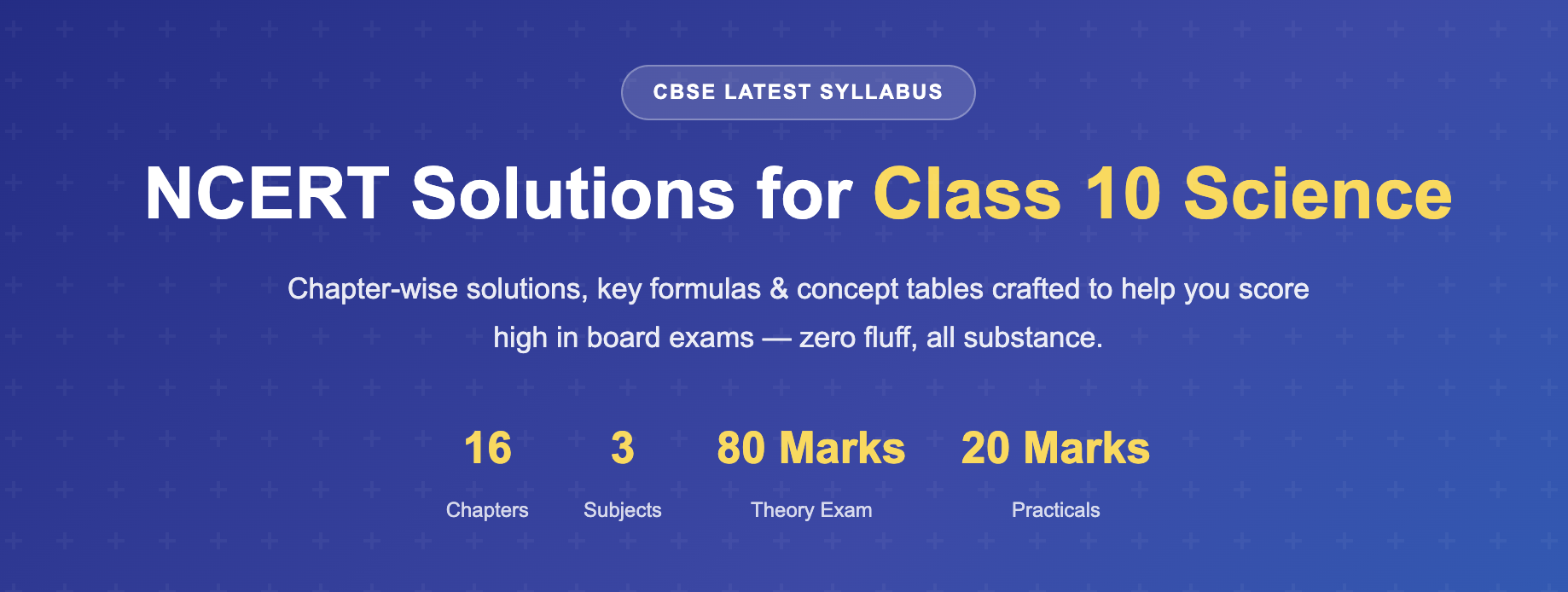
About NCERT Solutions for Class 10 Science
CBSE NCERT Class 10 Science is divided across three core domains — Physics, Chemistry, and Biology — integrating concepts from the natural world with real-life applications. Science remains one of the highest-scoring yet most challenging subjects at the secondary level.
This page consolidates every chapter's solutions, important formulas, key definitions, and topic-weight data in one place. Whether you are revising a single chapter or building a full exam strategy, use the tables below as your go-to reference.
Chapter-wise Overview — All 16 Chapters
| Ch. | Chapter Name | Subject | Core Concept | Board Weightage |
|---|---|---|---|---|
| 1 | Chemical Reactions and Equations | Chemistry | Types of chemical reactions; balancing equations | ~8 Marks |
| 2 | Acids, Bases and Salts | Chemistry | pH scale, neutralization, salts formation | ~9 Marks |
| 3 | Metals and Non-metals | Chemistry | Reactivity series, ionic bonding, corrosion | ~8 Marks |
| 4 | Carbon and its Compounds | Chemistry | Covalent bonding, homologous series, organic reactions | ~7 Marks |
| 5 | Life Processes | Biology | Nutrition, respiration, transportation, excretion | ~10 Marks |
| 6 | Control and Coordination | Biology | Nervous system, hormones, reflex action | ~8 Marks |
| 7 | How do Organisms Reproduce? | Biology | Asexual & sexual reproduction, DNA copying | ~8 Marks |
| 8 | Heredity | Biology | Mendel's laws, variation, sex determination | ~7 Marks |
| 9 | Light — Reflection and Refraction | Physics | Mirror/lens formulae, refractive index, ray diagrams | ~10 Marks |
| 10 | The Human Eye and the Colourful World | Physics | Accommodation, defects of vision, atmospheric refraction | ~5 Marks |
| 11 | Electricity | Physics | Ohm's law, resistance, series & parallel circuits | ~9 Marks |
| 12 | Magnetic Effects of Electric Current | Physics | Electromagnet, Fleming's rules, AC vs DC | ~7 Marks |
| 13 | Our Environment | Biology | Ecosystem, food chains, ozone depletion, waste management | ~5 Marks |
| 14 | Chemical Reactions (Practical) | Chemistry | Lab-based observation questions | ~3 Marks |
| 15 | Periodic Classification of Elements | Chemistry | Döbereiner, Newlands, Mendeleev, Modern periodic table | ~4 Marks |
| 16 | Sources of Energy | Physics | Conventional vs renewable energy, nuclear energy basics | ~5 Marks |
Master Formula Table — Physics, Chemistry & Biology
Every board-relevant formula with its variables clearly explained. Learn these cold before the exam.
| Formula | Meaning |
|---|---|
| 1/f = 1/v + 1/u | Mirror formula; f=focal length, v=image dist., u=object dist. |
| m = -v/u = h₂/h₁ | Magnification for mirrors |
| n = c/v | Refractive index; c=speed of light in vacuum |
| n = sin i / sin r | Snell's law of refraction |
| 1/f = 1/v - 1/u | Lens formula (sign convention) |
| P = 1/f (in m) | Power of lens in Dioptres (D) |
| V = IR | Ohm's Law; V=voltage, I=current, R=resistance |
| R = ρL/A | Resistance; ρ=resistivity, L=length, A=area |
| P = VI = I²R = V²/R | Electric Power (in Watts) |
| H = I²Rt | Joule's heating effect |
| R_s = R₁+R₂+R₃ | Resistors in series |
| 1/Rₚ = 1/R₁+1/R₂+1/R₃ | Resistors in parallel |
| Reaction / Rule | Example / Explanation |
|---|---|
| A + B → AB | Combination reaction (e.g., CaO + H₂O → Ca(OH)₂) |
| AB → A + B | Decomposition reaction |
| A + BC → AC + B | Single displacement (more reactive displaces less) |
| AB + CD → AD + CB | Double displacement / precipitation |
| pH < 7 | Acidic solution; pH = 7 neutral; pH > 7 basic |
| Acid + Base → Salt + H₂O | Neutralization reaction |
| CₙH₂ₙ₊₂ | General formula — Alkanes (saturated hydrocarbons) |
| CₙH₂ₙ | General formula — Alkenes |
| CₙH₂ₙ₋₂ | General formula — Alkynes |
| Valency of metals ↑ | Reactivity increases down Group 1 & 2 |
| Process / Formula | What it represents | Chapter |
|---|---|---|
| 6CO₂ + 6H₂O → C₆H₁₂O₆ + 6O₂ | Photosynthesis — light energy converts CO₂ and water into glucose | Life Processes |
| C₆H₁₂O₆ + 6O₂ → 6CO₂ + 6H₂O + ATP | Aerobic respiration — glucose breakdown releases energy | Life Processes |
| C₆H₁₂O₆ → 2C₂H₅OH + 2CO₂ | Anaerobic fermentation (yeast) — no oxygen needed | Life Processes |
| Tall (TT or Tt) : Short (tt) → 3:1 | Mendel's F₂ phenotypic ratio in monohybrid cross | Heredity |
| Genotypic ratio = 1TT : 2Tt : 1tt | F₂ genotypic ratio in monohybrid cross | Heredity |
| Dihybrid F₂ = 9:3:3:1 | Phenotypic ratio for two independently assorting traits | Heredity |
| Trophic efficiency ≈ 10% | Only ~10% energy passes from one trophic level to next (10% law) | Our Environment |
Chapter-wise Key Points Students Must Know
High-frequency board exam concepts distilled per chapter — ideal for last-minute revision.
Light — Reflection & Refraction (Ch. 9)
- Concave mirror converges light; convex mirror diverges
- Real and virtual images differ by position of object
- New Cartesian Sign Convention: distances from pole
- Convex lens — converging; Concave lens — diverging
- Power of combination = P₁ + P₂ + ...
- Optically denser medium → light bends toward normal
Electricity (Ch. 11)
- Electric current = charge / time (I = Q/t)
- Potential difference drives current through circuit
- Series: same current, voltages add up
- Parallel: same voltage, currents add up
- Household circuits use parallel connections
- 1 kWh = 3,600,000 J (commercial unit of energy)
Magnetic Effects (Ch. 12)
- Fleming's Left-Hand Rule → motor effect
- Fleming's Right-Hand Rule → generator effect
- AC reverses direction; DC flows one way
- Frequency of AC in India = 50 Hz
- Earth's magnetic field — geographic vs magnetic poles differ
Chemical Reactions (Ch. 1)
- Balanced equation follows law of conservation of mass
- Oxidation = loss of electrons / gain of oxygen
- Reduction = gain of electrons / loss of oxygen
- Redox reactions occur simultaneously
- Exothermic: releases heat | Endothermic: absorbs heat
- Rancidity — fat oxidation; prevented by antioxidants/N₂
Acids, Bases & Salts (Ch. 2)
- Acids donate H⁺; bases accept H⁺ (Brønsted concept)
- All acids and bases conduct electricity (electrolytes)
- Na₂CO₃ — washing soda; NaHCO₃ — baking soda
- pH paper vs universal indicator for identification
- Buffer solutions resist pH change
Carbon & Compounds (Ch. 4)
- Carbon forms 4 covalent bonds (tetravalent)
- Catenation = carbon chains itself uniquely
- Functional groups determine chemical properties
- Saponification: oil + NaOH → soap + glycerol
- Micelles — soap cleaning action mechanism
Life Processes (Ch. 5)
- Autotrophs make their own food; heterotrophs depend on others
- Stomata regulate gas exchange in leaves
- Human heart — 4 chambers; double circulation
- Nephron is the structural and functional unit of kidney
- Osmoregulation — kidneys regulate water balance
Control & Coordination (Ch. 6)
- Neuron — basic unit of nervous system
- Reflex arc bypasses the brain for quick responses
- Hormones — chemical messengers; produced by endocrine glands
- Insulin lowers blood sugar; Glucagon raises it
- Thyroxin controls metabolic rate; requires iodine
- Adrenaline — emergency hormone ("fight or flight")
Heredity (Ch. 8)
- Gregor Mendel — Father of Genetics
- Dominant allele masks recessive in heterozygous condition
- XX = female; XY = male (sex chromosomes in humans)
- Variation arises from sexual reproduction and mutation
- Evolution — gradual change in heritable characteristics over generations
Unit-wise Marks Distribution
Knowing where the marks come from is half the strategy. Allocate study time accordingly.
| Unit No. | Unit Name | Chapters Covered | Subject Area | Marks (Theory) |
|---|---|---|---|---|
| I | Chemical Substances — Nature & Behaviour | Ch. 1, 2, 3, 4, 15 | Chemistry | 25 |
| II | World of Living | Ch. 5, 6, 7, 8 | Biology | 25 |
| III | Natural Phenomena | Ch. 9, 10 | Physics | 12 |
| IV | Effects of Current & Sources of Energy | Ch. 11, 12, 16 | Physics | 13 |
| V | Natural Resources | Ch. 13 | Biology | 5 |
| Total Theory Marks → | 80 | |||
| Internal Assessment (Practicals) → | 20 | |||
| Grand Total → | 100 | |||
| Question Type | No. of Questions | Marks Each | Total Marks | Strategy |
|---|---|---|---|---|
| Multiple Choice (MCQ) | 20 | 1 | 20 | Concept clarity + elimination |
| Very Short Answer (VSA) | 6 | 2 | 12 | Precise 1–2 line answers |
| Short Answer (SA) | 7 | 3 | 21 | Diagrams score extra marks |
| Long Answer (LA) | 3 | 5 | 15 | Structure: intro + body + conclusion |
| Case-based Questions | 3 | 4 | 12 | Read passage carefully before answering |
| Total | 80 | Time: 3 hours | ||
Important Definitions Table — Board Exam Ready
One-line definitions students most frequently need in their answers.
| Term | Definition | Chapter | Subject |
|---|---|---|---|
| Corrosion | Gradual eating away of a metal due to reaction with moisture, oxygen or chemicals in environment | Ch. 3 | Chemistry |
| Catenation | Unique property of carbon to form long chains by bonding with itself | Ch. 4 | Chemistry |
| Isomers | Compounds having same molecular formula but different structural arrangements | Ch. 4 | Chemistry |
| Refraction | Bending of light as it passes from one medium to another due to change in speed | Ch. 9 | Physics |
| Power of Accommodation | Ability of the eye lens to change its focal length for near and far vision | Ch. 10 | Physics |
| Resistivity | Intrinsic property of material determining its electrical resistance per unit dimension | Ch. 11 | Physics |
| Electromagnet | Temporary magnet formed when current flows through a coil wound around a soft iron core | Ch. 12 | Physics |
| Osmosis | Movement of water molecules from a region of lower solute concentration to higher through a semi-permeable membrane | Ch. 5 | Biology |
| Synapse | Tiny gap between two nerve cells across which nerve impulse is transmitted via neurotransmitters | Ch. 6 | Biology |
| Pollination | Transfer of pollen grains from anther to stigma of a flower, enabling fertilisation | Ch. 7 | Biology |
| Allele | Alternative forms of a gene that code for different versions of the same trait | Ch. 8 | Biology |
| Biodegradable | Substances that can be broken down by biological processes (bacteria, fungi) into simpler compounds | Ch. 13 | Biology |
| Döbereiner's Triads | Groups of 3 elements with similar properties where middle element's atomic mass ≈ average of other two | Ch. 15 | Chemistry |
| Biomass | Organic material derived from plants and animals used as a renewable energy source | Ch. 16 | Physics |
Smart Exam Strategy for Class 10 Science
Evidence-based tips from CBSE topper analysis — what actually moves your score.
Top Strategies That Work
FAQs on NCERT Solutions for Class 10 Science
NCERT Solutions for Class 10 Science are important because they help students understand every concept explained in the textbook in a clear and systematic way. Most board examination questions are based directly or indirectly on NCERT concepts, making these solutions a reliable study resource. They provide step-by-step answers that explain the logic behind scientific principles instead of encouraging rote learning. Students can use them to clarify doubts, improve answer-writing skills, and learn the correct format for presenting responses in exams. Regular practice with NCERT Solutions also strengthens conceptual understanding in Physics, Chemistry, and Biology. As students become familiar with important questions and explanations, they gain confidence and improve their ability to solve both short-answer and long-answer questions effectively.
NCERT Solutions help students score high marks by providing accurate and well-structured answers to textbook questions. They explain important concepts in a simple manner, making it easier to understand complex scientific topics. Students learn how to write answers according to examination requirements, which improves presentation and clarity. Practicing these solutions regularly helps identify common question patterns and strengthens subject knowledge. Since many examination questions are concept-based, a strong understanding of NCERT content increases the chances of answering correctly. The solutions also save time during revision because all important explanations are organized chapter-wise. With consistent practice and revision, students can improve accuracy, reduce mistakes, and develop confidence needed to perform well in school and board examinations.
For most students, NCERT Solutions provide a strong foundation for board exam preparation because they cover all textbook questions and explain key concepts thoroughly. The syllabus and examination pattern are largely based on NCERT content, making these solutions highly valuable. However, students aiming for exceptional scores should also practice sample papers, previous years' questions, and competency-based questions. NCERT Solutions help in understanding concepts, but additional practice improves speed, application skills, and confidence. The combination of textbook study, NCERT Solutions, and regular revision creates a balanced preparation strategy. By focusing on understanding rather than memorization, students can effectively answer both direct and analytical questions that may appear in examinations.
Every chapter in Class 10 Science is important, but some chapters are frequently considered high-scoring due to their weightage and conceptual significance. Chemical Reactions and Equations, Life Processes, Electricity, Light Reflection and Refraction, Heredity and Evolution, and Our Environment are often highlighted by students and teachers. These chapters contain important diagrams, numerical problems, and theory-based questions that appear regularly in examinations. NCERT Solutions for these chapters help students understand concepts in depth and prepare answers accurately. However, students should avoid ignoring any chapter because board examinations can include questions from the entire syllabus. A balanced preparation approach ensures better understanding and reduces the risk of missing important topics.
Students should first complete reading the chapter from the textbook and understand all concepts before using NCERT Solutions. During revision, they can solve textbook exercises independently and then compare their answers with the solutions. This method helps identify mistakes and improve understanding. Important definitions, formulas, diagrams, and scientific explanations should be noted separately for quick revision. Revisiting NCERT Solutions multiple times before exams reinforces learning and boosts confidence. Students can also use these solutions to revise difficult topics and practice answer-writing techniques. A chapter-wise revision plan combined with regular self-assessment helps retain information effectively. This structured approach ensures better preparation and reduces stress during examinations.
Yes, NCERT Solutions are extremely helpful for understanding numerical questions, especially in chapters related to Physics. They provide detailed step-by-step explanations that show how formulas are applied and calculations are performed. Students learn how to identify given values, choose the correct formula, and arrive at accurate answers. This systematic approach improves problem-solving skills and reduces confusion while solving numerical questions. Regular practice with solved examples also helps students develop speed and accuracy. By understanding the reasoning behind each step, students can confidently solve similar questions in examinations. Numerical practice through NCERT Solutions strengthens conceptual clarity and prepares students for application-based questions that require logical thinking and mathematical accuracy.
Conceptual understanding is essential because Science is based on principles, observations, and logical reasoning rather than memorization alone. When students understand concepts clearly, they can answer questions in different formats and apply their knowledge to new situations. NCERT Solutions explain the reasoning behind scientific phenomena, helping students connect theory with practical examples. This approach improves analytical thinking and makes learning more meaningful. Strong concepts also help students remember information for longer periods and reduce examination stress. Whether solving numerical problems, drawing conclusions from experiments, or answering theoretical questions, conceptual clarity plays a key role. Students who focus on understanding concepts generally perform better than those who rely only on memorizing answers.
NCERT Solutions significantly improve answer-writing skills by demonstrating how answers should be structured and presented. Students learn to write concise, accurate, and logically organized responses that meet examination expectations. They understand how to include relevant scientific terms, definitions, diagrams, and explanations within their answers. This practice helps avoid unnecessary details and improves clarity. Regular exposure to well-written solutions also develops confidence in expressing scientific concepts correctly. During examinations, students who have practiced with NCERT Solutions can write answers more efficiently and effectively. Good answer presentation often leaves a positive impression and helps secure better marks. Therefore, NCERT Solutions serve as both a learning tool and a guide for effective answer writing.
Many students find certain Science chapters challenging because they contain complex concepts, scientific terminology, or calculations. NCERT Solutions simplify these topics by breaking explanations into smaller, easy-to-understand steps. Difficult questions are solved systematically, helping students understand the logic behind each answer. This method reduces confusion and makes learning more approachable. Students can revisit explanations multiple times until concepts become clear. The solutions also provide confidence by showing the correct approach to solving problems and answering theoretical questions. With regular practice, even challenging chapters become easier to understand and revise. This gradual improvement helps students develop a positive attitude toward Science and perform better in examinations.
The best strategy is to begin each chapter by carefully reading the textbook and understanding the concepts. After completing the chapter, students should attempt all textbook questions on their own. NCERT Solutions should then be used to verify answers and learn the correct approach. Important points, diagrams, formulas, and definitions should be revised regularly. Weekly revision sessions help strengthen memory and identify weak areas. Students should also solve sample papers and practice application-based questions alongside NCERT Solutions. Consistency is the key to success. Studying a little every day, rather than cramming before exams, improves understanding and retention. This balanced strategy helps students build confidence and achieve excellent results in Science.