





NCERT Solutions for Class 10 English: A Complete Study Guide for First Flight and Footprints Without Feet
Class 10 is the year everything starts to feel real. The board exam is no longer a distant rumour passed down by seniors — it's an actual date on the calendar. And somewhere in the middle of juggling Maths formulas and Science diagrams, English often gets pushed to the side, treated as the subject you'll "just read the night before." That approach rarely works out the way students hope.
The two Books for NCERT Solutions for Class 10 English Are
NCERT Solutions for Class 10 English: First Flight (Prose & Poetry)
NCERT Solutions for Class 10 English: Footprints Without Feet
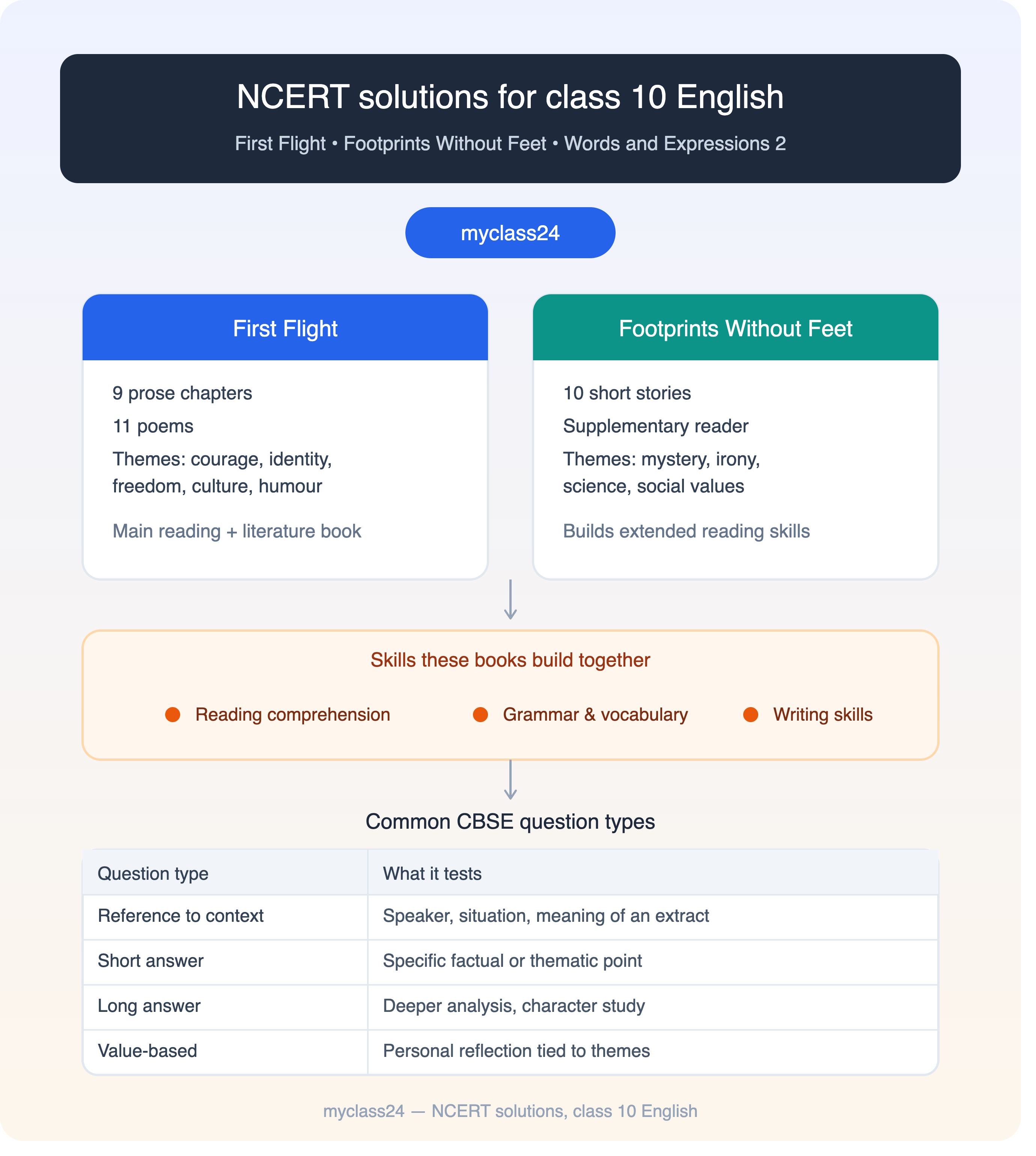
English in Class 10 is built around two textbooks — First Flight and Footprints Without Feet — along with the workbook Words and Expressions 2. Together, they test reading comprehension, literary understanding, grammar, and writing in ways that genuinely reward preparation. NCERT solutions exist to make that preparation structured rather than chaotic, turning a textbook full of stories and poems into something you can actually revise systematically before the exam.
This guide walks through how Class 10 English is structured, what each chapter is really testing, and how to use NCERT solutions in a way that builds understanding instead of just filling notebook pages.
NCERT Solutions for Class 10 English First Flight – Prose & Poem Chapter-wise List
First Flight – Prose
| Chapter No. | Prose Chapter Name |
|---|---|
| Chapter 1 | A Letter to God |
| Chapter 2 | Nelson Mandela: Long Walk to Freedom |
| Chapter 3 | Two Stories About Flying |
| Chapter 4 | From the Diary of Anne Frank |
| Chapter 5 | Glimpses of India |
| Chapter 6 | Mijbil the Otter |
| Chapter 7 | Madam Rides the Bus |
| Chapter 8 | The Sermon at Benares |
| Chapter 9 | The Proposal |
First Flight – Poems
| Chapter No. | Poem Name |
|---|---|
| Chapter 1 | Dust of Snow & Fire and Ice |
| Chapter 2 | A Tiger in the Zoo |
| Chapter 3 | How to Tell Wild Animals & The Ball Poem |
| Chapter 4 | Amanda! |
| Chapter 5 | The Trees |
| Chapter 6 | Fog |
| Chapter 7 | The Tale of Custard the Dragon |
| Chapter 8 | For Anne Gregory |
NCERT Solutions for Class 10 English Footprints Without Feet
| Chapter No. | Chapter Name | View Solutions |
|---|---|---|
| Chapter 1 | A Triumph of Surgery | View Solutions |
| Chapter 2 | The Thief's Story | View Solutions |
| Chapter 3 | The Midnight Visitor | View Solutions |
| Chapter 4 | A Question of Trust | View Solutions |
| Chapter 5 | Footprints without Feet | View Solutions |
| Chapter 6 | The Making of a Scientist | View Solutions |
| Chapter 7 | The Necklace | View Solutions |
| Chapter 8 | Bholi | View Solutions |
| Chapter 9 | The Book That Saved the Earth | View Solutions |
NCERT Solutions for Class 10 English – First Flight (Main Book)
Prose (Stories)
- A Letter to God – This story by Gregorio López y Fuentes portrays the power of faith as a farmer, Lencho, writes a letter to God asking for financial help after a storm destroys his crops. The NCERT solutions explain the moral values of faith, hope, and irony in the story.
- Nelson Mandela: Long Walk to Freedom – An excerpt from Nelson Mandela’s autobiography, this chapter highlights struggles against apartheid and the values of freedom, equality, and courage. The solutions help in understanding Mandela’s vision and the significance of his speech.
- Two Stories about Flying
- Part 1: His First Flight – A young seagull overcomes his fear of flying.
- Part 2: Black Aeroplane – A mysterious experience during a storm teaches the importance of bravery and unknown forces of life.
- From the Diary of Anne Frank – This real-life diary entry captures the emotions of Anne Frank, a Jewish girl during WWII. The solutions focus on themes like loneliness, self-reflection, and war-time hardships.
- The Hundred Dresses – I & II – A touching story about bullying, kindness, and regret, explaining how Wanda, a poor girl, was teased by her classmates for wearing the same dress daily. The solutions emphasize social justice and empathy.
- Glimpses of India
- A Baker from Goa – The importance of traditional Goan bakers in daily life.
- Coorg – A beautiful description of Coorg’s culture, bravery, and scenic beauty.
- Tea from Assam – A glimpse into India’s tea industry and its history.
- Mijbil the Otter – A humorous and emotional story about an otter’s journey from Iraq to England. The solutions explore themes of friendship, adventure, and pet bonding.
- Madam Rides the Bus – A simple yet thought-provoking story of a young girl, Valli, who experiences life’s realities through a bus ride. The solutions highlight themes of childhood curiosity and adventure.
- The Sermon at Benares – This chapter discusses Buddha’s first sermon, where he teaches about life’s suffering and detachment. The solutions help students grasp Buddhism’s core principles.
- The Proposal – A humorous one-act play about marriage, arguments, and human behavior. The solutions analyze character roles and social satire.
Poetry Section
- Dust of Snow – A short poem by Robert Frost about nature’s power to change moods and emotions.
- Fire and Ice – A deep metaphorical poem discussing destruction by desire and hatred.
- A Tiger in the Zoo – Explores the contrast between a wild and captive tiger, symbolizing freedom vs. confinement.
- How to Tell Wild Animals – A fun, descriptive poem about identifying different wild animals.
- The Ball Poem – Reflects on loss and growing up through a child’s experience of losing a ball.
- Amanda! – A poem about childhood freedom vs. societal expectations.
- Animals – Compares human selfishness with animals’ simplicity and honesty.
- The Trees – Symbolize nature’s power to break free from human control.
- Fog – A short, metaphorical poem comparing fog to a cat.
- The Tale of Custard the Dragon – A humorous ballad about bravery and cowardice.
- For Anne Gregory – Discusses inner beauty vs. external appearance.
NCERT Solutions for Class 10 English – Footprints Without Feet (Supplementary Reader)
- A Triumph of Surgery – A humorous story about a rich lady spoiling her dog with overfeeding, leading to its hospitalization. The solutions explain excessive care and discipline in life.
- The Thief’s Story – A story about trust and transformation, where a young thief reforms after meeting a kind-hearted man.
- The Midnight Visitor – A thrilling spy story with an unexpected twist, teaching about intelligence over physical strength.
- A Question of Trust – A classic crime story about a thief who gets tricked himself, highlighting irony and deception.
- Footprints Without Feet – A fascinating sci-fi story about an invisible scientist. The solutions focus on scientific advancements and moral dilemmas.
- The Making of a Scientist – A real-life story about Richard Ebright’s journey from a curious child to a famous scientist, inspiring students to pursue knowledge.
- The Necklace – A well-known story about greed, vanity, and irony, where a woman’s desire for luxury leads to unexpected consequences.
- The Hack Driver – A humorous yet insightful story about a young lawyer being fooled by a clever villager. The solutions discuss human nature and deception.
- Bholi – A touching story about a neglected village girl who overcomes social barriers. The solutions highlight women’s empowerment and self-confidence.
- The Book That Saved the Earth – A humorous sci-fi story about aliens misunderstanding a nursery rhyme book as Earth’s secret weapon! The solutions focus on miscommunication and humor in literature.
Why Class 10 English Deserves More Attention Than It Gets
There's a common belief that English is a "scoring subject" that doesn't need much effort. To an extent, that's true — English rewards clarity and structure far more than rote memorisation. But that same quality is what makes it easy to underprepare for. Without a study plan, you end up reading a chapter once, vaguely remembering the plot, and hoping the exam questions match what you remember.
NCERT solutions help fix this by breaking every chapter into the exact question patterns CBSE uses — short answers, long answers, value-based questions, and reference-to-context extracts. Practising with these patterns trains you to write answers the way examiners expect, with proper structure, relevant points, and the right length. That's a skill, not a guess, and it's one that pays off directly in marks.
How the Class 10 English Syllabus Is Organised
Before jumping into solutions, it helps to see the full shape of the syllabus. Here's a quick breakdown of the three books and what each one focuses on.
| Textbook | Type of Content | What It Builds |
|---|---|---|
| First Flight | Prose chapters and poems | Reading comprehension, literary appreciation, thematic understanding |
| Footprints Without Feet | Supplementary reader (short stories) | Extended reading skills, narrative analysis, value-based thinking |
| Words and Expressions 2 | Workbook | Grammar, vocabulary, writing tasks tied to the main chapters |
First Flight carries nine prose pieces and eleven poems, while Footprints Without Feet adds ten additional short stories that broaden your exposure to different writing styles and narrative voices. Together, they cover a wide emotional and thematic range — courage, identity, science, humour, social justice, and resilience all show up across these chapters in different forms.
Breaking Down First Flight: Prose and Poetry
First Flight is the main literature textbook, and it's where most of the heavier, exam-relevant content sits. Each prose chapter is typically paired with a poem, though they aren't always thematically connected — the pairing is more about textbook structure than literary intent.
The prose section opens with a story about a farmer whose unwavering, almost stubborn faith becomes the emotional core of the narrative. From there, the book moves into a deeply personal account of resilience and political struggle, framed around one of history's most significant moments of transition from oppression to democracy. A few chapters later, the focus shifts entirely — into the diary of a teenager living through one of the darkest periods of the twentieth century, offering a perspective that's intimate rather than historical.
The book also makes room for lighter, more reflective stories — one exploring how a child's small act of dishonesty unravels into guilt and eventual honesty, and another that travels across India through food, art, and culture in a way that feels more like a journey than a lesson. There's a touching account of a man's bond with an unusual pet, a satirical play built entirely around miscommunication and marriage proposals, and a chapter that captures a moment of moral courage from a young girl navigating class divisions on a bus.
The poetry in First Flight is just as varied. Some poems are short and almost playful in tone, built around clever wordplay or a twist in perspective. Others carry weight — meditations on captivity, ageing, loneliness, or the quiet dignity of nature. Reading these poems closely, rather than skimming for "the meaning," is where NCERT solutions genuinely help, because they show you how to unpack tone, imagery, and theme without losing the poem's emotional core in the process.
Footprints Without Feet: A Different Kind of Reading
If First Flight feels structured and curriculum-driven, Footprints Without Feet feels more like a collection you'd actually choose to read on your own. The stories here lean into mystery, irony, and human behaviour in ways that are genuinely entertaining, which makes them easier to remember — and easier to write about with confidence.
One story follows a surgeon whose skill is matched only by his arrogance, and the quiet irony in how his story unfolds. Another centres on a young thief who finds himself torn between dishonesty and an unexpected pull toward honesty, almost against his own instincts. There's a story about an uninvited guest who turns out to be far more dangerous than anyone expects, and a chilling account of a scientist who discovers invisibility — only to find that the ability isolates him rather than empowering him.
Later chapters move into biography and memoir, including the story of a self-taught scientist whose curiosity and persistence outweigh formal training, and a touching, sometimes funny account of an eccentric driver who ends up teaching an unexpected lesson in trust. The collection closes with stories that explore disability, gender expectations, and the quiet strength it takes to defy social norms — themes that tend to come up often in value-based exam questions.
A Closer Look: Common Question Types Across Chapters
CBSE doesn't ask questions in just one format. Understanding the different types helps you prepare smarter, not just longer.
| Question Type | What It Tests | How to Prepare |
|---|---|---|
| Reference to Context | Identifying speaker, situation, and meaning from an extract | Re-read key passages, note who says what and why |
| Short Answer (30–40 words) | Specific factual or thematic understanding | Practice writing precise, focused answers without padding |
| Long Answer (100–120 words) | Deeper analysis, character study, or thematic discussion | Build answers with an intro, 2–3 supporting points, and a closing line |
| Value-Based Questions | Personal reflection tied to chapter themes | Connect the chapter's message to real-life relevance, not just summary |
Reference-to-context questions are often underestimated, but they're some of the easiest marks to lose if you haven't revised the actual lines from the text. NCERT solutions are particularly useful here because they show you exactly how much context to include — enough to demonstrate understanding, without rewriting the entire paragraph.
Grammar and Writing: The Part Students Often Ignore
Words and Expressions 2 doesn't get nearly as much attention as the literature chapters, but it carries real weight in the exam — covering tenses, modals, reported speech, editing exercises, and writing tasks like letters, notices, and analytical paragraphs.
The mistake most students make is treating grammar as something to "brush up on" the night before the exam. Grammar rules are logical once understood, but they need repetition to become instinctive. The same applies to writing tasks — a notice or formal letter follows a fixed format, and losing marks for missing a date, heading, or signature is avoidable with just a little practice.
| Writing Task | Key Format Element to Remember |
|---|---|
| Formal Letter | Sender's address, date, subject line, formal closing |
| Notice Writing | Issuing authority, heading "NOTICE," date, word limit |
| Analytical Paragraph | Clear topic sentence, supporting reasoning, concise conclusion |
| Speech Writing | Greeting, structured points, persuasive closing line |
How to Actually Use NCERT Solutions (Without Just Copying Answers)
This is where most students go wrong. NCERT solutions are meant to be a reference for structure and depth, not a script to memorise word-for-word. Examiners are well aware of common "model answers," and overly generic responses tend to score lower than answers that show genuine engagement with the text.
A more effective approach looks like this: read the chapter first, attempt the questions on your own — even imperfectly — and only then check the solution. Compare not just the content, but how the answer is organised. Notice how it opens, how it builds its point, and how it concludes. Then go back and rewrite your own answer using that structure, but in your own words and with your own observations woven in.
This habit takes more time initially, but it builds something memorisation can't — the ability to handle a question you haven't seen exactly worded before. CBSE papers increasingly include rephrased or slightly altered questions, and students who've only memorised answers tend to struggle when the wording shifts even slightly.
Where Students Typically Lose Marks (And How to Avoid It)
After looking at how students approach these chapters year after year, certain patterns repeat themselves almost predictably. Recognising them early can save you marks that have nothing to do with how well you actually understood the chapter.
The first common slip is treating every answer like a summary. If a question asks why a character behaved a certain way, restating the plot isn't the same as explaining motivation. Examiners are looking for interpretation — what the character's actions reveal about their personality, fears, or values — not a retelling of what happened next in the story.
The second issue is word limit mismanagement. Writing 80 words for a question that asks for 30–40 doesn't earn extra credit; it usually means the answer drifts off-topic and dilutes the actual point being made. Precision matters more than length, especially in a subject where time management during the exam is already tight.
A third pattern shows up specifically with poetry. Many students memorise a single "meaning" for a poem without engaging with its tone or imagery, so when a question asks about a specific stanza or technique, the prepared answer doesn't quite fit. Reading poems slowly, stanza by stanza, and noting how the mood shifts is far more useful than memorising a single paragraph-long interpretation of the whole poem.
Finally, grammar and writing sections lose marks not because students don't know the rules, but because they rush through these sections, assuming literature carries more weight. In reality, the writing and grammar sections are entirely scoring-based on format and accuracy — mistakes here are avoidable in a way that literary interpretation sometimes isn't.
Building Genuine Understanding Instead of Surface-Level Notes
One thing that separates strong English answers from average ones is whether the student actually engaged with the "why" behind a story, not just the "what." Take the opening chapter of First Flight, where a poor farmer writes to God for help after a hailstorm destroys his crop, and a kind-hearted postmaster quietly arranges money to support him. A surface-level reading gives you only the plot. A deeper reading asks what the story is really doing: examining faith, dignity, and the quiet kindness of strangers, without ever turning preachy about it.
This kind of layered reading takes more time upfront, but it pays off in two ways. First, it makes your answers feel original rather than recycled, because you're writing from genuine understanding rather than a memorised template. Second, it makes the chapters far more memorable, since you're engaging with ideas rather than just facts — and ideas tend to stick better than isolated details under exam pressure.
The same applies to the supplementary reader. A story about a scientist's accidental discovery of invisibility isn't just science fiction — it's really a study of how unchecked ambition and isolation can corrode a person's sense of morality. Reading it that way opens up far richer answers for character-based and value-based questions than simply recalling the sequence of events.
Making Poetry Less Intimidating
Poetry tends to scare students more than prose, mostly because it feels less direct. A short story tells you what happened; a poem often hints at it through imagery, rhythm, and contrast. But once you stop looking for a single "hidden meaning" and instead pay attention to how the poem is built, it becomes far easier to handle.
A useful habit is to read each poem in First Flight at least twice — once for the surface story, and once specifically for tone. Ask simple questions as you read: Does the mood shift between stanzas? Is the poet being sincere, sarcastic, or reflective? Are there contrasts being drawn — between freedom and captivity, youth and age, nature and human interference? Most of the poems in the syllabus revolve around exactly these kinds of contrasts, whether it's a poem about a caged tiger longing for the freedom of the wild, or one that uses a playful, almost mocking tone to compare familiar animals to unfamiliar ones in a humorous twist.
Once you can identify these contrasts and the emotional shifts that come with them, answering questions about theme, tone, or poetic device becomes far less about guesswork and far more about observation — which is exactly the skill examiners are trying to test.
A Realistic Revision Timeline
Cramming literature in the final week rarely works, because understanding a story's theme takes more than one read. Here's a more sustainable way to structure revision across the months leading up to the exam.
| Timeframe Before Exam | Focus Area |
|---|---|
| 3 months | First full reading of all chapters, basic understanding |
| 2 months | Chapter-wise NCERT solutions practice, grammar revision |
| 1 month | Writing skills practice, value-based question drills |
| 2 weeks | Full-length answer writing under timed conditions |
| Final week | Quick revision of extracts, poem themes, grammar rules |
Spacing things out this way means each chapter gets revisited more than once, which is exactly how literary themes and character details actually stick in memory.
Final Thoughts
Class 10 English isn't a subject you can shortcut your way through entirely, but it's also not one that demands the same kind of rote memorisation as some other subjects. It rewards genuine reading, clear writing, and a bit of consistency. NCERT solutions, used the right way, aren't a substitute for understanding the chapters — they're a guide that shows you what a complete, well-structured answer actually looks like, so you can build that same skill in your own writing.
Treat the stories and poems as more than exam material, and the preparation tends to feel a lot less like a chore. The bonus is that strong reading and writing skills built this year don't just help with the board exam — they carry forward into every subject, every essay, and every exam that comes after Class 10 too.
FAQs on NCERT Solutions for Class 10 English
NCERT Solutions for Class 10 English are detailed answers to all questions given in the prescribed English textbook. These solutions help students understand chapters, poems, and supplementary stories in a simple and structured manner. They are important because they explain difficult concepts, literary devices, themes, and character sketches in an easy-to-understand format. Students can use them to improve their comprehension, writing skills, and exam preparation. Since board examination questions are often based on textbook content, studying these solutions helps learners develop confidence and accuracy. They also provide a clear understanding of answer-writing patterns, which is essential for scoring well in school assessments and final examinations.
NCERT Solutions for Class 10 English play a significant role in board exam preparation because they cover every chapter and question included in the syllabus. These solutions explain important themes, character traits, poetic devices, and textual interpretations in a systematic manner. Students can use them to revise chapters quickly and understand the expected format of answers. Regular practice with these solutions improves vocabulary, comprehension, and writing skills. They also help students identify frequently asked topics and important questions from prose, poetry, and supplementary readers. By studying chapter-wise solutions, students can strengthen their understanding of the subject and improve their chances of securing higher marks in examinations.
Teachers recommend NCERT Solutions because they align closely with the prescribed syllabus and provide accurate explanations of textbook content. These solutions help students understand lessons thoroughly and develop strong conceptual clarity. They encourage systematic learning by presenting answers in a structured and exam-oriented format. Teachers also appreciate how these resources support independent learning and self-assessment. Students can verify their answers, improve writing skills, and gain confidence in handling different types of questions. Since the solutions focus on understanding rather than rote learning, they help learners build a strong foundation in English. This makes them a valuable companion for academic success and examination preparation.
Yes, NCERT Solutions are highly useful for last-minute revision because they provide concise and organised explanations of all chapters. Students can quickly review important questions, summaries, themes, and key points without rereading entire lessons. The structured format allows learners to focus on essential concepts and revise efficiently before examinations. These solutions also help refresh understanding of character descriptions, poetic devices, and chapter-specific details. During revision, students can identify weak areas and revisit them for better clarity. Using NCERT Solutions strategically saves time and improves retention of important information, making them an effective resource for final exam preparation.
NCERT Solutions for Class 10 English commonly cover chapter summaries, question answers, character analyses, themes, poetic devices, and textual interpretations. They explain important concepts from prose lessons, poems, and supplementary stories in a simple manner. Students can also learn about figures of speech, symbolism, central ideas, and moral lessons present in different chapters. Many solutions include detailed explanations of difficult passages and important exam-oriented questions. These resources help learners understand the broader meaning of the text rather than focusing only on memorisation. Comprehensive topic coverage makes preparation easier and ensures students develop a complete understanding of the English syllabus.
NCERT Solutions improve writing and comprehension skills by exposing students to well-structured answers and clear language usage. When students read detailed explanations, they learn how to organise thoughts logically and present ideas effectively. The solutions also introduce new vocabulary, sentence structures, and literary interpretations that enhance language proficiency. By practising textbook questions regularly, learners develop better reading comprehension and analytical abilities. Understanding the meaning of passages, themes, and characters strengthens critical thinking skills. Additionally, students gain confidence in writing descriptive, analytical, and explanatory answers. Consistent practice with NCERT Solutions contributes significantly to overall language development and academic performance.
Chapter-wise NCERT Solutions are popular because they allow students to study one lesson at a time without feeling overwhelmed. This organized format helps learners focus on specific topics and understand concepts more clearly. Each chapter contains unique themes, characters, and literary elements, and dedicated solutions make them easier to grasp. Students can quickly locate answers, revise important points, and prepare for class tests efficiently. The structured approach also saves time during exam preparation. Since every lesson is explained separately, learners can identify their strengths and weaknesses more effectively. This convenience and clarity make chapter-wise solutions a preferred study resource for many students.
NCERT Solutions provide a strong foundation for scoring high marks because they cover all textbook questions thoroughly. Most examination questions are directly or indirectly based on NCERT content, making these solutions highly valuable. However, students should also practice grammar exercises, reading comprehension passages, and writing tasks regularly. Merely memorizing answers is not enough; understanding the chapter's theme and concepts is equally important. Reading the textbook carefully along with the solutions helps improve interpretation and analytical skills. Consistent revision and practice of sample questions can further enhance performance. When combined with effective study habits, NCERT Solutions become a reliable resource for achieving excellent results.
Students can use NCERT Solutions effectively by first reading the chapter thoroughly and trying to answer questions independently. After attempting the questions, they should compare their responses with the solutions to identify mistakes and improve understanding. Highlighting important points, themes, and vocabulary words can make revision easier. It is also useful to write answers in a notebook rather than simply reading them. This practice improves writing speed and presentation skills. Students should revise chapter summaries, character sketches, and poem explanations regularly. Using NCERT Solutions as a learning tool rather than a memorization guide helps develop deeper comprehension and stronger analytical abilities.
Yes, NCERT Solutions for Class 10 English generally cover all chapters, poems, and supplementary stories included in the syllabus. They provide answers to textbook exercises, explanations of literary concepts, chapter summaries, and important themes. Students can find detailed solutions for prose lessons, poetry sections, and supplementary readers. These explanations help clarify difficult passages and improve understanding of the text. Comprehensive coverage ensures that learners can prepare every chapter systematically without missing important topics. Such chapter-wise solutions also make revision easier before examinations. By studying all sections carefully, students can build a strong command over the English syllabus and perform confidently in exams.