





About NCERT Solutions for Class 9 Social Science
Chapter-Wise History, Geography, Civics & Economics Answers
Class 9 is the foundation year for the CBSE Social Science curriculum, and it is also the year where students typically struggle the most. Unlike Class 8, where chapters were shorter and more descriptive, Class 9 Social Science introduces analytical concepts such as democracy, federalism, poverty estimation, climate classification, and historical cause-and-effect reasoning. Many students find it difficult to frame answers in the exact way examiners expect, especially for 3-mark and 5-mark questions. This is exactly where well-structured NCERT Solutions for Class 9 Social Science become useful.
NCERT Solutions for Class 9 History
NCERT Solutions for Class 9 Geography
NCERT Solutions for Class 9 Economics
NCERT Solutions for Class 9 Civics (Political Science)
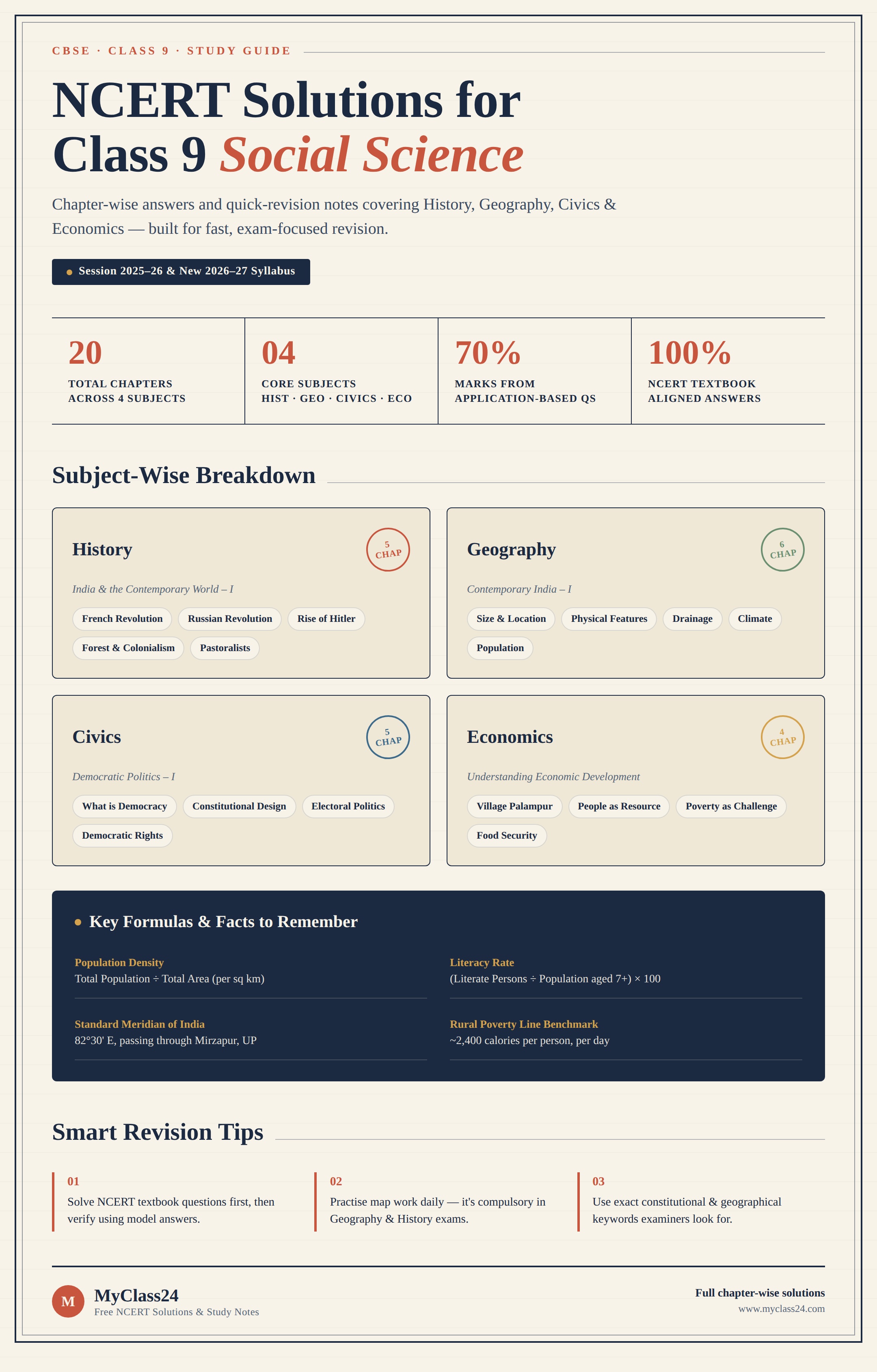
This page is designed by MyClass24 to give students a clear, simple, and exam-oriented walkthrough of the entire Class 9 Social Science syllabus, covering History (India and the Contemporary World), Geography (Contemporary India), Political Science or Civics (Democratic Politics), and Economics (Understanding Economic Development), along with the newly introduced integrated syllabus. Instead of just listing answers, this guide explains how each subject is structured, what concepts carry the highest weightage, and how to write answers that score full marks. Important terms, dates, and formulas have been organised into mobile-friendly tables so that revision becomes faster, especially during the last few days before an exam.
Whether the goal is to complete daily homework, revise before a Periodic Test, or prepare for the Half-Yearly and Annual Board-pattern exams, this guide on NCERT Solutions for Class 9 Social Science Chapter-wise will help students build a stronger conceptual base across all four subjects.
Why NCERT Solutions for Class 9 Social Science Matter
CBSE bases almost all of its Class 9 exam questions directly on the language and structure used in the NCERT textbook. This means that students who rely only on guesswork or generic internet answers often lose marks for not using the correct keywords or not following the expected answer format. Using accurate, chapter-wise NCERT Solutions for Class 9 Social Science helps in several ways.
Builds a clear understanding of how History, Geography, Civics, and Economics connect with real-world events and everyday life.
Trains students to write answers in the exact format CBSE examiners look for, including correct use of keywords, dates, and constitutional terms.
Helps in quick revision before exams through chapter summaries, important questions, and concept tables.
Improves performance in map-based questions, case-study questions, and assertion-reason type questions introduced in the competency-based exam pattern.
Saves time by clarifying difficult or confusing topics such as poverty line estimation, electoral systems, and the structure of Indian government institutions.
Class 9 Social Science Syllabus Structure
Class 9 Social Science under CBSE traditionally consists of four separate NCERT textbooks, each focusing on a different discipline. From the 2026-27 academic session, NCERT has introduced a new integrated textbook called Understanding Society: India and Beyond, based on the NCF-SE 2023 framework and NEP 2020, which combines History, Geography, Political Science, and Economics into 16 connected themes spread across two parts. Many schools are following this new structure, while several boards and state syllabi continue with the earlier four-book pattern for the 2025-26 session. This guide covers both structures so that students can find the right chapter regardless of which textbook their school has prescribed.
Traditional Four-Book Structure
Subject | Textbook Name | Number of Chapters |
History | India and the Contemporary World – I | 5 |
Geography | Contemporary India – I | 6 |
Civics (Political Science) | Democratic Politics – I | 5 |
Economics | Understanding Economic Development | 4 |
New Integrated Syllabus
The new textbook organises learning into broad themes rather than subject-wise silos. Part 1 includes themes such as Understanding Social Science, Beginnings of Civilisation, Shaping of the Earth's Surface, Democracy, and Building Blocks in Economics. Part 2 builds on these with themes including Resistance and Resilience, Authority, Elections, The Price Puzzle, and From Ideas to Startups. Students following this textbook should match their chapter names with their school timetable, since exact chapter numbering can vary slightly between schools during this transition year.
NCERT Solutions for Class 9 History – India and the Contemporary World I
The Class 9 History book introduces students to major world events that shaped the modern era, including revolutions, the rise of nationalism, and the impact of industrialisation on society. Most questions in this section test conceptual understanding rather than rote memorisation, so students should focus on the causes and effects of events rather than just dates.
Chapter | Title | Key Focus Areas |
1 | The French Revolution | Causes of 1789 revolution, Estates system, Reign of Terror, rise of Napoleon, ideas of liberty and equality |
2 | Socialism in Europe and the Russian Revolution | 1917 Russian Revolution, Bolsheviks, Lenin, collectivisation, formation of the USSR |
3 | Nazism and the Rise of Hitler | Treaty of Versailles, Weimar Republic, Hitler's rise, Nazi ideology, Holocaust |
4 | Forest Society and Colonialism | Deforestation, scientific forestry, impact of colonial forest laws on communities |
5 | Pastoralists in the Modern World | Nomadic pastoral communities, colonial restrictions on grazing, the Maasai of Africa |
Important tip: For History answers, always include the year or time period, the key person or group involved, and a brief cause-effect explanation. Two-mark questions usually need two clearly separated points, while five-mark questions need a short introduction, 3-4 explained points, and a brief conclusion.
NCERT Solutions for Class 9 Geography – Contemporary India I
Class 9 Geography builds a strong foundation in understanding India's physical features, climate, and population patterns. This subject also includes compulsory map-based questions, so practising locating and labelling places on the political and physical map of India is just as important as written answers.
Chapter | Title | Key Focus Areas |
1 | India – Size and Location | Latitude and longitude extent, standard meridian, neighbouring countries, strategic location |
2 | Physical Features of India | Himalayas, Northern Plains, Peninsular Plateau, Coastal Plains, Islands |
3 | Drainage | Himalayan and Peninsular river systems, lakes, role of rivers in the economy |
4 | Climate | Monsoon mechanism, factors affecting climate, seasons in India |
5 | Natural Vegetation and Wildlife | Forest types, biodiversity hotspots, conservation efforts, wildlife protection laws |
6 | Population | Census data interpretation, population distribution, density, growth, and composition |
Important Geography Concepts and Formulas
Concept | Formula / Key Fact |
Population Density | Density = Total Population ÷ Total Area (per sq km) |
Sex Ratio | Number of females per 1,000 males |
Standard Meridian of India | 82°30' E longitude, passing through Mirzapur (Uttar Pradesh) |
India's Latitudinal Extent | 8°4' N to 37°6' N |
India's Longitudinal Extent | 68°7' E to 97°25' E |
Time Difference (East-West) | India spans about 30° of longitude, creating a time gap of roughly 2 hours between its easternmost and westernmost points |
Decadal Growth Rate | The percentage change in population over a 10-year period, calculated using Census data |
Map practice tip: For NCERT Solutions for Class 9 Social Science Geography, examiners frequently ask students to mark rivers, mountain ranges, and important cities. Keep a blank political map of India handy and practise locating at least 15-20 commonly asked features regularly.
NCERT Solutions for Class 9 Civics – Democratic Politics I
This subject explains how democracy functions, why it is considered the most suitable form of government, and how Indian institutions like Parliament, the judiciary, and the Election Commission work together. Many questions here are conceptual and reasoning-based, so understanding the logic behind democratic processes is more important than memorising textbook lines.
Chapter | Title | Key Focus Areas |
1 | What is Democracy? Why Democracy? | Features of democracy, arguments for and against democracy, broader meanings |
2 | Constitutional Design | Making of the Indian Constitution, Constituent Assembly, guiding values, Preamble |
3 | Electoral Politics | First-past-the-post system, role of the Election Commission, free and fair elections |
4 | Working of Institutions | Parliament, Prime Minister, President, judiciary, and how decisions are taken |
5 | Democratic Rights | Fundamental Rights, Right to Constitutional Remedies, human rights, rule of law |
Important Civics Terms for Quick Revision
Term | Meaning |
Universal Adult Franchise | Right of every adult citizen to vote regardless of caste, religion, gender, or wealth |
Federalism | Division of power between central and state governments as per the Constitution |
Constituent Assembly | The body that drafted and adopted the Constitution of India between 1946 and 1949 |
Preamble | Introductory statement outlining the Constitution's guiding principles and values |
Universal Suffrage | Voting rights extended to all adult citizens without discrimination |
Coalition Government | A government formed by an alliance of two or more political parties |
NCERT Solutions for Class 9 Economics – Understanding Economic Development
Class 9 Economics introduces students to how an economy functions at the grassroots level, covering village economies, employment, poverty measurement, and food security. This subject often involves simple numerical interpretation, such as reading the poverty line or understanding employment data, so practising NCERT-based numerical questions is recommended.
Chapter | Title | Key Focus Areas |
1 | The Story of Village Palampur | Factors of production, farming methods, non-farm activities in a rural economy |
2 | People as Resource | Human capital, economic activities, unemployment types, quality of population |
3 | Poverty as a Challenge | Poverty line estimation, causes of poverty, anti-poverty programmes |
4 | Food Security in India | Buffer stock, Public Distribution System, food security schemes, Green Revolution |
Important Economics Concepts and Formulas
Concept | Formula / Key Fact |
Poverty Line (Rural, common benchmark) | Minimum income needed to meet a calorie requirement of around 2,400 calories per person per day |
Poverty Line (Urban, common benchmark) | Minimum income needed to meet a calorie requirement of around 2,100 calories per person per day |
Literacy Rate | Literacy Rate = (Number of literate persons ÷ Total population aged 7 years and above) × 100 |
Worker Population Ratio | Worker Population Ratio = (Number of workers ÷ Total population) × 100 |
Unemployment Rate | Unemployment Rate = (Number of unemployed persons ÷ Total labour force) × 100 |
Buffer Stock | Stock of foodgrains procured by the government through the Food Corporation of India to manage food security |
Numerical tip: Economics answers that involve data, such as poverty estimation or population ratios, should always show the formula first, then the substitution of values, followed by the final answer with the correct unit.
NCERT Solutions for Class 9 Social Science – New Integrated Syllabus
Students whose schools have adopted the new NCERT textbook, Understanding Society: India and Beyond, will notice that chapters are now organised around broad themes instead of separate subjects. This table summarises the major themes so students can match them with the chapter-wise solutions they need.
Theme Area | Sample Topics Covered |
History and Society | Beginnings of civilisation, early Indian societies, resistance and resilience (1000-1700 CE) |
Earth and Environment | Shaping of the Earth's surface, climate and population patterns, sustainability |
Democracy and Citizenship | Democracy, constitutional values, authority, elections, working of institutions |
Economic and Everyday Life | Building blocks in economics, the price puzzle, ideas to startups, personal finance management |
Because exam patterns under the new framework give about 70 percent weightage to application and reasoning-based questions rather than direct recall, students should focus on understanding why an event or concept matters, not just what it states. Practising case-based questions, reading short passages, and connecting concepts across History, Geography, Civics, and Economics will be especially useful for this updated structure.
How to Use These NCERT Solutions Effectively
Read the NCERT chapter first without looking at any solutions, and try to answer the in-text and end-of-chapter questions independently.
Use the chapter-wise NCERT Solutions for Class 9 Social Science only to check, correct, and improve your own answers, not as a shortcut to skip reading.
Pay close attention to keywords used in model answers, such as constitutional terms in Civics or geographical terms in Geography, since CBSE markers look for these specific words.
Revise using the concept tables provided in this guide a day or two before tests, since they condense entire chapters into quick, scannable facts.
Practise previous years' question papers and sample papers alongside these solutions to understand the actual difficulty level and question pattern used by CBSE.
For Geography, dedicate separate time to map practice, since map-based questions are compulsory and often overlooked during regular revision.
Exam Preparation Tips for Class 9 Social Science
Allocate separate revision time for each subject every week instead of studying Social Science as one combined block, since History, Geography, Civics, and Economics each need a different style of answer-writing.
For long-answer questions, structure responses with a short introduction, clearly numbered or separated points, and a brief concluding line wherever applicable.
Use diagrams, flowcharts, and labelled maps wherever the textbook includes them, since visual answers tend to score better and are easier to recall during revision.
Create a one-page formula and key-term sheet for Economics and Geography, since these subjects involve calculations and specific figures that are easy to forget under exam pressure.
Revise current and recent updates related to elections, government schemes, and economic policies mentioned in the Civics and Economics chapters, as these often appear in application-based questions.
Final Word
Class 9 Social Science lays the groundwork for Class 10 board exams, so building strong fundamentals now makes the following year significantly easier. These chapter-wise NCERT Solutions for Class 9 Social Science, along with the concept tables for History, Geography, Civics, and Economics, are designed to help students at MyClass24 study smarter, revise faster, and answer in the exact format CBSE examiners expect. Consistent practice using the NCERT textbook alongside these solutions, combined with regular map work and formula revision, will help students build genuine confidence in Social Science rather than relying on last-minute cramming.
FAQs on NCERT Solutions for Class 9 Social Science – MyClass24
NCERT Solutions for Class 9 Social Science are essential because they help students understand History, Geography, Political Science, and Economics in a simple and organized manner. The Class 9 syllabus introduces many concepts that continue in higher classes, making it important to build a strong foundation from the beginning. These solutions explain textbook questions with clear reasoning, allowing students to understand topics instead of memorizing answers. They also improve answer-writing skills, which are crucial for scoring well in examinations. Regular practice helps students remember important events, geographical concepts, constitutional principles, and economic ideas more effectively. MyClass24 provides chapter-wise NCERT Solutions in easy language so students can revise quickly, complete assignments confidently, and strengthen their conceptual understanding while preparing effectively for school examinations and future competitive exams.
MyClass24 offers reliable, student-friendly, and well-structured NCERT Solutions designed specifically to simplify Social Science learning for Class 9 students. Every solution is prepared according to the latest CBSE syllabus and explains textbook questions through detailed yet easy-to-understand steps. Instead of encouraging memorization, the solutions focus on conceptual understanding, logical explanation, and effective answer presentation. Students can complete homework independently, revise important chapters efficiently, and prepare confidently for examinations. The organized chapter-wise format also makes it easy to locate topics during revision. By combining accuracy, clarity, and simple language, MyClass24 helps students develop strong fundamentals in History, Geography, Political Science, and Economics while improving their overall academic performance and confidence in Social Science.
Students should revise Social Science regularly instead of waiting until examinations approach. Weekly revision of recently completed chapters helps strengthen memory and prevents students from forgetting important facts and concepts. Older chapters should also be reviewed periodically to maintain continuity throughout the academic session. Students should revise important dates, maps, definitions, constitutional terms, and economic concepts using short notes for quicker learning. Practicing textbook questions repeatedly also improves confidence and answer-writing speed. MyClass24 organizes NCERT Solutions chapter-wise, allowing students to revisit topics conveniently whenever required. Consistent revision using these solutions helps improve understanding, reduces examination stress, strengthens retention, and enables students to perform confidently in every school assessment.
Yes, NCERT Solutions build the strong conceptual foundation needed for various competitive and scholarship examinations conducted at school and national levels. Subjects like History, Geography, Political Science, and Economics form an important part of many competitive exams in higher classes. Understanding these concepts thoroughly from Class 9 makes future preparation much easier. Regular practice improves factual knowledge, logical reasoning, analytical thinking, and interpretation skills. Students also become familiar with important historical events, geographical features, democratic principles, and economic terminology that are useful in advanced studies. MyClass24 provides comprehensive NCERT Solutions that strengthen these fundamentals, helping students prepare confidently not only for school examinations but also for future competitive academic opportunities.
Good answer-writing is one of the most important factors in scoring high marks in Social Science. NCERT Solutions help students understand how to organize answers logically using introductions, explanations, relevant points, and appropriate conclusions. They demonstrate the correct way to present facts, examples, and definitions without including unnecessary information. Students also learn how to write precise short answers and detailed long answers according to examination requirements. Regular practice improves clarity, presentation, handwriting organization, and time management during exams. MyClass24 provides carefully explained answers that guide students in developing effective writing techniques, enabling them to express their knowledge confidently while meeting CBSE examination expectations and improving overall academic performance in Social Science.
MyClass24 prepares NCERT Solutions in simple language so that students can understand even complex Social Science topics without difficulty. Every answer follows a logical structure and explains the concepts step by step instead of providing only direct answers. This approach helps students understand historical events, geographical processes, political systems, and economic concepts more effectively. The solutions are prepared according to the latest CBSE syllabus and textbook pattern, ensuring complete accuracy and relevance. Students can easily revise chapters, complete homework, and prepare confidently for examinations using these resources. MyClass24 focuses on conceptual learning rather than rote memorization, enabling students to develop analytical thinking, improve answer-writing ability, and perform better in classroom assessments as well as annual examinations.
NCERT Solutions help students prepare systematically by covering every question included in the latest Class 9 Social Science textbook. Since CBSE examinations are largely based on NCERT content, practicing these solutions ensures complete syllabus coverage. Every answer is written in a logical sequence that helps students understand how to present information effectively in exams. Students also learn to frame descriptive answers using appropriate facts, examples, and explanations. Regular revision of NCERT Solutions improves memory retention and reduces confusion before examinations. MyClass24 provides detailed yet easy-to-understand solutions that simplify complex topics from all four subjects. By practicing these regularly, students gain confidence, improve answer-writing skills, manage time efficiently during exams, and significantly increase their chances of scoring high marks in Social Science.
Although every chapter is important, some topics usually require additional attention because they involve conceptual understanding, map work, and detailed explanations. In History, chapters related to major revolutions and social changes are important. Geography chapters on climate, natural vegetation, and drainage require careful study along with map practice. Political Science topics about democracy and constitutional rights demand conceptual clarity, while Economics chapters introduce basic economic principles that students should understand thoroughly. Students should revise important definitions, dates, locations, and key concepts regularly instead of relying on last-minute preparation. MyClass24 offers chapter-wise NCERT Solutions that explain every exercise question step by step, making difficult chapters easier to understand while helping students develop confidence and improve overall exam performance.
Yes, NCERT Solutions are generally sufficient for scoring excellent marks in Class 9 Social Science when students study them consistently and understand the concepts thoroughly. Most school examination questions are directly or indirectly based on NCERT textbooks. Students should read each chapter carefully, understand important concepts, and practice all exercise questions instead of memorizing answers. Revising maps, timelines, definitions, and important terms regularly also improves performance. Along with textbook exercises, students should practice writing descriptive answers within the prescribed word limit to improve presentation skills. MyClass24 provides detailed, accurate, and student-friendly NCERT Solutions that help learners understand concepts clearly, avoid common mistakes, and prepare effectively for periodic tests, half-yearly examinations, annual examinations, and future academic challenges.
The best approach is to begin by reading the textbook chapter carefully and understanding the main ideas before attempting the exercise questions independently. After completing the questions, students should compare their answers with NCERT Solutions to identify mistakes and understand the correct presentation style. Instead of copying answers directly, they should focus on learning the reasoning behind each response. Regular revision, note-making, and practicing maps improve long-term retention. Students should also revise important dates, constitutional terms, geographical features, and economic concepts weekly. MyClass24 provides well-organized chapter-wise NCERT Solutions that make daily study more structured, helping students build consistency, improve conceptual clarity, and develop strong answer-writing skills for better academic performance.