




About NCERT Solutions for Class 9 Hindi
Kshitij, Kritika, Sparsh & Sanchayan — Chapter-wise Guide for CBSE Students
NCERT Solutions for Hindi is one of the most scoring subjects in the Class 9 CBSE curriculum, yet many students struggle to organise their preparation because the syllabus is spread across four different textbooks: Kshitij (Part 1), Kritika (Part 1), Sparsh (Part 2 supplementary) and Sanchayan. At MyClass24, our NCERT Solutions for Class 9 Hindi are designed to simplify this journey by breaking down every chapter, poem and grammar topic into easy-to-understand explanations, word meanings, and exam-oriented answers. Whether you are revising for a unit test or preparing for the final board-pattern examination, this guide will help you build a strong foundation in Hindi language and literature.
• NCERT Solutions for Class 9 Hindi Sparsh
• NCERT Solutions for Class 9 Hindi Kshitij
• NCERT Solutions for Class 9 Hindi Kritika
• NCERT Solutions for Class 9 Hindi Sanchayan
Why NCERT Solutions for Class 9 Hindi Matter
The CBSE Class 9 Hindi syllabus is not just about memorising chapters; it tests a student's ability to comprehend, interpret and express ideas in Hindi. NCERT solutions act as a structured reference that helps students understand the expected depth and format of answers. Using well-explained solutions alongside your textbook offers several advantages.
They clarify difficult words (कठिन शब्दार्थ) and idiomatic expressions used in prose and poetry chapters.
They demonstrate the correct answer-writing pattern expected in CBSE exams, including word limits and presentation style.
They help students connect the central theme of a chapter with the questions asked in the exercises.
They save revision time before exams by offering chapter summaries and quick concept recall points.
They strengthen grammar fundamentals, which carry significant weightage in the question paper.
Class 9 Hindi Textbooks and Their Structure
CBSE Class 9 Hindi is offered in two course patterns: Course A and Course B. Most schools follow Course A, which includes Kshitij and Kritika, while some schools opt for Course B, which uses Sparsh and Sanchayan. It is important for students to first identify which course their school follows before starting their preparation, as the chapters and grammar emphasis differ slightly between the two.
Kshitij Bhag 1 – Prose and Poetry
Kshitij is the main reader for Course A and is divided into two sections: Gadya Khand (prose) and Kavya Khand (poetry). It introduces students to a wide range of authors and poets, covering themes such as social issues, nature, patriotism, and human relationships.
Kritika Bhag 1 – Supplementary Reader
Kritika is a supplementary textbook with shorter, story-based chapters that focus on moral values, social awareness and character building. The questions from Kritika are usually shorter but require thoughtful, original answers.
Sparsh and Sanchayan (Course B)
Schools following Course B use Sparsh for prose and poetry and Sanchayan as the supplementary reader. The structure is similar to Kshitij and Kritika, but with a different set of chapters and a slightly different difficulty level suited to Course B learners.
Chapter-wise Overview: Kshitij Bhag 1 (Gadya Khand)
Below is a quick reference table of the prose chapters in Kshitij along with their central theme, useful for quick revision before exams.
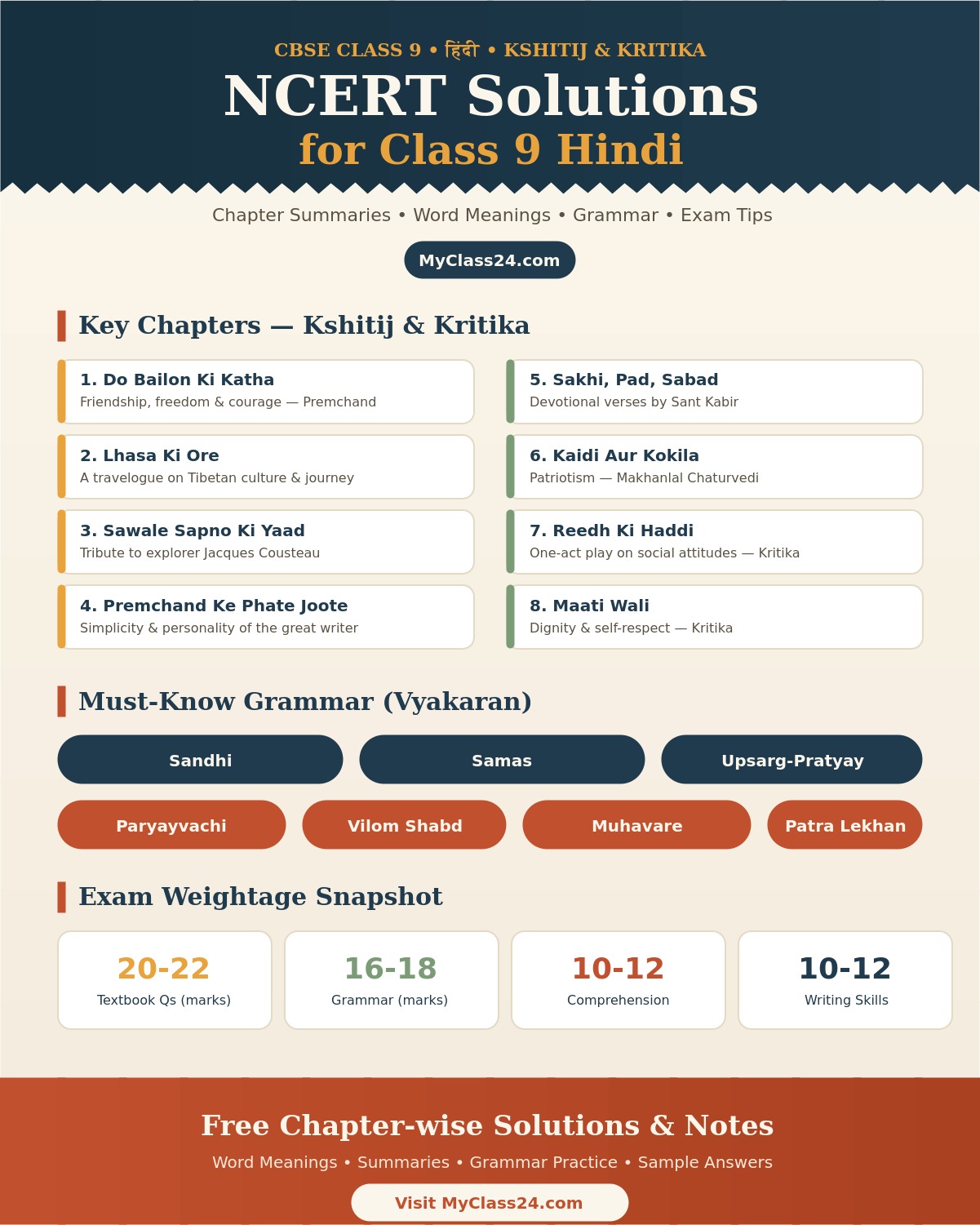
Ch. No. | Chapter Name | Central Theme |
1 | दो बैलों की कथा | Friendship, freedom and the value of cooperation, narrated through two bullocks. |
2 | ल्हासा की ओर | A travelogue describing the journey and culture of Tibet. |
3 | उपभोक्तावाद की संस्कृति | Critical view of consumerism and its effect on society. |
4 | साँवले सपनों की याद | Tribute to ocean explorer Jacques Cousteau and his vision. |
5 | नाना साहब की पुत्री देवी मैना को भस्म कर दिया गया | An account of the cruelty faced during the 1857 revolt. |
6 | प्रेमचंद के फटे जूते | Reflection on simplicity and the personality of writer Premchand. |
7 | मेरे बचपन के दिन | Memoirs of childhood and the importance of education for girls. |
8 | एक कुत्ता और एक मैना | Bond between animals and humans, observed through nature. |
Chapter-wise Overview: Kshitij Bhag 1 (Kavya Khand)
The poetry section of Kshitij introduces students to classical and modern Hindi poets. Understanding the poetic devices (अलंकार) and the poet's message is key to scoring well in this section.
Ch. No. | Poem Name | Poet |
1 | साखी, पद, सबद | संत कबीर |
2 | वाख | ललद्यद |
3 | सवैये | रसखान |
4 | कैदी और कोकिला | माखनलाल चतुर्वेदी |
5 | ग्राम श्री | सुमित्रानंदन पंत |
6 | चंद्र गहना से लौटती बेर | केदारनाथ अग्रवाल |
7 | मेघ आए / बच्चे काम पर जा रहे हैं | सर्वेश्वर दयाल सक्सेना |
8 | अग्निपथ / नए इलाके में | हरिवंशराय बच्चन / अरुण कमल |
Chapter-wise Overview: Kritika Bhag 1
Ch. No. | Chapter Name | Key Learning |
1 | इस जल प्रलय में | A first-person account of the devastation caused by floods. |
2 | मेरे संग की औरतें | Celebration of the strength and resilience of women in the family. |
3 | रीढ़ की हड्डी (एकांकी) | A one-act play that exposes outdated social attitudes through humour. |
4 | माटी वाली | Story of dignity and self-respect despite economic hardship. |
5 | किस तरह आख़िरकार मैं हिंदी में आया | A writer's personal journey of embracing the Hindi language. |
How to Use NCERT Solutions for Class 9 Hindi Effectively
Simply reading the answers is not enough; students need a structured study approach to retain concepts and perform well in exams. The following steps are recommended for using NCERT solutions productively.
Read the original chapter from the NCERT textbook first, without referring to the solution.
Attempt to answer the textbook questions on your own before checking the solution.
Compare your answer with the NCERT solution to identify gaps in understanding or expression.
Note down new words, their meanings (शब्दार्थ) and use them in your own sentences for better retention.
Revise the chapter summary a day before the exam instead of re-reading the entire lesson.
Practice writing answers within the prescribed word limit to build exam-time speed.
Important Hindi Grammar Topics for Class 9
Grammar (व्याकरण) holds significant weightage in the Class 9 Hindi paper and is often the section where students lose easy marks due to lack of practice. Below is a summary table of the major grammar topics along with their core concept, useful for quick revision.
Grammar Topic | Core Concept | Example |
शब्द-भेद (Parts of Speech) | Classification of words into noun, pronoun, verb, adjective, etc. | संज्ञा, सर्वनाम, क्रिया, विशेषण |
संधि (Sandhi) | Joining of two words by removing the intermediate vowel/consonant sound. | विद्या + आलय = विद्यालय |
समास (Samas) | Compound formation by combining two or more words into one. | राजपुत्र = राजा का पुत्र |
उपसर्ग एवं प्रत्यय | Prefixes and suffixes that change or add meaning to root words. | प्र + हार = प्रहार; सुंदर + ता = सुंदरता |
पर्यायवाची शब्द (Synonyms) | Words with similar meaning, useful for vocabulary building. | सूर्य – रवि, भानु, दिनकर |
विलोम शब्द (Antonyms) | Words with opposite meaning. | दिन x रात, जय x पराजय |
मुहावरे एवं लोकोक्तियाँ | Idioms and proverbs used to add expressiveness to language. | आँखों में धूल झोंकना – धोखा देना |
वाक्य रचना (Sentence Formation) | Rules of forming grammatically correct and meaningful sentences. | Simple, compound and complex sentence types |
रचना के आधार पर वाक्य भेद | Classification of sentences as simple, compound, or complex. | सरल, संयुक्त, मिश्र वाक्य |
पत्र लेखन (Letter Writing) | Format and structure for formal and informal letters. | प्रार्थना पत्र, शिकायती पत्र |
Marking Scheme and Exam Weightage (Indicative)
While the exact weightage may vary slightly depending on the academic session's CBSE circular, the table below gives students a general idea of how marks are typically distributed across sections in the Class 9 Hindi question paper.
Section | Approximate Marks |
Reading Comprehension (अपठित गद्यांश/पद्यांश) | 10–12 |
Grammar (व्याकरण) | 16–18 |
Textbook-based Questions (पाठ्यपुस्तक) | 20–22 |
Writing Skills (लेखन – पत्र, अनुच्छेद आदि) | 10–12 |
Note: Students should always verify the latest marking scheme from the official CBSE curriculum document or their school, as these patterns are revised periodically.
Tips to Score High Marks in Class 9 Hindi
Practice handwriting and presentation, as neat answers with proper headings score better.
Underline key points and quotations from poems and stories wherever relevant.
Build a personal glossary of difficult words encountered across all chapters.
Solve previous years' question papers and sample papers to understand the question pattern.
Focus equally on grammar and writing sections, as they are often neglected despite carrying high marks.
Revise idioms and proverbs regularly since they are frequently asked in both grammar and writing sections.
Common Mistakes Students Should Avoid
Memorising answers word-for-word instead of understanding the chapter's meaning.
Ignoring grammar practice until the last moment before exams.
Writing answers beyond the prescribed word limit, which can lead to loss of marks for irrelevant content.
Skipping the supplementary reader (Kritika or Sanchayan) assuming it carries lower weightage.
Not practising letter writing formats, which often leads to format-related deductions.
How MyClass24 Supports Class 9 Hindi Preparation
At MyClass24, our subject experts curate NCERT Solutions for Class 9 Hindi with a strong focus on clarity, accuracy and exam relevance. Every chapter solution is explained in simple language so that students can grasp difficult literary concepts without confusion. Along with chapter-wise solutions, students also get access to grammar notes, word-meaning lists and writing skill guides that are aligned with the latest CBSE Class 9 Hindi syllabus. This makes MyClass24 a reliable, one-stop study companion for students aiming to strengthen their Hindi language skills and improve their overall academic performance.
Conclusion
Scoring well in Class 9 Hindi requires a balanced approach that combines a clear understanding of prose and poetry chapters with consistent grammar practice and regular writing skill development. NCERT Solutions for Class 9 Hindi, when used the right way, become more than just an answer key; they become a learning tool that helps students think critically, express clearly and write confidently. With the chapter summaries, grammar tables and preparation tips shared in this guide, students can approach their Hindi exams with greater clarity and confidence. Keep practising consistently, revise smartly, and make the most of structured resources like those available on MyClass24 to excel in Class 9 Hindi.
FAQs for NCERT Solutions for Class 9 Hindi (Kshitij, Kritika) | MyClass24
NCERT Solutions for Class 9 Hindi are an excellent study resource for students who want to understand every chapter, poem, grammar topic, and supplementary lesson with clarity. The Class 9 Hindi syllabus introduces students to different literary forms, including prose, poetry, essays, and stories that develop language skills and critical thinking. Well-explained solutions help students understand the meaning, central idea, character sketches, literary devices, and important questions without confusion. They also improve answer-writing techniques by demonstrating how to write descriptive and precise responses in examinations. Regular practice enhances vocabulary, grammar, comprehension, and writing skills. MyClass24 provides chapter-wise NCERT Solutions in simple and student-friendly language, helping learners prepare confidently for classroom tests, assignments, and annual examinations while building a strong foundation in Hindi.
MyClass24 provides reliable, accurate, and easy-to-understand NCERT Solutions specially designed to meet the learning needs of Class 9 students. Every solution follows the latest CBSE syllabus and explains textbook questions in a simple, logical, and student-friendly manner. Instead of encouraging rote learning, the solutions focus on conceptual understanding, grammar improvement, literary appreciation, and effective answer-writing. Students can use these resources for homework, daily study, revision, and examination preparation with confidence. The chapter-wise organization makes it convenient to locate topics quickly during revision. By combining clarity, accuracy, and simple explanations, MyClass24 helps students develop strong Hindi language skills, improve academic performance, and gain confidence in reading, writing, and understanding literature.
Students should revise Hindi regularly instead of studying only before examinations. Weekly revision of recently completed chapters helps improve memory retention and strengthens understanding of important themes, vocabulary, and grammar concepts. Older chapters should also be reviewed periodically to avoid forgetting key points. Students should revise poems, prose lessons, grammar rules, writing formats, and important question answers consistently throughout the academic year. Reading chapters aloud also improves pronunciation and comprehension. MyClass24 organizes NCERT Solutions chapter-wise, making revision simple and systematic. Regular practice using these solutions enhances confidence, improves writing ability, reduces examination stress, and enables students to perform better in every school assessment.
Yes, NCERT Solutions provide a strong language foundation that benefits students in many competitive and scholarship examinations conducted in higher classes. Good reading comprehension, vocabulary, grammar, and writing skills are useful for various entrance exams as well as general academic development. Understanding Hindi literature also improves interpretation skills, analytical thinking, and communication abilities. Regular practice helps students become more confident in reading passages, answering comprehension questions, and writing descriptive responses. MyClass24 offers comprehensive NCERT Solutions that strengthen these essential language skills while helping students master textbook concepts. This strong foundation supports better academic performance and prepares learners for future educational opportunities requiring strong language proficiency.
Answer-writing is one of the most important skills required for scoring high marks in Hindi examinations. NCERT Solutions demonstrate how to organize answers logically using proper introductions, explanations, examples, and conclusions wherever necessary. Students learn to write clear, concise, and grammatically correct responses that match CBSE examination expectations. These solutions also improve sentence formation, vocabulary usage, and presentation skills. Instead of copying answers, students should understand the ideas and practice writing them in their own words. MyClass24 provides carefully structured solutions that guide students in developing effective writing techniques, improving language fluency, and expressing their thoughts confidently during classroom tests and annual examinations.
MyClass24 prepares NCERT Solutions in simple, student-friendly language so that every learner can understand Hindi literature without difficulty. Every answer is explained step by step with clear reasoning, allowing students to understand the lesson instead of memorizing it. The solutions explain themes, character sketches, poetic meanings, grammar concepts, and important questions in an organized manner. They are prepared according to the latest CBSE syllabus and textbook pattern, ensuring complete accuracy and relevance. Students can complete homework independently, revise lessons efficiently, and prepare confidently for examinations. MyClass24 focuses on conceptual learning and language development, helping students improve comprehension, vocabulary, grammar, and answer-writing skills throughout the academic session.
Yes, NCERT Solutions are generally sufficient for scoring high marks in Class 9 Hindi when students study them regularly and understand the concepts properly. Most CBSE school examinations are based primarily on the NCERT textbooks and related exercises. Students should read every chapter carefully, understand the meaning of poems and prose, practice grammar exercises, and write answers in their own words after understanding the concepts. Regular revision of important questions, vocabulary, and writing formats further strengthens preparation. MyClass24 provides accurate, well-organized, and easy-to-follow NCERT Solutions that help students improve conceptual understanding, writing style, grammar skills, and confidence, ensuring effective preparation for school examinations and better overall academic performance.
The most effective way to study Class 9 Hindi is to begin by reading the lesson or poem carefully and understanding its meaning before referring to the solutions. Students should first attempt textbook questions independently and then compare their responses with the NCERT Solutions to identify mistakes and improve answer-writing techniques. Instead of memorizing answers, they should focus on understanding themes, vocabulary, grammar, and literary ideas. Regular reading also improves pronunciation, comprehension, and language fluency. MyClass24 provides chapter-wise NCERT Solutions in a clear and organized format, helping students study systematically, strengthen conceptual understanding, and revise efficiently before examinations while developing confidence in the Hindi language.
NCERT Solutions are highly useful for exam preparation because they cover every question given in the prescribed Hindi textbook according to the latest CBSE syllabus. Most school examination questions are based directly on textbook chapters, poems, and grammar exercises. These solutions explain every answer systematically so students understand both the content and the correct answer-writing format. They also help students improve comprehension, grammar accuracy, and presentation skills. Regular practice enables learners to remember important themes, character descriptions, poetic meanings, and language concepts more effectively. MyClass24 provides detailed and easy-to-understand solutions that simplify difficult lessons, making revision faster and helping students prepare thoroughly for periodic tests, half-yearly examinations, annual exams, and future academic studies.
Although every chapter deserves equal attention, certain lessons often require additional practice because they involve deeper literary understanding and interpretation. Poetry chapters usually demand careful analysis of themes, emotions, poetic devices, and symbolism. Prose chapters require students to understand characters, events, and moral values, while supplementary stories focus on comprehension and interpretation. Grammar topics such as sentence formation, vocabulary, and writing skills also need consistent practice. Students should revise important meanings, question answers, and literary concepts regularly rather than depending on last-minute preparation. MyClass24 offers chapter-wise NCERT Solutions with detailed explanations that simplify even difficult chapters, enabling students to improve their understanding, writing ability, and overall performance in Hindi examinations.