





NCERT Solutions for Class 12 Political Science—Complete Chapter-Wise Guide | Myclass24
Subject Code: 028 | Board: CBSE | Academic Year: New | Total Marks: 100
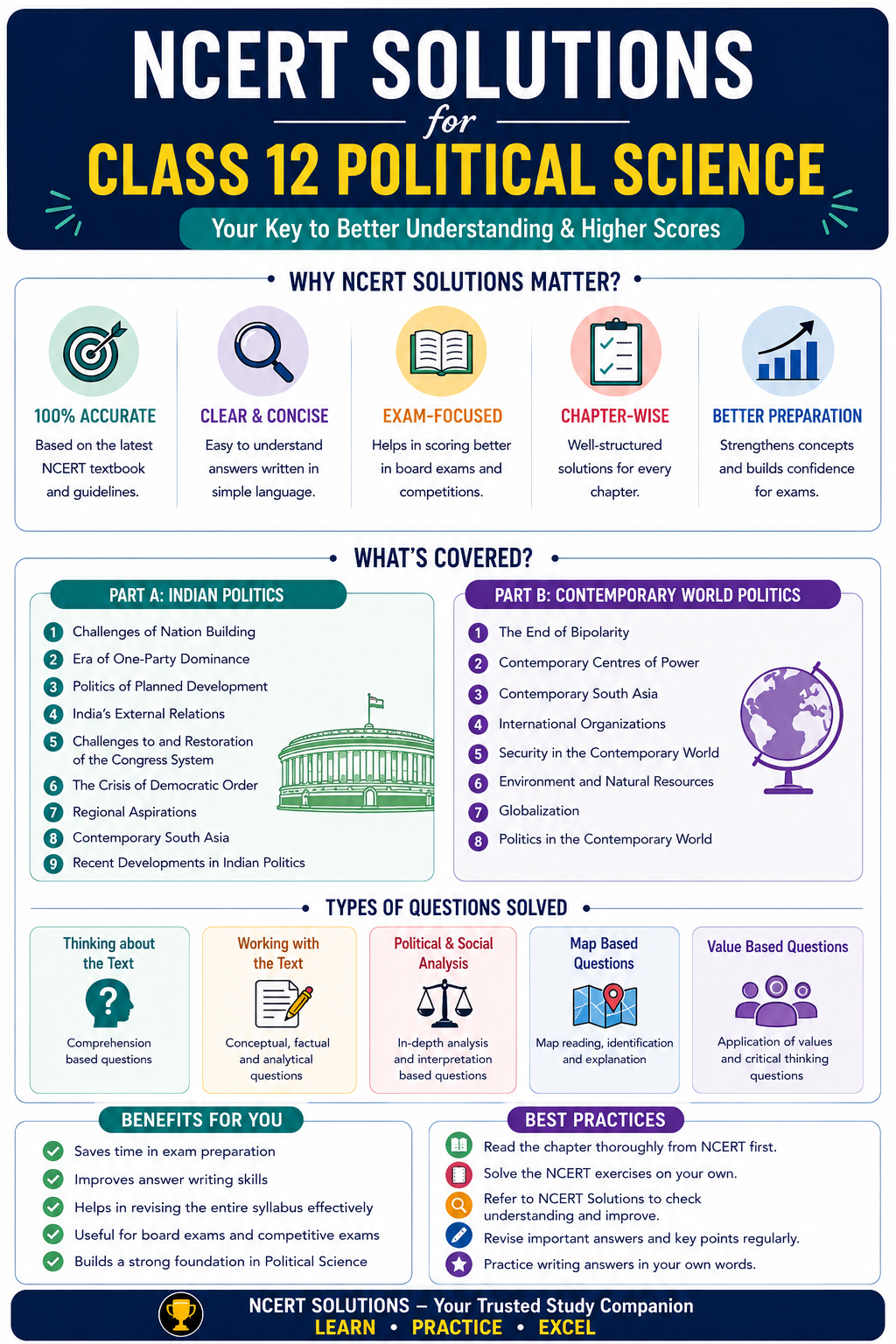
NCERT Solutions for Class 12 Political Science is one of the most scoring yet conceptually rich subjects in the Humanities stream. Unlike rote-heavy subjects, it demands analytical thinking, structured writing, and a clear understanding of both global and Indian political events. NCERT textbooks — Contemporary World Politics and Politics in India Since Independence — are the backbone of CBSE board preparation, and mastering their solutions is the single most effective strategy to score above 75 out of 80 in the theory exam.
This guide from Myclass24 breaks down every chapter, its key concepts, question types, and mark-fetching strategies — all in one place.
The Two NCERT Books You Must Master
The Class 12 Political Science syllabus is built entirely around two NCERT textbooks:
Book 1 — Contemporary World Politics (Part A) covers international relations, global power shifts, the fall of bipolarity, and India's role in a multipolar world.
Book 2 — Politics in India Since Independence (Part B) covers India's post-independence political journey — from nation-building challenges to recent developments in Indian democracy.
Both books carry equal weight in the board examination — 40 marks each for the theory paper.
Exam Pattern & Mark Distribution
Understanding the exam structure is the first step to a high score. The paper is 3 hours long and tests multiple skills — recall, comprehension, application, and analysis.
Table 1: Overall Marks Distribution — Class 12 Political Science
| Component | Marks | Details |
|---|---|---|
| Theory Paper (Part A) | 40 Marks | Contemporary World Politics |
| Theory Paper (Part B) | 40 Marks | Politics in India Since Independence |
| Project Work | 10 Marks | Research project + bibliography |
| Viva Voce | 10 Marks | Oral examination by external examiner |
| Total | 100 Marks | Theory 80 + Internal 20 |
Passing Criteria: Students must score at least 33% (i.e., 33 out of 100) to clear the subject. The theory and internal assessment are evaluated separately.
Table 2: Question Paper Blueprint — Section-Wise Breakdown
| Section | Question Type | Marks per Question | Number of Questions | Total Marks |
|---|---|---|---|---|
| Section A | Multiple Choice Questions (MCQs) | 1 mark | 20 | 20 |
| Section B | Short Answer Questions | 2 marks | 6 | 12 |
| Section C | Short Answer Questions | 4 marks | 6 | 24 |
| Section D | Long Answer Questions | 6 marks | 4 | 24 |
| Section E | Source/Cartoon-based Questions | — | — | ~12–14 |
| Total | 80 Marks |
Note: Section E includes passage-based, map-based, and cartoon-interpretation questions. Cartoon-based questions remain a permanent feature of the CBSE Class 12 Political Science paper as they test critical and visual reasoning skills.
Chapter-Wise NCERT Solutions Overview
PART A — Contemporary World Politics (7 Chapters, 40 Marks)
Chapter 1 — The End of Bipolarity
Core Concept: The dissolution of the Soviet Union in 1991 and the end of the Cold War era.
Key Topics to Master:
- Rise and structure of the Soviet Union
- Factors that led to its disintegration (economic stagnation, political reforms, nationalist movements)
- Shock Therapy — what it was, how it was applied, and why it largely failed
- Consequences for former Soviet Republics
- India's relations with post-Soviet states
Frequently Asked Question Types:
- "What is Shock Therapy? Why did it fail in most post-Soviet states?" (4–6 marks)
- "Explain the factors responsible for the disintegration of the USSR." (6 marks)
- MCQs on Glasnost, Perestroika, Boris Yeltsin, CIS
Myclass24 Tip: Draw a clear timeline from 1985 (Gorbachev's reforms) to 1991 (formal dissolution). Examiners reward structured, chronological answers.
Chapter 2 — Contemporary Centres of Power
Core Concept: In a post-Cold War world, multiple power centres — the EU, ASEAN, China — have emerged to challenge American unipolarity.
Key Topics to Master:
- European Union — its structure, significance, and influence as a soft power
- ASEAN — formation, ASEANWay, ASEAN Vision 2020
- China's rise — economic reforms since 1978, China as a major global player
- India's relationship with each power centre
Frequently Asked Question Types:
- "How has the European Union emerged as an alternative centre of power?" (6 marks)
- "What is the ASEAN Way? How does it differ from Western models of integration?" (4 marks)
- Cartoon/source-based questions on EU symbols and flags
Chapter 3 — Contemporary South Asia
Core Concept: South Asia's complex political landscape — democracy, military rule, civil conflict, and regional cooperation.
Key Topics to Master:
- Democratic transitions in Nepal, Bangladesh, and Pakistan
- India-Pakistan relations — causes of tension and peace initiatives
- India-Sri Lanka ethnic conflict and the LTTE issue
- SAARC — objectives, limitations, and India's role
- India's relations with Nepal and Bhutan
Frequently Asked Question Types:
- "Why has SAARC not been very successful? Give reasons." (4–6 marks)
- "Discuss the major causes of conflict between India and Pakistan." (6 marks)
Chapter 4 — International Organisations
Core Concept: The United Nations system — its structure, relevance, and the need for reform.
Key Topics to Master:
- Structure of the UN — General Assembly, Security Council, Secretariat, ICJ
- Veto power — how it works and why it's controversial
- UN Reforms — expanding UNSC membership, India's case for a permanent seat
- India's role in UN peacekeeping missions
- WHO, IMF, World Bank — their roles and criticisms
Frequently Asked Question Types:
- "What reforms are needed in the UN? Should India get a permanent seat on the Security Council?" (6 marks)
- "What is the veto power? Why do developing nations want its reform?" (4 marks)
Myclass24 Tip: Always mention India's contribution to UN peacekeeping (one of the largest troop contributors) — examiners find this specific data impressive.
Chapter 5 — Contemporary South Asia (Security in Contemporary World)
Core Concept: Redefining security — from traditional military threats to non-traditional threats like terrorism, climate change, and pandemics.
Key Topics to Master:
- Traditional vs. Non-Traditional security threats
- Sources of threat — terrorism, organised crime, drug trafficking
- Human security and its dimensions
- India's security challenges — nuclear doctrine, Kargil, terrorism
- Arms control treaties — NPT, CTBT, and India's stand
Frequently Asked Question Types:
- "Distinguish between traditional and non-traditional threats to security." (4–6 marks)
- MCQs on NPT, CTBT, India's nuclear doctrine
Chapter 6 — Environment and Natural Resources
Core Concept: Global political responses to environmental degradation, resource conflicts, and sustainable development.
Key Topics to Master:
- The global commons — atmosphere, oceans, Antarctica
- Key environmental agreements — Rio Summit 1992, Kyoto Protocol, Paris Agreement
- Resource geopolitics — oil, water, and land
- Indigenous people's rights and environmental justice
- India's position on climate change negotiations
Frequently Asked Question Types:
- "What are global commons? Why are they considered difficult to manage?" (4 marks)
- "How does India's position on climate change differ from developed nations?" (6 marks)
Chapter 7 — Globalisation
Core Concept: Globalisation as a multidimensional phenomenon — economic, political, cultural — and its unequal impact.
Key Topics to Master:
- Dimensions of globalisation — economic integration, cultural flows, political spread
- Drivers of globalisation — technology, trade, capital movement
- Effects on developing countries — both positive and negative
- Anti-globalisation movements
- India's response to globalisation — liberalisation, 1991 reforms
Frequently Asked Question Types:
- "Is globalisation beneficial for developing nations like India? Critically examine." (6 marks)
- "What are the cultural consequences of globalisation?" (4 marks)
PART B — Politics in India Since Independence (8 Chapters, 40 Marks)
Chapter 1 — Challenges of Nation-Building
Core Concept: India's three major challenges at independence — national unity, democracy, and development.
Key Topics to Master:
- Partition — causes, consequences, human tragedy
- Integration of princely states — Sardar Patel's role, Hyderabad, Junagadh, Kashmir
- Reorganisation of states on linguistic basis
- Nehru's vision and ideology
Frequently Asked Question Types:
- "What were the main challenges of nation-building in India after independence?" (6 marks)
- "How were princely states integrated into the Indian Union?" (4–6 marks)
Chapter 2 — Era of One-Party Dominance
Core Concept: The Congress Party's near-monopoly over Indian politics from 1947 to the mid-1960s.
Key Topics to Master:
- Congress system — how it maintained dominance
- First three General Elections (1952, 1957, 1962)
- Role of opposition parties — CPI, Jan Sangh, Socialists
- Social coalition behind Congress dominance
- Factors for Congress's decline
Frequently Asked Question Types:
- "Why was the Congress party dominant in early Indian politics?" (4–6 marks)
- MCQs on election years, opposition parties
Chapter 3 — Politics of Planned Development
Core Concept: The Five-Year Plan model, the role of the Planning Commission, and debates around development strategy.
Key Topics to Master:
- First Five-Year Plan — focus on agriculture
- Second Five-Year Plan (Nehru-Mahalanobis model) — focus on heavy industry
- Kerala model of development
- Debate on economic development — growth vs. equity
- Famine and food security challenges
Frequently Asked Question Types:
- "Compare the First and Second Five-Year Plans." (4 marks)
- "What is the Kerala Model of development?" (2–4 marks)
Chapter 4 — India's External Relations
Core Concept: India's foreign policy — Panchsheel, Non-Alignment Movement (NAM), and major conflicts.
Key Topics to Master:
- Panchsheel Principles (1954)
- Non-Aligned Movement — origins, significance, India's role
- India-China War 1962 — causes, outcome, impact
- India-Pakistan Wars — 1947, 1965, 1971
- Nuclear tests — Pokhran 1974 and 1998
Frequently Asked Question Types:
- "What is the Non-Alignment Movement? Is it still relevant today?" (6 marks)
- "Explain the causes and consequences of the 1962 India-China War." (6 marks)
Myclass24 Tip: NAM is a recurring 6-mark topic. Always mention its three pillars: anti-colonialism, non-alignment with military blocs, and peaceful coexistence.
Chapter 5 — Challenges to and Restoration of Congress System
Core Concept: The political crises of the late 1960s — Congress split, Indira Gandhi's rise, and the politics of poverty.
Key Topics to Master:
- Congress split of 1969 — Syndicate vs. Indira Gandhi
- 1971 elections — "Garibi Hatao" slogan and mandate
- Bangladesh War 1971
- Non-Congress governments — SVD experiments in states
- Privy purse abolition
Frequently Asked Question Types:
- "Why did the Congress party split in 1969?" (4 marks)
- "What was the significance of the 1971 elections?" (4–6 marks)
Chapter 6 — The Crisis of Democratic Order (Emergency)
Core Concept: The 1975 Emergency — causes, implementation, and its long-term impact on Indian democracy.
Key Topics to Master:
- Causes of Emergency — Allahabad High Court judgment, JP Movement
- Provisions of Emergency — suspension of fundamental rights, press censorship
- 42nd Constitutional Amendment
- MISA (Maintenance of Internal Security Act)
- Aftermath — 1977 elections, Janata Party, fall of Indira Gandhi
Frequently Asked Question Types:
- "What were the causes and consequences of the Emergency declared in 1975?" (6 marks)
- "How did the Emergency affect Indian democracy?" (4–6 marks)
Chapter 7 — Rise of Popular Movements
Core Concept: New social movements that reshaped Indian politics from the 1970s onwards.
Key Topics to Master:
- Chipko Movement — environmental protest in Uttarakhand
- Anti-Arrack Movement — women-led social movement in Andhra Pradesh
- Dalit Panthers and the Dalit rights movement
- Farmers' movements — NMKRV and others
- Role of new social movements in deepening democracy
Frequently Asked Question Types:
- "What is the significance of the Chipko Movement in Indian politics?" (4 marks)
- "How have new social movements contributed to Indian democracy?" (6 marks)
Chapter 8 — Regional Aspirations and Recent Developments (Highest Weightage)
Core Concept: Regionalism, insurgencies, and political developments in India from the 1990s to the present.
Key Topics to Master:
- Punjab crisis and Operation Blue Star (1984)
- North-East insurgencies — causes and peace process
- Jammu & Kashmir — political and security challenges
- Coalition politics — why no party has dominated since 1989
- Rise of regional parties — BSP, SP, DMK, TDP
- 2014 and 2019 elections — return of single-party majority
- Rise of identity politics — caste, religion, region
Frequently Asked Question Types:
- "How has coalition politics changed the nature of Indian democracy?" (6 marks)
- "Explain the causes of regional aspirations in India." (6 marks)
- "What led to the Punjab crisis? How was it resolved?" (4–6 marks)
Myclass24 Note: Chapter 8 / "Recent Developments in Indian Politics" consistently carries the highest marks in Part B. Prioritise this chapter in your revision schedule.
Key Concepts at a Glance
Table 3: Important Terms, Definitions & Exam Relevance
| Concept | Definition | Chapter | Exam Frequency |
|---|---|---|---|
| Shock Therapy | Rapid transition from a planned economy to a market economy, applied to post-Soviet states after 1991 | Ch.1 Part A | Very High |
| Glasnost | Mikhail Gorbachev's policy of political openness and transparency in the Soviet Union | Ch.1 Part A | High |
| Perestroika | Gorbachev's policy of economic restructuring in the USSR | Ch.1 Part A | High |
| ASEAN Way | ASEAN's principle of informal, non-confrontational, consensus-based diplomacy | Ch.2 Part A | High |
| Global Commons | Areas beyond national jurisdiction — atmosphere, deep oceans, Antarctica, outer space | Ch.6 Part A | High |
| Veto Power | The right of the five permanent UNSC members to block any resolution | Ch.4 Part A | Very High |
| Panchsheel | Five principles of peaceful coexistence agreed between India and China in 1954 | Ch.4 Part B | Very High |
| Non-Alignment | India's foreign policy of not joining any military bloc during the Cold War | Ch.4 Part B | Very High |
| Privy Purse | Annual payment made to former rulers of princely states; abolished by Indira Gandhi in 1971 | Ch.5 Part B | Moderate |
| Emergency (1975) | Constitutional provision under Article 352 invoked by PM Indira Gandhi, suspending civil liberties | Ch.6 Part B | Very High |
| Chipko Movement | 1973 environmental movement where villagers hugged trees to prevent logging in Uttarakhand | Ch.7 Part B | High |
| Dalit Panthers | Militant social organization formed in 1972 in Maharashtra to fight caste discrimination | Ch.7 Part B | Moderate |
| Coalition Politics | Governance by an alliance of multiple parties, common in India since 1989 | Ch.8 Part B | Very High |
| Operation Blue Star | Indian Army's 1984 operation to remove militants from the Golden Temple in Amritsar | Ch.8 Part B | High |
Smart Study Strategy for Class 12 Political Science
1. Prioritise by Marks, Not by Interest
Focus maximum energy on chapters with 6-mark long-answer potential — Emergency, Non-Alignment, Shock Therapy, Recent Developments, and Globalisation. These chapters appear every year in the board exam.
2. Answer Writing Framework
CBSE rewards structured answers. For 6-mark questions, use this approach:
- Introduction (2–3 lines): Define the topic or state the context.
- Body (4–6 points): Use a point-wise format with sub-headings.
- Conclusion (1–2 lines): End with significance or current relevance.
3. Cartoon & Source-Based Questions
These are now a fixed part of Section E. Practice:
- Identifying the political cartoon's message
- Connecting it to a chapter topic
- Writing a 3–4 line analytical response
4. Map-Based Practice
Know the following on the political map:
- Locations of SAARC nations
- Former Soviet Republics
- Major international organisations' headquarters (UN-New York, NATO-Brussels, EU-Brussels)
5. Use NCERT Intext Questions
Every chapter's intext questions in the NCERT textbook are potential board questions. Solve all of them — many appear verbatim in the exam.
Internal Assessment — 20 Marks Breakdown
Internal assessment constitutes 20% of the total score and is evaluated by both internal and external examiners.
| Component | Marks |
|---|---|
| Project Report (Content, Research, Bibliography) | 10 Marks |
| Viva Voce (Oral Assessment by External Examiner) | 10 Marks |
| Total | 20 Marks |
Suggested Project Topics (as per CBSE guidelines):
- Non-Aligned Movement: 1961 to Present
- India's Relations with Neighbouring Countries (choose one)
- The Emergency of 1975 — Causes and Consequences
- Role of the United Nations in Global Peacekeeping
- Environmental Movements in India
How Myclass24 Supports Your Political Science Preparation
At Myclass24, we believe a student from Delhi, Mumbai, Patna, or any corner of India deserves the same quality of NCERT solutions. Our platform offers:
- Chapter-wise solved NCERT exercises — every question answered in CBSE-expected format
- Previous year question papers (2019–2026) with model answers
- Concept maps and revision notes for quick last-minute review
- Cartoon and source-based question practice sets specific to Class 12 Political Science
- Hindi medium and English medium solutions for both NCERT books
Final Word — What Makes This Subject Scoreable
Class 12 Political Science is not about memorising dates and names. It is about understanding why the Soviet Union collapsed, how India managed to stay democratic, and what globalisation actually means for ordinary people. When you understand the logic behind events, writing exam answers becomes natural.
Start with the NCERT textbook. Read it like a story. Then practise answers using Myclass24's structured solutions. The 80 marks in theory are more accessible than students often assume — and this guide is your first step toward securing them.
FAQs on NCERT Solutions for Class 12 Political Science
NCERT Solutions for Class 12 Political Science are important because they help students understand political concepts, international relations, democratic institutions, and contemporary political developments in a clear and organised manner. Political Science requires analytical thinking and the ability to explain events, policies, and political ideas effectively. These solutions simplify complex topics and provide accurate explanations that make learning easier. Students can understand important concepts, revise key events, and learn how to write structured answers. Since many board examination questions are based directly on NCERT content, studying these solutions thoroughly helps improve conceptual clarity and confidence. Regular practice also enhances answer-writing skills, enabling students to perform better and score higher marks in examinations.
Students can avoid common mistakes by focusing on conceptual understanding and careful answer presentation. Reading questions thoroughly before answering helps ensure that responses remain relevant to the topic. Answers should include important facts, examples, and political terms wherever appropriate. Students should avoid writing vague or overly lengthy answers that do not address the question directly. Regular revision of key concepts, political developments, and important dates improves accuracy. Time management is also essential to ensure all questions are attempted properly. Consistent practice using NCERT Solutions helps students understand examination expectations and reduces common errors, resulting in more effective and confident performance.
Answer writing is crucial because Political Science examinations evaluate not only knowledge but also the ability to present ideas logically and effectively. NCERT Solutions demonstrate how answers should be structured using introductions, explanations, examples, and conclusions. Students learn how to organize information and highlight key points without making answers unnecessarily lengthy. Effective answer writing improves clarity and helps examiners understand the student's knowledge more easily. Regular practice also improves speed and confidence during examinations. By studying NCERT Solutions and practicing written responses, students can develop strong answer-writing skills that contribute significantly to better examination performance and higher marks.
Every exercise question in the NCERT textbook is designed to test understanding of important political concepts and events. Solving all questions helps students cover the entire syllabus and become familiar with different types of examination questions. These exercises encourage analytical thinking and improve answer-writing skills. Many board examination questions are directly or indirectly based on textbook exercises. Regular practice also helps students remember important facts, concepts, and political developments. By completing all exercise questions, students gain confidence, improve conceptual clarity, and strengthen their overall preparation for examinations. This comprehensive approach increases the likelihood of achieving better results.
NCERT Solutions are highly effective for revision because they present concepts and answers in an organized manner. Students should begin by revising chapter summaries, important political events, and key concepts. After reviewing the theory, they can attempt textbook questions independently and then compare their answers with the solutions. This process helps identify weak areas and improves answer-writing skills. Preparing short notes on major topics and political developments can make revision faster and more effective. Regular revision strengthens memory and improves recall during examinations. Consistent use of NCERT Solutions ensures complete syllabus coverage and increases confidence before the final examination.
Contemporary World Politics is an important section that discusses global political developments and international relations. NCERT Solutions simplify these topics by explaining events, organizations, and political changes in a clear and understandable manner. Students learn about globalization, international institutions, regional cooperation, and emerging global powers. The solutions provide context for understanding how political decisions affect countries and societies around the world. By studying these explanations, students develop analytical skills and gain a deeper understanding of global issues. This understanding helps them answer examination questions more effectively and improves their awareness of current political and international developments.
Several chapters in Class 12 Political Science are considered highly important because of their examination relevance and conceptual significance. Topics related to the End of Bipolarity, Contemporary Centres of Power, South Asia and the Contemporary World, United Nations and Globalization, Challenges to Nation Building, Politics in India Since Independence, and Regional Aspirations frequently appear in examinations. These chapters help students understand major political developments and international events. Students should focus on important dates, political concepts, constitutional developments, and significant case studies. Regular revision of these chapters helps strengthen understanding and improves the ability to answer analytical questions effectively during examinations.
NCERT Solutions can be sufficient for scoring high marks when studied thoroughly and revised consistently. Most board examination questions are based directly on NCERT chapters, concepts, and events. Students who understand every chapter, revise important points, and practice answer writing regularly often achieve excellent results. However, scoring very high marks also requires effective presentation and the ability to explain concepts clearly. Students should focus on understanding political events, constitutional provisions, and important developments rather than memorizing answers. Regular revision and practice of long-answer questions can further improve performance. A complete understanding of NCERT Solutions provides a strong foundation for achieving high scores.
NCERT Solutions help students score better marks by providing well-structured and accurate answers to textbook questions. Political Science examinations often test understanding, interpretation, and analytical skills rather than simple memorisation. These solutions demonstrate how to present answers logically using relevant facts, examples, and political concepts. Students learn the correct way to explain important events and political developments. Regular practice improves writing skills and helps students organise their thoughts effectively during examinations. The solutions also highlight important topics that are frequently asked in board exams. By understanding and revising these concepts consistently, students can write more confident and comprehensive answers, leading to improved examination performance.
Yes, NCERT Solutions for Class 12 Political Science can be helpful for various competitive examinations that include General Studies, Political Science, or Current Affairs sections. These solutions provide a strong foundation in topics such as democracy, governance, international relations, political ideologies, and contemporary world politics. Understanding these concepts helps students analyze political events and policies more effectively. The solutions explain important topics in a simple and systematic manner, making learning easier. Students who thoroughly study NCERT Political Science often find it easier to understand advanced political and social concepts. Therefore, NCERT Solutions serve as valuable study material for both board examinations and competitive exam preparation.