





NCERT Solutions for Class 12 History – Chapter-Wise Answers, Themes and Important Notes
Class 12 History, taught through the NCERT ‘Themes in Indian History’ series (Parts I, II, and III), is one of the most concept-heavy yet scoring subjects in the CBSE humanities stream. Many students find the subject difficult, not because the content is hard, but because the NCERT textbook language is dense and the answers demand precise dates, sources, and analytical writing. This page brings together well-structured, chapter-wise NCERT Solutions for Class 12 History, along with quick-revision tables of key concepts, important terms, dynasties, movements, and dates, so that students preparing for board exams, school tests, or competitive exams like UPSC can revise faster and write better answers.
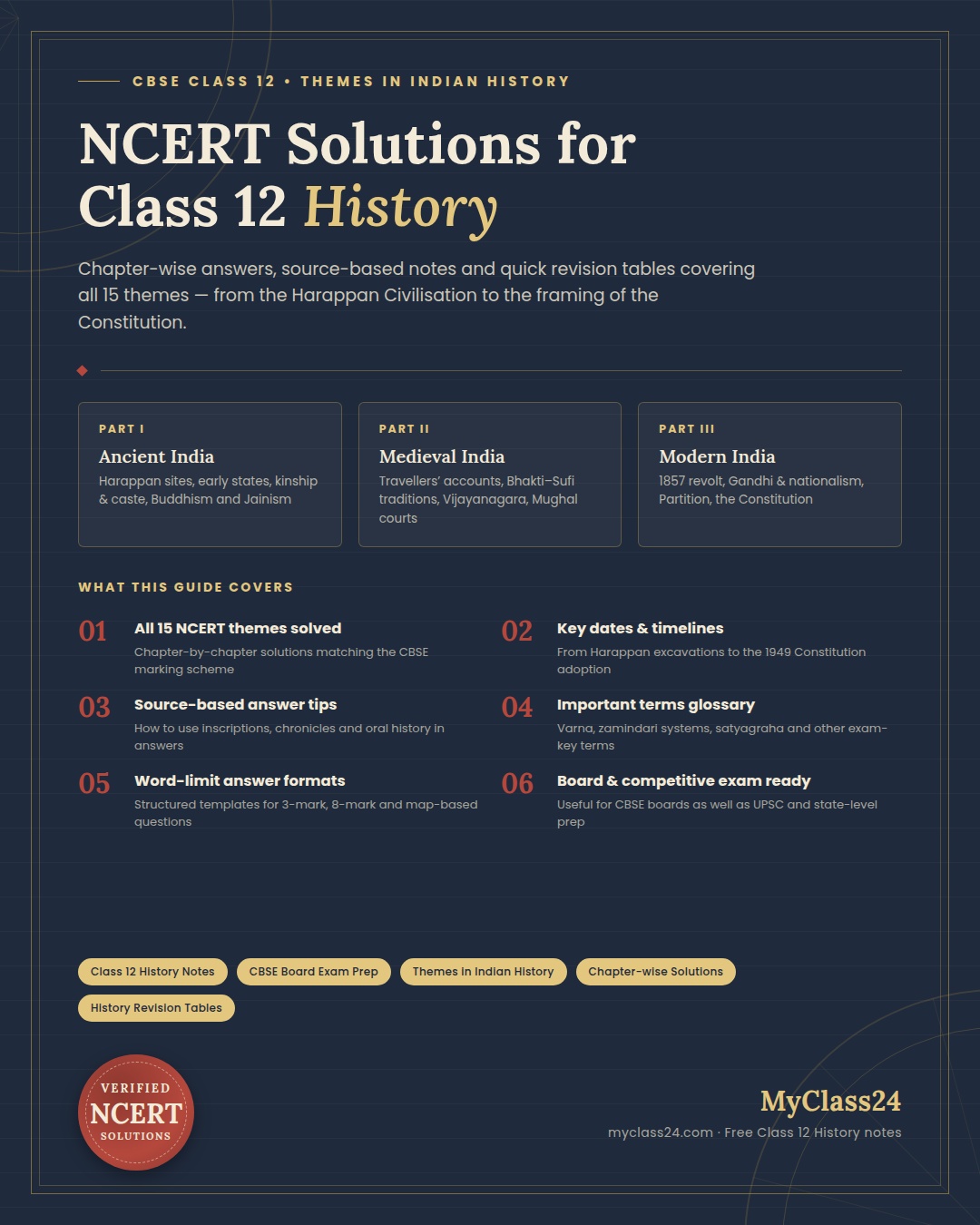
The CBSE Class 12 History syllabus is divided into three themed books — Themes in Indian History Part I, Part II, and Part III — covering everything from the Harappan Civilisation to the making of the Indian Constitution. Below, every chapter has been explained with its core theme, NCERT-pattern solutions, and an exam-oriented summary so that students at MyClass24 can use this as both a learning tool and a last-minute revision guide.
NCERT Solutions for Class 12 History – Chapter-wise
Book | Chapter No. | Chapter Name |
|---|---|---|
📘 Themes in Indian History – I | ||
History – I | Chapter 1 | |
History – I | Chapter 2 | |
History – I | Chapter 3 | |
History – I | Chapter 4 | |
📙 Themes in Indian History – II | ||
History – II | Chapter 5 | |
History – II | Chapter 6 | |
History – II | Chapter 7 | |
History – II | Chapter 8 | |
📕 Themes in Indian History – III | ||
History – III | Chapter 9 | |
History – III | Chapter 10 | |
History – III | Chapter 11 | |
History – III | Chapter 12 | |
Why Use NCERT Solutions for Class 12 History
NCERT Solutions are not meant to replace the textbook; they are meant to help students understand how to frame full-mark answers. CBSE history papers are evaluated based on factual accuracy, use of correct terminology, and the ability to connect sources with interpretation. A well-written NCERT solution shows students exactly how to structure short-answer (3 marks), long-answer (8 marks), and source-based questions within the word limit prescribed by the board.
Helps build chapter-wise clarity on themes, sources, and historiography
Provides model answers matching the CBSE marking scheme and word limits
Strengthens recall of dates, dynasties, movements, and key personalities
Useful for quick revision before unit tests, half-yearly, and board exams
Builds a strong base for UPSC, State PSC, and other competitive exams that use NCERT as a foundation
Class 12 History Syllabus Structure (Themes in Indian History)
The CBSE Class 12 History course (Code 027) is divided into three parts. Below is a quick overview table of all themes asked in the board exam.
Part | Theme No. | Theme / Chapter Title | Broad Period Covered |
Part I | Theme 1 | Bricks, Beads and Bones – The Harappan Civilisation | c. 2600–1900 BCE |
Part I | Theme 2 | Kings, Farmers, and Towns – Early States and Economies | c. 600 BCE–600 CE |
Part I | Theme 3 | Kinship, Caste, and Class – Early Societies | c. 600 BCE–600 CE |
Part I | Theme 4 | Thinkers, Beliefs and Buildings – Cultural Developments | c. 600 BCE–600 CE |
Part II | Theme 5 | Through the Eyes of Travellers – Perceptions of Society | c. 10th–17th century |
Part II | Theme 6 | Bhakti–Sufi Traditions – Religious Beliefs and Devotional Texts | c. 8th–18th century |
Part II | Theme 7 | An Imperial Capital – Vijayanagara | c. 14th–16th century |
Part II | Theme 8 | Peasants, Zamindars and the State – Agrarian Society (Mughal Empire) | c. 16th–17th century |
Part II | Theme 9 | Kings and Chronicles – The Mughal Courts | c. 16th–17th century |
Part III | Theme 10 | Colonialism and the Countryside – Exploring Official Archives | c. 18th–19th century |
Part III | Theme 11 | Rebels and the Raj – 1857 Revolt | 1857 |
Part III | Theme 12 | Colonial Cities – Urbanisation, Planning, Architecture | c. 18th–20th century |
Part III | Theme 13 | Mahatma Gandhi and the Nationalist Movement | 1915–1948 |
Part III | Theme 14 | Understanding Partition – Politics, Memories, Experiences | 1940s |
Part III | Theme 15 | Framing the Constitution – The Beginning of a New Era | 1946–1950 |
Part I: Solutions Overview – Ancient India
Theme 1: Bricks, Beads, and Bones (Harappan Civilisation)
This chapter explains how archaeologists like John Marshall and R.E.M. Wheeler reconstructed Harappan life through excavation. NCERT solutions for this chapter focus on the town planning of Mohenjodaro, the Great Bath, craft production centres like Chanhudaro and Lothal, and the unresolved debate around the Harappan script and the decline of the civilisation around 1900 BCE.
Theme 2: Kings, Farmers and Towns
This theme covers the transition from the Mauryan Empire to the post-Mauryan economy, including the contribution of inscriptions (especially Ashokan edicts), the role of the Sixteen Mahajanapadas, and agrarian expansion under Gupta rule. Solutions here emphasise how epigraphy and numismatics (study of coins) help historians reconstruct political and economic history.
Theme 3: Kinship, Caste and Class
Based primarily on the Mahabharata, this chapter explains the functioning of varna and jati systems, patriliny, and the position of women, especially through the figure of Draupadi. Answers should focus on how the text was compiled over centuries and used both as a social code and a normative ideal.
Theme 4: Thinkers, Beliefs and Buildings
This theme traces the rise of Buddhism and Jainism as responses to Vedic ritualism, the architectural evolution of stupas like Sanchi, and how monuments were rediscovered, restored, and sometimes contested in the colonial period.
Part II: Solutions Overview – Medieval India
Theme 5: Through the Eyes of Travellers
This chapter is based on accounts of foreign travellers — Al-Biruni, Ibn Battuta, and Francois Bernier — and how their cultural background shaped their observations of Indian society, the institution of caste, and economic conditions under the Mughals.
Theme 6: Bhakti–Sufi Traditions
Solutions here explain the philosophies of saints like Kabir, Mirabai, and Sufi orders like the Chishtis, the concept of nirguna and saguna bhakti, and how these movements challenged caste hierarchies and religious orthodoxy.
Theme 7: An Imperial Capital – Vijayanagara
This theme covers the urban layout, water management systems, and architectural styles of the Vijayanagara Empire, with focus on how archaeologists like Robert Sewell rediscovered the site of Hampi.
Theme 8: Peasants, Zamindars and the State
This chapter uses the Ain-i-Akbari as its primary source to explain Mughal agrarian relations, the role of zamindars, irrigation, and the position of women in agricultural production.
Theme 9: Kings and Chronicles – The Mughal Courts
Solutions focus on the production of imperial chronicles, miniature painting traditions, and how court histories like the Akbarnama portrayed kingship as divinely sanctioned.
Part III: Solutions Overview – Modern India
Theme 10: Colonialism and the Countryside
This theme is built on the Fifth Report and revenue records to explain the Permanent Settlement in Bengal, the Mahalwari and Ryotwari systems, and the impact of revenue policy on peasants and zamindars.
Theme 11: Rebels and the Raj – The Revolt of 1857
This is one of the most exam-important chapters. Solutions should cover causes of the revolt (political, economic, social, military), the role of leaders like Bahadur Shah Zafar, Rani Lakshmibai, and Nana Saheb, and how the revolt was suppressed and remembered through British and nationalist narratives.
Theme 12: Colonial Cities
This chapter explains the transformation of Bombay, Madras, and Calcutta under colonial town planning, the emergence of ‘White’ and ‘Black’ towns, and the development of municipal governance.
Theme 13: Mahatma Gandhi and the Nationalist Movement
A high-weightage chapter covering the Non-Cooperation Movement, Civil Disobedience Movement, Quit India Movement, and how newspapers and oral testimonies are used as sources to study Gandhi’s leadership and mass mobilisation.
Theme 14: Understanding Partition
This theme uses oral history, official records, and personal diaries to explain the human cost of Partition in 1947, focusing on migration, violence, and the role of political negotiations between the Congress, Muslim League, and the British government.
Theme 15: Framing the Constitution
This concluding chapter explains the working of the Constituent Assembly between 1946 and 1949, debates on federalism, minority rights, the language question, and the vision of leaders like Dr B.R. Ambedkar, Jawaharlal Nehru, and Sardar Patel in shaping the Indian Constitution.
Important Dates and Events – Quick Revision Table
Dates are frequently asked as 1-mark or short-answer questions. Use this table for fast revision before exams.
Event | Year / Period | Significance |
Discovery of Harappa | 1921 | Marked the beginning of Indus Valley excavations |
Discovery of Mohenjodaro | 1922 | Confirmed the scale of Harappan urban planning |
Compilation of Mahabharata (broad period) | c. 200 BCE–200 CE | Reflects evolving kinship and social norms |
Reign of Krishnadeva Raya (Vijayanagara) | 1509–1529 | Peak of Vijayanagara political and cultural power |
Akbarnama composed | c. 1589–1598 | Key source for Mughal court history |
Permanent Settlement, Bengal | 1793 | Fixed revenue system under Lord Cornwallis |
Revolt of 1857 | 1857 | First large-scale uprising against British rule |
Non-Cooperation Movement | 1920–1922 | First mass movement led by Gandhi |
Civil Disobedience Movement | 1930–1934 | Began with the Dandi Salt March |
Quit India Movement | 1942 | Demanded immediate British withdrawal |
Partition of India | 1947 | Creation of India and Pakistan |
Constituent Assembly formed | 1946 | Began drafting the Indian ConstitutionThe |
Constitution of India was adopted | 26 November 1949 | Came into effect on 26 January 1950 |
Important Terms and Concepts – Glossary Table
History answers score better when students use correct terminology instead of generic language. Refer to this table while writing definitions or explaining sources.
Term | Meaning / Concept |
Epigraphy | The study of inscriptions to understand political and economic history |
Numismatics | The study of coins, used to trace trade and ruler chronology |
Varna | A fourfold social classification mentioned in Brahmanical texts |
Jati | Sub-caste based on occupation, often more locally rooted than varna |
Sufism | Mystical tradition within Islam emphasising personal devotion to God |
Bhakti | Devotional worship of a personal deity, often cutting across caste lines |
Zamindar | A revenue-collecting intermediary recognised under colonial land systems |
Ryotwari System | Land revenue system where peasants paid tax directly to the state |
Mahalwari System | Revenue system based on collective village (mahal) assessment |
Satyagraha | Gandhi’s method of non-violent resistance against injustice |
Oral History | Use of personal memory and testimony as a historical source |
Constituent Assembly | The body that drafted the Constitution of India between 1946 and 1949 |
How to Write High-Scoring Answers in Class 12 History
CBSE History answers are evaluated differently from other humanities subjects because they require both factual recall and source-based interpretation. The following approach helps students structure answers correctly within the prescribed word limits.
Question Type | Suggested Word Limit | Answer-Writing Tip |
Very Short Answer | 20–30 words | State the fact directly; avoid unnecessary explanation |
Short Answer (3 marks) | 60–80 words | Give 2–3 clear points with one example or source reference |
Long Answer (8 marks) | 200–250 words | Use an intro, 3–4 developed points, and a concluding line |
Map-Based Question | As per the instruction | Mark locations precisely; label clearly and neatly |
Always mention the relevant source (inscription, chronicle, travelogue, or oral account) when the question is source-based
Use historical terms correctly instead of paraphrasing them loosely
Where possible, mention the historian or scholar associated with the interpretation
Practice writing answers within the time limit to build exam speed
Revise the date table and glossary a day before the exam for quick recall
Final Word
Class 12 History is ultimately a subject about how evidence — inscriptions, chronicles, travel accounts, oral testimonies and official records — is interpreted to build historical understanding. Studying NCERT Solutions for Class 12 History chapter by chapter, alongside the quick-revision tables above, helps students move beyond rote memorisation toward writing analytical, well-structured answers that match the CBSE marking scheme. Students preparing with MyClass24 are encouraged to revisit each theme regularly, practice source-based questions, and use the date and terminology tables provided here as a daily revision habit in the lead-up to exams.
FAQs for NCERT Solutions for Class 12 History
NCERT Solutions for Class 12 History are essential because the CBSE Board examination follows the NCERT textbook closely. Most of the questions are directly or indirectly based on the concepts, case studies, maps, and historical sources discussed in the chapters. Well-prepared solutions explain events in chronological order, making it easier to understand historical developments rather than simply memorizing facts. They also help students answer source-based, short-answer, and long-answer questions using the appropriate historical terms expected in board exams. By studying these solutions regularly, students gain confidence in writing structured answers with relevant examples and evidence. They also become familiar with important themes such as ancient civilizations, medieval kingdoms, and modern Indian history, improving both conceptual understanding and examination performance.
History is about understanding the relationship between events, societies, cultures, and political developments rather than memorizing isolated facts. NCERT Solutions simplify complex historical topics by explaining causes, consequences, continuity, and change in an easy-to-follow manner. They connect historical events logically, helping students understand why developments occurred and how they influenced later periods. Clear explanations, chronological presentation, and relevant examples strengthen analytical thinking and improve retention. Students gradually develop the ability to compare civilizations, interpret historical evidence, and evaluate different perspectives. This deeper conceptual understanding enhances classroom learning, improves answer quality in examinations, and encourages genuine interest in history. As a result, students gain lasting knowledge instead of short-term memorization for exams.
Many students rely solely on memorization without understanding historical developments, making it difficult to answer application-based questions. Others ignore maps, source-based exercises, timelines, and historical terminology, which often carry valuable marks in board exams. Some students skip regular revision and attempt to study the entire syllabus at the last moment, leading to confusion and poor retention. Another common mistake is writing lengthy but unorganized answers without proper introductions, logical sequencing, or conclusions. NCERT Solutions help avoid these mistakes by presenting structured explanations and exam-oriented answers. Students who understand concepts, revise consistently, practice answer writing, and focus on historical analysis generally perform much better than those who depend only on rote learning.
Yes, NCERT Solutions are beneficial for both school examinations and several competitive examinations that include History as part of their syllabus. They explain concepts clearly, making it easier to understand ancient, medieval, and modern Indian history. School examinations usually emphasize textbook understanding, while competitive exams often test conceptual clarity and factual accuracy. Strong preparation through NCERT Solutions creates a solid historical foundation that supports both objectives. Students become familiar with important events, historical developments, and cultural changes while improving analytical skills. Although advanced competitive examinations may require additional reference materials, mastering NCERT content remains the first and most important step. It builds confidence and prepares students for higher-level historical studies.
History involves remembering events, timelines, personalities, and interpretations, making regular revision extremely important. After completing each chapter, revise it within a few days to strengthen memory. Weekly revision helps retain important facts, while monthly revision reinforces overall understanding before examinations. During revision, focus on important terms, maps, source-based questions, and descriptive answers instead of rereading the entire chapter repeatedly. NCERT Solutions make revision easier because they summarize key concepts through well-structured answers. Students should also practice writing answers from memory and compare them with the solutions to identify missing points. Frequent revision improves recall speed, reduces examination stress, and increases confidence, ensuring better performance in both school assessments and CBSE Board examinations.
Source-based questions evaluate a student's ability to interpret historical evidence instead of recalling memorized information. NCERT Solutions explain the background of each source, helping students understand its historical context, meaning, and significance. They teach learners how to identify the main idea, interpret quotations, analyze visual sources, and answer related questions logically. Students also learn to connect source material with broader historical events and concepts discussed in the chapter. Regular practice improves comprehension and analytical thinking, which are essential for scoring well in board examinations. Instead of guessing answers, students develop confidence in interpreting historical documents accurately. This skill not only enhances examination performance but also builds a deeper appreciation of historical research and evidence.
Writing high-scoring long answers requires clarity, organization, and historical accuracy. Start with a brief introduction that defines the topic or provides historical context. Divide the main answer into logical headings or well-connected paragraphs explaining the causes, developments, impacts, and significance of the event. Include important dates, personalities, historical evidence, and examples wherever appropriate. Maintain chronological order to ensure your explanation is easy to follow. Conclude with a balanced summary that highlights the importance of the topic. NCERT Solutions demonstrate how to organize information without unnecessary repetition, helping students improve presentation and readability. Regular answer-writing practice develops speed, confidence, and the ability to express historical concepts effectively within the board examination time limit.
Although every chapter is important because CBSE can ask questions from any part of the syllabus, some chapters are frequently tested due to their conceptual depth and historical significance. Topics related to the Indus Valley Civilization, the Harappan culture, Kings, Farmers and Towns, Bhakti-Sufi traditions, Vijayanagara Empire, Mughal administration, Colonialism, Mahatma Gandhi, Partition, and the framing of the Indian Constitution often receive considerable attention. Students should also prepare source-based passages and map questions carefully. NCERT Solutions explain these chapters systematically, helping learners understand historical developments instead of memorizing isolated facts. Equal attention to every chapter, along with repeated revision of important themes, ensures balanced preparation and reduces the risk of missing scoring opportunities.
Scoring above 90 in Class 12 History requires more than reading chapters once. NCERT Solutions help students understand every topic in detail while presenting answers in the format expected by CBSE examiners. Begin by completing one chapter at a time and revising it through question-answer practice. Focus on timelines, important personalities, historical sources, maps, and key events. Practice writing descriptive answers within the prescribed word limit while maintaining proper sequencing of points. Revise source-based and map-based questions regularly because they carry significant marks. Consistent revision strengthens retention and reduces confusion between similar historical events. Combining NCERT Solutions with repeated self-assessment, previous question practice, and careful revision enables students to improve answer quality and maximize their board examination scores.
For most students, NCERT Solutions provide an excellent foundation for Class 12 History preparation because they cover every chapter and textbook question thoroughly. The CBSE Board primarily designs questions around NCERT concepts, making these solutions highly reliable for exam preparation. However, students aiming for exceptionally high scores should also practice sample papers, previous years' questions, and source-based exercises. Understanding the historical background, chronology, and interpretation of events is equally important. Instead of memorizing answers, students should learn how to explain causes, consequences, and significance of historical developments. Regular revision and answer-writing practice further improve presentation skills. When combined with disciplined study habits, NCERT Solutions become one of the most effective resources for achieving excellent results in History.