





NCERT Solutions for Class 12 Economics: A Complete Chapter-Wise Guide for Board Exam Success
Class 12 Economics often feels like two subjects packed into one. On one side, there's Microeconomics, dealing with how individual consumers and firms make choices. On the other, there's Macroeconomics, which zooms out to look at national income, money, government budgets, and the balance of payments. For a student preparing for boards, this dual structure can feel overwhelming unless approached with a clear, organised plan, and that's exactly where well-structured NCERT Solutions for Class 12 Economics come in handy.
This guide walks through why these solutions matter, how the syllabus is structured, and how to use solved exercises to actually improve your understanding rather than just memorising answers for the sake of marks.
NCERT Solutions for Class 12 Economics – Chapter-wise
Book | Chapter No. | Chapter Name |
|---|---|---|
📘 Introductory Macroeconomics | ||
Macroeconomics | Chapter 1 | |
Macroeconomics | Chapter 2 | |
Macroeconomics | Chapter 3 | |
Macroeconomics | Chapter 4 | |
Macroeconomics | Chapter 5 | |
Macroeconomics | Chapter 6 | |
📗 Introductory Microeconomics | ||
Microeconomics | Chapter 1 | |
Microeconomics | Chapter 2 | |
Microeconomics | Chapter 3 | |
Microeconomics | Chapter 4 | |
Microeconomics | Chapter 5 | |
Why NCERT Solutions Matter for Class 12 Economics
The NCERT textbook for Class 12 Economics is the foundation of the CBSE syllabus, and almost every board question draws directly from its concepts, diagrams, and numerical problems. Many students make the mistake of reading the chapter once and assuming they've understood it, only to struggle when faced with application-based or numerical questions in the actual exam.
Properly worked-out solutions help in three specific ways. First, they show the correct method of presenting an answer, which matters a lot in Economics because examiners award marks for the approach, not just the final number. Second, they clarify the difference between similarly worded concepts, such as "change in demand" versus "change in quantity demanded," which are commonly confused but heavily tested. Third, they give students a reference point to self-check their practice answers before the exam, building confidence rather than last-minute panic.
Understanding the Class 12 Economics Syllabus Structure
The CBSE Class 12 Economics syllabus is divided into two books: Introductory Microeconomics and Introductory Macroeconomics, each carrying equal weight in the final exam. Together, they're usually evaluated through an 80-mark theory paper and a 20-mark project or internal assessment, though students should always verify the latest weightage from their school or the current CBSE circular, since marking schemes can be revised.
Here's a simplified breakdown of how the two books are typically structured:
Book | Focus Area | Approximate Chapters | Nature of Content |
|---|---|---|---|
Introductory Microeconomics | Individual consumer and producer behavior | 6 | Theory-heavy with diagrams |
Introductory Macroeconomics | National economy, money, government, trade | 6 | Mix of theory and numericals |
Microeconomics: Chapter-Wise Breakdown
Microeconomics is the study of how individual units like households and firms make decisions about what to buy, produce, and sell. It begins with foundational ideas and slowly builds toward market structures.
Introduction to Microeconomics
This opening chapter sets the stage by explaining the central economic problem of scarcity and choice. Students learn about the production possibility curve, opportunity cost, and the basic questions every economy must answer: what to produce, how to produce, and for whom. Solutions to this chapter usually focus on diagram-based questions involving the PPC curve shifting due to resource changes or technological improvements.
Theory of Consumer Behaviour
Here the focus shifts to utility, demand, and how consumers maximize satisfaction given limited income. This chapter introduces the law of diminishing marginal utility and consumer equilibrium, both of which are frequently tested through numerical problems. A well-explained solution doesn't just give the final utility value; it walks through each step of the marginal utility table so students can replicate the method on similar numbers in the exam.
Production and Costs
This chapter deals with how firms convert inputs into outputs and the cost structures involved, including fixed cost, variable cost, and the relationship between average and marginal cost curves. Numerical questions here are common, and getting the formula sequence right is often more important than complex calculation.
The Theory of the Firm Under Perfect Competition
Supply, producer's equilibrium, and the conditions for a firm to operate under perfect competition are covered in this chapter. Diagram-based answers showing the marginal cost and marginal revenue intersection are a recurring exam favorite.
Market Equilibrium
This chapter combines demand and supply analysis to explain how prices are determined in a free market, along with the effects of government intervention like price ceilings and price floors.
Non-Competitive Markets
The final microeconomics chapter introduces monopoly and oligopoly, contrasting them with the perfectly competitive market discussed earlier.
Macroeconomics: Chapter-Wise Breakdown
Macroeconomics shifts the lens from individual behavior to the functioning of the entire economy, covering national income, money supply, government policy, and international trade.
National Income Accounting
This is one of the most numerically demanding chapters in the entire syllabus. Students must learn to calculate GDP, GNP, NNP, and per capita income using different methods, including the income method, expenditure method, and product method. Solutions here are most useful when they clearly tag each item in a numerical as either "to be included" or "not to be included" in national income, since that classification is where most students lose marks.
Money and Banking
This chapter explains the functions of money, the role of commercial banks in credit creation, and the function of the central bank in controlling money supply through tools like the repo rate and cash reserve ratio.
Determination of Income and Employment
Building on Keynesian economics, this chapter explains aggregate demand, aggregate supply, and the multiplier effect. It's conceptually dense, and solutions that break down the consumption function and saving function step by step are far more helpful than ones that simply state the final formula.
Government Budget and the Economy
This chapter covers the structure of a government budget, the difference between revenue and capital budgets, and concepts like fiscal deficit and revenue deficit, which are commonly asked as short-answer or numerical questions.
Balance of Payments
The final macroeconomics chapter introduces foreign exchange rates, the current account, the capital account, and how a country's transactions with the rest of the world are recorded.
Quick Reference: Key Formulas Students Must Remember
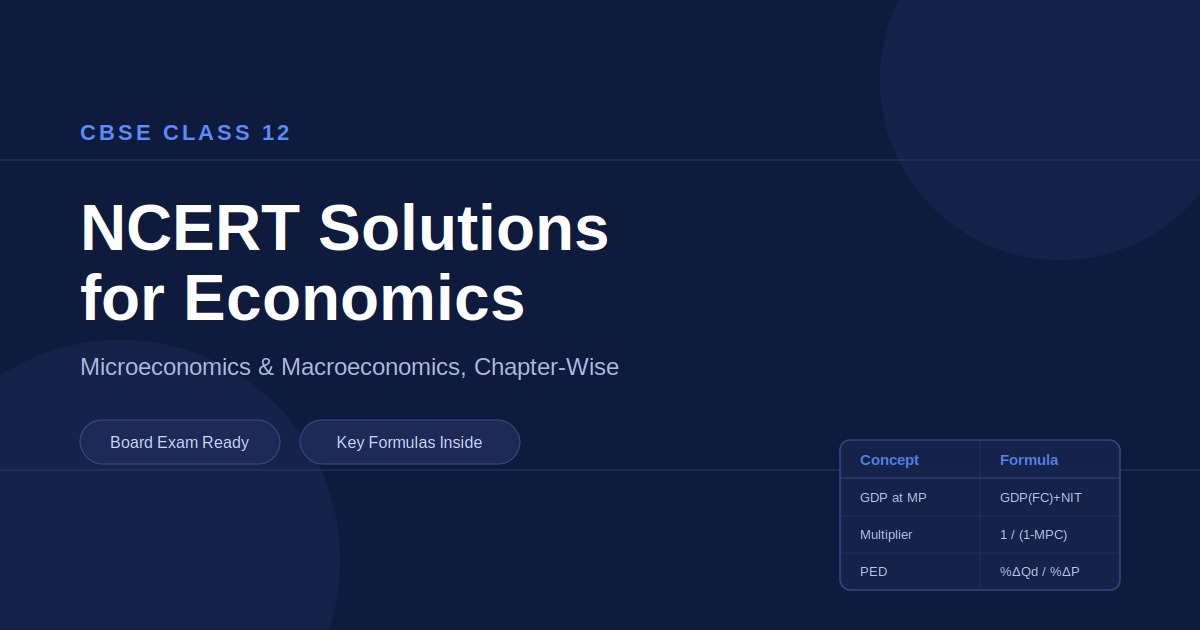
Having formulas in one place saves significant revision time before exams. Below is a condensed table of the most frequently used formulas across both books.
Concept | Formula | Chapter |
|---|---|---|
Marginal Utility | Change in Total Utility ÷ Change in Units Consumed | Theory of Consumer Behaviour |
Price Elasticity of Demand | % Change in Quantity Demanded ÷ % Change in Price | Theory of Consumer Behaviour |
Marginal Cost | Change in Total Cost ÷ Change in Output | Production and Costs |
GDP at Market Price | GDP at Factor Cost + Net Indirect Tax | National Income Accounting |
National Income (NNP at FC) | GNP at MP – Depreciation – Net Indirect Tax + Net Factor Income from Abroad | National Income Accounting |
Investment Multiplier | 1 ÷ (1 – MPC) or 1 ÷ MPS | Determination of Income and Employment |
Fiscal Deficit | Total Expenditure – Total Receipts excluding Borrowings | Government Budget and the Economy |
How to Use NCERT Solutions Effectively
Simply reading through solved answers without attempting the question first defeats the purpose of practice. A more effective approach is to attempt each in-text and end-of-chapter question independently, then compare the answer against a reliable solution to identify gaps in either understanding or presentation style. Pay close attention to how diagrams are labeled in model answers, since unlabeled axes or missing equilibrium points are a common reason for lost marks in board exams, even when the underlying concept is correct.
It also helps to maintain a separate notebook of formulas and definitions extracted from the solutions, rather than flipping back through the entire textbook during last-minute revision. Numerical-heavy chapters like National Income Accounting and Determination of Income and Employment deserve extra practice time, since these questions carry high weightage and a single classification error can affect the entire final answer.
Common Mistakes Students Should Avoid
A recurring issue in Economics answer sheets is confusing similar-sounding terms, such as "stock and flow," "movement along the curve versus shift of the curve," or "balance of trade versus balance of payments." These distinctions are tested almost every year in some form, and solutions that explicitly highlight such comparisons through short tables or bullet points tend to stick better in memory than long paragraph explanations.
Another frequent mistake is skipping diagrams entirely in theory answers where a diagram is expected, even when the written explanation is accurate. Since Economics answers are evaluated holistically, a missing or poorly drawn diagram can reduce marks even for an otherwise strong answer.
Final Thoughts
Class 12 Economics rewards consistent, structured practice far more than last-minute cramming, given how interconnected the microeconomics and macroeconomics units are. Using NCERT Solutions as a guided practice tool, rather than a shortcut to copy answers, builds the kind of conceptual clarity that helps not just in board exams but also in competitive exams and undergraduate economics courses that build on these same foundations. Treat each solved question as a model of how to think through a problem, and the subject becomes far less intimidating than it first appears.
FAQs – NCERT Solutions for Class 12 Economics (Micro & Macro Chapters)
NCERT Solutions for Class 12 Economics are designed to help students understand every concept covered in both Microeconomics and Macroeconomics according to the latest CBSE syllabus. These solutions explain difficult topics such as consumer behaviour, national income, money and banking, government budget, and market equilibrium in a simple, step-by-step manner. They also help students learn the correct method of writing answers, which is essential for scoring high marks in board examinations. By practicing chapter-wise solutions regularly, students can strengthen conceptual clarity, improve numerical solving skills, and revise important definitions, diagrams, and formulas effectively. Consistent practice with NCERT-based questions also builds confidence for school exams, board exams, and various competitive entrance examinations that include economics as a subject.
NCERT Solutions for Class 12 Microeconomics simplify complex economic concepts into easy-to-understand explanations. Chapters such as Theory of Consumer Behaviour, Producer Behaviour, Market Equilibrium, and Determination of Prices involve both theoretical and numerical questions that require conceptual understanding. Well-prepared solutions explain every calculation, graph, and economic principle with proper reasoning. Students learn how to present answers in the format preferred by CBSE evaluators, which improves answer quality and accuracy. Regular revision of chapter-wise solutions also helps identify common mistakes and strengthens analytical thinking. Since many board examination questions are directly based on NCERT concepts, mastering these solutions significantly increases the chances of scoring excellent marks in Class 12 Economics.
Practicing every NCERT exercise question ensures complete coverage of the syllabus and strengthens conceptual understanding across all chapters. These questions are carefully designed to test definitions, reasoning ability, diagrams, calculations, analytical thinking, and application of economic concepts. Solving all exercises regularly familiarises students with the types of questions commonly asked in CBSE examinations. It also improves answer-writing techniques, logical presentation, and time management during the exam. Students who revise complete chapter-wise exercise questions multiple times are generally more confident while attempting both objective and descriptive questions. Thorough NCERT practice creates a strong academic foundation and significantly improves the chances of achieving high scores in Class 12 Economics.
Yes, comprehensive NCERT Solutions include step-by-step explanations for all important numerical questions found in both Microeconomics and Macroeconomics. Topics such as national income accounting, elasticity, revenue calculations, cost analysis, money multiplier, income determination, and various macroeconomic calculations require proper formulas and systematic solutions. Detailed explanations help students understand not only the correct answer but also the logic behind every calculation. Learning the proper method of solving numericals reduces calculation errors during examinations and improves speed. Regular practice also develops confidence in handling application-based questions, which are increasingly included in CBSE board examinations to assess conceptual understanding rather than rote memorisation.
The most effective approach is to complete one chapter at a time. First, carefully read the NCERT textbook to understand the concepts. Next, solve the exercise questions independently before checking the solutions. Compare your answers with the detailed explanations and identify mistakes. Maintain notes of important definitions, formulas, diagrams, graphs, and numerical methods for quick revision. Practice difficult questions multiple times until the concepts become clear. Revise completed chapters regularly instead of waiting until the final examination. This systematic method strengthens conceptual understanding, improves answer-writing skills, and helps students retain economic theories for longer. Consistent chapter-wise practice ultimately leads to better performance in board examinations.
Every chapter in Class 12 Economics carries importance because questions are distributed across both Microeconomics and Macroeconomics. However, chapters like Theory of Consumer Behaviour, Producer Behaviour, Market Equilibrium, National Income Accounting, Money and Banking, Government Budget and the Economy, Determination of Income and Employment, and Open Economy Macroeconomics are frequently tested. Students should thoroughly understand concepts, formulas, graphs, and numerical methods from these chapters. Instead of focusing only on high-weightage topics, complete chapter-wise preparation ensures better overall performance. Solving all NCERT questions, examples, and exercise problems helps build confidence and reduces the chances of missing important concepts that may appear in the board examination.
Macroeconomics deals with broader economic concepts like national income accounting, money supply, banking, government budget, determination of income and employment, and open economy. NCERT Solutions explain these topics with detailed examples, calculations, flow charts, and logical reasoning. Students understand the relationships between different macroeconomic variables instead of memorising definitions. Numerical questions are solved step by step, making difficult calculations easier to follow. These solutions also clarify important diagrams and economic models that frequently appear in CBSE examinations. A strong conceptual foundation helps students answer application-based and case-study questions confidently. Regular practice improves analytical skills, enhances problem-solving ability, and prepares students for higher studies in economics, commerce, business, and finance.
NCERT Solutions provide an excellent foundation for Class 12 Economics because the CBSE board primarily follows the NCERT textbook. Most theoretical concepts, short-answer questions, long-answer questions, and numerical problems are directly based on NCERT chapters. However, students aiming for the highest scores should also practice previous years' question papers, sample papers, competency-based questions, and case-study questions along with NCERT Solutions. Revising important diagrams, formulas, definitions, and statistical calculations regularly further strengthens preparation. Combining chapter-wise NCERT practice with mock tests helps improve speed, answer presentation, and time management. This balanced strategy enables students to perform confidently in both school examinations and the CBSE board examination.