





About NCERT Solutions for Class 12 Chemistry
NCERT Solutions for Class 12 Chemistry are an essential study resource for students preparing for board examinations and various competitive exams. These solutions provide detailed and easy-to-understand answers to all textbook questions, helping students develop a strong understanding of chemical concepts. The subject includes important topics such as Electrochemistry, Chemical Kinetics, Coordination Compounds, Organic Chemistry, Biomolecules, and Surface Chemistry, all of which require conceptual clarity and regular practice. Master your CBSE Class 12 Chemistry revision in 11 days—enrol in our course today!
By studying NCERT Solutions, students can learn the correct approach to solving numerical problems, balancing chemical equations, and explaining theoretical concepts effectively. The step-by-step explanations make difficult topics easier to understand and improve problem-solving skills. Regular practice also helps students identify weak areas and strengthen their preparation.
In addition to board exams, NCERT-based learning is highly beneficial for entrance examinations where fundamental concepts play a crucial role. Consistent revision of NCERT Solutions from Class 12 enhances confidence, improves accuracy, and helps students achieve better academic results in Chemistry.
NCERT Solutions for Class 12 Chemistry – Chapter-wise List
Chapter No. | Chapter Name |
|---|---|
Chapter 1 | |
Chapter 2 | |
Chapter 3 | |
Chapter 4 | |
Chapter 5 | |
Chapter 6 | |
Chapter 7 | |
Chapter 8 | |
Chapter 9 | |
Chapter 10 |
The NCERT solutions for Class 12 Chemistry are divided into various chapters, covering all major topics:
- Chapter 1: Solid State
This chapter covers crystallography, defects in solids, and types of solids, along with key equations and laws. - Chapter 2: Solutions
Focuses on the different types of solutions, their properties, and colligative properties, which are essential for understanding practical applications. - Chapter 3: Electrochemistry
Students learn about electrochemical cells, cell potential, and electrolysis, which are critical for both board exams and entrance tests. - Chapter 4: Chemical Kinetics
This chapter helps in understanding the rate of reaction, order of reaction, and Arrhenius equation, which are essential for solving numerical problems in competitive exams. - Chapter 5: Surface Chemistry
This chapter explains catalysis, adsorption, and colloids, which are fundamental to understanding the behavior of substances at the surface level. - Organic Chemistry
Organic Chemistry is one of the most challenging parts of Class 12 Chemistry, and the NCERT solutions provide detailed steps to tackle topics like Hydrocarbons, Biomolecules, and Polymers.
Class 12 Chemistry Chapters and Their Exam Weightage
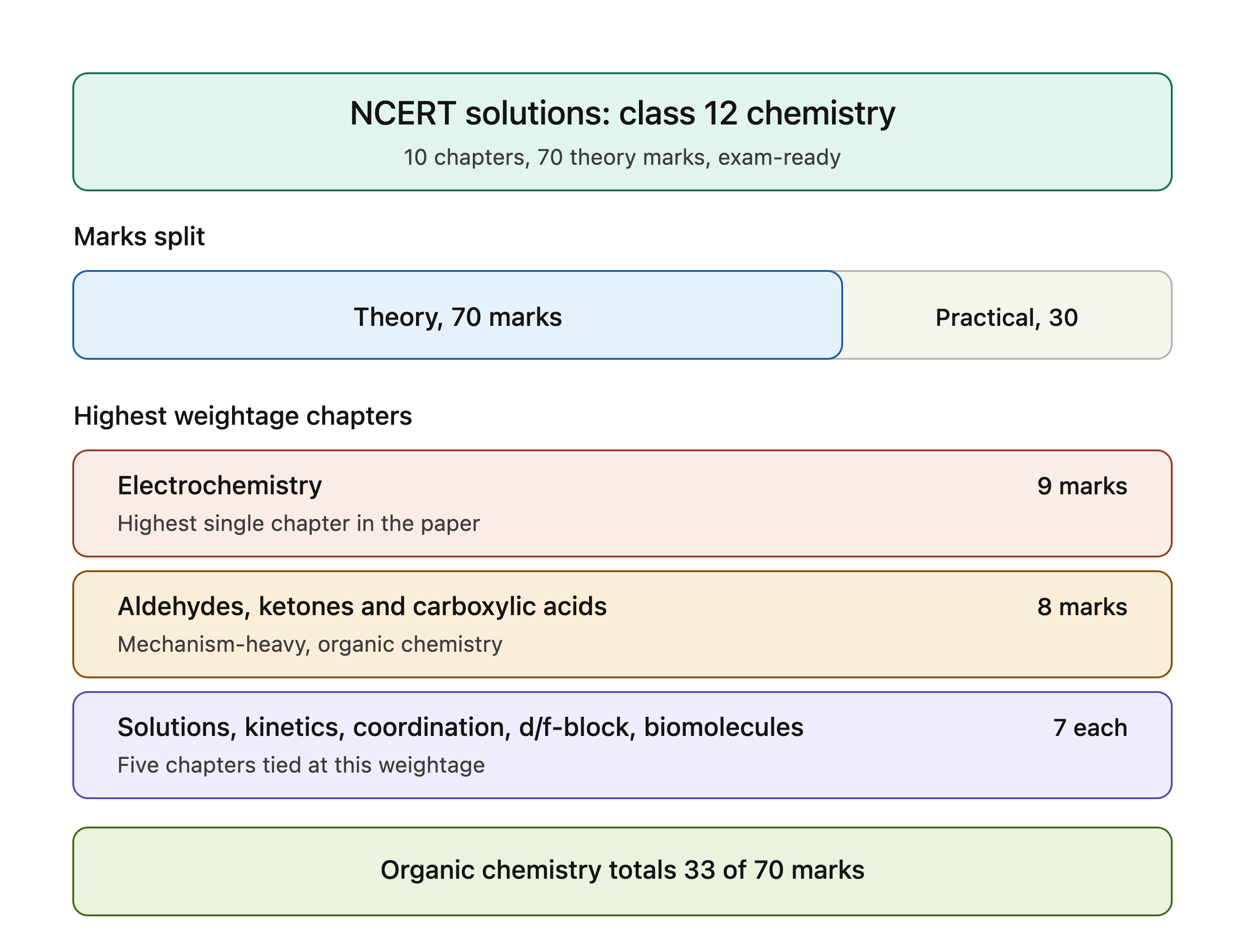
The CBSE Class 12 Chemistry theory paper carries 70 marks across 10 units; the remaining 30 marks come from practicals, the project and viva. The table below lists the exact unit-wise marks as prescribed in the current CBSE curriculum, along with what each chapter is mainly tested on.
| Unit | Chapter | Marks | What it’s mainly tested on |
|---|---|---|---|
| 1 | Solutions | 7 | Colligative properties, Raoult’s law, Van’t Hoff factor numericals |
| 2 | Electrochemistry | 9 | Nernst equation, EMF, Kohlrausch’s law, conductivity numericals |
| 3 | Chemical Kinetics | 7 | Rate law, order vs molecularity, integrated rate equations, half-life |
| 4 | d- and f-Block Elements | 7 | Electronic configuration, oxidation states, KMnO4 / K2Cr2O7 chemistry |
| 5 | Coordination Compounds | 7 | IUPAC nomenclature, VBT, CFT, isomerism, magnetic behaviour |
| 6 | Haloalkanes and Haloarenes | 6 | SN1/SN2 mechanisms, optical rotation, directive influence in haloarenes |
| 7 | Alcohols, Phenols and Ethers | 6 | Preparation methods, acidic nature of phenol, dehydration mechanism |
| 8 | Aldehydes, Ketones and Carboxylic Acids | 8 | Nucleophilic addition mechanism, alpha-hydrogen reactivity, acidity order |
| 9 | Amines | 6 | Basicity order, diazonium salt reactions, distinguishing 1°/2°/3° amines |
| 10 | Biomolecules | 7 | Carbohydrate classification, protein structure levels, DNA vs RNA |
Two patterns stand out from this table. First, Electrochemistry alone carries 9 of the 70 theory marks, making it the single highest-weighted chapter; pair it with Chemical Kinetics and the two physical chemistry chapters account for nearly a quarter of the paper. Second, Organic Chemistry (Units 6 to 10) together totals 33 marks, almost half the theory paper, so a student who treats organic chemistry as “memorise the reactions later” is leaving the largest scoring block for last.
How the 70-Mark Theory Paper Is Structured
CBSE does not publish a fixed chapter-wise weightage for the question paper itself; instead, it specifies which cognitive skill each mark is testing. Knowing this split changes how you revise, because a third of the paper rewards application, not recall.
| Cognitive domain | What it covers | Marks | Share |
|---|---|---|---|
| Remembering and understanding | Recalling facts, definitions, and explaining concepts in your own words | 28 | 40% |
| Applying | Using known formulas and concepts to solve new numerical or conceptual situations | 21 | 30% |
| Analysing, evaluating and creating | Comparing mechanisms, justifying trends, combining concepts across chapters | 21 | 30% |
In practice, this means 60% of the paper expects you to go beyond textbook definitions. Numerical questions on Electrochemistry and Chemical Kinetics, comparative questions on reaction mechanisms, and “justify the trend” style questions on periodic and coordination chemistry are where this 60% concentrates. NCERT’s in-text and end-of-chapter questions are written to train exactly this kind of application, which is why solving every NCERT question (not just the easy ones) matters more than reading extra reference material.
Practical Exam: 30 Marks You Cannot Ignore
The practical component is worth as much as four of the theory units combined, yet it is often the most neglected part of preparation. The evaluation scheme is fixed by CBSE as follows.
| Component | Marks |
|---|---|
| Volumetric analysis (titration) | 8 |
| Salt analysis (qualitative) | 8 |
| Content-based experiment | 6 |
| Project work | 4 |
| Class record and viva | 4 |
Salt analysis and volumetric analysis together make up more than half of the practical marks, so they deserve the same structured revision as a theory chapter: know the exact reagent sequence, the colour changes that confirm each cation and anion, and the calculation steps for molarity and normality cold, not just in the lab.
Important Formulas by Chapter
These are the formulas that turn up most often in numerical questions across the theory paper, JEE Main and NEET. Keep this table next to you during the final week of revision.
| Chapter | Formula | Used for |
|---|---|---|
| Solutions | Molality (m) = moles of solute / kg of solvent | Concentration independent of temperature |
| Solutions | p1 = x1.p1° (Raoult’s law) | Vapour pressure of an ideal solution |
| Solutions | ΔTb = Kb.m and ΔTf = Kf.m | Elevation in boiling point, depression in freezing point |
| Solutions | π = CRT | Osmotic pressure of a dilute solution |
| Solutions | i = normal molar mass / abnormal molar mass | Van’t Hoff factor for association or dissociation |
| Electrochemistry | ΔG° = -nFE°cell | Relation between Gibbs energy and EMF |
| Electrochemistry | E = E° - (RT/nF) ln Q | Nernst equation for non-standard conditions |
| Electrochemistry | Λm = κ / c | Molar conductivity from specific conductivity |
| Electrochemistry | Λm° = λ°(cation) + λ°(anion) | Kohlrausch’s law of independent ionic migration |
| Chemical Kinetics | rate = k[A]^x[B]^y | Rate law and order of reaction |
| Chemical Kinetics | t1/2 = 0.693/k | Half-life of a first-order reaction |
| Chemical Kinetics | k = A.e^(-Ea/RT) | Arrhenius equation relating rate constant to temperature |
Formulas are stated as per the NCERT Class 12 Chemistry textbook; symbols carry their standard NCERT meaning.
Key Concepts That Repeat Across Chapters
Beyond formulas, certain conceptual themes are tested again and again in different disguises. The table below groups them by the chapter cluster they belong to, so you can revise the underlying idea once instead of re-learning it per chapter.
| Concept area | Chapters it connects | Typical question type |
|---|---|---|
| Oxidation states and electronic configuration | d- and f-Block Elements, Coordination Compounds | Explain why a given ion is coloured or paramagnetic |
| Reaction mechanism (nucleophilic / electrophilic) | Haloalkanes, Alcohols/Phenols/Ethers, Aldehydes & Ketones | Draw the stepwise mechanism for a named reaction |
| Acid-base strength and stability of conjugate species | Phenols, Carboxylic Acids, Amines | Arrange given compounds in order of acidity or basicity |
| Structure-property relationship | Coordination Compounds, Biomolecules | Relate molecular structure to colour, magnetism, or biological role |
| Le Chatelier-type shifts and equilibrium thinking | Chemical Kinetics, Electrochemistry | Predict the effect of changing concentration or temperature |
A Smarter Way to Use NCERT Solutions
NCERT Solutions are most useful when they are used to check your reasoning, not your final answer. A method that works well for Class 12 Chemistry specifically:
- Attempt every in-text question first, including the ones inside the chapter, not just the end-of-chapter exercise. CBSE draws directly from both.
- For numerical chapters (Solutions, Electrochemistry, Chemical Kinetics), compare your working step by step against the solution. A wrong unit or a missed negative sign is usually where marks are lost, not the final formula.
- For mechanism-based organic questions, redraw the mechanism from memory after reading the solution once. Recognising a mechanism and reproducing it under exam conditions are different skills.
- For descriptive inorganic and biomolecule answers, note the exact NCERT phrasing for definitions (such as lanthanide contraction or denaturation). Board examiners award marks for precise terminology, not just the right idea.
- Revisit Electrochemistry, Aldehydes/Ketones/Carboxylic Acids, and Coordination Compounds at least twice before the exam, since together they carry 24 of the 70 theory marks.
Tips to Score Good Marks in Physical Chemistry in Class 12
Physical Chemistry is often regarded as one of the most scoring yet challenging sections of Class 12 Chemistry. It requires a good understanding of concepts, problem-solving skills, and regular practice. If you're aiming to score good marks in Physical Chemistry, here are some effective tips to guide your preparation:
1. Build a Strong Foundation of Concepts
Physical Chemistry is based on fundamental concepts that interconnect across various topics. Before diving into solving problems, ensure that you have a clear understanding of the basic concepts, such as:
- Moles and molar mass
- Atomic structure and bonding
- Gaseous state and laws of gases
- Thermodynamics
- Chemical kinetics
If you're unsure about any concept, revisit your NCERT textbook and refer to NCERT Solutions for Class 12 Chemistry for detailed explanations.
2. Focus on Important Chapters
Some chapters in Physical Chemistry carry more weight in the board exams and competitive exams like JEE and NEET. Focus on the following chapters:
- Chapter 1: Some Basic Concepts of Chemistry
- Chapter 2: Structure of the Atom
- Chapter 3: Classification of Elements and Periodicity in Properties
- Chapter 4: Chemical Bonding and Molecular Structure
- Chapter 5: States of Matter
- Chapter 6: Thermodynamics
- Chapter 7: Equilibrium
- Chapter 8: Redox Reactions
- Chapter 9: Hydrogen and Its Compounds
- Chapter 10: S Block Elements
These chapters have a significant presence in exams, so allocate more time for mastering them.
3. Practice Numericals Regularly
Physical Chemistry involves solving numerical problems, especially in chapters like Thermodynamics, Chemical Kinetics, and Equilibrium. To improve your numerical problem-solving skills:
- Practice consistently from your NCERT textbook and reference books.
- Solve past year papers to get an idea of question patterns and difficulty level.
- Work on unit conversions, formulas, and practice calculations to speed up problem-solving during exams.
- Focus on mastering Stoichiometry, Molarity, Molality, and Ideal Gas Laws, as these are commonly tested.
4. Make Use of NCERT Solutions for Physical Chemistry
NCERT Solutions for Class 12 Chemistry can be incredibly helpful for Physical Chemistry. These solutions provide:
- Step-by-step solutions to help you understand how to approach complex problems.
- Clarity on key derivations, which are important for exams.
- A thorough breakdown of important formulas and concepts that can be handy for quick revision.
Ensure that you don’t just memorize the solutions but understand the method behind each step so that you can apply it to different problems.
5. Revise Derivations and Formulas
Physical Chemistry involves various derivations and formulae, such as:
- First law of thermodynamics
- Ideal and non-ideal gas laws
- Rate Laws in Chemical Kinetics
- Le Chatelier’s Principle
Make sure to revise these derivations frequently and understand the reasoning behind each one. Keep a separate formula notebook where you note down important formulae and concepts for quick revision.
6. Practice Sample Papers and Mock Tests
- Solve sample papers regularly to get an idea of the types of questions you may encounter during exams.
- Take mock tests to evaluate your performance, identify weak areas, and improve your time management skills.
- After completing each test, analyse the mistakes and work on those topics to avoid making similar errors in the future.
7. Focus on Conceptual Understanding, Not Just Memorisation
While memorisation plays a role, Physical Chemistry requires deep conceptual understanding. Don't just memorise equations and formulas; ensure you understand:
- Why a particular reaction happens (for example, understanding the reasoning behind chemical equilibrium).
- The significance of each variable in equations.
- How to apply principles from one chapter (like thermodynamics) to solve problems in other chapters (like chemical kinetics).
8. Stay Consistent and Regular
Consistency is key when it comes to mastering Physical Chemistry. Allocate dedicated time daily for:
- Reviewing theory
- Solving numerals
- Revising important derivations
Instead of cramming the entire syllabus at once, spread your study plan over several weeks to allow time for thorough understanding and practice.
9. Clear Doubts Immediately
Don’t let doubts accumulate over time. If you have trouble understanding a concept or solving a problem, clarify your doubts as soon as possible. You can ask your teachers, peers, or refer to online educational platforms for better clarity. You can also use the NCERT Solutions for Class 12 Chemistry as a reference to clear your confusion.
10. Stay Calm and Confident During Exams
On exam day, it’s important to stay calm and confident. Follow these strategies:
- Read all the questions carefully before attempting them.
- Start with the questions you find easiest, then move on to the more difficult ones.
- Don’t spend too much time on a single question. If stuck, move on and come back to it later if time permits.
Quick Revision Checklist
- All 10 NCERT chapters solved at least once, including in-text questions
- Formula table (above) revised and self-tested without looking
- At least 5 years of previous board papers attempted under time conditions
- Salt analysis reagent sequence and colour changes revised separately from theory
- Weak chapters re-attempted from NCERT Solutions, not just re-read
Explore chapter-wise NCERT Solutions for Class 12 Chemistry on Myclass24 for step-by-step answers to every in-text and exercise question, mapped to the current CBSE syllabus.
FAQs on NCERT Solutions for Class 12 Chemistry
NCERT Solutions for Class 12 Chemistry are considered essential because most board examination questions are directly or indirectly based on NCERT concepts. These solutions help students understand every topic in a systematic manner and provide step-by-step explanations for textbook questions. They strengthen conceptual clarity in Physical, Organic, and Inorganic Chemistry while helping students learn the correct method of writing answers. Students also become familiar with important reactions, equations, derivations, and numerical problems. Regular practice of NCERT questions improves confidence and accuracy in examinations. Since the syllabus is extensive, well-explained solutions help save time and ensure complete coverage of every chapter. They are particularly useful for revision and help students identify weak areas before the final examination.
Teachers recommend NCERT Solutions because they closely align with the prescribed syllabus and examination pattern. The solutions cover every question in the textbook and explain concepts in a simple and logical manner. They help students build a strong conceptual foundation while improving problem-solving and analytical skills. Since board examination papers are largely based on NCERT content, mastering textbook questions significantly enhances preparation. Teachers also appreciate the systematic approach of NCERT Solutions because they encourage students to learn concepts rather than rely on rote memorization. Regular use of these solutions helps students perform better in school tests, board examinations, and competitive exams, making them an essential study resource.
Consistency is more important than studying for long hours occasionally. Students should practice NCERT Solutions regularly throughout the academic year rather than waiting until the final examination. A good strategy is to complete the solutions immediately after finishing each chapter in school. Weekly revision sessions help reinforce concepts and improve memory retention. During the final months before examinations, students should revise all chapters and solve important questions multiple times. Regular practice helps identify weak topics and prevents last-minute confusion. It also improves speed in solving numerical and theory-based questions. Students who revise NCERT Solutions consistently are generally more confident and better prepared for examinations.
Many students know the concepts but lose marks because they do not present answers correctly. NCERT Solutions demonstrate the proper structure, format, and terminology expected in examinations. Students learn how to write balanced chemical equations, explain concepts clearly, and present numerical solutions step by step. They also understand the importance of using scientific language and relevant keywords. Practicing answers from the solutions helps students develop a habit of writing concise yet complete responses. This improves clarity and ensures that important points are not missed. Better answer presentation often results in higher scores because examiners can easily evaluate well-organized and logically written responses.
Organic Chemistry becomes easier when students focus on understanding concepts rather than memorizing reactions blindly. NCERT Solutions explain reaction mechanisms, chemical properties, and conversions in a structured manner. Students should begin by learning fundamental concepts such as nomenclature, functional groups, and reaction types. After understanding the theory, they should practice textbook questions and study solved examples carefully. Creating short notes of important reactions and named reactions can also help during revision. Regular practice of exercise questions strengthens understanding and improves retention. Since many board examination questions are directly based on NCERT content, thoroughly studying the solutions helps students answer Organic Chemistry questions more accurately and confidently.
Chemistry numericals often seem difficult because they require both conceptual understanding and correct application of formulas. NCERT Solutions simplify this process by providing detailed, step-by-step calculations. Students learn how to identify given data, select the correct formula, substitute values accurately, and present the final answer with proper units. Chapters such as Solutions, Electrochemistry, Chemical Kinetics, and Surface Chemistry contain several numerical problems that require regular practice. By studying solved questions carefully, students understand common problem-solving techniques and avoid calculation mistakes. Repeated practice also improves speed and accuracy. As a result, students become more confident in tackling numerical questions during examinations and can score better marks in Chemistry.
NCERT Solutions provide a strong foundation and are often sufficient for scoring excellent marks when used properly. Students who thoroughly understand the concepts, practice all textbook questions, and revise regularly can achieve very high scores. The key is not merely reading solutions but understanding the logic behind each answer. Students should also practice writing complete answers in the required examination format and solve sample papers to improve speed and accuracy. Chemistry contains theory, reactions, and numerical problems, all of which are covered through NCERT exercises. Consistent revision and self-assessment, combined with a deep understanding of textbook concepts, can help students comfortably score above 90 marks in board examinations.
NCERT Solutions are highly useful for last-minute revision because they present answers in a concise and organized format. Students can revise important concepts, reactions, formulas, and numerical methods without searching through multiple resources. During revision, it is beneficial to focus on solved examples, in-text questions, and exercise problems from every chapter. Reading step-by-step solutions helps reinforce concepts and improves answer-writing skills. Students can also note important reactions and exceptions separately for faster review. Revising NCERT Solutions multiple times before examinations increases retention and confidence. Since board questions often follow the textbook pattern, practicing these solutions shortly before exams can significantly improve performance and reduce examination stress.
Yes, NCERT Solutions play a significant role in preparing for competitive examinations such as JEE and NEET. Many questions in these exams are based on fundamental concepts explained in the NCERT textbook. The solutions help students understand theoretical concepts, chemical reactions, mechanisms, and formula applications in a clear manner. For NEET aspirants, NCERT is especially important because a large portion of Chemistry questions is directly linked to textbook content. JEE aspirants can use NCERT Solutions as a foundation before moving to advanced-level problems. By solving textbook questions thoroughly, students develop conceptual understanding and problem-solving skills. This creates a strong base that makes it easier to tackle complex questions asked in competitive examinations.
Although every chapter is important, some chapters consistently carry significant weight in board examinations. Electrochemistry, Chemical Kinetics, Coordination Compounds, Haloalkanes and Haloarenes, Aldehydes, Ketones and Carboxylic Acids, Amines, and Biomolecules are often considered highly scoring. These chapters contain important concepts, reactions, numerical questions, and reasoning-based problems that frequently appear in examinations. However, students should avoid selective study because board papers are designed from the complete syllabus. NCERT Solutions help students prepare all chapters comprehensively and ensure that no important topic is left uncovered. A balanced approach that combines understanding concepts, learning reactions, and practicing textbook questions can help students achieve excellent marks in Chemistry.