



Synthetic fibres and plastics have revolutionised modern life. Unlike natural fibres obtained from plants (cotton, jute) and animals (wool, silk), synthetic fibres are man-made through chemical processes.
Why Study This Topic?
- Understand everyday materials around you
- Learn about polymer chemistry basics
- Develop awareness about environmental impact
- Important for CBSE Class 8 Science exams
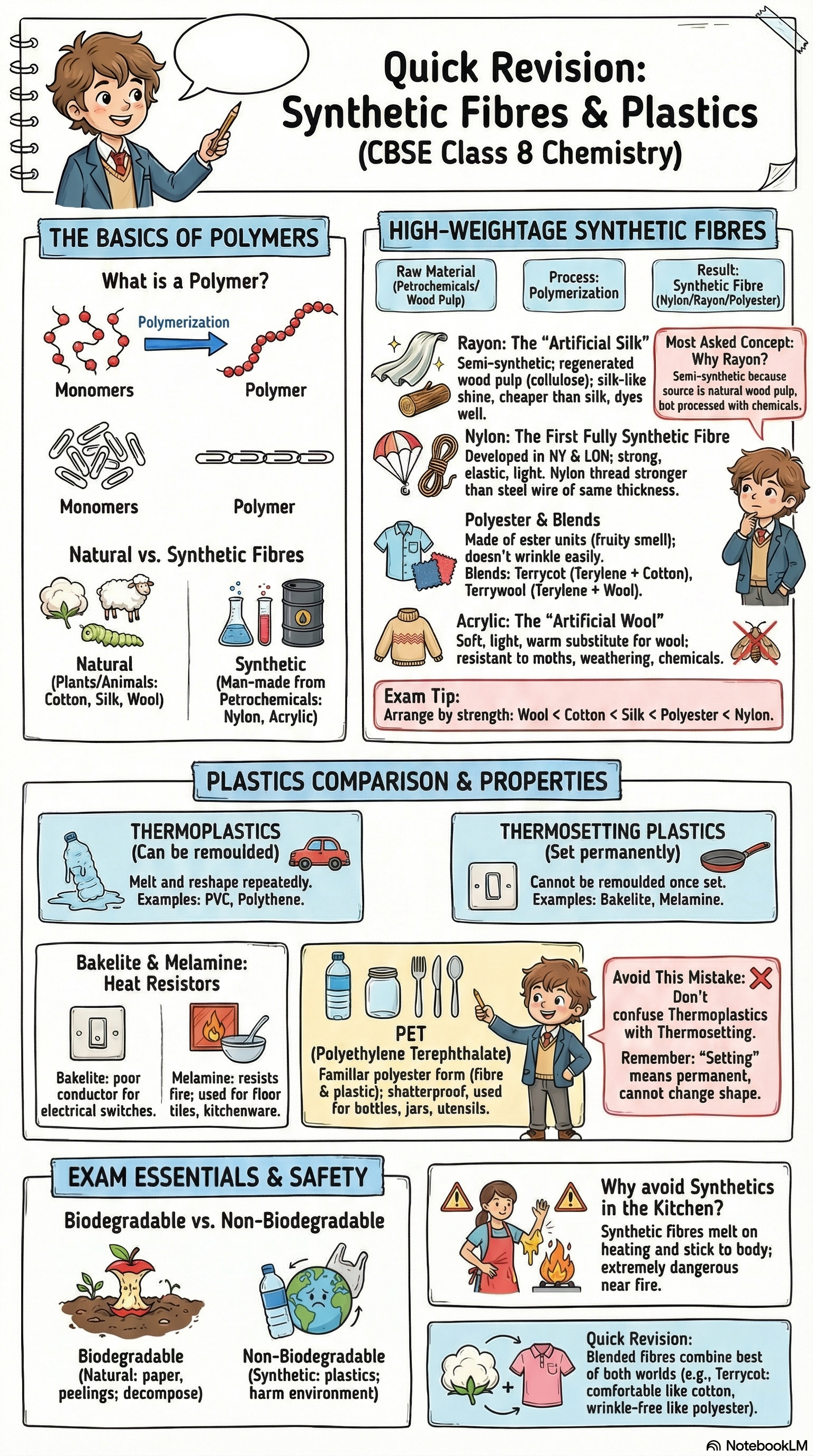
Synthetic materials are created by joining small molecules called monomers into long chains called polymers through a process called polymerization.
What Are Fibres?
Fibre is a thread-like strand used to make fabrics and textiles.
Types of Fibres
| Natural Fibres | Synthetic Fibres |
|---|---|
| Cotton, Jute, Silk, Wool | Rayon, Nylon, Polyester, Acrylic |
| From plants/animals | Made from petrochemicals |
| Biodegradable | Non-biodegradable |
| Limited properties | Can be engineered for specific uses |
What Are Synthetic Fibres?
Synthetic fibres are artificially manufactured fibres made from chemical substances derived primarily from petroleum products.
- Made from polymers (long chain molecules)
- Created through polymerization
- Raw materials: coal, petroleum
- Can be customized for different properties
Major Types of Synthetic Fibres
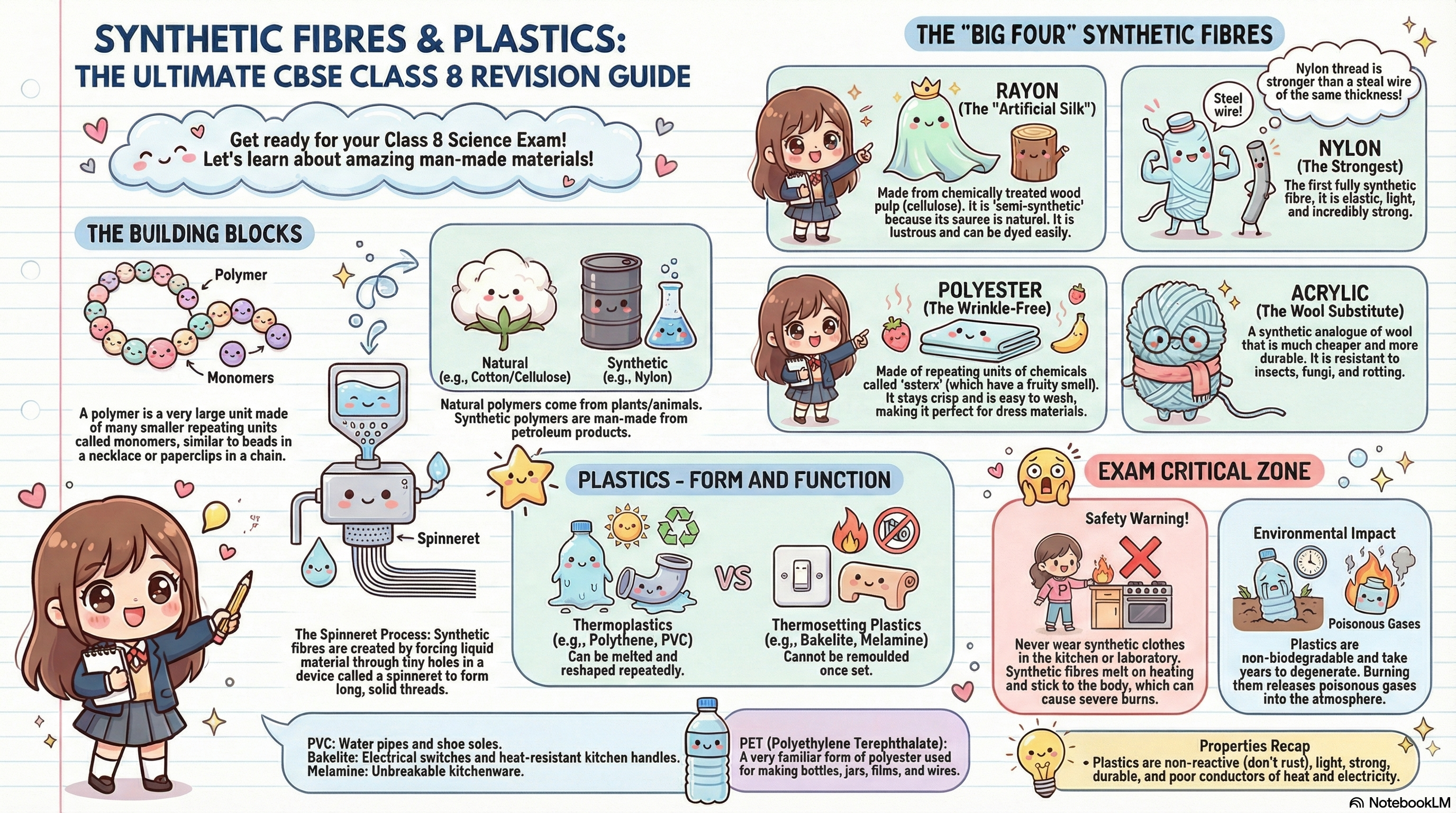
1. Rayon (Artificial Silk)
What is Rayon?
Rayon is a semi-synthetic fibre made from cellulose obtained from wood pulp.
Manufacturing Process:
- Wood pulp is dissolved in sodium hydroxide (alkaline solution)
- This forms a sticky liquid called viscose
- Viscose is forced through tiny holes (spinnerets) into sulphuric acid
- Silk-like threads of rayon are formed
Properties:
- Chemically similar to cotton
- Has shine like silk (called artificial silk)
- Can be dyed easily
- Lustrous and smooth
- Can be blended with cotton or wool
Uses:
- Making fabrics (sarees, dress materials)
- Blended with wool for carpets
- Reinforced tyres
- Medical bandages and surgical dressings
Why used in medical field?
Rayon is highly absorbent, soft, and does not cause skin irritation, making it ideal for bandages.
2. Nylon
What is Nylon?
Nylon was the first fully synthetic fibre, made from coal, water, and air. It's a polyamide polymer.
Origin of Name: NYLON = New York + LONdon (cities where it was developed)
Properties:
- Extremely strong and elastic
- Lightweight
- Lustrous appearance
- Water-resistant (absorbs very little water)
- Does not wrinkle easily
- Resistant to moths and chemicals
- Very durable
Uses:
- Parachutes and ropes (due to high strength)
- Fishing nets
- Tyre cords
- Toothbrush bristles
- Stockings, socks, sportswear
- Seat belts
3. Polyester
What is Polyester?
Polyester is made from repeating units of ester (organic compounds with fruity smell). The raw materials come from petroleum.
Common Trade Name: Terylene
Properties:
- Does not wrinkle easily (crease-resistant)
- Remains crisp and fresh
- Easy to wash and dries quickly
- Strong and durable
- Can be drawn into very fine fibres
Uses:
- Dress materials (shirts, trousers, sarees)
- Blended fabrics:
- Terrycot = Terylene + Cotton
- Terrywool = Terylene + Wool
- Boat sails
- Conveyor belts
- Bottles and containers (PET)
PET (Polyethylene Terephthalate):
- A form of polyester used as plastic
- Lightweight, transparent, and shatterproof
- Used for bottles, jars, containers
- Replacing glass in many applications
4. Acrylic
What is Acrylic?
Acrylic fibre is made from acrylonitrile through polymerization.
Properties:
- Soft and light like wool
- Warm and comfortable
- Weather-resistant
- Strong and durable
- Quick-drying (absorbs very little water)
Uses:
- Sweaters and woolen garments
- Blankets and shawls
- Cheaper alternative to wool
- Outdoor clothing
Comparison Table: Synthetic Fibres
| Property | Rayon | Nylon | Polyester | Acrylic |
|---|---|---|---|---|
| Type | Semi-synthetic | Fully synthetic | Fully synthetic | Fully synthetic |
| Strength | Moderate | Very strong | Strong | Strong |
| Water absorption | High | Very low | Low | Very low |
| Wrinkle resistance | Low | High | Very high | Moderate |
| Feel | Smooth, silk-like | Smooth, elastic | Crisp | Soft, wool-like |
| Common use | Clothing, medical | Ropes, parachutes | Dress materials | Winter wear |
Characteristics of Synthetic Fibres
Advantages
- Strong and durable - Last longer than natural fibres
- Wrinkle-resistant - Stay fresh and crisp
- Quick-drying - Absorb very little water
- Easy to maintain - Simple to wash and care for
- Moth-resistant - Not attacked by insects
- Cost-effective - Generally cheaper than natural fibres
- Versatile - Can be blended with natural fibres
- Independent of agriculture - Don't depend on crops or animals
Disadvantages
- Flammable - Catch fire easily and melt
- Low melting point - Damaged by heat
- Generate static electricity - Stick to body
- Non-biodegradable - Environmental pollution
- Uncomfortable in hot weather - Don't absorb sweat well
Safety Warning: Never wear synthetic clothes while working in kitchen or near fire. They can melt and stick to skin, causing severe burns.
CBSE Class 8 Science Notes Chapter-wise
What Are Plastics?
Plastic is a synthetic material that can be molded into desired shapes when soft and hardens to produce durable articles.
The word "plastic" means easy to mold.
Features
- Made from polymers (like synthetic fibres)
- Raw materials: petroleum and coal
- Can be shaped, colored, and molded
- Non-reactive with water and air
Types of Plastics
Plastics are classified based on their behavior when heated:
1. Thermoplastics
Plastics that can be softened repeatedly by heating and molded into new shapes.
Structure: Linear arrangement of monomers (no cross-linking)
Examples:
- Polythene (Polyethylene)
- PVC (Polyvinyl Chloride)
- Polystyrene
- Nylon
- Polyester
Properties:
- Can be remolded
- Soften on heating
- Recyclable
Uses:
- Carry bags
- Bottles and containers
- Pipes and tubes
- Wire insulation
2. Thermosetting Plastics
Plastics that can be molded only once. Once set, they cannot be softened again by heating.
Structure: Cross-linked arrangement of monomers
Examples:
- Bakelite
- Melamine
- Formaldehyde resin
Properties:
- Cannot be remolded
- Resistant to heat
- Strong and rigid
- Good electrical insulators
Uses:
- Electrical switches and plugboards
- Handles of cookware (pressure cooker handles)
- Floor tiles
- Coating for non-stick cookware
Comparison: Thermoplastics vs Thermosetting Plastics
| Feature | Thermoplastics | Thermosetting Plastics |
|---|---|---|
| Heating effect | Softens on heating | Does not soften |
| Remolding | Can be remolded | Cannot be remolded |
| Structure | Linear chains | Cross-linked chains |
| Recyclability | Recyclable | Not recyclable |
| Heat resistance | Low | High |
| Examples | Polythene, PVC | Bakelite, Melamine |
Common Plastics: Properties and Uses
1. Polythene (Polyethylene)
Preparation: Polymerization of ethene (CH₂=CH₂)
Types:
- LDPE (Low Density Polyethylene) - Flexible, used in bags
- HDPE (High Density Polyethylene) - Rigid, used in containers
Properties:
- Insoluble in all solvents
- Not affected by strong chemicals
- Non-biodegradable
- Lightweight
Uses:
- Carry bags and packaging
- Bottles and containers
- Electric wire insulation
- Anti-corrosion coating
2. PVC (Polyvinyl Chloride)
Preparation: Polymerization of vinyl chloride
Properties:
- Flexible and durable
- Water-resistant
- Chemical-resistant
Uses:
- Raincoats and handbags
- Floor covering (vinyl flooring)
- Shoe soles
- Water pipes and sanitary fittings
- Wire insulation
- Garden hoses
3. Polystyrene
Properties:
- Lighter than polythene
- Can be molded easily
- When air is blown through molten polystyrene, it forms foam (Thermocole)
Uses:
- Disposable cups and plates
- Packaging material (thermocole)
- Insulation in refrigerators
- Ice boxes
4. Teflon (Polytetrafluoroethylene)
Properties:
- Non-stick surface (oil and water don't stick)
- Heat-resistant
- Chemically inert
Uses:
- Non-stick coating on cookware (frying pans)
- Lubricant in machinery
- Electrical insulation
5. Bakelite
Type: Thermosetting plastic
Properties:
- Hard and rigid
- Good electrical insulator
- Heat-resistant
- Does not soften on heating
Uses:
- Electrical switches and plugs
- Cabinet for radios and TVs
- Handles for utensils
- Telephone bodies
6. Melamine
Type: Thermosetting plastic
Properties:
- Fire-resistant
- Heat-resistant
- Doesn't break easily
Uses:
- Floor tiles
- Kitchenware (plates, cups)
- Coating for fabrics (fire-resistant uniforms)
- Laminated sheets for furniture
Characteristics of Plastics
Physical Properties
Chemical Resistance:
- Hardly affected by acids and alkalis
- Non-reactive with water and air
- Long-lasting and corrosion-free
Weather Resistance:
- Not biodegradable
- Can last for hundreds of years
- Resistant to decay
Lightweight:
- Much lighter than metals
- Easy to transport and handle
Strength:
- Can withstand significant force
- Durable and tough
Insulation:
- Poor conductors of heat and electricity
- Used for wire coating and handles
Appearance:
- Can be transparent or colored
- Can be made in any texture
Plastic Codes: Understanding Recycling Symbols
| Code | Name | Common Uses |
|---|---|---|
| 1 - PET | Polyethylene Terephthalate | Water bottles, soft drink bottles |
| 2 - HDPE | High-Density Polyethylene | Milk jugs, detergent bottles |
| 3 - PVC | Polyvinyl Chloride | Pipes, medical tubing |
| 4 - LDPE | Low-Density Polyethylene | Plastic bags, film wrap |
| 5 - PP | Polypropylene | Food containers, bottle caps |
| 6 - PS | Polystyrene | Disposable cups, packaging |
| 7 - Other | Mixed polymers | Various applications |
Plastics and Environment
The Problem with Plastics
Non-Biodegradable Nature:
- Plastics do not decompose by natural processes
- Can remain in environment for hundreds of years
- Accumulate as waste
Environmental Impact:
- Clog drainage systems
- Harm wildlife (animals eat plastic waste)
- Pollute oceans (plastic islands forming)
- Toxic gases released when burned
- Contribute to soil pollution
Health Hazards:
- Burning plastics release poisonous gases
- Can cause respiratory problems
- Microplastics enter food chain
Biodegradable vs Non-Biodegradable Materials
Biodegradable Materials
Materials that can be broken down by natural processes (bacteria, fungi) into simpler substances.
Examples:
- Vegetable and fruit peels (1-2 weeks)
- Paper (10-30 days)
- Cotton cloth (2-5 months)
- Wood (10-15 years)
- Woolen clothes (about 1 year)
Benefits:
- Decompose naturally
- Return nutrients to soil
- Environmentally friendly
Non-Biodegradable Materials
Materials that cannot be broken down by natural processes and persist in the environment.
Examples:
- Plastics (several hundred years)
- Glass (thousands of years)
- Metals (100-500 years)
- Synthetic fibres
Problems:
- Accumulate as waste
- Cause pollution
- Harm ecosystem
The 3Rs to Save Environment
1. Reduce
Minimize plastic use:
- Use cloth bags instead of plastic bags
- Avoid disposable plastic items
- Buy products with minimal packaging
- Choose alternatives to plastic
2. Reuse
Use plastic items multiple times:
- Reuse plastic containers for storage
- Use carry bags multiple times
- Donate old items instead of throwing
- Repair items instead of replacing
3. Recycle
Convert waste plastic into new products:
- Segregate recyclable plastics
- Send to recycling centers
- Support recycled products
- Participate in collection drives
4th R - Refuse: Say no to single-use plastics!
Enhanced Study Notes
Quick Revision Points
Synthetic Fibres:
- Made from petrochemicals through polymerization
- Four main types: Rayon, Nylon, Polyester, Acrylic
- Rayon = semi-synthetic (from cellulose)
- Nylon = first fully synthetic fibre (strongest)
- Polyester = wrinkle-resistant (Terylene)
- Acrylic = synthetic wool
Plastics:
- Moldable synthetic materials
- Two types: Thermoplastics and Thermosetting
- Thermoplastics can be remolded (recyclable)
- Thermosetting plastics cannot be remolded
- Examples: Polythene, PVC, Bakelite, Melamine
Environmental Concerns:
- Non-biodegradable nature
- Pollution problems
- Apply 3Rs: Reduce, Reuse, Recycle
Memory Tricks & Mnemonics
RNPA for Synthetic Fibres:
- Rayon (artificial silk)
- Nylon (strong like steel)
- Polyester (no wrinkles)
- Acrylic (artificial wool)
Thermoplastic vs Thermosetting:
- Thermo-PLASTIC = can be PLASTERED again (remolded)
- Thermo-SETTING = once SET, stays SET (cannot remold)
Remember PET:
- Poly Ethylene Terephthalate
- Used in PET bottles
Biodegradable Timing:
- Paper = 1 month
- Cotton = 3 months (roughly)
- Wood = 10+ years
- Plastics = 100+ years
Summary Table for Quick Revision
| Topic | Key Points |
|---|---|
| Polymers | Long chains made from monomers |
| Rayon | Wood pulp → Viscose → Rayon (artificial silk) |
| Nylon | Strongest synthetic fibre, used in parachutes |
| Polyester | Wrinkle-resistant, PET bottles |
| Acrylic | Synthetic wool, warm and light |
| Thermoplastics | Can remold: Polythene, PVC |
| Thermosetting | Cannot remold: Bakelite, Melamine |
| 3Rs | Reduce, Reuse, Recycle |
Solved Examples
Q: What are synthetic fibres? How are they different from natural fibres?
Solution: Synthetic fibres are man-made fibres created by chemical processing of petroleum products through polymerization.
Differences:
| Natural Fibres | Synthetic Fibres |
|---|---|
| From plants/animals | From chemicals |
| Biodegradable | Non-biodegradable |
| Limited durability | More durable |
| Absorb more water | Absorb less water |
| Examples: Cotton, Silk | Examples: Nylon, Polyester |
Q: Why is rayon called artificial silk? Give two uses of rayon.
Solution:
Rayon is called artificial silk because:
- It has a lustrous, shiny appearance like silk
- It feels smooth and soft like silk
- But it's chemically similar to cotton (made from cellulose)
Uses of Rayon:
- Making fabrics (sarees, dress materials)
- Medical bandages and surgical dressings (highly absorbent)
Q: Why are ropes made from nylon preferred for rock climbing and parachutes?
Solution:
Nylon ropes are preferred because:
- High tensile strength - A nylon thread is stronger than a steel wire of same thickness
- Elastic - Can stretch and bear shock loads
- Lightweight - Easy to carry
- Weather-resistant - Not affected by moisture
- Durable - Long-lasting
These properties make nylon ideal for safety equipment where strength and reliability are crucial.
Q: What is PET? Write its properties and uses.
Solution:
PET = Poly Ethylene Terephthalate
It is a form of polyester used as plastic.
Properties:
- Very lightweight
- Transparent and colorless
- High transparency
- Strong and impact-resistant
- Shatterproof (unlike glass)
Uses:
- Making bottles for water, soft drinks
- Jars for storing food items
- Containers and utensils
- Replacing glass in many applications
Q: Differentiate between thermoplastics and thermosetting plastics with examples.
Solution:
| Thermoplastics | Thermosetting Plastics |
|---|---|
| Can be softened and remolded by heating | Cannot be softened once molded |
| Linear polymer chains | Cross-linked polymer chains |
| Recyclable | Not recyclable |
| Less heat resistant | More heat resistant |
| Examples: Polythene, PVC, Polystyrene | Examples: Bakelite, Melamine |
| Used for: bottles, bags, pipes | Used for: electrical switches, cookware handles |
Q: Why are handles of pressure cookers made of thermosetting plastics and not thermoplastics?
Solution:
Handles of pressure cookers are made from thermosetting plastics (like Bakelite) because:
- Heat resistance - They don't soften when exposed to high temperatures
- Rigidity - Remain hard and strong even when hot
- Safety - Won't melt or deform during cooking
- Poor heat conductor - Don't transfer heat to hands
Thermoplastics would soften and melt at cooking temperatures, making them unsafe.
Q: Why is plastic considered harmful to the environment?
Solution:
Plastics are harmful because:
- Non-biodegradable - Don't decompose naturally
- Persist for centuries - Remain in environment for 100+ years
- Pollute soil and water - Contaminate ecosystems
- Harm wildlife - Animals eat plastic waste and die
- Clog drainage - Block water flow in cities
- Toxic when burned - Release poisonous gases
- Accumulate as waste - Create plastic islands in oceans
Q: Arrange the following in order of time taken to degenerate: Cotton cloth, Paper, Plastic bag, Wood
Solution:
Order (fastest to slowest degradation):
- Paper - 10-30 days
- Cotton cloth - 2-5 months
- Wood - 10-15 years
- Plastic bag - Several hundred years
Paper degrades fastest, plastic takes the longest.
Q: Why should we not wear synthetic clothes while working in the kitchen or laboratory?
Solution:
We should avoid synthetic clothes near fire because:
- Low melting point - Synthetic fibres melt easily when heated
- Catch fire quickly - More flammable than natural fibres
- Stick to body - Melted fabric adheres to skin
- Cause severe burns - Can result in serious injuries
Safe alternative: Wear cotton clothes which don't melt and are less flammable.
Q: What are polymers? How are they formed? Give examples.
Solution:
Polymers are large molecules made up of many small repeating units called monomers.
Formation Process (Polymerization):
- Small molecules (monomers) are chemically joined
- They form long chains
- This process is called polymerization
Example:
- Ethene molecules (monomer) → Polythene (polymer)
- CH₂=CH₂ + CH₂=CH₂ + CH₂=CH₂... → (-CH₂-CH₂-)ₙ
Examples of Polymers:
- Natural: Cotton (cellulose), Silk, Wool
- Synthetic: Nylon, Polyester, PVC
Q: Assertion (A): Rayon is called a semi-synthetic fibre.
Reason (R): Rayon is made from natural cellulose but through chemical processing.
Options: (a) Both A and R are true, R is correct explanation of A
(b) Both A and R are true, R is not correct explanation of A
(c) A is true, R is false
(d) A is false, R is true
Solution:(a) Both A and R are true, R is correct explanation of A
Explanation: Rayon is indeed semi-synthetic because it starts with natural cellulose (from wood pulp) but undergoes extensive chemical processing to become rayon. The reason correctly explains why it's called semi-synthetic.
Q: Match the following:
| Column A | Column B |
|---|---|
| (i) Polyester | (a) Synthetic wool |
| (ii) Teflon | (b) Non-stick coating |
| (iii) Acrylic | (c) Terylene |
| (iv) Bakelite | (d) Electrical switches |
Solution:
- (i) Polyester → (c) Terylene (Terylene is a polyester)
- (ii) Teflon → (b) Non-stick coating (used on cookware)
- (iii) Acrylic → (a) Synthetic wool (soft and warm)
- (iv) Bakelite → (d) Electrical switches (good insulator)
Q: Ravi bought a new jacket. The label said "100% Polyester". His friend told him it's better than cotton.
(a) What is polyester?
(b) Give two advantages of polyester over cotton.
(c) What precaution should Ravi take while wearing this jacket?
Solution:
(a) Polyester is a synthetic fibre made from petroleum products through polymerization of ester units.
(b) Advantages over cotton:
- Wrinkle-resistant - Stays crisp without ironing
- Quick-drying - Absorbs very little water
- More durable - Lasts longer
- Easy maintenance - Simple to wash
(c) Precaution: Ravi should avoid wearing it near fire or while cooking because polyester can easily catch fire and melt, sticking to the skin and causing severe burns.
Q: Can we recycle all types of plastics? Explain.
Solution:
No, we cannot recycle all types of plastics.
Recyclable Plastics (Thermoplastics):
- Polythene
- PVC
- Polystyrene
- Can be melted and remolded
Non-Recyclable Plastics (Thermosetting):
- Bakelite
- Melamine
- Once set, cannot be softened again
- Cannot be remolded
Reason: The difference lies in their molecular structure. Thermoplastics have linear chains that can be broken and reformed, while thermosetting plastics have cross-linked chains that cannot be broken without destroying the material.
Q: Compare the properties of nylon and cotton. Which is better for making ropes and why?
Solution:
Comparison:
| Property | Nylon | Cotton |
|---|---|---|
| Strength | Very high | Moderate |
| Water absorption | Very low | High |
| Durability | Very durable | Less durable |
| Weight | Light | Heavier when wet |
| Resistance to decay | High | Low (can rot) |
Better for ropes: NYLON
Reasons:
- Much stronger - Can bear heavy loads
- Water-resistant - Won't rot when wet
- More durable - Lasts longer outdoors
- Elastic - Can stretch without breaking
Cotton ropes absorb water, become heavy, can rot, and are weaker - making them unsuitable for heavy-duty applications.
Q: Your mother wants to buy kitchen containers. The shopkeeper shows her plastic and glass containers. Which should she choose and why?
Solution:
Better choice: Plastic containers (made of PET or food-grade plastic)
Advantages of plastic containers:
- Lightweight - Easy to handle
- Shatterproof - Won't break if dropped
- Non-reactive - Don't react with food
- Durable - Last long
- Affordable - Cheaper than glass
Advantages of glass:
- Non-toxic - No chemical leaching
- Can be heated - Microwave safe
- Eco-friendly - Recyclable
- Doesn't stain or absorb odors
Best choice: Use plastic for dry storage (rice, pulses) and glass for storing liquids and items to be heated. This combines the benefits of both.
Q: How does plastic waste affect marine life? Suggest two ways to reduce this problem.
Solution:
Effects on marine life:
- Entanglement - Marine animals get trapped in plastic waste
- Ingestion - Fish, turtles, and birds eat plastic thinking it's food
- Starvation - Plastic fills stomach but provides no nutrition
- Toxic chemicals - Plastics release harmful substances in water
- Habitat destruction - Plastic waste damages coral reefs and ocean floor
Ways to reduce:
- Avoid single-use plastics - Use reusable bags, bottles, and containers
- Proper disposal - Don't throw plastic in water bodies; recycle properly
- Beach clean-ups - Participate in coastal cleaning drives
- Support biodegradable alternatives - Use eco-friendly products
Q: Explain the 3Rs concept with examples for each.
Solution:
1. REDUCE - Minimize use of plastics
Examples:
- Use cloth bags instead of plastic bags
- Buy products with less packaging
- Avoid disposable plastic items (plates, cups, spoons)
- Use steel/copper water bottles instead of plastic
2. REUSE - Use items multiple times
Examples:
- Reuse plastic containers for storage
- Use carry bags multiple times
- Donate old clothes and toys
- Refill bottles instead of buying new ones
3. RECYCLE - Convert waste into new products
Examples:
- Segregate recyclable plastics
- Send to recycling centers
- Support products made from recycled material
- Participate in collection drives
Added 4th R: REFUSE
- Say no to single-use plastics
- Refuse unnecessary packaging
Q: You are given four fabric samples but labels are missing. How will you identify which is cotton, wool, polyester, and nylon using the fire test?
Solution:
Fire Test Method:
1. Cotton:
- Burns with steady flame
- Smells like burning paper
- Leaves soft gray ash
- Continues to burn after flame removed
2. Wool:
- Burns slowly
- Smells like burning hair
- Forms hard black bead when cooled
- Self-extinguishes when flame removed
3. Polyester:
- Melts and shrinks away from flame
- Forms hard black bead
- Sweet chemical smell
- Continues to burn with black smoke
4. Nylon:
- Melts quickly
- Forms hard plastic-like bead
- Celery-like smell
- Doesn't continue burning easily
Safety Note: Perform this test under adult supervision with proper safety measures.
Q: Write a detailed note on plastics covering:
(a) Definition
(b) Types
(c) Properties
(d) Environmental concerns
Solution:
(a) Plastics are synthetic materials made from polymers that can be molded into desired shapes when soft and hardened to produce durable articles. The word "plastic" means "easy to mold."
(b) Types:
Based on heating behavior:
- Thermoplastics:
- Can be softened and remolded repeatedly
- Linear polymer structure
- Examples: Polythene, PVC, Polystyrene
- Recyclable
- Thermosetting Plastics:
- Can be molded only once
- Cross-linked polymer structure
- Examples: Bakelite, Melamine
- Non-recyclable
(c) Properties:
- Non-reactive - Resistant to chemicals
- Lightweight - Easy to handle
- Durable - Long-lasting
- Poor conductors - Don't conduct heat/electricity
- Moldable - Can be shaped easily
- Versatile - Available in various colors and textures
(d) Environmental concerns:
- Non-biodegradable - Don't decompose naturally
- Pollution - Contaminate soil and water
- Harm wildlife - Animals ingest plastic
- Clogging - Block drainage systems
- Toxic fumes - Release harmful gases when burned
- Long persistence - Remain for hundreds of years
Solutions: Practice 3Rs (Reduce, Reuse, Recycle) and use biodegradable alternatives.
Q: Assertion (A): Thermosetting plastics are used for making electrical switches.
Reason (R): Thermosetting plastics are poor conductors of electricity and heat.
Solution:(a) Both A and R are true, R is correct explanation of A
Thermosetting plastics like Bakelite are indeed used for electrical switches because they are poor conductors of electricity (good insulators), preventing electric shocks. They're also heat-resistant and don't soften, making them safe for electrical applications. The reason correctly explains the assertion.
Q: A plastic bag takes approximately 500 years to decompose. If a person uses 2 plastic bags daily, how many bags would be added to the environment in a year? If a city has 1 million people with similar usage, calculate the annual plastic bag waste.
Solution:
For one person:
- Bags per day = 2
- Days in year = 365
- Bags per year = 2 × 365 = 730 bags
For city of 1 million people:
- Population = 1,000,000
- Bags per person per year = 730
- Total bags = 1,000,000 × 730 = 730,000,000 bags
- That's 730 million plastic bags per year
Impact: All these bags will remain in the environment for 500 years, accumulating year after year.
Conclusion
Synthetic fibres and plastics have transformed modern life with their versatility, durability, and affordability. However, their non-biodegradable nature poses significant environmental challenges.
- Synthetic fibres (Rayon, Nylon, Polyester, Acrylic) are made through polymerization
- Plastics are of two types: Thermoplastics (recyclable) and Thermosetting (non-recyclable)
- While useful, plastics cause severe environmental pollution
- Practice the 3Rs: Reduce, Reuse, Recycle
For exam success:
- Understand properties and uses of each fibre type
- Know the differences between thermoplastics and thermosetting plastics
- Remember biodegradability times
- Practice diagram-based questions
- Focus on environmental impact questions
FAQs about Synthetic Fibres and Plastics
Natural fibres are obtained from plants (cotton, jute) and animals (wool, silk), while synthetic fibres are man-made through chemical processes using petroleum products.
Differences:
- Source: Natural (plants/animals) vs Synthetic (chemicals)
- Biodegradability: Natural fibres decompose, synthetic don't
- Properties: Synthetic fibres are stronger, wrinkle-resistant, and quick-drying
- Cost: Synthetic fibres are generally cheaper
- Environmental impact: Natural fibres are eco-friendly
Rayon is called semi-synthetic because:
- It starts with a natural material (cellulose from wood pulp)
- But goes through extensive chemical processing to become rayon
- The final product has properties different from the original natural material
It's not fully natural (like cotton) because it requires chemical treatment, and not fully synthetic (like nylon) because it starts with natural cellulose.
No, plastic cannot be recycled indefinitely.
Reasons:
- Quality degradation: Each recycling cycle degrades the polymer chains
- Limited cycles: Most plastics can be recycled 2-3 times only
- Type restrictions: Only thermoplastics can be recycled; thermosetting plastics cannot
- Contamination: Mixed plastics reduce recycling quality
- Downcycling: Recycled plastic is often of lower quality
Reality: Eventually, all recycled plastic becomes waste. This is why reducing and reusing are more important than recycling.
PET (Polyethylene Terephthalate) is preferred because:
Advantages over glass:
- Lightweight - Easy to transport, reducing fuel costs
- Shatterproof - Won't break if dropped, safer
- Transparent - Can see contents clearly
- Moldable - Can be shaped into various designs
- Cost-effective - Cheaper to manufacture
- Convenience - Easier to carry
Disadvantage: Not as eco-friendly as glass, which can be recycled indefinitely.
Immediate steps:
- Stop, Drop, and Roll - Don't run (increases oxygen)
- Smother flames - Cover with wet blanket or thick cloth
- Remove burning clothes - If possible, without pulling over face
- Cool the burn - Pour cold water for 15-20 minutes
- Seek medical help - Go to hospital immediately
Prevention:
- Don't wear synthetic clothes near fire
- Avoid loose synthetic clothes while cooking
- Keep fire extinguisher accessible
- Wear cotton clothes in kitchen
Remember: Synthetic fabrics melt and stick to skin, making burns more severe.
Partially yes, but with conditions:
Advantages:
- Break down faster than regular plastics
- Made from renewable resources (corn starch, sugarcane)
- Reduce plastic accumulation
Limitations:
- Require specific conditions - Need industrial composting facilities
- Don't decompose in landfills - Need oxygen and proper temperature
- Still pollute - Break into microplastics initially
- Resource intensive - Require agricultural land and water
- More expensive - Cost more than regular plastics
Best approach: Reduce overall plastic use, whether biodegradable or not.
Reason: Synthetic fibres (nylon, polyester) are poor conductors of electricity. When you move, friction between the fabric and your skin or other surfaces causes:
- Electron transfer - Electrons move from one surface to another
- Charge accumulation - Charges build up on the fabric
- No discharge - Since synthetic is an insulator, charges don't flow away
- Static electricity - Results in crackling, sticking, and mild shocks
Natural fibres (cotton, wool) absorb moisture, which helps conduct away the charges, preventing static buildup.
Solution: Use fabric softener or anti-static spray.
Yes, but most currently use petroleum.
Current scenario:
- Most synthetic fibres (nylon, polyester) are made from petroleum (non-renewable)
- This contributes to environmental problems
Emerging alternatives:
- Bio-based polyester - Made from sugarcane or corn
- Polylactic acid (PLA) - From fermented plant starch
- Rayon/Viscose - Already made from wood cellulose (renewable)
- Tencel - Made from eucalyptus trees (more eco-friendly)
Future: Research is ongoing to develop fully sustainable synthetic fibres, but they're not yet mainstream due to higher costs.
Teflon properties that make it ideal:
- Non-stick surface - Nothing adheres to it (food slides off)
- Heat resistant - Withstands cooking temperatures
- Chemically inert - Doesn't react with food or acids
- Low friction - Extremely slippery surface
- Easy to clean - Requires minimal washing
How it works: Teflon molecules have very low surface energy, meaning other molecules don't stick to them. This property prevents food from bonding to the pan surface.
Safety note: Overheating Teflon (above 260°C) can release harmful fumes, so use on medium heat.
Journey of plastic waste:
If sent to landfill:
- Remains buried for hundreds of years
- Doesn't decompose
- Leaches chemicals into soil and groundwater
- Takes up valuable land space
If recycled (best case):
- Collected and sorted by type
- Cleaned and shredded
- Melted and reformed into new products
- Can be recycled 2-3 times before quality degrades
If burned (worst case):
- Releases toxic gases (dioxins, furans)
- Causes air pollution
- Harmful to health
- Contributes to climate change
If ends up in water bodies:
- Harms marine life
- Breaks into microplastics
- Enters food chain
- Creates floating garbage patches
What you can do:
- Reduce plastic use
- Segregate waste properly
- Support recycling programs
- Choose eco-friendly alternatives