



Introduction
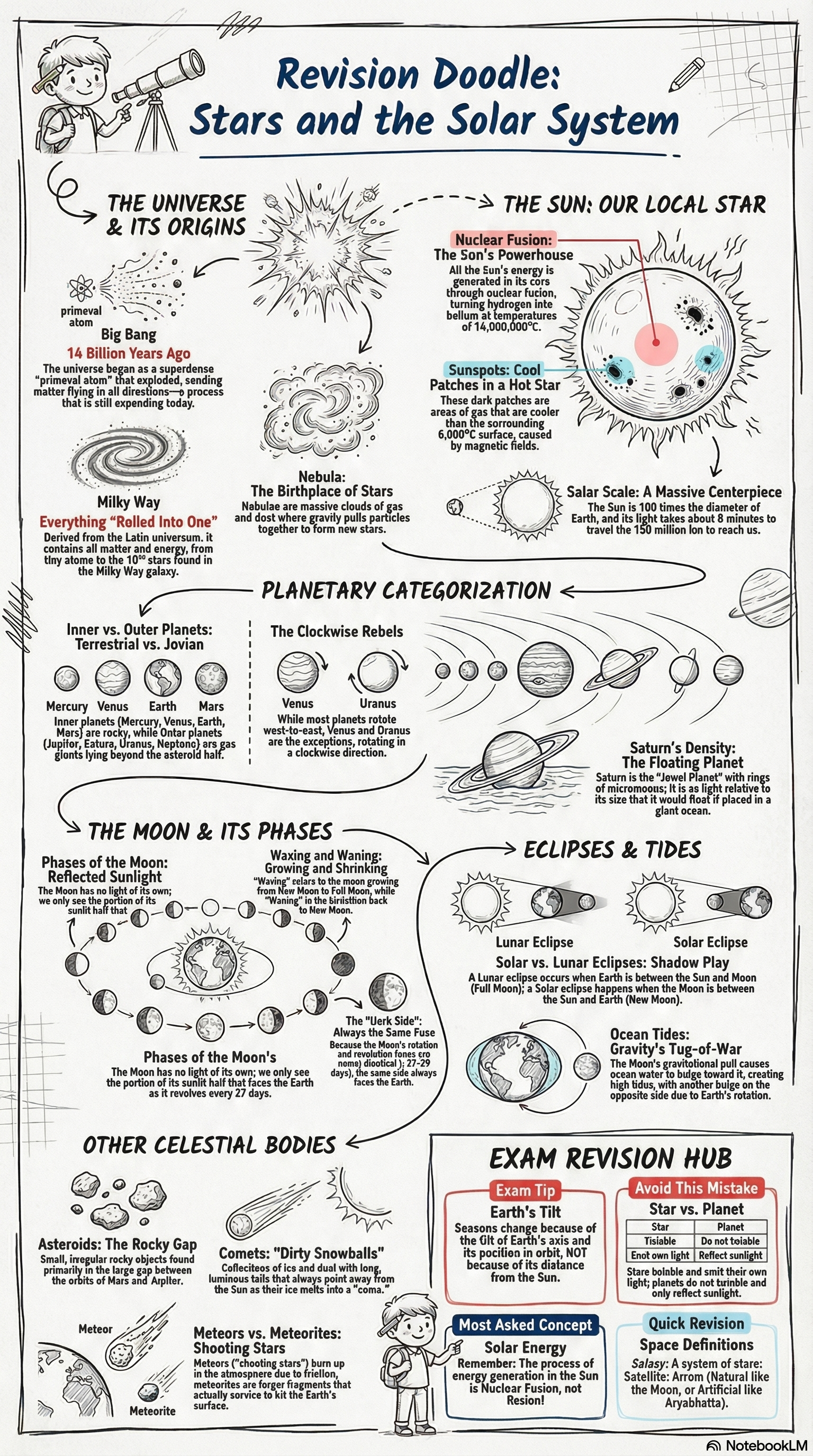
The Universe is an incredibly vast space containing everything that exists from the smallest particles to the largest galaxies. When we look up at the night sky, we see countless stars, planets, and other celestial objects. Understanding stars and the solar system helps us comprehend our place in the cosmos and explains natural phenomena we observe daily, such as day and night, seasons, moon phases, and eclipses.
Why is this chapter important?
- For Exams: This chapter carries significant weightage in CBSE Class 8 Science exams with questions on planets, moon phases, eclipses, and constellations
- For Real Life: Understanding celestial mechanics explains why we have seasons, tides, and helps in space exploration and satellite technology
- For Future Learning: Forms the foundation for advanced astronomy and space science studies
Important Concepts & Definitions
The Universe
Universe is the vast, unbounded space that contains everything all matter, energy, planets, stars, galaxies, and even space itself. The word comes from Latin "universum" meaning "everything rolled into one."
Example: Imagine the largest thing you can think of now multiply that by infinity. That's approximately the scale of the universe!
Galaxy
Galaxy is a massive collection of about 10¹¹ (100 billion) stars, dust, and light gases bound together by mutual gravity and separated from similar systems by vast regions of space.
Example: Our home galaxy is the Milky Way, which contains our solar system and formed about 5 billion years after the Big Bang.
Stars
Stars are huge, luminous spheres of hot burning gases (mainly hydrogen and helium) that produce their own light through nuclear fusion.
Difference: Stars produce their own light, while planets only reflect starlight.
Solar System
Solar System consists of the Sun, eight planets, dwarf planets, their moons, asteroids, comets, and all objects orbiting the Sun.
Members include:
- 1 Star (Sun)
- 8 Planets
- 5+ Dwarf Planets
- Thousands of asteroids
- Countless comets and meteoroids
Constellation
Constellation is a recognisable pattern of stars in the night sky that appears to form shapes or figures.
Example: Ursa Major (Great Bear/Saptarishi), Orion (The Hunter), Scorpio
Light Year
Light Year is the distance traveled by light in one year at a speed of 300,000 km/s.
Calculation: 1 light year = 9.46 × 10¹² km (approximately 9.5 trillion kilometers)
Why we use it:
Astronomical distances are so enormous that using kilometers becomes impractical. Light years provide a more manageable unit.
Detailed Explanation of Key Concepts
1. Origin of the Universe - The Big Bang Theory
The Big Bang Theory provides the best scientific explanation for how the universe began.
Timeline of the Big Bang:
14 billion years ago:
- The entire universe existed as an extremely hot, superdense point called the primeval atom
- This primeval atom was about 100 million light years wide
- It contained only neutrons and protons compressed to incredible density
The Explosion:
- The primeval atom exploded in a massive event called the Big Bang
- Matter scattered in all directions through space at tremendous speeds
- Within minutes, small atoms began forming
Formation of Structures:
- Atoms combined to form molecules
- Molecules formed clouds of gas and dust called nebulae
- Gravity pulled matter together within nebulae to form stars
- Stars grouped together to form galaxies
- The Milky Way galaxy formed about 5 billion years after the Big Bang
Present Day:
- Galaxies, stars, and other celestial bodies continue moving away from each other
- The universe is still expanding
- The farther objects are from each other, the faster they move apart
Evidence: Astronomers observe that galaxies are moving away from us in all directions, supporting the expansion theory.
2. Components of the Universe
A. Nebula - Birthplace of Stars
What is a Nebula?
- Clouds of gas (mainly hydrogen) and dust particles floating in space
- Can be enormous spanning hundreds of light years
- Appear as glowing patches or dark regions in the night sky
How Stars Form from Nebulae:
- Gravity pulls gas and dust particles together within the nebula
- These clumps become denser and hotter as more material accumulates
- When temperature and pressure become high enough, nuclear fusion begins
- A new star is born!
Example: The Orion Nebula is a famous star-forming region visible to the naked eye.
B. Galaxies - Island Universes
Structure of a Galaxy:
- Contains approximately 100 billion (10¹¹) stars
- Includes dust, gas, and dark matter
- Stars orbit around a common center due to gravity
- Vast empty spaces separate galaxies
Our Galaxy - The Milky Way:
- Spiral-shaped galaxy with multiple arms
- Contains our solar system
- About 100,000 light years in diameter
- Our Sun is located about 26,000 light years from the galactic center
Types of Galaxies:
- Spiral: Flat disk with spiral arms (like Milky Way)
- Elliptical: Oval or spherical shape
- Irregular: No defined shape
C. Stars - Cosmic Furnaces
Characteristics of Stars:
- Made of hot burning gases (mainly hydrogen and helium)
- Generate energy through nuclear fusion
- Produce their own light
- Surface temperatures range from 3,000°C to over 50,000°C
- Can be millions of times larger than Earth
Star vs. Planet
| Feature | Star | Planet |
|---|---|---|
| Light source | Produces own light | Reflects light from stars |
| Composition | Hot gases | Rocks, metals, gases |
| Size | Much larger | Relatively smaller |
| Number | Countless | Limited in any solar system |
| Twinkling | Twinkle at night | Don't twinkle |
| Temperature | Extremely hot | Varies, generally much cooler |
Why Stars Twinkle: Stars twinkle because their light passes through Earth's atmosphere, which has varying temperatures and densities. This causes the light to bend (refract) differently, making stars appear to flicker.
Why Planets Don't Twinkle: Planets are much closer to Earth than stars, so they appear as small disks rather than points. The light from different parts of the disk averages out the atmospheric disturbances.
3. The Solar System
Overview
The Solar System consists of the Sun at the center, with eight planets, dwarf planets, moons, asteroids, comets, and meteoroids all orbiting due to the Sun's gravitational pull.
Age: Approximately 4.6 billion years old
Radius: More than 5,900 million kilometers (distance to the farthest known objects)
Formation: The planets evolved from gas and dust particles (debris) that were spinning around the young Sun at high speeds.
Orbital Characteristics:
- All planets orbit the Sun in elliptical (oval) paths
- All planets orbit in an anticlockwise direction (when viewed from above)
- All planets rotate anticlockwise on their axes except Venus and Uranus (which rotate clockwise)
- Each planet's orbit lies roughly in the same plane
The Sun - Heart of the Solar System
Basic Facts:
- Type: Medium-sized star
- Age: At least 5 billion years old
- Distance from Earth: 150 million km (1 AU - Astronomical Unit)
- Diameter: 109 times Earth's diameter
- Volume: 1.3 million times Earth's volume
- Mass: 99.86% of the entire solar system's mass
- Gravity: 28 times stronger than Earth's
What this means:
A person weighing 50 kg on Earth would weigh 1,400 kg (1.4 tons) on the Sun!
Temperature:
- Surface temperature: 6,000°C
- Core temperature: 14,000,000°C (14 million degrees!)
Composition:
- 73% Hydrogen
- 25% Helium
- 2% Other elements
Energy Production: The Sun generates energy through nuclear fusion in its core:
- 4 hydrogen nuclei fuse together to form 1 helium nucleus
- This process converts mass into enormous amounts of energy (E = mc²)
- Enough hydrogen exists to keep the Sun shining for another 5 billion years
Solar Features:
1. Sunspots:
- Dark patches on the Sun's surface
- Actually cooler regions (about 3,800°C instead of 6,000°C)
- Caused by magnetic fields that slow heat flow from the core
- First discovered by Galileo
- Helped scientists determine that the Sun rotates
2. Solar Flares:
- Bright eruptions of energy from the Sun's surface
- Can affect satellite communications and power grids on Earth
Rotation and Revolution:
- Rotation: The Sun rotates on its axis once every 25 days
- Revolution: The Sun (along with the entire solar system) revolves around the center of the Milky Way galaxy once every 225 million years
Light Travel Time: Light from the Sun takes 8 minutes and 20 seconds to reach Earth, traveling at 300,000 km/s.
4. The Eight Planets - Detailed Guide
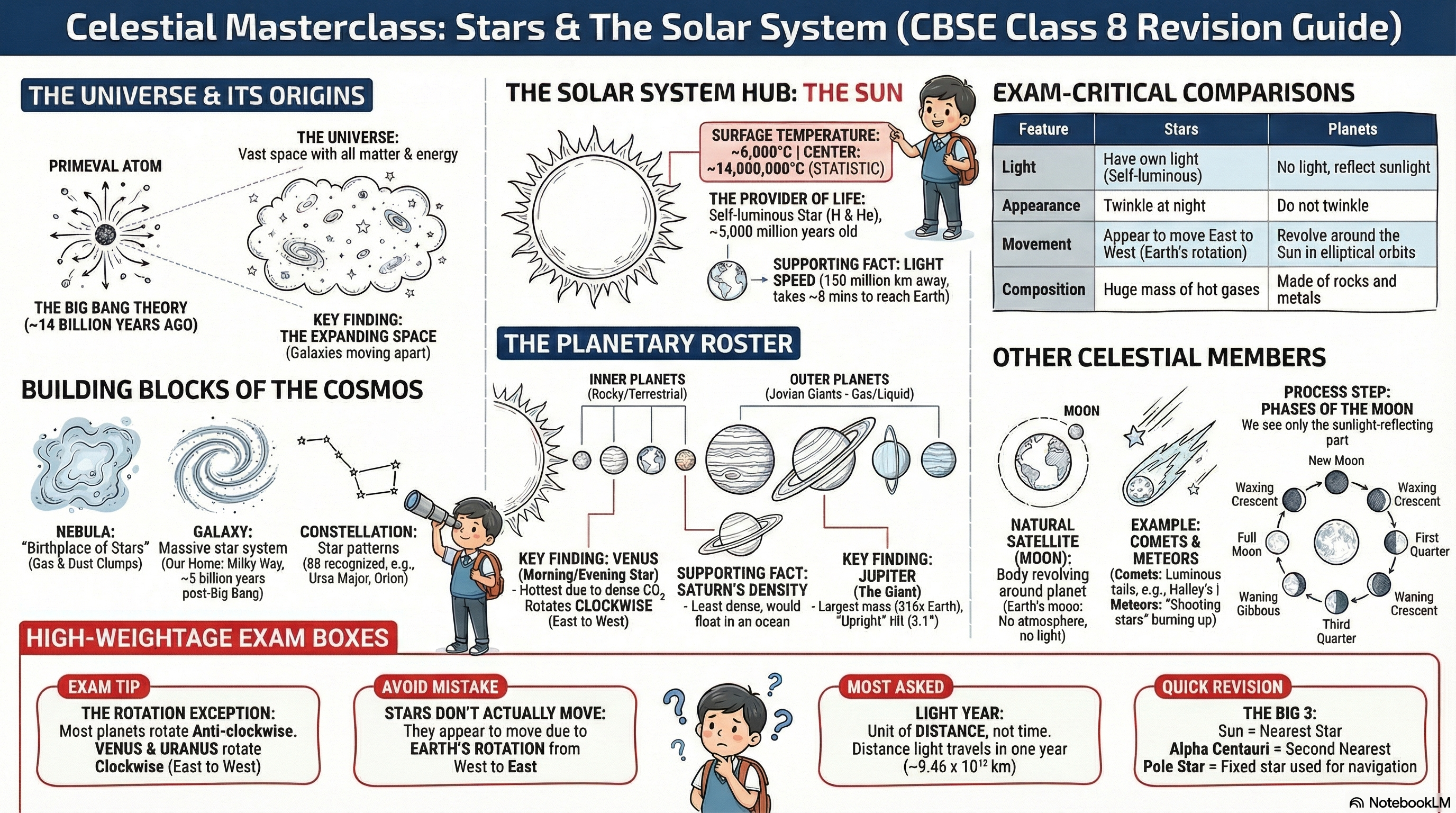
Planets are divided into two main groups:
Inner Planets (Terrestrial Planets)
- Mercury, Venus, Earth, Mars
- Rocky composition
- Smaller in size
- Closer to the Sun
- Few or no moons
Outer Planets (Jovian/Gas Giants)
- Jupiter, Saturn, Uranus, Neptune
- Gaseous composition
- Much larger in size
- Farther from the Sun
- Many moons and ring systems
Planet 1: Mercury (Budh) - The Swift Planet
Features:
- Closest planet to the Sun
- Distance from Sun: 58 million km
- Diameter: 4,880 km
- Orbital Period: 88 Earth days
- Rotation Period: 58 Earth days (very slow!)
- Moons: 0
- Atmosphere: None (virtually no atmosphere)
Temperature Extremes:
- Day temperature: 400°C (can melt lead!)
- Night temperature: -180°C
- Why such extremes? No atmosphere to trap heat or distribute it evenly
Special Characteristics:
- Smallest terrestrial planet
- Cannot support life (no atmosphere, extreme temperatures)
- Visible to the naked eye
- Surface covered with craters (like our Moon)
- Named after the Roman messenger god because of its fast orbit
Why Life is Impossible:
- No atmosphere means no protection from solar radiation
- Extreme temperature variations
- No water
Planet 2: Venus (Shukra) - The Veiled Planet
Features:
- Second planet from Sun
- Distance from Sun: 108 million km
- Diameter: 12,100 km (almost Earth's size!)
- Orbital Period: 225 Earth days
- Rotation Period: 243 Earth days (rotates very slowly clockwise)
- Moons: 0
Remarkable Fact: Venus takes longer to rotate once on its axis (243 days) than to orbit the Sun once (225 days)!
Temperature:
- Surface temperature: 450°C (hottest planet in the solar system!)
- Even hotter than Mercury, despite being farther from the Sun
Why So Hot?
- Thick atmosphere of 95% carbon dioxide
- Creates extreme greenhouse effect
- Dense clouds of sulfuric acid trap heat
- Heat cannot escape back into space
Atmosphere:
- Extremely dense
- Composed of:
- 95% Carbon dioxide
- Traces of nitrogen
- Thick clouds of sulfuric acid (yellow-white appearance)
- Atmospheric pressure 90 times greater than Earth's
Special Characteristics:
- Brightest planet in the night sky (after the Moon)
- Known as the "Morning Star" when visible before sunrise
- Known as the "Evening Star" when visible after sunset
- Visible to the naked eye
- Rotates clockwise (retrograde rotation) - only Venus and Uranus do this
- Often called Earth's "sister planet" due to similar size
Why It's Called the Morning/Evening Star:
Venus orbits closer to the Sun than Earth, so it's only visible for a few hours before sunrise or after sunset never in the middle of the night.
Planet 3: Earth (Prithvi) - The Blue Planet
Features:
- Third planet from Sun
- Distance from Sun: 150 million km (1 AU)
- Diameter: 12,760 km
- Orbital Period: 365¼ days (1 year)
- Rotation Period: 24 hours (1 day)
- Moons: 1 (The Moon)
- Axial Tilt: 23.5° (causes seasons)
Why Earth is Called the Blue Planet:
- 70% of surface covered with water (oceans, seas, lakes)
- Appears blue from space due to water
- The Earth's atmosphere scatters blue light, making it appear predominantly blue
Atmosphere - Earth's Protective Shield: Composition:
- 78% Nitrogen
- 21% Oxygen
- 0.03% Carbon dioxide
- Variable amounts of water vapor
- Trace amounts of other gases
Atmosphere Functions:
- Provides oxygen for breathing
- Filters harmful UV radiation from the Sun
- Maintains temperature through the greenhouse effect (not excessive like Venus)
- Protects from meteorites burns them up before they reach the surface
- Enables weather and the water cycle
Why Earth Supports Life:
- Presence of water in liquid form
- Suitable atmosphere with oxygen
- Moderate temperatures (average 15°C)
- Right distance from Sun (not too hot, not too cold)
- Magnetic field protects from solar radiation
- Stable orbit ensures consistent climate patterns
Earth's Unique Features:
- Only known planet with life
- Largest of the inner (terrestrial) planets
- Active geological processes (volcanoes, earthquakes, plate tectonics)
- Liquid water on the surface
- Protective magnetic field
Light Reflection: Earth reflects about one-third of the sunlight that falls on it (albedo = 30%)
Planet 4: Mars (Mangal) - The Red Planet
Key Features:
- Fourth planet from Sun
- Distance from Sun: 228 million km
- Diameter: 6,780 km (about half Earth's diameter)
- Orbital Period: 687 Earth days
- Rotation Period: 24 hours 37 minutes (similar to Earth!)
- Moons: 2 (Phobos and Deimos - very small moons)
Why Mars Appears Red:
- Surface rich in iron oxide (rust)
- Iron-rich soil gives it a reddish appearance
- Can be seen as a reddish point of light with the naked eye
Atmosphere:
- Very thin atmosphere
- Composition:
- 95% Carbon dioxide
- Only traces of oxygen
- Very little nitrogen
- Atmospheric pressure only 1% of Earth's
Surface Features:
- Deserts covering most of the planet
- High mountains (including Olympus Mons - largest volcano in the solar system!)
- Deep craters from meteor impacts
- Huge volcanoes (now extinct)
- Polar ice caps made of frozen water and carbon dioxide
Why Mars Cannot Support Life (as we know it):
- No liquid water on the surface (though ice exists at poles)
- 95% CO₂ atmosphere with almost no oxygen
- Very cold average temperature (-60°C)
- Thin atmosphere provides no protection from radiation
- Low gravity (38% of Earth's)
Special Characteristics:
- Closest planet to Earth
- Visible to the naked eye
- Often called the "Red Planet"
- Gravity is half that of Earth
- A Martian day (called a "sol") is almost the same length as an Earth day
Mars Exploration: Scientists are very interested in Mars because:
- It's the most Earth-like planet
- Evidence suggests it once had liquid water
- Possibility of finding past microbial life
- Potential for future human colonization
Planet 5: Jupiter (Brihaspati) - The Giant Planet
Features:
- Fifth planet from Sun
- Largest planet in the solar system
- Distance from Sun: 778 million km
- Diameter: 142,800 km (11 times Earth's diameter!)
- Orbital Period: 11.75 Earth years
- Rotation Period: 9 hours 50 minutes (fastest rotation!)
- Moons: At least 79 known moons (including 4 large Galilean moons)
- Mass: 318 times Earth's mass
Composition:
- No solid surface - Jupiter is a gas giant
- Mainly composed of:
- Hydrogen (89%)
- Helium (10%)
- Traces of methane, ammonia, water vapor
Atmospheric Structure:
- Upper atmosphere is gaseous
- Pressure increases with depth
- In lower regions, hydrogen behaves like a liquid due to extreme pressure
- Deep within the core, hydrogen shows metallic properties
- Possibly has a small rocky core
Distinctive Features:
The Great Red Spot:
- Giant storm system larger than Earth
- Has been raging for at least 400 years
- Winds reach 400 km/h
Colorful Bands:
- Light-colored zones and dark belts
- Created by winds and different chemical compositions at various altitudes
Axial Tilt:
- Jupiter is nearly "upright" with only 3.1° tilt
- Compare to Earth's 23.5° tilt
- This means Jupiter has almost no seasons
Special Characteristics:
- Visible to the naked eye (appears as a bright "star")
- Has a faint ring system (discovered in 1979)
- Acts as a "cosmic shield" - its gravity attracts many asteroids and comets that might otherwise hit Earth
- Emits more heat than it receives from the Sun
Famous Moons: The 4 largest moons (Galilean moons):
- Io - most volcanically active body in the solar system
- Europa - covered in ice, may have a subsurface ocean
- Ganymede - largest moon in the solar system
- Callisto - heavily cratered
Planet 6: Saturn (Shani) - The Jewel Planet
Features:
- Sixth planet from Sun
- Second largest planet
- Distance from Sun: 1,427 million km
- Diameter: 120,000 km (9.5 times Earth's diameter)
- Orbital Period: 29.5 Earth years
- Rotation Period: 10 hours 14 minutes
- Moons: At least 82 known moons (more than any other planet!)
- Mass: 95 times Earth's mass
Composition:
- Similar to Jupiter - a gas giant
- No solid surface
- Mainly composed of:
- Hydrogen
- Helium
- Internal structure similar to Jupiter:
- Gaseous outer layers
- Liquid hydrogen in middle layers
- Possibly metallic hydrogen deeper
- Small rocky core at center
The Famous Rings:
Discovery and Structure:
- Most spectacular ring system in the solar system
- Visible through small telescopes (discovered by Galileo)
- Composed of millions of tiny particles (ice and rock)
- Particles range from dust-sized to house-sized
- Each particle orbits Saturn independently like a "micromoon"
Ring Dimensions:
- Extend about 280,000 km from Saturn
- But only about 10 meters thick!
- Divided into several distinct bands (A, B, C, D, E, F, G rings)
Unique Property - Lowest Density: Saturn has the lowest density of all planets:
- Density less than water!
- If you could find an ocean big enough, Saturn would float!
- Density: 0.687 g/cm³ (water is 1.0 g/cm³)
Special Characteristics:
- Visible to the naked eye
- Appears yellowish due to ammonia crystals in upper atmosphere
- Often called the "Jewel of the Solar System" due to its beautiful rings
- Second most visible planet after Jupiter
- Has spectacular auroras at its poles
Notable Moon:
- Titan - Saturn's largest moon
- Only moon with a substantial atmosphere
- Larger than the planet Mercury
- May have liquid methane lakes on its surface
Planet 7: Uranus - The Sideways Planet
Features:
- Seventh planet from Sun
- Third largest planet
- Distance from Sun: 2,870 million km
- Diameter: 50,800 km (4 times Earth's diameter)
- Orbital Period: 84 Earth years
- Rotation Period: 10 hours 49 minutes (retrograde - clockwise!)
- Moons: 27 known moons
- Mass: 15 times Earth's mass
Unique Rotation:
- Uranus rotates clockwise (retrograde), like Venus
- Axial tilt of 98° - essentially lying on its side!
- Rotation axis almost parallel to its orbital plane
- This means:
- Each pole experiences 42 years of continuous sunlight
- Followed by 42 years of darkness
- Extreme seasonal variations
Why the Extreme Tilt?
Scientists believe a massive collision with an Earth-sized object billions of years ago knocked Uranus on its side.
Composition:
- Ice giant (not a gas giant like Jupiter and Saturn)
- Atmosphere consists mainly of:
- Hydrogen (83%)
- Helium (15%)
- Methane (2%) gives it blue-green color
- Small amounts of ammonia
- Interior likely contains:
- Icy mantle of water, methane, and ammonia
- Small rocky core
Color:
- Appears blue-green
- Methane in the atmosphere absorbs red light
- Reflects blue and green light
Special Characteristics:
- Can barely be seen with the naked eye (looks like a dim star)
- First planet discovered with a telescope (by William Herschel in 1781)
- Has a faint ring system (13 known rings)
- Coldest planetary atmosphere in solar system (-224°C)
- Named after the Greek god of the sky
Notable Moons:
- Titania and Oberon largest moons
- Named after characters from Shakespeare and Alexander Pope
Planet 8: Neptune - The Last Giant
Features:
- Eighth planet from Sun (farthest major planet)
- Fourth largest planet
- Distance from Sun: 4,504 million km
- Diameter: 48,600 km (nearly 4 times Earth's diameter)
- Orbital Period: 165 Earth years (takes 165 years to orbit the Sun once!)
- Rotation Period: 15 hours 48 minutes
- Moons: 14 known moons
- Mass: 17 times Earth's mass
Composition:
- Ice giant like Uranus
- Atmosphere consists mainly of:
- Hydrogen (80%)
- Helium (19%)
- Methane (1.5%) - gives it deep blue color
- Interior structure:
- Atmosphere of hydrogen, helium, and methane
- Mantle of water, methane, and ammonia ices
- Rocky silicate core
Why Neptune Appears Blue:
- Methane in the atmosphere absorbs red light from the Sun
- Reflects blue and green wavelengths
- Appears deeper blue than Uranus due to some unknown atmospheric component
Weather and Atmosphere:
- Most dynamic atmosphere of all planets
- Fastest winds in the solar system (up to 2,100 km/h!)
- Contains large storm systems:
- Great Dark Spot (similar to Jupiter's Great Red Spot)
- White clouds of methane ice
Special Characteristics:
- Cannot be seen with the naked eye
- First planet located through mathematical predictions before visual confirmation
- Has a faint ring system (at least 3 rings made up of dust particles)
- Coldest planet in terms of external temperature
- Named after the Roman god of the sea
Notable Moon:
- Triton - Neptune's largest moon
- Only large moon with retrograde orbit (orbits backwards)
- Has active geysers that spray nitrogen gas
- One of the coldest objects in the solar system (-235°C)
Planets at a Glance
| Planet | Distance from Sun (million km) | Revolution Period | Rotation Period | Diameter (km) | Mass (vs Earth) | Moons | Visible to Naked Eye |
|---|---|---|---|---|---|---|---|
| Mercury | 58 | 88 days | 58 days | 4,880 | 0.055 | 0 | Yes |
| Venus | 108 | 225 days | 243 days | 12,100 | 0.8 | 0 | Yes |
| Earth | 150 | 365¼ days | 24 hours | 12,760 | 1 | 1 | N/A |
| Mars | 228 | 687 days | 24 hours | 6,780 | 0.1 | 2 | Yes |
| Jupiter | 778 | 11.75 years | 9h 50m | 142,800 | 318 | 79+ | Yes |
| Saturn | 1,427 | 29.5 years | 10h 14m | 120,000 | 95 | 82+ | Yes |
| Uranus | 2,870 | 84 years | 10h 49m | 50,800 | 15 | 27 | Barely |
| Neptune | 4,504 | 165 years | 15h 48m | 48,600 | 17 | 14 | No |
5. Dwarf Planets
In 2006, the International Astronomical Union (IAU) created a new classification: dwarf planets.
Definition of a Planet (2006 IAU criteria): To be classified as a planet, a celestial body must:
- Orbit around the Sun
- Have enough mass to be spherical (due to its own gravity)
- Have "cleared its orbital path" (no similar-sized objects nearby)
Definition of a Dwarf Planet: Meets criteria 1 and 2, but fails criterion 3 has not cleared its orbital neighborhood.
Known Dwarf Planets
1. Pluto - The Famous Dwarf Planet
- Former Status: 9th planet (until 2006)
- Distance from Sun: 5,900 million km
- Diameter: About 2,370 km (1/5th of Earth's diameter)
- Orbital Period: 248 Earth years
- Moons: 5 (including Charon, which is nearly half Pluto's size)
- Surface: Frozen world with methane frost covering water ice
- Temperature: -233°C
- Cannot be seen with naked eye
Pluto's Unusual Orbit:
- Highly elongated (elliptical) orbit
- Tilted at 17° compared to other planets' orbits
- Sometimes comes closer to the Sun than Neptune
- From 1979 to 1999, Pluto was closer to the Sun than Neptune!
2. Ceres
- Located in the asteroid belt between Mars and Jupiter
- Smallest identified dwarf planet
- Only dwarf planet in the inner solar system
- Diameter: about 940 km
3. Eris
- One of the reasons Pluto was reclassified
- Slightly smaller than Pluto but more massive
- Located in the Kuiper Belt (beyond Neptune)
Other Potential Dwarf Planets:
- Makemake
- Haumea
- About 70 other objects may qualify as dwarf planets
- Hundreds more potential dwarf planets in the Kuiper Belt
The Kuiper Belt:
- Region beyond Neptune's orbit
- Contains thousands of icy bodies
- Source of many comets
- Home to most known dwarf planets
6. Other Members of the Solar System
A. Asteroids - Rocky Wanderers
What are Asteroids?
Asteroids are small, irregular rocky objects that orbit the Sun, mostly found in the asteroid belt between Mars and Jupiter.
The Asteroid Belt:
- Located between Mars and Jupiter orbits
- Contains millions of asteroids
- Total mass less than Earth's Moon
- Each asteroid has its own orbit
- Orbits spread over a large distance forming a band
Size Range:
- Largest: Pallas (diameter 500 km)
- Smallest: As small as 1 kilometer across
- Most are irregularly shaped (not spherical)
Composition:
- Primarily rock and metal
- Some contain carbon
- Some contain ice
Why They Exist:
Scientists believe asteroids are remnants from the early solar system leftover material that never formed into a planet due to Jupiter's strong gravitational influence.
Can We See Them?
- Only visible through large telescopes
- Too small and far away to see with naked eye
Famous Asteroid:
- Ceres - largest asteroid (now classified as a dwarf planet)
- About 940 km in diameter
B. Meteors and Meteorites - Shooting Stars
Meteors - "Shooting Stars"
What is a Meteor? When asteroids collide, fragments of rock may break off. If these fragments enter Earth's atmosphere, they are called meteors.
What Happens:
- Rock fragment enters Earth's atmosphere at high speed (up to 70 km/s)
- Friction with air molecules creates intense heat
- The meteor burns up, producing a bright streak of light
- Light is produced due to the heat, not fire
- Usually completely vaporizes before reaching Earth's surface
Why They're Called "Shooting Stars":
- They appear as bright streaks moving across the night sky
- Look like stars "shooting" through space
- Actually have nothing to do with stars!
Meteor Showers:
- Occur when Earth passes through debris left by comets
- Can see dozens or hundreds of meteors per hour
- Famous showers: Perseids (August), Leonids (November)
Meteorites - Space Rocks That Survive
What is a Meteorite?
When a meteor is large enough that it doesn't completely burn up in the atmosphere, the surviving piece that lands on Earth's surface is called a meteorite.
Types of Meteorites:
- Stony meteorites - made of rock (most common)
- Iron meteorites - made of iron and nickel
- Stony-iron meteorites - mixture of rock and metal
Origin: All meteorites are believed to originate from the asteroid belt, where collisions occasionally send fragments toward Earth.
Famous Impact Crater:
Meteor Crater, Arizona (USA):
- Diameter: 1.2 km across
- Depth: 170 meters deep
- Age: Created within the last 20,000 years
- Impact from an iron meteorite about 50 meters wide
- Released energy equivalent to 10 megatons of TNT
Meteorites and Dinosaur Extinction:
Most scientists believe a massive meteorite (about 10 km wide) struck Earth 66 million years ago, causing:
- Huge dust clouds blocking sunlight
- Global climate change
- Mass extinction of dinosaurs
- Wiping out about 75% of all species
Scientific Value: Meteorites are valuable because:
- They're samples from space (free delivery!)
- Help us understand the early solar system
- Some may contain organic compounds
- Provide information about asteroid composition
C. Comets - Cosmic Snowballs
What is a Comet? A comet is a collection of frozen gases (ice), rocky material, and metallic particles orbiting the Sun in highly elongated elliptical orbits.
Composition:
- Frozen gases: water, ammonia, methane, carbon dioxide
- Rocky particles
- Metallic dust
- Often called "dirty snowballs"
Structure of a Comet:
1. Nucleus:
- Solid, frozen core
- Typically a few kilometers across
- Contains ice and rock
2. Coma:
- Glowing head of gas surrounding the nucleus
- Forms when ice melts as the comet approaches the Sun
- Can be thousands of kilometers across
3. Tail(s):
- Gas tail: Ionized gas blown by solar wind (points directly away from Sun)
- Dust tail: Dust particles pushed by solar radiation (curves slightly)
- Can extend millions of kilometers into space
- Always points away from the Sun, regardless of direction of travel
Why Comets Have Tails:
- Comet approaches the Sun
- Heat causes ice to sublimate (turn from solid to gas)
- Gas and dust are released from the nucleus
- Solar wind (stream of particles from the Sun) pushes gas away
- Solar radiation pressure pushes dust particles away
- This creates the spectacular tail(s)
Comet Orbits:
- Highly elongated elliptical orbits
- Spend most time in outer solar system (frozen and inactive)
- Become visible only when approaching the Sun
- Some take hundreds or thousands of years to complete one orbit
Famous Comets:
Halley's Comet:
- Most famous periodic comet
- Orbital period: 75-76 years
- Last seen: 1986
- Next appearance: 2061
- Named after Edmund Halley who predicted its return
- Has been observed for over 2,000 years (recorded by ancient civilizations)
Other Notable Comets:
- Comet Hale-Bopp (1997) - visible for 18 months
- Comet NEOWISE (2020) - visible during COVID-19 pandemic
Where Do Comets Come From?
1. Kuiper Belt:
- Beyond Neptune's orbit
- Source of short-period comets
- Contains icy bodies left over from solar system formation
2. Oort Cloud:
- Spherical shell at the very edge of the solar system
- Contains trillions of comets
- Source of long-period comets
- Extends halfway to the nearest star!
7. Constellations - Star Patterns
What is a Constellation? A constellation is a recognizable pattern of stars in the night sky that appears to form a shape, figure, or picture.
Important Points:
- Stars in a constellation are not actually close to each other
- They only appear close from Earth's perspective
- Can be at vastly different distances from Earth
- Ancient civilizations named them after mythological characters, animals, or objects
How Constellations Help:
- Navigation: Sailors used them to find directions
- Timekeeping: Track seasonal changes
- Astronomical reference: Astronomers divide the sky into 88 official constellations
- Locating stars: Help find specific stars and planets
Modern Use:
Today, 88 constellations are officially recognized by the International Astronomical Union (IAU). Every star in the sky belongs to one of these constellations.
Important Constellations
1. Ursa Major (Great Bear / Saptarishi)
Indian Name: Saptarishi (Seven Sages)
Appearance:
- Contains seven bright stars
- Forms a shape like a large ladle or dipper
- Also called the "Big Dipper" in North America
The Seven Stars: In Hindu mythology, these seven stars represent seven great sages (rishis).
How to Use It: The two stars at the end of the "bowl" of the Big Dipper point toward Polaris (the Pole Star).
Finding the Pole Star using Ursa Major:
- Locate the Big Dipper shape in Ursa Major
- Find the two stars at the outer edge of the "bowl"
- Draw an imaginary line through these stars
- Extend this line about 5 times the distance between those two stars
- The bright star you reach is Polaris (Pole Star)
Visibility: Can be seen throughout the year in the Northern Hemisphere
2. Ursa Minor (Little Bear / Dhruva Matsya)
Indian Name: Dhruva Matsya
Key Feature: Contains Polaris (the Pole Star / North Star)
Appearance:
- Also has a dipper shape, but smaller than Ursa Major
- Called the "Little Dipper"
- Polaris is at the end of the "handle"
The Pole Star (Polaris):
- Located almost directly above Earth's North Pole
- Appears stationary in the night sky
- All other stars appear to rotate around it due to Earth's rotation
- Used for navigation (always indicates north direction)
- Does not move while other stars appear to circle around it
Why Polaris Doesn't Move:
- Earth's axis of rotation points almost directly at Polaris
- As Earth rotates, our perspective of other stars changes
- But Polaris stays in the same position
Can You See It from the Southern Hemisphere?
No! Polaris is never visible from the Southern Hemisphere because Earth's curvature blocks the view.
3. Orion (The Hunter / Mirga)
Indian Name: Mirga (The Deer)
Appearance:
- Looks like a hunter holding a sword and shield
- One of the most recognizable constellations
- Contains some of the brightest stars in the night sky
Features:
Orion's Belt:
- Three bright stars in a straight row
- Easiest part to spot
- Forms the "belt" of the hunter
Betelgeuse:
- Bright red star
- Forms Orion's shoulder
- A red supergiant star (about 1,000 times Sun's diameter!)
Rigel:
- Bright blue-white star
- Forms Orion's foot
- One of the brightest stars in the night sky
The Orion Nebula:
- Star-forming region below Orion's Belt
- Can be seen with binoculars
- One of the brightest nebulae
Visibility:
- Best seen in winter months (December to March)
- Visible from both Northern and Southern Hemispheres
4. Scorpio (Vrishchika)
Indian Name: Vrishchika
Appearance:
- Resembles a scorpion with curved tail
- Contains bright red star Antares (the "heart" of the scorpion)
Antares:
- Red supergiant star
- Name means "rival of Mars" (because of similar red color)
- About 700 times the diameter of the Sun
Visibility:
- Best seen in summer months
- Prominent in Southern Hemisphere
5. Draco (The Dragon / Kaleya)
Indian Name: Kaleya
Appearance:
- Winding pattern resembling a dragon
- Long, serpentine shape
- Winds between Ursa Major and Ursa Minor
Historical Significance:
- Around 5,000 years ago, the star Thuban in Draco was the North Star
- Earth's axis slowly changes direction over thousands of years (called precession)
- Eventually, other stars will become the "pole star"
The Zodiac Constellations
What is the Zodiac?
As Earth orbits the Sun, different constellations become visible at night at different times of the year. The twelve constellations that appear along Earth's orbital plane are called the Zodiac.
The Twelve Zodiac Constellations:
- Aries (Mesha) - The Ram
- Taurus (Vrishabha) - The Bull
- Gemini (Mithuna) - The Twins
- Cancer (Karka) - The Crab
- Leo (Simha) - The Lion
- Virgo (Kanya) - The Virgin
- Libra (Tula) - The Scales
- Scorpio (Vrishchika) - The Scorpion
- Sagittarius (Dhanu) - The Archer
- Capricorn (Makara) - The Goat
- Aquarius (Kumbha) - The Water Bearer
- Pisces (Meena) - The Fish
Why Different Constellations at Different Times?
- We can only see stars when looking away from the Sun (at night)
- As Earth moves around the Sun, our night-side view changes
- Different zodiac constellations become visible each month
- Each full moon appears against a different zodiac constellation
8. The Moon - Earth's Natural Satellite
What is a Natural Satellite?
A natural satellite (or moon) is a solid celestial body that revolves around a planet.
Earth's Moon - Basic Facts:
- Distance from Earth: 384,000 km
- Diameter: 3,474 km (about 1/4 of Earth's diameter)
- Mass: 1/81 of Earth's mass
- Gravity: 1/6 of Earth's gravity (a 60 kg person would weigh only 10 kg on the Moon!)
- Age: About 4.5 billion years (formed shortly after Earth)
Why the Moon Looks So Large:
The Moon appears large in our sky because it's very close to Earth compared to other celestial objects.
Orbital Motion:
- Revolution: Completes one orbit around Earth in 27.3 days
- Rotation: Rotates on its axis once every 27.3 days
Synchronous Rotation - Same Side Always Faces Earth: Because the Moon's rotation period equals its revolution period, the same side always faces Earth. We never see the "far side" (often incorrectly called the "dark side") from Earth.
Surface Features:
- Maria (seas): Dark, flat plains formed by ancient volcanic lava flows (though there's no actual water)
- Highlands: Bright, cratered regions
- Craters: Impact craters from meteorites and asteroids
- Mountains: Some peaks reach 4,500 meters high
- No erosion: Features remain unchanged for billions of years (no wind, water, or weather)
Temperature Extremes:
- Day temperature: +127°C (hotter than boiling water!)
- Night temperature: -173°C (colder than dry ice!)
- Why such extremes? No atmosphere to trap heat or distribute it evenly
Why There's No Life on the Moon:
- No atmosphere:
- No air to breathe
- No protection from meteorites
- No weather or water cycle
- No sound (sound needs air to travel)
- No water:
- No liquid water on the surface
- Ice may exist in permanently shadowed craters at poles
- Extreme temperatures:
- Unsurvivable day-night temperature swings
- No magnetic field:
- No protection from harmful solar radiation
Moon Exploration:
- First humans on Moon: Apollo 11 mission (July 20, 1969)
- Neil Armstrong and Buzz Aldrin were the first people to walk on the Moon
- Since then, 12 humans have walked on the Moon
- Footprints left by astronauts will remain for millions of years (no wind to erase them!)
9. Phases of the Moon
What are Moon Phases? The Moon's appearance changes from night to night in a regular cycle. These changing shapes are called the phases of the Moon.
Why Do Moon Phases Occur?
- The Moon does not produce its own light
- The Moon reflects sunlight
- Half the Moon is always illuminated by the Sun
- As the Moon orbits Earth, we see different amounts of the sunlit half
- This creates the phases
The Eight Main Phases (29.5-day cycle):
1. New Moon:
- Moon is between Earth and Sun
- Dark side faces Earth
- Moon is not visible (or barely visible)
- Occurs once every 29.5 days
2. Waxing Crescent:
- Thin sliver of Moon visible
- "Waxing" means growing
- Right side illuminated (in Northern Hemisphere)
- 3-4 days after New Moon
3. First Quarter:
- Half the Moon is visible
- Right half illuminated (in Northern Hemisphere)
- Often called "half moon"
- About 7 days after New Moon
4. Waxing Gibbous:
- More than half visible
- "Gibbous" means swollen or humped
- Still growing toward full
- 10-11 days after New Moon
5. Full Moon:
- Entire face of Moon visible
- Earth is between Moon and Sun
- Moon's fully lit side faces Earth
- Occurs about 14-15 days after New Moon
6. Waning Gibbous:
- More than half visible
- "Waning" means shrinking
- Left side illuminated (in Northern Hemisphere)
- 18-19 days after New Moon
7. Last Quarter (Third Quarter):
- Half the Moon visible
- Left half illuminated (in Northern Hemisphere)
- About 22 days after New Moon
8. Waning Crescent:
- Thin sliver visible
- Getting smaller toward New Moon
- Left side illuminated (in Northern Hemisphere)
- 26-27 days after New Moon
Then the cycle repeats!
Complete Cycle Duration: 29.5 days (called a lunar month or synodic month)
Important Terms:
Waxing: Moon is growing (getting more illuminated)
- New Moon → First Quarter → Full Moon
Waning: Moon is shrinking (getting less illuminated)
- Full Moon → Last Quarter → New Moon
Crescent: Less than half illuminated
Gibbous: More than half illuminated
Memory Trick:
- DOC: Crescent moon looks like the letter "D" when waxing, "O" when full, "C" when waning
- If the right side is lit, it's waxing (growing)
- If the left side is lit, it's waning (shrinking)
10. Eclipses
What is an Eclipse?
An eclipse occurs when one celestial body moves into the shadow of another, or when one body blocks light from reaching another.
Types of Eclipses:
- Solar Eclipse - Moon blocks the Sun
- Lunar Eclipse - Earth blocks the Sun's light from reaching the Moon
Shadow Terminology:
Umbra:
- The darkest, central part of a shadow
- Complete blockage of light
- Total eclipse occurs here
Penumbra:
- The lighter, outer part of a shadow
- Partial blockage of light
- Partial eclipse occurs here
A. Solar Eclipse (Eclipse of the Sun)
What Happens: The Moon passes between the Sun and Earth, casting its shadow on Earth.
Alignment Required: Sun → Moon → Earth (all in a straight line)
When Can It Occur?
Only on New Moon day (when Moon is between Earth and Sun)
Types of Solar Eclipse:
1. Total Solar Eclipse:
- Observer is in the Moon's umbra
- Sun is completely blocked by Moon
- Sun appears as a black disk with a bright ring (corona) around it
- Sky becomes dark (like twilight)
- Stars become visible
- Temperature drops
- Duration: Maximum 7 minutes at any location
2. Partial Solar Eclipse:
- Observer is in the Moon's penumbra
- Only part of the Sun is blocked
- Sun appears as a crescent
- More common than total eclipse
3. Annular Eclipse:
- Moon is farther from Earth than usual
- Moon appears smaller than Sun
- Moon doesn't completely cover the Sun
- Sun appears as a bright ring ("annulus") around the Moon
- Also called "ring of fire" eclipse
Why Solar Eclipses are Rare:
- Moon's shadow is very small (about 270 km wide at Earth's surface)
- Earth is rotating, so shadow moves rapidly across surface
- Only visible from a small area on Earth
- Any given location sees a total solar eclipse only once every 375 years on average!
Why We Don't Have Eclipses Every Month:
- Moon's orbit is tilted 5° relative to Earth's orbit around the Sun
- Usually, the Moon passes above or below the Sun's position
- Eclipses only occur when the alignment is perfect (2-5 times per year somewhere on Earth)
Safety Warning:Never look directly at the Sun during an eclipse!
- Can cause permanent eye damage or blindness
- Use special eclipse glasses or indirect viewing methods
B. Lunar Eclipse (Eclipse of the Moon)
What Happens: Earth passes between the Sun and Moon, casting Earth's shadow on the Moon.
Alignment Required: Sun → Earth → Moon (all in a straight line)
When Can It Occur?
Only on Full Moon night (when Earth is between Sun and Moon)
Types of Lunar Eclipse:
1. Total Lunar Eclipse:
- Moon passes completely through Earth's umbra
- Moon doesn't disappear completely
- Moon appears reddish-orange ("Blood Moon")
- Why red? Earth's atmosphere bends (refracts) some sunlight around Earth, filtering out blue light and allowing red light to reach the Moon
- Duration: Can last up to 1 hour 40 minutes
- Safe to view with naked eye
2. Partial Lunar Eclipse:
- Only part of Moon passes through Earth's umbra
- Part of Moon appears dark while the rest remains bright
- More common than total lunar eclipse
3. Penumbral Lunar Eclipse:
- Moon passes through Earth's penumbra only
- Slight darkening of Moon's surface
- Difficult to notice
- Most common type
Why Lunar Eclipses are More Common (to observe):
- Earth's shadow is much larger than Moon's shadow
- Lunar eclipse visible from entire night side of Earth
- Lasts much longer (up to several hours total)
- Same location can see lunar eclipse about once every 2-3 years
Why Lunar Eclipses Don't Occur Every Month: Same reason as solar eclipses:
- Moon's orbit tilted 5° relative to Earth's orbit
- Perfect alignment needed
- Only occurs 2-4 times per year somewhere on Earth
Safe to Watch: Unlike solar eclipses, lunar eclipses are completely safe to watch with the naked eye!
Comparison: Solar Eclipse vs. Lunar Eclipse
| Feature | Solar Eclipse | Lunar Eclipse |
|---|---|---|
| Alignment | Sun → Moon → Earth | Sun → Earth → Moon |
| When | New Moon day | Full Moon night |
| What's blocked | Moon blocks Sun | Earth blocks sunlight from Moon |
| Shadow | Moon's shadow on Earth | Earth's shadow on Moon |
| Visibility | Narrow path on Earth (270 km wide) | Entire night side of Earth |
| Duration | Few minutes (max 7 min) | Up to 1 hour 40 min (totality) |
| Frequency at one location | Once every 375 years (average) | Once every 2-3 years |
| Safe to view | NO - Use special glasses | YES - Safe with naked eye |
| Moon color | N/A | Reddish during totality |
| Can see umbra | No | Yes |
| Can see penumbra | No | Yes (as partial eclipse) |
11. Tides
What are Tides?
Tides are the alternate rise and fall of ocean water levels along coastlines, occurring twice daily.
Types of Tides:
1. High Tide:
- Water level rises to its highest point
- Covers much of the shore
- Occurs when a location is closest to or farthest from the Moon
2. Low Tide:
- Water level falls to its lowest point
- Exposes more shoreline
- Occurs between high tides
Tidal Cycle:
- 2 high tides and 2 low tides every ~24 hours
- Each tide cycle lasts about 6 hours
- Example: High tide → 6 hours → Low tide → 6 hours → High tide
What Causes Tides?
Tides are caused by the gravitational pull of the Moon and Sun on Earth's oceans.
The Moon's Role (Primary Cause):
- Moon's gravity pulls on Earth's water
- Water on the side facing the Moon bulges outward → High Tide
- Earth rotates, but the bulge stays facing the Moon
- As coastlines rotate into the bulge → High Tide
- As coastlines rotate out of the bulge → Low Tide
Why Two High Tides?
- First bulge: On the side facing the Moon (Moon's gravity pulls water)
- Second bulge: On the opposite side (centrifugal force from Earth-Moon rotation)
- In between these bulges → Low tides
The Sun's Role (Secondary Cause):
- Sun also exerts gravitational pull on Earth's oceans
- Effect is about half that of the Moon (despite Sun being much more massive, it's much farther away)
Spring Tides (Highest Tides):
- Occur during Full Moon and New Moon
- Sun, Earth, and Moon are aligned
- Gravitational effects combine
- Higher high tides and lower low tides
- Greater tidal range
Neap Tides (Lowest Tides):
- Occur during First Quarter and Last Quarter moons
- Sun and Moon at right angles to Earth
- Gravitational effects partially cancel
- Lower high tides and higher low tides
- Smaller tidal range
Importance of Tides
1. Navigation and Shipping:
- High tides allow larger ships to enter harbors
- Ships time their departures to use ebbing (outgoing) tides
- Helps prevent ships from running aground
2. Fishing Industry:
- Fishermen depend on tidal rhythms
- Many fish species follow tidal patterns
- Fishermen sail out and return with the tides
3. Coastal Cleansing:
- Tides constantly sweep coastlines
- Carry away silt and sediment brought by rivers
- Keep harbors and river channels free from sediment buildup
- Help maintain navigable waterways
4. Energy Generation:
- Tidal energy can be harnessed to produce electricity
- Renewable energy source
- Predictable (unlike wind or solar)
- Tidal power plants exist in several countries
5. Salt Production:
- During high tides, low-lying coastal areas flood
- Water trapped in shallow pools
- Water evaporates, leaving salt behind
- Important method of salt production in India (especially west coast)
6. Preventing Ice-Bound Ports:
- In cold countries, tides prevent ports from freezing in winter
- Brings in warmer salt water
- Keeps water in constant motion
- Maintains ice-free shipping channels
7. Ecological Importance:
- Creates unique coastal ecosystems (tide pools, salt marshes)
- Supports diverse marine life
- Nutrients brought in by tides support coastal food chains
8. River Formation:
- Strong tidal currents help rivers build flood plains
- Deposits sediment from the sea
- Creates fertile agricultural land
12. Artificial Satellites
What is an Artificial Satellite?
An artificial satellite is a human-made object intentionally placed into orbit around Earth (or another planet) to perform specific functions.
History:
- First artificial satellite: Sputnik 1 (Soviet Union, 1957)
- Thousands have been launched since then
- Some are still operational, others are "space junk"
How Satellites Stay in Orbit:
- Satellite launched by rocket to sufficient altitude
- Achieves orbital velocity (speed needed to stay in orbit)
- Falls toward Earth due to gravity, but moves forward fast enough to keep missing Earth
- Continuously "falling around" Earth
Types of Artificial Satellites (by Purpose)
1. Communication Satellites:
- Enable telephone calls across oceans
- Transmit television signals
- Provide internet connectivity
- Enable GPS navigation
- Example: INSAT series (India)
2. Weather Satellites:
- Monitor weather patterns
- Track storms and hurricanes
- Help with weather forecasting
- Observe cloud cover and temperature
- Example: METSAT (KALPANA-1, India)
3. Remote Sensing Satellites:
- Observe Earth's surface from space
- Used for:
- Groundwater surveys
- Forest management
- Crop monitoring and disease detection
- Urban planning
- Disaster management
- Mapping
- Example: IRS series, RESOURCESAT (India)
4. Navigation Satellites:
- Provide positioning information (GPS)
- Help with navigation on land, sea, and air
- Example: NavIC (India's navigation system)
5. Military Satellites:
- Intelligence gathering
- Surveillance
- Secure communications
- Missile warning systems
6. Scientific Satellites:
- Study space environment
- Observe distant galaxies and stars
- Monitor solar radiation
- Example: Hubble Space Telescope, Aryabhata (India's first satellite)
7. Educational Satellites:
- Enable distance learning
- Broadcast educational programs
- Example: EDUSAT (India)
Satellite Orbits - Understanding Orbital Mechanics
Orbital Parameters:
1. Orbital Plane:
- A satellite always moves in a fixed plane
- This plane passes through Earth's center
- Determines which parts of Earth the satellite can observe
2. Apogee:
- Point in the orbit farthest from Earth's surface
- Satellite moves slower here
3. Perigee:
- Point in the orbit closest to Earth's surface
- Satellite moves faster here
4. Orbital Inclination:
- Angle between the satellite's orbital plane and Earth's equatorial plane
- 0° inclination = orbiting directly above equator
- 90° inclination = polar orbit (passes over both poles)
Types of Orbits
1. Geostationary Orbit (GEO):
Satellite appears stationary above a fixed point on Earth's surface.
Characteristics:
- Altitude: 36,000 km above Earth's surface
- Orbital period: 24 hours (same as Earth's rotation)
- Inclination: 0° (orbits above equator)
- Speed: Moves at 3 km/s
- Coverage: Can see about 1/3 of Earth's surface
- Use: Communication satellites, weather satellites
Advantages:
- Ground antennas can stay pointed in one direction
- Continuous communication link
- No need for tracking equipment
Disadvantages:
- High altitude causes signal delay (about 0.25 seconds round trip)
- Cannot observe polar regions
- Launch requires more energy
Examples: INSAT series (India), most TV broadcast satellites
2. Polar Orbit:
Orbit passing close to or directly over Earth's North and South Poles.
Characteristics:
- Inclination: 90° (or close to it)
- Altitude: Typically 600-1,000 km (lower than GEO)
- Orbital period: About 90-100 minutes
- Coverage: Can eventually observe entire Earth's surface
How It Works:
- Satellite orbits pole to pole
- Earth rotates beneath it
- Each orbit covers a different strip of Earth
- Over several days, satellite can image entire planet
Advantages:
- Can observe entire Earth, including polar regions
- Closer to Earth = better image resolution
- Lower altitude = less powerful transmitters needed
Use:
- Earth observation
- Weather forecasting
- Environmental monitoring
- Military surveillance
Examples: IRS series, RESOURCESAT (India)
3. Sun-Synchronous Orbit (SSO):
A polar orbit where the satellite's orbital plane rotates at the same rate as Earth orbits the Sun.
Characteristics:
- Special type of polar orbit
- Inclination: Slightly more than 90° (typically 98°-99°)
- Altitude: Usually 600-800 km
- Key feature: Satellite passes over any location at the same local solar time
Why the Inclination is Greater Than 90°:
- The slight inclination over 90° creates a "retrograde precession"
- This causes the orbital plane to rotate slowly
- Rotation rate matches Earth's orbit around Sun (about 1° per day)
Advantages for Earth Observation:
- Consistent illumination:
- Satellite always photographs a location at the same time of day
- Same sun angle and lighting conditions
- Easier to compare images over time
- Shadows fall in the same direction
- Full Earth coverage:
- Like any polar orbit, can observe entire Earth
- Repeated coverage at consistent times
Use:
- Remote sensing (primary use)
- Earth observation
- Environmental monitoring
- Agricultural assessment
- Disaster management
Objectives Achieved:
- Groundwater surveys
- Wasteland mapping
- Forest surveys
- Crop disease detection
- Crop yield estimation
- Fishing zone identification
- Drought assessment
Examples:
- RESOURCESAT (IRS-P6) - India
- Landsat series - USA
- Most remote sensing satellites worldwide
Notable Indian Satellites
| Satellite | Launch Date | Purpose |
|---|---|---|
| Aryabhata | March 19, 1975 | India's first satellite; scientific experiments |
| ROHINI | July 18, 1980 | First satellite launched by India from Indian soil |
| INSAT-1B | August 30, 1983 | Communication and meteorology |
| IRS-1A | March 17, 1988 | Remote sensing |
| EDUSAT | September 20, 2004 | Educational broadcasting |
| CARTOSAT-2A | April 28, 2008 | High-resolution Earth imaging |
Father of Indian Space Program: Dr. Vikram Sarabhai
Enhanced Study Notes
Quick Revision Points
Universe and Origin:
- Universe contains everything: matter, energy, and space itself
- Big Bang occurred 14 billion years ago from a primeval atom
- Universe is still expanding - galaxies moving apart
Components of Universe:
- Nebulae → birthplace of stars
- Galaxies → collections of 10¹¹ stars (our galaxy: Milky Way)
- Stars → hot gas spheres producing own light through nuclear fusion
- Solar System → Sun + 8 planets + dwarf planets + other objects
The Sun:
- Nearest star to Earth (150 million km away)
- 73% hydrogen, 25% helium
- Surface temperature: 6,000°C; Core: 14,000,000°C
- Energy from nuclear fusion
- Light takes 8 minutes 20 seconds to reach Earth
Planets - Memory Trick (Order from Sun):"My Very Educated Mother Just Served Us Noodles"
- Mercury, Venus, Earth, Mars, Jupiter, Saturn, Uranus, Neptune
Planet Categories:
- Inner/Terrestrial: Mercury, Venus, Earth, Mars (rocky, small, few moons)
- Outer/Jovian: Jupiter, Saturn, Uranus, Neptune (gaseous, large, many moons)
Planet Facts:
- Hottest: Venus (450°C - greenhouse effect)
- Coldest: Uranus/Neptune (atmospheric temperature)
- Largest: Jupiter (318× Earth's mass)
- Smallest: Mercury
- Most moons: Saturn (82+)
- Only life: Earth
- Visible rings: Saturn
- Sideways rotation: Uranus (98° tilt)
- Clockwise rotation: Venus and Uranus (all others rotate anticlockwise)
Dwarf Planets:
- Must orbit Sun, be round, but NOT cleared orbital path
- Examples: Pluto, Ceres, Eris
- Pluto was a planet until 2006 IAU redefinition
Other Solar System Objects:
- Asteroids: Rocky objects in belt between Mars and Jupiter
- Comets: "Dirty snowballs" with tails pointing away from Sun
- Famous: Halley's Comet (76-year period, last seen 1986, next 2061)
- Meteors: "Shooting stars" - burn up in atmosphere
- Meteorites: Meteors that reach Earth's surface
Constellations:
- Star patterns recognized in night sky
- 88 official constellations
- Important ones: Ursa Major (Saptarishi), Ursa Minor, Orion (Hunter), Scorpio
- Finding Pole Star: Use pointer stars in Ursa Major's Big Dipper
The Moon:
- Distance: 384,000 km from Earth
- Diameter: 1/4 of Earth
- Gravity: 1/6 of Earth
- Revolution = Rotation: 27.3 days (same side always faces Earth)
- Temperature: +127°C (day) to -173°C (night)
- No atmosphere: No life, no sound, no weather
Moon Phases (29.5-day cycle):Memory: "New Wax First Wax Full Wan Last Wan New"
- New Moon → 2. Waxing Crescent → 3. First Quarter → 4. Waxing Gibbous → 5. Full Moon → 6. Waning Gibbous → 7. Last Quarter → 8. Waning Crescent → (repeat)
- Waxing = growing, Waning = shrinking
Eclipses:
Solar Eclipse:
- Moon blocks Sun
- Alignment: Sun → Moon → Earth
- New Moon day only
- NEVER look directly - eye damage!
Lunar Eclipse:
- Earth blocks Sun's light from Moon
- Alignment: Sun → Earth → Moon
- Full Moon night only
- Safe to watch
Tides:
- Caused by Moon's (primary) and Sun's (secondary) gravitational pull
- 2 high tides + 2 low tides per day (6-hour cycle)
- Spring tides: (highest) during Full/New Moon (Sun+Moon aligned)
- Neap tides: (lowest) during Quarter Moons (Sun+Moon at right angles)
Artificial Satellites:
- Human-made objects orbiting Earth
- Types: Communication, Weather, Remote sensing, Navigation, Military, Scientific
- First satellite: Sputnik 1 (1957, Soviet Union)
- India's first: Aryabhata (1975)
Satellite Orbits:
- Geostationary (36,000 km): Appears stationary, 24-hour period, communication/weather
- Polar: Passes over poles, observes entire Earth, remote sensing
- Sun-synchronous: Special polar orbit, same local time each pass, remote sensing
Important Definitions Table
| Term | Definition | Example/Note |
|---|---|---|
| Universe | All of space, matter, and energy | Contains galaxies, stars, planets |
| Big Bang | Explosion that created the universe 14 billion years ago | From primeval atom |
| Galaxy | Collection of ~10¹¹ stars bound by gravity | Milky Way (our galaxy) |
| Star | Hot gas sphere producing own light via fusion | Sun (nearest star) |
| Planet | Large body orbiting star, not producing light | Earth, Jupiter |
| Dwarf Planet | Orbits Sun, round, but hasn't cleared orbital path | Pluto, Ceres |
| Light Year | Distance light travels in one year | 9.46 × 10¹² km |
| Constellation | Recognizable star pattern in night sky | Orion, Ursa Major |
| Nebula | Cloud of gas and dust; star birthplace | Orion Nebula |
| Asteroid | Small rocky object, mostly between Mars and Jupiter | Ceres (largest) |
| Comet | Icy body with tail when near Sun | Halley's Comet |
| Meteor | Space rock burning in atmosphere | "Shooting star" |
| Meteorite | Meteor that reaches Earth's surface | Creates craters |
| Moon | Natural satellite orbiting a planet | Earth's Moon |
| Lunar Month | Time for one complete Moon phase cycle | 29.5 days |
| Eclipse | One body blocks light to/from another | Solar, Lunar |
| Tide | Rise and fall of ocean water | High tide, Low tide |
| Artificial Satellite | Human-made orbiting object | INSAT, GPS satellites |
Solved Examples
Example 1: Conceptual - Universe and Origin
Question: What is the Big Bang Theory? When did it occur, and what evidence supports it?
Solution:
The Big Bang Theory is the prevailing scientific explanation for the origin of the universe.
Points:
- When: About 14 billion years ago
- What happened:
- All matter and energy was concentrated in an extremely hot, superdense point called the primeval atom
- This was about 100 million light years wide
- Contained only neutrons and protons
- Exploded in a massive event (the "Big Bang")
- Matter scattered in all directions at tremendous speeds
- After the explosion:
- Small atoms formed within minutes
- Atoms combined to form molecules
- Molecules formed nebulae (clouds of gas and dust)
- Gravity pulled matter together to form stars
- Stars grouped into galaxies
- Universe has been expanding ever since
Evidence:
- Galaxies moving apart: Astronomers observe that all galaxies are moving away from us, and the farther they are, the faster they're receding
- Cosmic microwave background radiation: "Echo" of the Big Bang detected throughout space
- Abundance of light elements: Hydrogen and helium ratios match predictions
Answer: The Big Bang Theory states that the universe began 14 billion years ago from the explosion of a superdense primeval atom, after which matter scattered to eventually form stars and galaxies. The universe continues to expand today.
Example 2: Calculation - Light Year
Question: Calculate the distance traveled by light in one year if light travels at 3 × 10⁵ km/s. Express your answer in kilometers and explain why this unit is used in astronomy.
Solution:
Given:
- Speed of light = 3 × 10⁵ km/s = 300,000 km/s
- Time = 1 year
Step 1: Convert 1 year to seconds
- 1 year = 365 days (approximately)
- 1 day = 24 hours
- 1 hour = 60 minutes
- 1 minute = 60 seconds
Time in seconds = 365 × 24 × 60 × 60 = 365 × 86,400 = 31,536,000 seconds ≈ 3.15 × 10⁷ seconds
Step 2: Calculate distance Distance = Speed × Time = 3 × 10⁵ km/s × 3.15 × 10⁷ s = 9.45 × 10¹² km ≈ 9.5 trillion kilometers
Why this unit is used:
- Astronomical distances are enormous
- Using kilometers becomes impractical (too many zeros!)
- Light year provides a manageable unit for cosmic distances
- Example: Nearest star (Alpha Centauri) is 4.2 light years away
- In kilometers: 4.2 × 9.46 × 10¹² = 39.7 × 10¹² km = 39,700,000,000,000 km!
- Much easier to say "4.2 light years"
Answer: One light year equals approximately 9.46 × 10¹² km or 9.5 trillion kilometers. This unit is used because astronomical distances are so vast that using kilometers becomes cumbersome.
Example 3: Differentiation - Stars vs Planets
Question: Create a detailed comparison between stars and planets, highlighting at least 6 key differences.
Solution:
| Feature | Star | Planet |
|---|---|---|
| 1. Light Source | Produces its own light through nuclear fusion | Has no light of its own; reflects starlight |
| 2. Composition | Made of hot burning gases (mainly hydrogen and helium) | Made of rocks, metals, and/or gases (but not producing fusion) |
| 3. Temperature | Extremely hot (surface: thousands to tens of thousands of degrees) | Much cooler; depends on distance from star |
| 4. Size | Generally much larger (Sun is 109× Earth's diameter) | Generally smaller than stars |
| 5. Visual Appearance | Twinkle when viewed from Earth | Do not twinkle; appear as steady points or disks |
| 6. Number | Countless trillions in the universe | Limited number in any solar system |
| 7. Energy Production | Generates energy through nuclear fusion | No internal energy production (some have internal heat from formation) |
| 8. Examples | Sun, Sirius, Polaris | Earth, Jupiter, Mars |
Why Stars Twinkle but Planets Don't:
- Stars: Appear as point sources due to vast distance. Light bends (refracts) passing through Earth's turbulent atmosphere, causing apparent flickering.
- Planets: Much closer, appear as small disks (even if tiny). Light from different parts of the disk averages out atmospheric disturbances, resulting in steady appearance.
Answer: Stars produce their own light through fusion and are much hotter and larger than planets. Planets orbit stars and only reflect light. Stars twinkle due to atmospheric effects on their point-source appearance, while planets appear steady.
Example 4: Application - Finding the Pole Star
Question: Describe step-by-step how to locate the Pole Star using the constellation Ursa Major. Why is the Pole Star important for navigation?
Solution:
Step-by-Step Method:
Step 1: Locate Ursa Major (Saptarishi/Big Dipper) in the northern sky
- Look for seven bright stars forming a ladle/dipper shape
- Usually visible throughout the year in the Northern Hemisphere
- Appears in different positions depending on season and time
Step 2: Identify the "pointer stars"
- Find the two stars at the outer edge of the "bowl" (the stars farthest from the handle)
- These are called the pointer stars
Step 3: Draw an imaginary line
- Draw an imaginary straight line connecting the two pointer stars
- Extend this line beyond the top star of the bowl
Step 4: Measure the distance
- Extend the line approximately 5 times the distance between the two pointer stars
- Continue in the direction away from the bowl
Step 5: Locate Polaris
- The bright star you reach is Polaris (the Pole Star)
- It's part of the constellation Ursa Minor (Little Bear)
- Polaris is at the end of the "handle" of the Little Dipper
Why the Pole Star is Important:
- Indicates True North:
- Polaris is located almost directly above Earth's North Pole
- Always points in the north direction
- Doesn't appear to move as Earth rotates
- Navigation:
- Sailors have used it for thousands of years
- In the Northern Hemisphere, facing Polaris means you're facing north
- Your latitude equals the angle of Polaris above the horizon
- Fixed Reference Point:
- All other stars appear to rotate around Polaris
- Makes it easy to identify in any season
- Time and Season Indicator:
- Position of other stars relative to Polaris indicates time and season
Limitation: Polaris is only visible in the Northern Hemisphere and cannot be seen south of the equator.
Answer: To find the Pole Star, locate Ursa Major's Big Dipper, identify the two pointer stars at the bowl's edge, draw an imaginary line through them, and extend it about 5 times the pointer stars' distance. The bright star you reach is Polaris. It's important because it indicates true north and remains stationary, making it invaluable for navigation.
Example 5: Numerical - Planetary Comparison
Question: The radius of Jupiter is 11 times the radius of Earth. Calculate: a) The ratio of the volumes of Jupiter and Earth b) How many Earth-sized spheres can fit inside Jupiter?
Solution:
Given:
- Radius of Jupiter (R_J) = 11 × Radius of Earth (R_E)
Formula for volume of sphere: V = (4/3)πr³
Part (a): Ratio of volumes
Volume of Earth (V_E) = (4/3)π(R_E)³
Volume of Jupiter (V_J) = (4/3)π(R_J)³ = (4/3)π(11R_E)³ = (4/3)π × 11³ × (R_E)³ = (4/3)π × 1,331 × (R_E)³
Ratio: V_J / V_E = [(4/3)π × 1,331 × (R_E)³] / [(4/3)π(R_E)³] = 1,331 / 1 = 1,331 : 1
Part (b): Number of Earths inside Jupiter
If we could pack Earth-sized spheres into Jupiter perfectly (ignoring gaps): Number of Earths = Volume of Jupiter / Volume of Earth = 1,331
Answer: a) The ratio of volumes is 1,331:1 (Jupiter to Earth) b) Approximately 1,331 Earth-sized spheres could fit inside Jupiter
Real-world note: Jupiter's actual mass is only 318 times Earth's mass (not 1,331 times) because Jupiter is much less dense. Jupiter is made of gases while Earth is rocky and metallic.
Example 6: Conceptual - Seasons on Earth
Question: Explain in detail why seasons change on Earth. What role do Earth's tilt and revolution play? Why don't all planets experience seasons the same way?
Solution:
Seasons occur due to two main factors:
1. Earth's Axial Tilt:
- Earth's rotation axis is tilted 23.5° from vertical (perpendicular to orbital plane)
- This tilt remains in the same direction throughout the year
2. Earth's Revolution Around the Sun:
- Takes 365¼ days to complete one orbit
- As Earth moves, different hemispheres tilt toward or away from the Sun
How Seasons Work:
Summer in Northern Hemisphere (around June 21):
- Northern Hemisphere tilted toward the Sun
- Receives more direct sunlight
- Days are longer (more daylight hours)
- Sun appears higher in the sky
- Warmer temperatures
- Southern Hemisphere experiences winter (tilted away)
Winter in Northern Hemisphere (around December 22):
- Northern Hemisphere tilted away from the Sun
- Receives more indirect sunlight (at an angle)
- Days are shorter
- Sun appears lower in the sky
- Cooler temperatures
- Southern Hemisphere experiences summer (tilted toward)
Spring and Autumn (around March 21 and September 23):
- Neither hemisphere tilted toward Sun
- Equal day and night (12 hours each) = Equinoxes
- Moderate temperatures
- Transitional seasons
Important Note: Seasons are NOT caused by Earth's distance from the Sun! In fact, Earth is closest to the Sun in January (Northern Hemisphere winter) and farthest in July (Northern Hemisphere summer).
Why Different Planets Experience Seasons Differently:
| Planet | Axial Tilt | Season Experience |
|---|---|---|
| Mercury | 0.03° | Almost no tilt → No seasons |
| Venus | 177° | Tilted nearly upside down, but slow rotation → minimal seasons |
| Earth | 23.5° | Moderate tilt → Four distinct seasons |
| Mars | 25° | Similar to Earth → Has seasons |
| Jupiter | 3.1° | Nearly upright → Almost no seasons |
| Saturn | 26.7° | Similar to Earth → Has seasons |
| Uranus | 98° | Extreme tilt (lying on side) → Extreme seasons (42-year day/night cycles!) |
| Neptune | 28.3° | Moderate tilt → Has seasons (but takes 165 years to orbit!) |
Answer: Seasons change because Earth's axis is tilted 23.5° and this tilt remains constant as Earth revolves around the Sun. When the Northern Hemisphere tilts toward the Sun, it's summer there (more direct sunlight, longer days). Six months later, the same hemisphere tilts away, causing winter. Different planets experience seasons differently based on their axial tilt—Jupiter has almost no seasons (3° tilt), while Uranus has extreme seasons (98° tilt).
Example 7: Assertion-Reason
Question:Assertion (A): Venus is the hottest planet in the solar system.
Reason (R): Venus is the closest planet to the Sun.
Options:
a) Both A and R are true, and R is the correct explanation of A
b) Both A and R are true, but R is NOT the correct explanation of A
c) A is true but R is false
d) A is false but R is true
Solution:
Analyzing the Assertion:
- Venus has a surface temperature of 450°C
- This is indeed the highest temperature of any planet in the solar system
- Even Mercury (closer to the Sun) is cooler (day: 400°C, night: -180°C)
- Assertion is TRUE
Analyzing the Reason:
- Mercury is the closest planet to the Sun (58 million km)
- Venus is the second closest (108 million km)
- Reason is FALSE
What Actually Makes Venus the Hottest?
- Thick atmosphere (90 times Earth's atmospheric pressure)
- 95% carbon dioxide composition
- Extreme greenhouse effect:
- Sunlight enters atmosphere
- Heat is trapped by CO₂
- Cannot escape back to space
- Temperature builds up continuously
- Dense clouds of sulfuric acid add to the insulation
Why Mercury Isn't Hotter Despite Being Closer:
- Mercury has virtually no atmosphere
- No greenhouse effect to trap heat
- Heat easily radiates back into space
- Extreme temperature difference between day and night
Answer:(c) A is true but R is false
Venus is indeed the hottest planet, but NOT because it's closest to the Sun. It's hot due to its extreme greenhouse effect from the thick CO₂ atmosphere. Mercury is actually closest to the Sun.
Example 8: Assertion-Reason
Question:Assertion (A): The same side of the Moon always faces Earth.
Reason (R): The Moon's rotation period equals its revolution period around Earth.
Options:
a) Both A and R are true, and R is the correct explanation of A
b) Both A and R are true, but R is NOT the correct explanation of A
c) A is true but R is false
d) A is false but R is true
Solution:
Analyzing the Assertion:
- We always see the same side (near side) of the Moon from Earth
- We never see the far side (often incorrectly called "dark side") from Earth
- Assertion is TRUE
Analyzing the Reason:
- Moon's rotation period (time to spin once on axis) = 27.3 days
- Moon's revolution period (time to orbit Earth once) = 27.3 days
- These are equal
- Reason is TRUE
Is R the Correct Explanation of A?
YES! This is called synchronous rotation or tidal locking.
How it works:
- Moon rotates on its axis at the same rate it orbits Earth
- During one complete orbit (27.3 days), Moon also completes exactly one rotation
- This synchronizes the Moon's face toward Earth
- Same hemisphere always faces us
Demonstration: Imagine walking around a chair while always facing it:
- You complete one orbit around the chair
- You've also rotated 360° on your own axis
- From the chair's perspective, it always sees your face
- This is exactly what the Moon does!
Why This Happens:
- Tidal forces from Earth's gravity
- Early in the Moon's history, it rotated faster
- Earth's tidal forces gradually slowed the Moon's rotation
- Eventually locked into synchronous rotation
- This is common for moons in the solar system
Common Misconception:
Some people think "the Moon doesn't rotate" because the same side faces us. This is incorrect! The Moon DOES rotate exactly once per orbit.
Answer: (a) Both A and R are true, and R is the correct explanation of A
The same side of the Moon always faces Earth because its rotation period equals its revolution period (27.3 days), a phenomenon called synchronous rotation caused by tidal locking.
Example 9: Case-Based Question
Question: Read the following passage and answer the questions:
"On July 20, 1969, NASA's Apollo 11 mission successfully landed two astronauts on the Moon. Neil Armstrong became the first human to step onto the lunar surface, followed by Buzz Aldrin. They spent about 2.5 hours outside the spacecraft, collecting samples and setting up experiments. The astronauts had to wear specially designed spacesuits. Communication with Earth took several seconds due to the distance. The astronauts reported that the Moon's surface was covered with fine dust and craters. They also noticed that the sky appeared black even during 'daytime,' and stars were visible."
Questions:
a) Why did astronauts need special spacesuits on the Moon? Give at least three reasons.
b) Explain why there is a communication delay between the Moon and Earth.
c) Why does the sky appear black on the Moon even during daytime?
d) The astronauts' footprints on the Moon are still preserved today, more than 50 years later. Explain why they haven't disappeared.
Solution:
a) Why special spacesuits were needed:
1. No Atmosphere:
- Moon has no atmosphere
- No air to breathe
- Spacesuit provides oxygen supply
- Pressurized to maintain body pressure
2. Extreme Temperatures:
- Day temperature: +127°C
- Night temperature: -173°C
- Spacesuit has temperature regulation system
- Multiple insulating layers
3. Radiation Protection:
- No atmosphere means no protection from:
- Solar radiation (UV, X-rays)
- Cosmic rays
- Solar wind
- Spacesuit has radiation shielding
4. Micrometeorite Protection:
- Small space rocks constantly hit the Moon
- No atmosphere to burn them up
- Spacesuit provides physical protection
5. Communication:
- No air means sound cannot travel
- Spacesuit has built-in radio communication system
b) Communication delay:
Calculation:
- Distance to Moon: 384,000 km
- Speed of light (radio waves): 300,000 km/s
One-way travel time: Time = Distance / Speed = 384,000 km / 300,000 km/s = 1.28 seconds
Round-trip (Earth → Moon → Earth): = 1.28 × 2 = 2.56 seconds
Explanation:
- Radio waves travel at the speed of light
- Even at this incredible speed, the distance causes a noticeable delay
- Conversation between astronauts and Mission Control had a 2-3 second pause
- This made real-time conversation difficult
c) Why the sky appears black:
On Earth:
- Atmosphere contains gas molecules (nitrogen, oxygen)
- Sunlight enters atmosphere
- Blue light scatters more than other colors (Rayleigh scattering)
- Scattered blue light reaches our eyes from all directions
- Sky appears blue
On the Moon:
- No atmosphere (vacuum)
- No molecules to scatter sunlight
- Light travels in straight lines only
- We only see light that enters our eyes directly:
- Sun appears as bright disk
- Stars visible (not drowned out by scattered light)
- Everything else appears black
- Black sky even during daytime!
Bonus Effect: Without atmospheric scattering:
- Shadows are extremely dark (no ambient light)
- Contrast is extreme (bright sunlight vs. pitch-black shadows)
- Stars visible during lunar "day"
d) Why footprints are preserved:
On Earth, footprints disappear due to:
- Wind blowing sand/soil
- Rain washing them away
- Animals walking over them
- Plants growing through them
- Human activity
On the Moon:
- No wind:
- No atmosphere means no air movement
- Dust stays exactly where it is
- No rain:
- No water on the surface
- No erosion
- No life:
- No animals, no plants
- No biological activity to disturb the surface
- No geological activity:
- Moon is geologically "dead"
- No volcanic activity
- No plate tectonics
- Micrometeorite impacts:
- This is the ONLY thing that will eventually erase them
- Process takes millions of years
Result:
- Armstrong and Aldrin's footprints will remain for millions of years
- Only very slow micrometeorite bombardment will gradually smooth them out
- Estimated to last 10-100 million years!
Answer:
a) Special spacesuits were needed because: (1) No atmosphere → need oxygen and pressure, (2) Extreme temperatures → need insulation, (3) No radiation protection → need shielding, (4) Micrometeorite danger → need armor, (5) No sound transmission → need radio communication.
b) Communication delay occurs because radio waves take 1.28 seconds to travel 384,000 km at light speed (300,000 km/s), resulting in a 2.56-second round-trip delay.
c) The sky appears black because the Moon has no atmosphere. Without air molecules to scatter sunlight, light travels in straight lines only, making the sky appear black except where we look directly at the Sun or stars.
d) Footprints are preserved because the Moon has no wind, rain, life, or geological activity to erase them. Only gradual micrometeorite bombardment will eventually smooth them out over millions of years.
Example 10: Conceptual - Moon Phases
Question: Explain the phases of the Moon with diagrams. Why do we see different phases? Why don't we have a lunar eclipse during every full moon?
Solution:
Why Moon Phases Occur:
Principle:
- Moon does NOT produce its own light
- Moon REFLECTS sunlight
- Half of the Moon is always illuminated by the Sun
- As Moon orbits Earth, we see different amounts of the illuminated half
The Eight Main Phases:
Phase 1 - New Moon:
- Position: Moon between Earth and Sun
- What we see: Dark side faces Earth; Moon invisible (or thin crescent)
- When: Once every 29.5 days
Phase 2 - Waxing Crescent:
- Position: Moon moved slightly in orbit
- What we see: Thin crescent on right side (Northern Hemisphere)
- Days after New Moon: 3-4 days
- "Waxing" = growing larger
Phase 3 - First Quarter:
- Position: Moon 90° from Sun (as seen from Earth)
- What we see: Right half illuminated
- Days after New Moon: 7 days
- Often called "half moon"
Phase 4 - Waxing Gibbous:
- Position: Moon continues orbiting
- What we see: More than half illuminated (right side)
- Days after New Moon: 10-11 days
- "Gibbous" = swollen or humped
Phase 5 - Full Moon:
- Position: Earth between Moon and Sun
- What we see: Entire face illuminated
- Days after New Moon: 14-15 days
- Brightest Moon
Phase 6 - Waning Gibbous:
- Position: Moon continues past Full
- What we see: More than half illuminated (left side)
- Days after New Moon: 18-19 days
- "Waning" = shrinking
Phase 7 - Last Quarter (Third Quarter):
- Position: Moon 270° from Sun (as seen from Earth)
- What we see: Left half illuminated
- Days after New Moon: 22 days
Phase 8 - Waning Crescent:
- Position: Moon approaching New Moon position
- What we see: Thin crescent on left side
- Days after New Moon: 26-27 days
- Soon returns to New Moon
Complete Cycle: 29.5 days (Lunar Month / Synodic Month)
Why No Eclipse Every Full Moon:
Condition for Lunar Eclipse:
- Need Sun → Earth → Moon alignment
- This happens every Full Moon, right?
- NO! Here's why:
The Key Reason: Orbital Inclination
Moon's orbit is tilted:
- Moon's orbital plane is tilted 5° relative to Earth's orbital plane (ecliptic)
- Moon's orbit is NOT in the same plane as Earth's orbit around Sun
What this means:
Most months:
- During Full Moon, Moon passes above or below Earth's shadow
- No eclipse occurs
- We see Full Moon normally
Eclipse months (2-5 times per year):
- Moon's orbit crosses Earth's orbital plane at special points (nodes)
- If Full Moon occurs when Moon is at or near a node
- Moon passes through Earth's shadow
- Lunar eclipse occurs
Similarly for Solar Eclipse:
- Also requires alignment at nodes
- Moon must be between Earth and Sun
- AND at or near a node
- Otherwise, Moon's shadow misses Earth
Diagram Explanation: If you imagine looking at the Earth-Moon system from the side:
- Earth orbits Sun in a flat plane (like a disk)
- Moon orbits Earth in a tilted plane (tilted 5°)
- These planes intersect at two points (nodes)
- Eclipses only occur when Moon is near a node during Full/New Moon
Eclipse Frequency:
- Lunar eclipses: 2-4 per year (somewhere on Earth)
- Solar eclipses: 2-5 per year (somewhere on Earth)
- At any specific location:
- Lunar eclipse: Every 2-3 years
- Solar eclipse: Every 375 years (on average)
Answer:
Moon phases occur because the Moon reflects sunlight and we see different amounts of the illuminated half as it orbits Earth. The cycle includes eight main phases over 29.5 days: New Moon → Waxing Crescent → First Quarter → Waxing Gibbous → Full Moon → Waning Gibbous → Last Quarter → Waning Crescent → (repeat).
Lunar eclipses don't occur every Full Moon because the Moon's orbit is tilted 5° relative to Earth's orbit around the Sun. Usually, the Moon passes above or below Earth's shadow during Full Moon. Eclipses only occur when the Full Moon happens while the Moon is crossing Earth's orbital plane (at the nodes), which happens only 2-4 times per year.
Example 11: Numerical - Tides
Question: If high tide occurs at a coastal location at 6:00 AM, approximately what times will the next high tide and the next two low tides occur? Explain the tidal cycle.
Solution:
Understanding the Tidal Cycle:
Basic Pattern:
- 2 high tides per day (approximately)
- 2 low tides per day (approximately)
- Each full cycle takes about 24 hours 50 minutes (not exactly 24 hours!)
Duration Between Tides:
- Between consecutive tides: approximately 6 hours 12.5 minutes
- High → Low → High → Low
Why 24 hours 50 minutes?
- Moon orbits Earth while Earth rotates
- Moon advances about 13° in its orbit each day
- Earth must rotate slightly extra to "catch up" to Moon
- This adds about 50 minutes to the day
Calculating the Tide Times:
Given:
- First high tide: 6:00 AM
Cycle:
High Tide 1:
- Time: 6:00 AM
Low Tide 1:
- Time after previous tide: ~6 hours 12 minutes
- Time: 6:00 AM + 6 hours 12 min = 12:12 PM (approximately 12:15 PM)
High Tide 2:
- Time after previous tide: ~6 hours 12 minutes
- Time: 12:12 PM + 6 hours 12 min = 6:24 PM (approximately 6:30 PM)
Low Tide 2:
- Time after previous tide: ~6 hours 12 minutes
- Time: 6:24 PM + 6 hours 12 min = 12:36 AM next day (approximately 12:30 AM)
Next day's High Tide 3:
- Time after previous tide: ~6 hours 12 minutes
- Time: 12:36 AM + 6 hours 12 min = 6:48 AM next day (approximately 6:50 AM)
Pattern Over Multiple Days:
- Each day, tides occur about 50 minutes later than the previous day
- This 50-minute shift continues throughout the month
What Causes Tides:
Primary Cause - Moon's Gravity:
- Moon's gravitational pull on Earth
- Water on side facing Moon is pulled toward Moon → High Tide 1
- Water on opposite side bulges due to centrifugal force → High Tide 2
- Sides perpendicular to Moon experience less pull → Low Tides
Secondary Cause - Sun's Gravity:
- Sun also exerts gravitational pull
- Effect is about half that of the Moon
- Sun's effect adds to or subtracts from Moon's effect
Spring Tides (Highest):
- Occur during Full Moon and New Moon
- Sun, Earth, and Moon aligned
- Gravitational effects ADD
- Higher high tides, lower low tides
- Greater tidal range
Neap Tides (Lowest):
- Occur during First Quarter and Last Quarter moons
- Sun and Moon at right angles to Earth
- Gravitational effects partially CANCEL
- Lower high tides, higher low tides
- Smaller tidal range
Answer:
If high tide occurs at 6:00 AM, the tidal schedule will be approximately:
- First High Tide: 6:00 AM
- First Low Tide: 12:15 PM (6 hours 12 minutes later)
- Second High Tide: 6:30 PM (6 hours 12 minutes later)
- Second Low Tide: 12:30 AM next day (6 hours 12 minutes later)
Tides occur approximately every 6 hours 12 minutes due to Earth's rotation and the Moon's orbital motion. The complete cycle takes 24 hours 50 minutes, causing tides to occur about 50 minutes later each day. Tides are caused primarily by the Moon's gravitational pull, with the Sun's gravity playing a secondary role.
Example 12: Short Answer - Artificial Satellites
Question: Explain the difference between geostationary orbit and sun-synchronous orbit. Give one application of each.
Solution:
Geostationary Orbit (GEO):
Characteristics:
- Altitude: 36,000 km above Earth's equator
- Orbital period: 24 hours (same as Earth's rotation)
- Inclination: 0° (directly above equator)
- Direction: Moves with Earth's rotation (west to east)
- Speed: 3 km/s
Feature: Satellite appears stationary from Earth's surface always above the same location on the equator.
How it works:
- Satellite orbits at exactly the same rate Earth rotates
- As Earth spins, satellite keeps pace
- Ground station antennas can be fixed (don't need to track satellite)
- Provides continuous coverage of one-third of Earth
Applications:
- Communication satellites (TV, telephone, internet)
- Weather satellites (continuous monitoring of same region)
- Broadcasting
- Example: INSAT series (India)
Advantages:
- Continuous coverage
- Fixed ground antennas
- No tracking needed
Disadvantages:
- Cannot observe polar regions
- High altitude = signal delay (~0.25 seconds)
- Cannot observe fine details (too far away)
Sun-Synchronous Orbit (SSO):
Characteristics:
- Type: Special polar orbit
- Altitude: Typically 600-800 km (much closer than GEO!)
- Orbital period: ~90-100 minutes
- Inclination: Slightly more than 90° (typically 98°)
Feature: Satellite passes over any point on Earth at approximately the same local solar time each day.
How it works:
- Slightly retrograde polar orbit (inclination > 90°)
- Orbital plane precesses (rotates) at same rate Earth orbits Sun
- Keeps constant angle to Sun
- Satellite always sees locations with same sun angle
Example:
- If satellite passes over Delhi at 10:30 AM local time today
- Tomorrow it will pass over Delhi at approximately 10:30 AM again
- Same sun angle, same lighting conditions, same shadows
Applications:
- Remote sensing (Earth observation)
- Environmental monitoring
- Agricultural assessment
- Land-use mapping
- Disaster management
- Example: RESOURCESAT series (India)
Why This is Important:
- Consistent lighting → easier to compare images over time
- Same sun angle → shadows fall in same direction
- Seasonal changes visible
- Changes in vegetation, ice cover, urban development easily tracked
Advantages:
- Consistent imaging conditions
- Can observe entire Earth (polar orbit)
- Much closer = better resolution
- Lower altitude = less power needed
Comparison Summary:
| Feature | Geostationary Orbit | Sun-Synchronous Orbit |
|---|---|---|
| Altitude | 36,000 km | 600-800 km |
| Period | 24 hours | 90-100 minutes |
| Coverage | Fixed region (1/3 Earth) | Entire Earth over days |
| Inclination | 0° (equatorial) | ~98° (polar) |
| Application | Communication, weather | Remote sensing, mapping |
| Advantage | Appears stationary | Consistent sun angle |
Answer:
A geostationary orbit is at 36,000 km altitude with a 24-hour period, making the satellite appear stationary above a fixed point on the equator. Used for communication and weather satellites (e.g., INSAT).
A sun-synchronous orbit is a polar orbit (600-800 km altitude) where the satellite passes over any location at the same local solar time, providing consistent lighting for imaging. Used for remote sensing and Earth observation (e.g., RESOURCESAT).
Example 13: Long Answer - Solar Eclipse Safety
Question: Explain what a solar eclipse is, the types of solar eclipses, and why it is dangerous to look directly at the Sun during an eclipse. What are safe methods to view a solar eclipse?
Solution:
What is a Solar Eclipse?
A solar eclipse occurs when the Moon passes between the Sun and Earth, casting its shadow on Earth's surface.
Alignment Required: Sun → Moon → Earth (all in straight line)
When:
- Only during New Moon (Moon between Earth and Sun)
- Only when alignment is perfect (Moon near orbital node)
- 2-5 times per year somewhere on Earth
Types of Solar Eclipses:
1. Total Solar Eclipse:
What happens:
- Observer is in Moon's umbra (darkest shadow)
- Moon completely blocks Sun
- Sun appears as black disk with bright corona (outer atmosphere)
- Sky becomes dark (like twilight)
- Stars become visible
- Temperature drops noticeably
Duration:
- Maximum 7 minutes at any location
- Usually less (2-4 minutes typical)
Visibility:
- Only from narrow path on Earth (~270 km wide)
- Shadow moves across Earth at ~1,700 km/h
- Any given location sees total eclipse only once every ~375 years!
What you can see:
- Sun's corona (outer atmosphere)
- Solar prominences
- Inner planets (Venus, Mercury)
- Bright stars
2. Partial Solar Eclipse:
What happens:
- Observer is in Moon's penumbra (partial shadow)
- Moon blocks only part of the Sun
- Sun appears as crescent
- Sky remains bright (slight dimming)
Duration:
- Several hours total
Visibility:
- Much larger area on Earth
- More common to observe than total eclipse
3. Annular Eclipse:
What happens:
- Moon is farther from Earth in its elliptical orbit
- Moon appears smaller than Sun
- Moon doesn't completely cover Sun
- Bright ring of sunlight surrounds Moon
- Called "ring of fire" eclipse
Why this occurs:
- Moon's distance from Earth varies (elliptical orbit)
- When Moon is at apogee (farthest point), it appears smaller
- Can't completely block Sun even when perfectly aligned
Duration:
- Up to 12 minutes
Why Looking at Solar Eclipse is Dangerous:
The Danger - Retinal Burns:
1. Concentrated Light:
- Sun emits enormous amounts of light and radiation
- Eye's lens focuses sunlight onto retina
- Concentrated beam can burn retinal cells
- Damage occurs in seconds
2. No Pain Warning:
- Retina has no pain receptors
- You won't feel the damage happening
- Realize damage only hours later (when vision loss appears)
3. Permanent Damage:
- Burned retinal cells cannot regenerate
- Damage is permanent
- Can cause:
- Partial vision loss
- Blind spots
- Complete blindness in severe cases
- Distorted vision
- Color blindness in affected area
4. Invisible Radiation:
- Sun emits ultraviolet (UV) and infrared (IR) radiation
- These are invisible to human eye
- Still cause damage to retina
- Even when Sun appears dim during eclipse
Why Eclipse is More Dangerous Than Normal Day:
Normally:
- Looking at bright Sun is uncomfortable
- Natural reflex: squint or look away
- Exposure time limited
During Eclipse:
- Sun appears less bright (partially blocked)
- Less discomfort = longer staring
- Pupils dilate (trying to gather more light)
- More harmful radiation enters eye
- False sense of safety!
The Myth: Some believe the Sun emits "special harmful rays" during eclipse. FALSE!
- Sun is exactly the same during eclipse
- Danger comes from people staring longer (Sun appears dimmer)
Safe Methods to View Solar Eclipse:
1. Eclipse Glasses (Safest for Direct Viewing):
- Special solar filters
- Must meet ISO 12312-2 international safety standard
- Blocks 99.999% of sunlight
- Blocks UV and IR radiation
- Check for damage before use!
- Discard if scratched, punctured, or torn
How to use:
- Put on before looking at Sun
- Remove only after looking away
- No peeking around edges
WARNING:
- Regular sunglasses NOT safe (even if very dark)
- Smoked glass NOT safe
- Multiple sunglasses NOT safe
- Neutral density filters NOT safe (unless specifically for solar viewing)
2. Pinhole Projection (Safest Indirect Method):
Simple setup:
- Take two pieces of cardboard
- Make small pinhole in one piece
- Hold up to Sun (back to Sun)
- Second piece acts as screen behind first
- Image of Sun projects onto screen
- Watch the projected image, not the Sun
What you'll see:
- During partial eclipse: crescent-shaped Sun
- During annular eclipse: ring shape
- Safe for everyone (including children)
Advantages:
- Completely safe (never look at Sun)
- Free and easy
- Educational
3. Solar Telescope or Binoculars with Solar Filter:
- Special solar filters for telescopes
- MUST be designed for solar viewing
- Filter attaches to front of telescope (not eyepiece!)
- Provides magnified view of eclipse
WARNING:
- NEVER look through telescope/binoculars without proper solar filter
- NEVER use improvised filters
- Can cause instant, severe damage
4. Welder's Glass:
- Shade #14 welder's glass (minimum)
- Found at welding supply stores
- Blocks sufficient light and UV/IR
- Must be in good condition (no scratches)
5. Live Stream:
- Watch online broadcasts from observatories
- Completely safe
- Often includes expert commentary
- Can see from multiple locations
During Totality ONLY (Total Eclipse):
Special Case: During the brief period of totality (when Sun is completely blocked):
- Safe to view with naked eye
- Corona visible
- Beautiful sight
CRITICAL TIMING:
- Must put glasses back on immediately when totality ends
- Even tiny sliver of Sun emerging is dangerous
- "Diamond ring effect" signals totality ending
What NOT to Do:
Dangerous Methods (DO NOT USE):
- Regular sunglasses
- Smoked glass
- CDs or DVDs
- Camera/phone through regular lens
- Water reflection
- Exposed photographic film
- Improvised filters
Answer:
A solar eclipse occurs when the Moon passes between the Sun and Earth, casting its shadow on Earth. There are three types:
- Total eclipse: Moon completely blocks Sun (visible in umbra, max 7 minutes)
- Partial eclipse: Moon partially blocks Sun (visible in penumbra)
- Annular eclipse: Moon appears smaller, creates "ring of fire" (Moon at apogee)
It's dangerous to look directly because concentrated sunlight and UV/IR radiation burn retinal cells, causing permanent damage (blind spots or blindness). The retina has no pain receptors, so damage occurs without warning. During eclipses, people tend to stare longer because the Sun appears dimmer, increasing danger.
Safe viewing methods:
- Eclipse glasses (ISO 12312-2 certified)
- Pinhole projection (project image onto card)
- Solar telescope with proper front filter
- Welder's glass (shade #14)
- Live streams online
During total eclipse only, it's safe to view the completely blocked Sun with naked eyes during totality, but eclipse glasses must be worn immediately when Sun begins to emerge.
Example 14: Conceptual - Asteroids, Comets, and Meteors
Question: Compare asteroids, comets, meteors, and meteorites. Where is each found, what are they made of, and what happens when they approach Earth?
Solution:
Comprehensive Comparison:
1. ASTEROIDS - Rocky Wanderers
Small, irregular rocky objects orbiting the Sun.
Location:
- Mostly in the Asteroid Belt between Mars and Jupiter orbits
- Some (Near-Earth Asteroids) have orbits crossing Earth's path
Composition:
- Primarily rock and metal
- Some contain:
- Iron
- Nickel
- Carbon
- Silicate minerals
Size Range:
- Largest: Ceres (940 km diameter - now classified as dwarf planet)
- Typical: 1 km to several hundred km
- Smallest: Less than 1 km
- Irregularly shaped (not spherical)
Orbit:
- Elliptical orbits around Sun
- Each has its own orbit
- Orbits spread over large distance forming a band
What Happens Near Earth:
- Most stay in asteroid belt
- Occasionally, collisions send fragments toward inner solar system
- If entering Earth's atmosphere → becomes meteor
- Large asteroid impact could cause mass extinction
Origin:
- Leftover material from solar system formation
- Never formed into planet due to Jupiter's gravitational influence
How to Observe:
- Only visible through large telescopes
- Too small and far to see with naked eye
2. COMETS - Dirty Snowballs
Collections of frozen gases, rock, and metallic particles in highly elliptical orbits around the Sun.
Location:
- Kuiper Belt: Beyond Neptune, source of short-period comets
- Oort Cloud: Far edge of solar system, source of long-period comets
Composition:
- "Dirty snowballs"
- Frozen gases:
- Water ice (H₂O)
- Ammonia (NH₃)
- Methane (CH₄)
- Carbon dioxide (CO₂)
- Rocky particles
- Metallic dust
Structure:
1. Nucleus:
- Solid frozen core
- Few kilometers across
- Contains ice and rock
2. Coma:
- Glowing head of gas
- Forms when approaching Sun (ice melts)
- Can be thousands of km across
3. Tail(s):
- Gas tail: Ionized gas blown by solar wind
- Dust tail: Dust pushed by solar radiation
- Can extend millions of kilometers
- Always points away from Sun (regardless of comet's direction)
Orbit:
- Highly elongated elliptical orbits
- Short-period comets: < 200 years (e.g., Halley's 76 years)
- Long-period comets: Thousands or millions of years
What Happens Near Sun:
- Comet approaches Sun from outer solar system
- Ice begins to melt (sublimate)
- Coma forms around nucleus
- Solar wind and radiation push gas and dust away
- Spectacular tail(s) form
- Visible from Earth (if bright enough)
- Comet swings around Sun
- Heads back to outer solar system
- Tail shrinks as comet moves away from Sun
- Freezes again in cold outer solar system
Famous Example:
- Halley's Comet:
- 76-year orbital period
- Last seen: 1986
- Next return: 2061
- Recorded observations for over 2,000 years
How to Observe:
- Sometimes visible to naked eye
- Binoculars or telescope for fainter ones
3. METEORS - "Shooting Stars"
Fragments of rock or metal that burn up while passing through Earth's atmosphere.
Location:
- Travel through Earth's atmosphere
- Typically 50-120 km altitude when visible
Origin:
- Fragments broken off from asteroids during collisions
- Dust particles left by comets
- Small pieces of space debris
Composition:
- Rocky material (silicates)
- Metallic material (iron, nickel)
- Can range from dust-sized to boulder-sized
What Happens:
- Fragment enters Earth's atmosphere at high speed (11-72 km/s)
- Friction with air molecules creates intense heat
- Reaches temperatures of 1,600°C+
- Object vaporizes (turns to gas)
- Air around it glows brightly
- We see a bright streak of light across sky
- Usually completely vaporized before reaching ground
Common Name:"Shooting Star" (though it has nothing to do with stars)
Duration:
- Visible for less than 1 second typically
Frequency:
- About 25 million meteors enter Earth's atmosphere daily!
- Most too small or faint to see
- Typical observer might see 5-10 per hour on clear night
Meteor Showers:
- Occur when Earth passes through debris left by a comet
- Dozens to hundreds visible per hour
- Famous showers:
- Perseids: August
- Leonids: November
- Geminids: December
- Named after constellation where they appear to originate
Why Most Don't Reach Ground:
- Small size
- High speed creates enormous friction
- Complete vaporization occurs
4. METEORITES - Space Rocks That Survive
Definition: Meteor that survives passage through atmosphere and lands on Earth's surface.
Location:
- On Earth's surface (after landing)
- Collections in museums worldwide
What Makes Them Special:
- Large enough to survive atmospheric entry
- Didn't completely burn up
- Provide free samples from space
Types:
A. Stony Meteorites (Most Common):
- Made of rock (silicate minerals)
- Similar to Earth rocks but with differences
- About 94% of meteorites
B. Iron Meteorites:
- Made of iron-nickel alloy
- Very dense and heavy
- About 5% of meteorites
- Easy to identify
C. Stony-Iron Meteorites (Rarest):
- Mixture of rock and metal
- Beautiful when cut and polished
- About 1% of meteorites
Famous Impact Sites:
Meteor Crater, Arizona:
- 1.2 km across
- 170 meters deep
- Created ~50,000 years ago
- Iron meteorite ~50 meters wide
- Released energy = 10 megatons TNT
Chicxulub Crater, Mexico:
- ~180 km across (buried under surface)
- Created 66 million years ago
- Meteorite ~10 km wide
- Caused mass extinction (dinosaurs)
- Wiped out ~75% of species
What Happens During Impact:
- Meteorite strikes at high speed (km/s)
- Enormous kinetic energy released
- Creates:
- Crater
- Shockwave
- Heat
- Dust cloud
- Large impacts can affect global climate
Scientific Value:
- Contain pristine solar system material
- 4.6 billion years old (age of solar system)
- Help understand:
- Solar system formation
- Asteroid composition
- Early planetary processes
- Some contain organic compounds (carbon-based molecules)
- Possible source of Earth's water and organic compounds
How to Identify:
- Often have:
- Fusion crust (melted outer layer)
- Unusual density (heavy for size)
- Magnetic properties (if contain iron)
- Regmaglypts (thumbprint-like depressions)
Comparison Summary Table:
| Feature | Asteroid | Comet | Meteor | Meteorite |
|---|---|---|---|---|
| Location | Asteroid belt (mostly) | Kuiper Belt, Oort Cloud | Earth's atmosphere | Earth's surface |
| Composition | Rock, metal | Ice, rock, dust | Rock, metal (fragments) | Rock, metal (survivors) |
| Size | 1 km - 940 km | Nucleus: few km | mm to meters | cm to meters |
| Orbit | Around Sun | Around Sun (elliptical) | N/A | N/A |
| Visible | Telescope only | Sometimes naked eye | Naked eye (bright streak) | On ground |
| Tail | No | Yes (when near Sun) | No (burns up) | No |
| Lifespan | Billions of years | Billions of years | < 1 second | Permanent (on Earth) |
| Danger to Earth | Rare impact risk | Low | None (burns up) | Physical impact |
How They're Related:
The Connection:
- Asteroids orbit in asteroid belt
- Collisions break fragments off asteroids
- Some fragments drift toward inner solar system
- Fragment enters Earth's atmosphere → Meteor
- If fragment survives → Meteorite
Comets add:
- Comets leave dust trails along their orbits
- Earth passes through dust trail → Meteor shower
- Dust particles burn up as meteors
Answer:
Asteroids are rocky objects (1-940 km) orbiting in the belt between Mars and Jupiter. Comets are icy "dirty snowballs" from the outer solar system with tails pointing away from the Sun. Meteors ("shooting stars") are fragments burning up in Earth's atmosphere, creating bright streaks. Meteorites are meteors that survive atmospheric entry and land on Earth's surface.
Asteroids are made of rock/metal, comets of ice/rock/dust, meteors are fragments from either, and meteorites are the survivors. Asteroids stay in their belt, comets develop tails when near the Sun, meteors vaporize in the atmosphere, and meteorites create impact craters. All provide valuable information about the solar system's formation 4.6 billion years ago.
Example 15: Long Answer - Lunar Exploration
Question: Describe the significance of the first Moon landing in 1969. What challenges did astronauts face on the Moon, and what scientific knowledge did we gain from lunar missions?
Solution:
Apollo 11 Mission - Historic Achievement:
Date: July 20, 1969
Crew:
- Neil Armstrong: Commander
- Buzz Aldrin: Lunar Module Pilot
- Michael Collins: Command Module Pilot (remained in orbit)
Historic Moment: At 10:56 PM EDT, Neil Armstrong became the first human to step onto the Moon's surface.
Famous Words: "That's one small step for [a] man, one giant leap for mankind."
Mission Timeline:
Launch: July 16, 1969 (Kennedy Space Center)
- Powerful Saturn V rocket
- Tallest, heaviest, most powerful rocket ever operational
Journey to Moon: 3 days
Lunar Orbit: July 19
- Command Module (Columbia) entered lunar orbit
- Collins remained in orbit
Lunar Descent: July 20
- Armstrong and Aldrin transferred to Lunar Module (Eagle)
- Separated from Command Module
- Descended to surface
Landing: Mare Tranquillitatis (Sea of Tranquility)
- Armstrong manually controlled final landing
- "The Eagle has landed"
Moonwalk:
- Duration on surface: 21.5 hours
- Time outside spacecraft: 2.5 hours
- Distance traveled: ~250 meters from landing site
Activities on Moon:
- Planted American flag
- Collected 21.5 kg of lunar samples
- Set up scientific experiments:
- Seismometer (moonquake detector)
- Laser reflector (for measuring Earth-Moon distance)
- Took photographs and video
- Made observations
Return:
- Lunar Module lifted off from Moon
- Docked with Command Module
- Journey back to Earth: 3 days
Splashdown: July 24, 1969 (Pacific Ocean)
Challenges Faced by Astronauts:
1. No Atmosphere:
Problems:
- No air to breathe
- No pressure (body fluids would boil in vacuum)
- No protection from:
- Solar radiation (UV, X-rays)
- Cosmic rays
- Solar wind
- Micrometeorites
Solution:
- Spacesuits with:
- Oxygen supply
- Pressurization
- Multiple insulating layers
- Radiation shielding
- Communication systems
2. Extreme Temperature:
Problems:
- Sunlight: +127°C (260°F)
- Shade: -173°C (-280°F)
- Temperature swing: 300°C difference!
Why such extremes:
- No atmosphere to distribute heat
- Direct sunlight vs. complete shade
Solution:
- Temperature-controlled spacesuits
- Careful planning of activities
- Managing exposure to sunlight vs. shade
3. Reduced Gravity:
Challenge:
- Moon's gravity = 1/6 of Earth's
- 80 kg person weighs only 13 kg on Moon
Effects:
- Different way of walking (bunny hops)
- Easy to lose balance
- Objects behave differently
- Dust kicked up stays suspended longer
Advantage:
- Easier to carry heavy equipment
- Less strain on body
- Could jump higher
4. Lunar Dust:
Major Problem:
- Fine, powdery dust covers entire surface
- Created by billions of years of meteorite impacts
- Properties:
- Extremely fine (like talcum powder)
- Very sharp (no erosion to smooth edges)
- Highly abrasive
- Electrostatically charged (sticks to everything)
Problems Caused:
- Stuck to spacesuits
- Got into equipment mechanisms
- Scratched helmet visors
- Difficult to brush off
- Health concern if breathed
Armstrong's description: "The surface is fine and powdery."
5. Communication Delay:
Problem:
- Distance: 384,000 km
- Radio waves travel at light speed: 300,000 km/s
- One-way delay: 1.28 seconds
- Round-trip delay: 2.56 seconds
Effect:
- Pauses in conversation with Mission Control
- No real-time dialogue
- Had to wait for response
Example:
- Astronaut: "Houston, we have a question."
- [2.5 second silence]
- Mission Control: "Go ahead, we're listening."
6. Navigation and Landing:
Challenges:
- No GPS on Moon
- Limited computer power (less than a modern phone!)
- Need precision landing
- Fuel limitations
- No atmosphere for parachutes
Apollo 11 Landing Drama:
- Computer alarms during descent
- Original landing site too rocky
- Armstrong took manual control
- Landed with only ~25 seconds of fuel remaining!
- Heart rates spiked (Mission Control very nervous)
7. Psychological Challenges:
Isolation:
- 384,000 km from home
- No quick rescue possible
- Everything depends on equipment working
- Vast, empty, silent landscape
Michael Collins's Experience:
- Orbited Moon alone for 21.5 hours
- Behind Moon: completely cut off from Earth
- Most isolated human ever
- Said: "I am alone now, truly alone, and absolutely isolated from any known life"
8. No Sound:
Why:
- Sound requires atmosphere
- Moon has no atmosphere
- Complete silence
Effect:
- Could only hear own breathing in spacesuit
- Radio communication only
- Had to communicate through helmet radio even when close together
9. No Landmarks:
Problem:
- Everything looks similar
- Hard to judge distances
- No familiar references
- Easy to get disoriented
Solution:
- Careful documentation
- Photographs
- Planned routes
- Stay close to Lunar Module
Scientific Knowledge Gained:
1. Lunar Samples:
What we learned:
- Age of Moon: 4.5 billion years (formed shortly after Earth)
- Composition:
- Similar to Earth's mantle
- Rich in oxygen, silicon, iron, magnesium, calcium
- Different ratios than Earth
- Formation theory confirmed:
- Giant Impact Hypothesis
- Early Earth collided with Mars-sized object
- Debris formed the Moon
- No life: No organic compounds found
- No water: Surface completely dry (though ice later found in craters)
Sample Facts:
- Apollo missions (all 6 landings) brought back 382 kg of samples
- Samples still studied today
- Some kept sealed (for future analysis with better technology)
2. Moonquakes:
Discovery:
- Seismometers detected moonquakes
- Four types:
- Deep moonquakes (~700 km deep)
- Shallow moonquakes (20-30 km deep)
- Thermal moonquakes (temperature changes)
- Impact moonquakes (meteorites)
What we learned:
- Moon has small core
- Core possibly partially molten
- Moon still geologically active (slightly)
- Seismic waves travel far (no atmosphere to dampen)
3. No Magnetic Field:
Discovery:
- Moon has no global magnetic field today
- BUT: Moon rocks show past magnetism
Conclusion:
- Moon once had molten core (billions of years ago)
- Generated magnetic field
- Core cooled and solidified
- Magnetic field disappeared
4. Ancient Impacts:
Discovery:
- Surface heavily cratered
- Craters of all sizes
- Some billions of years old
What we learned:
- "Heavy Bombardment Period" early in solar system
- Moon preserves record (no erosion)
- Earth was bombarded too (but erosion erased craters)
- Impact rate has decreased dramatically
5. Lunar Surface Characteristics:
Regolith:
- Loose, fragmented material covering surface
- Depth: several meters
- Created by billions of years of impacts
- No soil in Earth sense (no organic matter)
Observations:
- Fine dust on surface
- Larger rocks and boulders
- Smooth plains (maria - ancient lava flows)
- Rough highlands (older, more cratered)
6. No Atmosphere Effects:
Discoveries:
- Footprints remain preserved (no wind or water erosion)
- Temperature extremes
- No weathering
- Features unchanged for billions of years
- Surface directly exposed to space environment
7. Earth-Moon Distance:
Laser Ranging:
- Reflectors left on Moon
- Laser beams from Earth bounce back
- Measure distance precisely
Discovery:
- Moon is moving 3.8 cm farther from Earth each year
- Earth's rotation is slowing
- Tidal forces responsible
- Billions of years ago, Moon was much closer
8. Solar Wind Studies:
Discovery:
- Solar wind particles embedded in lunar rocks
- Moon directly exposed to solar wind (no magnetic field)
What we learned:
- Composition of solar wind
- History of Sun's activity
- Ancient solar events preserved
9. Feasibility of Moon Base:
Knowledge gained about:
- Radiation levels (need shielding)
- Temperature control needs
- Dust management challenges
- Resource availability
- Landing site selection
- Construction requirements
Significance of Apollo Program:
Scientific:
- Revolutionized understanding of Moon
- Tested formation theories
- Provided samples for study
- Established Moon's age and history
Technological:
- Drove development of:
- Computers
- Materials science
- Life support systems
- Telecommunications
- Rocket technology
Political:
- Demonstrated US capabilities (Cold War context)
- National achievement
- Showed international cooperation potential
Inspirational:
- Inspired generation of scientists and engineers
- Showed that "impossible" goals achievable
- Symbol of human potential
- Peaceful use of technology
Cultural:
- United humanity (watched by ~600 million people)
- Changed perspective on Earth
- "Earthrise" photo showed planet's fragility
- Increased environmental awareness
Later Apollo Missions:
Apollo 11 through Apollo 17:
- 6 successful landings (Apollo 13 was aborted)
- 12 humans walked on Moon (all American)
- Increasingly complex missions
- Lunar rover used (last 3 missions)
- Longer stays
- More samples collected
- More experiments conducted
Last Moon Landing: Apollo 17 (December 1972)
- No human has returned since
- Gap of 50+ years
Future Plans:
Artemis Program (NASA):
- Goal: Return humans to Moon by 2025-2026
- Establish permanent Moon base
- Use Moon as stepping stone to Mars
Other Nations:
- China, India, Russia planning lunar missions
- International cooperation
Answer:
The Apollo 11 mission (July 20, 1969) was humanity's first Moon landing, with Neil Armstrong and Buzz Aldrin spending 21.5 hours on the surface and 2.5 hours conducting moonwalks.
Challenges faced:
- No atmosphere (required spacesuits for oxygen, pressure, radiation protection)
- Extreme temperatures (+127°C to -173°C)
- Reduced gravity (1/6 Earth's)
- Lunar dust (abrasive, sticky)
- Communication delay (2.56 seconds round trip)
- Landing difficulties (limited computer power, fuel)
- Psychological isolation
- Complete silence (no sound without atmosphere)
Scientific knowledge gained:
- Moon's age: 4.5 billion years
- Formation: Giant impact with early Earth
- Composition: Similar to Earth's mantle but different ratios
- No life or liquid water on surface
- Moonquakes detected: Moon still slightly geologically active
- No global magnetic field today (but had one in past)
- Ancient impact record preserved
- Moon receding from Earth at 3.8 cm/year
- Surface characteristics: Regolith, no erosion, features preserved billions of years
The Apollo program revolutionized our understanding of the Moon, tested theories of solar system formation, drove technological advancement, and inspired generations demonstrating that humanity could achieve seemingly impossible goals.
Example 16-20: Quick Conceptual Questions
Example 16: Quick Fact
Question: Why is Pluto no longer considered a planet?
Solution:
In 2006, the International Astronomical Union (IAU) created a new definition of "planet."
The Three Criteria for a Planet:
- Must orbit around the Sun
- Must have enough mass to be nearly round (spherical) due to its own gravity
- Must have "cleared its orbital neighborhood" of other debris
Pluto's Status:
- Orbits the Sun
- Is round
- Has NOT cleared its orbital neighborhood
What "Cleared Its Neighborhood" Means:
- Planet must be gravitationally dominant in its orbit
- Either absorbed nearby objects or pushed them away
- No similar-sized objects in similar orbits
Pluto's Problem:
- Orbits in the Kuiper Belt
- Surrounded by thousands of similar-sized icy objects
- Shares its orbital space with other objects
- Not gravitationally dominant
New Classification: Pluto is now a dwarf planet meets first two criteria but not the third.
Other Dwarf Planets:
- Ceres (asteroid belt)
- Eris, Makemake, Haumea (Kuiper Belt)
- Potentially 100+ more await classification
Answer: Pluto was reclassified as a dwarf planet in 2006 because, although it orbits the Sun and is spherical, it has not "cleared its orbital neighborhood" it shares its orbit with thousands of other objects in the Kuiper Belt and is not gravitationally dominant in its region.
Example 17: Quick Fact
Question: Why do we always see the same side of the Moon from Earth?
Solution:
This phenomenon is called synchronous rotation or tidal locking.
The Reason:
- Moon's rotation period (time to spin once on axis) = 27.3 days
- Moon's revolution period (time to orbit Earth once) = 27.3 days
- These are exactly equal
What This Means:
- During one complete orbit around Earth, the Moon also completes exactly one rotation
- This keeps the same hemisphere facing Earth at all times
Demonstration: Imagine walking around a chair while always facing it:
- You complete one orbit around the chair
- You've also rotated 360° on your own axis
- From the chair's perspective, it always sees your face
- This is exactly what the Moon does!
Why This Happened:
Tidal Locking Process:
- Early in Moon's history, it rotated faster
- Earth's strong gravitational pull created tidal bulges on the Moon
- These bulges created friction as the Moon rotated
- Friction gradually slowed the Moon's rotation
- Eventually, rotation period matched orbital period
- Moon became "locked" - synchronous rotation achieved
How Long Ago:
- Tidal locking likely occurred billions of years ago
- Now the Moon is permanently locked
The Far Side:
- The hemisphere we don't see is called the "far side" (not "dark side")
- It gets just as much sunlight as the near side
- First photographed by Soviet Luna 3 in 1959
Is This Common?
Yes! Most large moons in the solar system are tidally locked to their planets.
Answer: We always see the same side of the Moon because it's tidally locked to Earth its rotation period (27.3 days) equals its revolution period (27.3 days). Earth's gravitational forces gradually slowed the Moon's rotation billions of years ago until both periods synchronized, keeping the same hemisphere always facing us.
Example 18: Quick Calculation
Question: If you weigh 60 kg on Earth, how much would you weigh on: a) The Moon b) Jupiter
Solution:
Understanding Weight vs. Mass:
- Mass: Amount of matter (stays constant everywhere)
- Weight: Force due to gravity = Mass × Gravitational acceleration
Earth's Gravity:
- Gravitational acceleration (g) = 9.8 m/s²
Part (a): Weight on the Moon
Moon's gravity:
- Moon's gravitational pull = 1/6 of Earth's
Calculation: Weight on Moon = Weight on Earth × (1/6) = 60 kg × (1/6) = 10 kg
(More precisely: 10 kg-force, since we're measuring weight)
What this means:
- You could jump 6 times higher!
- You could lift objects 6 times heavier!
- Walking feels very bouncy (astronauts used bunny hops)
Part (b): Weight on Jupiter
Jupiter's gravity:
- Jupiter's gravitational pull = 2.5 times Earth's
- (Document states 28 times for the Sun, but Jupiter is about 2.5 times Earth)
Calculation: Weight on Jupiter = Weight on Earth × 2.5 = 60 kg × 2.5 = 150 kg
What this means:
- You'd feel much heavier
- Moving would be difficult
- Lifting objects would be much harder
Note: This assumes Jupiter had a solid surface, which it doesn't—Jupiter is a gas giant!
Comparison:
| Location | Gravity (relative to Earth) | Your Weight (if 60 kg on Earth) |
|---|---|---|
| Moon | 1/6 (0.17×) | 10 kg |
| Earth | 1× | 60 kg |
| Jupiter | 2.5× | 150 kg |
| Sun | 28× | 1,680 kg |
Answer: a) On the Moon: 10 kg (1/6 of Earth weight) b) On Jupiter: 150 kg (2.5 times Earth weight)
Example 19: Quick Conceptual
Question: Explain why Venus is called the "Morning Star" and "Evening Star" even though it's a planet, not a star.
Solution:
Why It's Called a "Star":
Historical Reason:
- Ancient civilizations thought Venus was two different objects:
- One visible before sunrise
- Another visible after sunset
- Called them "Morning Star" and "Evening Star"
- Later realized both were the same object: planet Venus
- Names stuck even after truth was known
Why Venus is Visible Only Near Sunrise/Sunset:
Venus's Orbit:
- Venus orbits closer to the Sun than Earth
- Venus is an "interior planet" (inside Earth's orbit)
- From Earth's perspective, Venus never appears far from the Sun in the sky
When Venus is Visible:
Morning Star (Before Sunrise):
- Venus is west of the Sun in its orbit
- Rises before the Sun
- Visible in eastern sky just before dawn
- Appears as bright "star" for 1-3 hours before sunrise
- Fades as Sun rises
Evening Star (After Sunset):
- Venus is east of the Sun in its orbit
- Sets after the Sun
- Visible in western sky just after dusk
- Appears as bright "star" for 1-3 hours after sunset
- Fades as it sets
Why Never Visible at Midnight:
- Venus's orbit keeps it close to the Sun in the sky
- When the Sun is on opposite side of Earth (midnight), Venus is too
- Venus rises and sets within ~3 hours of the Sun
Why So Bright:
Three Reasons:
- Closeness to Earth: Venus is the closest planet to Earth at its nearest approach
- Size: Venus is almost Earth's size (12,100 km diameter)
- Reflectivity: Thick cloud layer reflects 70% of sunlight (very high albedo)
Result:
- Venus is the brightest object in the night sky after the Moon
- Bright enough to cast shadows!
- Sometimes visible during the day (if you know where to look)
The Cycle:
- Venus alternates between morning and evening appearances
- Cycle duration: About 584 days
- Visible as Morning Star for ~263 days
- Not visible for ~8-50 days (behind or in front of Sun)
- Visible as Evening Star for ~263 days
- Not visible for ~8-50 days
- Cycle repeats
Other Planets: Mercury can also appear as "morning star" or "evening star" for the same reason (interior planet), but it's:
- Smaller
- Closer to Sun (harder to see)
- Less bright
- Less famous
Answer:
Venus is called the "Morning Star" and "Evening Star" because it's visible only near sunrise or sunset, never in the middle of the night. This happens because Venus orbits closer to the Sun than Earth, keeping it close to the Sun in our sky. When Venus is west of the Sun, it appears as the Morning Star (visible before sunrise); when east of the Sun, it's the Evening Star (visible after sunset). It's extremely bright due to its proximity to Earth, large size, and highly reflective cloud layer, making it the brightest "star" in the sky (even though it's actually a planet).
Example 20: Quick Comparison
Question: What's the difference between a solar eclipse and a lunar eclipse? Can we have both on the same day?
Solution:
Quick Comparison:
| Feature | Solar Eclipse | Lunar Eclipse |
|---|---|---|
| What's blocked | Moon blocks Sun | Earth blocks sunlight from Moon |
| Alignment | Sun → Moon → Earth | Sun → Earth → Moon |
| When | New Moon day | Full Moon night |
| Shadow | Moon's shadow on Earth | Earth's shadow on Moon |
| Duration | Minutes (max 7 min totality) | Hours (max 1h 40m totality) |
| Visibility | Narrow path (~270 km) | Entire night side of Earth |
| Frequency (at one location) | ~375 years | ~2-3 years |
| Safe to view | NO (need special glasses) | YES (safe with naked eye) |
| Sky appearance | Dark (like twilight) | Normal night |
| Moon appearance | Blocks Sun | Reddish (blood moon) |
Can We Have Both on the Same Day?
Answer: NO
Reason:
For Solar Eclipse:
- Needs New Moon (Moon between Earth and Sun)
- Sun → Moon → Earth alignment
For Lunar Eclipse:
- Needs Full Moon (Earth between Moon and Sun)
- Sun → Earth → Moon alignment
Time Between New Moon and Full Moon:
- About 14-15 days (half a lunar month)
- These are opposite phases!
Therefore:
- Cannot have both on the same day
- Would need Moon to be in two places at once (impossible!)
Can We Have Both in the Same Month?
Technically possible but extremely rare!
Requirements:
- Solar eclipse at New Moon (start of month)
- About 14 days later: Lunar eclipse at Full Moon
- Both must occur when Moon crosses orbital nodes (only 2-5 eclipse opportunities per year)
Likelihood:
- Extremely rare
- Hasn't occurred in recent history
- Not expected in near future
More Common:
- One eclipse per month occasionally
- Two eclipses separated by ~6 months (eclipse season pattern)
Eclipse Seasons:
Why Eclipses Come in Pairs:
- Moon's orbit tilted 5° from Earth's orbital plane
- Moon crosses Earth's plane at two points (nodes)
- When Sun is near a node, eclipses can occur
- This happens twice per year (eclipse seasons)
- Each eclipse season lasts ~34 days
- Usually 2-3 eclipses per eclipse season
Typical Pattern:
- Solar eclipse (New Moon)
- ~14 days later: Lunar eclipse (Full Moon)
- OR: Lunar eclipse followed by Solar eclipse
- ~6 months later: Another pair
Answer:
A solar eclipse occurs when the Moon blocks the Sun (Sun → Moon → Earth, New Moon day, dangerous to view). A lunar eclipse occurs when Earth blocks sunlight from the Moon (Sun → Earth → Moon, Full Moon night, safe to view).
No, we cannot have both on the same day because they require opposite Moon phases: solar eclipse needs New Moon, while lunar eclipse needs Full Moon. These phases are separated by ~14 days (half a lunar month). It's technically possible to have both within the same month, but this is extremely rare.
Stars and the Solar System Class 8 Science related FAQs
The Universe is everything that exists all matter, energy, space, and time. It includes all galaxies, stars, planets, atoms, and even the empty space between them.
Size:
- We don't know the exact size because we can't see the entire Universe
- The observable Universe (what we can detect) has a radius of about 46.5 billion light years
- The actual Universe may be much larger possibly infinite!
Why we can't see it all:
- Light from very distant regions hasn't reached us yet
- The Universe is also expanding, carrying distant galaxies away from us faster than light
Scale to understand:
- Our solar system is tiny compared to our galaxy (Milky Way)
- Our galaxy contains ~100 billion stars
- The observable Universe contains ~2 trillion galaxies
- Each galaxy contains billions to trillions of stars
The Universe is unimaginably vast!
A light year is the distance that light travels in one year.
Calculation:
- Speed of light = 300,000 km/s
- Seconds in a year = 31,536,000 (365 days × 24 hours × 60 min × 60 sec)
- 1 light year = 9.46 × 10¹² km (about 9.5 trillion kilometers)
Why we use it:
- Astronomical distances are enormous
- Using kilometers becomes impractical (too many zeros!)
- Light year provides a manageable, intuitive unit
Examples:
- Nearest star (Proxima Centauri): 4.2 light years away
- In kilometers: 40 trillion km!
- Center of Milky Way: 26,000 light years
- Nearest large galaxy (Andromeda): 2.5 million light years
Important Note: Light year measures distance, not time! It's how far light travels, not how long it takes.
Example: "If a star is 4 light years away, am I seeing it 4 years in the past?"
Yes Light from that star took 4 years to reach Earth, so you're seeing how it looked 4 years ago. The farther we look into space, the farther back in time we see!
The Sun appears biggest because it's the closest star to Earth.
Distance Comparison:
- Sun: 150 million km away (8 light-minutes)
- Next nearest star (Proxima Centauri): 40 trillion km away (4.2 light-years)
- That's 270,000 times farther
Size vs. Distance:
Even though many stars are much larger than the Sun:
Betelgeuse (red supergiant):
- Diameter: ~1,000 times the Sun
- Distance: 550 light years
- Appears as a tiny point in the sky
If Betelgeuse were at the Sun's distance:
- It would extend beyond Mars's orbit!
- Would fill most of the sky
- Earth would be inside it!
The Rule:
- Objects appear smaller when farther away
- Apparent size = Actual size ÷ Distance
Why the Sun looks like a disk:
- Close enough to see as a disk (extended object)
- Other stars are so far they appear as points even through powerful telescopes
Think about it:
- Moon appears same size as Sun in the sky during solar eclipse
- But Sun is 400 times larger!
- Moon is also 400 times closer
- The ratios cancel out → same apparent size
This is why distance, not actual size, determines how big celestial objects appear to us.
We don't feel Earth's motion because we're moving along with it at a constant velocity.
The Science - Inertia:
Newton's First Law:
- Objects in motion stay in motion unless acted upon by an external force
- We, and everything around us, are moving with Earth
- No force pushes us backward
Constant Velocity:
- Earth's orbit is nearly circular
- Orbital speed: ~30 km/s (67,000 mph!)
- This speed is constant (doesn't change much)
- We don't feel constant motion only changes in motion (acceleration)
Airplane Analogy:
- In a smoothly cruising airplane at 900 km/h
- Can walk around, pour water normally
- Don't feel the speed
- Only feel turbulence (acceleration) or takeoff/landing
Earth's Movements We Don't Feel:
1. Earth's Rotation:
- Speed at equator: ~1,670 km/h
- Constant speed → don't feel it
2. Earth's Revolution Around Sun:
- Speed: ~107,000 km/h
- Nearly circular → almost constant velocity
3. Solar System Moving Through Galaxy:
- Speed: ~828,000 km/h
- Constant velocity relative to galaxy
4. Galaxy Moving Through Universe:
- Speed: ~2,100,000 km/h
- Constant velocity relative to nearby galaxies
All Together:
- We're moving incredibly fast!
- But all at relatively constant velocities
- No acceleration = no feeling of motion
Why We DO Feel Some Things:
Things we can feel (accelerations):
- Car turning: Change in direction = acceleration
- Elevator starting/stopping: Change in speed = acceleration
- Roller coaster: Constant changes in velocity
- Earthquake: Sudden acceleration of ground
Earth's orbit is so smooth and constant that we don't feel it.
Stars Twinkle:
Reason:
- Stars are extremely far away
- Appear as point sources of light (even through telescopes)
- Light passes through Earth's turbulent atmosphere
- Atmosphere has layers with different temperatures and densities
- These layers cause light to refract (bend) constantly
- Light path changes rapidly
- Apparent brightness and position fluctuate
- We see this as twinkling (scintillation)
Think of it like:
- Looking at a coin at the bottom of a swimming pool
- Ripples on water surface make the coin appear to shimmer and dance
- Earth's atmosphere is like rippling water for starlight
Planets Don't Twinkle:
Reason:
- Planets are much closer to Earth than stars
- Appear as tiny disks (extended sources), not point sources
- Even though the disk looks like a point to the naked eye, it's technically not
- Light comes from many points across the planet's disk
- Atmospheric disturbances affect different points differently
- These effects average out
- Result: steady, non-twinkling appearance
Analogy:
- Star = Single laser pointer through turbulent air (beam dances around)
- Planet = Many laser pointers bunched together (individual movements cancel out)
When Can Stars Not Twinkle?
From Space:
- No atmosphere → no twinkling
- Hubble Space Telescope sees steady starlight
- Astronauts on ISS see steady stars
Near Horizon vs. Overhead:
- Stars near horizon twinkle more (light passes through more atmosphere)
- Stars directly overhead twinkle less (light passes through less atmosphere)
Quick Test: If you see a bright "star" that doesn't twinkle, it's probably a planet
Visible Planets (Don't Twinkle):
- Venus: Brightest "star," visible near sunrise/sunset
- Jupiter: Very bright, appears yellowish-white
- Mars: Reddish color
- Saturn: Yellowish, less bright than Jupiter
- Mercury: Rarely visible, near horizon at dawn/dusk
Mars appears red because its surface is rich in iron oxide (rust).
The Chemistry:
- Mars's soil contains iron minerals
- Over billions of years, these iron minerals reacted with oxygen
- Formed iron oxide (Fe₂O₃) - the same compound as rust on Earth
- Iron oxide has a distinctive reddish-brown color
- This "rusty" soil covers most of the planet's surface
Why It Looks Red From Earth:
- Sunlight hits Mars's rusty surface
- Red and orange wavelengths reflect back into space
- Blue and green wavelengths absorbed
- We see the reflected red/orange light
- Mars appears as a reddish point in the night sky
Color Variations on Mars:
- Bright red-orange regions: Dusty areas (fine iron oxide particles)
- Darker regions: Rocky terrain with less dust
- White regions: Polar ice caps (frozen water and CO₂)
- Dust storms: Can make entire planet appear more uniformly red
Seeing Mars From Earth:
- Visible to the naked eye as a bright, distinctly red "star"
- One of the brightest objects in the night sky (when close to Earth)
- Best viewing when Mars is at opposition (Earth between Mars and Sun)
Other Red Features:
- Martian sky: Also has reddish tint during day (due to iron oxide dust in atmosphere)
- Martian dust storms: Can engulf the entire planet, making it appear even redder
Historical Names:
- Romans named it Mars after their god of war (associated with blood and conflict)
- Ancient civilizations noticed its red color
- Chinese called it "Fire Star"
- Egyptians called it "Her Desher" (The Red One)
The red color of Mars is one of its most distinctive features and has fascinated humans for thousands of years!
The Moon doesn't actually change shape—we see different amounts of the sunlit half as it orbits Earth.
Facts:
- Moon doesn't produce its own light
- Half the Moon is always illuminated by the Sun
- The illuminated half doesn't always face Earth
- As Moon orbits Earth (29.5 days), we see varying amounts of the lit side
The Cycle:
New Moon:
- Moon between Earth and Sun
- Sunlit side faces away from Earth
- Dark side faces us → Moon not visible
Waxing (Growing) Phases:
- Moon moving in its orbit
- More and more of sunlit side becomes visible
- Crescent → Quarter → Gibbous → Full
Full Moon:
- Earth between Moon and Sun
- Entire sunlit side faces Earth
- Moon appears fully illuminated
Waning (Shrinking) Phases:
- Moon continuing in orbit
- Less and less of sunlit side visible
- Gibbous → Quarter → Crescent → New
Repeat!
Mnemonic: "DOC"
- D shape = waxing (first half of month)
- O shape = full moon (middle of month)
- C shape = waning (second half of month)
Why 29.5 Days?
- Moon orbits Earth in 27.3 days
- But Earth is also moving around the Sun
- Moon must orbit slightly extra to realign with Sun
- Total cycle: 29.5 days (synodic month)
Common Misconception:"Moon phases are caused by Earth's shadow on the Moon."
FALSE!
- That's a lunar eclipse (happens rarely, only at Full Moon)
- Moon phases happen every month due to orbital geometry
- Phases are NOT caused by shadows!
NO, humans cannot breathe on any other planet in our solar system without life support.
What Humans Need:
- Oxygen (O₂): At least 16% concentration
- Pressure: 0.2 to 5 atmospheres
- Temperature: Survivable range
- No toxic gases
Planet-by-Planet Analysis:
Mercury:
- No atmosphere (virtually zero)
- Extreme temperatures (+400°C to -180°C)
- Cannot breathe
Venus:
- Atmosphere 95% CO₂ (poison)
- No oxygen
- Extreme pressure (90 times Earth's)
- Extreme temperature (450°C)
- Sulfuric acid clouds
- Cannot breathe
Mars:
- Atmosphere 95% CO₂
- Only traces of oxygen
- Very low pressure (1% of Earth's)
- Cold (-60°C average)
- Cannot breathe
Jupiter, Saturn, Uranus, Neptune:
- No solid surface (gas giants)
- Atmosphere mainly hydrogen and helium
- No oxygen
- Extreme pressures deep in atmosphere
- Extreme cold at cloud tops
- Cannot breathe
Could We Breathe on Any Moon?
Titan (Saturn's moon):
- Thick atmosphere (mostly nitrogen)
- No oxygen
- Extremely cold (-179°C)
- Methane lakes
- Cannot breathe
All Other Moons:
- No atmospheres or very thin ones
- Cannot breathe
Why Earth is Unique:
Earth's Atmosphere:
- 78% Nitrogen (inert, doesn't interfere)
- 21% Oxygen (perfect for breathing)
- Moderate pressure (1 atmosphere)
- Moderate temperature (average 15°C)
- Ozone layer (protects from UV radiation)
How Earth Got This:
- Early Earth had no oxygen
- Photosynthetic organisms (cyanobacteria) produced oxygen over billions of years
- Built up to current levels
- Made animal life possible
No other planet has gone through this process!
Future Possibilities:
Mars Colonization:
- Could build enclosed habitats with breathable air
- Generate oxygen from:
- Water ice (split H₂O into H₂ and O₂)
- CO₂ atmosphere (chemical processes)
- But Mars will never have breathable atmosphere naturally
Terraforming (Theoretical):
- Idea: Transform Mars over centuries/millennia
- Add greenhouse gases to warm planet
- Release oxygen
- Create breathable atmosphere
- Currently science fiction, not science fact
Bottom Line: Earth is the only place in our solar system where humans can breathe naturally!
If the Moon suddenly vanished, Earth would experience dramatic and catastrophic changes:
1. Tides Would Almost Disappear:
Current Situation:
- Moon's gravity causes most of Earth's tides
- Sun contributes about 30% of tidal effect
After Moon Disappears:
- Only Sun's tides remain
- Tides would be much smaller (~1/3 current size)
- Difference between high and low tide greatly reduced
Consequences:
- Marine ecosystems disrupted (many species depend on tidal rhythms)
- Coastal erosion patterns change
- Ocean mixing reduced (tides help distribute nutrients)
- Tidal power plants would stop working
2. Day Length Would Change:
Current Situation:
- Moon's tidal forces are gradually slowing Earth's rotation
- Days getting longer by ~1.7 milliseconds per century
- Moon moving away from Earth by ~3.8 cm per year (these are related)
After Moon Disappears:
- This slowing process stops
- Earth's day would stabilize at current ~24 hours
- Over millions of years, day length might become more stable
3. Earth's Axial Tilt Would Become Unstable:
Current Situation:
- Earth's axis tilted 23.5° from vertical
- Moon's gravity helps stabilize this tilt
- Tilt varies only slightly (22.1° to 24.5°) over 41,000-year cycles
- This stability gives us predictable seasons
After Moon Disappears:
- Earth's axial tilt could vary wildly
- Could range from 0° to 85° over thousands of years
Consequences of Unstable Tilt:
At 0° tilt (axis perpendicular to orbit):
- No seasons at all
- Poles permanently cold
- Equator permanently hot
- No spring or autumn
At 85° tilt (axis nearly parallel to orbit):
- Extreme seasons
- Poles would face Sun directly for months (extreme summer)
- Followed by months of darkness (extreme winter)
- Temperature swings of 100°C+
- Life as we know it couldn't survive
At intermediate tilts:
- Unpredictable climate changes
- Ice ages more frequent or more severe
- Difficult for complex life to adapt
4. Nights Would Be Much Darker:
Current Situation:
- Full Moon provides significant light at night
- Can see well enough to walk without artificial light
After Moon Disappears:
- Nights much darker (only starlight)
- Nighttime navigation harder for humans and animals
- Nocturnal animals affected
- Human culture and history would be different (no lunar calendars, less nighttime activity)
5. No More Eclipses:
Current Situation:
- Solar eclipses: Moon blocks Sun
- Lunar eclipses: Earth's shadow falls on Moon
After Moon Disappears:
- No more solar eclipses
- No more lunar eclipses
- We'd lose one of nature's most spectacular phenomena
6. Cultural and Calendrical Impact:
Historical:
- Many ancient calendars based on lunar cycles
- Islamic calendar still uses lunar months
- Cultural festivals tied to Moon phases
After Moon Disappears:
- These systems would become obsolete
- Human timekeeping would rely only on Sun (solar calendar)
- Loss of cultural heritage
7. Psychological and Aesthetic Effects:
For Humans:
- Moon has inspired art, poetry, music for millennia
- Psychological studies show Moon affects human behavior (debated)
- Loss of a beautiful celestial companion
- Night sky would feel emptier
For Animals:
- Many species use moonlight for navigation
- Some reproductive cycles tied to lunar phases
- Predator-prey relationships affected (hunting under moonlight)
- Sea turtles use Moon to navigate to nesting beaches
8. Scientific Knowledge Loss:
Moon as Laboratory:
- Moon preserves record of early solar system (ancient craters)
- Helps us understand Earth's formation (Giant Impact theory)
- Platform for astronomy (no atmosphere, stable surface)
After Moon Disappears:
- Loss of nearby laboratory for space exploration
- Harder to study solar system history
What Would NOT Happen:
Common Myths (FALSE):
- Earth would stop rotating (FALSE - rotation is independent of Moon)
- Earth would crash into Sun (FALSE - Earth's orbit stable without Moon)
- Gravity would disappear (FALSE - Earth's gravity unaffected)
- Immediate human extinction (FALSE - humans could survive initially, though long-term climate instability would be catastrophic)
Timeline of Effects:
Immediate (Hours-Days):
- Tides diminish
- Nights become darker
Short-term (Years-Decades):
- Cultural/calendrical adjustments
- Ecological changes in tidal zones
Long-term (Thousands-Millions of Years):
- Axial tilt becomes unstable
- Climate becomes unpredictable
- Mass extinctions possible
- Complex life threatened
The Good News:
Moon Won't Disappear!
- Moon is moving away slowly (3.8 cm/year)
- But this is natural and has been happening for billions of years
- Will continue for billions more years
- No danger of Moon suddenly vanishing
We're lucky to have the Moon! It has been crucial for the development and stability of life on Earth.
Yes, thousands of planets exist outside our solar system, called exoplanets (or extrasolar planets).
Discovery:
First Confirmed Exoplanet:
- Discovered in 1992 orbiting a pulsar
- First around a Sun-like star: 1995 (51 Pegasi b)
- Revolutionized astronomy!
How Many Known:
- As of 2024: Over 5,500 confirmed exoplanets
- Thousands more candidates awaiting confirmation
- Estimates: Billions of exoplanets in our galaxy alone
How Do We Find Them?
Exoplanets are VERY hard to detect:
- Too far away to see directly (most)
- Too dim compared to their stars
- Need indirect detection methods
Main Detection Methods:
1. Transit Method (Most successful):
- Planet passes in front of its star (from our view)
- Star's brightness dims slightly
- We measure the dimming
- Kepler Space Telescope used this method (found ~2,700 exoplanets!)
2. Radial Velocity Method:
- Planet's gravity causes star to "wobble"
- We detect star's motion from spectrum changes
- Can determine planet's mass
3. Direct Imaging:
- Actually photograph the planet!
- Requires blocking the star's light
- Only works for large planets far from bright stars
4. Gravitational Microlensing:
- Distant star's light bent by planet's gravity
- Rare but can detect distant planets
Types of Exoplanets Found:
Hot Jupiters:
- Gas giants orbiting very close to their stars
- Extremely hot surfaces (1,000°C+)
- Orbit in days (not years!)
- Surprised scientists (Jupiter-sized planets shouldn't be this close to stars)
Super-Earths:
- Rocky planets larger than Earth (up to 10× Earth's mass)
- Common type of exoplanet
- May have thick atmospheres
Neptune-like:
- Similar size to Neptune
- Likely have thick hydrogen/helium atmospheres
Terrestrial (Earth-like):
- Rocky planets similar to Earth
- Potentially habitable
- Hardest to detect (small and dim)
Habitable Zone Planets:
What's the "Habitable Zone"?
- Region around a star where liquid water could exist
- Not too hot (water boils)
- Not too cold (water freezes)
- Often called the "Goldilocks Zone" (just right!)
Potentially Habitable Exoplanets:
- Several dozen candidates identified
- Right size, right distance from star
- Could have liquid water
- Examples:
- Proxima Centauri b (closest exoplanet, 4.2 light years away)
- TRAPPIST-1 system (7 Earth-sized planets, 3 in habitable zone!)
- Kepler-452b ("Earth's cousin")
Do They Have Life?
- We don't know yet.
- Finding life would require:
- Detecting oxygen, methane, or other biosignatures in atmospheres
- Next-generation telescopes (James Webb, future missions)
Strange Exoplanet Facts:
Weird Exoplanets Discovered:
- HD 189733 b: Rains molten glass sideways (wind speed 7,000 km/h)
- Kepler-16b: Orbits two stars (like Tatooine in Star Wars!)
- WASP-12b: Being consumed by its star
- 55 Cancri e: May have surface made of graphite and diamond
- PSR J1719-1438 b: Diamond planet (compressed carbon)
Could We Visit Exoplanets?
The Challenge: Distance
Closest Exoplanet:
- Proxima Centauri b: 4.2 light years away
- That's 40 trillion kilometers
With Current Technology:
- Fastest spacecraft (Voyager 1): ~60,000 km/h
- Time to Proxima Centauri b: 73,000 years
Future Possibilities:
- Breakthrough Starshot: Proposal to send tiny probes at 20% light speed
- Could reach Proxima in ~20 years
- Would need entirely new technology
- Still in concept stage
Realistically:
- Humans unlikely to visit exoplanets in foreseeable future
- We can study them with telescopes
- Maybe send robotic probes in distant future
What This Means:
Revolutionary Discovery:
- Planets are COMMON in the universe
- Most stars probably have planets
- Our solar system is not unique
- Billions of potentially habitable worlds exist
Implications for Life:
- If planets are common, maybe life is too?
- Increases chances of finding extraterrestrial life
- We might not be alone!
Future Exploration:
- Next-generation telescopes (James Webb, etc.) studying exoplanet atmospheres
- Looking for signs of life
- Characterizing surface conditions
- 21st century is the "Golden Age" of exoplanet discovery.
Bottom Line: Yes, thousands of exoplanets exist! We're discovering new ones regularly, and some might even harbor life. While we can't visit them yet, studying exoplanets is one of the most exciting fields in astronomy today.