





Sound is a form of energy that travels as waves through a medium. When you speak, sing, or clap your hands, vibrations create disturbances in the air around you. These disturbances travel outward in all directions, carrying sound energy to your ears.
Why is this topic important?
- Understanding sound helps explain everyday phenomena (echoes, music, noise)
- Critical for exams (10-15% weightage in Class 8 Physics)
- Real-world applications: SONAR, ultrasound technology, noise control
- Foundation for advanced wave concepts in higher classes
What is a Wave?
A wave is a disturbance (or oscillation) that travels through space with time, accompanied by energy transfer.
Point: Waves transfer energy, NOT matter. When ripples move across water, the water itself doesn't travel forward only the energy does.
Simple Experiment: Water Ripples
When you drop a stone in still water:
- Circular ripples spread outward
- A floating leaf bobs up and down but doesn't move sideways
- This shows waves carry energy, not the medium itself
Understanding Oscillations and Vibrations
Oscillation
Repetitive motion around a central position (mean position).
Example: A pendulum swinging back and forth.
Vibration
The to-and-fro or back-and-forth motion of an object.
Fact: Oscillations and vibrations are the same phenomenon.
Simple Pendulum
A simple pendulum consists of:
- A bob (mass m) suspended from a rigid support
- An unstretchable, massless string
- Length 'l' measured from the point of suspension to the center of gravity of the bob
Motion: The pendulum oscillates between two extreme positions (A and B) with a constant amplitude.
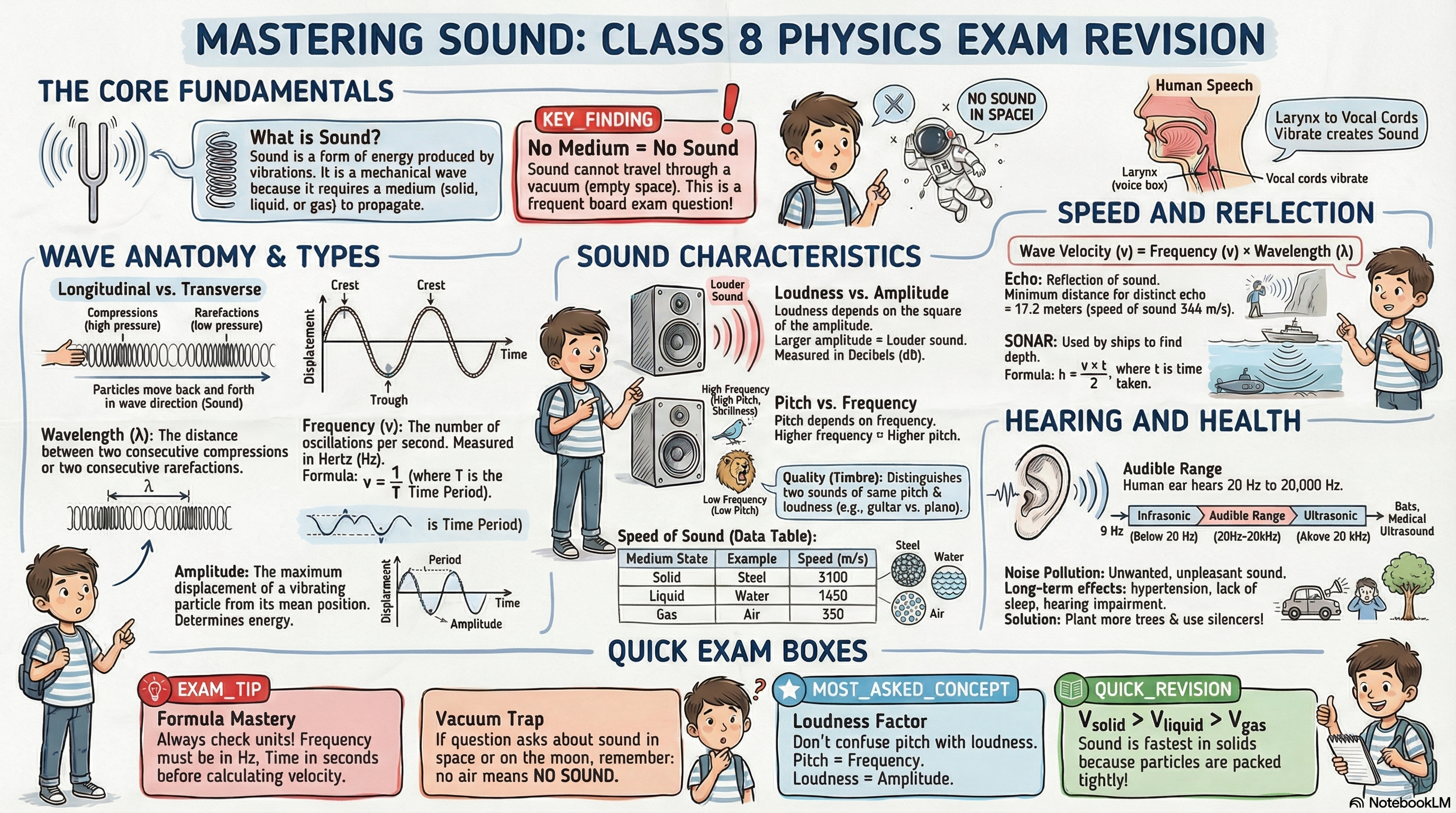
Classification of Waves
Based on Medium of Propagation
1. Mechanical Waves
Require a medium to propagate.
Examples:
- Sound waves
- Water waves
- Waves on a stretched string
2. Non-Mechanical Waves
Do NOT require a medium; can travel through vacuum.
Examples:
- Light waves
- Radio waves
- X-rays
- Gamma rays
Based on Particle Motion
1. Transverse Waves
Particles vibrate perpendicular to the direction of wave propagation.
Features:
- Propagate as crests (maximum upward displacement) and troughs (maximum downward displacement)
- All electromagnetic waves are transverse
Example: Waves on a string
2. Longitudinal Waves
Particles vibrate parallel to the direction of wave propagation.
Features:
- Propagate as compressions and rarefactions
- Also called pressure waves
Example: Sound waves in air
Compression: Region where particles are closer together than normal (momentary volume decrease).
Rarefaction: Region where particles are farther apart than normal (momentary volume increase).
CBSE Class 8 Science Notes Chapter-wise
Important Terms Related to Wave Motion
1. Crest
Point of maximum upward displacement in a transverse wave.
2. Trough
Point of maximum downward displacement in a transverse wave.
3. Amplitude (A)
Maximum displacement of particles from their mean position.
Impact: Greater amplitude = louder sound
4. Wavelength (λ)
Distance between two successive crests or troughs (or two successive compressions or rarefactions).
Unit: meters (m)
5. Wave Number
Reciprocal of wavelength: 1/λ
6. Time Period (T)
Time required for one complete oscillation.
Unit: seconds (s)
7. Frequency (ν)
Number of oscillations or vibrations per second.
Formula: ν = 1/T
Unit: Hertz (Hz)
- 1 Hz = 1 s⁻¹
8. Wave Velocity (v)
Speed at which the wave propagates through the medium.
Formulas:
- v = λ/T
- v = νλ
Important: Wave velocity is different from particle velocity.
- Wave velocity: constant for a given medium
- Particle velocity: varies with time for each particle
What is Sound?
Sound is a type of energy produced by vibrations. When an object vibrates, it creates disturbances in surrounding air particles, which travel as waves.
- Sound is Energy: Requires energy to start vibrations
- Sound is a Wave: Carries energy through space
- Sound is Longitudinal: Particles vibrate parallel to wave direction
Production of Sound
All sounds are produced by vibrating objects:
- Musical instruments: Vibrating strings, membranes, air columns
- Human voice: Vibrating vocal cords in the larynx
- Clapping: Vibrating hands
Rule: When vibration stops, sound stops.
How We Hear Sound
Sound waves cause our eardrum to vibrate, which our brain interprets as sound.
Propagation of Sound
Critical Fact: Sound CANNOT travel through vacuum. It requires a material medium (solid, liquid, or gas).
Sound Through Solids
- Example: Placing your ear on a railway track to detect a distant train
- Speed: Fastest in solids
Sound Through Liquids
- Example: Hearing a squeaking toy inside water
- Speed: Faster than in gases
Sound Through Gases
- Example: Hearing through air
- Speed: Slowest in gases
Speed Comparison
V_solid > V_liquid > V_gas
| Medium | Speed of Sound (m/s) |
|---|---|
| Gases | |
| Air (0°C) | 330 |
| Carbon dioxide | 260 |
| Hydrogen | 1270 |
| Liquids | |
| Alcohol | 1210 |
| Turpentine | 1325 |
| Water | 1450 |
| Solids | |
| Copper | 3560 |
| Steel | 5100 |
| Glass | 5500 |
| Granite | 6000 |
Factors Affecting Speed of Sound
Sound velocity depends on:
- Temperature
- Pressure
- Humidity
- Density of the medium
Sound velocity is INDEPENDENT of:
- Amplitude
- Frequency
- Wavelength
Special Case: If temperature is constant, speed of sound becomes independent of pressure too.
Standard Conditions: Speed of sound in air ≈ 330 m/s at 273.15 K (0°C) and 100 kPa (0.986 atm).
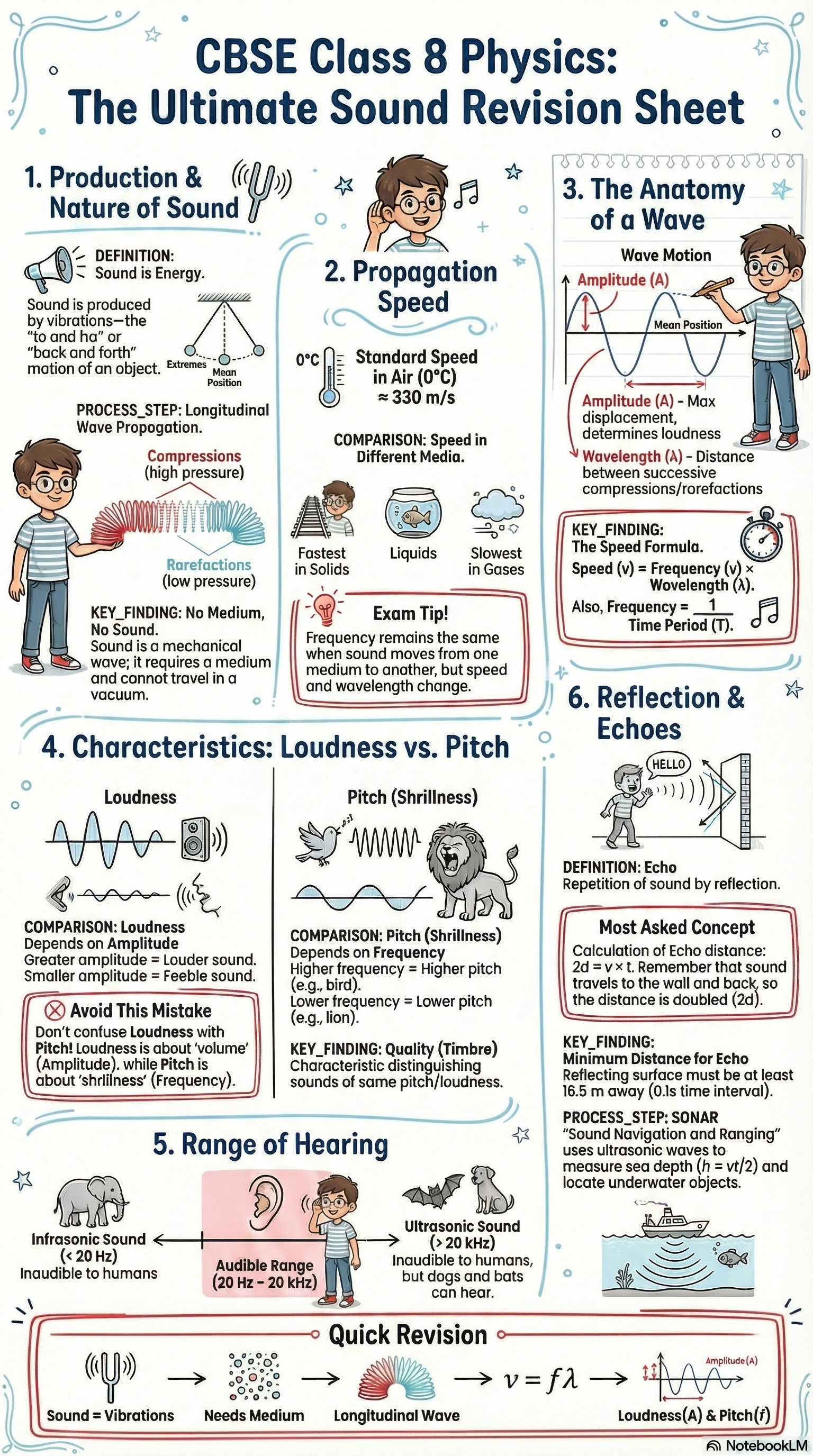
Characteristics of Sound
1. Loudness
The degree of sensation of sound produced in the ear.
Factors Affecting Loudness:
- Amplitude: Greater amplitude = louder sound
- Area of vibrating body: Larger area = louder sound (large drum vs small drum)
- Distance from source: Loudness decreases with distance
- Sensitivity of the ear: Varies from person to person
2. Pitch
The characteristic that determines the shrillness of sound.
Factors Affecting Pitch:
- Frequency: Higher frequency = higher pitch
- Relative motion:
- Source approaching listener = pitch appears higher
- Source receding = pitch appears lower
Important Distinction:
- Pitch is subjective (cannot be measured)
- Frequency is objective (can be measured in Hz)
- Same frequency may sound different in pitch to different people
3. Quality (Timbre)
The characteristic that enables us to distinguish between two sounds of the same pitch and loudness produced by different sources.
Example: A piano and a guitar playing the same note at the same volume sound different due to quality.
Audible and Inaudible Sounds
Human Hearing Range
Audible Range: 20 Hz to 20,000 Hz (20 kHz)
Infrasonic Sound
- Frequency < 20 Hz
- Cannot be heard by humans
- Examples: Earthquakes, ocean waves
Ultrasonic Sound
- Frequency > 20 kHz
- Cannot be heard by humans
- Examples: Dog whistles, ultrasound machines, SONAR
Animal Hearing
Some animals can hear ultrasonic sounds:
- Dogs: Up to 50 kHz
- Bats: Up to 120 kHz
- Dolphins: Up to 150 kHz
Application: Police use high-frequency whistles that dogs can hear but humans cannot.
Noise vs Music
Musical Sound
Pleasant to the ear; produced by regular vibrations.
Examples:
- Harmonium
- Sitar
- Flute
Noise
Unpleasant to the ear; produced by irregular vibrations.
Examples:
- Bus/truck horns
- Construction machinery
- Traffic sounds
Noise Pollution
Unwanted, loud sounds that cause harmful effects on humans and the environment.
Harmful Effects
- Hearing impairment (temporary or permanent)
- Sleep disturbance
- Hypertension (high blood pressure)
- Anxiety and stress
- Reduced concentration
- Cardiovascular problems
Measures to Control Noise Pollution
- Location planning: Set up noisy industries away from residential areas
- Natural barriers: Plant trees along roads and around buildings
- Infrastructure: Build airports away from residential zones
- Technology: Use quality silencers in vehicles and aircraft
- Volume control: Run TVs, music systems at low volumes
- Awareness: Educate public about harmful effects
- Minimize horn use: Reduce unnecessary honking
Reflection of Sound
Sound waves reflect when they encounter a surface, following the laws of reflection (similar to light).
Echoes
Echo: Phenomenon of hearing reflected sound from a distant surface.
Minimum Distance for Echo
For an echo to be heard distinctly:
- Minimum time gap required: 1/10th second (0.1 s)
- Speed of sound in air: 330 m/s
Calculation:
Distance traveled by sound = Speed × Time = 330 × 0.1 = 33 m
This is the round-trip distance (sound goes to the wall and comes back).
Therefore, minimum distance from the reflecting surface = 33/2 = 16.5 meters
Memory Trick: "Sweet Sixteen and a Half" minimum distance for echo is 16.5 m.
Applications of Reflection of Sound
1. SONAR (Sound Navigation and Ranging)
Purpose: Detect underwater objects, measure ocean depth, locate submarines.
Working Principle:
- Transmitter sends ultrasonic waves into water
- Waves reflect from the ocean floor or objects
- Receiver detects the reflected waves (echo)
- Electronic system measures time interval
Formula for Depth Calculation:
If time interval between transmission and reception = t Speed of sound in water = v
Then depth (h) = vt/2
(Divided by 2 because sound travels down and back up)
Why Ultrasonic Waves?
- High frequency (> 20 kHz)
- Greater penetrating power
- More accurate detection
2. Echolocation in Bats
Bats use ultrasonic sounds (up to 120 kHz) to navigate and hunt:
- Emit ultrasonic waves
- Listen to reflected echoes
- Determine location and distance of objects
- Hunt prey in complete darkness
Sonic Booms
Definition
A loud explosive sound created when an object travels faster than the speed of sound (supersonic speed).
Examples of Supersonic Objects
- Fighter jets
- Bullets
- Spacecraft during re-entry
How Sonic Booms Form
- Object moves faster than sound waves it creates
- Sound waves pile up and form shock waves
- Shock waves consist of:
- High-pressure layer (compression)
- Low-pressure layer (rarefaction)
- Shock waves travel at the speed of sound
- Create a burst or cracking sound when they reach our ears
Impact: Can be loud enough to break windows or damage buildings.
Enhanced Study Notes & Quick Revision
| Term | Definition | Unit |
|---|---|---|
| Wave | Disturbance carrying energy through space | - |
| Amplitude | Maximum displacement from mean position | m |
| Wavelength | Distance between two successive crests/troughs | m |
| Frequency | Number of oscillations per second | Hz |
| Time Period | Time for one complete oscillation | s |
| Wave Velocity | Speed of wave propagation | m/s |
| Compression | Region where particles are closer together | - |
| Rarefaction | Region where particles are farther apart | - |
Important Formulas
1. v = λ/T
2. v = νλ
3. ν = 1/T
4. Echo distance: d = vt/2
5. SONAR depth: h = vt/2
Memory Tricks & Mnemonics
- Wave Types: "TL" — Transverse needs Less Medium (can go through vacuum), Longitudinal needs Tangible Medium
- Speed in Media: "Solids are Speedy, Gases are Gentler" (V_solid > V_liquid > V_gas)
- Audible Range: "Twenty-Twenty vision for sound" (20 Hz to 20,000 Hz)
- Echo Distance: "Sweet Sixteen and a Half" (16.5 m minimum)
- Sound Characteristics: "Loud People Quit" — Loudness, Pitch, Quality
- SONAR Formula: "Half Time Voyage" (h = vt/2 — use half the time)
Quick Revision Table
| Concept | Point |
|---|---|
| Sound nature | Energy + Wave (Longitudinal) |
| Sound medium | Needs material medium (no vacuum) |
| Speed hierarchy | Solid > Liquid > Gas |
| Standard speed in air | ~330 m/s (at 0°C) |
| Human hearing range | 20 Hz to 20 kHz |
| Infrasonic | < 20 Hz |
| Ultrasonic | > 20 kHz |
| Minimum echo distance | 16.5 m |
| Echo time gap | 0.1 s (1/10th second) |
| SONAR uses | Ultrasonic waves |
| Sonic boom | Supersonic speed creates shock waves |
Solved Examples of Sound
Example 1: Basic Frequency and Time Period
Question: A simple pendulum completes 10 oscillations in 20 seconds. Find its time period and frequency.
Solution:
Time period (T) = Total time / Number of oscillations T = 20/10 = 2 seconds
Frequency (ν) = 1/T = 1/2 = 0.5 Hz
Answer: Time period = 2 s, Frequency = 0.5 Hz
Example 2: Wavelength Calculation
Question: The distance between the 1st compression and the rarefaction next to the 2nd compression in a longitudinal wave is 15 m. If the frequency of the wave is 200 Hz, find the speed of the wave.
Solution:
Distance between consecutive compressions = λ (one wavelength) Distance between neighboring compression and rarefaction = λ/2
Given distance = λ + λ/2 = 3λ/2 = 15 m
Therefore: λ = (15 × 2)/3 = 10 m
Speed (v) = νλ = 200 × 10 = 2000 m/s
Answer: 2000 m/s
Example 3: Reading Wave Graphs
Question: Find the frequency and wavelength of a wave whose time period is 0.001 sec and speed is 200 m/s.
Solution:
Time period T = 0.001 s
Frequency ν = 1/T = 1/0.001 = 1000 Hz
Wavelength λ = speed/frequency = 200/1000 = 0.2 m
Answer: Frequency = 1000 Hz, Wavelength = 0.2 m
Example 4: Multiple Wave Properties
Question: A source produces 12 waves in 4 seconds. The distance between a crest and consecutive trough is 6 m. Find: (a) Frequency (b) Wavelength (c) Velocity of wave
Solution:
(a) Number of waves per second = 12/4 = 3 Therefore, frequency = 3 Hz
(b) Distance between crest and consecutive trough = λ/2 = 6 m Therefore, wavelength λ = 12 m
(c) Velocity v = νλ = 3 × 12 = 36 m/s
Answer: (a) 3 Hz, (b) 12 m, (c) 36 m/s
Example 5: Wave Graph Analysis
Question: A wave graph shows time period of 4 milliseconds and distance between trough and crest is 2 m. Find wave velocity, wavelength, and frequency.
Solution:
Time period T = 4 ms = 4 × 10⁻³ s
Frequency ν = 1/T = 1/(4 × 10⁻³) = 250 Hz
Distance between trough and crest = λ/2 = 2 m Therefore, wavelength λ = 4 m
Wave speed v = νλ = 250 × 4 = 1000 m/s
Answer: Velocity = 1000 m/s, Wavelength = 4 m, Frequency = 250 Hz
Example 6: Echo Between Two Walls
Question: A person stands between two walls and claps. He hears two successive echoes at an interval of 0.25 seconds. If the distance between the walls is d and speed of sound is v, find the position of the person.
Solution:
Let distance from wall A = x Distance from wall B = (d - x)
Time for echo from wall A: t₁ = 2x/v Time for echo from wall B: t₂ = 2(d - x)/v
Time difference: t₂ - t₁ = [2(d - x) - 2x]/v = 2(d - 2x)/v
Given: t₂ - t₁ = 0.25 = 1/4 s
Therefore: 2(d - 2x)/v = 1/4
Solving: x = d/2 - v/8
Answer: x = d/2 - v/8 (from wall A)
Example 7: SONAR Depth Calculation
Question: A ship sends a SONAR signal towards the ocean bottom at depth 12 km. After how long will the reflected signal reach the ship? (Speed of sound in seawater = 1200 m/s)
Solution:
Depth h = 12 km = 12,000 m Total distance traveled = 2h = 24,000 m Speed v = 1200 m/s
Time t = Distance/Speed = 24,000/1200 = 20 seconds
Answer: 20 seconds
Example 8: Minimum Echo Distance
Question: Why must an obstacle be at least 17 m away to hear an echo clearly? Explain with calculation.
Solution:
Human ear can distinguish two sounds only if time gap ≥ 0.1 s Speed of sound in air = 330 m/s (approximately)
For echo, sound must travel to obstacle and back: Total distance = v × t = 330 × 0.1 = 33 m
Since this is round trip: Minimum distance to obstacle = 33/2 = 16.5 m ≈ 17 m
Answer: 16.5 m (approximately 17 m)
Example 9: Comparing Wave Properties
Question: Two sound waves have frequencies 256 Hz and 512 Hz traveling through air at 340 m/s. Compare their wavelengths.
Solution:
For wave 1: λ₁ = v/ν₁ = 340/256 = 1.328 m For wave 2: λ₂ = v/ν₂ = 340/512 = 0.664 m
Ratio: λ₁/λ₂ = 1.328/0.664 = 2:1
Answer: Wave 1 has double the wavelength of wave 2. Higher frequency = shorter wavelength.
Example 10: Converting Units
Question: A wave has a time period of 20 milliseconds. Express this in seconds and find the frequency.
Solution:
Time period T = 20 ms = 20 × 10⁻³ s = 0.02 s
Frequency ν = 1/T = 1/0.02 = 50 Hz
Answer: Time period = 0.02 s, Frequency = 50 Hz
Example 11: Assertion-Reason
Question:
Assertion (A): Sound cannot travel through vacuum.
Reason (R): Sound requires a medium with particles to propagate.
(a) Both A and R are true, and R is the correct explanation of A
(b) Both A and R are true, but R is not the correct explanation of A
(c) A is true but R is false
(d) A is false but R is true
Solution:
Sound is a mechanical wave that propagates through the vibration of particles in a medium. In a vacuum, there are no particles to vibrate, so sound cannot travel.
Both statements are true, and R correctly explains why A is true.
Answer: (a)
Example 12: Case-Based Question (Short)
Context: During a thunderstorm, you see lightning before hearing thunder.
Question: Why does this happen? Calculate the approximate distance of lightning if you hear thunder 3 seconds after seeing the flash. (Speed of sound = 330 m/s, speed of light = 3 × 10⁸ m/s)
Solution:
Light travels much faster than sound (practically instantaneous for short distances).
Distance = Speed of sound × Time Distance = 330 × 3 = 990 m ≈ 1 km
Answer: Lightning is approximately 1 km away. We see it first because light travels much faster than sound.
Example 13: Ultrasonic vs Audible
Question: A bat emits an ultrasonic sound of frequency 50 kHz. Can a human hear it? If the sound travels in air at 340 m/s, what is its wavelength?
Solution:
Frequency = 50 kHz = 50,000 Hz
Human hearing range: 20 Hz to 20,000 Hz Since 50,000 Hz > 20,000 Hz, humans cannot hear it.
Wavelength λ = v/ν = 340/50,000 = 0.0068 m = 6.8 mm
Answer: No, humans cannot hear it. Wavelength = 6.8 mm
Example 14: Speed in Different Media
Question: Why does sound travel fastest in solids and slowest in gases?
Solution:
Sound propagates through particle vibrations.
- Solids: Particles are closest together, vibrations transfer quickly
- Liquids: Particles are farther apart than solids
- Gases: Particles are farthest apart, vibrations transfer slowly
Answer: Closer particles = faster sound transmission. Solid particles are most closely packed, so sound travels fastest in solids.
Example 15: Frequency and Pitch
Question: Distinguish between frequency and pitch with an example.
Solution:
| Frequency | Pitch |
|---|---|
| Objective, measurable | Subjective, depends on listener |
| Measured in Hz | Cannot be measured numerically |
| Physical property | Psychological property |
| Same for all listeners | May vary for different people |
Example: A tuning fork vibrating at 440 Hz has that frequency for everyone, but a person with hearing loss might perceive its pitch differently than someone with normal hearing.
Answer: Frequency is measurable (Hz); pitch is how we perceive that frequency.
Example 16: Loudness Factors
Question: List three factors that affect the loudness of sound. Give one example for each.
Solution:
- Amplitude: Striking a drum harder (more amplitude) produces louder sound
- Surface area: Large drum produces louder sound than small drum (more area vibrating)
- Distance: Sound from a speaker is louder nearby than far away
Answer: Amplitude, surface area, and distance all affect loudness.
Example 17: SONAR Application
Question: A SONAR device on a ship detects a submarine. The echo returns after 4 seconds. If the speed of sound in seawater is 1500 m/s, how deep is the submarine?
Solution:
Total distance = Speed × Time = 1500 × 4 = 6000 m This is the round trip (down and up)
Depth h = 6000/2 = 3000 m = 3 km
Answer: Submarine is at 3 km depth.
Example 18: Wave Classification
Question: Classify the following as transverse or longitudinal waves: (a) Light waves (b) Sound in air (c) Waves on water surface (d) Seismic P-waves
Solution:
(a) Light waves Transverse (electromagnetic)
(b) Sound in air Longitudinal (compression/rarefaction)
(c) Waves on water surface Transverse (up and down motion)
(d) Seismic P-waves Longitudinal (compression waves)
Answer: (a) T, (b) L, (c) T, (d) L
Example 19: Noise Pollution
Question: Give three harmful effects of noise pollution and three measures to control it.
Solution:
Harmful Effects:
- Hearing loss (temporary or permanent)
- Sleep disturbance and insomnia
- Increased stress and anxiety
Control Measures:
- Plant trees as sound barriers
- Use silencers in vehicles
- Locate industries away from residential areas
Answer: See above
Example 20: Practical Application
Question: Why are concert halls designed with specific wall materials and shapes?
Solution:
Concert halls use acoustic design principles:
- Soft materials (curtains, carpets) absorb sound, reducing echoes
- Curved walls distribute sound evenly to all areas
- Proper spacing prevents echo overlap
- Sound reflectors direct sound to the audience
This ensures clear music without distortion from excessive echoes or dead spots.
Answer: To control sound reflection, prevent echoes, and ensure even sound distribution.
Example 21: Multiple Choice Challenge
Question: If the frequency of a sound wave is doubled while traveling through the same medium, what happens to its: (i) Wavelength (ii) Speed
(a) Both double
(b) Wavelength halves, speed remains constant
(c) Wavelength doubles, speed halves
(d) Both remain constant
Solution:
Speed v = νλ
In the same medium, speed remains constant.
If frequency doubles (ν → 2ν): v = (2ν)λ_new Since v is constant: λ_new = v/(2ν) = λ/2
Wavelength halves, speed constant.
Answer: (b)
Example 22: Long Answer Question
Question: Explain the working of SONAR with a labeled diagram (textual description). Write the formula used and give one application.
Solution:
SONAR (Sound Navigation and Ranging)
Components:
- Transmitter: Sends ultrasonic waves into water
- Receiver: Detects reflected waves (echo)
Working:
- Transmitter emits ultrasonic pulse downward into ocean
- Sound waves travel through water at speed v
- Waves hit ocean floor or object and reflect back
- Receiver detects the echo
- Electronic timer measures time interval t between transmission and reception
Formula: Depth h = vt/2
(Divided by 2 because sound makes a round trip)
Applications:
- Measuring ocean depth
- Detecting submarines
- Locating shipwrecks
- Finding schools of fish
- Underwater navigation
Why Ultrasonic?
- High frequency (> 20 kHz)
- Better penetration
- More accurate
Answer: See detailed explanation above.
Conclusion
Understanding sound is crucial not just for exams but for comprehending the world around us. From music to medicine (ultrasound), from ocean exploration (SONAR) to environmental protection (noise control), sound physics has countless applications.
- Sound is a longitudinal mechanical wave
- Requires medium to propagate
- Speed varies with medium: fastest in solids
- Human hearing: 20 Hz to 20 kHz
- Echo minimum distance: 16.5 m
- SONAR uses ultrasonic reflection
Learn these concepts through regular practice, solve numerical problems daily, and relate them to real-life observations. This comprehensive guide is designed for Class 8 students following NCERT curriculum. Content is aligned with latest exam patterns and includes CBSE board question types.
Frequently Asked Questions about Sound
No, sound cannot travel through vacuum. Sound is a mechanical wave that requires a material medium (solid, liquid, or gas) to propagate. It travels through the vibration of particles in the medium. Vacuum has no particles, so there's nothing to vibrate and carry the sound energy.
| Longitudinal Waves | Transverse Waves |
|---|---|
| Particles vibrate parallel to wave direction | Particles vibrate perpendicular to wave direction |
| Travel as compressions and rarefactions | Travel as crests and troughs |
| Example: Sound waves | Example: Light waves, water waves |
Sound travels through particle vibrations. In solids, particles are tightly packed and strongly bound, so vibrations transfer quickly from one particle to the next. In gases, particles are far apart with weak interactions, so vibrations take longer to transfer. Therefore: V_solid > V_liquid > V_gas.
The audible range for human ears is approximately 20 Hz to 20,000 Hz (20 kHz). Sounds below 20 Hz are called infrasonic, and sounds above 20 kHz are called ultrasonic. Both are inaudible to humans but some animals can hear them.
Human ear can distinguish two sounds if the time gap is at least 0.1 seconds (1/10th second).
Formula:
- Total distance = Speed × Time = 330 × 0.1 = 33 m
- Minimum distance from reflecting surface = 33/2 = 16.5 meters
(Divided by 2 because sound travels to the wall and back)
SONAR stands for Sound Navigation and Ranging. It uses ultrasonic waves to detect underwater objects and measure depths.
Working:
- Transmitter sends ultrasonic pulse into water
- Pulse reflects from object/ocean floor
- Receiver detects the echo
- Time interval is measured
Formula: Depth h = vt/2 (where v = speed of sound in water, t = time interval)
- Loudness: Degree of sound sensation; depends on amplitude
- Pitch: Shrillness of sound; depends on frequency
- Quality (Timbre): Distinguishes sounds of same pitch and loudness from different sources
| Noise | Music |
|---|---|
| Unpleasant to hear | Pleasant to hear |
| Irregular vibrations | Regular vibrations |
| Examples: Traffic, construction | Examples: Musical instruments |
| Can cause health problems | Can have therapeutic effects |
Ultrasonic sounds have frequencies above 20,000 Hz, which is beyond the upper limit of human hearing range (20 Hz to 20 kHz). Our eardrum and auditory system are not sensitive to such high frequencies. However, some animals like bats, dolphins, and dogs can hear ultrasonic sounds.
Health Effects:
- Hearing impairment (temporary or permanent)
- Sleep disturbance and insomnia
- Increased blood pressure (hypertension)
- Stress and anxiety
- Reduced concentration
- Cardiovascular problems
Prevention: Use earplugs in noisy environments, plant trees as barriers, reduce volume of electronic devices, and avoid prolonged exposure to loud sounds.