





Some natural events around us can look simple, but they actually follow important scientific rules. In this chapter, Some Natural Class 8 notes, students will learn about common natural phenomena like lightning and earthquakes in an easy and clear way. These class 8 science Notes are designed to help students understand how and why such events happen in our environment.
The topic some natural phenomena notes class 8 explains concepts like electric charges, transfer of charge, and safety measures during lightning. It also gives basic idea about earthquakes, their causes, and how we can stay safe. These concepts are important not only for exams but also for real life awareness, because natural disasters can happen anytime.
With the help of some natural phenomena class 8 questions and answers, students can test their understanding and improve their learning step by step. This some natural phenomena class 8 notes also includes simple explanations, examples, and key points..
What is Some Natural Phenomena?
Natural phenomena are events that occur in nature without human intervention. Some phenomena like lightning, earthquakes, and cyclones can cause significant damage to life and property.
Why Study This Chapter?
- Understand the science behind dangerous natural events
- Learn safety measures to protect yourself and others
- Important for CBSE Class 8 exams (5-8 marks weightage)
- Real-life applications in disaster management
This chapter covers two major natural phenomena:
- Lightning - caused by electric charges
- Earthquakes - caused by movement of earth's plates
Electric Charge - Foundation Concepts
What is Electric Charge?
Electric charge is a fundamental property of matter responsible for electrical phenomena. It exists in two forms:
Types of Charges:
- Positive Charge (+) - Carried by protons
- Negative Charge (-) - Carried by electrons
Properties:
- Like charges repel each other (+ and + OR - and -)
- Unlike charges attract each other (+ and -)
- Charge can be transferred but not created or destroyed
Charged vs Uncharged Objects
| Charged Object | Uncharged Object |
|---|---|
| Has excess or deficit of electrons | Equal number of protons and electrons |
| Attracts uncharged objects | No electric effect on other objects |
| Can be detected by electroscope | Does not affect electroscope |
| Exerts electric force | No electric force |
Charging by Friction (Rubbing)
How Does Rubbing Produce Charge?
When two objects are rubbed together:
- Friction occurs between surface atoms
- Electrons transfer from one object to another
- One object loses electrons → becomes positively charged
- Other object gains electrons → becomes negatively charged
Important: Protons cannot move as they are locked in the nucleus. Only electrons transfer.
Common Examples of Charging by Friction
Example 1: Plastic Comb and Dry Hair
- Rub plastic comb on dry hair
- Comb gains electrons → becomes negatively charged
- Comb now attracts tiny paper pieces
- Paper pieces have opposite charge induced on them
Example 2: Rubber Balloon and Wool
- Rub inflated balloon with woollen cloth
- Balloon becomes charged
- Stick balloon to wall - it stays due to attraction
Example 3: Glass Rod and Silk
- Glass rod rubbed with silk becomes positively charged
- Silk becomes negatively charged
- Both acquire equal and opposite charges
Static Electricity
The charges produced by friction are called static charges because:
- They remain bound to the object's surface
- They don't move (stationary)
- Also called "charges at rest"
The Electroscope
What is an Electroscope?
An electroscope is a device used to detect the presence of electric charge on an object.
Structure of Electroscope
Components:
- Metal disc/sphere - at the top (for touching objects)
- Metal rod - connects disc to leaves
- Aluminum/gold leaves - two thin strips inside flask
- Glass flask - protects leaves from air currents
- Cork/rubber stopper - insulates the rod
Working Principle
When uncharged object touches electroscope:
- Aluminum leaves remain closed
- No divergence
When charged object touches electroscope:
- Charge transfers to metal disc
- Flows down to aluminum leaves
- Both leaves get same charge
- Like charges repel → leaves diverge (open up)
Point: Greater the charge → greater the divergence
Earthing of Electroscope
Process:
- Touch the charged electroscope's metal disc with your finger
- Charge flows from electroscope to earth through your body
- Leaves collapse back (lose charge)
Earthing Definition: Transferring electric charge from a charged object to the earth.
Purpose in Buildings:
- Protects from electric shocks
- Prevents charge accumulation
- Safety mechanism in electrical wiring
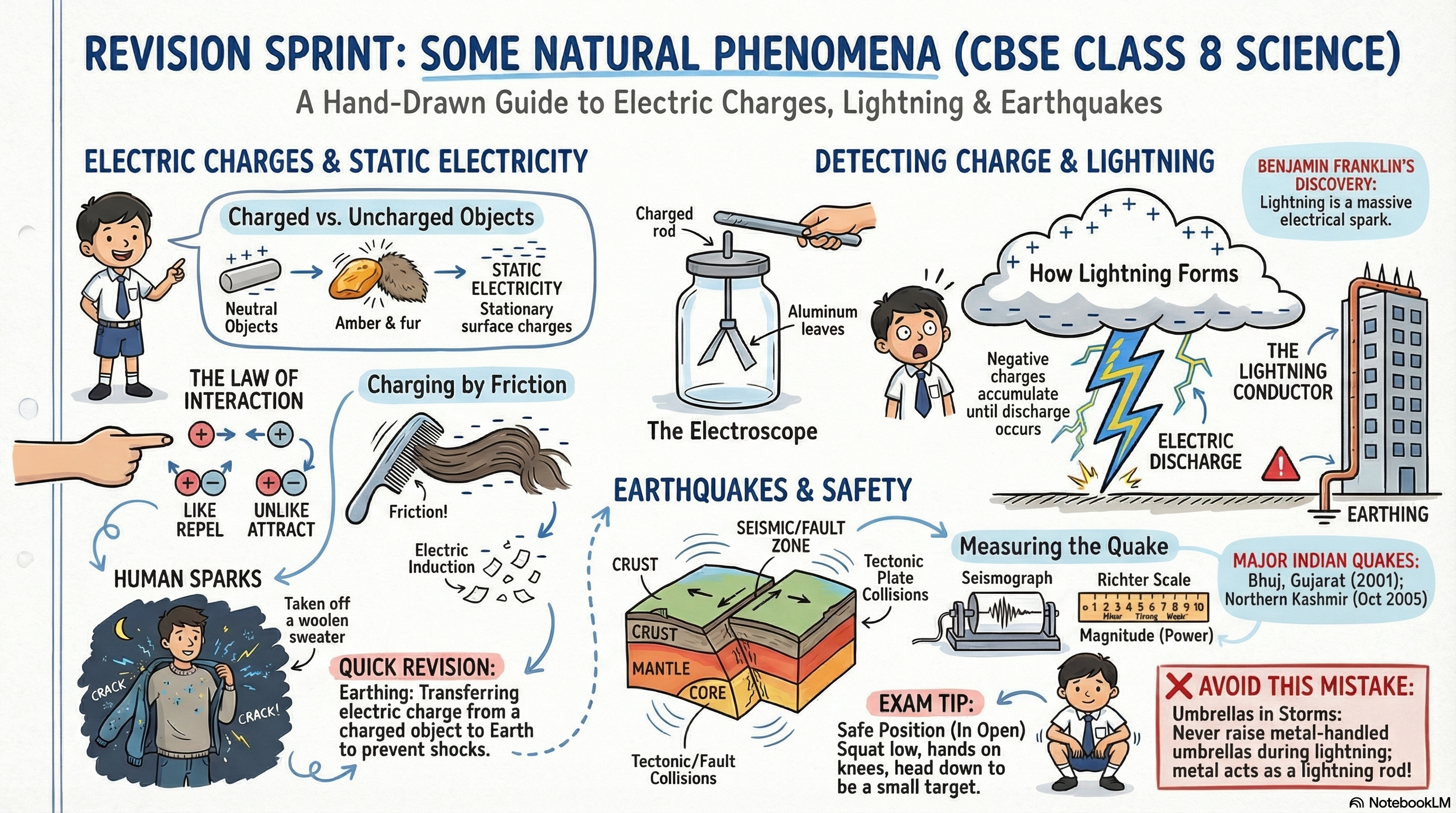
Electric Discharge and Lightning
Electric Discharge
Passage of electric current through air due to movement of electric charges.
When Does It Occur?
- Air is normally an insulator (non-conductor)
- When opposite charges are very large
- Air's insulation breaks down
- Charges flow through air producing:
- Spark (flash of light)
- Crackling sound
Examples of Small Electric Discharge:
- Taking off woollen sweater in dark → tiny sparks
- Loose electrical plug → sparks
- Touching metal after walking on carpet
Lightning - Nature's Electric Discharge
What is Lightning?
Lightning is a massive electric discharge in the atmosphere between:
- Oppositely charged clouds, OR
- Charged cloud and earth
Historical Note:
Benjamin Franklin established the electrical nature of lightning through experiments.
How Lightning Forms - Step by Step
Step 1: Cloud Formation
- Storm clouds develop during rainy season
- Strong winds blow upward through clouds
Step 2: Charge Separation
- Water drops in clouds rub against each other
- Friction produces electric charges
- Small drops → gain positive charge → move up (lighter)
- Large drops → gain negative charge → move down (heavier)
Step 3: Charge Accumulation
- Top of cloud → positively charged
- Bottom of cloud → negatively charged
- Charges become extremely large
Step 4: Electric Discharge
- When charge becomes too large
- Air between positive and negative charges conducts
- Intense spark produced = Lightning
- Rapid air heating → expansion → Thunder sound
Step 5: Lightning to Earth
- Bottom of cloud is negatively charged
- Induces positive charge on earth below
- Lightning can strike from cloud to ground
Lightning Safety Measures
DO's During Thunderstorm
If at Home:
- Stay indoors - house or building is safest
- Take shelter under table - if shaking starts
- Cover head with hands - for protection
- Avoid windows - glass can shatter
- Switch off TV - to prevent damage
If Outdoors:
- Stay away from:
- Tall trees
- Electric poles
- Telephone poles
- Metal objects
- Squat low - if caught in open space
- Place hands on knees
- Head between hands
- Become smallest target possible
- Inside vehicle is safe - keep windows/doors closed
- Move to clear spot - away from tall structures
DON'Ts During Thunderstorm
Never Do These:
- Carry umbrella - metal rod attracts lightning
- Stand under tall trees - common lightning target
- Touch metal pipes - in buildings (water pipes, gas pipes)
- Use corded telephone - use mobile instead
- Switch lights on/off - wait till storm passes
- Stand in open fields - you become tallest object
- Use open vehicles - bikes, tractors, scooters unsafe
Why Lightning Strikes Tall Objects
- Lightning seeks shortest path to ground
- Tall objects are closer to clouds
- Buildings, towers, trees are frequent targets
- That's why lightning conductors are needed
Lightning Conductor
What is a Lightning Conductor?
A protective device that safely conducts lightning's electric energy to the ground, preventing damage to buildings.
Invented by: Benjamin Franklin
Structure and Installation
Components:
- Metal spike/rod - copper, pointed top
- Thick metal strip - runs down building
- Metal plate - buried deep in earth
Installation:
- Spike fixed at highest point of building
- Strip runs along outer wall
- Connected to earth through buried plate
How It Works
Step 1: Lightning strikes the pointed metal spike
Step 2: Electric charge flows through thick metal strip
Step 3: Charge safely discharged into earth through buried plate
Step 4: Building remains protected - no damage
Where You See Them:
- Tall buildings
- Factory chimneys
- Qutub Minar
- Radio/TV towers
- Important monuments
Earthquakes - Understanding Earth's Tremors
What is an Earthquake?
An earthquake is a sudden shaking or trembling of the earth that lasts for a very short time.
Cause: Violent movement of rocks deep inside earth's crust.
Characteristics:
- Occurs all the time worldwide
- Most are too mild to feel
- Major earthquakes are rare but devastating
- Cannot be predicted accurately
Damage Caused by Earthquakes
Immediate Effects:
- Buildings collapse
- Bridges destroyed
- Dams crack
- Loss of human life
- Infrastructure damage
Secondary Effects:
- Floods (due to dam bursts)
- Landslides (in hilly areas)
- Tsunamis (underwater earthquakes)
- Fire (due to electrical short circuits)
Major Earthquakes in India:
- 2001 - Bhuj, Gujarat (26th January)
- 2005 - Uri and Tangdhar, Kashmir (8th October)
Structure of Earth
Understanding earth's structure helps explain why earthquakes occur.
Three Main Layers
1. Core (Innermost Layer)
- Made of molten iron
- Extremely hot
- Divided into:
- Inner core - solid
- Outer core - liquid
2. Mantle (Middle Layer)
- Between core and crust
- Made of dense solid rocks
- Some parts have molten rocks (like lava)
- Convection currents occur here due to heat from core
- These currents cause mantle movement
3. Crust (Outermost Layer)
- Where we live
- Made of lighter rocks
- Thicker under continents (30-70 km)
- Thinner under oceans (5-10 km)
- NOT one solid piece - broken into plates
Tectonic Plates
Facts:
- Earth's crust divided into many large pieces called plates
- Like tiles on a bathroom floor
- Continental plates - under land masses
- Oceanic plates - under oceans
Why Plates Move:
- Float on partially molten mantle rocks
- Convection currents in mantle push them
- Move very, very slowly (few cm per year)
Why Earthquakes Occur
Two Main Causes
Cause 1: Plates Sliding Past Each Other
The Process:
- Two plates moving in same/opposite directions
- Plates have rough, jagged edges
- Edges get entangled/locked
- Pressure builds up as plates keep pushing
- Rocks suddenly break free with huge jolt
- Tremendous energy released
- Shock waves (seismic waves) travel through earth
- Ground shakes = Earthquake
Cause 2: Plates Colliding Head-On
The Process:
- Two plates moving toward each other
- Plates collide with tremendous force
- Edges buckle and fold upward
- Forms new mountains
- Massive energy released during collision
- Produces powerful earthquakes
Additional Cause:
- Volcanic eruptions can also cause tremors
Seismic Zones (Fault Zones)
What are Seismic Zones?
Areas where earthquakes are most likely to occur due to plate boundaries.
Also Called: Fault zones or earthquake-prone areas
Seismic Zones in India
High-Risk Areas:
- Kashmir - entire region
- Western and Central Himalayas
- North-East India - all states
- Rann of Kutch - Gujarat
- Rajasthan - parts
- Indo-Gangetic Plain
- Parts of South India
Why These Areas?
- Located near plate boundaries
- Indian plate colliding with Eurasian plate
- Active tectonic movement
- History of earthquakes
Global Seismic Belt
Most earthquakes occur in a belt around the Pacific Ocean (called "Ring of Fire"):
- Japan
- Philippines
- Indonesia
- Western coast of Americas
Measuring Earthquakes
Richter Scale
Developed by: Charles F. Richter (1935)
What It Measures: Magnitude (strength/intensity) of earthquake
Scale Range: 1 to 12 (theoretically no upper limit)
How It Works:
- Logarithmic scale
- Each number is 10 times stronger than previous
Examples:
- Magnitude 2 = 10× stronger than magnitude 1
- Magnitude 3 = 100× stronger than magnitude 1
- Magnitude 4 = 1000× stronger than magnitude 1
Classification:
| Magnitude | Classification | Effects |
|---|---|---|
| < 2.0 | Micro | Not felt |
| 2.0 - 3.9 | Minor | Rarely felt |
| 4.0 - 4.9 | Light | Felt, minor damage |
| 5.0 - 5.9 | Moderate | Some damage to buildings |
| 6.0 - 6.9 | Strong | Considerable damage |
| 7.0 - 7.9 | Major | Serious damage, large area |
| 8.0+ | Great | Devastating destruction |
Seismograph
Instrument that detects and records earthquake vibrations.
What It Records:
- Time of earthquake
- Intensity of tremors
- Duration of shaking
- Location of epicenter
How It Works:
- Sensitive pendulum or spring system
- Stays still while ground shakes
- Records relative motion on paper/computer
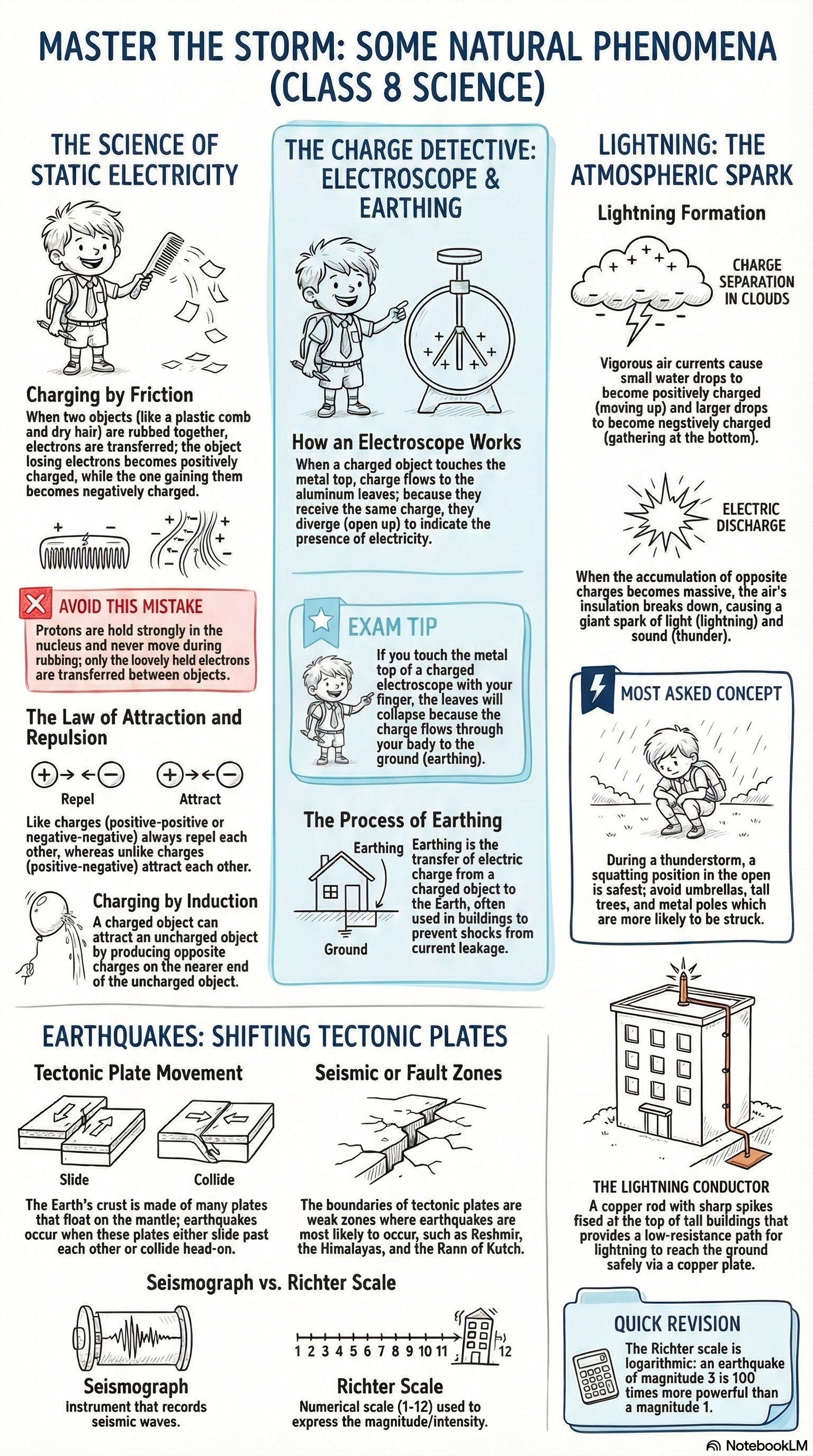
Earthquake Safety Measures
Before Earthquake (Preparedness)
Building Construction:
- Use earthquake-resistant designs
- Modern building technology available
- Flexible structures that can sway
- Strong foundations
In Seismic Zones - Special Rules:
- Use light materials for roofs
- If roof falls, less damage
- Mud and timber better than heavy concrete
- Fix furniture to walls:
- Cupboards
- Shelves
- Water heaters
- Secure heavy objects:
- Keep low to ground
- Don't place on high shelves
- Mount safely on walls:
- Mirrors
- Photo frames
- Wall clocks
- Fire safety:
- Keep fire extinguishers ready
- In working condition
During Earthquake - If at Home
Do This:
- Take shelter under:
- Sturdy table
- Kitchen counter
- Doorway (strong support)
- Stay there till shaking stops
- Cover head with hands or pillow
- Stay away from:
- Heavy furniture (almirahs, refrigerators)
- Glass windows (can shatter)
- Hanging objects (fans, lights)
- If in bed:
- Don't get up
- Move close to wall
- Protect head with pillow
During Earthquake - If Outdoors
Do This:
- Move to clear, open area
- Away from buildings
- Away from trees
- Away from power lines
- Sit on ground
- Prevents falling due to shaking
- Stay low
- If in vehicle:
- DON'T get out
- Driver should slow down
- Move to clear area
- Stop safely
- Wait inside till tremors stop
Don't Do This:
- Run into buildings
- Stand under trees
- Touch overhead wires
- Panic and run randomly
After Earthquake
Immediate Actions:
- Check for injuries - give first aid
- Check for gas leaks, fire hazards
- Switch off electricity if damaged
- Evacuate if building damaged
- Stay away from damaged structures
- Follow official instructions
- Help rescue operations
Don't:
- Use elevators
- Light matches near gas leaks
- Touch electrical wires
- Spread rumors
- Return to damaged buildings
Enhanced Study Notes
Quick Revision Points
Electric Charge:
- Two types: positive (+) and negative (-)
- Like charges repel, unlike attract
- Produced by friction/rubbing
- Electrons move, protons don't
- Object losing electrons → positive
- Object gaining electrons → negative
Electroscope:
- Detects electric charge
- Parts: metal disc, rod, aluminum leaves, flask
- Charged object → leaves diverge
- Uncharged object → leaves stay closed
- Earthing discharges electroscope
Lightning:
- Electric discharge in atmosphere
- Occurs between oppositely charged clouds or cloud-earth
- Caused by friction of water drops in clouds
- Thunder = sound produced by lightning
- Benjamin Franklin studied lightning
Lightning Safety:
- Stay indoors during thunderstorm
- Avoid tall trees, metal objects, umbrellas
- Squat position if caught in open
- Vehicle with closed windows is safe
Lightning Conductor:
- Protects buildings from lightning
- Made of metal rod/strip
- Pointed top, connected to earth
- Invented by Benjamin Franklin
Earthquakes:
- Sudden shaking of earth
- Caused by plate movement
- Plates slide past or collide
- Release tremendous energy
- Produce seismic waves
Earth Structure:
- Core (innermost) - molten iron
- Mantle (middle) - solid/molten rocks
- Crust (outermost) - broken into plates
Richter Scale:
- Measures earthquake magnitude
- Scale 1-12
- Each number = 10× stronger
- Recorded by seismograph
Seismic Zones in India:
- Kashmir, Himalayas
- North-East India
- Rann of Kutch
- Rajasthan, Indo-Gangetic Plain
Earthquake Safety:
- During: Take shelter under table, protect head
- Outdoors: Move to open area, sit down
- In vehicle: Stay inside, stop safely
- Buildings: Earthquake-resistant design
Memory Tricks (Mnemonics)
Types of Charges:"PP RR Unlike Attracts"
- Positive-Positive Repel
- Negative-Negative Repel (Remember as R-R)
- Unlike Attracts
Earth's Layers (Inside to Outside):"Come, Make Curry"
- Core
- Mantle
- Crust
Seismic Zones in India:"King Has No Rules In Gujarat"
- Kashmir
- Himalayas
- North-East
- Rajasthan (and Rann of Kutch)
- Indo-Gangetic Plain
- Gujarat
Lightning Safety DO'S:"SIT SAFE"
- Stay indoors
- Inside vehicle okay
- Table - take shelter under
- Squat low in open
- Avoid tall objects
- Finger - don't touch metal
- Electronics - switch off
Summary Table for Quick Revision
| Topic | Points |
|---|---|
| Electric Charge | Two types (+/-), like repel, unlike attract, friction produces charge |
| Charging Methods | Rubbing/friction - electrons transfer between objects |
| Electroscope | Detects charge, leaves diverge if charged, earthing discharges it |
| Static Electricity | Charges at rest, remain on surface, don't flow |
| Lightning | Electric discharge in clouds, friction of water drops, produces thunder |
| Lightning Conductor | Metal rod on buildings, conducts charge to earth, prevents damage |
| Earthquake Cause | Plate movement - sliding or collision, releases energy |
| Earth Layers | Core (molten iron), Mantle (solid rocks), Crust (plates) |
| Seismic Zones | Plate boundaries, India: Kashmir, Himalayas, NE, Gujarat |
| Richter Scale | 1-12 scale, logarithmic, each +1 = 10× stronger |
| Earthquake Safety | Indoors: under table, outdoors: open area, in vehicle: stay inside |
Solved Examples
Question: What are the two types of electric charges? Give one example of each.
Solution: The two types of electric charges are:
- Positive Charge (+)
- Example: When a glass rod is rubbed with silk cloth, the glass rod acquires positive charge
- It has lost electrons (deficit of electrons)
- Negative Charge (-)
- Example: When a plastic comb is rubbed with dry hair, the comb acquires negative charge
- It has gained electrons (excess of electrons)
Point: Charges are named by convention. Benjamin Franklin decided to call the charge on glass rubbed with silk as "positive."
Question: A charged balloon is brought near small pieces of paper. What will happen and why?
Solution:
What happens: The paper pieces are attracted to the balloon and stick to it.
Why this happens:
- The balloon is charged (either positive or negative from rubbing)
- When brought near paper pieces:
- The charged balloon induces opposite charge on the near side of paper
- This is called electrostatic induction
- Since opposite charges attract:
- Paper pieces move toward balloon
- They stick to the balloon
Important: A charged object can attract an uncharged object through induction.
Question: Describe what happens when a charged glass rod is touched to the metal disc of an electroscope.
Solution:
Step-by-step process:
- Before touching:
- Electroscope is uncharged
- Aluminum leaves hang close together
- When glass rod touches disc:
- Positive charge transfers from rod to disc
- Charge flows down metal rod
- Reaches both aluminum leaves
- What happens to leaves:
- Both leaves acquire positive charge
- Like charges repel
- Leaves diverge (open up/spread apart)
- If more charge:
- Greater divergence of leaves
- Indicates stronger charge
Conclusion: The electroscope detects and indicates the presence of electric charge.
Question: Why do we sometimes feel a shock when we touch a metal door handle after walking on a carpet?
Solution:
Explanation:
- While walking:
- Shoes rub against carpet
- Friction occurs
- Body accumulates static electric charge (usually negative)
- When touching metal handle:
- Metal is a good conductor
- Excess charge wants to flow
- Rapid discharge occurs from body to handle
- The shock:
- This discharge produces a small spark
- We feel it as a shock
- Sometimes visible in dark
Prevention: Touch a non-metal object first or increase humidity (moisture reduces static buildup).
Question: Explain how charges are separated in a storm cloud leading to lightning.
Solution:
Step 1: Water Droplet Formation
- Storm clouds contain millions of water droplets
- Strong upward winds blow through clouds
Step 2: Friction and Charging
- Water droplets rub against each other
- Friction produces electric charges
- Small droplets → acquire positive charge
- Large droplets → acquire negative charge
Step 3: Charge Separation
- Light positive droplets → carried up by wind → top of cloud
- Heavy negative droplets → fall down → bottom of cloud
- Cloud becomes like a battery (+ top, - bottom)
Step 4: Charge Accumulation
- Charges keep building up
- Become extremely large
Step 5: Lightning
- When charges are huge enough
- Air between positive and negative regions breaks down
- Charge flows = electric current through air
- Produces intense spark = Lightning
- Heats air rapidly → expansion → Thunder
Question:How does a lightning conductor protect a building from lightning strike?
Solution:
Protection Mechanism:
Normal Situation (Without Conductor):
- Lightning may strike building directly
- Electric energy damages structure
- Can cause fire
- Dangerous to occupants
With Lightning Conductor:
- Installation:
- Metal spike at highest point of building
- Thick metal strip along outer wall
- Strip connected to metal plate buried in earth
- During Lightning:
- Lightning strikes the pointed metal spike (highest point)
- Spike attracts lightning (pointed objects attract charge)
- Electric charge flows through thick metal strip
- Strip conducts charge safely downward
- Charge disperses into earth through buried plate
- Result:
- Building structure remains safe
- No electric current through walls
- No fire damage
- Occupants protected
Why it works: Provides easy path for charge to reach ground safely.
Assertion (A): When we take off a woollen sweater, we sometimes hear crackling sounds and see tiny sparks.
Reason (R): Rubbing of sweater against our shirt produces electric charges.
Options:
(a) Both A and R are true, R is correct explanation of A
(b) Both A and R are true, R is not correct explanation of A
(c) A is true, R is false
(d) A is false, R is true
Solution:(a) Both A and R are true, R is correct explanation of A
Explanation:
- When removing sweater, it rubs against shirt
- Friction produces static charges on both (R is true)
- Sweater and shirt acquire opposite charges
- When we complete removal, charges discharge rapidly
- Discharge produces sparks and crackling sound (A is true)
- R correctly explains A
Question: List three DO's and three DON'Ts during a thunderstorm.
Solution:
Three DO's:
- Stay Indoors
- House or building is safest place
- Lightning is less likely to strike you inside
- Protected from direct strike
- Squat Low in Open Space (if caught outside)
- Place hands on knees
- Put head between hands
- Makes you smallest/shortest target
- Less likely to attract lightning
- Stay Inside Vehicle (if traveling)
- Keep windows and doors closed
- Metal body conducts charge around you (Faraday cage effect)
- Don't touch metal parts
Three DON'Ts:
- Don't Carry Umbrella
- Metal rod attracts lightning
- Held high above head
- Makes you taller target
- Don't Stand Under Tall Trees
- Trees are tall and attract lightning
- Lightning may jump from tree to you
- Very dangerous
- Don't Touch Metal Objects
- Water pipes, metal pipes
- Can conduct lightning charge
- May give severe shock
Question: Name the three layers of earth and describe one characteristic of each.
Solution:
1. Core (Innermost Layer)
- Location: Center of earth
- Characteristic: Made of molten (liquid) iron
- Temperature: Extremely hot (thousands of degrees)
- Composition: Divided into solid inner core and liquid outer core
2. Mantle (Middle Layer)
- Location: Between core and crust
- Characteristic: Made of dense, solid rocks
- Movement: Some parts have molten rocks; convection currents occur due to heat from core
- Effect: These currents cause plates to move
3. Crust (Outermost Layer)
- Location: Surface where we live
- Characteristic: Made of lighter rocks compared to mantle
- Structure: Broken into many large pieces called tectonic plates
- Thickness: 30-70 km under continents, 5-10 km under oceans
Question: What are tectonic plates? Why do they move?
Solution:
What are Tectonic Plates:
- Earth's crust is NOT one solid piece
- Broken into many huge pieces of rock
- Each piece is called a tectonic plate
- Like tiles on bathroom floor
- Continental plates - carry continents
- Oceanic plates - carry oceans
Why They Move:
- Floating on Mantle:
- Plates float on partially molten rocks of mantle
- Like icebergs floating on water
- Convection Currents:
- Heat from earth's core warms mantle
- Hot mantle rock rises up
- Cool mantle rock sinks down
- Creates circular motion = convection currents
- Pushing Force:
- These currents push the plates above
- Plates move very slowly (few centimeters per year)
- Movement is continuous
Result: Plate movement causes earthquakes when plates interact at boundaries.
Question: Explain how sliding of tectonic plates causes an earthquake.
Solution:
The Process:
Step 1: Plates in Contact
- Two plates moving in opposite directions
- OR moving in same direction at different speeds
- Edges are rough and jagged (not smooth)
Step 2: Edges Get Locked
- Rough edges catch on each other
- Plates get stuck/entangled
- Cannot move smoothly past each other
Step 3: Pressure Builds Up
- Plates keep pushing
- But edges are locked - no movement
- Tremendous pressure accumulates
- Rocks bend and strain
Step 4: Sudden Break
- When pressure exceeds rock strength
- Entangled edges break apart suddenly
- Huge jolt occurs
- Plates jerk forward
Step 5: Energy Release
- Tremendous stored energy released instantly
- Produces shock waves (seismic waves)
- Waves travel through earth in all directions
- Ground shakes = Earthquake
Step 6: After Earthquake
- Plates continue moving
- Process repeats over time
Analogy: Like pulling a heavy drawer - it sticks, you keep pulling harder, then suddenly it jerks open.
Question: An earthquake of magnitude 6 on Richter scale is how many times stronger than an earthquake of magnitude 4?
Solution:
Given:
- Earthquake 1: Magnitude = 6
- Earthquake 2: Magnitude = 4
- Difference = 6 - 4 = 2
Richter Scale Property:
- It is a logarithmic scale
- Each increase of 1 = 10 times stronger
Calculation:
- Difference = 2 units
- For each unit: 10 times stronger
- For 2 units: 10 × 10 = 100 times stronger
Alternative Method:
- Magnitude 6 compared to magnitude 1: 10^5 times stronger
- Magnitude 4 compared to magnitude 1: 10^3 times stronger
- Ratio = 10^5 / 10^3 = 10^2 = 100 times
Answer: An earthquake of magnitude 6 is 100 times stronger than magnitude 4.
Important: Even small differences in Richter scale represent huge differences in actual strength.
Question: Name any four seismic zones in India. Why are these areas earthquake-prone?
Solution:
Four Major Seismic Zones in India:
- Kashmir - Entire region
- Western and Central Himalayas
- North-East India - All states (Assam, Meghalaya, etc.)
- Rann of Kutch, Gujarat
Other Zones:
- Rajasthan
- Indo-Gangetic Plain
- Parts of South India
Why These Areas are Earthquake-Prone:
Main Reason - Tectonic Activity:
- Indian tectonic plate is moving northward
- Colliding with Eurasian plate
- Boundary of these plates passes through:
- Himalayas (collision zone)
- North-East India
- Kashmir
Collision Effect:
- Continuous pushing and pressure
- Plates crunch together
- Created Himalayan mountains
- Still creating mountains (Himalayas rising)
- Frequent earthquakes at collision boundary
Rann of Kutch:
- Another active fault zone
- Historical earthquakes (2001 Bhuj earthquake)
Conclusion: Areas near plate boundaries have highest earthquake risk.
Question:Your family is at home when an earthquake occurs. What immediate steps should you take to ensure safety?
Solution:
Immediate Actions During Earthquake at Home:
Step 1: Take Shelter (Within 2-3 seconds)
- Quickly move under:
- Sturdy dining table
- Kitchen counter
- Strong desk
- If in bed:
- Don't get up
- Move close to wall
- Protect head with pillow
Step 2: Protect Yourself
- Cover head with hands
- Hold the table leg if under table
- Stay in place - don't run around
Step 3: Stay Away From:
- Heavy furniture (almirahs, refrigerators)
- Glass windows (can shatter)
- Mirrors on walls
- Hanging objects (chandeliers, fans)
- Shelves with heavy objects
Step 4: Wait
- Stay in safe position till shaking stops
- Usually lasts 30-60 seconds
- Aftershocks may occur
Step 5: After Shaking Stops
- Check for injuries
- Check for fire/gas leaks
- If safe, turn off gas/electricity
- If building damaged, evacuate carefully
- Use stairs, not elevators
- Move to open safe area
For Other Family Members:
- Stay calm
- Help elderly and children
- Don't panic and run
Question:You are in a park during an earthquake. Describe the safety measures you should follow.
Solution:
Safety Measures in Open Area (Park):
Immediate Action:
- Stay in Open Area:
- Park is already relatively safe
- Continue staying there
- Don't run toward buildings
- Move Away From:
- Tall trees - may fall or break
- Electric poles - may collapse
- Buildings - walls may fall
- Boundary walls - may topple
- Overhead wires - may snap
- Find Clearest Spot:
- Away from all tall structures
- Open ground with nothing overhead
- At least 50 meters from buildings
- Body Position:
- Squat down low to ground
- Place hands on knees
- Put head between hands
- This makes you shortest object
- Less likely to fall
- Stay Down:
- Don't stand up during shaking
- Ground may be unstable
- You may lose balance
If Near Others:
- Help children squat down
- Assist elderly persons
- Stay together if possible
- Keep talking to reduce panic
After Earthquake:
- Stand up carefully
- Check if anyone is injured
- Look around for hazards
- Move to designated safe zone if authorities direct
- Don't go near damaged structures
Why Park is Safer:
- No risk of falling debris
- No collapsing structures
- Open space all around
Question: During a storm, Rahul was riding his bicycle. He saw dark clouds and heard thunder. What safety measures should he take immediately?
Solution:
Situation Analysis:
- Rahul is outdoors
- On bicycle (open vehicle)
- Storm approaching
- Thunder indicates lightning nearby
Immediate Safety Measures:
Step 1: Leave the Bicycle
- Stop cycling immediately
- Get off bicycle
- Move away from it
- Why? Bicycle is metal, conducts electricity, makes you taller
Step 2: Find Shelter
- Look for nearest building/house
- Shop, school, any solid structure
- Best option: Get inside quickly
Step 3: If No Shelter Available
- Move away from:
- Tall trees
- Electric poles
- Isolated structures
- Find open, low area
Step 4: Safety Position
- Squat down low on ground
- Hands on knees
- Head between hands
- Feet together
- Minimize height
Step 5: Wait
- Stay in position till storm passes
- Thunder sound reduces
- Rain stops or lessens
What Rahul Should NOT Do:
- Continue riding bicycle
- Take shelter under tree
- Hold umbrella
- Use mobile phone while exposed
Better Planning:
- Check weather before going out
- Carry information about nearby shelters
- If storm predicted, postpone trip
Assertion (A): Lightning conductors are installed on tall buildings.
Reason (R): Lightning usually strikes tall objects which are nearer to clouds.
Options:
(a) Both A and R are true, R is correct explanation of A
(b) Both A and R are true, R is not correct explanation of A
(c) A is true, R is false
(d) A is false, R is true
Solution:(a) Both A and R are true, R is correct explanation of A
Explanation:
Assertion is True:
- Lightning conductors ARE installed on tall buildings
- This is a common safety practice
- Required by building codes in many areas
Reason is True:
- Lightning seeks shortest path to ground
- Tall objects are closer to charged clouds
- Higher probability of lightning strike
- Buildings, towers, trees frequently struck
R Explains A:
- Because tall buildings are likely to be struck (R)
- Therefore we install lightning conductors on them (A)
- R gives the reason why A is done
- Direct cause-and-effect relationship
Additional Point:
Lightning conductors provide safe path for lightning's energy to reach ground without damaging the building.
Question: Differentiate between charged and uncharged objects.
Solution:
| Property | Charged Object | Uncharged Object |
|---|---|---|
| Electron balance | Excess or deficit of electrons | Equal number of protons and electrons |
| Net charge | Has positive or negative charge | Net charge is zero (neutral) |
| Effect on other objects | Attracts uncharged objects | No electrical effect |
| Electroscope test | Makes leaves diverge | Leaves remain closed |
| Electric force | Exerts electric force | Does not exert electric force |
| Examples | Rubbed plastic comb, balloon after rubbing | Comb before rubbing, normal paper |
| Attraction | Two charged objects may attract or repel based on charge type | Uncharged objects don't repel anything |
| Production | Created by friction/rubbing | Normal state of matter |
Difference:
- Charged object has imbalance of electrons and protons
- Uncharged object has balance of electrons and protons
Question: Why do the aluminum leaves of an electroscope diverge when a charged object touches it?
Solution:
Step-by-Step Explanation:
Initial State:
- Electroscope is uncharged
- Metal disc, rod, and leaves have equal positive and negative charges
- Leaves hang close together (no repulsion)
When Charged Object Touches Disc:
Step 1: Charge Transfer
- Let's say positively charged rod touches disc
- Positive charge transfers to metal disc
- (Same process for negative charge)
Step 2: Charge Distribution
- Metal is good conductor
- Charge flows down the metal rod
- Reaches both aluminum leaves
Step 3: Both Leaves Get Same Charge
- If rod was positive, both leaves become positive
- Each leaf has excess positive charge
- Both have similar (like) charges
Step 4: Repulsion
- Like charges repel each other
- Positive leaf-1 repels positive leaf-2
- Electrostatic force of repulsion acts
Step 5: Leaves Spread Apart
- Repulsion pushes leaves away from each other
- Leaves diverge (open up like V-shape)
- Greater charge = greater divergence
Important Point:
- Divergence proves object is charged
- Does NOT tell if positive or negative
- Only indicates presence of charge
If Uncharged Object Touches:
- No charge transfer
- Leaves remain closed
- No divergence
Question: What features should a building in seismic zone have to withstand earthquakes?
Solution:
Earthquake-Resistant Building Features:
1. Foundation Design:
- Deep, strong foundation
- Reinforced concrete base
- Reaches stable rock layer below
- Can handle ground shaking
2. Building Materials:
- Flexible materials preferred
- Steel framework
- Reinforced concrete
- Wood (in some designs)
- Avoid: Brittle materials (unreinforced brick)
3. Structural Design:
- Cross-bracing: Diagonal supports
- Shear walls: Special reinforced walls
- Flexible joints: Allow slight movement
- Symmetrical design: Balanced weight distribution
4. Height and Shape:
- Lower is safer (less top-heavy)
- Regular shape (avoid irregular L or T shapes)
- Strong columns and beams
5. Special in Seismic Zones:
- Light roof materials
- If roof falls, less damage
- Corrugated sheets better than heavy concrete slabs
- Mud and timber houses
- Traditional design effective
- Can sway without collapsing
6. Safety Features:
- Fix furniture to walls
- Cupboards, shelves, heaters
- Safety glass in windows
- Secure heavy objects
- Fire safety equipment
7. Regular Features:
- No heavy objects on high shelves
- Emergency exits clearly marked
- Open spaces around building
Modern Technology:
- Base isolation: Building sits on flexible pads
- Dampers: Absorb shock like car suspension
- Computer modeling: Test design before building
Why These Work:
- Allow building to sway slightly without breaking
- Absorb energy from earthquake
- Prevent total collapse
- Give people time to evacuate
FAQs about Some Natural Phenomena Class 8
Lightning:
- Visual phenomenon (what you see)
- Electric discharge in atmosphere
- Produces intense flash of light
- Travels at speed of light (300,000 km/s)
- Caused by flow of electric charges
Thunder:
- Sound phenomenon (what you hear)
- Sound produced by lightning
- Created when lightning heats air rapidly
- Hot air expands suddenly creating shock wave
- Travels at speed of sound (330 m/s)
Why We See Lightning Before Hearing Thunder:
- Light travels much faster than sound
- Lightning reaches us instantly
- Thunder takes time to arrive
- Distance in km ≈ (seconds between lightning and thunder) ÷ 3
Example: If you see lightning and hear thunder 6 seconds later, the lightning is about 2 km away.
Current Status:
- No, earthquakes cannot be predicted accurately with current technology
- We cannot predict:
- Exact date and time
- Precise location
- Magnitude of earthquake
What We CAN Do:
- Identify Seismic Zones:
- Areas with high earthquake probability
- Based on historical data and plate boundaries
- Build earthquake-resistant structures there
- Early Warning (Limited):
- After earthquake starts
- Detect initial waves
- Warn areas further away
- Only seconds to few minutes warning
- Monitor Precursors:
- Scientists study:
- Small tremors (foreshocks)
- Changes in groundwater levels
- Animal behavior
- But not reliable for prediction
- Scientists study:
Why Prediction is Difficult:
- Earth's crust is complex
- Many factors involved
- Underground processes invisible
- Each earthquake is different
Best Approach:
- Focus on preparedness not prediction
- Build safe structures
- Educate people
- Have emergency plans
The Process - Electrostatic Induction:
Step 1: Charging the Comb
- Rub plastic comb on dry hair
- Comb gains electrons
- Becomes negatively charged
Step 2: Bringing Comb Near Paper
- Negatively charged comb approaches paper piece
- Paper is initially uncharged (neutral)
Step 3: Induced Charges
- Comb's negative charge repels electrons in paper
- Electrons in paper move away from comb
- Near side of paper: Becomes positive (lost electrons)
- Far side of paper: Becomes negative (gained electrons)
Step 4: Attraction
- Near side of paper is positive
- Comb is negative
- Unlike charges attract
- Attraction is stronger (near side closer)
- Repulsion is weaker (far side distant)
- Net result: Attraction
Step 5: Paper Moves
- Electrostatic force pulls paper toward comb
- Paper piece jumps and sticks
Point: Even though paper was initially uncharged, the charged comb created opposite charge on the near side through induction, causing attraction.
Yes, it is safe to use mobile phones during thunderstorms.
Reasons:
- Mobile phones don't attract lightning
- Lightning is attracted to tall objects
- Mobile phone's weak radio waves don't attract lightning
- Signal strength too low to affect lightning
- Cordless device
- No physical connection to electrical lines
- Not connected to metal pipes or wires
- Battery-powered, isolated
- Scientific evidence
- No documented cases of lightning striking someone because of mobile phone use
- Studies show no increased risk
What IS Dangerous:
Corded Telephones:
- Connected to telephone lines
- Lines run outside, can conduct lightning
- Can give shock if lightning hits phone line
- DO NOT use during thunderstorm
Standing Outside:
- Using mobile phone while standing in open field
- You are tall object, phone irrelevant
- Being outside is danger, not the phone
Safe Practice:
- Use mobile indoors: Completely safe
- Use mobile in car: Safe
- Avoid: Using mobile while standing under tree or in open field (location is problem, not phone)
The mobile phone itself doesn't increase lightning risk, but always follow general lightning safety measures.
Earthquakes are NOT more common in all hilly areas - it depends on location.
The Real Reason for Earthquakes:
- Plate Boundaries:
- Earthquakes occur at tectonic plate boundaries
- Where plates slide past or collide
- Has nothing to do with hills themselves
- Mountain Formation:
- Many mountain ranges formed at plate collision zones
- Himalayas: Indian plate colliding with Eurasian plate
- Andes: Nazca plate under South American plate
- Rockies, Alps: Also formed by plate activity
So the Connection is:
- Mountains exist because of plate collision
- Plate collision causes earthquakes
- Same region has both mountains and earthquakes
- Mountains don't cause earthquakes
- Common cause: Tectonic plate activity
Examples:
High Earthquake Risk + Mountains:
- Himalayas (collision zone)
- Kashmir (collision zone)
- North-East India (collision zone)
Low Earthquake Risk + Flat Areas:
- Many plains are stable
Low Earthquake Risk + Mountains:
- Old, stable mountains (like some parts of South India)
- No active tectonic activity
Lightning in Hills:
- Lightning IS more frequent in hilly areas
- Clouds are closer to ground
- Mountains act as tall objects
- Different phenomenon from earthquakes
Safe Steps if Earthquake Occurs While Driving:
Step 1: Don't Panic (First 2-3 seconds)
- Stay calm
- Keep holding steering wheel
- Don't brake suddenly
Step 2: Slow Down Gradually
- Reduce speed slowly
- Avoid sudden movements
- Others may also be reacting
Step 3: Move to Safe Location
- Drive to open area:
- Away from buildings
- Away from trees
- Away from overhead bridges
- Away from power lines
- Away from walls
Step 4: Stop Safely
- Pull over to roadside (if safe)
- Stop in clear area
- Apply parking brake
Step 5: Stay Inside Car
- DO NOT get out
- Car body protects you
- Metal frame can withstand debris
- Safer than being outside
- Keep windows closed
Step 6: Wait
- Stay in car till shaking stops
- Usually 30-60 seconds
- Aftershocks may occur
Step 7: After Earthquake
- Check for hazards around
- Look for:
- Fallen power lines
- Cracked roads
- Damaged bridges
- If safe, proceed slowly
- Avoid damaged infrastructure
What NOT to Do:
- Don't stop under bridge/overpass
- Don't park under trees
- Don't stop near buildings
- Don't get out of car
- Don't speed up
If Trapped:
- If bridge/debris falls and traps car
- Stay calm
- Try to call for help
- Wait for rescue teams
Earthing Explained:
What is Earthing:
- Connecting electrical appliances to earth (ground) using metal wire
- Earth acts as infinite charge absorber
- Any excess charge flows safely to ground
How It Prevents Shock:
Without Earthing - Dangerous:
- Electrical appliance has metal body
- Internal wire insulation fails (fault)
- Live wire touches metal body
- Metal body becomes electrified
- You touch body = Electric shock
- Current flows through your body
- Can be fatal
With Earthing - Safe:
- Electrical appliance connected to earth via earth wire
- If insulation fails and live wire touches body
- Current flows through earth wire
- Earth wire has lower resistance than human body
- Current chooses easier path (earth wire)
- You touch body = No shock
- Fuse blows or circuit breaker trips
- Power cuts off automatically
The Three Wires:
| Wire | Color | Function |
|---|---|---|
| Live | Brown/Red | Brings current to appliance |
| Neutral | Blue/Black | Returns current |
| Earth | Green/Yellow | Safety - connects metal body to ground |
In Lightning Context:
- Lightning conductor uses same principle
- Provides easy path to earth
- Charge flows through conductor, not building
Common Earthing:
- All houses should have earthing
- Three-pin plugs (third pin is earth)
- Metal rod driven deep into moist ground
- Connected to appliances
Why It Works:
- Earth is huge - can absorb any charge
- Acts as reference point (zero potential)
- Excess current harmlessly disperses
Reason: Different Speeds of Light and Sound
Speed Comparison:
- Light (Lightning):
- Speed: 300,000,000 meters per second (3 × 10⁸ m/s)
- Reaches us almost instantly
- Travels extremely fast
- Sound (Thunder):
- Speed: 330 meters per second at sea level
- Much slower than light
- Takes time to reach us
The Process:
When Lightning Occurs:
- Both light and sound produced at same time
- Light travels to our eyes almost instantly (practically no delay)
- Sound takes time to reach our ears
Time Gap Calculation:
- If lightning is 1 km away:
- Light reaches: Almost instantly (0.0000033 seconds)
- Sound reaches: 3 seconds later
- If lightning is 3 km away:
- Time gap: About 9 seconds
Useful Formula: Distance to lightning (in km) ≈ Time gap (in seconds) ÷ 3
Example:
- You see lightning flash
- Count: 1, 2, 3, 4, 5, 6 (6 seconds)
- Thunder arrives
- Distance = 6 ÷ 3 = 2 km away
Practical Use:
- If time gap is decreasing: Storm coming closer (dangerous)
- If time gap is increasing: Storm moving away (safer)
- Very short gap (1-2 seconds): Very close - take shelter immediately
Interesting Fact:
- Very close lightning (few meters): You hear thunder almost simultaneously
- May sound like sharp crack instead of rumble
- Distant lightning: May see flash but not hear thunder (too far)
Focus (Hypocenter):
Definition:
- The point inside the earth where earthquake originates
- Where rocks first break and rupture
- Where seismic waves start
- Also called hypocenter
Characteristics:
- Located underground
- Can be shallow (0-70 km deep)
- Intermediate (70-300 km deep)
- Deep (300-700 km deep)
- Actual source of earthquake
Epicenter:
Definition:
- The point on earth's surface directly above the focus
- Not inside earth - on surface
- Where earthquake effects are usually strongest
Characteristics:
- Located on surface
- Directly above focus
- Usually experiences maximum damage
- Point from which distance to affected areas measured
- Reported in news
Differences:
| Aspect | Focus | Epicenter |
|---|---|---|
| Location | Inside earth | On surface |
| Origin | Where earthquake starts | Above where it starts |
| Depth | Has depth value | Zero depth (surface) |
| Measurement | Point in 3D space | Point on 2D map |
| Seismic waves | Origin point | Not origin |
In Earthquake Reports:
- "Earthquake epicenter: Bhuj, Gujarat"
- Means: Surface location above where earthquake started
- Focus depth might be: "10 km below surface"
Importance:
- Focus depth determines damage pattern
- Shallow focus (< 70 km): More surface damage
- Deep focus: Energy dissipates, less surface damage
Observation: Animals Sometimes Behave Strangely Before Earthquakes
Reported Animal Behaviors:
- Dogs barking unusually or becoming restless
- Birds flying away from area
- Fish jumping out of water
- Snakes coming out of hibernation
- Elephants trumpeting and running
- Cattle refusing to enter shelters
Possible Scientific Explanations:
1. Sensitive to Vibrations:
- Animals may feel foreshocks (tiny tremors before main earthquake)
- More sensitive than humans
- Can detect smaller vibrations through ground
2. Electromagnetic Changes:
- Rocks under stress emit electromagnetic signals
- Some animals may sense these changes
- Their nervous systems more attuned
3. Gas Emissions:
- Crustal stress releases gases (radon)
- Animals may smell or sense chemical changes
- Humans cannot detect
4. Sound Detection:
- Infrasound (below human hearing range)
- Produced by earth movements
- Many animals hear infrasound
Current Scientific Status:
NOT Reliable for Prediction:
- Not all animals show behavior change
- Changes can be due to many other reasons:
- Weather changes
- Hunger
- Mating season
- Human disturbance
- No consistent, specific pattern
- Cannot predict timing or magnitude
Research Ongoing:
- Scientists study animal behavior
- No conclusive evidence yet
- Cannot replace scientific instruments
Famous Cases:
- 1975 Haicheng, China: Officials noticed animals acting strangely, evacuated city, earthquake occurred
- But many other earthquakes: No unusual animal behavior