




Pollution is one of the most critical environmental issues affecting our planet today. As Class 8 students, understanding pollution its causes, effects, and prevention is essential not only for your exams but also for becoming responsible citizens who can contribute to environmental conservation.
Why This Topic Matters:
- Exam Relevance: Core CBSE Class 8 Science note chapter with frequent questions in board exams
- Real-Life Application: Understanding pollution helps you make eco-friendly choices daily
- Current Affairs: Links to global issues like climate change, sustainable development, and public health
- Career Awareness: Foundation for environmental science, public health, and policy-making fields
This comprehensive guide covers everything you need to know about air and water pollution, including detailed explanations, solved examples, and exam-focused practice questions.
What is Pollution?
Pollution is the presence of unusually high concentrations of harmful or poisonous substances in the environment (air, water, land) that makes it impure and unsuitable for living organisms.
Pollutant: An unwanted and harmful substance that contaminates the environment.
Points
- Pollution occurs when harmful substances enter the environment as part of human activities
- Places with higher population and industrial concentration typically face more pollution
- Air, water, and land are all affected by pollution
- Both natural and human activities can cause pollution
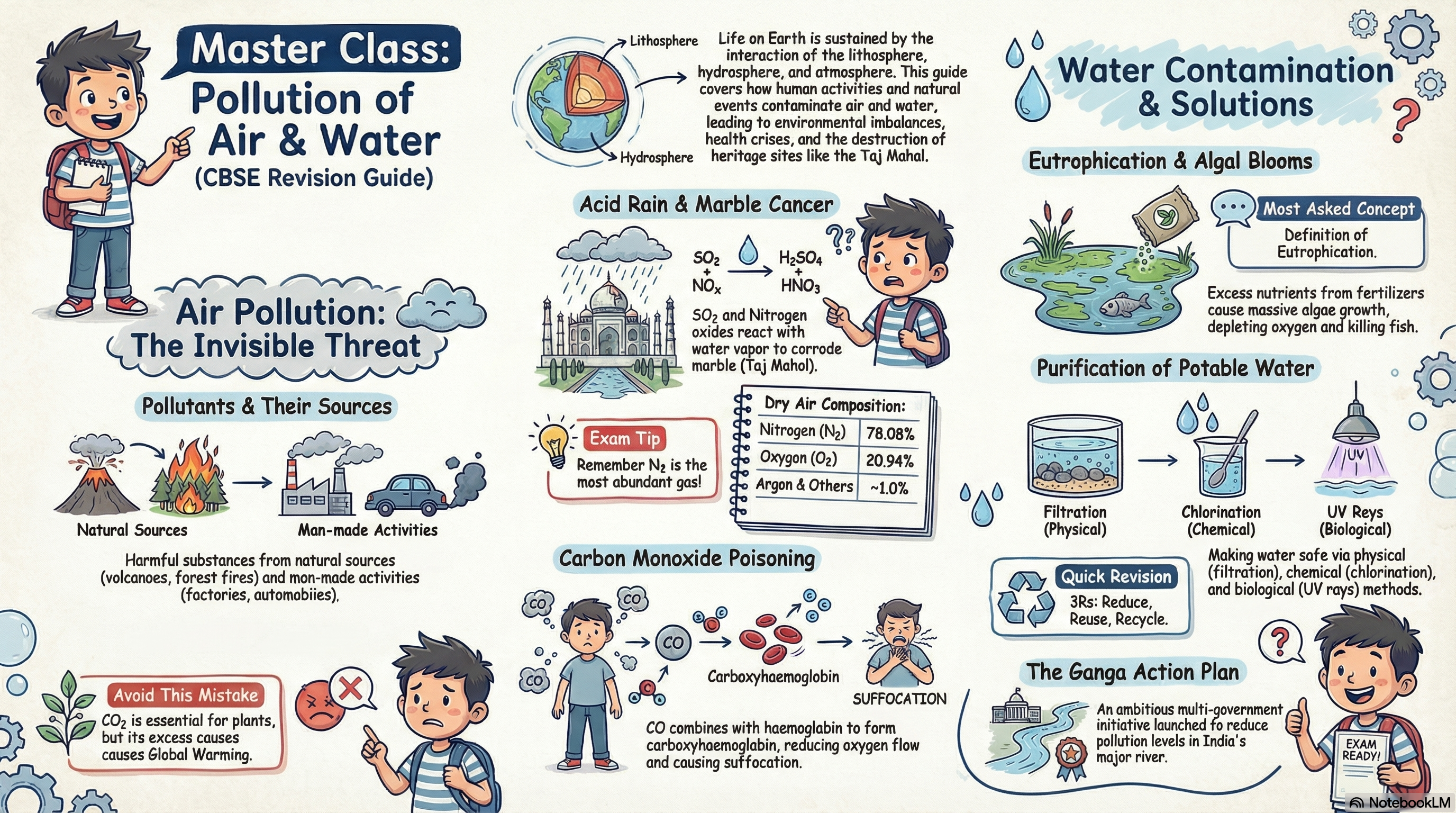
The Three Pillars of Life on Earth
Life exists where three components interact:
- Lithosphere (Land)
- Hydrosphere (Water)
- Atmosphere (Air)
These provide food, energy, and essential resources for all living organisms.
Air Pollution
What is Air?
Air is an invisible, odorless, and tasteless mixture of gases that also contains water vapor and dust particles.
Composition of Dry Atmosphere:
| Component | Volume % |
|---|---|
| Nitrogen (N₂) | 78.08% |
| Oxygen (O₂) | 20.94% |
| Argon (Ar) | 0.91% |
| Carbon dioxide (CO₂) | 0.03% |
| Trace components | 0.04% |
Definition of Air Pollution
Air Pollution is the contamination of air with harmful gases (like sulfur dioxide, nitrogen oxides, carbon monoxide), excess carbon dioxide, smoke, dust, and other particulate matter.
Types of Air Pollutants
1. Gaseous Pollutants
- Sulfur dioxide (SO₂) - from burning coal and petroleum
- Nitrogen oxides (NO, NO₂, NO₃) - from vehicle emissions and industries
- Carbon monoxide (CO) - from incomplete combustion
- Excess carbon dioxide (CO₂) - greenhouse gas
- Chlorofluorocarbons (CFCs) - from refrigerants and aerosols
2. Suspended Particulate Matter (SPM)
- Dust particles
- Smoke
- Fly ash
- Cement dust
- Asbestos dust
- Pollen grains
Sources of Air Pollution
A. Natural Sources
- Volcanic eruptions (toxic gases, ash, heat)
- Forest fires
- Dust storms
- Electric storms and solar flares
- Decay of organic matter (produces methane CH₄)
- Decay of vegetation in marshy places
- Pollen grains, spores, cysts, and bacteria
B. Man-Made Sources
- Automobiles - largest source of urban air pollution
- Industries - thermal power plants, chemical factories, oil refineries
- Burning of fossil fuels - coal, petroleum, natural gas
- Deforestation - reduces natural air purification
- Mining activities
- Nuclear explosions and testing
- Fireworks
- Burning of wood and cattle dung cakes
- Over-population - increases demand and pollution
Harmful Effects of Air Pollution
1. Respiratory Problems
Pollutants causing respiratory issues:
- Sulfur dioxide (SO₂)
- Nitrogen oxides (NO, NO₂, NO₃)
- Dust (cement, asbestos, pollen)
Health conditions:
- Breathing difficulties
- Sneezing and allergies
- Bronchitis
- Asthma
- Tuberculosis
- Lung cancer
How it happens:
These pollutants affect the respiratory passage, making breathing difficult and damaging lung tissue over time.
2. Carbon Monoxide Poisoning
Process of CO poisoning:
- Normal oxygen transport:
- Hemoglobin (Hb) in blood has high affinity for oxygen
- Oxygen combines with Hb in lungs → Oxyhemoglobin
- Blood carries oxygen to body tissues
- When CO is inhaled:
- Carbon monoxide has even higher affinity for hemoglobin than oxygen
- CO + Hb → Carboxyhemoglobin (COHb) - a stable, poisonous compound
- This directly reduces oxygen availability in the body
- Results in suffocation and can lead to death
Sources of CO:
- Motor vehicle emissions
- Cigarette smoke
- Incomplete combustion of fuels
3. Acid Rain
What is Acid Rain?
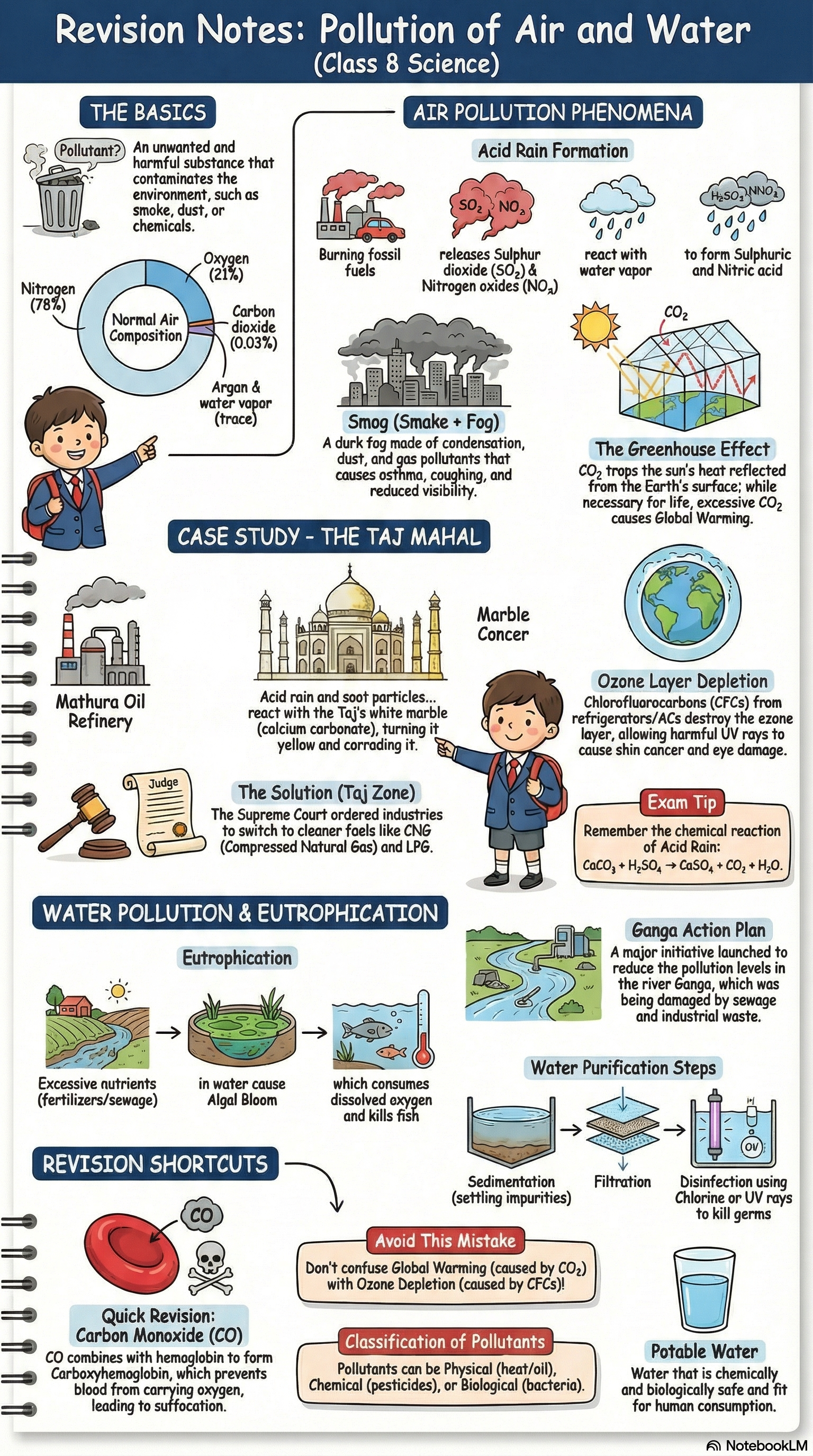
Acid rain is rainwater that contains a mixture of sulfuric acid (H₂SO₄) and nitric acid (HNO₃), making it acidic and harmful.
How Acid Rain Forms:
Step 1: Fossil fuel combustion in industries, vehicles, thermal plants
 ↓
Step 2: Release of SO₂ and nitrogen oxides (NOₓ)
 ↓
Step 3: These gases react with water vapor in atmosphere
 SO₂ + H₂O → H₂SO₄ (Sulfuric acid)
 NOₓ + H₂O → HNO₃ (Nitric acid)
 ↓
Step 4: Acids mix with rain and fall as acid rain
Harmful Effects of Acid Rain:
| Effect Category | Impact |
|---|---|
| Forests | Destroys leaves, turns them yellow, causes defoliation |
| Aquatic Life | Makes water bodies acidic, kills fish and aquatic animals |
| Buildings & Monuments | Corrodes marble, stone, and metal structures slowly |
| Soil | Reduces soil fertility, affects crop growth |
Marble Cancer: The phenomenon where acid rain reacts with marble (calcium carbonate) in monuments, causing corrosion and yellowing.
Chemical reactions:
CaCO₃ + H₂SO₄ → CaSO₄ + CO₂ + H₂O
(Marble + Sulfuric acid → Calcium Sulphate + Carbon dioxide + Water)
CaCO₃ + 2HNO₃ → Ca(NO₃)₂ + CO₂ + H₂O
(Marble + Nitric acid → Calcium nitrate + Carbon dioxide + Water)
4. Smog (Smoke + Fog)
Definition: Smog is a dark fog formed by the condensation of water vapor, dust, smoke particles, and various gaseous pollutants.
Composition:
- Water vapor
- Dust particles
- Smoke
- Sulfur dioxide
- Nitrogen oxides
- Other pollutants
Effects:
- Respiratory problems (asthma, cough, wheezing)
- Reduces visibility leading to accidents
- Eye irritation
- Cardiovascular issues
Where it occurs: Cities with high vehicle density and industrial areas, especially during winter mornings.
5. Greenhouse Effect and Global Warming
Greenhouse Effect:
The greenhouse effect is a natural process where certain gases in Earth's atmosphere trap heat from the sun, keeping the planet warm enough for life.
How it Works (Natural Process):
1. Sun's heat rays reach Earth
 ↓
2. Earth absorbs heat and reflects some back
 ↓
3. Greenhouse gases (CO₂, methane) allow incoming heat but trap outgoing heat
 ↓
4. Heat remains trapped in atmosphere
 ↓
5. Earth stays warm (suitable for life)
Greenhouse Gases:
- Carbon dioxide (CO₂) - primary greenhouse gas
- Methane (CH₄)
- Water vapor
- Nitrous oxide (N₂O)
- CFCs
Global Warming:
Definition: The undue rise in Earth's atmospheric temperature due to excessive greenhouse effect caused by increasing amounts of greenhouse gases (mainly CO₂).
Causes:
- Burning fossil fuels
- Deforestation (trees absorb CO₂)
- Industrial emissions
- Vehicle emissions
- Population growth
Harmful Effects of Global Warming:
| Impact | Description |
|---|---|
| Rising sea levels | Melting of polar ice caps floods coastal areas and islands |
| Extreme weather | More frequent storms, floods, droughts |
| Reduced rainfall | Some regions face water scarcity |
| Ecosystem disruption | Species extinction, habitat loss |
| Agricultural impact | Crop failures, food security issues |
| Health risks | Heat waves, spread of tropical diseases |
6. Ozone Layer Depletion
What is Ozone Layer?
The ozone layer is a protective layer in the Earth's stratosphere (18-50 km above surface) that absorbs harmful ultraviolet (UV) radiation from the sun.
Importance: Protects life on Earth from harmful UV rays that can cause:
- Skin cancer
- Eye damage (cataracts)
- Immune system damage
- Plant mutations
- Reduced crop yields
How Ozone Layer Gets Depleted:
1. CFCs released from refrigerators, air conditioners, aerosols
 ↓
2. CFCs rise to stratosphere
 ↓
3. UV radiation breaks down CFC molecules
 ↓
4. Chlorine atoms released
 ↓
5. Chlorine destroys ozone molecules (O₃ → O₂)
 ↓
6. Ozone layer becomes thinner
Ozone Hole:
Definition: A decline in the thickness of the ozone layer over a restricted area.
Discovery: First discovered over Antarctica in 1985.
Consequences:
- More UV radiation reaches Earth
- Increased skin cancer cases
- Eye damage and cataracts
- Weakened immune systems
- Higher embryonic mortality
- Increased seedling death rates
- Plant mutations
7. Damage to Buildings and Monuments
Black patches on buildings: Caused by soot and smoke particles settling on surfaces over time.
Corrosion: Acid rain corrodes stone, marble, and metal structures.
Water Pollution
What is Water Pollution?
The contamination of freshwater bodies (rivers, lakes, ponds) due to the addition of harmful substances, making them unfit for use.
Water Pollutant: Any agent or substance that pollutes water.
Types of Water Pollutants
1. Physical Pollutants
- Heat (thermal pollution)
- Oil spills
- Solid waste
2. Chemical Pollutants
- Organic wastes - sewage, food waste
- Detergents - synthetic soaps
- Pesticides - DDT, BHC
- Inorganic chemicals - arsenic, cadmium, mercury, lead, nickel
- Phosphates and nitrates - from fertilizers
- Fluorides
- Radioactive waste
3. Biological Pollutants
- Viruses
- Bacteria
- Protozoa
- Helminthes (worms)
- Algae
- Fungi
Sources of Water Pollution
1. Untreated Sewage
What it contains:
- Human excreta
- Food waste
- Detergents
- Harmful microorganisms (bacteria, viruses, fungi, parasites)
Problems:
- Spreads waterborne diseases (cholera, typhoid, diarrhea, dysentery, jaundice)
- Depletes oxygen in water
- Produces foul smell
2. Industrial Waste
Pollutants from industries:
- Toxic chemicals
- Heavy metals (arsenic, lead, mercury, cadmium)
- Acids and alkalis
- Organic compounds
- Heat (thermal pollution)
Sources:
- Chemical industries
- Textile factories
- Leather industries (use chromium)
- Paper mills
- Oil refineries
Effects:
- Kills aquatic life
- Damages human nervous system
- Causes blood poisoning and cancer
- Contaminates food chain
3. Agricultural Chemicals
Types:
- Fertilizers - contain nitrates and phosphates
- Pesticides - DDT, BHC, and other chemicals
How they pollute:
- Excess fertilizers and pesticides wash into water bodies from fields
- Cause algal blooms (eutrophication)
- Kill aquatic animals
- Enter food chain and harm humans
4. Synthetic Soaps and Detergents
Problems:
- Not easily biodegradable
- Form foam in water
- Reduce oxygen content
- Toxic to aquatic life
5. Oil Spills
Sources:
- Ship accidents
- Offshore drilling leaks
- Pipeline ruptures
Effects:
- Forms a layer on water surface
- Prevents oxygen from dissolving
- Kills fish and marine birds
- Destroys coastal ecosystems
Harmful Effects of Water Pollution
1. Waterborne Diseases
Drinking polluted water containing sewage causes:
| Disease | Caused by |
|---|---|
| Cholera | Bacteria |
| Typhoid | Bacteria |
| Diarrhea | Bacteria/Viruses |
| Dysentery | Bacteria/Protozoa |
| Jaundice | Virus (Hepatitis) |
| Polio | Virus |
2. Death of Aquatic Animals
How pollution kills fish:
Fertilizers/sewage in water
 ↓
Algal bloom (excessive algae growth)
 ↓
Algae consume dissolved oxygen
 ↓
Oxygen level drops drastically
 ↓
Fish and other aquatic animals suffocate and die
3. Food Chain Contamination
Example with pesticides:
Pesticides wash into water
 ↓
Absorbed by small aquatic plants/organisms
 ↓
Small fish eat these organisms
 ↓
Larger fish eat small fish
 ↓
Humans eat large fish
 ↓
Pesticides accumulate in human body (biomagnification)
 ↓
Causes health problems (nervous system damage, cancer)
4. Ecosystem Disruption
- Loss of biodiversity
- Destruction of habitats
- Imbalance in aquatic food chains
Eutrophication
The process in which excessive growth of algae occurs as a result of extra loading of nutrients (nitrates, phosphates) in a water body.
Detailed Process:
Step 1: Sewage/fertilizers enter water body
 ↓
Step 2: Provide excess nutrients (N, P) to algae
 ↓
Step 3: Rapid algae growth → Algal Bloom
 ↓
Step 4: Green layer covers entire water surface
 ↓
Step 5: Blocks sunlight to underwater plants
 ↓
Step 6: Algae die and decompose
 ↓
Step 7: Decomposers consume dissolved oxygen rapidly
 ↓
Step 8: Oxygen depletion
 ↓
Step 9: Fish and aquatic life suffocate and die
Why called "algal bloom": The water surface appears green like a sheet due to massive algae population.
Result: The water body becomes "dead" - unable to support aquatic life.
Potable Water and Water Purification
What is Potable Water?
Water that is fit for consumption by humans and animals. Also called drinking water.
Important Note: Clear, transparent, and odorless water may not always be safe for drinking because it may still contain:
- Harmful microorganisms (bacteria, viruses)
- Dissolved heavy metals
- Chemical pollutants
Characteristics of Potable Water:
- Free from harmful microorganisms
- Free from toxic chemicals
- Pleasant taste and odor
- Colorless and clear
- Acceptable levels of dissolved minerals
Water Purification Methods
1. At Home/Individual Level
A. Filtration
Process:
- Water is passed through a filter to remove particulates
- Popular household filter: Candle-type filter (ceramic filter)
What it removes:
- Dust, dirt, sand
- Some bacteria and cysts
- Suspended particles
Limitation: Does not remove dissolved chemicals or all microorganisms
B. Boiling
Process:
- Heat water to boiling point (100°C) for 10-15 minutes
- Cool before drinking
What it does:
- Kills most bacteria and viruses
- Destroys harmful microorganisms
Limitation: Does not remove:
- Heavy metals
- Chemical pollutants
- Dissolved salts
C. Chemical Treatment
Chlorine tablets:
- Add prescribed amount of chlorine tablet to water
- Kills harmful microorganisms
- Follow recommended dosage (excess chlorine is harmful)
Bleaching powder:
- Small amount kills bacteria
- Must not exceed specified quantity
D. UV (Ultraviolet) Treatment
Used in: Electric water filters
Process:
- Water passes through UV chamber
- UV rays kill bacteria, viruses, and other pathogens
- Most effective method for eliminating microorganisms
Advantage: No chemicals added
2. At Community/Municipal Level
Water Treatment Plants - Step-by-Step Process:
Step 1: Screening
- Remove large objects (leaves, twigs, plastic)
- Water passes through screens
Step 2: Sedimentation
- Water stored in large tanks
- Heavy impurities settle at bottom (called sludge)
- Process aided by adding alum (helps particles clump together)
Step 3: Filtration
- Water passes through layers of sand, gravel, and charcoal
- Removes smaller suspended particles
- Multiple filtration stages
Step 4: Chlorination
- Chlorine gas added to kill remaining microorganisms
- Disinfects water
- Small amount remains to prevent recontamination in pipes
Step 5: Aeration and Flocculation
- Air bubbled through water
- Helps remove dissolved gases
- Improves taste and odor
Step 6: Storage and Distribution
- Treated water stored in overhead tanks
- Distributed through pipeline network to homes
Case Studies
Case Study 1: The Taj Mahal - Marble Cancer
Background:
- The Taj Mahal is India's most famous monument, located in Agra
- Made of white marble
- Great tourist attraction
- Built in the 17th century
Problem: White marble is gradually turning yellow and getting corroded.
Causes of Damage:
- Air pollution from Mathura Oil Refinery
- Located nearby
- Releases SO₂ and other pollutants
- Traffic fumes
- Heavy vehicle traffic in Agra
- Emissions of SO₂, NO₂, hydrocarbons
- Illegal building works
- Construction activities
- Dust and pollution
- Water pollution in Yamuna River
- Raw sewage flows into river
- Industrial waste from nearby areas
- Industries in nearby areas
- Over 5000 industries in region
- Fertilizer, detergent, leather, paint industries
- Chromium and other chemicals used
The Chemical Process (Marble Cancer):
Marble (Calcium Carbonate - CaCO₃)
 +
Sulfuric acid (H₂SO₄) from acid rain
 ↓
CaCO₃ + H₂SO₄ → CaSO₄ + CO₂ + H₂O
 ↓
Calcium sulfate (yellow/brown compound)
 +
Discoloration and corrosion
Similarly with nitric acid:
CaCO₃ + 2HNO₃ → Ca(NO₃)₂ + CO₂ + H₂O
Additional Damage Factors:
- Suspended Particulate Matter (SPM)
- Soot particles from rubber processing, automobiles
- Contributes to yellowing of marble
Conservation Efforts:
1998 onwards:
- Supreme Court ordered protection measures
- Industries switched to cleaner fuels (CNG, LPG)
- Vehicle restrictions in Taj Mahal zone
- Mandatory use of unleaded petrol
- Some industries relocated
Ongoing challenges:
- Thousands of vehicles still emit pollutants
- Complete protection difficult
- Need for stricter enforcement
Historical monuments need protection from pollution through stricter environmental laws and cleaner technologies.
Case Study 2: Ganga Action Plan
About River Ganga:
- One of India's most sacred rivers
- Originates from Himalayas (Gangotri glacier)
- Flows through several states
- Lifeline for millions of people
The Problem:
Upstream (near origin):
- Water relatively pure
- Low biochemical oxygen demand
- Low fecal coliform count
Downstream (especially in cities like Kanpur, Varanasi):
- Heavily polluted
- WWF declared Ganga one of the ten most endangered rivers (due to pollution)
- River is "dead" at many places (aquatic life cannot survive)
Sources of Ganga Pollution:
1. Domestic/Human Activities
- People bathe and wash clothes in the river
- Open defecation near riverbanks
- Garbage dumping (flowers, idols, polythene bags)
- Dead bodies thrown into river
- Ritual immersion of idols
2. Industrial Pollution
Kanpur Example:
- Over 5000 industries in region
- Major polluters: Leather industries
Leather industry problems:
- Use large amounts of chromium and other chemicals
- Most waste discharged directly into Ganga without treatment
- Highly toxic to aquatic life
Other industries:
- Oil refineries (release arsenic, lead, fluoride)
- Textile industries (dyes, chemicals)
- Fertilizer factories
- Detergent manufacturers
- Paint industries
3. Agricultural Runoff
- Excess fertilizers wash into river
- Pesticides contaminate water
- Causes eutrophication
4. Untreated Sewage
- Cities discharge sewage directly into river
- Minimal or no treatment
- Carries disease-causing organisms
Effects of Pollution:
On River:
- High toxicity levels
- Reduced dissolved oxygen
- Cannot support aquatic life in many stretches
- Foul smell
On Soil:
- Polluted water used for irrigation affects soil
- Changes soil acidity
- Reduces fertility
- Growth of harmful organisms
On Human Health:
- Waterborne diseases
- Contaminated crops
- Poisoning from heavy metals
Ganga Action Plan (GAP):
Launch: April 1985 by Government of India
Objective: Reduce pollution load on the river
Budget: ₹901.71 crores spent over 15 years
Main Strategies:
- Build sewage treatment plants
- Control industrial discharge
- Promote awareness
- River cleaning operations
Result: Plan failed to significantly decrease pollution levels
Why GAP Failed:
- Inadequate sewage treatment capacity
- Industries not following discharge norms
- Lack of strict enforcement
- Population growth outpaced infrastructure
- Insufficient maintenance of treatment plants
- Cultural practices continued
Current Status:
- Pollution levels remain dangerously high
- Multiple schemes launched later (Namami Gange, etc.)
- Challenge continues
Key Learning:
- Environmental restoration needs sustained effort
- Strict law enforcement essential
- Public participation crucial
- Long-term commitment required
Prevention and Control Measures
Reducing Air Pollution
1. Industrial Level
For Factories and Power Plants:
- Scrubbers: Wash smoke and waste gases with water jets before releasing
- Filters and precipitators: Remove particulate matter
- Tall chimneys: Disperse pollutants over larger area (reduces local concentration)
- Switch to cleaner fuels: Natural gas instead of coal
2. Energy Production
Use renewable energy sources:
- Solar energy
- Wind energy
- Hydropower (water energy)
- Geothermal energy
- Reduces fossil fuel burning
Benefits:
- No emissions
- Sustainable
- Reduces greenhouse gases
3. Transportation
Vehicle-related measures:
A. Fuel switching:
- CNG (Compressed Natural Gas) - cleaner than petrol/diesel
- LPG (Liquefied Petroleum Gas)
- Electric vehicles
- Biofuels
- Unleaded petrol (reduces lead pollution)
B. Reduce vehicle use:
- Walk or cycle for short distances
- Use public transport (buses, trains, metro)
- Carpooling to office
- Plan trips to minimize travel
C. Vehicle maintenance:
- Regular servicing
- Emission checks
- Proper tire inflation
4. Individual Actions
At home:
- Save electricity (reduces power plant emissions)
- Turn off lights when not needed
- Use energy-efficient appliances
- Adjust thermostat sensibly
- Reduce aerosol use
- CFCs in old aerosols damage ozone layer
- Use pump sprays instead
- Plant trees
- Trees absorb CO₂
- Release oxygen
- Filter air
- Avoid burning leaves/garbage
- Use compost pits for organic waste
- Follow waste segregation
In community:
- Create "tree-watch" groups
- Ensure trees are well maintained
- Support green initiatives
- Spread awareness
Reducing Water Pollution
1. Sewage Treatment
Before discharge:
- Treat sewage at treatment plants
- Remove harmful organisms
- Reduce organic load
- Make it harmless before releasing into rivers
Process in treatment plants:
- Primary treatment (physical - remove solids)
- Secondary treatment (biological - decompose organic matter)
- Tertiary treatment (chemical - remove nutrients)
2. Industrial Waste Management
Industries must:
- Treat toxic wastes before disposal
- Use effluent treatment plants (ETPs)
- Follow discharge standards
- Adopt cleaner production methods
- Recycle and reuse water
Common treatment methods:
- Neutralization (pH adjustment)
- Precipitation of heavy metals
- Biological treatment
- Chemical oxidation
3. Agricultural Practices
Farmers should:
- Use correct amounts of fertilizers
- Soil testing to determine needs
- Avoid excess application
- Use pesticides judiciously
- Integrated Pest Management (IPM)
- Natural pesticides where possible
- Follow recommended doses
- Adopt organic farming
- Natural compost
- Biopesticides
- Crop rotation
4. Waste Disposal
Do's:
- Segregate waste (wet, dry, hazardous)
- Use dustbins properly
- Dispose toxic products (paints, batteries) at designated centers
- Prefer biodegradable products
Don'ts:
- Never throw garbage in water bodies
- Don't dump trash in open drains
- Avoid throwing dead bodies in rivers
- Don't litter near water sources
5. Household Practices
Use eco-friendly products:
- Biodegradable soaps and detergents
- Natural cleaning agents (vinegar, baking soda)
- Avoid chemical-laden products
Water conservation:
- Fix leaking taps
- Take showers instead of baths
- Reuse water (washing vegetables → water plants)
- Turn off taps when not in use
- Reduces sewage load on treatment plants
Natural pesticides:
- Insecticidal soap
- Pyrethrum (from chrysanthemum)
- Wood ash
- Prevents chemical runoff
6. Legal and Administrative
Strict implementation of laws:
- Water Pollution Prevention and Control Act
- Industries must follow discharge norms
- Regular monitoring
- Heavy penalties for violations
Public awareness:
- Education programs
- Community involvement
- Media campaigns
- School curricula
7. Dead Body Disposal
Proper methods:
- Cremation at designated places
- Burial in designated areas
- Electric crematoriums
- Never throw in rivers
Important Terms and Definitions
| Term | Definition |
|---|---|
| Air Pollution | Contamination of air with harmful gases, smoke, dust, and particulate matter |
| Water Pollution | Contamination of water bodies making them unfit for use |
| Pollutant | Unwanted and harmful substance that contaminates the environment |
| SPM | Suspended Particulate Matter - pollutants suspended in air (dust, smoke, fly ash) |
| CNG | Compressed Natural Gas - cleaner vehicle fuel |
| LPG | Liquefied Petroleum Gas - cooking fuel and vehicle fuel |
| CFCs | Chlorofluorocarbons - chemicals that deplete ozone layer |
| Acid Rain | Rain containing sulfuric and nitric acids |
| Smog | Smoke + Fog - dark fog with pollutants |
| Greenhouse Effect | Trapping of sun's heat by atmospheric gases keeping Earth warm |
| Global Warming | Excessive rise in Earth's temperature due to greenhouse gases |
| Ozone Layer | Protective layer in stratosphere that absorbs UV rays |
| Ozone Hole | Thinning of ozone layer over a specific region |
| Eutrophication | Excessive algae growth due to nutrient overload in water |
| Algal Bloom | Rapid excessive growth of algae forming green layer on water |
| Potable Water | Water fit for drinking |
| Sewage | Wastewater containing human excreta and other wastes |
| Marble Cancer | Corrosion of marble monuments due to acid rain |
| Carboxyhemoglobin | Poisonous compound formed when CO combines with hemoglobin |
| BOD | Biochemical Oxygen Demand - oxygen required by organisms to decompose waste |
| Biodegradable | Substances that can be broken down by natural processes |
| Non-biodegradable | Substances that cannot be broken down naturally (plastics, some chemicals) |
Enhanced Study Notes
Quick Revision Notes
Air Pollution
Main Pollutants (Remember: SCNCD)
- S - Sulfur dioxide
- C - Carbon monoxide
- N - Nitrogen oxides
- C - Carbon dioxide (excess)
- D - Dust/particulates
Major Effects (Remember: RAG-SOG)
- R - Respiratory problems
- A - Acid rain
- G - Global warming
- S - Smog
- O - Ozone depletion
- G - Greenhouse effect
Sources (Remember: IADF)
- I - Industries
- A - Automobiles
- D - Deforestation
- F - Fossil fuel burning
Water Pollution
Types of Pollutants (Remember: PCB)
- P - Physical (heat, oil)
- C - Chemical (pesticides, metals)
- B - Biological (bacteria, viruses)
Main Sources (Remember: SIAF)
- S - Sewage
- I - Industrial waste
- A - Agricultural chemicals
- F - Fertilizers
Diseases (Remember: CTDDJ)
- C - Cholera
- T - Typhoid
- D - Diarrhea
- D - Dysentery
- J - Jaundice
Memory Tricks (Mnemonics)
1. Composition of Air: "Naughty Owls Carry Apples Together"
- N = Nitrogen (78%)
- O = Oxygen (21%)
- C = Carbon dioxide (0.03%)
- A = Argon (0.9%)
- T = Trace gases
2. Greenhouse Gases: "Cows Make Wet Nests"
- C = Carbon dioxide
- M = Methane
- W = Water vapor
- N = Nitrous oxide
3. Waterborne Diseases: "Children Take Dirty Drinks, Jaundice"
- C = Cholera
- T = Typhoid
- D = Diarrhea
- D = Dysentery
- J = Jaundice
4. Prevention of Air Pollution: "Please Use Clean Technology Everyday"
- P = Plant trees
- U = Use public transport
- C = CNG vehicles
- T = Turn off unnecessary lights
- E = Energy efficiency
Summary Tables for Quick Revision
Table 1: Air Pollution vs Water Pollution
| Aspect | Air Pollution | Water Pollution |
|---|---|---|
| Definition | Contamination of air with harmful substances | Contamination of water bodies |
| Main sources | Vehicles, industries, burning | Sewage, industries, agriculture |
| Common pollutants | SO₂, NO₂, CO, smoke, dust | Heavy metals, bacteria, pesticides |
| Major effects | Respiratory issues, acid rain, global warming | Waterborne diseases, death of aquatic life |
| Prevention | CNG, renewable energy, less vehicle use | Sewage treatment, proper waste disposal |
Table 2: Harmful Effects of Pollution
| Pollutant | Source | Effect on Health | Effect on Environment |
|---|---|---|---|
| SO₂ (Sulfur dioxide) | Coal burning | Respiratory problems | Acid rain, damages plants |
| NO₂ (Nitrogen oxides) | Vehicles | Lung irritation | Acid rain, smog |
| CO (Carbon monoxide) | Incomplete combustion | Oxygen deficiency, death | Contributes to smog |
| CO₂ (Carbon dioxide) | All combustion | Not directly harmful | Global warming |
| CFCs | Refrigerants | Not directly harmful | Ozone depletion |
| Lead | Old petrol | Nervous system damage | Accumulates in food chain |
| Mercury | Industries | Brain damage | Poisons water, fish |
Table 3: Water Purification Methods
| Method | What it removes | What it doesn't remove | Best for |
|---|---|---|---|
| Filtration | Dirt, sand, some bacteria | Dissolved chemicals, viruses | Removing visible impurities |
| Boiling | Bacteria, viruses, parasites | Chemicals, heavy metals | Killing microorganisms |
| Chlorination | Bacteria, viruses | Chemicals, heavy metals | Disinfection |
| UV Treatment | All microorganisms | Chemicals, dissolved solids | Complete microbial removal |
| RO (Reverse Osmosis) | Almost everything | None (most comprehensive) | Complete purification |
Solved Examples
Q: Why is air pollution more severe in cities than in villages?
Solution:
Cities have higher air pollution due to several reasons:
- Higher vehicle density:
- Cities have more cars, buses, trucks
- Continuous traffic congestion
- More emissions of CO, NO₂, SO₂
- Industrial concentration:
- Factories and industries located in/near cities
- Release smoke, gases, particulates
- Chemical plants, power stations
- Population density:
- More people = more activities
- More waste burning
- More energy consumption
- Less vegetation:
- Fewer trees in urban areas
- Less natural air purification
- Buildings trap pollutants
- Construction activities:
- Dust from construction sites
- Demolition work
- Road building
Villages, in contrast:
- Less traffic
- Fewer industries
- More trees and open spaces
- Better air circulation
Answer: Cities have more vehicles, industries, higher population density, and less vegetation compared to villages, leading to more severe air pollution.
Q: Explain how fertilizers in agricultural fields lead to the death of fish in nearby ponds.
Solution:
Step-by-step process:
Step 1: Fertilizer Application
- Farmers apply fertilizers (containing nitrates and phosphates) to increase crop yield
- Excess fertilizers remain in soil
Step 2: Runoff
- Rainwater washes excess fertilizers from fields
- Nutrients flow into nearby ponds and lakes
Step 3: Nutrient Loading
- Water becomes rich in nitrates and phosphates
- Provides excess nutrients for aquatic plants
Step 4: Eutrophication
- Algae and water plants grow rapidly (algal bloom)
- Green layer covers entire water surface
Step 5: Oxygen Depletion
- Algae die after rapid growth
- Decomposer bacteria break down dead algae
- Bacteria consume dissolved oxygen in large amounts
- Oxygen level in water drops drastically
Step 6: Fish Death
- Fish and other aquatic animals need dissolved oxygen
- Insufficient oxygen causes suffocation
- Fish die in large numbers
This process is called eutrophication.
Answer: Excess fertilizers wash into water bodies, causing algal bloom. When algae decompose, bacteria consume dissolved oxygen, leading to oxygen deficiency that kills fish.
Q: Your school is located near a busy highway. What steps can be taken to reduce air pollution exposure to students?
Solution:
Immediate measures:
- Plant barrier trees:
- Plant thick rows of trees between highway and school
- Trees act as air filters
- Absorb CO₂ and particulates
- Reduce noise pollution too
- Keep windows closed during peak traffic:
- Morning and evening rush hours
- Use air purifiers if possible
- Ensure ventilation at other times
- Create green zones:
- Plant trees and shrubs in school compound
- Lawns and gardens improve air quality
- Indoor plants in classrooms
- Schedule outdoor activities wisely:
- Avoid sports periods during peak traffic hours
- Early morning or late afternoon better
- Monitor air quality index (AQI)
- Student awareness:
- Educate about air pollution
- Encourage walking/cycling instead of cars
- Promote carpooling among parents
Long-term advocacy:
- Request traffic management:
- Approach authorities for speed limits near school
- Request dedicated school zone
- Better traffic flow planning
- Promote CNG vehicles:
- Encourage parents to use CNG/electric vehicles
- School buses should be CNG-based
Answer: Plant barrier trees, schedule outdoor activities during low-traffic times, create green zones, and promote awareness about using cleaner fuels.
Q: Two statements are given below marked as Assertion (A) and Reason (R). Choose the correct option.
Assertion (A): Taj Mahal is being damaged by air pollution.
Reason (R): Acid rain reacts with marble (calcium carbonate) to form calcium sulfate, which causes corrosion.
Options: (a) Both A and R are true, and R is the correct explanation of A (b) Both A and R are true, but R is not the correct explanation of A (c) A is true but R is false (d) A is false but R is true
Solution:
Let's analyze each statement:
Assertion (A): "Taj Mahal is being damaged by air pollution"
- ✓ TRUE
- Evidence:
- Marble turning yellow
- Surface erosion visible
- Mathura refinery pollution
- Vehicle emissions in Agra
- Well-documented phenomenon
Reason (R): "Acid rain reacts with marble (calcium carbonate) to form calcium sulfate, which causes corrosion"
- ✓ TRUE
Chemical reaction:
CaCO₃ + H₂SO₄ → CaSO₄ + CO₂ + H₂O(Marble) (Acid) (Corrosion product)- This is scientifically accurate
Is R the correct explanation of A?
- ✓ YES
- Reason directly explains HOW air pollution damages Taj Mahal
- The mechanism is acid rain formation and reaction with marble
Answer: (a) Both A and R are true, and R is the correct explanation of A
Q: The table shows the air quality index (AQI) of four cities. Based on the data, answer the questions:
| City | AQI Value | Major Pollutant |
|---|---|---|
| City A | 85 | PM2.5 |
| City B | 245 | PM10 |
| City C | 150 | NO₂ |
| City D | 55 | O₃ |
AQI Categories:
- 0-50: Good
- 51-100: Satisfactory
- 101-200: Moderate
- 201-300: Poor
- 301+: Very Poor/Severe
(i) Which city has the best air quality?(ii) Which city's residents are at highest health risk?(iii) What could be the main source of pollution in City B?
Solution:
(i) Which city has the best air quality?
Comparing AQI values:
- City D: 55 (lowest)
- City A: 85
- City C: 150
- City B: 245 (highest)
Lower AQI = Better air quality
Answer: City D has the best air quality (AQI = 55, "Satisfactory" category)
(ii) Which city's residents are at highest health risk?
City B has AQI = 245 ("Poor" category)
- Highest AQI among all cities
- Major pollutant: PM10 (particulate matter)
- PM10 causes:
- Respiratory problems
- Lung diseases
- Cardiovascular issues
- Reduced lung function
Answer: City B residents face highest health risk due to poor air quality (AQI 245)
(iii) What could be the main source of pollution in City B?
Major pollutant: PM10 (coarse particulate matter)
Possible sources:
- Construction activities
- Dust from building sites
- Road construction
- Demolition work
- Industrial operations
- Cement factories
- Steel plants
- Crushing units
- Vehicle emissions
- Heavy trucks
- Diesel vehicles
- Road dust resuspension
- Waste burning
- Open garbage burning
- Agricultural waste burning
Most likely: Construction activities and industrial dust, as PM10 is coarse dust that comes mainly from these sources.
Answer: Main sources are likely construction activities, industrial operations (cement/crushing units), and vehicle-generated dust.
Q: Given below is a diagram showing how acid rain forms. Study it and answer:
[Coal/Petroleum burning in factories]
 ↓
 [SO₂ and NOₓ released]
 ↓
[Gases rise into atmosphere]
 ↓
 [React with water vapor]
 ↓
 [Form H₂SO₄ and HNO₃]
 ↓
 [Fall as acid rain]
 ↓
 [Damages buildings/plants]
(i) Name the acids formed in acid rain.(ii) Write the chemical reaction between SO₂ and water.(iii) How does acid rain damage marble statues?
Solution:
(i) Name the acids formed in acid rain.
Two main acids:
- Sulfuric acid (H₂SO₄)
- Formed from sulfur dioxide (SO₂)
- Strong acid
- Major component of acid rain
- Nitric acid (HNO₃)
- Formed from nitrogen oxides (NOₓ)
- Strong acid
- Secondary component
Answer: Sulfuric acid (H₂SO₄) and Nitric acid (HNO₃)
(ii) Write the chemical reaction between SO₂ and water.
Step 1: SO₂ reacts with water vapor
SO₂ + H₂O → H₂SO₃
(Sulfur dioxide + Water → Sulfurous acid)
Step 2: Further oxidation in presence of oxygen
2H₂SO₃ + O₂ → 2H₂SO₄
(Sulfurous acid + Oxygen → Sulfuric acid)
Overall simplified:
SO₂ + H₂O + ½O₂ → H₂SO₄
Answer:
SO₂ + H₂O → H₂SO₃ (Sulfurous acid)
H₂SO₃ + ½O₂ → H₂SO₄ (Sulfuric acid)
(iii) How does acid rain damage marble statues?
Process:
Step 1: Composition of Marble
- Marble = Calcium carbonate (CaCO₃)
Step 2: Acid Rain Falls on Statue
- Contains H₂SO₄ and HNO₃
Step 3: Chemical Reaction
CaCO₃ + H₂SO₄ → CaSO₄ + CO₂ + H₂O
(Marble) (Acid) (Calcium sulfate)
CaCO₃ + 2HNO₃ → Ca(NO₃)₂ + CO₂ + H₂O
(Marble) (Acid) (Calcium nitrate)
Step 4: Corrosion Process
- Calcium sulfate and calcium nitrate are soft, powdery compounds
- They do not protect the surface
- Marble surface gradually wears away
- Statue develops cracks and pits
- Surface becomes rough
- Details of carving lost
Step 5: Color Change
- Products cause yellowing/browning
- White marble turns dull
This phenomenon is called "Marble Cancer"
Answer: Acid rain reacts with calcium carbonate in marble (CaCO₃ + H₂SO₄ → CaSO₄ + CO₂ + H₂O), forming calcium sulfate which corrodes the surface, causing the "marble cancer" effect.
Q: Read the case study and answer:
Case Study: "Amit lives near a lake. Recently, he noticed that the lake water has turned green and has a foul smell. Many dead fish are floating on the surface. A nearby factory was discharging its waste into the lake for the past few months."
(i) What might be the reason for green color of water?(ii) Why are fish dying?(iii) What type of waste could the factory be discharging?(iv) Suggest two solutions.
Solution:
(i) What might be the reason for green color of water?
Reason: Algal Bloom (Eutrophication)
Process:
- Factory waste contains nutrients (nitrates, phosphates)
- These nutrients dissolve in lake water
- Excessive nutrients cause rapid algae growth
- Algae multiply very fast → Algal bloom
- Green algae covers entire water surface
- Water appears green
Additional factors:
- Sewage may also contribute nutrients
- Warm water promotes algae growth
- Sunlight aids algae growth
Answer: Green color is due to algal bloom caused by excessive nutrients (nitrates, phosphates) from factory waste leading to rapid algae growth (eutrophication).
(ii) Why are fish dying?
Reason: Oxygen Depletion
Step-by-step explanation:
Step 1: Algae Life Cycle
- Algae grow rapidly due to excess nutrients
- After some time, algae die
Step 2: Decomposition
- Dead algae sink to bottom
- Decomposer bacteria start breaking down dead algae
- This decomposition requires oxygen
Step 3: Oxygen Consumption
- Bacteria consume dissolved oxygen rapidly
- Oxygen level in water drops drastically
- Very little oxygen remains for fish
Step 4: Fish Suffocation
- Fish need dissolved oxygen to breathe
- Through gills, fish absorb oxygen from water
- When oxygen is too low, fish suffocate
- Fish die in large numbers
Answer: Fish are dying due to lack of dissolved oxygen. Decomposition of dead algae by bacteria consumes all the oxygen in water, causing fish to suffocate.
(iii) What type of waste could the factory be discharging?
Possible factory types and their waste:
- Fertilizer Factory:
- Discharges: Nitrates, phosphates
- These are nutrients for algae
- Food Processing Plant:
- Discharges: Organic waste
- High BOD (Biochemical Oxygen Demand)
- Promotes bacterial growth
- Textile Industry:
- Discharges: Dyes, chemicals
- Can be toxic + nutrient-rich
- Chemical Factory:
- Discharges: Various chemicals
- Toxic compounds
- Heavy metals possible
Most likely: Based on algal bloom, factory is discharging nutrient-rich waste (nitrates, phosphates) - possibly from fertilizer/food processing industry.
Answer: Factory is likely discharging nutrient-rich waste containing nitrates and phosphates (possibly from fertilizer, food processing, or chemical industry), causing eutrophication.
(iv) Suggest two solutions.
Solution 1: Stop Untreated Discharge
Immediate action:
- Factory must immediately stop discharging waste into lake
- Install Effluent Treatment Plant (ETP)
- Treat all waste before discharge
- Follow discharge standards (BOD, nutrient levels)
Long-term:
- Regular monitoring of discharge
- Heavy penalties for violations
- Mandatory pollution control certificate
Solution 2: Lake Remediation
Clean the lake:
- Remove excess algae mechanically
- Aerate water (pump oxygen)
- Bioremediation (use bacteria to clean)
- Prevent further nutrient input
Restore ecosystem:
- Introduce oxygen-producing plants
- Monitor water quality regularly
- Create buffer zone around lake
Additional measures:
- Public awareness
- Regular inspections
- Legal action against factory
Answer:
- Factory must install effluent treatment plant and stop untreated discharge into the lake
- Clean the lake by removing algae, aerating water, and monitoring water quality regularly
Q: Compare air pollution and water pollution on the following parameters:
- Causes
- Effects on health
- Prevention methods
Solution:
Detailed Comparison Table
| Parameter | Air Pollution | Water Pollution |
|---|---|---|
| CAUSES | ||
| Natural | Volcanic eruptions, forest fires, dust storms, pollen | Floods, soil erosion, natural organic decay |
| Human-made | Vehicle emissions, industries, fossil fuel burning, deforestation | Sewage discharge, industrial waste, agricultural runoff, garbage dumping |
| Main pollutants | SO₂, NO₂, CO, CO₂, smoke, dust, CFCs, SPM | Heavy metals, bacteria, viruses, pesticides, fertilizers, detergents |
| EFFECTS ON HEALTH | ||
| Primary effects | Respiratory problems (asthma, bronchitis, lung cancer) | Waterborne diseases (cholera, typhoid, dysentery, jaundice) |
| Secondary effects | Cardiovascular issues, eye irritation, reduced immunity | Skin diseases, poisoning, cancer (from heavy metals) |
| Long-term | Chronic lung disease, cancer, neurological damage | Organ damage, nervous system problems, reproductive issues |
| EFFECTS ON ENVIRONMENT | ||
| Immediate | Reduced visibility (smog), damage to plants | Death of aquatic life, foul smell, algal bloom |
| Long-term | Acid rain, global warming, ozone depletion, monument damage | Ecosystem destruction, eutrophication, contaminated food chain |
| PREVENTION METHODS | ||
| Individual level | Use public transport, walk/cycle, save electricity, plant trees | Proper waste disposal, use biodegradable products, water conservation |
| Industrial level | Install scrubbers, use clean fuels, adopt renewable energy | Install ETPs, follow discharge norms, recycle water |
| Government level | Emission standards, promote CNG/electric vehicles, green policies | Sewage treatment plants, strict laws, monitoring |
| Technology | Catalytic converters, filters, renewable energy | Water treatment plants, bioremediation, UV treatment |
Similarities:
- Both caused by human activities
- Both affect human health
- Both require collective action
- Both have natural and man-made sources
Differences:
- Air pollution spreads faster (wind)
- Water pollution more localized
- Air pollution harder to clean (dispersed)
- Water pollution can be treated more easily
Answer: Refer to comprehensive comparison table above showing causes, health effects, environmental impacts, and prevention methods for both types of pollution
Q: Why is carbon monoxide considered a dangerous air pollutant?
Solution:
Carbon monoxide (CO) is extremely dangerous because of how it affects blood's oxygen-carrying capacity.
Normal oxygen transport in body:
- Hemoglobin (Hb) in red blood cells carries oxygen
- In lungs: O₂ + Hb → Oxyhemoglobin (HbO₂)
- Blood transports oxygen to all body tissues
- Cells use oxygen for respiration and energy
What happens with carbon monoxide:
- Higher affinity:
- CO has 200-250 times higher affinity for Hb than oxygen
- CO binds much more strongly to Hb
- Formation of Carboxyhemoglobin:
- CO + Hb → Carboxyhemoglobin (COHb)
- This is a stable compound
- Very difficult to break
- Blocking effect:
- COHb cannot carry oxygen
- Hemoglobin is "occupied" by CO
- Less Hb available for oxygen transport
- Result:
- Reduced oxygen in blood
- Tissues don't get enough oxygen
- Oxygen starvation (hypoxia)
Symptoms of CO poisoning:
- Mild exposure: Headache, dizziness, nausea
- Moderate: Confusion, weakness, chest pain
- Severe: Loss of consciousness, seizures, death
Why it's particularly dangerous:
- Colorless, odorless, tasteless (cannot detect)
- Non-irritating (no warning symptoms initially)
- Cumulative effect (builds up gradually)
- Can be fatal quickly at high concentrations
Sources:
- Motor vehicle exhaust
- Cigarette smoke
- Incomplete combustion of fuels
- Gas water heaters (if improperly vented)
Answer: Carbon monoxide is dangerous because it has higher affinity for hemoglobin than oxygen. It forms stable carboxyhemoglobin (COHb), preventing hemoglobin from carrying oxygen. This reduces oxygen supply to body tissues, causing suffocation and potentially death.
Example 10: Long Answer Type
Q: Explain the greenhouse effect. How does it lead to global warming? What are its consequences?
Solution:
Part 1: The Greenhouse Effect
Definition: The greenhouse effect is a natural process where certain gases in Earth's atmosphere trap heat from the sun, keeping the planet warm enough to support life.
How it works (Natural Process):
Step 1: Sunlight Reaches Earth
- Sun emits solar radiation (visible light, UV rays, infrared)
- Most radiation passes through atmosphere
- Reaches Earth's surface
Step 2: Earth Absorbs and Reflects
- Earth absorbs some radiation (heats up)
- Earth radiates heat back as infrared radiation
- This outgoing radiation tries to escape to space
Step 3: Greenhouse Gases Trap Heat
- Greenhouse gases in atmosphere:
- Carbon dioxide (CO₂)
- Methane (CH₄)
- Water vapor (H₂O)
- Nitrous oxide (N₂O)
- CFCs
Step 4: Heat Retention
- These gases allow incoming solar radiation to pass through
- BUT they absorb and trap outgoing infrared radiation
- Heat remains trapped in atmosphere
- Re-radiated back to Earth
Step 5: Temperature Balance
- Without greenhouse effect: Earth's average temperature would be -18°C
- With natural greenhouse effect: Average temperature is +15°C
- This makes Earth habitable
Greenhouse Analogy:
- Like a glass greenhouse for plants
- Glass walls let sunlight in
- Trap heat inside
- Keeps plants warm
This natural process is ESSENTIAL for life.
Part 2: How Greenhouse Effect Leads to Global Warming
The Problem: Enhanced Greenhouse Effect
What's happening:
- Increased CO₂ levels:
- Burning fossil fuels (coal, petroleum, natural gas)
- Deforestation (trees normally absorb CO₂)
- Industrial activities
- Vehicle emissions
- More greenhouse gases:
- CO₂ concentration rising year by year
- Pre-industrial: 280 ppm (parts per million)
- Current: Over 410 ppm
- Increase of ~47%
- Enhanced heat trapping:
- More CO₂ = More heat trapped
- Temperature rises beyond natural levels
- This is GLOBAL WARMING
The Vicious Cycle:
More fossil fuels burned
 ↓
More CO₂ released
 ↓
More heat trapped
 ↓
Global temperature rises
 ↓
More energy needed for cooling
 ↓
More fossil fuels burned
(Cycle continues)
Rate of warming:
- Earth's average temperature has increased by about 1.1°C since pre-industrial times
- Seems small, but has huge impacts
- Rate is accelerating
Part 3: Consequences of Global Warming
A. Environmental Consequences
1. Melting Ice Caps and Glaciers
- Polar ice melting faster
- Glaciers in Himalayas shrinking
- Arctic sea ice declining
Effects:
- Rising sea levels
- Coastal flooding
- Islands disappearing
- Cities like Mumbai, New York at risk
2. Extreme Weather Events
- More frequent and severe:
- Hurricanes and cyclones
- Floods
- Droughts
- Heat waves
Examples:
- Severe droughts in Africa
- Intense hurricanes (Katrina, Irma)
- Unprecedented heat waves in Europe
3. Disrupted Ecosystems
- Species unable to adapt fast enough
- Coral bleaching (oceans warming)
- Changes in animal migration patterns
- Extinction risk for many species
Examples:
- Polar bears losing habitat
- Coral reefs dying (Great Barrier Reef)
- Changes in bird migration
4. Ocean Changes
- Ocean warming
- Ocean acidification (absorbing more CO₂)
- Changes in ocean currents
- Disrupted marine food chains
B. Impact on Humans
1. Agricultural Impact
- Changing rainfall patterns
- Crop failures in some regions
- New pests and diseases
- Food security threatened
Effects:
- Reduced crop yields
- Rising food prices
- Famine in vulnerable regions
2. Water Scarcity
- Glaciers melting affects river flow
- Reduced water availability
- Droughts becoming more common
Impact:
- Water stress in many regions
- Conflicts over water resources
3. Health Impacts
- Heat-related deaths
- Spread of diseases (malaria, dengue to new areas)
- Air pollution worsens
- Respiratory problems increase
4. Economic Impact
- Damage to infrastructure from extreme weather
- Crop losses
- Insurance costs rising
- Climate refugees (people displaced)
5. Social Impact
- Migration due to climate change
- Conflicts over resources
- Disproportionate impact on poor communities
C. Positive Feedback Loops (Making it Worse)
1. Melting permafrost:
- Releases trapped methane
- Methane is 25x more potent greenhouse gas than CO₂
- Accelerates warming
2. Less ice = Less reflection:
- Ice reflects sunlight (high albedo)
- Dark ocean water absorbs heat
- More warming
3. Forest fires:
- Warmer, drier conditions → More fires
- Fires release CO₂
- Loss of trees = Less CO₂ absorption
Prevention and Mitigation
Individual Level:
- Reduce energy consumption
- Use renewable energy
- Plant trees
- Reduce, reuse, recycle
- Choose sustainable products
Government and Global Level:
- International agreements (Paris Agreement)
- Carbon emission targets
- Invest in renewable energy
- Protect forests
- Climate adaptation strategies
Answer: [Complete comprehensive answer covering all three parts as detailed above]
Example 11: True/False with Justification
Q: State whether the following statements are true or false. Justify your answer.
(i) Clear and transparent water is always safe to drink.(ii) CNG is better than petrol as a vehicle fuel.(iii) Ozone in the atmosphere is harmful.
Solution:
(i) Clear and transparent water is always safe to drink.
Answer: FALSE
Justification:
Clear and transparent water may LOOK pure, but it is not necessarily safe to drink.
Why?
- Invisible microorganisms:
- Bacteria (E. coli, Salmonella)
- Viruses (Hepatitis, Polio)
- Parasites (Giardia, Cryptosporidium)
- These are too small to see
- Dissolved chemicals:
- Heavy metals (arsenic, lead, mercury)
- Pesticides
- Industrial chemicals
- Fluorides
- All dissolved, hence invisible
- Examples:
- Arsenic-contaminated groundwater in Bangladesh/West Bengal looks perfectly clear
- Can cause serious health problems
- Many deaths due to assuming clear water is safe
What makes water safe (potable)?
- Free from disease-causing microorganisms
- Free from toxic chemicals
- Acceptable levels of dissolved minerals
Therefore: Water must be properly tested and treated before drinking, regardless of its appearance.
(ii) CNG is better than petrol as a vehicle fuel.
Answer: TRUE
Justification:
CNG (Compressed Natural Gas) is indeed better than petrol for several reasons:
1. Cleaner combustion:
- Burns more completely
- Produces less smoke
- Fewer particulates (no soot)
2. Lower emissions:
- Reduces CO by 70-90%
- Reduces NOx by 80-90%
- Reduces hydrocarbons by 60-90%
- Almost no sulfur dioxide (petroleum has sulfur)
3. Environmental benefits:
- Less air pollution
- Reduced greenhouse gas emissions (20-30% less CO₂)
- Doesn't contribute to smog formation
4. Health benefits:
- Fewer respiratory problems
- Less carcinogenic (cancer-causing) emissions
- Cleaner air quality in cities
5. Economic:
- Often cheaper than petrol/diesel
- Better fuel efficiency in some cases
6. Reduced acid rain:
- No sulfur means no SO₂
- Less contribution to acid rain
Limitations:
- Requires special storage tanks
- Fewer refueling stations
- Initial conversion cost
However, overall environmental and health benefits far outweigh these limitations.
That's why:
- Delhi mandated CNG for public transport
- Significantly reduced air pollution
- Other cities following suit
(iii) Ozone in the atmosphere is harmful.
Answer: PARTIALLY TRUE (Depends on location)
Justification:
This statement requires clarification because ozone has different effects at different altitudes:
Case 1: Ozone in Stratosphere (Ozone Layer) - BENEFICIAL
Location: 18-50 km above Earth's surface
Role:
- Protects life on Earth
- Absorbs harmful UV radiation from sun
- Acts as protective shield
Benefits:
- Prevents UV rays from reaching Earth
- Without it:
- Skin cancer rates would skyrocket
- Eye damage (cataracts)
- Weakened immune systems
- Plant mutations
- Damage to aquatic life
Therefore: Ozone in stratosphere is HELPFUL, not harmful
Depletion is a problem:
- CFCs destroy this beneficial ozone
- "Ozone hole" is dangerous
- We need to protect stratospheric ozone
Case 2: Ozone at Ground Level (Troposphere) - HARMFUL
Location: Near Earth's surface (0-12 km)
Formation:
- Vehicle emissions (NOx, hydrocarbons)
- React in sunlight
- Form ground-level ozone
Why it's harmful:
Health effects:
- Respiratory irritation
- Aggravates asthma
- Damages lung tissue
- Reduces lung function
- Chest pain, coughing
- More vulnerable: children, elderly, people with lung diseases
Environmental effects:
- Damages plant leaves
- Reduces crop yields
- Harms forests
- Component of smog
Therefore: Ground-level ozone is a POLLUTANT
Summary:
| Location | Effect | Reason |
|---|---|---|
| Stratosphere (High altitude) | BENEFICIAL | Protects from UV rays |
| Troposphere (Ground level) | HARMFUL | Air pollutant, health hazard |
Complete answer:
- The statement is partially true
- Ozone in stratosphere (ozone layer) is beneficial protects from UV rays
- Ozone at ground level is harmful causes respiratory problems and is a pollutant
Example 12: Application-Based
Q: A factory near a residential area releases smoke containing SO₂. Residents complain of:
- Difficulty in breathing
- Damage to painted surfaces of buildings
- Yellowing of marble statues in nearby temple
- Fish dying in nearby pond
Explain how SO₂ is responsible for each problem.
Solution:
Problem 1: Difficulty in Breathing
How SO₂ causes respiratory problems:
Step 1: Inhalation
- SO₂ is a gas
- Residents breathe polluted air
- SO₂ enters respiratory system
Step 2: Irritation
- SO₂ is acidic in nature
- Dissolves in moisture in respiratory tract
- Forms sulfurous acid (H₂SO₃)
- Irritates respiratory passages
Step 3: Inflammation
- Causes inflammation of:
- Throat
- Bronchi (air passages)
- Lungs
Step 4: Health effects
- Coughing
- Wheezing
- Shortness of breath
- Asthma attacks (in asthmatics)
- Bronchitis
- Long-term: Chronic lung diseases
More vulnerable:
- Children
- Elderly
- People with existing respiratory conditions
Problem 2: Damage to Painted Surfaces
How SO₂ damages paint:
Step 1: Acid Formation
- SO₂ in air reacts with moisture
- Forms sulfurous acid (H₂SO₃)
- Further oxidizes to sulfuric acid (H₂SO₄)
SO₂ + H₂O → H₂SO₃
H₂SO₃ + ½O₂ → H₂SO₄
Step 2: Acid Deposition
- Acid settles on painted surfaces
- Can be dry deposition (direct SO₂)
- Or wet deposition (acid rain)
Step 3: Chemical Reaction
- Acid reacts with paint components
- Breaks down paint binders
- Corrodes underlying surface
- Particularly affects:
- Oil-based paints
- Metal paints
- Older formulations
Step 4: Visible Damage
- Paint fading/discoloration
- Chalking (powdery surface)
- Peeling and cracking
- Loss of gloss
- Rust on metal surfaces beneath
Problem 3: Yellowing of Marble Statues
How SO₂ causes marble cancer:
Marble composition:
- Marble = Calcium carbonate (CaCO₃)
- White, pure form
Step 1: Acid Rain Formation
SO₂ + H₂O + ½O₂ → H₂SO₄ (Sulfuric acid)
Step 2: Acid Contacts Marble
- Acid rain falls on statues
- Direct contact with marble surface
Step 3: Chemical Reaction
CaCO₃ + H₂SO₄ → CaSO₄ + CO₂ + H₂O
(Marble) (Acid) (Calcium sulfate)
Step 4: Formation of Calcium Sulfate
- CaSO₄ (gypsum) forms
- Appears yellow/brownish
- Soft and powdery
- Does not adhere well to surface
Step 5: Corrosion
- Surface layer wears away
- Yellowing appears
- Details of carving lost
- Pitting and roughness
- Gradual degradation
This is called "Marble Cancer"
Timeline:
- Continuous exposure
- Cumulative damage
- Takes years to become visible
- Eventually irreversible
Problem 4: Fish Dying in Nearby Pond
How SO₂ causes fish death:
Path 1: Direct Toxicity
Step 1: SO₂ Dissolves in Water
SO₂ + H₂O → H₂SO₃ (Sulfurous acid)
Step 2: Water Becomes Acidic
- pH of water drops
- Becomes acidic (pH < 7)
- Normal fish-friendly pH: 6.5-8.5
- Acidic water: pH 4-5 or lower
Step 3: Acid Effects on Fish
- Burns fish gills
- Damages gill tissue
- Interferes with oxygen absorption
- Disrupts osmoregulation (salt-water balance)
- Damages fish skin and scales
Step 4: Fish Death
- Unable to breathe properly
- Stress and disease
- Death by suffocation
- Also affects fish eggs and larvae
Path 2: Ecosystem Disruption
Step 1: Acid Rain in Pond
- Acid rain (from SO₂) falls directly into pond
- Or runoff carries acids from surrounding area
Step 2: Kills Aquatic Plants
- Aquatic plants need specific pH
- Acid conditions damage plants
- Photosynthesis reduced
Step 3: Reduced Oxygen
- Plants produce oxygen through photosynthesis
- Fewer plants = Less oxygen production
- Dissolved oxygen drops
Step 4: Food Chain Disruption
- Aquatic insects die (acid intolerant)
- Fish food source reduced
- Starvation
Step 5: Bioaccumulation
- Pollutants concentrate in food chain
- Fish accumulate toxins
- Weakened, more susceptible to disease
Path 3: Heavy Metal Release
Additional problem:
- Acidic water dissolves heavy metals from sediment
- Metals like aluminum, mercury become soluble
- These are directly toxic to fish
- Even at low concentrations
Comprehensive Answer Summary:
1. Breathing problems: SO₂ forms sulfurous acid in respiratory tract, causing irritation, inflammation, and respiratory diseases.
2. Paint damage: SO₂ forms sulfuric acid which corrodes paint, causing fading, peeling, and loss of protective coating.
3. Marble yellowing: Sulfuric acid from SO₂ reacts with marble (CaCO₃ + H₂SO₄ → CaSO₄), forming yellow calcium sulfate and causing "marble cancer."
4. Fish deaths: SO₂ dissolves in pond water forming sulfurous acid, lowering pH. Acidic water damages fish gills, disrupts oxygen absorption, kills aquatic plants, and releases toxic metals, leading to fish death.
All problems trace back to SO₂'s acidic nature and its conversion to sulfuric acid in the environment.
Example 13: Practical Observation
Q: During an experiment, a student observed that a green aquatic plant kept in a test tube with pond water started releasing bubbles in sunlight. When the same setup was covered with black paper, bubbles stopped forming. After removing the paper and adding some fertilizer to the water, the plant showed much faster bubble formation initially, but after a few days, the plant died. Explain these observations.
Solution:
Let's analyze each observation:
Observation 1: Bubbles in Sunlight
Explanation:
The green aquatic plant is performing photosynthesis.
Process:
6CO₂ + 6H₂O + Sunlight → C₆H₁₂O₆ + 6O₂
 (Chlorophyll) (Glucose) (Oxygen)
What's happening:
- Plant has chlorophyll (green pigment)
- In sunlight, photosynthesis occurs
- Plant uses CO₂ from water
- Produces oxygen gas (O₂)
- Oxygen appears as bubbles
Why bubbles?
- Oxygen produced during photosynthesis
- Less soluble in water
- Escapes as gas bubbles
- Rises to surface
This shows:
- Plant is healthy
- Photosynthesis is active
- Oxygen is being produced
Observation 2: No Bubbles When Covered with Black Paper
Explanation:
Black paper blocks sunlight.
Why bubbles stopped:
Step 1: No sunlight reaches plant
- Black paper is opaque
- Absorbs all light
- Plant in darkness
Step 2: Photosynthesis stops
- Photosynthesis requires sunlight
- Light energy drives the reaction
- No light = No photosynthesis
Step 3: No oxygen production
- If no photosynthesis
- No oxygen produced
- No bubbles
Plant switches to respiration only:
- Uses stored food
- Consumes oxygen
- Produces CO₂
This confirms:
- Bubbles are from photosynthesis
- Light is essential for photosynthesis
Observation 3: Faster Bubbles After Adding Fertilizer
Explanation:
Fertilizers contain plant nutrients.
What fertilizers provide:
- Nitrogen (N) - for proteins, chlorophyll
- Phosphorus (P) - for energy transfer
- Potassium (K) - for various functions
Initially faster growth because:
Step 1: Nutrient boost
- Plant gets extra nutrients
- Can make more chlorophyll
- More active photosynthesis
Step 2: Enhanced photosynthesis
- More chlorophyll = More light absorption
- Better nutrition = Healthier cells
- Faster growth rate
Step 3: More oxygen production
- Increased photosynthesis rate
- More O₂ produced
- More bubbles, faster
This shows:
- Nutrients stimulate plant growth
- Better nutrition = Better photosynthesis
Observation 4: Plant Dies After Few Days
Explanation:
This is EUTROPHICATION in miniature!
What went wrong:
Step 1: Excess nutrients in small volume
- Test tube has limited water
- Fertilizer concentration becomes too high
- Unnaturally high nutrient level
Step 2: Algae growth
- Microscopic algae in pond water
- Get boost from nutrients
- Multiply rapidly (algal bloom)
- May not be visible but present
Step 3: Algae dominate
- Algae grow faster than large plant
- Cover water surface
- Block light to the plant below
- Consume nutrients
Step 4: Plant gets shaded
- Cannot get enough light
- Photosynthesis reduced
- Starts to weaken
Step 5: Oxygen depletion
- When algae die (natural lifecycle)
- Decomposers break them down
- Decomposition consumes oxygen
- Dissolved oxygen drops rapidly
Step 6: Plant suffocates
- Plant needs oxygen for respiration (at night/in darkness)
- Oxygen level too low
- Cannot respire properly
- Plant dies
Additional factors:
Toxic effects:
- Too much fertilizer = Chemical toxicity
- Disrupts cell osmosis
- Direct damage to plant cells
Nutrient imbalance:
- Not all nutrients in right proportion
- Some in excess, some deficient
- Metabolic problems
Comprehensive Answer:
1. Bubbles in sunlight: Plant performs photosynthesis producing oxygen, which escapes as bubbles.
2. No bubbles with black paper: Sunlight blocked, photosynthesis stops, no oxygen produced.
3. Faster bubbles with fertilizer: Initially, nutrients boost chlorophyll and photosynthesis rate, producing more oxygen.
4. Plant dies after few days: Excess fertilizer causes eutrophication in the test tube. Algae multiply rapidly, block light to the plant, deplete oxygen during decomposition, and chemical toxicity from excess nutrients kills the plant.
This experiment demonstrates:
- Light is essential for photosynthesis
- Nutrients support plant growth
- Excess nutrients are harmful (eutrophication)
- Balance is crucial in aquatic ecosystems
Example 14: Match the Following
Q: Match Column A with Column B:
Column A (Pollutant/Phenomenon)
- (i) CFC
- (ii) Carbon monoxide
- (iii) Sulfur dioxide
- (iv) Algal bloom
- (v) Chlorination
Column B (Effect/Use)
- (a) Causes carboxyhemoglobin formation
- (b) Water purification method
- (c) Causes acid rain
- (d) Depletes ozone layer
- (e) Result of eutrophication
Solution:
Let's match each item:
(i) CFC → (d) Depletes ozone layer
Explanation:
- CFC = Chlorofluorocarbon
- Used in refrigerators, air conditioners, aerosols
- When released, rises to stratosphere
- UV rays break down CFC
- Releases chlorine atoms
- Chlorine destroys ozone molecules
- O₃ → O₂
- Results in ozone layer depletion
- Creates "ozone holes"
(ii) Carbon monoxide → (a) Causes carboxyhemoglobin formation
Explanation:
- CO has high affinity for hemoglobin
- 200-250 times stronger than oxygen
- CO + Hemoglobin → Carboxyhemoglobin (COHb)
- COHb is stable, poisonous compound
- Prevents oxygen transport
- Causes suffocation
- Can be fatal
Sources: Vehicle emissions, incomplete combustion
(iii) Sulfur dioxide → (c) Causes acid rain
Explanation:
- SO₂ from burning coal and petroleum
- Reacts with water in atmosphere
- SO₂ + H₂O + ½O₂ → H₂SO₄ (Sulfuric acid)
- Sulfuric acid falls as acid rain
- Damages buildings, plants, aquatic life
- Causes "marble cancer"
(iv) Algal bloom → (e) Result of eutrophication
Explanation:
- Eutrophication = Nutrient overloading in water
- Excess nitrates, phosphates from fertilizers/sewage
- Causes rapid algae growth
- Algae multiply explosively
- Covers entire water surface = Algal bloom
- Appears as green sheet
- Leads to oxygen depletion
- Fish die
(v) Chlorination → (b) Water purification method
Explanation:
- Chlorination = Adding chlorine to water
- Kills bacteria, viruses, parasites
- Disinfects water
- Used in water treatment plants
- Also in swimming pools
- Makes water safe for drinking
- Small amount of residual chlorine remains
- Prevents recontamination
Complete Answer:
| Column A | Column B |
|---|---|
| (i) CFC | (d) Depletes ozone layer |
| (ii) Carbon monoxide | (a) Causes carboxyhemoglobin formation |
| (iii) Sulfur dioxide | (c) Causes acid rain |
| (iv) Algal bloom | (e) Result of eutrophication |
| (v) Chlorination | (b) Water purification method |
Example 15: Fill in the Blanks
Q: Complete the following statements:
(a) The region where lithosphere, hydrosphere, and atmosphere interact is called _______.
(b) _______ is a mixture of smoke and fog.
(c) The process of nutrient enrichment in water bodies leading to algal growth is called _______.
(d) _______ is water fit for human consumption.
(e) The _______ layer protects Earth from harmful UV radiation.
Solution:
(a) The region where lithosphere, hydrosphere, and atmosphere interact is called BIOSPHERE.
Explanation:
- Lithosphere = Land/rocky layer
- Hydrosphere = Water bodies
- Atmosphere = Air layer
- Biosphere = Zone of life
- Where all three meet, life exists
- Extends from deep ocean to high atmosphere
- Contains all living organisms
- Ecosystem interactions occur here
(b) SMOG is a mixture of smoke and fog.
Explanation:
- SMOG = SMOke + fOG
- Smoke + Fog + Air pollutants
- Dark, thick fog
- Contains:
- Water vapor
- Dust particles
- Smoke
- Gaseous pollutants (SO₂, NO₂)
- Common in industrial cities
- Reduces visibility
- Causes respiratory problems
- Happens especially in winter mornings
(c) The process of nutrient enrichment in water bodies leading to algal growth is called EUTROPHICATION.
Explanation:
- Eutroph = Well-nourished
- Process where water becomes nutrient-rich
- Excess nitrates and phosphates
- From fertilizers, sewage
- Causes algal bloom
- Results in:
- Oxygen depletion
- Death of aquatic life
- "Dead zones" in water
- Natural process accelerated by pollution
(d) POTABLE WATER is water fit for human consumption.
Explanation:
- Potable = Drinkable
- Also called drinking water
- Characteristics:
- Free from harmful microorganisms
- Free from toxic chemicals
- Acceptable taste, odor, color
- Safe mineral levels
- Not all clear water is potable
- Requires testing and treatment
- Essential for health
(e) The OZONE layer protects Earth from harmful UV radiation.
Explanation:
- Ozone = O₃ (three oxygen atoms)
- Located in stratosphere
- 18-50 km above Earth's surface
- Absorbs UV-B and UV-C rays
- Acts as protective shield
- Without it:
- Skin cancer
- Eye damage
- Crop damage
- Life threatened
- Being depleted by CFCs
- International efforts to protect it (Montreal Protocol)
Complete Answers:
(a) BIOSPHERE
(b) SMOG
(c) EUTROPHICATION
(d) POTABLE WATER
(e) OZONE
Example 16: Diagram Interpretation
Q: Study the water treatment process diagram and answer:
[Description: The document shows a water purification process with stages: Screening → Sedimentation → Filtration → Chlorination → Storage → Distribution]
(i) Why is screening done first?(ii) What is the purpose of adding alum in sedimentation tanks?(iii) Why is chlorination done at the end?
Solution:
(i) Why is screening done first?
Answer:
Screening is the first step because it removes large solid objects that could damage equipment or interfere with subsequent treatment processes.
Purpose of Screening:
1. Remove large physical objects:
- Leaves, twigs, branches
- Plastic bags, bottles
- Paper and cardboard
- Rags, cloth
- Dead animals
- Other debris
2. Protect equipment:
- Pumps could get clogged
- Filters could get damaged
- Pipes could get blocked
- Screens prevent mechanical damage
3. Make subsequent treatment easier:
- Smaller particles easier to handle
- Sedimentation more effective
- Filters last longer
4. Improve efficiency:
- Removes bulky waste quickly
- Reduces load on other treatment stages
- Prevents contamination
Types of screens:
- Coarse screens - Large gaps (5-15 cm)
- Remove big objects
- First level of screening
- Fine screens - Smaller gaps (1-5 cm)
- Remove smaller debris
- Second level
Process:
- Water flows through metal grids/mesh
- Large objects caught
- Collected and disposed (landfill)
- Clean water proceeds to next stage
Why it must be first:
- Logical sequence
- Can't filter or chemically treat big debris
- Must remove physical obstacles first
(ii) What is the purpose of adding alum in sedimentation tanks?
Answer:
Alum is added to speed up sedimentation and make it more effective through a process called coagulation.
Full Explanation:
What is Alum?
- Chemical name: Potassium aluminum sulfate or Aluminum sulfate
- Chemical formula: KAl(SO₄)₂ or Al₂(SO₄)₃
- White crystalline powder
- Dissolves in water
Purpose of Adding Alum:
1. Coagulation Process:
Without alum:
- Small particles (clay, silt, bacteria) remain suspended
- Too small and light to settle on their own
- Would take days or weeks to settle naturally
- Water remains turbid (cloudy)
With alum:
- Alum dissolves in water
- Forms positively charged aluminum ions (Al³⁺)
- Small particles usually negatively charged
- Aluminum ions neutralize particle charges
2. Flocculation:
Step 1: Coagulation
- Alum neutralizes electrical charges on particles
- Particles can now stick together
Step 2: Floc Formation
- Small particles clump together
- Form larger particles called "flocs"
- Flocs are like fluffy snowflakes
- Much larger and heavier
Step 3: Settling
- Heavy flocs sink rapidly
- Settle at bottom of tank
- Forms "sludge" layer
3. Benefits:
Faster settling:
- Hours instead of days
- More efficient treatment
- Smaller tanks needed
Clearer water:
- Removes more particles
- Better turbidity reduction
- Removes color
Removes bacteria:
- Many bacteria trapped in flocs
- Sink with particles
- Reduces bacterial load
4. After Sedimentation:
- Clear water at top
- Sludge at bottom (removed separately)
- Clearer water proceeds to filtration
(iii) Why is chlorination done at the end?
Answer:
Chlorination is done at the end to ensure that water remains disinfected during storage and distribution, preventing recontamination.
Detailed Explanation:
Why at the End (Not Earlier):
Reason 1: Maximum Effectiveness
- Chlorine kills microorganisms most effectively in clear water
- Earlier stages remove particles, organic matter
- Less interference with chlorine's disinfecting action
- Doesn't waste chlorine on particles that will be filtered out
Reason 2: Residual Chlorine
- Small amount of chlorine remains in water = "Residual chlorine"
- Protects water during:
- Storage in overhead tanks
- Flow through distribution pipes
- Prevents regrowth of bacteria
- Prevents contamination from pipe leaks
Reason 3: Avoid Reaction with Organic Matter
- Earlier stages have high organic content
- Chlorine would react with organic matter
- Forms harmful byproducts (trihalomethanes)
- These are carcinogenic
- Less organic matter at end = safer chlorination
Reason 4: Cost Efficiency
- No point adding chlorine if particles will be removed later
- Chlorine would be wasted
- Need to add more chlorine = more cost
How Chlorination Works:
Step 1: Chlorine Addition
- Chlorine gas (Cl₂) bubbled through water
- Or sodium hypochlorite solution added
- Mixes thoroughly with water
Step 2: Disinfection
- Chlorine reacts with water: Cl₂ + H₂O → HOCl + HCl (Hypochlorous acid - kills microorganisms)
Step 3: Killing Action
- Hypochlorous acid penetrates cell walls
- Destroys enzymes and proteins
- Kills bacteria, viruses, parasites
- Very effective disinfectant
Step 4: Residual Protection
- Excess chlorine remains
- Typical: 0.2-0.5 ppm (parts per million)
- Provides ongoing protection
- Safe for humans at this level
Step 5: Storage and Distribution
- Water stored in tanks
- Distributed through pipes
- Residual chlorine prevents recontamination
- Water stays safe until it reaches homes
Why Final Stage is Critical:
- Last line of defense
- Ensures microbial safety
- Protects against contamination in distribution
- Essential for public health
Limitations:
- Doesn't remove chemicals
- Doesn't remove heavy metals
- Only disinfects
Alternative methods:
- UV treatment (no residual protection)
- Ozone (no residual protection)
- Chlorine preferred for municipal supply because of residual effect
Summary Answers:
(i) Screening is done first to remove large solid objects (leaves, plastic, debris) that could damage equipment and interfere with subsequent treatment processes.
(ii) Alum is added to cause coagulation - it makes small suspended particles clump together into larger "flocs" that settle rapidly, making sedimentation faster and more effective.
(iii) Chlorination is done at the end to:
- Work most effectively in already-clean water
- Leave residual chlorine for protection during storage and distribution
- Avoid reactions with organic matter
- Prevent recontamination in pipes and tanks
Example 17: Calculation Question
Q: A water sample from a pond has the following dissolved oxygen (DO) levels at different times during a pollution incident:
- Day 0 (before pollution): 8 mg/L
- Day 5 (after organic waste discharge): 3 mg/L
- Day 10: 1 mg/L
- Day 15: 0.5 mg/L
Fish require minimum 4 mg/L dissolved oxygen to survive.
(a) On which day would fish start dying?(b) Calculate the percentage decrease in DO from Day 0 to Day 15.(c) Explain why DO decreases after organic waste discharge.
Solution:
(a) On which day would fish start dying?
Given:
- Minimum DO required for fish survival = 4 mg/L
- Day 0: DO = 8 mg/L (above threshold, fish survive)
- Day 5: DO = 3 mg/L (below threshold)
- Day 10: DO = 1 mg/L
- Day 15: DO = 0.5 mg/L
Analysis:
- At Day 0: DO (8 mg/L) > Minimum (4 mg/L) ✓ Fish OK
- At Day 5: DO (3 mg/L) < Minimum (4 mg/L) ✗ Fish at risk
Critical point:
- DO dropped below 4 mg/L between Day 0 and Day 5
- Let's estimate:
- Rate of decrease = (8-3)/(5-0) = 5/5 = 1 mg/L per day
- DO reaches 4 mg/L at: Day 0 + (8-4)/1 = Day 4
Answer: Fish would start dying around Day 4-5, when dissolved oxygen drops below the critical threshold of 4 mg/L.
Note:
- Some sensitive fish species die earlier (need 5-6 mg/L)
- Hardier fish may survive a bit longer
- By Day 5, significant fish mortality would occur
(b) Calculate the percentage decrease in DO from Day 0 to Day 15.
Formula:
Percentage decrease = (Initial value - Final value) / Initial value × 100%
Given:
- Initial DO (Day 0) = 8 mg/L
- Final DO (Day 15) = 0.5 mg/L
Calculation:
Step 1: Find decrease in DO
Decrease = Initial - Final
 = 8 - 0.5
 = 7.5 mg/L
Step 2: Calculate percentage
Percentage decrease = (7.5 / 8) × 100%
 = 0.9375 × 100%
 = 93.75%
Answer: The dissolved oxygen decreased by 93.75% from Day 0 to Day 15.
Interpretation:
- Nearly 94% reduction in DO
- Severe oxygen depletion
- Pond is essentially "dead"
- Cannot support aquatic life
- Classic sign of severe eutrophication
(c) Explain why DO decreases after organic waste discharge.
Complete Explanation:
When organic waste is discharged into a water body, dissolved oxygen decreases due to bacterial decomposition consuming oxygen faster than it can be replenished.
Step-by-Step Process:
Day 0: Before Pollution
- Water has good DO (8 mg/L)
- Balanced ecosystem
- Oxygen sources:
- Aquatic plants (photosynthesis)
- Diffusion from atmosphere
- Water flow/mixing
- Oxygen consumers:
- Fish respiration
- Normal bacterial activity
- Balance maintained
Days 1-5: After Organic Waste Discharge
What is organic waste?
- Sewage
- Food waste
- Animal waste
- Dead organic matter
- High BOD (Biochemical Oxygen Demand)
Step 1: Bacteria Population Explodes
- Organic waste = Food for bacteria
- Aerobic bacteria multiply rapidly
- Population increases exponentially
- Need oxygen for decomposition
Step 2: Increased Oxygen Consumption
Organic waste + O₂ + Bacteria → CO₂ + H₂O + Energy + Nutrients
- Bacteria decompose waste
- Process requires oxygen (aerobic decomposition)
- Consume dissolved oxygen rapidly
- Consumption rate > Replenishment rate
Step 3: First DO Drop
- DO falls from 8 mg/L to 3 mg/L
- Severe oxygen demand
- Sensitive fish start dying
Days 5-10: Escalating Crisis
Step 4: Algal Bloom Begins
- Nutrients released from decomposition:
- Nitrates (NO₃⁻)
- Phosphates (PO₄³⁻)
- Ammonia (NH₃)
- These stimulate algae growth
- Algae multiply on surface
Step 5: Surface Blocking
- Dense algal layer covers surface
- Blocks sunlight to underwater plants
- Underwater plants cannot photosynthesize
- Oxygen production stops
Step 6: More Oxygen Consumption
- More organic matter (dead algae + original waste)
- More bacterial activity
- Even faster oxygen consumption
- DO drops to 1 mg/L
Days 10-15: Dead Zone Formation
Step 7: Massive Algae Die-Off
- Algae have short life span
- Rapid growth → Rapid death
- Huge amounts of dead algae sink
Step 8: Decomposition Intensifies
- Enormous bacterial activity
- Decomposing tons of dead algae
- Consuming all remaining oxygen
- DO crashes to 0.5 mg/L
Step 9: Anaerobic Conditions
- Oxygen nearly depleted
- Aerobic bacteria die
- Anaerobic bacteria take over
- Produce toxic gases:
- Hydrogen sulfide (H₂S) - rotten egg smell
- Methane (CH₄)
- Foul odor
Step 10: Complete Ecosystem Collapse
- All fish dead
- Most aquatic plants dead
- Only anaerobic bacteria survive
- Water appears dark, murky
- Strong foul smell
- Pond is "dead"
Why Oxygen Cannot Recover:
Limited Replenishment:
- Atmospheric diffusion too slow:
- Oxygen from air dissolves slowly
- Dense algae layer blocks surface
- Cannot keep up with demand
- No photosynthesis:
- Underwater plants dead/dying
- Surface blocked
- No oxygen production
- No water flow:
- Pond is stagnant
- No fresh oxygenated water
- No mixing
- Continuous consumption:
- Bacterial activity continues
- Keeps consuming any oxygen
- Recovery impossible without intervention
Summary Answer for (c):
DO decreases because:
- Organic waste provides food for bacteria which multiply rapidly
- Aerobic bacteria consume oxygen to decompose organic waste (respiration)
- Oxygen consumption rate exceeds replenishment rate from atmosphere and photosynthesis
- Algal bloom forms due to nutrients released, blocking sunlight to underwater plants
- When algae die, even more decomposition occurs, consuming more oxygen
- Photosynthesis stops in underwater plants (no light), so no oxygen production
- Eventually leads to anaerobic conditions where only bacteria that don't need oxygen can survive
This process is called eutrophication and creates a dead zone where aquatic life cannot survive.
Example 18: Higher Order Thinking (HOTS)
Q: In some countries, they pump pure oxygen into polluted rivers to help fish survive. However, this is only a temporary solution. Explain why this is not a permanent solution and suggest better alternatives.
Solution:
Why Pumping Oxygen is Only Temporary:
Analysis of the Problem
What pumping oxygen does:
- Increases dissolved oxygen (DO) immediately
- Fish can breathe temporarily
- Provides short-term relief
- Buys time
Why it's not permanent:
1. Does Not Address Root Cause
The real problem: Pollution source
What pumping oxygen does:
- ✗ Does NOT remove pollutants
- ✗ Does NOT stop pollution source
- ✗ Does NOT treat contaminated water
- ✗ Does NOT reduce organic load
Result:
- Pollution continues
- Bacteria keep consuming oxygen
- Organic waste accumulates
- Need to keep pumping oxygen forever
- Like treating symptom, not disease
Example:
- Factory keeps discharging waste
- Sewage keeps entering river
- Fertilizer runoff continues
- Pumping oxygen just masks the problem
2. Economically Unsustainable
Cost factors:
Equipment costs:
- Oxygen generators/concentrators
- Aerators and diffusers
- Compressors and pumps
- Distribution systems
- Maintenance
Operational costs:
- Electricity (24/7 operation)
- Oxygen supply (if using bottled)
- Labor for operation
- Monitoring equipment
Scale:
- River is huge
- Need massive oxygen supply
- Costs multiply
- Who pays? Government? Taxpayers?
Calculation example:
- Small river section (1 km × 10m × 2m depth) = 20,000 m³
- If DO needs to go from 2 to 6 mg/L = 4 mg/L increase
- Need: 20,000,000 L × 4 mg/L = 80,000 g = 80 kg oxygen
- At $2/kg = $160 per day
- Per year = $58,400
- For entire river = Millions of dollars
Comparison:
- Treating pollution at source = One-time investment
- Pumping oxygen = Continuous expense forever
3. Technically Difficult
Challenges:
River dynamics:
- Water flows downstream
- Oxygen gets carried away
- Need pumping at multiple points
- Difficult to maintain levels
Distribution:
- How to ensure oxygen reaches all areas?
- Deep sections?
- Under vegetation?
- Stagnant zones?
Variable demand:
- Pollution levels vary
- Seasonal changes
- Weather effects (temperature, rain)
- Need constant monitoring and adjustment
Equipment limitations:
- May not work in all conditions
- Floods can damage
- Silt can clog
- Requires backup systems
4. Doesn't Solve Other Problems
Pollution causes multiple issues:
Still present even with oxygen:
- ✗ Toxic chemicals remain (heavy metals)
- ✗ Pathogens (bacteria, viruses) survive
- ✗ Water still unfit for drinking
- ✗ Aesthetics (smell, color, turbidity)
- ✗ Ecosystem still damaged
- ✗ Fish may survive but are contaminated
- ✗ Cannot use for irrigation (toxic)
Long-term ecosystem damage:
- Loss of biodiversity
- Invasive species
- Disrupted food chains
- Bottom sediments still polluted
5. May Create New Problems
Hyperoxia (excess oxygen):
- If too much oxygen pumped
- Can stress some species
- Affects gas exchange
- Changes water chemistry
Energy consumption:
- Carbon footprint of electricity
- Ironically, if electricity from coal = More pollution elsewhere
- Contributing to climate change
False security:
- People think problem is "solved"
- No pressure to actually stop pollution
- Industries keep polluting
- Situation worsens
Better Permanent Alternatives
1. Stop Pollution at Source (Most Important)
Industrial waste:
- Mandatory Effluent Treatment Plants (ETPs)
- Industries must treat waste before discharge
- Meet discharge standards
- Regular monitoring
- Heavy fines for violations
- Zero liquid discharge (ZLD)
- Recycle and reuse all water
- No discharge into rivers
- Used by responsible industries
Municipal sewage:
- Sewage Treatment Plants (STPs)
- Treat domestic sewage
- Primary, secondary, tertiary treatment
- Safe discharge
- Decentralized treatment
- Community-level STPs
- Reduce load on centralized plants
Agricultural runoff:
- Precision agriculture
- Use exact amounts of fertilizer
- Soil testing
- Reduce excess
- Buffer zones
- Plant trees/grass between fields and river
- Absorbs excess nutrients
- Organic farming
- Natural fertilizers
- Biopesticides
- Less chemical runoff
2. Clean Existing Pollution
Bioremediation:
- Use microorganisms to break down pollutants
- Add oxygen naturally (plant-based)
- Restores ecosystem
Dredging:
- Remove contaminated sediments
- Dispose properly
- Removes pollution reservoir
Wetland construction:
- Artificial wetlands filter water
- Plants absorb nutrients
- Natural purification
3. Restore Natural Oxygen Production
Aquatic vegetation:
- Plant water plants
- Photosynthesis produces oxygen
- Natural, sustainable
- No cost after establishment
Reduce siltation:
- Control soil erosion
- Clear water allows photosynthesis
- More oxygen production
Improve flow:
- Remove obstructions
- Better aeration naturally
- Turbulence adds oxygen
4. Strong Legislation and Enforcement
Laws:
- Strict pollution control laws
- Water quality standards
- Heavy penalties
Monitoring:
- Regular water quality testing
- Pollution source identification
- Public data access
Enforcement:
- Polluters must pay
- Close violating industries
- Criminal prosecution if needed
5. Public Participation
Awareness:
- Education about water pollution
- Community involvement
- Report violations
River adoption:
- Communities adopt river sections
- Monitor and protect
- Cultural connection
Reduce demand:
- Water conservation
- Less wastewater generated
- Reuse and recycle
6. Economic Incentives
Polluter pays principle:
- Charge for pollution
- Make polluting expensive
- Make treating cheap (subsidies)
Green industry incentives:
- Tax benefits for clean industries
- Low-interest loans for ETPs
- Recognition and awards
Comprehensive Answer Summary:
Pumping oxygen is temporary because:
- Does not address root cause - Pollution source continues
- Economically unsustainable - Huge ongoing costs
- Technically difficult - Hard to maintain in flowing water
- Doesn't solve other problems - Toxins, pathogens remain
- May create new issues - Energy use, false security
Better permanent alternatives:
- Stop pollution at source
- ETPs for industries
- STPs for sewage
- Controlled agricultural practices
- Clean existing pollution
- Bioremediation
- Dredging contaminated sediments
- Restore natural oxygen
- Plant aquatic vegetation
- Improve water flow
- Strong laws and enforcement
- Strict standards
- Heavy penalties
- Regular monitoring
- Public participation
- Awareness and education
- Community monitoring
- Economic incentives
- Polluter pays
- Green industry support
Example 19: Critical Thinking
Q: Some people argue: "A little pollution is acceptable for economic growth. We can't shut down all industries." How would you respond to this argument? Consider both environmental and economic perspectives.
Solution:
This is a complex issue requiring balanced analysis.
Understanding the Argument
What they're saying:
- Industries create jobs
- Economic development needs industries
- Some pollution is unavoidable
- We can tolerate some pollution for prosperity
- Shutting industries = Unemployment, poverty
Why this seems logical:
- Industrialization brought development
- Higher living standards
- Employment opportunities
- Tax revenue for government
- Infrastructure development
Historical context:
- Developed nations polluted during growth
- Now they're rich and can afford cleaning
- Developing nations want same opportunity
Counter-Argument: Why This Logic is Flawed
1. False Choice Fallacy
The argument presents a false binary:
- Either: Economic growth + Pollution
- Or: No growth + No pollution
Reality:
- Can have economic growth WITH pollution control
- Not mutually exclusive
- Many examples exist
Examples of green growth:
- Japan: Heavy industries, but very clean
- Germany: Manufacturing powerhouse, strict environmental laws
- Costa Rica: Eco-tourism based economy
2. "A Little Pollution" Quickly Becomes A Lot
Slippery slope:
- If everyone thinks "a little is okay"
- Every industry adds "a little"
- Cumulative effect is huge
Math:
- 100 industries, each releasing "just 10 kg" waste
- Total = 1000 kg
- 1000 industries = 10,000 kg
- This accumulates daily!
Real example:
- Many industries in Kanpur, each claiming "small discharge"
- Combined effect: Ganga is dead in that stretch
Time factor:
- Daily small amounts accumulate
- Pollution is cumulative
- Nature's capacity to absorb is limited
3. Hidden Economic Costs of Pollution
The argument ignores costs:
Healthcare costs:
- Respiratory diseases
- Cancer treatment
- Waterborne diseases
- Lost productivity (sick days)
- Premature deaths
Calculation:
- Healthcare costs from pollution > Short-term economic gains
- Studies show pollution costs countries 3-8% of GDP
Other economic impacts:
Agriculture:
- Crop damage from acid rain
- Contaminated irrigation water
- Reduced yields
- Food security threat
Tourism:
- Polluted areas lose tourism
- Taj Mahal yellowing = Lost tourism revenue
- Polluted beaches = Less tourists
Property values:
- Real estate near polluting industries drops
- Who wants to live near pollution?
Fisheries:
- Dead rivers = No fish
- Fishing industry collapses
- Livelihoods lost
Water scarcity:
- Polluted water unusable
- Have to fetch from far
- Or expensive purification
Summary: Long-term economic cost of pollution exceeds short-term benefits.
4. Intergenerational Injustice
Ethics question:
- Do we have the right to pollute for current generation's benefit?
- And leave a damaged planet for our children?
What we're doing:
- Taking resources (clean air, water)
- Not paying for damage
- Future generations will pay
- This is unfair
Analogy:
- Like taking a loan and making your children repay it
- Without asking them
Responsibility:
- Current generation should not compromise future
- Sustainable development principle
- "Meet present needs without compromising future generations"
5. Alternative Model: Green Economy
We CAN have both:
Pollution control creates jobs:
- ETP installation and operation
- Renewable energy sector
- Environmental monitoring
- Waste management
- R&D for clean technology
Examples:
- Solar panel manufacturing
- Wind turbine industry
- Electric vehicle production
- Recycling sector
Economic benefits:
- New industries
- Innovation and technology
- Global leadership
- Export opportunities
Case study - South Korea:
- Invested heavily in green technology
- Now exports environmental technology
- Creates jobs AND protects environment
6. Technology Makes Pollution Control Feasible
Modern technology:
- Advanced filtration systems
- Catalytic converters
- Clean coal technology
- Renewable energy (solar, wind)
- Electric vehicles
Cost decreasing:
- Solar energy now cheaper than coal
- Electric vehicles becoming affordable
- Clean technology improving
Result:
- No excuse for pollution
- Technology exists
- Just need will to implement
7. Legal and Human Rights Perspective
Right to clean environment:
- Fundamental right (many countries)
- Clean air and water = Basic need
- Industries cannot violate human rights
Responsibility:
- Industries earn profit
- They MUST treat their waste
- Cost of doing business
- Cannot externalize costs (make public pay for their pollution)
Legal frameworks:
- Polluter pays principle
- Environmental laws exist
- Need strict enforcement
A Balanced Response
What I would say:
"I understand the concern about economic growth and employment. However, the argument that we must accept pollution for growth is based on outdated thinking and false assumptions.
Here's why:
1. It's a false choice: We don't have to choose between environment and economy. We can have both through:
- Clean technology
- Renewable energy
- Green industries
- Pollution control measures
2. Pollution IS costly: Healthcare costs, agricultural losses, reduced tourism, and environmental damage exceed short-term economic gains. Studies show pollution costs countries 3-8% of GDP annually.
3. Better alternative:
- Mandate effluent treatment plants
- Shift to cleaner fuels
- Invest in renewable energy
- Strict enforcement of pollution laws
This creates jobs in new sectors while protecting the environment.
4. Examples exist: Countries like Japan, Germany, and South Korea have strong industries AND clean environments. It's possible.
5. Responsibility: Industries earn profits. They must internalize the cost of waste treatment. It's not acceptable to profit while making the public pay for pollution cleanup.
6. Intergenerational justice: We cannot mortgage our children's future for short-term gains.
Conclusion:
Economic growth and environmental protection are not opposing goals. With modern technology, proper regulations, and political will, we can achieve sustainable development - growth that benefits current and future generations.
The question should not be 'Can we afford environmental protection?' but rather 'Can we afford NOT to protect our environment?'"
Final Answer:
[Complete balanced argument as presented above, considering:
- Environmental perspective
- Economic perspective
- Social justice
- Technological feasibility
- Legal/ethical framework
- Practical examples
- Sustainable alternatives]
Example 20: Project/Research Question
Q: Design a simple experiment to demonstrate eutrophication in a model ecosystem. Include:
- Materials needed
- Procedure
- Expected observations
- Explanation of results
- Precautions
Solution:
Experiment to Demonstrate Eutrophication
Aim:
To demonstrate the process of eutrophication and its effects on aquatic life.
Principle:
Excess nutrients (nitrates, phosphates) cause rapid algae growth, leading to oxygen depletion and death of aquatic organisms.
Materials Needed:
Containers:
- 3 large transparent jars/beakers (1-2 liter capacity)
- OR 3 aquarium tanks (small, 5 liter)
Water:
- Pond water (contains natural microorganisms and algae)
- OR Tap water (dechlorinated - keep for 24 hours)
Aquatic life:
- Small aquatic plants (Hydrilla, Elodea)
- Few small fish (guppies, goldfish) - 2-3 per jar
- OR aquatic snails (if fish not available)
Nutrients:
- Liquid fertilizer (NPK fertilizer)
- OR crushed fertilizer pellets dissolved in water
Other materials:
- Labels/markers
- Measuring cup
- Dissolved Oxygen test kit (optional - available at aquarium shops)
- Ruler/scale
- Notebook for observations
Procedure:
Setup (Day 0):
Step 1: Prepare three jars
Jar A (Control):
- Fill with pond water (or dechlorinated tap water)
- Add 2-3 small aquatic plants
- Add 2-3 small fish
- Label "Control - No fertilizer"
Jar B (Moderate nutrient):
- Fill with same water as Jar A
- Add 2-3 similar aquatic plants
- Add 2-3 similar fish
- Add 5 ml liquid fertilizer (or 1/4 teaspoon dissolved fertilizer)
- Label "Moderate nutrients"
Jar C (High nutrient):
- Fill with same water as Jar A
- Add 2-3 similar aquatic plants
- Add 2-3 similar fish
- Add 20 ml liquid fertilizer (or 1 teaspoon dissolved fertilizer)
- Label "High nutrients - Eutrophication"
Step 2: Initial measurements
- Note clarity of water
- Count visible algae (if any)
- Note fish behavior (swimming actively)
- Measure dissolved oxygen (if test kit available)
- Photograph all jars
Step 3: Place all jars
- Keep in same location
- Good sunlight (but not direct harsh sunlight all day)
- Room temperature
- Don't cover
Step 4: Maintain
- Don't change water
- Don't feed fish (natural food in water)
- Don't disturb excessively
Observations (Daily for 10-14 days):
Record in a table:
| Day | Jar A (Control) | Jar B (Moderate) | Jar C (High nutrients) |
|---|---|---|---|
| 0 | Clear, fish active | Clear, fish active | Clear, fish active |
| 1-2 | ... | ... | ... |
| ... | ... | ... | ... |
What to observe:
- Water color/clarity
- Algae growth (color, density)
- Fish behavior (active/sluggish/at surface)
- Plant health
- Smell
- Any dead fish
Take photos every 2 days
Expected Observations:
Jar A (Control - No fertilizer):
Day 0-14:
- Water remains relatively clear
- Slight natural algae growth
- Fish remain active throughout
- Plants grow slowly but healthy
- No foul smell
- Stable ecosystem
Why:
- Normal nutrient levels
- Balanced system
- Algae growth limited
- Sufficient oxygen
- Sustainable
Jar B (Moderate nutrients):
Day 0-3:
- Water clear
- Fish active
Day 4-7:
- Slight green tinge develops
- Small algae growth
- Fish still active but slightly less
- Water less transparent
Day 8-14:
- Green color more pronounced
- Algae visible on sides
- Fish moderately active
- Some may come to surface more
- Slight decrease in clarity
Why:
- Moderate nutrient boost
- Algae grow faster than control
- Still manageable
- Fish survive but ecosystem stressed
Jar C (High nutrients - Eutrophication):
Day 0-2:
- Water still clear
- Fish active
Day 3-5:
- Water turns slightly green
- Rapid algae growth begins
- Algae visible as green suspension
Day 6-8:
- Algal bloom appears
- Water becomes murky green
- Thick algae on surface
- Fish come to surface frequently (gasping for oxygen)
- Fish sluggish
- Water clarity very poor
Day 9-12:
- Critical stage
- Dense green layer covers surface
- Water dark, murky
- Fish very sluggish or at surface
- Some fish may die (floating)
- Foul smell develops (if fish die and decompose)
- Water stinks
Day 13-14:
- Ecosystem collapse
- Multiple fish deaths likely
- Only algae and bacteria thrive
- Very poor water quality
- Strong odor
Why:
- Excess nutrients → Algal bloom
- Algae consume oxygen
- Block light to underwater plants
- Plants die
- Decomposition → More oxygen consumption
- Fish suffocate
- Classic eutrophication
Comparison Table (Day 14):
| Parameter | Jar A (Control) | Jar B (Moderate) | Jar C (Eutrophication) |
|---|---|---|---|
| Water clarity | Clear/Slight turbid | Somewhat turbid | Very murky, green |
| Algae growth | Minimal | Moderate | Excessive (bloom) |
| Fish survival | All alive, active | All alive, moderately active | Several dead, others gasping |
| Smell | Fresh | Slightly musty | Foul, rotten |
| Oxygen (visual) | Fish breathe normally | Fish occasionally at surface | Fish constantly at surface |
| Plant health | Healthy | Okay | Covered by algae, dying |
Explanation of Results:
Why Jar C shows eutrophication:
Step 1: Nutrient overload
- Excess fertilizer provides nitrates and phosphates
- Algae use these for rapid growth
- Unnatural growth rate
Step 2: Algal bloom
- Algae population explodes
- Covers entire water surface
- Green color due to chlorophyll
Step 3: Light blocking
- Underwater plants cannot get sunlight
- Photosynthesis stops
- Plants die
Step 4: Oxygen depletion
- Living algae + decomposing plants + bacteria
- All consume oxygen
- Production stops (no photosynthesis)
- Net oxygen decrease
Step 5: Fish suffocation
- Fish need dissolved oxygen
- Insufficient oxygen
- Fish come to surface (more oxygen near air-water interface)
- Eventually cannot survive
- Die from oxygen starvation
Step 6: Decomposition
- Dead fish and plants decompose
- More bacterial activity
- More oxygen consumption
- Foul smell (H₂S, ammonia)
- Ecosystem collapse
This demonstrates eutrophication exactly as it happens in nature!
Precautions:
Ethical:
- Minimize animal suffering
- Use minimum fish necessary (2-3)
- Monitor daily
- If fish show severe distress, transfer to clean water
- Better: Use snails instead of fish (less ethical concern)
- Can also do without fish - just demonstrate algae growth
- Responsible disposal
- Don't pour eutrophied water into natural water bodies
- Dispose in sink with plenty of running water
- Bury dead fish or dispose properly
Experimental: 3. Use identical conditions
- Same size jars
- Same amount of water
- Same number/size of fish and plants
- Same location (light, temperature)
- Only difference: Fertilizer amount
- Clear labeling
- Label jars clearly
- Don't confuse
- Safety
- Wash hands after handling water
- Don't drink or touch water
- Keep away from food area
- Accurate observation
- Observe same time each day
- Record honestly (even if doesn't match expectations)
- Take photos for documentation
- Don't disturb
- Don't shake jars
- Don't change water
- Minimal interference
If doing in school: 8. Get permission
- Principal/teacher approval
- Use science lab
- Supervised by teacher
Variations/Extensions:
If you want to explore further:
Variation 1: Recovery
- After Day 10, clean Jar C
- Add fresh water
- Add new plants
- See if ecosystem can recover
Variation 2: Oxygen measurement
- Use DO test kit
- Measure oxygen daily
- Plot graph: Day vs DO
- Quantitative data
Variation 3: Different nutrient sources
- Jar D: Add sewage water instead of fertilizer
- Jar E: Add detergent (phosphates)
- Compare effects
Variation 4: Light variation
- Keep one set in dark
- See if algae bloom still occurs
- Understand role of photosynthesis
Conclusion:
This experiment demonstrates:
- How excess nutrients cause algal bloom
- How algal bloom leads to oxygen depletion
- How oxygen depletion causes death of aquatic life
- The process of eutrophication
Real-world relevance:
- This happens in polluted lakes, rivers, ponds
- Caused by fertilizer runoff, sewage discharge
- Major environmental problem
- Understanding leads to solutions (control nutrient input)
Frequently Asked Questions about Pollution of Air and Water
Pollution:
The process or condition where the environment becomes contaminated with harmful substances
- It's a state/condition
- Example: Air pollution in Delhi
Pollutant:
The actual harmful substance that causes pollution
- It's the material
- Example: Carbon monoxide (CO), sulfur dioxide (SO₂)
Analogy:
- Pollution = Disease (condition)
- Pollutant = Germ/virus (causative agent)
Example:
- When factories release SO₂ (pollutant) into air, it causes air pollution (condition)
Difference:
- Pollutant is singular - specific substance
- Pollution is broader - overall contamination
Air pollution appears worse in winter due to a phenomenon called temperature inversion and other meteorological factors.
Normal conditions (Summer):
- Ground heats up
- Warm air rises (carrying pollutants up)
- Pollutants disperse vertically
- Good mixing of air
- Pollution dilutes
Winter conditions:
1. Temperature inversion:
- Cold air near ground (heavy, dense)
- Warmer air layer above (acts as lid)
- Pollutants trapped near ground
- Cannot rise up
- Accumulate at breathing level
2. Lower mixing height:
- Less vertical air movement
- Pollutants stay concentrated
3. More emissions:
- Heating systems (burning wood, coal)
- More fossil fuel burning
- Vehicle cold starts (more emissions)
4. Weather:
- Less wind in winter (less dispersion)
- Fog and mist trap pollutants
- Forms smog
5. Photochemical reactions:
- Less sunlight in winter
- Slower breakdown of pollutants
- Pollutants persist longer
Result: Same amount of pollution stays concentrated near ground, feels worse.
Air pollution can affect rainfall in several ways:
1. Reduces rainfall (Paradox):
Cloud condensation nuclei:
- Water vapor needs particles to condense on
- Natural particles: Dust, salt, pollen (large)
- Pollution particles: Very small, numerous
What happens:
- Too many small pollution particles
- Water vapor spreads thin over many particles
- Forms many tiny droplets
- Too small to fall as rain
- Clouds hold water longer
Result:
- Clouds become thicker
- But rain is suppressed
- Drought in polluted areas
2. Can increase rainfall (Sometimes):
In heavily polluted areas:
- Large pollution particles (like dust, soot)
- Can act as condensation nuclei
- Triggers rain formation
Acid rain:
- SO₂ and NO₂ form acids
- Fall as acid rain
- Harmful rain
3. Changes rainfall patterns:
Urban heat island:
- Cities warmer than surroundings
- Creates local updrafts
- Can trigger thunderstorms
- Increased lightning
Location shift:
- Rain shifts downwind of polluted cities
- Upwind areas get less rain
4. Global climate effects:
Greenhouse gases:
- Change global temperature
- Alter atmospheric circulation
- Change monsoon patterns
- More extreme weather (floods, droughts)
Black carbon (soot):
- Absorbs heat in atmosphere
- Affects cloud formation
- Disrupts rainfall patterns
Example - Research findings:
- Studies in India: Pollution reduces monsoon rainfall
- China: Heavy pollution associated with rainfall reduction
- Urban areas: 5-25% more rainfall than rural (but shifted downwind)
Air pollution disrupts the natural water cycle and rainfall patterns.
Good question! While electric vehicles (EVs) are ideal, CNG is still used due to practical limitations:
Why EVs aren't everywhere yet:
1. Cost:
- EVs more expensive initially
- Batteries cost a lot
- Not affordable for many
- CNG vehicles cheaper to convert
2. Charging infrastructure:
- Need charging stations everywhere
- Takes time to build
- Expensive infrastructure
- India still developing this
- CNG pumps easier to set up (similar to petrol pumps)
3. Charging time:
- EV charging: 30 minutes to several hours
- CNG refueling: 5 minutes (like petrol)
- For commercial vehicles (buses, taxis), time is money
4. Range anxiety:
- EVs limited range per charge (200-400 km typically)
- CNG range similar to petrol
- People worry about battery running out
5. Battery issues:
- Limited lifespan (5-8 years)
- Replacement expensive
- Disposal/recycling concerns
- Temperature sensitive (less efficient in extreme heat/cold)
6. Electricity source:
- If electricity comes from coal plants
- Just shifting pollution from vehicle to power plant
- Need renewable electricity for truly clean EVs
7. Heavy vehicle limitation:
- Trucks, buses need more power
- Current EV technology better for cars
- CNG works for heavy vehicles
Why CNG is still useful:
Advantages:
- Much cleaner than petrol/diesel
- 70-90% less pollution
- Cheaper fuel cost
- Proven technology
- Existing infrastructure (in many cities)
- Can use immediately
Bridge technology:
- CNG is transition fuel
- Better than petrol/diesel
- While EV infrastructure develops
- Eventually shift to EVs
Best approach:
- Cities: Promote EVs for personal vehicles
- Public transport: CNG buses for now, electric later
- Long distance: Hydrogen or biofuels research
- Gradual transition
CNG is not the final solution, but a practical intermediate step while we develop EV infrastructure and technology.
Interesting idea! This has actually been tried (called "liming"), but has serious limitations:
What the idea is:
- Add limestone (calcium carbonate) or lime (calcium hydroxide) to lakes
- Neutralizes acid
- Raises pH back to normal
- CaCO₃ + H₂SO₄ → CaSO₄ + CO₂ + H₂O
Why it's not a good solution:
1. Treats symptom, not cause:
- Like pumping oxygen in rivers
- Acid rain keeps coming
- Have to keep adding lime forever
- Pollution source continues
2. Scale problem:
- Millions of lakes, rivers, forests
- Vast areas affected
- Cannot treat everything
- Logistically impossible
3. Cost:
- Extremely expensive
- Who pays?
- Money better spent stopping pollution
4. Practical difficulties:
- How to spread lime evenly in large lake?
- How often to add?
- Monitoring pH continuously?
- Reaches deeper areas?
5. Can harm ecosystem:
Overdosing:
- Too much lime → Water becomes too alkaline
- pH too high also harmful
- Different problem
Calcium sulfate buildup:
- Product of neutralization
- Accumulates in sediments
- Can be harmful
- Changes water chemistry
Harms some species:
- Sudden pH change stresses organisms
- Some species adapted to slightly acidic water
- Disrupts ecosystem
6. Doesn't protect everything:
- Can maybe lime lakes
- How to protect:
- Forests? (Cannot spread lime on millions of trees)
- Buildings? (Impossible to lime every monument)
- Crops? (Impractical)
- Soil over vast areas? (Too much work)
7. Temporary effect:
- Next rain brings more acid
- Effect wears off
- Have to repeat
- Never-ending task
Better solution:
Stop acid rain at source:
- Reduce SO₂ emissions (cleaner fuels, filters)
- Reduce NO₂ emissions (better vehicles)
- Renewable energy (no SO₂)
This approach:
- Permanent solution
- Addresses root cause
- Cost-effective long-term
- Protects everything (not just limed areas)
Success story:
- USA Clean Air Act (1990)
- Mandated SO₂ reduction from power plants
- Acid rain decreased dramatically
- Some lakes recovering naturally
Liming is emergency first aid for severely damaged lakes, but the real solution is preventing acid rain by controlling emissions.
Both air and water pollution cause diseases, but water pollution has more direct pathways for disease transmission:
Why water pollution seems worse for disease:
1. Microorganisms survive in water:
Water:
- Bacteria, viruses, parasites live in water
- Can survive for days/weeks
- Multiply in water
- Directly ingested when drinking
Air:
- Most pathogens die quickly in air
- Sunlight kills them
- Dry conditions unfavorable
- Less direct transmission
2. Direct entry route:
Water:
- Drinking polluted water = Pathogens directly into stomach
- 100% exposure if water contaminated
- Large volume ingested (2-3 liters/day)
- Direct infection pathway
Air:
- Breathing pollutants = Some reach lungs
- Body defenses (nose hair, mucus, cilia)
- Not all inhaled pollutants cause infection
3. Types of diseases:
Waterborne diseases (many, acute):
- Cholera (kills quickly, epidemics)
- Typhoid (high fever, serious)
- Dysentery (severe diarrhea)
- Hepatitis (liver damage)
- Polio (paralysis)
- Diarrheal diseases (kills children)
Most are infectious = Spread rapidly
Air pollution diseases (chronic):
- Asthma (develops slowly)
- Bronchitis (chronic)
- Lung cancer (takes years)
- Cardiovascular disease (long-term)
More long-term than immediate
4. Impact on poor populations:
Water pollution:
- Poor areas lack clean water
- No choice but to drink polluted water
- Immediate impact
- Major cause of death in developing countries
- Children most vulnerable
Air pollution:
- Everyone breathes same air
- Rich can have air purifiers
- Effects take time to manifest
5. Epidemics:
Water:
- Cholera epidemics (thousands die in weeks)
- Typhoid outbreaks
- Rapid spread through contaminated water supply
Air:
- No epidemics from air pollution
- Effects individual, not contagious
However, air pollution is also very harmful:
Long-term deaths:
- WHO: 7 million deaths annually from air pollution
- More than most infectious diseases
- But spread over time, less visible
Quality of life:
- Chronic respiratory problems
- Reduced lung function
- Cardiovascular diseases
- Affects everyone continuously
Comparison:
| Aspect | Water Pollution | Air Pollution |
|---|---|---|
| Type of diseases | Mostly infectious, acute | Mostly non-infectious, chronic |
| Speed of impact | Immediate (days) | Long-term (years) |
| Visibility | Outbreaks visible, dramatic | Gradual, less visible |
| Age group | Mainly children | All ages, especially elderly |
| Prevention | Water treatment, sanitation | Emission control |
| Treatability | Diseases treatable (antibiotics) | Chronic conditions harder to treat |
Water pollution causes more immediate, visible, epidemic diseases (mainly infectious), especially in developing countries. Air pollution causes more long-term, chronic diseases (lung, heart) that develop slowly but affect everyone. Both are serious, just different types of health impacts.
This is called "carbon capture" or "carbon removal," and it IS possible, but very challenging:
Why it's difficult:
1. Scale of the problem:
Numbers:
- Humans emit ~40 billion tons CO₂ per year
- Atmosphere has ~3,200 billion tons CO₂ total
- Need to remove billions of tons annually
Challenge:
- Scale is massive
- No current technology can handle this volume
- Would need millions of machines
2. Energy intensive:
Capturing CO₂ requires energy:
- Separating CO₂ from air takes a lot of energy
- If energy comes from fossil fuels → Emitting more CO₂!
- Paradox: Removing CO₂ but creating more in the process
Need:
- Renewable energy for capture
- But then why not just use renewable energy instead of fossil fuels?
- Chicken and egg problem
3. Cost:
Current technology:
- Direct Air Capture: $600-1000 per ton CO₂
- Need to remove billions of tons
- Cost: Hundreds of billions to trillions of dollars annually
Who pays?
- Governments? Taxpayers?
- Companies? (They won't voluntarily)
- Economics don't work out
4. What to do with captured CO₂?
Options:
A. Store underground (CCS - Carbon Capture and Storage):
- Pump into depleted oil wells, deep rock formations
- Risky: Could leak back out
- Causes small earthquakes (sometimes)
- Limited storage space
- Not proven at large scale
B. Convert to useful products:
- Make fuels, plastics, building materials
- Technology exists but expensive
- Can't use all captured CO₂ this way
C. Mineralization:
- React CO₂ with minerals to form stable carbonates
- Takes a lot of time and space
5. Natural carbon sinks are better but being destroyed:
Trees and forests:
- Absorb CO₂ naturally, free
- But we're cutting them down (deforestation)
- Destroying our best carbon removers
Oceans:
- Absorb 25% of our CO₂ emissions
- But becoming acidic (ocean acidification)
- Harming marine life
- Capacity decreasing
Soil:
- Can store carbon
- But intensive agriculture degrades soil
- Losing this storage
6. Speed:
Problem grows faster than solutions:
- Still emitting 40 billion tons/year
- Carbon removal technology: Maybe 0.001% of that
- Like trying to empty a bathtub while tap is fully open
- And using a teaspoon to bail water
7. Technology limitations:
Current methods:
A. Direct Air Capture (DAC):
- Fans blow air through chemical absorbers
- CO₂ sticks to chemicals
- Heat to release CO₂
- Very expensive, energy-intensive
- Few plants exist (small scale)
B. Bioenergy with CCS (BECCS):
- Grow plants (absorb CO₂)
- Burn for energy
- Capture emissions
- Store underground
- Sounds good, but:
- Need huge land area
- Competes with food production
- Water intensive
C. Ocean fertilization:
- Add iron to ocean
- Stimulates plankton growth (absorb CO₂)
- Risky: Unknown ecosystem effects
- Could cause harm
The real solution:
Better approach:
- Stop emitting (most important!)
- Renewable energy (solar, wind)
- Electric vehicles
- Energy efficiency
- Stop fossil fuels
- Protect and restore natural carbon sinks:
- Stop deforestation
- Plant more trees
- Restore wetlands and mangroves
- Improve soil health (organic farming)
- Develop carbon capture as supplementary:
- Research better technologies
- Reduce costs
- Use renewable energy for capture
- For hard-to-eliminate emissions (cement, aviation)
Analogy:
- House on fire
- Don't just think about cleaning up ash (carbon removal)
- STOP THE FIRE first (stop emissions)
- Then clean up
Current status:
Carbon removal technology:
- Exists but very limited
- Removes ~10,000 tons CO₂/year (all plants combined)
- Emissions: 40 billion tons/year
- Removal is 0.00002% of emissions!
Bottom line:
Carbon removal is necessary but cannot be the primary solution. We must dramatically reduce emissions first. Removal should complement, not replace, emission reduction.
We CAN'T rely on carbon removal to stop global warming. Prevention (reducing emissions) is far more effective, cheaper, and necessary. Carbon removal may help later, but stopping emissions is urgent and essential.
Most fish CANNOT survive in severely polluted, low-oxygen water. They die, which is why we see mass fish deaths in polluted rivers and lakes.
However, some fish have adaptations:
1. Behavioral adaptations:
A. Surface breathing:
- Fish come to water surface
- Gulp air (oxygen richer near surface)
- Air-water interface has more dissolved oxygen
- Temporary measure
B. Reduced activity:
- Swim less
- Metabolic rate decreases
- Need less oxygen
- Survival mode
C. Migration:
- If possible, fish move to cleaner areas
- Upstream (less polluted)
- Deeper water (sometimes more oxygen)
- Away from pollution source
2. Physiological adaptations:
Some species are more tolerant:
Labyrinth fish:
- Catfish, climbing perch, bettas
- Have special organ (labyrinth organ)
- Can breathe atmospheric air directly
- Survive in low oxygen water
Lungfish:
- Have primitive lungs
- Can breathe air
- Survive even in mud during dry season
Crucian carp:
- Can produce ethanol in body (like fermentation)
- Survive low oxygen
- Remarkable adaptation
3. Different oxygen needs:
Sensitive species (die first):
- Trout, salmon
- Need high oxygen (6-8 mg/L)
- Clean, cold, fast-flowing water
- Cannot tolerate pollution
Hardy species (survive longer):
- Carp, catfish
- Need less oxygen (2-4 mg/L)
- Tolerate murky, slow water
- Last to die
4. Time factor:
Short-term low oxygen:
- Fish can survive hours to days
- Emergency adaptations work
- If pollution removed, recover
Long-term/severe depletion:
- Adaptations not enough
- Fish die
- No survival
What actually happens in polluted water:
Phase 1: Pollution begins
- Oxygen starts dropping (from 8 to 5 mg/L)
- Sensitive fish stressed
- All fish more active at surface
Phase 2: Moderate depletion
- Oxygen 3-5 mg/L
- Sensitive species die (trout, etc.)
- Hardy species struggle
- Behavioral changes obvious
Phase 3: Severe depletion
- Oxygen <2 mg/L
- Even hardy species dying
- Mass mortality
- Only most tolerant survive briefly
Phase 4: Dead zone
- Oxygen <1 mg/L or zero
- No fish can survive
- Only anaerobic bacteria remain
Real-world example:
Gulf of Mexico dead zone:
- Mississippi River brings farm runoff
- Nutrients cause eutrophication
- Oxygen depletes
- 20,000+ square kilometers
- No fish can live there
- Economic disaster for fishing industry
Signs of fish struggling with low oxygen:
Observable behaviors:
- Gasping at surface
- Mouths opening and closing rapidly
- Erratic swimming
- Lethargy
- Bunching together at surface
- Lying on bottom (later stage)
Why we see dead fish in polluted water:
The simple truth:
- Most normal fish species CANNOT survive severe pollution
- Adaptations help only temporarily or in mild pollution
- Severe pollution = Fish death
- This is why:
- Mass fish kills in polluted rivers
- "Dead zones" in oceans
- Lakes with no fish
Fish do NOT really "survive" in heavily polluted, low-oxygen water - they die. Some species have limited adaptations that help them tolerate moderate pollution temporarily, but severe eutrophication leads to mass fish mortality. The presence of dead fish is actually an indicator of severe water pollution and oxygen depletion.
Pollution and overpopulation are closely interconnected:
Direct Relationships:
1. More People = More Consumption = More Pollution
Basic equation:
Pollution = Population × Consumption per person × Pollution per unit consumption
Examples:
A. Energy:
- More people = More electricity needed
- More power plants (often coal)
- More emissions (CO₂, SO₂, NO₂)
Numbers:
- If population doubles
- And consumption stays same
- Pollution doubles
B. Transport:
- More people = More vehicles
- More traffic
- More air pollution
- More road construction (land, materials)
C. Water:
- More people = More water use
- More wastewater (sewage)
- More treatment needed
- Often inadequate treatment
- Water pollution
2. Food Production Pressure
Challenge:
- More people = More food needed
- Agricultural intensification
Results:
A. More fertilizers and pesticides:
- To increase yield
- Leads to:
- Water pollution (runoff)
- Soil degradation
- Eutrophication
B. More deforestation:
- Clear forests for farmland
- Loss of carbon sink
- Habitat destruction
- More CO₂ in atmosphere
C. More livestock:
- Especially for meat
- Livestock produce:
- Methane (greenhouse gas)
- Waste (water pollution)
- Require huge water and land
3. Waste Generation
Volume:
- More people = More waste
- Exponentially more (due to modern lifestyle)
Types:
A. Solid waste:
- Garbage, plastic
- Landfills overflow
- Soil and water pollution
- Methane from decomposition
B. E-waste:
- More electronic consumption
- Toxic metals (lead, mercury)
- Improper disposal
C. Sewage:
- Overwhelms treatment capacity
- Untreated sewage into water bodies
- Disease spread
4. Urbanization
Trend:
- More people → Cities grow
- Urban areas = Pollution hotspots
Why cities pollute more:
A. Density:
- Concentrated pollution sources
- Vehicles, industries, people all together
- Air quality poor
B. Infrastructure strain:
- Sewage systems overloaded
- Waste management inadequate
- Water supply stressed
C. Urban heat island:
- Concrete, less vegetation
- Higher temperatures
- More AC use
- More energy, more pollution
D. Loss of green spaces:
- Natural filters (trees) removed
- For buildings, roads
- Less carbon absorption
5. Resource Depletion and Pollution
Extraction:
- More people = More resource needs
- Mining, drilling, logging increases
Consequences:
A. Mining:
- Pollutes air (dust)
- Pollutes water (heavy metals, chemicals)
- Destroys landscapes
B. Fossil fuel extraction:
- Oil spills
- Methane leaks
- Air pollution
C. Deforestation:
- For resources and space
- Loss of biodiversity
- More CO₂
6. Poverty-Population-Pollution Link
Complex cycle:
High population → Poverty:
- Limited resources divided among more
- Lower per capita income
- Less education
Poverty → More pollution:
- Cannot afford clean technology
- Use cheap, polluting fuels (wood, coal)
- Lack proper waste disposal
- Open defecation (water pollution)
- Cannot afford clean water
Poverty → Higher population growth:
- Less education (especially girls)
- Child labor (economic reason for more children)
- Lack of family planning access
- Traditional mindsets
Cycle continues
Counter-Arguments (Important Nuance):
1. Rich people pollute more per capita:
Reality:
- Small population of rich countries
- Pollute much more per person
- Example:
- Average American emits 16 tons CO₂/year
- Average Indian emits 1.8 tons CO₂/year
- US population 330 million
- India population 1.4 billion
- But US total emissions significant
Consumption matters more than just numbers
2. Technology and efficiency:
- Better technology can reduce pollution even with more people
- Example: LED lights use 1/10th energy of old bulbs
- 10x people with LEDs = Same energy as 1x with old bulbs
3. Distribution problem:
- Resources not fairly distributed
- Not that there isn't enough
- But that it's wasted and unequally shared
The Real Picture:
Formula should be:
Pollution = Population × Consumption × Technology factor
All three matter:
- Population: Yes, more people = Challenge
- Consumption: Rich consume much more
- Technology: Can reduce pollution per unit consumption
Example:
Scenario A: 1 billion people, high consumption, dirty technology = High pollution
Scenario B: 2 billion people, moderate consumption, clean technology = Could be LESS pollution than A
So it's not just population!
What History Shows:
Demographic transition:
- As countries develop:
- Education improves (especially women)
- Healthcare improves
- Economy grows
- Family size decreases naturally
- Population growth slows
Pollution first increases, then decreases:
- Early development = More pollution
- Later development = Can afford clean tech
- Population stabilizes
- Pollution can decrease
Examples:
- Japan: High development, low population growth, improving environment
- Europe: Similar pattern
- China: Population controlled, now focusing on environment
Solutions - Integrated Approach:
1. Population management:
- Education (especially girls)
- Healthcare access
- Family planning
- Women empowerment
- Economic development
2. Consumption change:
- Reduce waste
- Sustainable lifestyles
- Less materialism
- Sharing economy
3. Technology:
- Clean energy
- Efficient appliances
- Waste treatment
- Pollution control
4. Policy:
- Environmental regulations
- Incentives for clean tech
- Support for sustainable practices
5. Education and awareness:
- Environmental education
- Responsible citizenship
- Understanding connections
Conclusion:
Yes, overpopulation contributes to pollution:
- More people = More consumption = More waste and pollution
- Strains resources and infrastructure
- Increases food production pressure
- Accelerates deforestation and resource extraction
BUT:
- It's not just numbers - consumption patterns matter more
- Rich nations pollute more per capita
- Technology can reduce pollution significantly
- Distribution and efficiency are key issues
Most important:
- Population, consumption, and technology all interact
- Need holistic approach addressing all three
- Sustainable development balances population, resources, and environment
- Education and empowerment naturally stabilize population
- Combine population management with clean technology and sustainable consumption