




Introduction
Microorganisms are living beings so tiny that they cannot be seen with the naked eye. Yet they are everywhere in the air we breathe, the water we drink, the food we eat, and even inside our own bodies.
There are approximately 100 trillion microorganisms in and around the human body. This chapter explores how these invisible beings can be both our greatest friends and our most dangerous enemies.
Why Is This Topic Important?
- For exams: This chapter is a high-weightage topic in CBSE Class 8 Science and forms the foundation for Class 10 Biology (Life Processes, Control and Coordination).
- For real life: Understanding microbes helps you make sense of hygiene, food spoilage, vaccination, antibiotics, and environmental health.
Important Concepts & Definitions
What Is a Microorganism?
A microorganism (microbe) is a living organism so small it can only be observed under a microscope. Some, like bread mould (Rhizopus), can be seen with a magnifying glass, but most require a compound microscope.
- Bacterial cells are about one-hundredth the size of a human cell.
- Viruses are even smaller than bacteria.
What Is Microbiology?
Microbiology is the scientific study of microorganisms. It was founded by Anton Van Leeuwenhoek in 1675, who first observed microbes using a microscope of his own design.
Major Groups of Microorganisms
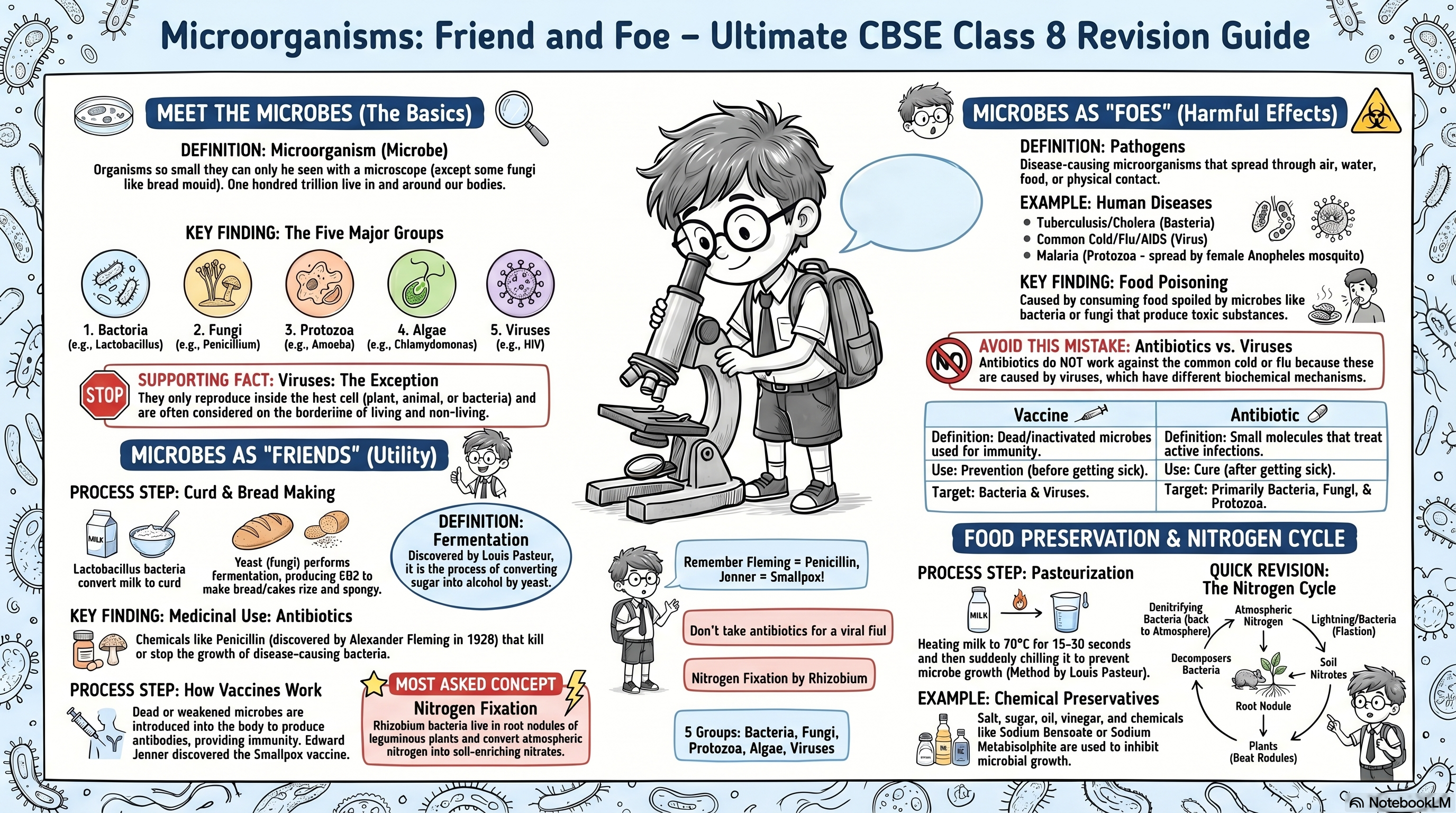
Microorganisms are classified into five major groups:
| Group | Important Features | Examples |
|---|---|---|
| Protozoa | Single-celled; mostly aquatic | Amoeba, Paramecium |
| Algae | Plant-like; contain chlorophyll; photosynthetic | Chlamydomonas, Spirogyra |
| Fungi | Non-green; no chlorophyll; saprophytic or parasitic | Penicillium, Aspergillus |
| Bacteria | Single-celled; found everywhere | Lactobacillus, Rhizobium |
| Viruses | Non-cellular; need a host to reproduce | HIV, Poliovirus |
Note: Some scientists classify viruses as microorganisms, while others consider them non-living because they cannot survive or reproduce independently.
A Closer Look at Each Group
Protozoa
Protozoa are single-celled organisms found in ponds, lakes, rivers, dirty water drains, and damp soil. Most are obligate aquatic microbes, meaning they depend on water to survive.
Algae
Algae are plant-like but differ from true plants because they lack proper roots, stems, and leaves (their body is called a thallus). They perform photosynthesis using chlorophyll. They are found in freshwater, saltwater, hot springs, and moist soil.
Fungi
Fungi cannot make their own food (no chlorophyll). They either:
- Feed on dead and decaying organic matter → called saprophytes
- Live on other living organisms → called parasites
A fungal thread-like structure is called a hypha (plural: hyphae). The collective network of hyphae is a mycelium.
Did You Know?
A giant fungus called Armillaria bulbosa found in Michigan, USA covers 15 hectares, weighs ~100 metric tonnes, and is at least 1,500 years old — one of the largest living things on Earth!
Bacteria
Bacteria are extremely small, single-celled organisms found virtually everywhere in air, soil, water, on surfaces, and inside living organisms. They are the most abundant life forms on Earth.
Viruses
Viruses are the smallest microorganisms and are unique because:
- They consist of only genetic material (DNA or RNA) wrapped in a protein coat.
- They cannot reproduce independently they need a living host cell.
- They are often considered a connecting link between living and non-living matter.
CBSE Class 8 Science Notes Chapter-wise
Where Do Microorganisms Live?
Microbes are found in virtually every environment on Earth:
- Hot springs (extreme heat)
- Polar ice caps (extreme cold)
- Ocean depths
- Inside the human body (gut, skin, mouth)
- Soil, air, and freshwater
Most microbes require water or moisture to survive, so wherever there is moisture, microbes are present.
Microorganisms and Us
Friendly Microorganisms
Many microorganisms perform vital functions that benefit humans, animals, and the environment.
In Food Production
| Microorganism | Use |
|---|---|
| Lactobacillus | Converts milk into curd (yogurt) by fermenting lactose into lactic acid |
| Yeast (Saccharomyces cerevisiae) | Used in baking (makes dough rise) and brewing (converts sugar to alcohol) |
| Penicillium | Used in cheese making; source of Penicillin antibiotic |
In Medicine
- Genetically modified E. coli produces insulin and other drugs.
- Streptomyces bacteria produce the antibiotic streptomycin.
- Penicillium notatum produces Penicillin discovered by Alexander Fleming in 1928.
- Vaccines are prepared from weakened or killed microorganisms.
In the Environment
- Bacteria and fungi act as decomposers, breaking down dead plants and animals and returning nutrients (carbon, nitrogen, sulphur) to the soil.
- Algae like Chlorella help in sewage decomposition by producing oxygen during photosynthesis.
- Nitrosomonas and Nitrobacter help in converting ammonia to nitrates in the nitrogen cycle.
- Rhizobium bacteria in root nodules of legumes fix atmospheric nitrogen into the soil.
Other Uses
- Mushrooms (Agaricus bisporus) are a rich source of protein (21–30%), low in fat and carbohydrates ideal food for diabetics and heart patients.
- Dried yeast contains ~50% protein and is rich in Vitamin B.
- Agar-agar, extracted from red algae (Gelidium, Gracilaria), is a jelly-like substance used in laboratory culture media.
- Enzymes from fungi: Amylase from Aspergillus oryzae; Zymase from Saccharomyces cerevisiae.
- Hormones from fungi: Gibberellic acid (GA) from Gibberella fujikuroi.
- Algae as fodder:Sargassum and Laminaria are used as animal feed.
Microbes in the Healthy Human Body
| Body Part | Microorganism |
|---|---|
| Ear (outer) | Aspergillus (fungus) |
| Skin | Candida (fungus) |
| Stomach | Lactobacillus |
| Intestine | Escherichia coli |
| Mouth | Streptococcus salivarius |
| Nose | Staphylococcus aureus |
| Large intestine | Trichomonas hominis (protozoa) |
These microbes are harmless in normal numbers. An imbalance can cause illness.
Fermentation: An Important Process
Fermentation is the conversion of sugar into alcohol and carbon dioxide by yeast.
Chemical Equation:
C₆H₁₂O₆ →(Yeast)→ 2C₂H₅OH + 2CO₂
(Glucose) (Ethanol) (Carbon dioxide)
- Discovered by: Louis Pasteur
- Used to produce: alcohol, wine, beer, bread, idli, dosa
How curd forms:Lactobacillus bacteria ferment lactose (milk sugar) into lactic acid, which curdles the milk proteins, giving curd its sour taste and thick texture. This occurs best at 30–40°C.
Antibiotics
Antibiotics are chemical substances produced by microorganisms (or synthetically) that kill or inhibit the growth of bacteria.
| Antibiotic | Source |
|---|---|
| Penicillin | Penicillium notatum (fungus) first antibacterial antibiotic |
| Streptomycin | Streptomyces bacteria — first antifungal antibiotic |
| Tetracycline | Bacteria |
| Erythromycin | Bacteria |
How antibiotics work: They block the bacterial cell's biochemical pathways without harming the host (patient).
Why don't antibiotics work against viruses?
Viruses use the host cell's own machinery to survive. They have very few independent biochemical pathways to target. This is why making antiviral medicines is much harder than making antibacterials.
Vaccines
A vaccine is a preparation of weakened, killed, or inactivated pathogens (or their surface proteins) that stimulates the immune system to produce antibodies.
Edward Jenner discovered the first vaccine for smallpox.
| Vaccine | Disease Prevented |
|---|---|
| BCG vaccine | Tuberculosis |
| OPV (Oral Polio Vaccine) | Polio |
| MMR vaccine | Measles, Mumps, Rubella |
| Hepatitis B vaccine | Hepatitis B |
| DPT vaccine | Diphtheria, Pertussis, Tetanus |
Difference Between Vaccine and Antibiotic
| Feature | Vaccine | Antibiotic |
|---|---|---|
| Purpose | Prevents disease (immunity) | Treats active bacterial infection |
| Nature | Weakened/killed pathogens or antigens | Chemical compounds |
| When used | Before infection | After infection |
| Effective against | Specific pathogens | Bacteria, fungi, protozoa |
| Side effects | Possible allergic reactions | Diarrhoea, nausea, allergy |
Harmful Microorganisms
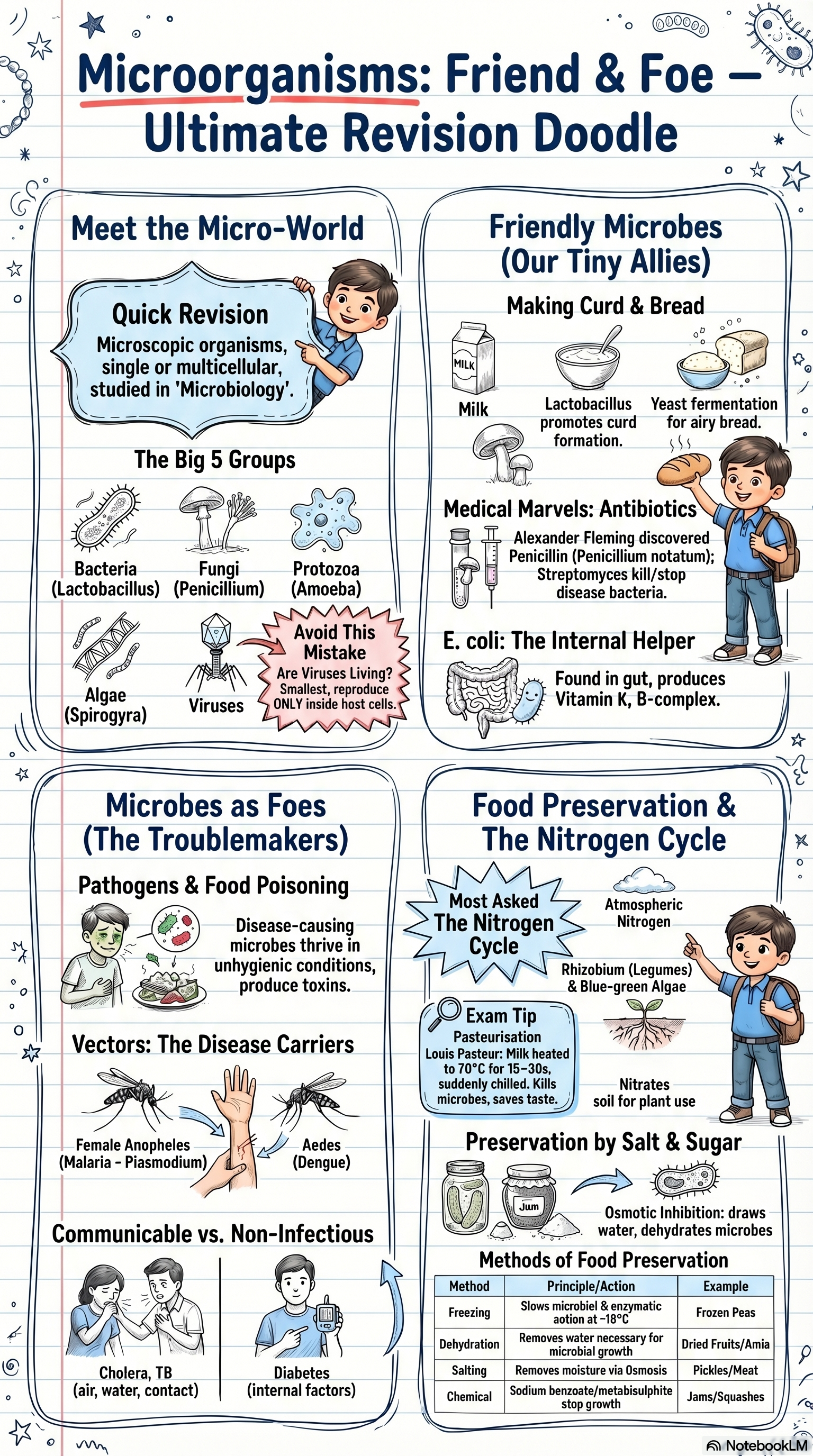
Pathogens are disease-causing microorganisms. They thrive in unhygienic conditions.
Common Human Diseases
Viral Diseases
| Disease | Causative Virus | Mode of Spread |
|---|---|---|
| Common cold, Influenza | Rhinovirus / Influenza virus | Air (droplets) |
| Chickenpox | Varicella-zoster virus | Physical contact, air |
| Dengue | Dengue virus | Aedes mosquito (vector) |
| Polio | Poliovirus | Contaminated food/water |
| Hepatitis | Hepatitis virus | Contaminated food/water |
| AIDS | HIV (Retrovirus) | Sexual contact, blood |
| Rabies | Rabies virus (Lyssa virus) | Animal bite (rabid dog/cat) |
Bacterial Diseases
| Disease | Causative Bacterium | Mode of Spread |
|---|---|---|
| Typhoid | Salmonella typhi | Contaminated water/food |
| Tuberculosis | Mycobacterium tuberculosis | Air (droplets) |
| Cholera | Vibrio cholerae | Contaminated water |
| Anthrax | Bacillus anthracis | Endospores via inhalation/ingestion |
Protozoan Diseases
| Disease | Causative Organism | Vector |
|---|---|---|
| Malaria | Plasmodium vivax | Female Anopheles mosquito |
| Kala-azar | Leishmania donovani | Sandfly |
| Amoebic Dysentery | Entamoeba histolytica | Contaminated food/water |
| Giardiasis | Giardia intestinalis | Contaminated water |
Common Vectors and Diseases Transmitted
| Vector | Disease Transmitted |
|---|---|
| Anopheles mosquito (female) | Malaria |
| Culex mosquito | Filaria |
| Aedes mosquito (female) | Dengue, Yellow fever |
| Housefly | Cholera, Typhoid, Dysentery, Diarrhoea, TB |
| Sandfly | Kala-azar |
| Tse-tse fly | Sleeping sickness |
| Rat flea | Plague |
Types of Disease Transmission
Direct Transmission (without intermediate agent):
- Physical contact (Chickenpox, Ringworm)
- Sexual contact (Syphilis, AIDS)
- Animal bites (Rabies)
- Soil contact (Tetanus)
Indirect Transmission (through intermediate agents):
- Air: droplets from sneezing/coughing (Common cold, TB, Pneumonia)
- Contaminated water: (Cholera, Diarrhoea)
- Vectors: Insects and animals (Malaria, Dengue)
Plant Diseases Caused by Microorganisms
| Plant Disease | Microorganism | Mode of Transmission |
|---|---|---|
| Citrus canker | Bacteria | Air |
| Rust of wheat | Fungi | Air, Seeds |
| Yellow vein mosaic of bhindi (Okra) | Virus | Insect |
Types of Diseases
Infectious (Communicable) Diseases
Caused by microbes (viruses, bacteria, fungi, protozoa). They spread from one person to another through contaminated water, food, insects, or contact.
Examples: Tuberculosis, Malaria, Cholera, Diarrhoea
Non-Infectious (Non-Communicable) Diseases
Not caused by microbes. Caused by internal factors, genetic abnormalities, or lifestyle.
Examples:
- Cancer → genetic abnormalities
- Diabetes → hormonal imbalance
- High blood pressure → poor diet, lack of exercise
Food Spoilage and Preservation
What Is Food Spoilage?
Food spoilage occurs when food deteriorates in quality or becomes unfit for consumption due to microbial action or chemical changes.
Effects on different food types:
- Protein foods → putrefy, produce foul smell
- Fats and oils → turn rancid
- Cooked cereals → become slimy and stale
- Fruits and vegetables → rot, ferment, and decay
Methods of Food Preservation
Food preservation prevents microbial growth and chemical breakdown, extending shelf life while retaining nutritional value.
1. Lowering Temperature
| Method | Description | Temperature |
|---|---|---|
| Freezing | Stops microbial growth; water unavailable to microbes | 0°F (−18°C) or below |
| Refrigeration | Slows microbial growth | 0–5°C (optimum 5°C) |
- Blanching: Briefly boiling food then placing in cold water — halts enzymes before freezing.
- Thawing: Bringing frozen food to room temperature without artificial heat.
2. Increasing Temperature
| Method | Description |
|---|---|
| Pasteurisation | Heating milk to 71.7°C for ≥15 seconds, then quickly cooling — destroys most pathogens |
| Sterilisation | Exposing food to high heat (often under pressure) for longer — destroys ALL microorganisms |
3. Dehydration (Drying)
Removing moisture from food inhibits microbial growth.
| Method | Description | Examples |
|---|---|---|
| Sun drying | Traditional method; practiced in hot, dry climates | Amla, raw mango |
| Spray drying | Liquid sprayed into hot air; water evaporates → powder | Milk powder |
| Vacuum drying | Air removed from container; water evaporates quickly | Instant coffee |
4. Osmotic Inhibition (Salt and Sugar)
Salt or sugar draws water out of microbial cells by osmosis, dehydrating and killing them.
- Salt → Used in pickling, curing meat
- Sugar → Used in jams, crystallised fruits
5. Irradiation
Food exposed to ionising radiation (gamma rays, X-rays, or high-energy electrons). Also called "cold pasteurisation" because the food is not heated.
- Kills bacteria, moulds, insects
- Extends shelf life
- A special international symbol is printed on irradiated food packaging.
6. Chemical Preservatives
| Preservative | Used In |
|---|---|
| Citric acid / Phosphoric acid | Carbonated drinks, fruit juices |
| Acetic acid (Vinegar) | Pickles |
| Sorbic acid | Soft drinks, processed cheese |
| Benzoic acid | Soft drinks |
| Sulphur dioxide | Dried fruits, fruit syrups, pickles |
| Potassium nitrate | Cured meat |
Common antioxidants:
- Ascorbic acid → fruit drinks
- Propyl gallate → vegetable oils, chewing gum
- Butylated hydroxyanisole → cheese spread
The Nitrogen Cycle
Why Is Nitrogen Important?
Nitrogen is a key component of amino acids, proteins, and nucleic acids essential for all living organisms.
The atmosphere is ~80% nitrogen gas (N₂), but this form is chemically inert and cannot be directly used by most organisms.
Important Processes in the Nitrogen Cycle
1. Nitrogen Fixation
Converting atmospheric N₂ into usable nitrogen compounds (ammonia/nitrates).
Agents:
- Clostridium and Azotobacter (free-living soil bacteria)
- Nostoc (blue-green algae)
- Rhizobium (symbiotic bacteria in root nodules of leguminous plants like peas, beans)
- Lightning (during storms) — fixes nitrogen through atmospheric reactions
2. Ammonification
Dead plant and animal matter is broken down by soil bacteria and fungi, releasing ammonia into the soil.
3. Nitrification
Ammonia in the soil is converted to nitrates in two steps:
- Nitrosomonas → converts ammonia to nitrites
- Nitrobacter → converts nitrites to nitrates
Plants absorb nitrates through their roots.
4. Denitrification
Bacteria like Thiobacillus and Pseudomonas convert soil nitrates back into atmospheric nitrogen gas, completing the cycle.
Nitrogen Cycle Flow (Textual Diagram)
Atmospheric N₂ (inert)
 ↓ (Nitrogen fixation: Rhizobium, Azotobacter, lightning)
Ammonia / Ammonium compounds in soil
 ↓ (Nitrification: Nitrosomonas, Nitrobacter)
Nitrates in soil
 ↓ (Absorbed by plant roots)
Plants (proteins, nucleic acids)
 ↓ (Consumed by animals)
Animals → Nitrogenous waste (excretion and death)
 ↓ (Ammonification: bacteria, fungi)
Ammonia in soil
 ↓ (Denitrification: Thiobacillus, Pseudomonas)
Atmospheric N₂ ← (cycle repeats)
perfect gaseous cycle
Important Terms
| Term | Meaning |
|---|---|
| Microorganism | Organism visible only under a microscope |
| Microbiology | Study of microorganisms |
| Pathogen | Disease-causing microorganism |
| Antibiotic | Chemical that kills or inhibits bacteria |
| Vaccine | Preparation of weakened/killed pathogens to build immunity |
| Fermentation | Conversion of sugar to alcohol/acid by microbes |
| Saprophyte | Organism that feeds on dead organic matter |
| Vector | Organism that transmits pathogens from one host to another |
| Nitrogen fixation | Converting atmospheric N₂ into usable compounds |
| Pasteurisation | Heat treatment to kill most pathogens in liquid food |
| Hyphae | Thread-like structures of fungi |
| Mycelium | Mass of hyphae forming the fungal body |
| Communicable disease | Disease that spreads from person to person |
| Antibody | Protein produced by the immune system to fight pathogens |
| Thallus | Undifferentiated plant body of algae (no root/stem/leaf) |
Enhanced Study Notes
Quick Revision Mnemonics
Mnemonic for Major Groups of Microorganisms: "PAFBV"
Protozoa – Algae – Fungi – Bacteria – Viruses "People Always Find Biology Very interesting"
Mnemonic for Nitrogen Cycle steps: "FANDN"
Fixation → Ammonification → Nitrification → Denitrification → back to Nitrogen
Mnemonic for Food Preservation Methods: "LI-D-O-C"
Lowering temperature – Irradiation – Dehydration – Osmotic inhibition – Chemicals
Scientist Associations:
- Leeuwenhoek → Discovered microorganisms (1675)
- Alexander Fleming → Discovered Penicillin (1928)
- Louis Pasteur → Discovered fermentation; Pasteurisation
- Edward Jenner → Discovered smallpox vaccine
Summary Table: Friendly vs Harmful Microorganisms
| Friendly Microorganisms | Harmful Microorganisms |
|---|---|
| Lactobacillus → curd making | Salmonella typhi → typhoid |
| Yeast → bread, alcohol | Vibrio cholerae → cholera |
| Rhizobium → nitrogen fixation | Plasmodium → malaria |
| Penicillium → antibiotics | HIV → AIDS |
| Bacteria/Fungi → decomposers | Mycobacterium tuberculosis → TB |
| E. coli → vitamin K, B12 in gut | Entamoeba → dysentery |
5-Point Rapid Revision
- Microorganisms are of 5 types: Protozoa, Algae, Fungi, Bacteria, Viruses.
- Lactobacillus makes curd; Yeast makes bread and alcohol.
- Penicillin was discovered by Alexander Fleming from Penicillium notatum.
- Female Anopheles → Malaria; Female Aedes → Dengue.
- Nitrogen cycle key bacteria: Rhizobium (fixation), Nitrosomonas (nitrification), Thiobacillus (denitrification).
Solved Examples (20 Questions)
SECTION A: Conceptual Questions
Q1. What is a microorganism? Why can't we see them with the naked eye?
A microorganism is a living organism too small to be seen without a microscope. Bacterial cells are about one-hundredth the size of a human cell, and viruses are even smaller. Their dimensions are measured in micrometres (µm) or nanometres (nm), far below the resolution limit of the human eye (~100 µm). A microscope specifically a compound microscope — is needed to observe them.
Q2. Why do viruses not respond to antibiotics?
Antibiotics work by blocking specific biochemical pathways unique to bacteria (such as cell wall synthesis). Viruses do not have their own metabolism — they hijack the host cell's machinery to replicate. Since there are few virus-specific pathways to target, and attacking those pathways would also harm the host's cells, antibiotics are completely ineffective against viral infections. Antiviral drugs are used instead.
Q3. How does yeast make bread dough rise?
Yeast carries out fermentation it converts sugar in the dough into carbon dioxide (CO₂) and ethanol. The CO₂ gas gets trapped within the dough, forming tiny bubbles. These bubbles expand when the dough is baked, making the bread light, porous, and spongy. The ethanol evaporates during baking.
Q4. Explain the role of Rhizobium in agriculture.
Rhizobium is a symbiotic nitrogen-fixing bacterium that lives in root nodules of leguminous plants (peas, beans, lentils). It converts inert atmospheric nitrogen (N₂) into ammonia, which the plant converts into amino acids and proteins. When the plant dies, this fixed nitrogen enriches the soil, reducing the need for chemical fertilisers. Leguminous crops are therefore often grown to naturally improve soil fertility.
Q5. Differentiate between a saprophyte and a parasite (in the context of fungi).
| Feature | Saprophyte | Parasite |
|---|---|---|
| Food source | Dead and decayed organic matter | Living host organism |
| Effect on host | No direct host | Harms the host |
| Example | Bread mould (Rhizopus) | Trichophyton (causes ringworm) |
Both cannot prepare their own food since they lack chlorophyll, but they differ in where they obtain nutrients.
Q6. Why is pasteurisation used for milk and not simple boiling?
Simple boiling at 100°C for prolonged periods destroys most pathogens but also damages heat-sensitive vitamins (like Vitamin C and some B vitamins) and alters the taste and texture of milk. Pasteurisation uses a lower temperature 71.7°C for at least 15 seconds followed by rapid cooling. This kills the most dangerous pathogens while causing minimal nutritional or sensory damage. Some heat-resistant organisms survive pasteurisation, which is why pasteurised milk still has a limited shelf life.
Q7. What are communicable diseases? Give three examples and their modes of transmission.
Communicable (infectious) diseases are illnesses caused by microbes that can spread from an infected person or animal to a healthy person through various routes.
| Disease | Causative Organism | Mode of Transmission |
|---|---|---|
| Tuberculosis | Mycobacterium tuberculosis | Air (droplets from coughing) |
| Malaria | Plasmodium vivax | Female Anopheles mosquito bite |
| Cholera | Vibrio cholerae | Contaminated water/food |
Q8. How does salt preserve food? Explain the osmotic mechanism.
Answer: When salt (or brine) is added to food, it creates a high-concentration salt solution outside the microbial cells. The cytoplasm inside the microbial cell is less concentrated than this solution. By the process of osmosis, water moves from the region of lower concentration (inside the cell) to higher concentration (outside), causing the microbial cell to dehydrate and shrivel. Without adequate water, the microbe cannot grow or reproduce, and food spoilage is prevented.
Q9. Name the scientist associated with each discovery:
(a) Microorganisms
(b) Fermentation
(c) Penicillin
(d) Smallpox vaccine
Answer:
- (a) Anton Van Leeuwenhoek — first to observe microorganisms (1675)
- (b) Louis Pasteur — discovered and explained the process of fermentation
- (c) Alexander Fleming — discovered Penicillin from Penicillium notatum (1928)
- (d) Edward Jenner — developed the first vaccine (smallpox vaccine)
Q10. What is food poisoning? Name two bacteria responsible for it.
Food poisoning is an illness caused by consuming food contaminated with harmful microorganisms or their toxic by-products. When food is left exposed, microbes grow and produce toxins that remain even if the food is later heated.
Common symptoms: nausea, vomiting, diarrhoea, abdominal cramps.
Two bacteria responsible:
- Salmonella — found in undercooked poultry, eggs
- Escherichia coli (pathogenic strains) — found in contaminated water and food
SECTION B: Short Answer Questions
Q11. What are the major differences between algae and fungi?
| Feature | Algae | Fungi |
|---|---|---|
| Chlorophyll | Present | Absent |
| Nutrition | Autotrophic (photosynthesis) | Heterotrophic (saprophytic/parasitic) |
| Habitat | Water, moist soil | Soil, decaying matter, host organisms |
| Cell wall | Cellulose (in most) | Chitin |
| Example | Spirogyra | Penicillium |
Q12. Why should we NOT take antibiotics without a doctor's prescription?
- Overuse kills beneficial bacteria in the gut along with harmful ones.
- Incorrect dosage can lead to antibiotic resistance bacteria evolve and become immune to the antibiotic.
- Some antibiotics have severe side effects if taken unnecessarily.
- Antibiotics do not work against viral infections (common cold, flu), so taking them is pointless and harmful.
- Always complete the full course even if symptoms improve stopping early can leave resistant bacteria alive.
Q13. Explain the function of Nitrosomonas and Nitrobacter in the nitrogen cycle.
Both are nitrifying bacteria involved in the nitrification step of the nitrogen cycle:
- Nitrosomonas oxidises ammonia (NH₃) in the soil → nitrites (NO₂⁻)
- Nitrobacter further oxidises nitrites (NO₂⁻) → nitrates (NO₃⁻)
Nitrates are the form of nitrogen that plant roots can directly absorb and use to make amino acids and proteins. Without these bacteria, plants would be unable to obtain usable nitrogen from the soil.
Q14. How does the housefly spread diseases? What precaution can be taken?
Houseflies feed and breed on decaying matter, garbage, and faeces all of which contain pathogenic microorganisms. When a housefly lands on food, it transfers these pathogens from its body, legs, and mouth onto the food. The fly also regurgitates digestive juices onto food to liquefy it before eating, further contaminating it.
Diseases spread: Cholera, Typhoid, Dysentery, Diarrhoea, Tuberculosis
Precautions:
- Always keep food covered.
- Dispose of garbage in sealed bags.
- Keep surroundings clean; avoid leaving decomposing organic matter unattended.
- Use flytraps or UV fly-killer devices.
Q15. What is denitrification? Which bacteria perform it and why is it important?
Denitrification is the process by which certain soil bacteria convert nitrates (NO₃⁻) back into atmospheric nitrogen gas (N₂).
Bacteria involved: Thiobacillus and Pseudomonas
Importance: Without denitrification, all the nitrogen would gradually accumulate in the soil as nitrates, disturbing the balance of the nitrogen cycle. Denitrification ensures that the percentage of nitrogen in the atmosphere remains constant (~78%), completing the cycle.
SECTION C: Assertion-Reason Questions
Q16. Assertion (A): Antibiotics are effective against bacterial infections but not viral infections.
Reason (R): Viruses use the host cell's own machinery and have very few unique biochemical pathways that antibiotics can target.
Both A and R are correct, and R is the correct explanation of A.
Antibiotics target specific structures or pathways found in bacteria (e.g., cell walls, ribosomes) that do not exist in viruses. Since viruses lack these structures and depend entirely on the host cell, antibiotics have nothing to act upon in a viral infection.
Q17. Assertion (A): Mosquitoes should not be allowed to breed in stagnant water near homes. Reason (R): Mosquitoes breed in stagnant water and act as vectors for serious diseases.
Both A and R are correct, and R is the correct explanation of A.
Mosquitoes lay their eggs in stagnant water. Preventing water accumulation eliminates breeding sites, reducing mosquito populations and thereby lowering the risk of diseases like Malaria (Anopheles), Dengue (Aedes), and Filaria (Culex).
SECTION D: Case-Based Questions
Q18. Case Study: Ramesh noticed that the milk he bought yesterday has turned sour even though he kept it in the refrigerator. However, when he added some of this sour milk to fresh warm milk and left it overnight, the fresh milk also turned sour and thick.
(a) What caused the fresh milk to turn sour?
(b) Name the bacterium involved.
(c) What did the bacterium produce to cause sourness?
(d) Why does refrigeration only slow and not completely stop this process?
Answer: (a) The microorganism present in the old sour milk (used as a starter) multiplied in the warm fresh milk and fermented its sugar (lactose) into lactic acid, causing it to coagulate and turn sour. (b) Lactobacillus (c) Lactic acid — this acid lowers the pH of the milk, causing the milk proteins to denature (curdle) and giving curd its characteristic sour taste. (d) Lactobacillus is still active at refrigerator temperatures (0–8°C), just at a slower rate. Refrigeration reduces metabolic activity but does not halt it completely. The milk will eventually sour even in the fridge, just more slowly.
Q19. Case Study: During a science fair, students were shown four food samples:
(A) freshly made jam
(B) salted raw mango pickle
(C) freeze-dried instant coffee powder
(D) pasteurised milk in a sealed carton. All four had a shelf life of over 3 months without refrigeration (except D).
(a) Which preservation method is used in sample A?
(b) How does salt preserve sample B?
(c) Why does sample C have such a long shelf life?
(d) Why does sample D need refrigeration after opening despite being pasteurised?
Answer: (a) Osmotic inhibition by sugar the high sugar concentration prevents microbial growth by making water unavailable. (b) Salt draws water out of microbial cells by osmosis, dehydrating them and preventing growth. Salt also creates an unfavourable, high-salinity environment. (c) Freeze-drying removes moisture from the coffee. Without water, microorganisms cannot survive or reproduce. The sealed packaging prevents moisture from re-entering. (d) Pasteurisation destroys most pathogens but not all microorganisms. After opening, the milk is exposed to air and microbes from the environment. Refrigeration is then necessary to slow the growth of any surviving or newly introduced microorganisms.
Q20. Long Answer: Write a detailed note on the nitrogen cycle, explaining why it is called a "perfect gaseous cycle."
Answer:
The nitrogen cycle is the biogeochemical cycle that describes the continuous movement of nitrogen between the atmosphere, soil, water, and living organisms.
Why it is essential: Nitrogen is a vital component of amino acids, proteins, and nucleic acids (DNA, RNA). The atmosphere is ~80% N₂, but this gas is chemically inert organisms cannot use it directly.
Steps of the Nitrogen Cycle:
Step 1 – Nitrogen Fixation: Atmospheric N₂ is converted into ammonia or nitrates by:
- Rhizobium bacteria (in root nodules of legumes)
- Free-living bacteria: Azotobacter, Clostridium
- Blue-green algae: Nostoc
- Lightning: high-energy electrical discharges combine N₂ with O₂ → nitric oxide → nitrates (washed into soil by rain)
Step 2 – Ammonification: When plants and animals die, decomposer bacteria and fungi break down nitrogenous compounds in dead matter into ammonia (NH₃). This ammonia forms ammonium compounds in the soil.
Step 3 – Nitrification: Soil bacteria convert ammonia into nitrates in two stages:
- Nitrosomonas: NH₃ → NO₂⁻ (nitrites)
- Nitrobacter: NO₂⁻ → NO₃⁻ (nitrates)
Plants absorb nitrates through their roots and build proteins. Animals get nitrogen by eating plants or other animals.
Step 4 – Denitrification:Thiobacillus and Pseudomonas convert soil nitrates back into N₂ gas, which returns to the atmosphere.
Why it is called a perfect gaseous cycle: The nitrogen cycle is called perfect because nitrogen cycling between the abiotic atmosphere and biotic organisms is continuous, rapid, and self-sustaining there is no permanent net loss or gain of nitrogen. The atmospheric percentage (~78%) remains constant over geological time, demonstrating the cycle's near-perfect balance.
FAQs about Microorganisms: Friend and Foe
Most microorganisms cannot be seen with the naked eye because their size is measured in micrometres. However, some fungi like the mould that grows on bread can be seen with a magnifying glass. A compound microscope is needed to observe most bacteria, protozoa, and algae. Viruses require an electron microscope.
Common cold and flu are caused by viruses, not bacteria. Antibiotics specifically target bacterial structures and pathways. Viruses do not have cell walls or their own ribosomes they replicate using the host cell's machinery. Since antibiotics cannot distinguish between the host cell and the virus, they are completely ineffective against viral infections.
A pathogen is the microorganism that directly causes the disease (e.g., Plasmodium causes malaria). A vector is an intermediate organism (usually an insect or animal) that carries the pathogen from one host to another without being directly harmed by it (e.g., the female Anopheles mosquito is a vector for Plasmodium).
Yeast (Saccharomyces cerevisiae) in bread dough ferments sugars, producing CO₂ gas. These gas bubbles get trapped inside the elastic dough. During baking, the heat causes the bubbles to expand further and the protein (gluten) structure sets permanently around them, creating the characteristic porous, spongy texture of bread.
Only the female Anopheles mosquito is responsible for transmitting malaria. Female mosquitoes need blood meals to nourish their eggs. Male mosquitoes feed only on plant nectar. Similarly, only the female Aedes mosquito transmits dengue virus.
This is a classic scientific debate. Viruses show some characteristics of life they have genetic material (DNA or RNA) and can evolve. However, they cannot carry out life processes independently they have no metabolism, cannot grow, and cannot reproduce without a host cell. Most modern scientists classify them as non-cellular infectious agents, not true living organisms.
Unnecessary antibiotic use can lead to:
- Antibiotic resistance bacteria evolve to withstand the drug, making future infections harder to treat.
- Disruption of beneficial gut bacteria (microbiome damage).
- Side effects such as diarrhoea, nausea, and allergic reactions.
- The antibiotic won't work when you genuinely need it.
This is why antibiotics must only be taken on a doctor's prescription and the full course must be completed.
Leguminous plants (peas, beans, lentils, clover) host Rhizobium bacteria in their root nodules. These bacteria fix atmospheric nitrogen into the soil as ammonia/nitrates a form plants can absorb. When the crop residue is ploughed back into the soil (green manuring), the nitrogen it contains enriches the soil further. This is why farmers rotate cereal crops with legume crops to naturally replenish soil nitrogen.
Decomposers mainly bacteria and fungi break down dead organic matter (leaves, dead animals, faeces) into simpler inorganic substances. This process:
- Recycles nutrients (nitrogen, carbon, phosphorus) back into the soil and atmosphere
- Keeps the environment clean
- Makes nutrients available for plants
- Drives the carbon, nitrogen, and other biogeochemical cycles
Without decomposers, dead matter would accumulate endlessly and nutrients would remain locked away.
A vaccine introduces weakened, killed, or inactivated pathogens (or their specific proteins) into the body. The immune system recognises these as foreign and produces antibodies against them. Crucially, the immune system also creates memory cells that remember the pathogen. If the real pathogen enters the body later, the immune system responds rapidly and powerfully destroying the pathogen before it can cause disease. This is called acquired immunity.