




Metals and non-metals form the building blocks of all materials around us. From the air we breathe to the devices we use, understanding these elements is crucial for science students.
Why This Topic Matters:
- Forms 10-15% of your Science exam
- Essential for understanding chemistry concepts
- Helps explain everyday phenomena (rusting, cooking, etc.)
- Foundation for higher chemistry studies
Earth's crust contains various elements in different states. More than 75% of known elements are metals, while only 22 are non-metals. This chapter explores their properties, reactions, and applications.
Important Concepts & Definitions
What are Elements?
Elements are pure substances made up of only one type of atom. Though millions of substances exist, they are all composed of a limited number (about 118) of basic elements.
Classification of Elements
Elements are broadly classified into:
- Metals - Elements with characteristic shine, conductivity, and malleability
- Non-metals - Elements lacking metallic properties
- Metalloids - Elements showing properties of both metals and non-metals
- Noble gases - Inert gaseous elements
Important Terms Explained
Malleability: The property of metals to be hammered into thin sheets without breaking.
- Example: Gold can be beaten into extremely thin foils used in sweets decoration.
Ductility: The ability of metals to be drawn into thin wires.
- Example: Copper is drawn into wires for electrical connections.
Sonority: The property of producing a ringing sound when struck.
- Example: Church bells are made of metals due to this property.
Luster: The shiny appearance of metals when freshly cut or polished.
- Example: Gold and silver jewelry shine due to metallic luster.
Conductivity: The ability to allow heat or electricity to pass through.
- Example: Copper wires conduct electricity efficiently.
CBSE Class 8 Science Notes Chapter-wise
Physical Properties of Metals
1. Physical State
- Metals: Crystalline solids at room temperature (except mercury - liquid)
- Non-metals: Can be solids, liquids, or gases (bromine is the only liquid non-metal)
2. Metallic Luster
- Metals: Shine when polished; can reflect light
- Non-metals: Dull appearance (exceptions: graphite, iodine)
3. Density
- Metals: Generally high density (exception: sodium, potassium, lithium - float on water)
- Non-metals: Low density (exception: diamond has high density)
4. Hardness
- Metals: Hard solids (exceptions: sodium and potassium - can be cut with knife)
- Non-metals: Soft and brittle if solid (exception: diamond - hardest natural substance)
5. Melting and Boiling Points
- Metals: High melting/boiling points (exceptions: sodium ~98°C, potassium ~63°C)
- Non-metals: Low melting/boiling points (exceptions: carbon, silicon, boron have high values)
6. Malleability
- Metals: Can be hammered into sheets
- Gold, silver, aluminum are highly malleable
- Gold is most malleable - 1 gram can cover 0.5 m²
- Non-metals: Brittle; break into powder when hammered
7. Ductility
- Metals: Can be drawn into wires
- Gold is most ductile - 1 gram makes 2 km wire
- Exceptions: zinc, arsenic, antimony
- Non-metals: Not ductile (exception: carbon fiber)
8. Tensile Strength
- Metals: High - can withstand stress without breaking
- Non-metals: Low tensile strength (exception: carbon fiber)
9. Thermal and Electrical Conductivity
- Metals: Excellent conductors
- Silver is best conductor
- Used in electrical wiring, cooking utensils
- Non-metals: Poor conductors/insulators (exception: graphite)
10. Sonority
- Metals: Produce ringing sound when struck
- Used in bells, musical instruments
- Non-metals: Non-sonorous; no characteristic sound
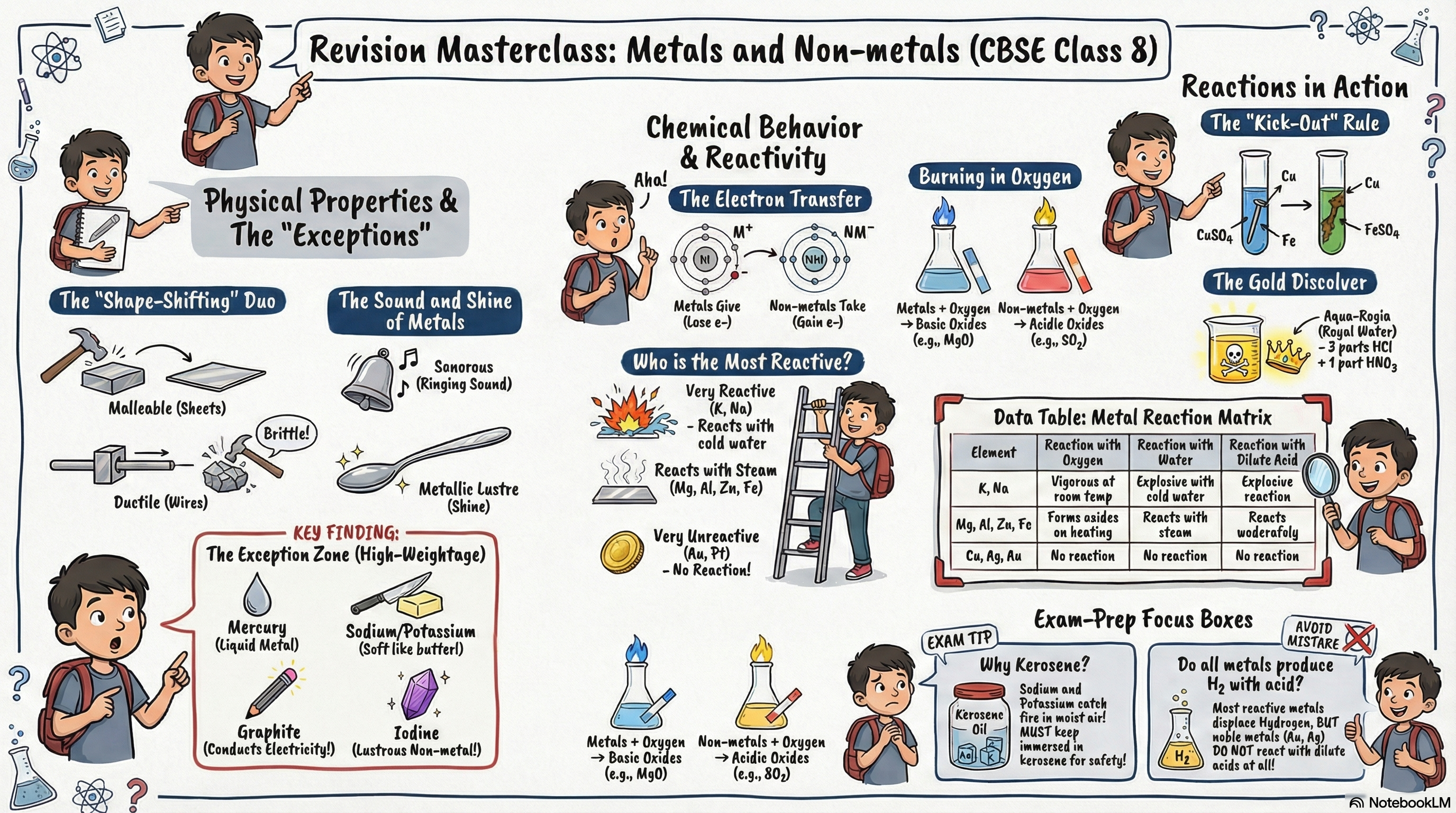
Physical Properties Comparison Table
| Property | Metals | Non-metals |
|---|---|---|
| State | Solid (except Hg) | Solid/Liquid/Gas |
| Luster | Shiny, can be polished | Dull (except graphite, iodine) |
| Density | High (except Na, K, Li) | Low (except diamond) |
| Hardness | Hard (except Na, K) | Soft, brittle (except diamond) |
| Melting Point | High (except Na, K) | Low (except C, Si, B) |
| Malleability | Malleable | Brittle |
| Ductility | Ductile | Non-ductile (except carbon fiber) |
| Conductivity | Good conductors | Poor conductors (except graphite) |
| Sonority | Sonorous | Non-sonorous |
Chemical Properties of Metals
1. Reaction with Oxygen
General Equation:
Metal + Oxygen → Metal Oxide (Basic)
Examples:
a) Highly Reactive Metals (Na, K)
- React vigorously even at room temperature
- Must be stored in kerosene
4Na + O₂ → 2Na₂O (sodium oxide)
4K + O₂ → 2K₂O (potassium oxide)
b) Moderately Reactive Metals (Mg, Al, Zn, Fe, Pb, Cu)
- React on heating
- Form basic oxides (insoluble in water)
2Mg + O₂ --heat→ 2MgO (magnesium oxide)
2Cu + O₂ --heat→ 2CuO (copper oxide - black)
4Fe + 3O₂ --heat→ 2Fe₂O₃ (ferric oxide - rust)
c) Unreactive Metals (Ag, Au, Pt)
- Do not react even on strong heating
- Called noble metals
Point: Metal oxides are basic in nature they form salt and water with acids.
2. Reaction with Water
General Equation:
Metal + Water → Metal Hydroxide/Oxide + Hydrogen gas
Classification by Reactivity:
a) Very Reactive Metals (Na, K)
- React vigorously with cold water
- Reaction produces heat (exothermic)
- Can cause fire/explosion
2Na + 2H₂O --vigorous→ 2NaOH + H₂↑ + Heat
2K + 2H₂O --very vigorous→ 2KOH + H₂↑ + Heat
b) Moderately Reactive (Ca)
- Reacts with cold water, but less vigorously
Ca + 2H₂O --moderate→ Ca(OH)₂ + H₂↑
c) Less Reactive Metals (Mg, Al, Zn, Fe)
- React with hot water or steam only
- Form metal oxides
Mg + H₂O --steam→ MgO + H₂↑
3Fe + 4H₂O --steam→ Fe₃O₄ + 4H₂↑
d) Unreactive Metals (Cu, Ag, Au, Hg)
- Do not react with water or steam
3. Reaction with Acids
General Equation:
Metal + Acid → Salt + Hydrogen gas
Important Notes:
- Only dilute acids are used (HCl, H₂SO₄)
- Not nitric acid - it oxidizes H₂ to water
- Reactivity varies by metal
Examples:
a) Highly Reactive (Na, K)
- React explosively with dilute acids
- Too dangerous to perform
2Na + 2HCl --vigorous→ 2NaCl + H₂↑
b) Moderately Reactive (Mg, Zn, Fe)
- React at moderate speed
Zn + H₂SO₄ → ZnSO₄ + H₂↑
Fe + 2HCl --slow→ FeCl₂ + H₂↑
Mg + 2HCl → MgCl₂ + H₂↑
c) Unreactive Metals (Cu, Ag, Au, Pb)
- Do not react with dilute acids
- Some react with concentrated acids only
Cu + 2H₂SO₄(conc.) → CuSO₄ + SO₂ + 2H₂O
Chemical Properties of Non-Metals
1. Reaction with Oxygen
General Equation:
Non-metal + Oxygen → Non-metallic Oxide (Acidic)
Examples:
C + O₂ --heat→ CO₂ (carbon dioxide - acidic)
S + O₂ --heat→ SO₂ (sulphur dioxide - acidic)
4P + 5O₂ → 2P₂O₅ (phosphorus pentoxide)
Special Case - Hydrogen:
2H₂ + O₂ → 2H₂O (neutral oxide)
Point: Non-metal oxides are acidic in nature they turn blue litmus red.
2. Reaction with Water
Non-metal oxides dissolve in water to form acids.
Examples:
CO₂ + H₂O → H₂CO₃ (carbonic acid)
SO₂ + H₂O → H₂SO₃ (sulphurous acid)
Natural Phenomenon: During thunderstorms, lightning causes:
N₂ + O₂ --lightning→ nitrogen oxides
Nitrogen oxides + Rain → Nitric acid (natural fertilizer)
3. Reaction with Bases
Acidic oxides react with bases to form salt and water.
Examples:
CO₂ + 2NaOH → Na₂CO₃ + H₂O
SO₂ + 2NaOH → Na₂SO₃ + H₂O
4. Reaction with Acids
Non-metals generally do not react with dilute acids.
However, some react with concentrated acids:
C + 2H₂SO₄(conc.) → CO₂ + 2SO₂ + 2H₂O
S + 2H₂SO₄(conc.) → 3SO₂ + 2H₂O
P + 5HNO₃(conc.) → H₃PO₄ + 5NO₂ + H₂O
Metalloids (Semi-Metals)
Elements showing properties of both metals and non-metals.
Common Metalloids:
- Silicon (Si)
- Germanium (Ge)
- Arsenic (As)
- Antimony (Sb)
- Tellurium (Te)
- Boron (B)
Properties:
- Metallic luster but brittle
- Intermediate electrical conductivity
- Used as semiconductors in electronics
Example - Silicon:
- Shiny appearance (like metals)
- Brittle (like non-metals)
- Semiconductor properties
- Used in computer chips, solar cells
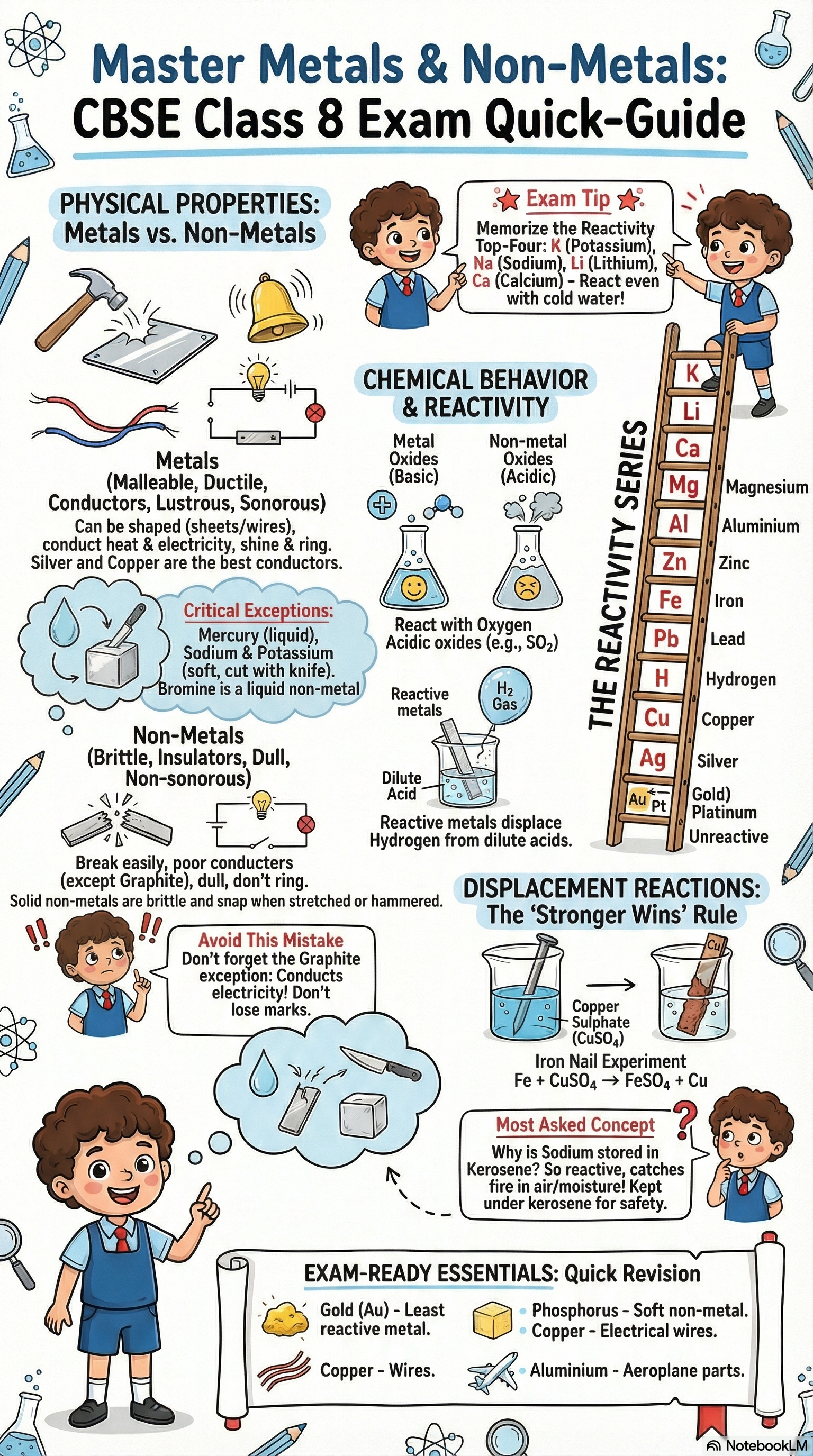
Metal Reactivity Series
The reactivity series arranges metals in decreasing order of reactivity.
Complete Reactivity Series
MOST REACTIVE
 ↓
Potassium (K)
Sodium (Na)
Calcium (Ca)
Magnesium (Mg)
Aluminium (Al)
Zinc (Zn)
Iron (Fe)
Tin (Sn)
Lead (Pb)
[HYDROGEN] ← Reference point
Copper (Cu)
Mercury (Hg)
Silver (Ag)
Gold (Au)
Platinum (Pt)
 ↓
LEAST REACTIVE
Significance of Reactivity Series
1. Reaction with Water:
- Above Ca: React with cold water
- Mg to Fe: React with hot water/steam
- Below Fe: No reaction with water
2. Reaction with Acids:
- Above H: Displace hydrogen from acids
- Below H: Do not react with dilute acids
3. Displacement Reactions:
- More reactive metal displaces less reactive metal from its salt
- Example: Zn + CuSO₄ → ZnSO₄ + Cu
4. Occurrence in Nature:
- Above H: Found as compounds (ores)
- Below H: Can occur in free state (Au, Ag, Pt)
5. Extraction Method:
- Highly reactive: Electrolysis required
- Moderately reactive: Reduction with carbon
- Less reactive: Simple heating may suffice
Displacement Reactions
Reaction where a more reactive metal displaces a less reactive metal from its salt solution.
General Pattern:
More reactive metal + Less reactive metal salt → More reactive metal salt + Less reactive metal
Examples of Displacement Reactions
Example 1: Zinc displaces Copper
Zn(s) + CuSO₄(aq) → ZnSO₄(aq) + Cu(s)
 (blue) (colorless) (reddish-brown)
- Blue solution turns colorless
- Reddish-brown copper deposits on zinc
Example 2: Magnesium displaces Iron
Mg(s) + FeSO₄(aq) → MgSO₄(aq) + Fe(s)
 (green) (colorless) (grey)
Example 3: Iron displaces Copper
Fe(s) + CuSO₄(aq) → FeSO₄(aq) + Cu(s)
 (blue) (green) (brown)
Non-Displacement Examples
Example 1: Copper cannot displace Zinc
Cu + ZnSO₄ → NO REACTION
Reason: Cu is less reactive than Zn
Example 2: Silver cannot displace Copper
Ag + CuSO₄ → NO REACTION
Reason: Ag is less reactive than Cu
Ores and Minerals
Minerals
Naturally occurring compounds of metals mixed with earthy impurities (sand, clay, rocks).
- Found beneath Earth's surface
- Chemical ingredients of rocks
- Not all are economically viable
Ores
Minerals from which metals can be extracted profitably and conveniently.
Point:
All ores are minerals, BUT all minerals are NOT ores.
Gangue (Matrix)
Earthy impurities (sand, clay, mud) present in an ore.
Mineral + Gangue = Ore
Common Ores and Their Metals
| Type | Ore Name | Chemical Formula | Metal Extracted |
|---|---|---|---|
| Oxide Ores | Bauxite | Al₂O₃·2H₂O | Aluminium |
| Haematite | Fe₂O₃ | Iron | |
| Magnetite | Fe₃O₄ | Iron | |
| Zincite | ZnO | Zinc | |
| Cuprite | Cu₂O | Copper | |
| Sulphide Ores | Galena | PbS | Lead |
| Copper glance | Cu₂S | Copper | |
| Iron pyrite | FeS₂ | Iron | |
| Zinc blende | ZnS | Zinc | |
| Cinnabar | HgS | Mercury | |
| Carbonate Ores | Marble | CaCO₃ | Calcium |
| Magnesite | MgCO₃ | Magnesium | |
| Siderite | FeCO₃ | Iron | |
| Malachite | CuCO₃·Cu(OH)₂ | Copper | |
| Chalk | CaCO₃ | Calcium | |
| Sulphate Ores | Epsom salt | MgSO₄·7H₂O | Magnesium |
| Gypsum | CaSO₄·2H₂O | Calcium | |
| Halide Ores | Rock salt | NaCl | Sodium |
| Horn silver | AgCl | Silver | |
| Fluorspar | CaF₂ | Calcium | |
| Cryolite | AlF₃·3NaF | Aluminium |
Occurrence of Metals in Nature
Native or Free State
Metals found in pure form:
- Gold (Au) - Non-reactive, found in river beds
- Platinum (Pt) - Extremely unreactive
- Silver (Ag) - Low reactivity
- Copper (Cu) - Relatively unreactive
Reason: These metals are very less reactive; do not form compounds easily.
Combined State
Most metals occur as compounds:
- Highly reactive metals form stable compounds
- Found as:
- Oxides
- Sulphides
- Carbonates
- Sulphates
- Silicates
Relative Abundance in Earth's Crust:
| Metal | Percentage |
|---|---|
| Aluminium | 8% |
| Iron | 6% |
| Calcium | 5% |
| Magnesium | 3% |
| Sodium | 2.5% |
| Potassium | 1.5% |
| Other metals | 2% |
Metallurgy: Extraction of Metals
Metallurgy is the science and process of extracting pure metals from their ores.
Factors Affecting Extraction
- Type of ore being used
- Nature of impurities present
- Degree of reactivity of the metal
Steps in Metallurgical Process
Step 1: Concentration of Ore (Ore Dressing)
Removal of gangue (earthy impurities) from ore.
Purpose:
- Increase metal concentration
- Make extraction easier
- Reduce waste
Methods of Concentration
a) Hydraulic Washing (Gravity Separation)
- Based on difference in density of ore and gangue
- Used for: Tin, Lead ores
- Process:
- Crushed ore is placed in large tanks
- Water current washes away lighter gangue
- Heavier ore particles settle at bottom
b) Froth Flotation
- Based on difference in wettability with oil and water
- Used for: Sulphide ores (Cu, Pb, Zn)
- Process:
- Crushed ore mixed with water and pine oil
- Air is blown through the mixture
- Ore particles stick to oil froth
- Froth is skimmed off; gangue settles
c) Magnetic Separation
- Based on magnetic properties
- Used for: Iron ore, Nickel, Manganese
- Process:
- Ore is placed on moving belt
- Magnetic roller attracts ore particles
- Non-magnetic gangue falls separately
Step 2: Conversion to Metal Oxide
Concentrated ore is converted to metal oxide by:
a) Roasting
Heating concentrated ore in excess air at high temperature.
Used for: Sulphide ores
Purpose:
- Removes water
- Removes volatile impurities (arsenic, phosphorus)
- Converts ore to oxide
- Makes ore porous
Examples:
2ZnS + 3O₂ --roasting→ 2ZnO + 2SO₂
2Cu₂S + 3O₂ --roasting→ 2Cu₂O + 2SO₂
2PbS + 3O₂ --roasting→ 2PbO + 2SO₂
4FeS + 7O₂ --roasting→ 2Fe₂O₃ + 4SO₂
b) Calcination
Strongly heating concentrated ore in absence/limited air below its melting point.
Used for: Carbonate ores
Purpose:
- Removes moisture
- Removes volatile impurities (CO₂)
- Converts carbonates to oxides
- Makes ore porous
Examples:
CuCO₃ --calcination→ CuO + CO₂
ZnCO₃ --calcination→ ZnO + CO₂
PbCO₃ --calcination→ PbO + CO₂
CaCO₃ --calcination→ CaO + CO₂
Step 3: Reduction of Metal Oxide (Smelting)
Removal of oxygen from metal oxide to obtain pure metal.
Three Methods:
a) Reduction by Carbon/Carbon Monoxide
Used for: Moderately reactive metals (Zn, Fe, Pb, Cu)
Examples:
ZnO + C → Zn + CO
PbO + C → Pb + CO
Fe₂O₃ + 3CO → 2Fe + 3CO₂
CuO + CO → Cu + CO₂
b) Reduction by Electrolysis
Used for: Highly reactive metals (Na, K, Ca, Mg, Al)
Reason: Cannot be reduced by carbon (too reactive)
Example - Extraction of Aluminium:
2Al₂O₃ --electrolysis→ 4Al + 3O₂
c) Reduction by Thermal Decomposition
Used for: Least reactive metals (Hg, Ag)
Process: Simply heating above 300°C
Example:
2HgO --heat→ 2Hg + O₂
2Ag₂O --heat→ 4Ag + O₂
Step 4: Refining of Impure Metal
Removing remaining physical and chemical impurities from extracted metal.
Impurities May Include:
- Other metals (pure or impure)
- Non-metals
- Dissolved gases
Methods of Refining
a) Distillation
- Used for low melting metals (Zn, Hg)
b) Liquefaction
- Selective melting and separation
c) Oxidation
- Impurities oxidized and removed
d) Electro-refining (Best Method)
- Gives 99-99.9% pure metal
- Used for: Cu, Zn, Sn, Al, Ni, Cr, Ag, Au
Electro-refining Process:
- Anode: Impure metal
- Cathode: Pure metal strip
- Electrolyte: Metal salt solution
Process:
- Impure metal dissolves from anode
- Pure metal deposits on cathode
- Impurities settle as anode mud
Flux and Slag
Flux
Substance added to ore to remove impurities during reduction.
Purpose:
- Lowers melting point
- Reacts chemically with impurities
- Forms fusible slag
Common Fluxes:
- Limestone (CaCO₃) - for acidic impurities
- Silica (SiO₂) - for basic impurities
Slag
Fusible compound formed by reaction of flux with impurities.
Flux + Impurities → Slag
Properties:
- Lighter than molten metal
- Floats on top
- Easily removed
Example:
CaCO₃ → CaO + CO₂
CaO + SiO₂ → CaSiO₃ (slag)
(flux) (impurity) (removed)
Thermite Reaction
Reduction of certain metal oxides using aluminium as reducing agent.
General Equation:
Metal Oxide + Al → Metal + Al₂O₃ + Heat
Examples:
3MnO₂ + 4Al → 3Mn + 2Al₂O₃
Fe₂O₃ + 2Al → 2Fe + Al₂O₃
Cr₂O₃ + 2Al → 2Cr + Al₂O₃
Uses:
- Welding railway tracks
- Repairing broken machine parts
- Joining heavy metal pieces
Uses of Common Metals
Copper (Cu)
Properties:
- Reddish-brown color
- Highly ductile
- Excellent heat and electricity conductor
Uses:
- Electric wires and cables
- Cooking utensils
- Water pipes
- Electronic devices
- Coins (in alloys - brass, bronze)
- Electroplating operations
Why not silver for wiring?
Though silver is the best conductor, copper is used because:
- Silver is costly
- Copper is chemically more stable
- Copper is sufficiently conductive
Iron (Fe)
Three Varieties:
- Pig Iron (Cast Iron)
- Highest carbon content (~4%)
- Most impure form
- Uses: Radiators, pipes, drain covers
- Wrought Iron
- Lowest carbon content (~0.1%)
- Purest form
- Uses: Chains, wires, bolts, nails, gates
- Steel
- Moderate carbon content (0.5-1.5%)
- Most widely used
- Uses: Bridges, buildings, ships, automobiles, utensils
Why steel is most useful:
- Stronger than pure iron
- Does not rust easily
- Can be molded easily
- Cost-effective
Aluminium (Al)
Properties:
- Silvery-white color
- Light and strong
- Malleable and ductile
- Excellent conductor
- Corrosion-resistant (forms protective oxide layer)
Uses:
- Cooking utensils
- Aircraft bodies (duralumin alloy)
- Automobile parts
- Electrical wires
- Window frames
- Aluminium foil (food packaging)
- Paints (aluminium powder)
- Mirrors (reflective coating)
Why aluminium doesn't corrode?
Forms a thin, protective Al₂O₃ layer that prevents further corrosion.
Zinc (Zn)
Uses:
- Galvanization: Coating iron to prevent rusting
- Dry cells and batteries
- Brass and bronze (alloys)
- Extraction of gold and silver (from ores)
- Die-casting
- Protective coatings
Lead (Pb)
Uses:
- Pipes and sanitary fittings
- Bullets
- Roofing material
- Storage batteries
- Paint pigments (lead compounds)
- X-ray shielding
- Solder (lead-tin alloy)
Magnesium (Mg)
Uses:
- Fireworks and flares (burns with dazzling light)
- Alloys - duralumin, magnalium (for aircraft)
- Flash photography
- Fuse wire
- Nuclear reactors (neutron absorption)
Gold (Au)
Properties:
- Does not tarnish
- Excellent conductor
- Most malleable and ductile metal
Uses:
- Jewelry (22-carat gold)
- Electronic devices
- Coins
- Dental fillings (gold amalgam)
- Gold plating
- Space equipment (reflects radiation)
Purity Measurement:
- 24-carat = 100% pure gold
- 22-carat = 91.6% gold
- 18-carat = 75% gold
Silver (Ag)
Properties:
- Best conductor of electricity
- Most ductile after gold
- Lustrous
Uses:
- Jewelry
- Dental amalgam
- Photography (AgBr, AgNO₃)
- Water purification
- Electrodes
- Cloud seeding (AgI for artificial rain)
- Electroplating
Mercury (Hg)
Properties:
- Only liquid metal at room temperature
- Does not wet glass
- Expands uniformly with temperature
Uses:
- Thermometers
- Barometers
- Dental amalgam
- Scientific instruments
- Mercury vapor lamps
Platinum (Pt)
Uses:
- Jewelry and watches
- Electrodes in electrolytic cells
- Catalysts in chemical reactions
- Laboratory equipment
Uses of Common Non-Metals
Oxygen (O₂)
Uses:
- Respiration (breathing)
- Combustion (burning)
- Welding and metal cutting
- Steel manufacturing
- Medical use (carbogen: 95% O₂ + 5% CO₂)
- Rocket fuel (liquid oxygen - LOX)
- Explosives
- Deep sea diving, mountaineering
Nitrogen (N₂)
Properties:
- Slightly lighter than air
- Neither combustible nor supports combustion
- Essential component of proteins
Uses:
- Controls combustion rate (dilutes oxygen)
- Ammonia production
- Fertilizers (ammonium salts, urea)
- Explosives (TNT)
- Food preservation (prevents bacterial growth)
- Protein formation in plants
Natural Nitrogen Cycle: During thunderstorms:
N₂ + O₂ --lightning→ nitrogen oxides
Nitrogen oxides + rain → nitric acid (fertilizes soil)
Chlorine (Cl₂)
Uses:
- Bleaching agent (paper, textiles)
- Water purification (kills bacteria)
- Swimming pool disinfectant
- Manufacturing HCl
- Pesticides (DDT, BHC)
- Bleaching powder (disinfectant)
Sulphur (S)
Properties:
- Yellow solid
- Brittle
- Found in garlic, onion, eggs, hair
Uses:
- Sulphuric acid production
- Gunpowder
- Matches and fireworks
- Dyes
- Fungicides and insecticides
- Skin ointments (fungicide)
- Blood purification
- Medicines (homeopathy, ayurveda)
Phosphorus (P)
Occurrence:
- Bones and teeth (calcium phosphate)
- Brain cells
Uses:
- Match boxes (phosphorus sulphide on sides)
- Fertilizers
- Detergents
- Ceramics and chinaware
- Rat poison (white phosphorus)
- Fireworks
Silicon (Si)
Properties:
- Does not occur free in nature
- Second most abundant element (as SiO₂ - sand)
Uses:
- Microchips and transistors
- Solar cells
- Computer components
- Silicon carbide (grinding agent - hardest man-made substance)
- Concrete, bricks, cement
- Glass manufacturing
- Pottery and enamel
- Steel production (as alloy)
Iodine (I₂)
Uses:
- Iodized salt (prevents goiter)
- Tincture of iodine (antiseptic)
- Photography
- Iodex (pain reliever)
Fluorine (F₂)
Uses:
- Toothpaste (stannous fluoride - prevents decay)
- Teflon plastic (non-stick coating)
- Refrigerants
- Water fluoridation
Alloys
Homogeneous mixture of two or more metals, or a metal and a non-metal.
Why Make Alloys?
- Increase strength
- Improve corrosion resistance
- Lower melting point
- Enhance appearance
- Modify electrical properties
Common Alloys
| Alloy | Composition | Uses |
|---|---|---|
| Steel | Fe + C (0.5-1.5%) | Buildings, bridges, tools |
| Stainless Steel | Fe + Cr + Ni | Utensils, surgical instruments |
| Brass | Cu + Zn | Utensils, decorative items |
| Bronze | Cu + Sn | Coins, statues, medals |
| Duralumin | Al + Cu + Mg + Mn | Aircraft bodies |
| Magnalium | Al + Mg | Aircraft parts |
| Solder | Pb + Sn | Joining metals |
| Amalgam | Hg + Ag/Au | Dental fillings |
Enhanced Study Notes
Quick Revision Points
Metals:
- ✓ Lustrous, hard, malleable, ductile
- ✓ Good conductors of heat and electricity
- ✓ High melting points (except Na, K)
- ✓ Form basic oxides
- ✓ React with acids to give H₂ gas
Non-Metals:
- ✓ Dull, soft, brittle
- ✓ Poor conductors (except graphite)
- ✓ Low melting points (except C, Si)
- ✓ Form acidic oxides
- ✓ Do not react with dilute acids
Metalloids:
- ✓ Properties of both metals and non-metals
- ✓ Semiconductors
- ✓ Examples: Si, Ge, As
Memory Tricks & Mnemonics
1. Reactivity Series: "Please Send Charlies Monkeys And Zebras In Trunk Like Happy Children Making Silver Golden Pancakes"
K, Na, Ca, Mg, Al, Zn, Fe, Sn, Pb, [H], Cu, Hg, Ag, Au, Pt
2. Properties of Metals: "Most Dogs Love Salty Chicken Meals Twice Daily"
Metallic luster, Ductile, Lustrous, Sonorous, Conductive, Malleable, Tensile strength, Dense
3. Metallurgy Steps: "Cats Can Run Really Fast"
Concentration, Conversion, Reduction, Refining
4. Concentration Methods: "Happy Fish Move"
Hydraulic washing, Froth flotation, Magnetic separation
5. Noble Metals:"Good Silver Platinum"
Gold, Silver, Platinum (do not react with oxygen)
Summary Table for Quick Revision
| Aspect | Metals | Non-Metals |
|---|---|---|
| Examples | Fe, Cu, Au, Al, Zn | O, S, P, C, Cl |
| State | Solid (except Hg) | Solid/Liquid/Gas |
| Appearance | Shiny (lustrous) | Dull |
| Conductivity | Good | Poor (except graphite) |
| Malleability | Yes | No (brittle) |
| Ductility | Yes | No |
| Sonority | Yes | No |
| Oxides | Basic | Acidic |
| With Acids | Give H₂ gas | No reaction |
| Electron Transfer | Lose electrons | Gain electrons |
Solved Examples
Example 1: Conceptual
Q: Why is sodium kept immersed in kerosene oil?
Solution:
Sodium is a highly reactive metal. It reacts vigorously with:
- Oxygen in air to form Na₂O
- Moisture in air to form NaOH
Reaction:
4Na + O₂ → 2Na₂O
2Na + 2H₂O → 2NaOH + H₂↑ + Heat
The reaction is so vigorous that it can catch fire.
Answer: To prevent contact with oxygen and moisture in air, sodium is stored in kerosene oil.
Example 2: Identification
Q: A greenish layer forms on copper vessels left in moist air. What is this layer? Why does it form?
Solution:
Observation: Greenish layer on copper
Reason: Copper reacts with moist air containing:
- Oxygen (O₂)
- Water vapor (H₂O)
- Carbon dioxide (CO₂)
Reaction:
2Cu + O₂ + H₂O + CO₂ → Cu(OH)₂·CuCO₃
 (basic copper carbonate - green)
Answer: The greenish layer is basic copper carbonate [Cu(OH)₂·CuCO₃]. It forms due to corrosion of copper by moist air.
Example 3: Comparison
Q: Compare the malleability of: (a) Gold (b) Sulphur
Solution:
(a) Gold:
- Most malleable metal
- 1 gram can be beaten into 0.5 m² sheet
- Used in gold foils for decorating sweets
(b) Sulphur:
- Non-metal, hence non-malleable
- Brittle in nature
- Breaks into powder when hammered
Answer: Gold is highly malleable; sulphur is non-malleable and brittle.
Example 4: Reaction Prediction
Q: What happens when zinc granules are added to copper sulphate solution? Write the equation.
Solution:
Given: Zn + CuSO₄ solution
Reactivity: Zn is more reactive than Cu
Observation:
- Blue color of CuSO₄ fades
- Colorless ZnSO₄ solution forms
- Reddish-brown Cu deposits on Zn
Equation:
Zn(s) + CuSO₄(aq) → ZnSO₄(aq) + Cu(s)
 (blue) (colorless) (brown)
Answer: Zinc displaces copper from copper sulphate. Blue solution becomes colorless and copper metal is deposited.
Example 5: Property-Based
Q: Why are electrical wires made of copper and not silver, even though silver is the best conductor?
Solution:
Comparison:
| Factor | Silver | Copper |
|---|---|---|
| Conductivity | Best | Very good |
| Cost | Very expensive | Affordable |
| Availability | Rare | Abundant |
| Chemical stability | Good | Better |
Conclusion: Though silver has higher conductivity, copper is preferred because:
- Much cheaper
- More readily available
- Sufficiently good conductor
- More chemically stable for long-term use
Answer: Copper is used instead of silver due to cost-effectiveness and sufficient conductivity.
Example 6: Differentiation
Q: Differentiate between roasting and calcination.
Solution:
| Aspect | Roasting | Calcination |
|---|---|---|
| Air supply | Excess air | Absence/limited air |
| Ore type | Sulphide ores | Carbonate ores |
| Product | Metal oxide + SO₂ | Metal oxide + CO₂ |
| Example | 2ZnS + 3O₂ → 2ZnO + 2SO₂ | ZnCO₃ → ZnO + CO₂ |
Answer: Roasting uses excess air for sulphide ores; calcination uses limited air for carbonate ores.
Example 7: Application-Based
Q: Why is aluminium used for making cooking utensils?
Solution:
Properties of Aluminium favorable for cooking:
- Good heat conductor - cooks food evenly
- Light weight - easy to handle
- Does not rust - forms protective Al₂O₃ layer
- Non-toxic - safe for food contact
- Malleable - can be shaped easily
- Does not react with food acids in normal conditions
Answer: Aluminium's conductivity, lightness, corrosion resistance, and non-toxicity make it ideal for utensils.
Example 8: Assertion-Reason
Q: Assertion (A): Sodium and potassium are stored in kerosene. Reason (R): They are highly reactive and react with oxygen and moisture in air.
Options:
(a) Both A and R are true, R is correct explanation of A
(b) Both A and R are true, R is not correct explanation of A
(c) A is true, R is false
(d) A is false, R is true
Solution:
Assertion: TRUE
- Na and K are indeed stored in kerosene
Reason: TRUE
- They react vigorously:
2Na + O₂ → 2Na₂O
2Na + 2H₂O → 2NaOH + H₂ + Heat
Relation: Reason correctly explains why they are stored in kerosene (to prevent contact with air and moisture)
Answer: (a) Both A and R are true, R is correct explanation of A
Example 9: Prediction
Q: Predict whether the following reactions will occur. Give reasons. (a) Cu + ZnSO₄ → ? (b) Mg + FeSO₄ → ?
Solution:
(a) Cu + ZnSO₄ → ?
Reactivity: Cu < Zn (from reactivity series)
Conclusion: Cu cannot displace Zn
Answer: NO REACTION occurs
(b) Mg + FeSO₄ → ?
Reactivity: Mg > Fe (from reactivity series)
Conclusion: Mg can displace Fe
Equation:
Mg + FeSO₄ → MgSO₄ + Fe
Answer: REACTION OCCURS; magnesium displaces iron.
Example 10: Numerical
Q: If 1 gram of gold can be drawn into a wire of 2 km length, calculate the length of wire from 10 grams of gold.
Solution:
Given:
- 1 g gold = 2 km wire
To find: Length from 10 g gold
Method: Since gold is perfectly ductile, the relationship is directly proportional:
Length ∝ Mass
Length = 2 km/g × Mass
Calculation:
Length = 2 km/g × 10 g
Length = 20 km
Answer: 10 grams of gold can be drawn into 20 km of wire.
Example 11: Identification
Q: A student added a few pieces of aluminium metal to two test tubes A and B containing aqueous solutions of iron sulphate and copper sulphate. In the second part of the experiment, she added iron metal to another two test tubes C and D containing aqueous solutions of aluminium sulphate and copper sulphate. In which test tube(s) will a metal deposition occur?
Solution:
Test Tube A: Al + FeSO₄
- Reactivity: Al > Fe
- Reaction occurs: Al displaces Fe
- Metal deposition: Iron metal deposited
Test Tube B: Al + CuSO₄
- Reactivity: Al > Cu
- Reaction occurs: Al displaces Cu
- Metal deposition: Copper metal deposited
Test Tube C: Fe + Al₂(SO₄)₃
- Reactivity: Al > Fe
- No reaction: Fe cannot displace Al
- No deposition
Test Tube D: Fe + CuSO₄
- Reactivity: Fe > Cu
- Reaction occurs: Fe displaces Cu
- Metal deposition: Copper metal deposited
Answer: Metal deposition occurs in test tubes A, B, and D.
Example 12: Process-Based
Q: Name the process used for:
(a) Removing gangue from iron ore
(b) Extracting zinc from zinc oxide
Solution:
(a) Removing gangue from iron ore
Ore: Haematite (Fe₂O₃) or Magnetite (Fe₃O₄)
Method:Magnetic separation
Reason: Iron ore has magnetic properties; gangue does not
Process:
- Crushed ore on moving belt
- Magnetic roller attracts ore particles
- Non-magnetic gangue falls separately
(b) Extracting zinc from zinc oxide
Method:Reduction by carbon
Equation:
ZnO + C → Zn + CO
Reason: Zn is moderately reactive; can be reduced by carbon
Answer: (a) Magnetic separation (b) Reduction by carbon
Example 13: Anomaly Explanation
Q:Explain why:
(a) Platinum is more expensive than gold
(b) Diamond is hard but graphite is soft (both are carbon)
Solution:
(a) Platinum more expensive than gold
Reasons:
- Rarity: Platinum is 30 times rarer than gold
- Extraction difficulty: Harder to extract and purify
- Industrial demand: Used in catalytic converters, lab equipment
- Higher density: More platinum needed for same volume
- Higher melting point: More energy for processing
(b) Diamond hard, graphite soft
Structure explains properties:
Diamond:
- Each C atom bonded to 4 others
- 3D tetrahedral network
- Very strong covalent bonds
- Hardest natural substance
Graphite:
- Each C atom bonded to 3 others
- 2D layered structure
- Weak forces between layers
- Layers slide easily
- Soft and slippery
Answer: (a) Rarity, extraction difficulty, higher demand (b) Different structural arrangements of carbon atoms
Example 14: Observation-Based
Q: A shiny brown coloured element X on heating in air becomes black in colour. Name the element X and the black compound formed.
Solution:
Clue Analysis:
- Shiny brown metal → Copper
- Turns black on heating → Formation of black oxide
Element X: Copper (Cu)
Reaction:
2Cu(s) + O₂(g) --heat→ 2CuO(s)
(brown) (black)
Black compound: Copper oxide (CuO)
Confirmation:
- Copper is the only common brown metal
- CuO is black in color
- Reaction occurs readily on heating copper
Answer: Element X is copper (Cu); black compound is copper oxide (CuO).
Example 15: Case-Based Question
Q: A jeweler claims to sell pure gold (24-carat). When tested, it was found to be 22-carat gold.
(a) What does 22-carat mean?
(b) Why is jewelry not made from 24-carat gold?
(c) What are the common metals mixed with gold to make jewelry?
Solution:
(a) 22-carat meaning:
Carat system: Measures gold purity out of 24 parts
22-carat gold:
Purity = 22/24 × 100 = 91.67% gold
Remaining 2 parts: Other metals (Cu, Ag)
(b) Why not 24-carat jewelry?
24-carat gold issues:
- Too soft - easily bends and scratches
- Loses shape - cannot hold intricate designs
- Not durable for daily wear
- Difficult to work with for making jewelry
- Pure gold color is too yellow (not preferred by all)
(c) Common metals mixed:
Main additions:
- Copper (Cu): Adds hardness, reddish tinge
- Silver (Ag): Adds strength, whitish tone
- Zinc (Zn): Improves workability
Common jewelry gold:
- 22-carat: 91.6% Au + 8.4% Cu/Ag (Indian standard)
- 18-carat: 75% Au + 25% Cu/Ag (Western standard)
Answer: (a) 91.67% pure gold (b) Pure gold is too soft and loses shape (c) Copper, silver, zinc
Example 16: Equation Writing
Q: Complete and balance the following equations: (a) Al + Fe₂O₃ → (b) Zn + H₂SO₄(dil) → (c) CaCO₃ --heat→
Solution:
(a) Thermite reaction:
2Al + Fe₂O₃ → Al₂O₃ + 2Fe + Heat
(Aluminium reduces iron oxide)
(b) Metal-acid reaction:
Zn + H₂SO₄(dil) → ZnSO₄ + H₂↑
(Zinc displaces hydrogen)
(c) Calcination:
CaCO₃ --heat→ CaO + CO₂↑
(Calcium carbonate decomposes)
Answer: See balanced equations above.
Example 17: Critical Thinking
Q: An element A reacts with water to form a compound B which is used in white washing. Identify A and B. Write the reactions involved.
Solution:
Clue analysis:
"Used in white washing" → Calcium hydroxide [Ca(OH)₂] - commonly called slaked lime
Working backwards:
- B = Ca(OH)₂
- A must give Ca(OH)₂ with water
- A = Calcium (Ca)
Reaction 1: Calcium with water
Ca + 2H₂O → Ca(OH)₂ + H₂↑
 (compound B)
Reaction 2: Ca(OH)₂ with air (during whitewashing)
Ca(OH)₂ + CO₂ → CaCO₃ + H₂O
 (white layer)
Answer:
- Element A: Calcium (Ca)
- Compound B: Calcium hydroxide [Ca(OH)₂]
Example 18: Assertion-Reason (Type 2)
Q: Assertion (A): Aluminium is a highly reactive metal, yet it is used for making cooking utensils. Reason (R): Aluminium forms a thin protective layer of aluminium oxide on its surface.
Options:
(a) Both A and R true, R explains A
(b) Both A and R true, R doesn't explain A
(c) A true, R false
(d) A false, R true
Solution:
Assertion: TRUE
- Al is highly reactive (above Zn in reactivity series)
- Yet widely used for utensils
Reason: TRUE
- Al reacts with O₂ to form Al₂O₃ layer
4Al + 3O₂ → 2Al₂O₃ (thin protective layer)
Relation:
- R explains WHY highly reactive Al can be used
- The oxide layer prevents further reaction
- Makes Al resistant to corrosion
Answer: (a) Both A and R true, R correctly explains A
Example 19: Practical Application
Q: During the extraction of metals, limestone (CaCO₃) is often added. Explain why.
Solution:
Purpose: Limestone acts as flux
What happens:
Step 1: Limestone decomposes
CaCO₃ --heat→ CaO + CO₂
Step 2: CaO reacts with sandy impurities (SiO₂)
CaO + SiO₂ → CaSiO₃
(flux) (impurity) (slag)
Benefits:
- Removes impurities: Converts sand (gangue) to slag
- Lowers melting point: Makes extraction easier
- Slag floats: Being lighter, easily separated
- Improves purity: Metal obtained is cleaner
Analogy: Like soap removing dirt by converting it to easily removable foam
Answer: Limestone acts as flux to remove silica impurities by forming calcium silicate slag.
Example 20: Multi-Step Problem
Q: Explain the complete metallurgical process for extracting iron from haematite ore. Include all steps with equations.
Solution:
Ore: Haematite (Fe₂O₃)
STEP 1: CONCENTRATION
Method: Hydraulic washing + Magnetic separation
Process: Removes sand, clay impurities
STEP 2: CALCINATION/ROASTING
Process: Heating to remove moisture and volatile impurities
2Fe₂O₃ + Heat → Concentrated ore (no chemical change in this case)
STEP 3: REDUCTION (in Blast Furnace)
Reducing agent: Carbon (coke) and carbon monoxide
Temperature: 1200°C
Reactions:
(a) Coke burns to form CO:
2C + O₂ → 2CO
(b) CO reduces Fe₂O₃:
Fe₂O₃ + 3CO → 2Fe + 3CO₂
(c) Direct reduction also occurs:
Fe₂O₃ + 3C → 2Fe + 3CO
STEP 4: FLUX AND SLAG FORMATION
Flux used: Limestone (CaCO₃)
Reactions:
CaCO₃ → CaO + CO₂
CaO + SiO₂ → CaSiO₃ (slag)
 (impurity)
Slag removal: Floats on top; tapped separately
STEP 5: REFINING
Method: Re-melting and removing remaining impurities
Alternatively: Electrolytic refining for pure iron
Final product:
- Pig iron (93% Fe, 4% C) for general use
- Further refined to make steel or wrought iron
Answer: Complete process involves concentration → calcination → reduction by CO → slag removal → refining.
Frequently Asked Questions about Metals and Non-Metals
Sodium (Na) is an extremely reactive metal that:
- Reacts vigorously with oxygen:
4Na + O₂ → 2Na₂O
- Reacts explosively with moisture:
2Na + 2H₂O → 2NaOH + H₂↑ + Heat
The reaction releases so much heat that hydrogen gas produced can catch fire.
Storing in kerosene prevents contact with air and moisture, keeping sodium safe.
Potassium (K) is even more reactive and also stored in kerosene.
Reason: Metallic bonding
Explanation:
- Free electrons: In metals, valence electrons are loosely held
- Electron sea model: These electrons move freely throughout the metal structure
- Electricity = flow of electrons: Free electrons carry electric current easily
- Not bound to specific atoms: Can move from one end to another
Best conductors:
- Silver (Ag) - most conductive
- Copper (Cu) - commonly used (cost-effective)
- Gold (Au) - does not corrode
- Aluminium (Al) - light and cheap
Non-metals lack free electrons, so they cannot conduct electricity (except graphite, which has delocalized electrons).
| Aspect | Roasting | Calcination |
|---|---|---|
| Definition | Heating ore in excess air | Heating ore in absence/limited air |
| Ore type | Sulphide ores (ZnS, PbS) | Carbonate ores (ZnCO₃, CaCO₃) |
| Gas evolved | SO₂ (sulphur dioxide) | CO₂ (carbon dioxide) |
| Purpose | Convert sulphide → oxide | Convert carbonate → oxide |
| Example | 2ZnS + 3O₂ → 2ZnO + 2SO₂ | ZnCO₃ → ZnO + CO₂ |
| Temperature | Below melting point | Below melting point |
Both processes:
- Remove moisture
- Remove volatile impurities
- Make ore porous
- Prepare ore for reduction step
Main Properties:
- Low density (2.7 g/cm³):
- Makes aircraft lighter
- Reduces fuel consumption
- Increases payload capacity
- High strength-to-weight ratio:
- Alloy used: Duralumin (Al + Cu + Mg + Mn)
- Stronger than pure aluminium
- Still lightweight
- Corrosion resistant:
- Forms protective Al₂O₃ layer
- Doesn't rust in atmosphere
- Long-lasting
- Malleable and ductile:
- Can be shaped into complex parts
- Easy to manufacture
- Good conductor:
- Useful for electrical systems in aircraft
Why not steel?
Too heavy - would make aircraft too heavy to fly efficiently.
Arrangement of metals in decreasing order of reactivity.
Order (partial):
K > Na > Ca > Mg > Al > Zn > Fe > Pb > [H] > Cu > Hg > Ag > Au > Pt
Importance:
1. Predicts reactions with water:
- Above Ca → react with cold water
- Mg to Fe → react with hot water/steam
- Below Fe → no reaction
2. Predicts reactions with acids:
- Above H → displace H₂ from acids
- Below H → no reaction with dilute acids
3. Displacement reactions:
- More reactive displaces less reactive
- Example: Zn + CuSO₄ → ZnSO₄ + Cu ✓
- But: Cu + ZnSO₄ → No reaction ✗
4. Extraction method:
- Highly reactive → electrolysis
- Moderately reactive → reduction by carbon
- Less reactive → thermal decomposition
5. Occurrence in nature:
- Above H → found as compounds
- Below H → can occur free (Au, Ag, Pt)
Iron rusting:
Process:
4Fe + 3O₂ + 2xH₂O → 2Fe₂O₃·xH₂O (hydrated ferric oxide - rust)
Requirements:
- Both oxygen AND water needed
- Rust is porous and flaky
- Does not protect metal underneath
- Rusting continues until iron is completely corroded
Iron is moderately reactive → readily forms compounds
Gold does not corrode:
Reasons:
- Extremely unreactive - below hydrogen in reactivity series
- Noble metal - does not react with O₂, even on heating
- No oxide formation - remains shiny forever
- Does not react with acids (except aqua regia)
Other noble metals: Silver (Ag), Platinum (Pt)
Prevention of rusting:
- Painting
- Greasing
- Galvanization (Zn coating)
- Electroplating (Cr, Ni coating)
- Alloying (making stainless steel)
Homogeneous mixture of two or more metals (or metal + non-metal).
Advantages of Alloys:
1. Increased strength:
- Pure iron is soft
- Steel (Fe + C) is much stronger
2. Corrosion resistance:
- Stainless steel (Fe + Cr + Ni) doesn't rust
- Better than pure iron
3. Lower melting point:
- Solder (Pb + Sn) melts easily
- Good for joining metals
4. Improved hardness:
- 24-carat gold is too soft
- 22-carat gold (Au + Cu) is harder
5. Better appearance:
- Desired color can be achieved
- Rose gold, white gold
6. Cost reduction:
- Mixing expensive with cheap metal
- Example: Gold jewelry (Au + Cu + Ag)
Common Alloys:
- Bronze (Cu + Sn) → statues, bells
- Brass (Cu + Zn) → utensils, decorative items
- Duralumin (Al + Cu + Mg + Mn) → aircraft
- Stainless steel (Fe + Cr + Ni) → cutlery, appliances
Physical Tests:
1. Appearance:
- Metal: Shiny, lustrous
- Non-metal: Dull (except iodine, graphite)
2. Hammer test:
- Metal: Flattens into sheet (malleable)
- Non-metal: Breaks into powder (brittle)
3. Conductivity test:
- Metal: Conducts electricity
- Non-metal: Does not conduct (except graphite)
4. Sound test:
- Metal: Produces ringing sound (sonorous)
- Non-metal: No characteristic sound
5. Heat test:
- Metal: Feels cold initially, heats up
- Non-metal: Poor heat conductor
Chemical Tests:
1. Reaction with dilute acid:
- Metal: Produces H₂ gas (if above H in reactivity series)
Metal + Acid → Salt + H₂↑
- Non-metal: No reaction
2. Nature of oxide:
- Metal oxide: Basic (turns red litmus blue)
Na₂O + H₂O → 2NaOH
- Non-metal oxide: Acidic (turns blue litmus red)
SO₂ + H₂O → H₂SO₃
3. Reaction with oxygen:
- Metal: Forms basic oxide
- Non-metal: Forms acidic oxide
Properties of Gold:
1. Extremely non-reactive:
- Does not tarnish or corrode
- Shines forever
- No effect of air, water, acids
- Stable for centuries
2. Most malleable:
- 1 gram → 0.5 m² sheet
- Can be shaped into intricate designs
- Perfect for detailed jewelry
3. Most ductile (after silver):
- 1 gram → 2 km wire
- Can make fine threads (gold threads in zari work)
4. Beautiful color:
- Attractive yellow shine
- Can be alloyed for different colors (rose gold, white gold)
5. Rarity and value:
- Symbol of wealth and status
- Investment value retained
- Easy to sell
6. Cultural significance:
- Auspicious in many cultures
- Traditional importance
7. Biological compatibility:
- Does not cause allergies
- Safe for piercings
Why not 24-carat gold jewelry?
- Too soft
- Gets scratched easily
- Loses shape
- 22-carat or 18-carat preferred (mixed with Cu, Ag)
Highly exothermic reaction where aluminium reduces metal oxides (Fe₂O₃, Cr₂O₃, MnO₂).
Reaction:
Metal Oxide + Al → Al₂O₃ + Metal + Heat
Example - Iron Thermite:
Fe₂O₃ + 2Al → Al₂O₃ + 2Fe + Tremendous Heat
Why aluminium?
- Highly reactive metal
- Has strong affinity for oxygen
- Acts as powerful reducing agent
Characteristics:
- Temperature reached: ~2500°C
- Type: Highly exothermic (releases heat)
- Products: Pure molten metal + aluminium oxide
- Initiator: Requires high temperature to start (magnesium ribbon used)
Applications:
1. Welding railway tracks:
- Molten iron produced joins tracks
- Strong, permanent weld
- Called "thermite welding"
2. Repairing broken machine parts:
- Fills cracks in heavy machinery
- Quick and effective
3. Military applications:
- Thermite bombs
- Incendiary devices
4. Metal extraction:
- Extracting Cr, Mn from their oxides
5. Underwater welding:
- Continues even in presence of water
Why not use regular welding?
- Regular welding needs electricity
- Thermite reaction is self-sustaining
- Produces own heat
- Can work in remote locations without power