



Class 8 Science Light Notes: Light is an important topic in the light chapter of class 8, and it helps students understand how we see objects around us. These class 8 science light notes are designed in simple words so that every student can easily learn the basic concepts like reflection, refraction, and types of light sources. In class 8 science light notes chapter 16, you will study how light travels in straight lines, how mirrors form images, and how lenses work in daily life.
These notes also support learning with light class 8 notes questions and answers, which help students practice and check their understanding step by step. Many students also prefer downloading class 8 science light notes pdf so they can revise anytime, even without internet.
Light is a part of physics but it is not very difficult if you read carefully and try to imagine real life examples. For example, seeing your face in a mirror or light bending in water. Sometimes students get confused between reflection and refraction, but with clear notes it become easy.
Overall, these notes follow a student-friendly approach, covering important terms like ray of light, incident ray, normal, and image formation in a clear and simple way.
Introduction to Light
Light is a form of invisible energy that produces the sensation of sight. Without light, we cannot see objects around us. When you enter a dark room, objects become invisible until the room is illuminated by a light source. This fascinating phenomenon is the basis of the chapter on Light.
Why Study Light?
- Understanding vision and how we see objects
- Explaining natural phenomena like rainbows, mirages, and twinkling stars
- Applications in optical instruments like mirrors, lenses, periscopes
- Foundation for advanced physics concepts
- Frequently appears in exams with numerical and conceptual questions
Key Learning Outcomes:
- Understand the nature and properties of light
- Learn laws of reflection and refraction
- Explore image formation by mirrors
- Study dispersion and color mixing
- Understand the human eye structure
Concepts & Definitions
What is Light?
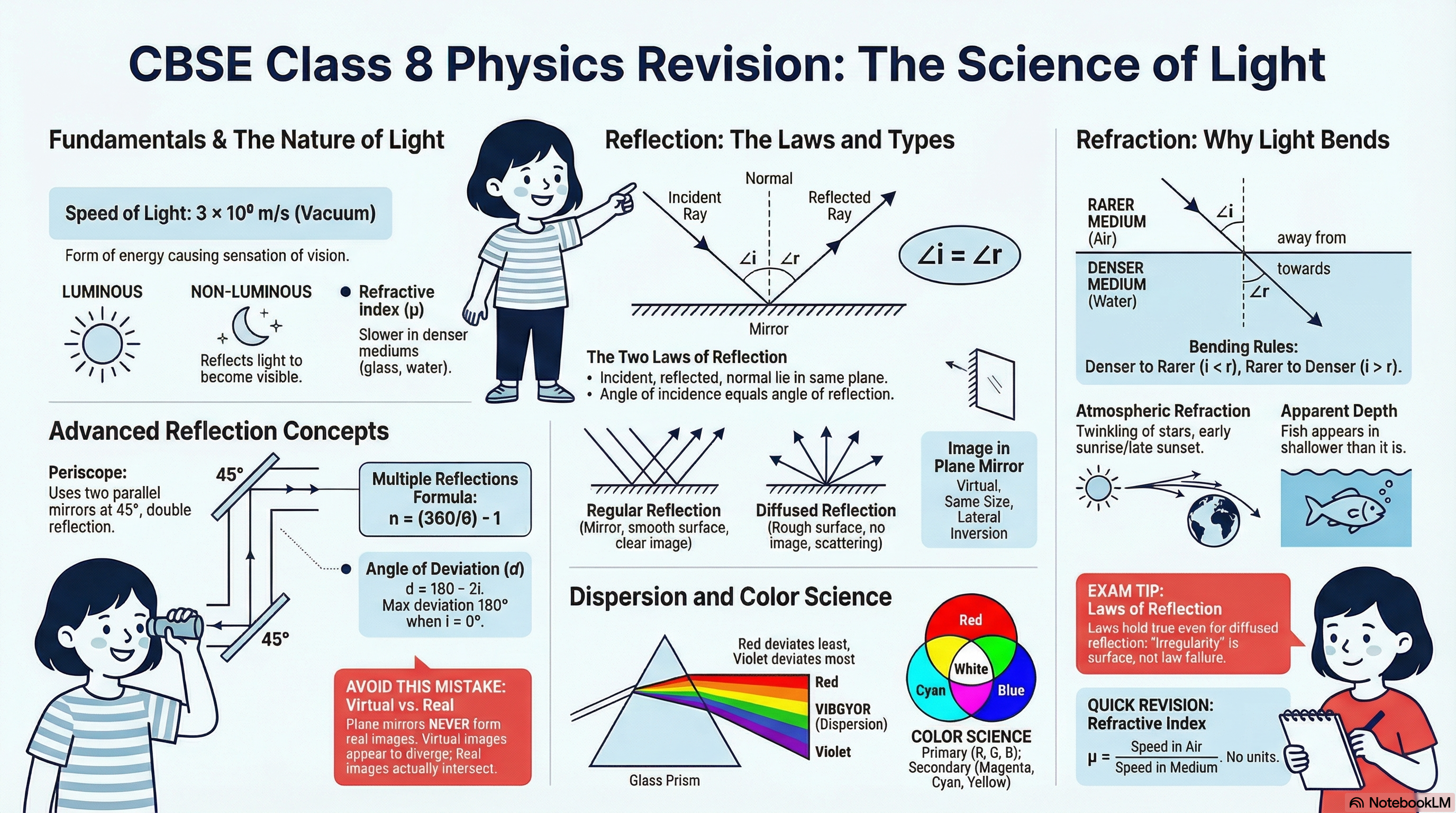
Light is a form of energy that:
- Produces the sensation of vision
- Travels in straight lines
- Can be reflected, refracted, and dispersed
- Travels at approximately 3 × 10⁸ m/s (186,000 miles per second) in vacuum
- Does not require a material medium for propagation
Important Terms
| Term | Definition | Example |
|---|---|---|
| Luminous Objects | Objects that emit their own light | Sun, burning candle, tube light |
| Non-luminous Objects | Objects that do not emit light but reflect it | Moon, table, books |
| Ray of Light | The path followed by light energy in a transparent medium | Straight line representation |
| Beam of Light | A group of parallel rays of light | Sunlight through window |
| Reflection | Bouncing back of light when it falls on a surface | Mirror reflection |
| Refraction | Bending of light when passing from one medium to another | Bent appearance of stick in water |
| Dispersion | Splitting of white light into constituent colors | Rainbow formation |
| Spectrum | Band of colors obtained from dispersion (VIBGYOR) | Red, Orange, Yellow, Green, Blue, Indigo, Violet |
Nature of Light
Light is a unique form of energy with special characteristics:
Properties:
- Energy Form: Light can be transformed into other forms of energy (heat, electrical, chemical)
- Invisibility: Light itself is invisible; we only see objects when light reflects from them
- Example: Dust particles in air make the light beam visible through scattering
- In a dust-free room, the beam becomes invisible
- No Medium Required: Light can travel through vacuum (unlike sound)
- Sunlight reaches Earth through empty space
- High Speed: Light travels at 3 × 10⁸ m/s in vacuum
- Speed varies in different media (slower in glass, water, etc.)
- Rectilinear Propagation: Light travels in straight lines
- Shadows are formed because light cannot bend around objects
Speed of Light in Different Media:
- Vacuum/Air: 3 × 10⁸ m/s
- Water: ~2.25 × 10⁸ m/s
- Glass: ~2 × 10⁸ m/s
- Diamond: ~1.24 × 10⁸ m/s
CBSE Class 8 Science Notes Chapter-wise
Reflection of Light
What is Reflection?
When a ray of light falls on any surface, a part of the light is sent back to the same medium. This phenomenon is called reflection.
Daily Life Examples:
- Seeing yourself in a mirror
- Reflection from water surface
- Shiny metal surfaces reflecting light
Types of Reflection
1. Regular Reflection (Specular Reflection)
Definition: Reflection from smooth, polished surfaces where parallel incident rays remain parallel after reflection.
Characteristics:
- Occurs on mirrors, polished metals, calm water
- Produces clear, defined images
- All reflected rays follow the same pattern
Example: Reflection from a plane mirror, car windshield, still water
2. Irregular Reflection (Diffused Reflection)
Definition: Reflection from rough, unpolished surfaces where parallel incident rays scatter in different directions.
Characteristics:
- Occurs on walls, paper, wood, clothing
- No clear image is formed
- Makes surfaces visible without forming images
- This is why we can see non-luminous objects
Example: Reading a book, seeing walls, viewing matte surfaces
Important Point: Both types follow the laws of reflection, but surface roughness determines whether reflection is regular or diffused.
Reflection by a Plane Surface
Important Terminology
When light reflects from a plane mirror, several key terms are used:
1. Incident Ray (AO): The ray of light approaching the mirror
2. Point of Incidence (O): The point where the incident ray strikes the mirror surface
3. Normal (ON): A perpendicular line drawn to the surface at the point of incidence
4. Reflected Ray (OB): The ray of light bouncing back from the mirror
5. Angle of Incidence (∠i): The angle between the incident ray and the normal
6. Angle of Reflection (∠r): The angle between the reflected ray and the normal
Important Notes:
- All angles are measured from the normal, not from the mirror surface
- The normal is always perpendicular (90°) to the mirror surface
Laws of Reflection
Reflection of light follows two fundamental laws:
Law 1: Coplanarity
Statement: The incident ray, the reflected ray, and the normal at the point of incidence all lie in the same plane.
Meaning: All three elements exist in one flat surface (plane)
Law 2: Equality of Angles
Statement: The angle of incidence is equal to the angle of reflection.
Mathematical Expression:
∠i = ∠r
Notable Points:
- These laws apply to ALL types of reflection (regular and irregular)
- Valid for all types of surfaces (smooth or rough)
- All angles are measured from the normal
Angle of Deviation
Definition: The angle through which the incident ray is turned after reflection.
Formula:
Angle of Deviation (d) = 180° - 2i
Where i is the angle of incidence
Special Cases:
- When i = 0° (perpendicular incidence): d = 180° (maximum deviation - ray retraces path)
- When i = 90° (grazing incidence): d = 0° (ray continues along surface)
Real and Virtual Images
Real Image
An image formed when light rays actually converge (meet) at a point after reflection or refraction.
Characteristics:
- Can be obtained on a screen
- Formed by actual intersection of light rays
- Cannot be seen directly by the human eye (unless captured on screen)
- Usually inverted
Example: Image formed by a concave mirror, cinema screen projection
Virtual Image
An image formed when light rays appear to diverge from a point but do not actually meet.
Characteristics:
- Cannot be obtained on a screen
- Formed by the apparent intersection of light rays when produced backward
- Can be seen directly by the human eye
- Usually erect (upright)
Example: Image formed by a plane mirror, image in a periscope
Why We See Virtual Images: Light rays appear to come from the image position, so our eyes perceive them as if originating from that point.
Formation of Image by a Plane Mirror
Ray Diagram Construction
To locate the image formed by a plane mirror:
Step 1: Draw two incident rays from the object point to the mirror
Step 2: Draw the reflected rays following the law of reflection (∠i = ∠r)
Step 3: Extend the reflected rays backward (behind the mirror) using dotted lines
Step 4: The point where extended rays meet is the image location
Key Construction Rays:
Ray 1: A ray perpendicular to the mirror (i = 0°)
- Reflects back along the same path
Ray 2: A ray at any other angle
- Reflects such that ∠i = ∠r
Characteristics of Images Formed by Plane Mirrors
Plane mirrors produce images with specific, predictable properties:
1. Nature: Virtual
- Image cannot be caught on a screen
- Formed by apparent intersection of reflected rays
2. Position: Behind the Mirror
- Image distance from mirror = Object distance from mirror
- If object is 5 cm in front, image is 5 cm behind
3. Size: Same as Object
- Image height = Object height
- No magnification or reduction
4. Orientation: Erect (Upright)
- Image is not inverted
- Top remains top, bottom remains bottom
5. Lateral Inversion
- Definition: Left and right sides are interchanged
- Example: When you raise your right hand, the image raises its left hand
- Real-life observation: Ambulance written reversed so it reads correctly in vehicle mirrors
6. Image is Colorful
- All colors are preserved in the image
Summary Table:
| Property | Characteristic |
|---|---|
| Nature | Virtual |
| Position | Same distance behind mirror as object is in front |
| Size | Equal to object size |
| Orientation | Erect (upright) |
| Special Feature | Laterally inverted |
| Color | Same as object |
Practice Concept: If object moves toward mirror with speed v, the image also moves toward mirror (from behind) with speed v. The relative speed of approach between object and image is 2v.
Multiple Reflection
Images Formed by Two Inclined Mirrors
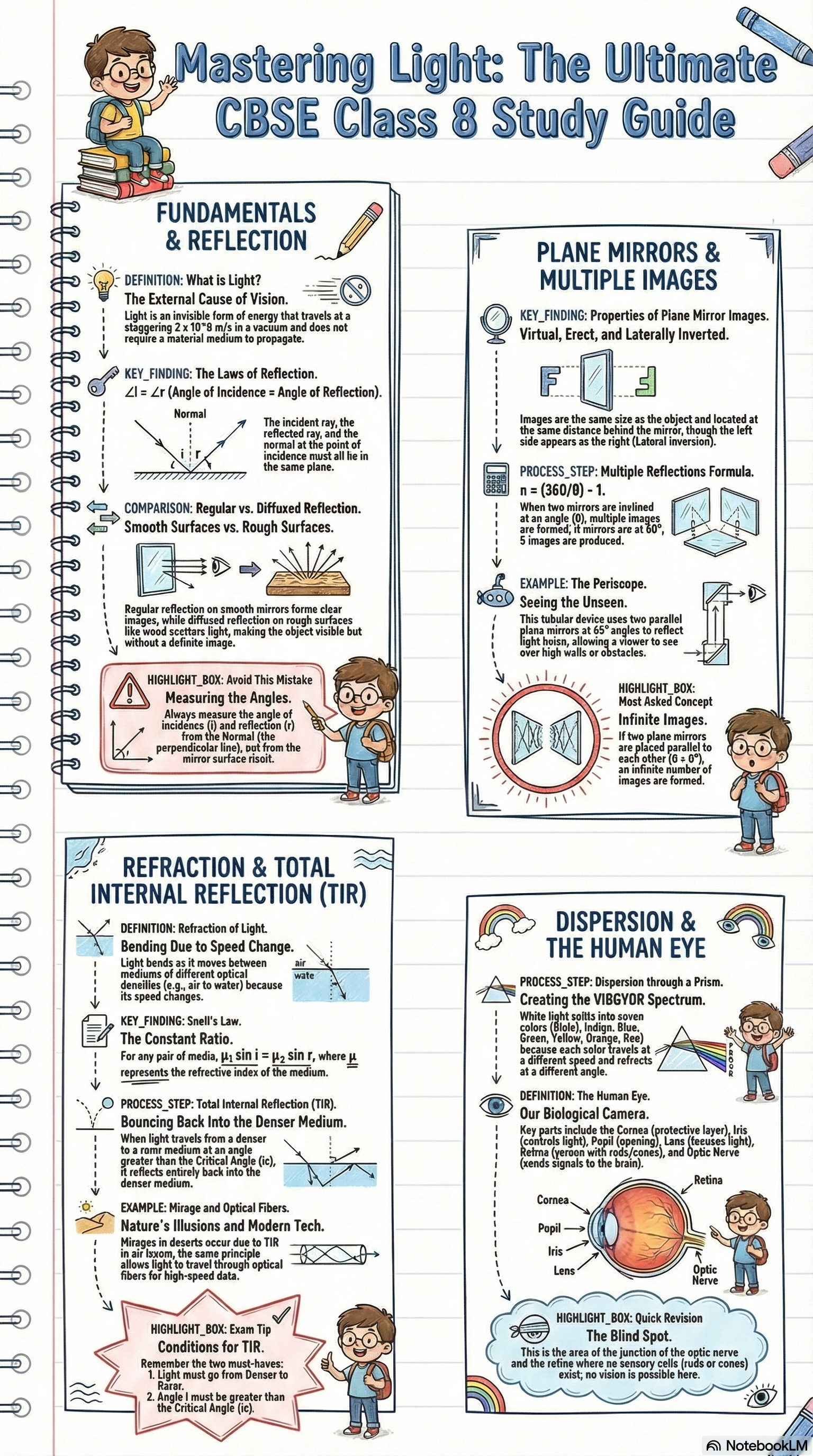
When an object is placed between two plane mirrors inclined at an angle θ, multiple images are formed due to repeated reflections.
Formula for Number of Images
Case 1: When 360°/θ is an even integer
Number of images (n) = (360°/θ) - 1
Example: θ = 60°
n = (360°/60°) - 1 = 6 - 1 = 5 images
Case 2: When 360°/θ is an odd integer
Sub-case A: Object placed symmetrically
n = (360°/θ) - 1
Sub-case B: Object placed asymmetrically
n = 360°/θ
Special Case: Parallel Mirrors (θ = 0°)
n = 360°/0° = ∞ (infinite images)
Common Angles and Image Count:
| Angle (θ) | Number of Images |
|---|---|
| 90° | 3 |
| 60° | 5 |
| 45° | 7 |
| 30° | 11 |
| 0° (parallel) | ∞ |
Applications of Multiple Reflection
1. Periscope
An optical instrument that uses two plane mirrors to see objects that are out of direct line of sight.
Structure:
- Long tubular device
- Two plane mirrors (M₁ and M₂) at both ends
- Mirrors placed parallel to each other
- Each mirror inclined at 45° to the tube sides
- Two holes: one at top (near M₁), one at bottom (near M₂)
Working Principle:
- Light from the object falls on the top mirror (M₁) at 45°
- Reflects downward to the bottom mirror (M₂)
- M₂ reflects the light horizontally to the observer's eye
- Uses the law of reflection twice
Applications:
- Submarines (to see above water surface)
- Viewing over crowds or walls
- Military bunkers and trenches
- Seeing around corners
2. Kaleidoscope
An optical toy/instrument containing inclined plane mirrors that produce multiple reflections of colored objects, creating beautiful symmetrical patterns.
Structure:
- Three rectangular plane mirror strips (15 cm × 4 cm)
- Mirrors inclined at 60° to each other, forming a triangular prism
- Enclosed in a cardboard tube
- One end: Opaque disc with small central hole (eyepiece)
- Other end: Two glass discs
- Inner disc: Transparent glass
- Outer disc: Ground (translucent) glass
- Colored glass/plastic pieces placed between the two glass discs
Working Principle:
- Light enters through the ground glass disc
- Colored pieces act as objects
- Three mirrors create multiple reflections (5 images with 60° angle)
- Reflections form symmetrical, beautiful patterns
- Rotating the tube rearranges pieces, creating new patterns
Feature: No pattern ever repeats - infinite unique designs
Applications:
- Toy for entertainment
- Designers use for inspiration (wallpapers, fabrics, rangoli)
- Artists use for creating patterns
- Teaching tool for symmetry and reflection
Mathematical Basis: With 60° angle between mirrors:
- Number of images = (360°/60°) - 1 = 5 images
- Plus the original object = 6 visible elements forming pattern
Refraction of Light
What is Refraction?
The deviation (bending) in the path of light when it passes from one medium to another medium of different optical density.
Cause of Refraction: Light changes speed when entering a different medium, causing its path to bend.
Common Observations:
- A swimming pool appears shallower than it actually is
- A straight stick partly immersed in water appears bent at the surface
- A coin at the bottom of a glass appears raised when filled with water
- Stars appear to twinkle due to atmospheric refraction
Important Terms in Refraction
Using the same ray diagram terminology:
1. Incident Ray: Ray approaching the boundary between two media
2. Point of Incidence: Point where light strikes the boundary
3. Normal: Perpendicular to the surface at the point of incidence
4. Refracted Ray: Ray that travels into the second medium after bending
5. Angle of Incidence (i): Angle between incident ray and normal
6. Angle of Refraction (r): Angle between refracted ray and normal
Refractive Index
Refractive Index (μ): The ratio of the speed of light in one medium to the speed of light in another medium.
Mathematical Expression
For light traveling from Medium 1 to Medium 2:
₁μ₂ = (Speed of light in Medium 1) / (Speed of light in Medium 2)
Absolute Refractive Index
When Medium 1 is vacuum or air:
μ = (Speed of light in vacuum) / (Speed of light in the medium)
μ = c / v
Where:
- c = 3 × 10⁸ m/s (speed in vacuum)
- v = speed in the medium
Refractive Index Values
| Medium | Refractive Index (μ) |
|---|---|
| Vacuum/Air | 1.0 |
| Water | 1.33 |
| Glass | 1.5 |
| Kerosene | 1.44 |
| Diamond | 2.42 |
Optical Density
Optically Denser Medium: Has higher refractive index
- Example: Glass is denser than water
Optically Rarer Medium: Has lower refractive index
- Example: Air is rarer than glass
Important: Optical density ≠ Mass density
- Kerosene (less mass density) has higher optical density than water
Refraction Behavior
Light traveling from Rarer to Denser medium:
- Bends TOWARD the normal
- Angle of refraction < Angle of incidence (r < i)
- Speed decreases
Light traveling from Denser to Rarer medium:
- Bends AWAY FROM the normal
- Angle of refraction > Angle of incidence (r > i)
- Speed increases
Snell's Law of Refraction
Statement
The product of the refractive index of the first medium and the sine of the angle of incidence equals the product of the refractive index of the second medium and the sine of the angle of refraction.
Mathematical Expression
μ₁ sin i = μ₂ sin r = constant
Or, rearranged:
μ₁/μ₂ = sin r / sin i
Laws of Refraction
Law 1: The incident ray, refracted ray, and normal at the point of incidence all lie in the same plane.
Law 2: The ratio of sine of angle of incidence to sine of angle of refraction is constant for a given pair of media (Snell's Law).
Relationship with Speed
Since μ = c/v, Snell's law can also be expressed as:
sin i / sin r = v₁ / v₂
This shows refraction occurs due to change in speed of light.
Critical Angle and Total Internal Reflection
Critical Angle
The angle of incidence in the denser medium for which the angle of refraction in the rarer medium is 90° (ray grazes along the surface).
Conditions:
- Light must travel from denser to rarer medium
- Applies only at specific angle
Symbol: i_c or C
For Different Media:
| Medium Pair | Critical Angle |
|---|---|
| Glass-Air | ~42° |
| Water-Air | ~49° |
| Diamond-Air | ~24° |
Calculation: Using Snell's Law at critical angle:
μ_denser × sin C = μ_rarer × sin 90°
μ_denser × sin C = μ_rarer × 1
sin C = μ_rarer / μ_denser
For medium-air interface:
sin C = 1/μ
Total Internal Reflection
When light traveling from denser to rarer medium is completely reflected back into the denser medium instead of refracting.
Conditions Required:
- Light must travel from denser to rarer medium
- Example: Glass to air, water to air
- Angle of incidence must be greater than critical angle
- i > C
What Happens:
- No refraction occurs
- 100% of light is reflected back
- Follows laws of reflection
- Reflection is complete and perfect
Behavior at Different Angles:
| Condition | What Happens |
|---|---|
| i < C | Mostly refraction, little reflection |
| i = C | Refraction at 90° (grazing) |
| i > C | Total internal reflection |
Applications of Total Internal Reflection
1. Sparkling of Diamond
Why Diamonds Sparkle:
- Diamond has very high refractive index (μ = 2.42)
- Critical angle is very small (~24°)
- Diamond is cut with specific angles
- Most light rays entering undergo total internal reflection multiple times
- Light bounces inside and emerges from top
- Creates brilliant sparkle and fire
Cutting Strategy: Diamonds are cut so incident angles exceed critical angle, maximizing total internal reflection.
2. Mirage
Definition: An optical illusion observed in deserts where distant objects appear inverted, and the ground appears to have water.
Cause: Total internal reflection of light through air layers of different temperatures.
How It Forms:
In Deserts (Hot Surface):
- Sand becomes very hot during daytime
- Air layer near sand is hottest (least dense, optically rarest)
- Upper air layers are cooler (denser)
- Light from tree top travels downward
- Continuously refracts away from normal (toward horizontal)
- At some layer, angle exceeds critical angle
- Total internal reflection occurs
- Light travels upward to observer's eye
- Observer sees inverted image below object
- Brain interprets this as reflection in water
3. Looming
A type of mirage observed over cold surfaces (like sea) where objects appear floating in air above their actual position.
How It Forms:
Over Water Bodies:
- Water surface is cool
- Air near water is cooler (denser)
- Upper air is warmer (less dense)
- Light from ship travels upward
- Continuously refracts away from normal (downward)
- Total internal reflection occurs in warm upper layers
- Light bends downward to observer
- Observer sees ship suspended in air above actual position
Difference from Mirage:
| Feature | Mirage | Looming |
|---|---|---|
| Surface | Hot (desert) | Cold (sea) |
| Air Density | Decreases upward | Increases upward |
| Image Position | Below object (inverted) | Above object (upright) |
| Common Location | Deserts, roads | Oceans, large water bodies |
4. Optical Fibers
Very thin, flexible glass or plastic fibers that transmit light through total internal reflection.
Structure:
- Core: High refractive index glass (denser)
- Cladding: Lower refractive index material (rarer)
- Protective outer coating
Working Principle:
- Light enters at one end of fiber
- Strikes core-cladding boundary at angle > critical angle
- Undergoes total internal reflection
- Continues reflecting along the fiber
- Emerges at the other end with minimal loss
Applications:
- Medical: Endoscopy (viewing inside body)
- Communication: High-speed internet, telephone cables
- Imaging: Accessing hard-to-reach areas
- Decoration: Lighting effects
Advantages:
- No signal loss (total reflection)
- Can transmit over long distances
- Flexible and thin
- Immune to electromagnetic interference
- High data transmission capacity
Atmospheric Refraction Phenomena
1. Twinkling of Stars
Cause: Atmospheric refraction through air layers of varying density.
Explanation:
- Starlight enters Earth's atmosphere
- Passes through layers of different temperatures and densities
- Continuously refracts
- Air layers are constantly moving (wind, temperature changes)
- Apparent position of star keeps changing slightly
- Brightness also fluctuates
- This appears as twinkling
Why Planets Don't Twinkle:
- Planets are much closer than stars
- Appear as extended sources (discs) rather than point sources
- Light from different parts of the disc undergoes varying refraction
- Net effect averages out
- Appears steady
2. Advanced Sunrise and Delayed Sunset
Observation: Sun becomes visible ~2 minutes before actual sunrise and remains visible ~2 minutes after actual sunset.
Cause: Atmospheric refraction bends sunlight toward Earth.
Explanation:
- When sun is below horizon, its light enters Earth's atmosphere
- Atmosphere acts as dense medium
- Light bends toward the normal (toward Earth)
- Continuous refraction through various layers
- Light reaches our eyes even when sun is geometrically below horizon
- We see the sun even though it's actually not risen yet
Effect:
- Day is extended by approximately 4 minutes daily
- Actual sunrise occurs after we see it
- Actual sunset occurs before it disappears from view
3. Apparent Star Position
Fact: Stars appear slightly higher than their actual geometric position.
Reason:
- Atmospheric refraction bends starlight toward normal
- Normal points toward Earth center
- Refracted light appears to come from a higher position
Dispersion of Light
What is Dispersion?
The phenomenon of splitting white light into its constituent colors when passed through a transparent medium (like a prism).
Discovered by: Sir Isaac Newton (1665)
Colors Obtained: Seven colors - VIBGYOR
- Violet
- Indigo
- Blue
- Green
- Yellow
- Orange
- Red
Newton's Experiment
Setup:
- Darkened room
- Small hole in window shutter allowing sunlight
- Glass prism placed in path of light beam
- White screen to observe result
Observation:
- White circular patch on screen (without prism)
- Band of seven colors on screen (with prism)
- Colors arranged in specific order (VIBGYOR)
- Red deviates least, violet deviates most
Conclusion: White light is composed of seven different colors.
Why Dispersion Occurs
Cause: Different colors of light have different speeds in a medium.
Explanation:
- White light contains multiple wavelengths
- Each color has different wavelength
- Refractive index varies for different wavelengths
- Violet: Highest refractive index → Maximum bending
- Red: Lowest refractive index → Minimum bending
- All colors refract at different angles
- They separate out as distinct colors
Spectrum: The band of colors obtained from dispersion is called a spectrum.
Types of Spectrum:
- Impure Spectrum: Colors merge into each other (from prism)
- Pure Spectrum: Colors have sharp boundaries (using additional lenses)
Order of Deviation: Violet > Indigo > Blue > Green > Yellow > Orange > Red
Wavelength Order: Red (longest) > Orange > Yellow > Green > Blue > Indigo > Violet (shortest)
Frequency Order: Violet (highest) > Indigo > Blue > Green > Yellow > Orange > Red (lowest)
Rainbow Formation
Natural Dispersion: Rainbow is nature's display of dispersion.
How It Forms:
- Sunlight enters water droplets in atmosphere
- Refraction occurs (dispersion begins)
- Internal reflection inside droplet
- Refraction again while exiting (dispersion completes)
- Different colors reach observer at different angles
- Observer sees arc of colors
Types:
- Primary Rainbow: One internal reflection (VIBGYOR from top to bottom)
- Secondary Rainbow: Two internal reflections (ROYGBIV - reversed order, fainter)
Colors
Primary Colors
Colors that cannot be produced by mixing other colors.
The Three Primary Colors:
- Red
- Green
- Blue
Also aalled Additive Primary Colors
Property: Mixing all three primary colors in equal proportions produces white light.
Red + Green + Blue = White
Secondary Colors
Colors produced by mixing two primary colors.
Also called Composite Colors or Subtractive Primaries
The Three Secondary Colors:
- Magenta (Red + Blue)
- Cyan (Blue + Green)
- Yellow (Red + Green)
Mixing Formulas:
Red + Blue = Magenta
Blue + Green = Cyan
Red + Green = Yellow
Complementary Colors
Definition: Pairs of colors that combine to produce white light.
Complementary Pairs:
| Color | Complementary Color | Result |
|---|---|---|
| Red | Cyan | White |
| Green | Magenta | White |
| Blue | Yellow | White |
Verification:
Red + Cyan = Red + (Blue + Green) = Red + Blue + Green = White
Green + Magenta = Green + (Red + Blue) = Red + Green + Blue = White
Blue + Yellow = Blue + (Red + Green) = Red + Green + Blue = White
Color Mixing Summary Table
| Colors Mixed | Resulting Color |
|---|---|
| Red + Green | Yellow |
| Red + Blue | Magenta |
| Blue + Green | Cyan |
| Red + Green + Blue | White |
| Red + Cyan | White |
| Green + Magenta | White |
| Blue + Yellow | White |
Human Eye
Structure of Human Eye
The human eye is a remarkable natural optical instrument that enables vision.
Main Parts and Functions:
1. Cornea
Transparent, curved outer layer at the front of the eye
Functions:
- Acts as the window/aperture of the eye
- Allows light to enter
- Provides ~65-75% of the eye's focusing power
- Protects the internal eye components
Properties:
- Transparent and bulging
- No blood vessels
- Very sensitive
2. Iris
Colored, circular muscular diaphragm behind the cornea
Functions:
- Controls the size of the pupil
- Regulates amount of light entering the eye
- Gives eye its color (brown, blue, green, etc.)
How It Works:
- Bright light: Iris expands → Pupil becomes smaller → Less light enters
- Dim light: Iris contracts → Pupil becomes larger → More light enters
3. Pupil
Small circular opening in the center of the iris
Functions:
- Entry point for light into the eye
- Size changes automatically based on light intensity
Properties:
- Appears black (no light reflects from it)
- Diameter: 2-8 mm (varies with light)
4. Eye Lens (Crystalline Lens)
Transparent, flexible, biconvex lens behind the pupil
Functions:
- Fine-tunes focus of light on retina
- Provides remaining ~25-35% focusing power
- Changes shape to focus on near/far objects (accommodation)
Properties:
- Made of transparent, flexible tissue
- Held in position by ciliary muscles
- Can change curvature
5. Ciliary Muscles
Ring of muscles surrounding the eye lens
Functions:
- Control the focal length of the eye lens
- Enable accommodation (focusing on different distances)
How They Work:
- For distant objects: Muscles relax → Lens becomes thin → Focal length increases
- For near objects: Muscles contract → Lens becomes thick → Focal length decreases
6. Retina
Light-sensitive screen at the back of the eye
Functions:
- Acts as screen where image is formed
- Contains photoreceptor cells (rods and cones)
- Converts light energy into electrical nerve impulses
Properties:
- Contains ~125 million rods and ~6 million cones
- Very delicate and sensitive
Types of Cells:
Rods:
- Sensitive to dim light
- Responsible for vision in low light
- Cannot detect color
- ~125 million in number
Cones:
- Sensitive to bright light and color
- Three types: Red-sensitive, Green-sensitive, Blue-sensitive
- Enable color vision
- ~6 million in number
- Concentrated at fovea (central region)
7. Optic Nerve
Bundle of nerve fibers connecting retina to brain
Functions:
- Carries electrical signals from retina to brain
- Transmits visual information for interpretation
Blind Spot:
- Point where optic nerve exits the eye
- No rods or cones present
- Cannot detect light
- Brain fills in this gap
8. Other Parts
Aqueous Humor: Watery fluid between cornea and lens
Vitreous Humor: Jelly-like substance filling main eye cavity
Sclera: White outer protective layer
Choroid: Middle layer with blood vessels
How We See Objects
Step-by-Step Process:
- Light enters: Passes through cornea
- Light regulated: Iris adjusts pupil size
- Refraction 1: Cornea bends light
- Refraction 2: Eye lens fine-tunes focus
- Image formation: Real, inverted image forms on retina
- Light detection: Rods and cones detect light
- Signal conversion: Photoreceptors convert light to electrical signals
- Signal transmission: Optic nerve carries signals to brain
- Image interpretation: Brain processes signals and interprets as upright image
Persistence of Vision:
- Image formed on retina persists for ~1/16 second
- If multiple images appear faster than this, they appear continuous
- Basis for movies and animation (24 frames/second)
Color Vision and Deficiency
How We See Colors
Trichromatic Theory:
- Retina has three types of cone cells
- Each sensitive to one primary color (Red, Green, Blue)
- Brain combines signals from three types
- Creates perception of all colors
Color Perception:
- White light: All three cones equally stimulated
- Red object: Only red cones stimulated strongly
- Other colors: Different combinations of cone stimulation
Color Blindness (Color Deficiency)
Inability to distinguish between certain colors due to malfunction or absence of specific cone cells.
Also called Daltonism (after John Dalton, who was color blind)
Types:
- Red-Green Color Blindness (Most common)
- Cannot distinguish between red and green
- Appears as shades of yellow/brown
- Blue-Yellow Color Blindness (Rare)
- Cannot distinguish between blue and yellow
- Complete Color Blindness (Very rare)
- Sees only shades of gray
- All cones absent or non-functional
Causes:
- Genetic (inherited, X-linked recessive)
- Cone cells absent or malfunctioning
- More common in males than females
Detection:
- Ishihara Color Test (plates with colored dots)
- Cannot be cured currently
- Managed with special lenses and aids
Animal Color Vision
Different animals have different color perception:
| Animal | Color Vision | Reason |
|---|---|---|
| Humans | Full color (trichromatic) | Three types of cones |
| Dogs | Limited (dichromatic) | Only two types of cones |
| Cats | Limited | Mostly rods, few cones |
| Bees | UV vision | Can see ultraviolet |
| Birds | Superior color vision | Four types of cones |
| Chickens | Good day vision | Many cones, few rods |
| Owls | Excellent night vision | Mostly rods, few cones |
Rod vs Cone Distribution:
- Chickens: Mostly cones → See well in bright light, poor in dark → Sleep at sunset
- Owls: Mostly rods → See well in dim light → Active at night
Important Eye Care Tips
Maintaining Healthy Vision
- Reading Distance: Maintain at least 25 cm between book and eyes
- Lighting: Ensure proper lighting while reading or working
- Rest: Give eyes regular breaks during prolonged reading/screen time (20-20-20 rule: Every 20 minutes, look at something 20 feet away for 20 seconds)
- Nutrition: Consume Vitamin A-rich foods
- Protection: Wear sunglasses in bright sunlight
- Rubbing: Avoid rubbing eyes with dirty hands
- Check-ups: Regular eye examinations
Vitamin A for Eyes
Importance:
- Essential for healthy retina
- Maintains rod and cone function
- Deficiency causes night blindness
Food Sources:
- Carrots
- Green leafy vegetables (spinach, broccoli)
- Papaya, mangoes
- Milk and dairy products
- Cod liver oil
- Eggs
Common Vision Defects
Myopia (Short-sightedness):
- Can see near objects clearly
- Distant objects appear blurred
- Corrected with concave lens
Hypermetropia (Long-sightedness):
- Can see distant objects clearly
- Near objects appear blurred
- Corrected with convex lens
Presbyopia:
- Age-related focusing difficulty
- Cannot see both near and far clearly
- Corrected with bifocal lens
Enhanced Study Notes
Quick Revision Points
Light Fundamentals:
- Light = Energy that produces vision
- Speed in vacuum = 3 × 10⁸ m/s
- Travels in straight lines (rectilinear propagation)
- No medium required for travel
Reflection Important Points:
- Incident ray, reflected ray, normal - same plane
- ∠i = ∠r (always)
- Deviation = 180° - 2i
- Regular reflection → smooth surface → clear images
- Irregular reflection → rough surface → no clear images
Plane Mirror Images:
- Virtual, erect, same size
- Distance behind mirror = Distance in front
- Laterally inverted
- Can be seen but not caught on screen
Multiple Images:
- n = (360°/θ) - 1 when 360°/θ is even
- Periscope: Two mirrors at 45°, parallel arrangement
- Kaleidoscope: Three mirrors at 60°, beautiful patterns
Refraction Essentials:
- Bending of light when medium changes
- Cause: Change in speed of light
- Rarer to denser: Bends toward normal (r < i)
- Denser to rarer: Bends away from normal (r > i)
Refractive Index:
- μ = c/v = Speed in vacuum / Speed in medium
- Higher μ = Optically denser
- Water: 1.33, Glass: 1.5, Diamond: 2.42
Snell's Law:
- μ₁ sin i = μ₂ sin r
- Constant for given pair of media
Total Internal Reflection:
- Conditions: (1) Denser to rarer, (2) i > Critical angle
- Applications: Diamond sparkle, mirage, optical fibers
- Critical angle: sin C = μ_rarer/μ_denser
Dispersion:
- White light → Seven colors (VIBGYOR)
- Cause: Different colors have different speeds
- Violet deviates most, red deviates least
- Rainbow: Natural dispersion
Colors:
- Primary: Red, Green, Blue
- Secondary: Magenta, Cyan, Yellow
- Complementary pairs produce white
- Red + Green + Blue = White
Human Eye:
- Cornea: Transparent window, main focusing
- Iris: Colored part, controls pupil size
- Pupil: Opening for light entry
- Lens: Fine-tunes focus, changes shape
- Retina: Screen with rods (dim light) and cones (color)
- Optic nerve: Carries signals to brain
Vision Facts:
- Persistence: Image stays 1/16 second on retina
- Near point: 25 cm for normal eye
- Color blindness: Absence/malfunction of cones
- Vitamin A: Essential for healthy vision
Memory Tricks and Mnemonics
1. VIBGYOR for Spectrum Colors:
- Violet Indigo Blue Green Yellow Orange Red
- Memory aid: Vibgyor is the rainbow color
2. Laws of Reflection:
- Same Plane, Same Angle
- In reflection, angles match, all in one plane attach
3. Refraction Direction:
- Rarer to Denser = Ray Bends IN (toward normal)
- Denser to Rarer = Ray Bends OUT (away from normal)
- Dense pulls in, rare pushes out
4. Primary Colors:
- RGB = Red, Green, Blue
- Think: "TV/Monitor RGB pixels"
5. Secondary Colors:
- MCY = Magenta, Cyan, Yellow
- Mixing two primaries gives one secondary
6. Complementary Pairs:
- Red ↔ Cyan (remember: Red + Cyan = White)
- Green ↔ Magenta
- Blue ↔ Yellow
- Pattern: Primary ↔ Mix of other two primaries
7. Eye Parts (Front to Back):
- Cornea Iris Pupil Lens Retina Optic nerve
- "CIPLO - See clearly, use eye drops" (playful)
8. Refractive Index Order:
- Air < Water < Glass < Diamond
- "As We Go Deep" (Alphabetical first letters)
9. Total Internal Reflection Conditions:
- 2D >C: Denser to rarer (D), angle greater than Critical (>C)
10. Rod vs Cone:
- Rods for Rough/dim light (night vision)
- Cones for Color and bright light
Summary Tables
Reflection vs Refraction
| Property | Reflection | Refraction |
|---|---|---|
| Definition | Bouncing back of light | Bending of light when medium changes |
| Medium | Same medium | Different media |
| Speed of light | Unchanged | Changes |
| Laws | ∠i = ∠r | μ₁ sin i = μ₂ sin r |
| Example | Mirror, polished surface | Glass prism, water surface |
Plane Mirror vs Real Object
| Property | Object | Image |
|---|---|---|
| Position | In front of mirror | Behind mirror (equal distance) |
| Size | Original | Same as object |
| Nature | Real | Virtual |
| Orientation | Upright | Upright but laterally inverted |
| Can be caught on screen? | Yes (it's real) | No |
Refractive Indices
| Medium | Refractive Index (μ) | Speed of Light |
|---|---|---|
| Vacuum | 1.0 | 3 × 10⁸ m/s |
| Air | ~1.0003 | ~3 × 10⁸ m/s |
| Water | 1.33 | 2.25 × 10⁸ m/s |
| Glass | 1.5 | 2 × 10⁸ m/s |
| Diamond | 2.42 | 1.24 × 10⁸ m/s |
Primary vs Secondary Colors
| Type | Colors | How Produced | Mix All Three |
|---|---|---|---|
| Primary | Red, Green, Blue | Cannot be produced by mixing | White |
| Secondary | Magenta, Cyan, Yellow | Mix two primaries | White |
Rods vs Cones
| Feature | Rods | Cones |
|---|---|---|
| Number | ~125 million | ~6 million |
| Function | Dim light vision | Bright light and color vision |
| Color detection | No | Yes (3 types: R, G, B) |
| Sensitivity | Very sensitive | Less sensitive |
| Location | Spread throughout retina | Concentrated at fovea |
Solved Examples
Example 1: Laws of Reflection - Angle Calculation
Question: A ray of light is incident on a plane mirror at an angle of 35°. What will be the angle of reflection?
Solution: According to the law of reflection:
Angle of incidence (i) = Angle of reflection (r)
Given: i = 35°
Therefore: r = 35°
Answer: The angle of reflection is 35°.
Example 2: Angle of Deviation
Question: For an angle of incidence of 40° on a plane mirror, calculate the angle of deviation.
Solution: Formula for angle of deviation:
d = 180° - 2i
Given: i = 40°
Calculation:
d = 180° - 2(40°)
d = 180° - 80°
d = 100°
Answer: The angle of deviation is 100°.
Example 3: Maximum Deviation
Question: What is the maximum angle of deviation possible for a ray reflecting from a plane mirror?
Solution: Angle of deviation: d = 180° - 2i
For maximum deviation, we need minimum value of 2i. Minimum value of i = 0° (perpendicular incidence)
Therefore:
d_max = 180° - 2(0°)
d_max = 180°
When light falls perpendicularly (i = 0°), it retraces its path, giving maximum deviation of 180°.
Answer: Maximum angle of deviation is 180°.
Example 4: Mirror Distance and Image Position
Question: An object is placed 10 cm in front of a plane mirror. Where will the image be formed, and what will be the distance between the object and its image?
Solution:
Property: Image distance behind mirror = Object distance in front
Object distance from mirror = 10 cm
Therefore:
- Image distance behind mirror = 10 cm
- Total distance between object and image = 10 + 10 = 20 cm
Answer:
- Image is formed 10 cm behind the mirror
- Distance between object and image = 20 cm
Example 5: Number of Images - Inclined Mirrors
Question: Two plane mirrors are inclined at an angle of 60°. How many images will be formed of an object placed between them?
Solution: Formula when 360°/θ is an even integer:
n = (360°/θ) - 1
Given: θ = 60°
Check: 360°/60° = 6 (even integer)
Calculation:
n = (360°/60°) - 1
n = 6 - 1
n = 5
5 images will be formed.
Example 6: Number of Images - 90° Angle
Question: How many images are formed when two mirrors are placed at 90° to each other?
Solution:
n = (360°/θ) - 1
Given: θ = 90°
Check: 360°/90° = 4 (even integer)
Calculation:
n = (360°/90°) - 1
n = 4 - 1
n = 3
3 images will be formed.
Example 7: Parallel Mirrors
Question: What happens to the number of images when two plane mirrors are placed parallel to each other?
Solution: For parallel mirrors: θ = 0°
n = 360°/θ
n = 360°/0°
n = ∞ (infinity)
Answer: Infinite images are formed when mirrors are parallel.
Example 8: Refractive Index Calculation
Question: The speed of light in glass is 2 × 10⁸ m/s. Calculate the refractive index of glass. (Speed of light in air = 3 × 10⁸ m/s)
Solution: Formula:
μ = Speed of light in air / Speed of light in glass
Given:
- Speed in air (c) = 3 × 10⁸ m/s
- Speed in glass (v) = 2 × 10⁸ m/s
Calculation:
μ = (3 × 10⁸) / (2 × 10⁸)
μ = 3/2
μ = 1.5
Answer: Refractive index of glass = 1.5
Example 9: Speed of Light in Medium
Question: The refractive index of diamond is 2.42. Calculate the speed of light in diamond.
Solution: Formula:
μ = c / v
Therefore: v = c / μ
Given:
- μ = 2.42
- c = 3 × 10⁸ m/s
Calculation:
v = (3 × 10⁸) / 2.42
v = 1.24 × 10⁸ m/s
Speed of light in diamond = 1.24 × 10⁸ m/s
Example 10: Relative Refractive Index
Question: If the refractive indices of water and glass with respect to air are 1.33 and 1.5 respectively, find the refractive index of glass with respect to water.
Solution: Formula:
water μ glass = μ_glass / μ_water
Given:
- μ_water = 1.33
- μ_glass = 1.5
Calculation:
water μ glass = 1.5 / 1.33
water μ glass = 1.128 ≈ 1.13
Answer: Refractive index of glass with respect to water = 1.13
Example 11: Snell's Law Application
Question: A ray of light traveling in air enters glass (μ = 1.5) at an angle of incidence of 30°. Calculate the angle of refraction.
Solution: Snell's Law:
μ₁ sin i = μ₂ sin r
Given:
- μ₁ (air) = 1
- μ₂ (glass) = 1.5
- i = 30°
Calculation:
1 × sin 30° = 1.5 × sin r
1 × 0.5 = 1.5 × sin r
sin r = 0.5 / 1.5
sin r = 1/3
sin r = 0.333
r = sin⁻¹(0.333)
r ≈ 19.5°
Answer: Angle of refraction ≈ 19.5°
Example 12: Critical Angle Calculation
Question: The refractive index of glass is 1.5. Calculate the critical angle for glass-air interface.
Solution: Formula:
sin C = 1 / μ
Given: μ = 1.5
Calculation:
sin C = 1 / 1.5
sin C = 0.667
C = sin⁻¹(0.667)
C ≈ 42°
Answer: Critical angle ≈ 42°
Example 13: Total Internal Reflection Condition
Question: A ray of light in glass (μ = 1.5) strikes the glass-air boundary at 50°. Will total internal reflection occur?
Solution:
Step 1: Find critical angle
sin C = 1/μ = 1/1.5 = 0.667
C = 42°
Step 2: Compare with angle of incidence Given: i = 50°
Since i (50°) > C (42°), total internal reflection will occur.
Answer: Yes, total internal reflection will occur because the angle of incidence exceeds the critical angle.
Example 14: Object Movement and Image
Question: An object is placed 5 cm in front of a plane mirror. If the object starts moving toward the mirror with a speed of 2 cm/s, at what speed will the image approach the object?
Solution: When object moves toward mirror with speed v:
- Image also moves toward mirror (from behind) with speed v
- Relative speed of approach = v + v = 2v
Given: v = 2 cm/s
Therefore:
Relative speed = 2 × 2 = 4 cm/s
Answer: Image approaches object at 4 cm/s.
Example 15: Assertion-Reason Question
Question:
Assertion (A): A rainbow is formed due to dispersion of sunlight by water droplets.
Reason (R): Different colors of light have different speeds in water.
Choose the correct option:
(a) Both A and R are true, and R is the correct explanation of A
(b) Both A and R are true, but R is not the correct explanation of A
(c) A is true but R is false
(d) A is false but R is true
Solution:
Analysis of Assertion: Rainbow forms when sunlight passes through water droplets, undergoes refraction, internal reflection, and refraction again, causing dispersion. This is TRUE.
Analysis of Reason: Different colors have different wavelengths, and thus different speeds in water (different refractive indices). This causes them to bend at different angles. This is TRUE.
Relationship: The reason correctly explains why dispersion occurs in water droplets, which is the basis of rainbow formation.
Answer: (a) Both A and R are true, and R is the correct explanation of A
Example 16: Case-Based Question - Periscope
Question:A submarine uses a periscope to view objects above water. The periscope has two plane mirrors M₁ and M₂ placed parallel to each other at 45° to the tube sides.
(i) If a light ray falls on M₁ at 45°, at what angle will it reflect?
(ii) After reflection from M₁, at what angle will this ray strike M₂?
(iii) What is the total deviation of the ray after both reflections?
Solution:
(i) According to laws of reflection: ∠i = ∠r If i = 45°, then r = 45°
Answer (i): Ray reflects at 45°
(ii) Since mirrors are parallel and both at 45°:
- Ray from M₁ travels downward at 45° to vertical
- This ray strikes M₂ at 45° angle of incidence
Answer (ii): Ray strikes M₂ at 45°
(iii) Each reflection causes deviation:
- First reflection: d₁ = 180° - 2(45°) = 90°
- Second reflection: d₂ = 180° - 2(45°) = 90°
- Total deviation = 0° (ray emerges parallel to incident direction but displaced)
Answer (iii): Net deviation is 0° (ray direction unchanged, but laterally displaced)
Example 17: Conceptual - Why Diamond Sparkles
Question: Diamond sparkles more than glass. Explain why, using the concept of total internal reflection.
Solution:
Step 1: Compare Refractive Indices
- Diamond: μ = 2.42
- Glass: μ = 1.5
Step 2: Calculate Critical Angles
For diamond:
sin C = 1/2.42 = 0.413
C ≈ 24°
For glass:
sin C = 1/1.5 = 0.667
C ≈ 42°
Step 3: Explain Sparkling
Diamond has:
- Much smaller critical angle (24° vs 42°)
- When cut properly, most internal rays exceed critical angle
- More total internal reflections occur inside diamond
- Light bounces multiple times before emerging
- Creates brilliant sparkle and fire
Glass has larger critical angle, so more light escapes without total internal reflection, resulting in less sparkle.
Answer: Diamond sparkles more because its very small critical angle (24°) causes most light to undergo multiple total internal reflections inside, creating brilliant sparkle, whereas glass with larger critical angle (42°) allows more light to escape.
Example 18: Practical Application - Optical Fiber
Question:An optical fiber has a core of refractive index 1.5 and cladding of refractive index 1.4.
(a) Calculate the critical angle for the core-cladding interface.
(b) Will a ray at 85° to the fiber axis undergo total internal reflection?
Solution:
(a) Critical angle calculation:
For core-cladding interface:
sin C = μ_cladding / μ_core
sin C = 1.4 / 1.5
sin C = 0.933
C = sin⁻¹(0.933)
C ≈ 69°
Answer
(a): Critical angle ≈ 69°
(b) Ray analysis:
If ray is at 85° to fiber axis, angle of incidence on core-cladding boundary:
i = 90° - 85° = 5°
Since i (5°) < C (69°), the ray will NOT undergo total internal reflection initially.
However, in practice, optical fibers are designed so rays enter at specific acceptance angles that ensure all subsequent reflections exceed critical angle.
Answer
(b): At this angle, total internal reflection will not occur because angle of incidence (5°) is less than critical angle (69°).
Example 19: Color Mixing
Question:
(a) What color is produced when red and green lights are mixed?
(b) What color must be added to blue to produce white?
(c) Are magenta and green complementary? Justify.
Solution:
(a) Red + Green From color mixing:
Red + Green = Yellow
Answer (a):Yellow
(b) To produce white from blue: Blue + ? = White
We know:
Blue + Yellow = White
Therefore, Yellow must be added.
Alternatively:
Blue + (Red + Green) = White
So, Red + Green (which equals Yellow) must be added.
Answer (b):Yellow (or Red + Green)
(c) Complementary color check:
Magenta = Red + Blue
Magenta + Green = (Red + Blue) + Green = Red + Green + Blue = White
Since they produce white, they are complementary.
Answer (c):Yes, magenta and green are complementary because their combination produces white light.
Example 20: Human Eye - Numerical
Question: The eye lens has a focal length that can vary from 2 cm to 2.5 cm. If the distance from lens to retina is fixed at 2.5 cm, calculate:
(a) The minimum distance (near point) at which an object can be clearly seen
(b) Can this eye see objects at infinity clearly?
Solution:
This is a simplified model using lens formula:
1/f = 1/v - 1/u
Where:
- f = focal length
- v = image distance (fixed at 2.5 cm for retina)
- u = object distance
(a) For near point (minimum distance):
Use maximum focal length (f = 2.5 cm):
1/2.5 = 1/2.5 - 1/u
1/2.5 - 1/2.5 = -1/u
0 = -1/u
This suggests lens must change more. Use minimum f = 2 cm:
1/2 = 1/2.5 - 1/u
0.5 - 0.4 = -1/u
0.1 = -1/u
u = -10 cm
Answer (a): Near point is approximately 10 cm (actual near point for normal eye is 25 cm; this is simplified model)
(b) For distant objects (u = ∞):
1/f = 1/2.5 - 1/∞
1/f = 1/2.5
f = 2.5 cm
Since the lens can achieve f = 2.5 cm, yes, it can see distant objects.
Answer (b): Yes, this eye can see objects at infinity when focal length is 2.5 cm.
Example 21: Conceptual - Mirage
Question:Explain why a mirage is seen in deserts during hot afternoons but not during cool mornings, using the concept of refraction and total internal reflection.
Solution:
Hot Afternoon Conditions:
- Sand surface becomes extremely hot (60-70°C)
- Air layer immediately above sand is hottest (least dense, lowest refractive index)
- Air temperature decreases with height
- Creates layers of air with gradually increasing density upward
Light Path:
- Light from tree top travels downward through air layers
- Enters progressively rarer (hotter) layers
- Continuously refracts away from normal (bends toward horizontal)
- Eventually angle of incidence exceeds critical angle
- Total internal reflection occurs
- Light travels upward to observer's eye
- Observer sees inverted image, interprets as water reflection
Cool Morning Conditions:
- Sand is cool
- Air layers have nearly uniform temperature
- No significant density gradient
- No progressive refraction
- No total internal reflection
- No mirage
Answer: Mirage occurs in hot afternoons because extreme temperature gradient creates air layers of different densities, causing progressive refraction and eventual total internal reflection of light. In cool mornings, absence of temperature gradient means no density variation, hence no mirage.
Example 22: Comprehensive Problem
Question:A ray of light traveling in air (μ = 1) strikes a glass slab (μ = 1.5) at an angle of 60° to the normal.
(a) Calculate the angle of refraction in glass
(b) If the ray then strikes the glass-air boundary from inside at 50°, will it emerge or undergo total internal reflection?
(c) Calculate the critical angle for glass-air interface
Solution:
(a) Angle of refraction:
Using Snell's Law:
μ₁ sin i = μ₂ sin r
1 × sin 60° = 1.5 × sin r
0.866 = 1.5 × sin r
sin r = 0.866/1.5
sin r = 0.577
r = sin⁻¹(0.577)
r ≈ 35.3°
Answer:
(a): Angle of refraction ≈ 35.3°
(b) Total internal reflection check:
First, find critical angle:
sin C = 1/μ = 1/1.5 = 0.667
C ≈ 42°
Given: Angle of incidence from inside = 50°
Since 50° > 42° (i > C), total internal reflection will occur.
Answer (b): Ray will undergo total internal reflection and will not emerge.
(c) Critical angle:
Already calculated in part (b):
sin C = 1/1.5 = 0.667
C ≈ 42°
Answer (c): Critical angle ≈ 42°
Example 23: Short Answer - Lateral Inversion
Question: What is lateral inversion? Give two practical examples where it creates problems.
Solution:
Lateral inversion is the phenomenon where left and right sides appear interchanged in a plane mirror image.
Why it occurs:
The mirror reverses the image along the axis perpendicular to its surface, causing left-right reversal when facing the mirror.
Practical Problems:
Example 1: Reading in Mirror
- Text appears reversed
- Word "AMBULANCE" written reversed on ambulances so it reads correctly in vehicle rear-view mirrors
Example 2: Clock Reading
- Clock face in mirror shows reversed time
- Can cause confusion when checking time in mirror
Example 3: Medical Procedures
- Dentists must mentally reverse what they see in mouth mirrors
- Requires special training to adapt
Answer: Lateral inversion is the left-right reversal of images in plane mirrors. It causes reading difficulties (hence reversed "AMBULANCE" on emergency vehicles) and requires adaptation in medical procedures using mirrors.
Example 24: Long Answer - Dispersion and Rainbow
Question:
(a) What is dispersion of light?
(b) How did Newton demonstrate dispersion?
(c) Explain rainbow formation using the concept of dispersion
(d) Why does violet deviate more than red?
Solution:
(a) Dispersion Definition:
Dispersion is the phenomenon of splitting white light into its constituent colors (spectrum) when passed through a transparent medium like a prism.
The spectrum produced contains seven colors: Violet, Indigo, Blue, Green, Yellow, Orange, Red (VIBGYOR).
(b) Newton's Experiment:
Setup:
- Darkened room with small hole in shutter
- Sunlight beam passing through hole
- Glass prism in path of light
- White screen to observe result
Observation:
- Without prism: White circular patch
- With prism: Band of seven colors (spectrum)
- Colors always in same order: VIBGYOR
Conclusion: White light is composed of seven different colors, each with different properties.
(c) Rainbow Formation:
Process:
- Sunlight enters water droplets suspended in atmosphere
- First refraction: Light refracts and disperses into colors while entering
- Internal reflection: Colors reflect from back surface of droplet
- Second refraction: Colors refract again while exiting, further separating
- Different colors emerge at different angles
- Violet emerges at ~40°, Red at ~42° to incident light
- Observer sees arc of colors in sky
Types:
- Primary rainbow: One internal reflection, VIBGYOR from top to bottom
- Secondary rainbow: Two internal reflections, reversed order, fainter
(d) Why Violet Deviates More:
Reason 1: Wavelength
- Violet has shortest wavelength (~400 nm)
- Red has longest wavelength (~700 nm)
Reason 2: Refractive Index
- Refractive index varies with wavelength
- Violet: Higher refractive index
- Red: Lower refractive index
Reason 3: Deviation
- Higher refractive index → More bending
- Violet bends most, red bends least
- Hence violet appears at bottom of spectrum, red at top
Answer: (Compiled from above) - Dispersion is splitting of white light into colors. Newton demonstrated it using prism in 1665. Rainbow forms through refraction, internal reflection, and refraction again in water droplets, with different colors emerging at different angles. Violet deviates most because it has shortest wavelength and highest refractive index in water.
Example 25: Application-Based Question
Question: You are given three plane mirrors. How would you arrange them to create a kaleidoscope that produces 5 images? Explain with reasoning.
Solution:
Target: 5 images
Formula: For even integer result:
n = (360°/θ) - 1
Finding the angle:
5 = (360°/θ) - 1
6 = 360°/θ
θ = 360°/6
θ = 60°
Arrangement:
Step 1: Take three rectangular mirror strips (approximately 15 cm × 4 cm)
Step 2: Arrange them at 60° to each other, forming an equilateral triangular prism
Step 3: Reflecting surfaces face inward
Step 4: Fix in cardboard tube
Step 5: Add colored pieces and glass discs at one end, eyepiece at other
Reasoning:
- With 60° angle, formula gives: n = (360°/60°) - 1 = 6 - 1 = 5 images
- Three mirrors at 60° form stable equilateral triangle structure
- Multiple reflections between mirrors create 5 images plus original object
- Total 6 visible elements create beautiful symmetric patterns
Verification: 360°/60° = 6 (even integer) n = 6 - 1 = 5
Answer: Arrange three mirrors at 60° angles to each other forming an equilateral triangular prism. This configuration produces exactly 5 images (plus the original object) creating symmetric 6-fold patterns characteristic of kaleidoscopes.
FAQs on CBSE Class 8 Science Light
Reflection: Light bounces back when it hits a surface, staying in the same medium.
- No change in speed
- Angle of incidence = Angle of reflection
- Example: Mirror, polished surface
Refraction: Light bends when it passes from one medium to another.
- Speed changes
- Path bends toward or away from normal
- Example: Stick appearing bent in water, prism
Difference: Reflection is bouncing back, refraction is bending while passing through.
When you stand in front of a mirror:
- Light from your body falls on the mirror
- Mirror reflects light following laws of reflection
- Reflected rays appear to come from behind the mirror when extended backward
- Your eyes receive these reflected rays
- Brain interprets them as if coming from behind the mirror
- You perceive a virtual image at that position
The image is virtual because light rays don't actually come from behind the mirror; they only appear to diverge from that point.
This is due to refraction of light.
Process:
- Light from pool bottom travels from water (denser) to air (rarer)
- Bends away from normal when exiting water
- Your eye receives these bent rays
- Brain assumes light traveled in straight lines
- Traces rays backward (straight line assumption)
- Concludes object is at a shallower position than actual
Result: Apparent depth < Real depth
Formula: Apparent depth = Real depth / μ_water ≈ Real depth / 1.33
Example: If pool is 2m deep, it appears only 2/1.33 ≈ 1.5m deep.
Lateral Inversion: The phenomenon where left and right appear interchanged in a plane mirror image.
Example: When you raise your right hand, your mirror image raises its left hand.
Why it happens:
It's not actually a left-right swap, but rather a front-back reversal:
- Mirror reverses things along the axis perpendicular to its surface
- When you face the mirror, this perpendicular axis runs left-right for you
- So the reversal appears as left-right swap
Think of it this way: Imagine writing on transparent paper, then viewing from behind - letters appear reversed. Mirror does the same thing optionally.
Practical use:
- "AMBULANCE" written reversed on emergency vehicles
- Reads correctly in rear-view mirrors of vehicles ahead
- Helps drivers quickly recognize and give way
Yes, we can see virtual images in fact, we see them every day in plane mirrors!
Why we can see them:
- Virtual images are formed where light rays appear to come from
- Even though rays don't actually meet there, they enter our eyes
- Our eyes and brain perceive them as real objects
- Example: You clearly see yourself in a mirror
Why they can't be caught on screen:
- Screen can only capture light when actual light rays converge (meet) at that point
- In virtual images, light rays only appear to come from the image location
- No actual light reaches behind the mirror
- Therefore, screen placed at image position receives no light
- Nothing to capture or display
Analogy: It's like seeing a star's position in the sky - we see it clearly, but we can't place a screen in the sky and capture it there because light is actually coming from the star, not from that point in our sky.
Why seven colors:
Actually, a rainbow is a continuous spectrum with infinite color gradations. The "seven colors" (VIBGYOR) are a convenient classification of the visible spectrum, popularized by Newton.
The truth:
- Light wavelengths change continuously from ~400 nm (violet) to ~700 nm (red)
- Infinite intermediate wavelengths exist
- Human eyes can distinguish millions of shades
Why we say seven:
- Historical: Newton initially described 5 colors, later added 2 more to match musical notes
- Practical: Easy to remember and teach
- Cultural: Different cultures recognize different numbers (some say 6, some say 12)
Can it have more visible colors?
The visible spectrum is fixed (400-700 nm), but:
- Infrared (IR) exists beyond red (longer wavelength) - we can't see it
- Ultraviolet (UV) exists beyond violet (shorter wavelength) - we can't see it
- Some animals (bees, birds) can see UV, so they see "more colors" in rainbow
- Special cameras can detect IR and UV, showing colors beyond human vision
Rainbow has infinite color gradations; "seven" is a convenient human classification. The visible range is limited by human eye sensitivity (400-700 nm), though other wavelengths exist beyond our perception.
These are completely different properties:
Optical Density
- Definition: Property of a material that determines how much light slows down when passing through it.
- Measured by: Refractive Index (μ)
- Formula: μ = Speed of light in vacuum / Speed in medium
- Example: Diamond (μ = 2.42) is optically denser than glass (μ = 1.5)
- Meaning: Higher optical density = Light travels slower = More bending
Mass Density
- Definition: Mass per unit volume of a substance.
- Formula: ρ = Mass / Volume
- Unit: kg/m³ or g/cm³
- Example: Iron (7.87 g/cm³) is denser than water (1 g/cm³)
- Meaning: How much matter is packed in a given space
Difference
They are NOT related:
Example: Kerosene vs Water
- Mass density: Kerosene (0.8 g/cm³) < Water (1 g/cm³) - Kerosene floats on water
- Optical density: Kerosene (μ = 1.44) > Water (μ = 1.33) - Light slows more in kerosene
Another example: Turpentine oil
- Lower mass density than water (floats)
- Higher optical density than water (refracts light more)
Optical density measures how much light slows down (refractive index), while mass density measures how much mass is in a given volume. They're independent properties - a material can have high optical density but low mass density (like kerosene).
Stars Twinkle:
Reason: Atmospheric refraction through moving air layers
Process:
- Stars are extremely far away - appear as point sources
- Their light passes through Earth's atmospheric layers
- Air layers have different densities (due to temperature variations)
- These layers constantly move due to wind and convection
- Light path keeps changing randomly
- Star's apparent position and brightness fluctuate
- We see this as twinkling
Planets Don't Twinkle:
Reason 1: Extended Source
- Planets are much closer than stars
- Appear as small discs rather than point sources
- Can be considered collection of many point sources
Reason 2: Averaging Effect
- Light from different parts of the planet's disc undergoes different refractions
- Some parts appear brighter, some dimmer
- Net effect averages out
- Overall brightness remains steady
Analogy:
- Star = Single small light bulb seen from far away - any movement noticeable
- Planet = Array of many small bulbs close together - individual movements average out
Observer Effect: From space (no atmosphere), nothing twinkles - stars and planets both appear steady.
Stars twinkle due to atmospheric refraction of their point-like light through moving air layers. Planets don't twinkle because they're extended sources whose light from different parts averages out the refraction effects.