





Force, friction, and pressure are fundamental concepts in physics that govern how objects interact with each other and their environment. From walking and driving to flying airplanes and drinking through a straw, these principles are at work in our daily lives.
Force is any influence that causes an object to undergo change in movement, direction, or shape. Friction is the resistive force between surfaces that opposes motion, enabling us to walk and drive. Pressure is force distributed over an area, essential for phenomena like atmospheric pressure and hydraulic systems.
What is Force?
Definition of Force
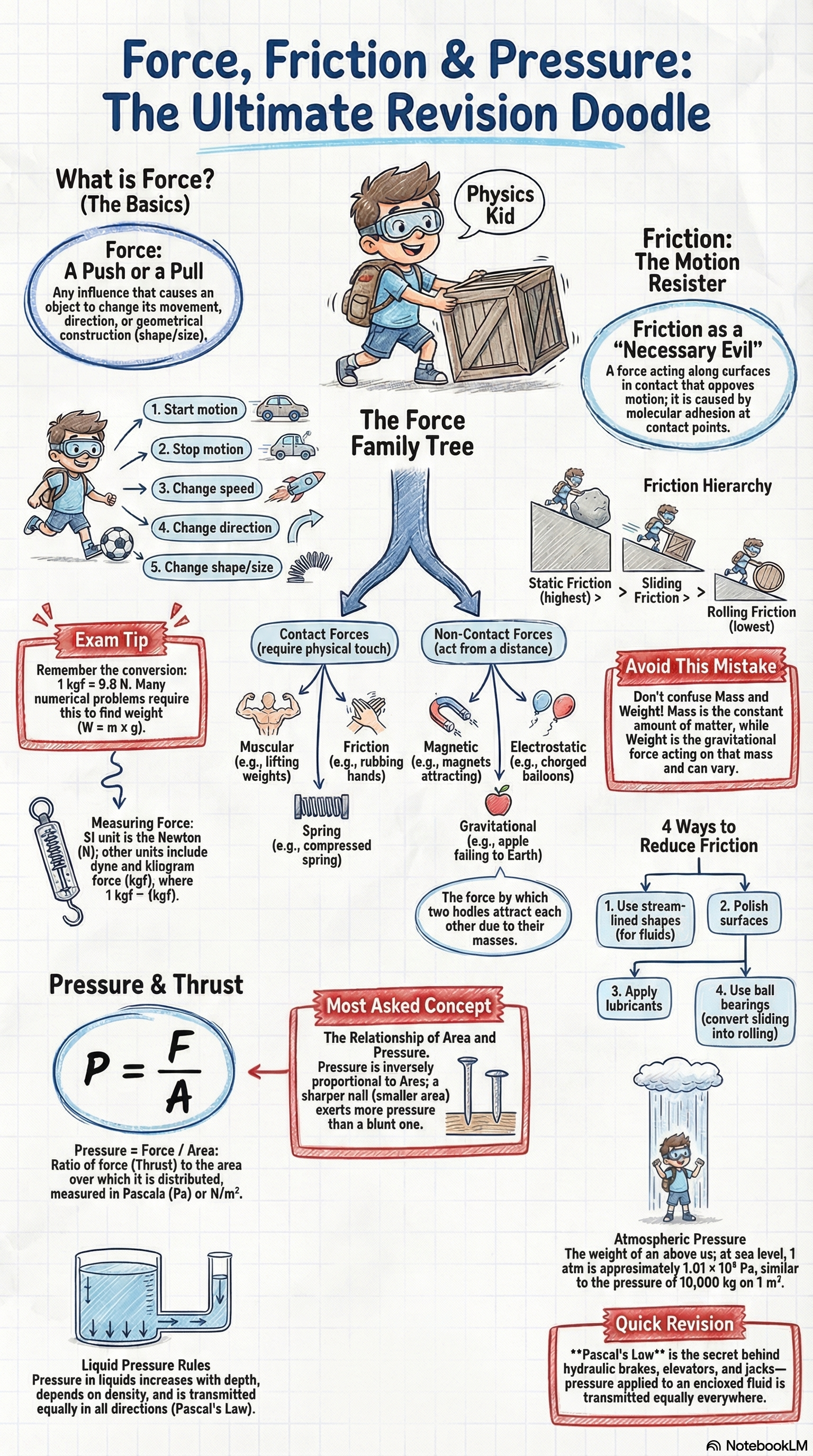
A force is a push or pull that can produce at least one of the following effects:
- Set a body at rest into motion: A football starts moving when kicked
- Stop a moving body: A car stops after hitting a wall
- Change the speed of a moving body: Acceleration or deceleration
- Change the direction of motion: A cricket ball changes direction when hit by a bat
- Change the shape or size of a body: Squeezing a sponge or stretching a rubber band
The direction of force is the direction in which the object is pushed or pulled.
Types of Forces
Forces are classified into two main categories based on whether physical contact is required:
1. Contact Forces
These forces act only when objects are in physical contact with each other.
(a) Muscular Force: Force exerted by muscles during physical activities. Examples include lifting objects, pushing doors, or holding items.
(b) Frictional Force: The force that opposes motion between surfaces in contact. It acts tangentially (parallel) to the contact surface.
(c) Normal Force: The perpendicular force exerted by a surface on an object in contact with it. It acts at right angles to the surface.
(d) Elastic Spring Force: Force exerted by compressed or stretched springs on objects in contact with them.
2. Non-Contact Forces
These forces act from a distance without physical contact.
(a) Magnetic Force: Force exerted by magnets on other magnets or magnetic materials like iron, cobalt, and nickel.
(b) Electrostatic Force: Force resulting from the attraction of opposite charges or repulsion of similar charges.
(c) Gravitational Force: The force by which objects attract each other due to their masses. Earth's gravity pulls all objects toward its center.
Units of Force
- SI Unit: Newton (N)
- CGS Unit: Dyne
- Practical Unit: Kilogram-force (kgf)
- Conversion: 1 kgf = 9.8 N (gravitational force on 1 kg mass)
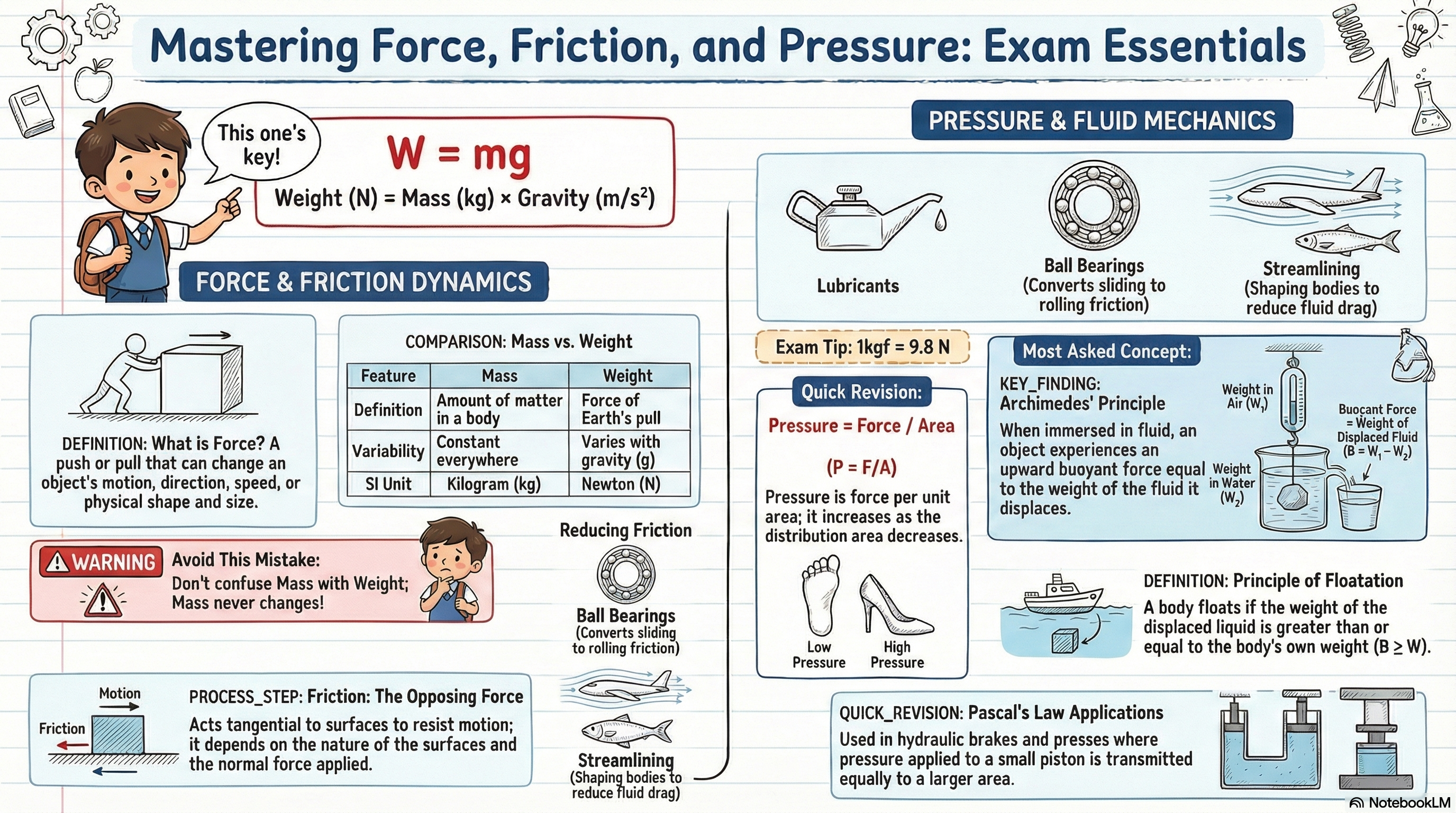
Mass and Weight
Mass
Mass is the amount of matter in a body. It remains constant regardless of location.
Units:
- SI unit: Kilogram (kg)
- CGS unit: Gram (g)
Measurement: Mass is measured using a beam balance by comparing with known masses.
Weight
Weight is the gravitational force with which Earth pulls a body toward itself.
Formula: W = mg
Where:
- W = Weight (in Newtons)
- m = Mass (in kg)
- g = Acceleration due to gravity (9.8 m/s²)
Units: Same as force (Newton, kgf, gf)
Measurement: Weight is measured using a spring balance.
Difference: Mass is constant everywhere, but weight changes with the gravitational field strength.
CBSE Class 8 Science Notes Chapter-wise
Friction Force - The Necessary Evil
What is Friction?
Friction is the force acting along two surfaces in contact that opposes the motion or tendency of motion of one body over another.
Why Does Friction Occur?
Friction arises due to:
- Adhesive forces between molecules of different materials at contact points
- Surface irregularities that interlock when surfaces come together
- Actual area of contact formed by microscopic contact points
When rough surfaces contact each other, atoms and molecules at these points attract through adhesive forces, creating resistance to motion.
Factors Affecting Friction
Friction depends on:
- Nature of surfaces - Rough surfaces (grass) produce more friction than smooth surfaces (ice)
- Normal force - Friction is directly proportional to the perpendicular force between surfaces
- Actual area of contact - More contact area means more friction (independent of apparent area)
Note: Friction does NOT depend on:
- Apparent contact area
- Speed of motion (for most practical purposes)
Types of Friction
1. Static Friction
Friction when an object is not moving but has a tendency to move. It must be overcome to initiate motion.
2. Sliding (Kinetic) Friction
Friction when one object slides over another. Also called kinetic friction.
3. Rolling Friction
Friction when an object rolls over a surface. This is the smallest type of friction.
Relationship: Static friction > Sliding friction > Rolling friction
Limiting Friction
Limiting friction is the maximum frictional force that must be overcome to start motion. As applied force increases, friction also increases up to this limit. Once the applied force exceeds limiting friction, the object begins to move.
Friction in Fluids (Liquids and Gases)
When solids move through fluids, they experience frictional resistance called drag.
Relationship: f_solid > f_liquid > f_gas
Streamlined shape: A body shape designed to minimize fluid friction by allowing smooth flow around it. Examples include airplanes, submarines, rockets, and fish.
Effects of Friction
Negative Effects:
- Opposes motion, requiring more energy
- Produces heat, causing energy loss
- Causes wear and tear of surfaces
Positive Effects:
- Enables walking and running
- Allows vehicles to move and brake
- Enables writing with pens and pencils
- Helps in gripping objects
How Friction Enables Walking
Walking is possible because of friction between our feet and the ground:
- Position 1: Friction acts forward (driving force)
- Position 2: No friction acts
- Position 3: Friction acts backward (decelerating force for stopping)
Ways to Reduce Friction
- Streamlined shapes - Reduces fluid friction
- Polishing - Makes surfaces smoother
- Wheels - Converts sliding to rolling friction
- Lubricants - Oil, grease create smooth layers between surfaces
- Ball bearings - Use rolling friction instead of sliding
Thrust and Pressure
Thrust
Thrust is the total force acting perpendicular (normal) to a given surface area.
Unit: Newton (N)
Pressure
Pressure is the force acting perpendicularly per unit area.
Formula:
P = Thrust/Area = F/A
Units:
- SI unit: Pascal (Pa) or Newton per square meter (N/m²)
- 1 Pa = 1 N/m²
- Practical unit: Bar (1 bar = 10⁵ Pa)
For the same force, smaller area produces higher pressure. This is why a sharp needle penetrates easily while a blunt object doesn't.
Atmospheric Pressure
Atmospheric pressure is the pressure exerted by the atmosphere at any location.
Standard Value:
- 1.01 × 10⁵ Pa at sea level
- Also called 1 atmosphere (1 atm)
- Equivalent to pressure by 760 mm mercury column
Variation: Atmospheric pressure decreases with altitude because air density decreases.
Measurement: Measured using a barometer.
Pressure in Liquids
Liquids exert pressure on container bases (due to weight) and walls (due to molecular collisions).
Important Properties of Liquid Pressure
- Pressure is same at all points on the same horizontal level
- Pressure increases with depth (deeper points experience more pressure)
- Pressure depends on liquid density (denser liquids exert more pressure)
- Liquids exert lateral pressure on container walls
Measurement: Liquid pressure is measured using a manometer a U-shaped tube with one arm open to air and the other connected to the measurement point.
Pascal's Law
Statement: In a fluid at rest, pressure applied at any point is transmitted equally in all directions throughout the fluid.
Formula: For a hydraulic system:
F₁/A₁ = F₂/A₂
Where F₁, F₂ are forces on pistons with areas A₁, A₂
Applications of Pascal's Law
- Hydraulic brakes - Brake pedal force transmitted to wheels via brake fluid
- Hydraulic press - Small force on small piston creates large force on large piston
- Hydraulic jacks - Lift heavy vehicles
- Hydraulic elevators - Move passengers between floors
- Vacuum pumps and air compressors
The force multiplication factor equals the ratio of piston areas: F₂/F₁ = A₂/A₁
Buoyant Force (Upthrust)
What is Buoyant Force?
Buoyant force (or upthrust) is the upward force experienced by an object when immersed in a fluid, making it feel lighter.
Examples:
- Wood held underwater rises when released
- Stones feel lighter when lifted underwater
- Ships float on water
Cause of Buoyant Force
Buoyant force arises because:
- Fluid pressure increases with depth
- Bottom surface of immersed object experiences greater upward pressure than top surface experiences downward pressure
- The net unbalanced force acts upward
Important Point: The deeper a point on the object, the greater the pressure at that point.
Factors Affecting Buoyant Force
Buoyant force depends on:
- Volume of object immersed - Greater immersed volume produces larger buoyant force
- Density of fluid - Denser fluids (like seawater) exert more buoyant force than less dense fluids (like fresh water)
Buoyant force does NOT depend on:
- Mass or density of the immersed object
- Depth of immersion (once fully submerged)
- Shape of the object
Archimedes Principle
Statement: When a body is fully or partially immersed in a fluid, the fluid exerts an upward buoyant force equal to the weight of the displaced fluid.
Formula:
Buoyant Force (B) = Weight of displaced fluid
B = ρ_fluid × V_displaced × g
Where:
- ρ_fluid = Density of fluid
- V_displaced = Volume of fluid displaced
- g = Acceleration due to gravity
Application: This principle works for objects in both liquids and gases.
Principle of Floatation
When an object is released in a fluid:
- If W > B (Weight > Buoyant force): Object sinks to the bottom
- If B > W (Buoyant force > Weight): Object rises and floats with part above surface
- If B = W (Equilibrium): Object floats in stable position
For a floating body in equilibrium:
Weight of liquid displaced = Weight of the body
This explains why:
- Ships made of steel (denser than water) float - their hollow design displaces enough water
- Ice floats on water - ice is less dense than liquid water
- Hot air balloons rise - hot air inside is less dense than surrounding cool air
Density and Relative Density
Density
Density is mass per unit volume of a substance.
Formula:
Density (ρ) = Mass/Volume
SI Unit: kg/m³
Density is a characteristic property - each substance has a specific density under given conditions.
Apparent Weight
Apparent weight is the weight of an object when immersed in a fluid.
Formula:
Apparent Weight = True Weight - Buoyant Force
Apparent Weight = W - B
Objects feel lighter in water because buoyant force reduces the net downward force.
Relative Density (Specific Gravity)
Relative Density is the ratio of a substance's density to water's density.
Formula:
Relative Density = Density of substance/Density of water
 = Mass of substance/Mass of equal volume of water
Features:
- Has no units (dimensionless)
- Expresses how many times heavier/lighter a substance is compared to water
- Example: Iron has relative density 7.8, meaning iron is 7.8 times heavier than equal volume of water
Solved Examples
Example: An object has mass 10 kg. What is its weight on Earth? (g = 9.8 m/s²)
Solution:
Given: m = 10 kg, g = 9.8 m/s²
Weight, W = m × g
W = 10 × 9.8 = 98 N
Answer: Weight = 98 N
Example: A force of 20 N acts over an area of 4 cm². Find the pressure in N/m².
Solution:
Given: F = 20 N, A = 4 cm² = 4 × 10⁻⁴ m²
Pressure = Force/Area
P = 20/(4 × 10⁻⁴) = 5 × 10⁴ N/m²
Answer: Pressure = 50,000 Pa
Example: In a hydraulic lift, a force of 5 N is applied to a piston with area 1 m². If the other piston has area 5 m², find the force on the larger piston.
Solution:
Given: F₁ = 5 N, A₁ = 1 m², A₂ = 5 m²
Using Pascal's law: F₁/A₁ = F₂/A₂
F₂ = (F₁ × A₂)/A₁ = (5 × 5)/1 = 25 N
Answer: Force on larger piston = 25 N
Example: A body of density 5 × 10³ kg/m³ and volume 4 m³ is immersed in a fluid of density 4 × 10³ kg/m³. Find the buoyant force. (g = 10 m/s²)
Solution:
Volume of body = Volume displaced = 4 m³
Mass of liquid displaced = Volume × Density
 = 4 × (4 × 10³) = 16 × 10³ kg
Weight of liquid displaced = Mass × g
 = 16 × 10³ × 10
 = 16 × 10⁴ N = 160,000 N
Buoyant Force = 1.6 × 10⁵ N
Answer: Buoyant force = 160,000 N
Example: Convert 5 kgf to Newtons.
Solution:
1 kgf = 9.8 N
5 kgf = 5 × 9.8 = 49 N
Answer: 5 kgf = 49 N
Example: Calculate the pressure at a depth of 10 m in water. (Density of water = 1000 kg/m³, g = 10 m/s²)
Solution:
Pressure at depth = ρgh
P = 1000 × 10 × 10 = 100,000 Pa = 10⁵ Pa
Answer: Pressure = 100 kPa or 1 bar
Example: A stone weighs 100 N in air. When immersed in water, it experiences a buoyant force of 30 N. What is its apparent weight?
Solution:
Apparent Weight = True Weight - Buoyant Force
Apparent Weight = 100 - 30 = 70 N
Answer: Apparent weight = 70 N
Example: An object has mass 500 g and occupies 250 cm³. Find its relative density.
Solution:
Volume of object = 250 cm³
Equal volume of water has mass = 250 g (density of water = 1 g/cm³)
Relative Density = Mass of object/Mass of equal volume of water
 = 500/250 = 2
Answer: Relative Density = 2 (object is 2 times denser than water)
Example: A block requires a minimum force of 50 N to start moving on a surface. What is the limiting friction?
Solution:
Limiting friction = Minimum force needed to start motion
Limiting friction = 50 N
Answer: Limiting friction = 50 N
Example: Two identical forces act on surfaces of area 2 m² and 4 m². Compare the pressures.
Solution:
Let force = F
Pressure₁ = F/2
Pressure₂ = F/4
Ratio = P₁/P₂ = (F/2)/(F/4) = 4/2 = 2
Answer: Pressure on smaller area is 2 times greater
Example: A wooden block of mass 500 g floats on water. How much water does it displace?
Solution:
For floating equilibrium:
Weight of block = Weight of water displaced
Mass of water displaced = Mass of block = 500 g
Volume of water displaced = 500 cm³ (since density of water = 1 g/cm³)
Answer: 500 cm³ or 0.5 L of water displaced
Example: A hydraulic press has pistons of area 10 cm² and 100 cm². What is the mechanical advantage?
Solution:
Mechanical Advantage = A₂/A₁ = 100/10 = 10
This means a force of 1 N on small piston produces 10 N on large piston
Answer: Mechanical Advantage = 10
Example: An astronaut has mass 60 kg. Her weight on Earth is 588 N. What would be her mass on the Moon?
Solution:
Mass is independent of location and remains constant
Mass on Moon = Mass on Earth = 60 kg
(Note: Her weight would be different due to Moon's weaker gravity)
Answer: Mass remains 60 kg
Example: A substance has mass 2400 g and occupies a volume of 300 cm³. Find its density in SI units.
Solution:
Mass = 2400 g = 2.4 kg
Volume = 300 cm³ = 300 × 10⁻⁶ m³ = 3 × 10⁻⁴ m³
Density = Mass/Volume = 2.4/(3 × 10⁻⁴)
 = 0.8 × 10⁴ = 8000 kg/m³
Answer: Density = 8000 kg/m³
Example: An object has density 800 kg/m³. Will it float or sink in water (density 1000 kg/m³)?
Solution:
Object density (800 kg/m³) < Water density (1000 kg/m³)
When density of object < density of liquid, it floats
Answer: The object will float
Example: Two identical objects are immersed at the same depth in water (density 1000 kg/m³) and oil (density 800 kg/m³). Which experiences greater pressure?
Solution:
Pressure = ρgh
For same depth h:
P_water = 1000 × g × h
P_oil = 800 × g × h
P_water > P_oil
Answer: Object in water experiences greater pressure
Example: A stone has weight 200 N in air. When completely submerged in water, buoyant force is 60 N. What force is needed to lift it underwater?
Solution:
Net downward force underwater = Weight - Buoyant force
 = 200 - 60 = 140 N
Force required to lift = 140 N (upward)
Answer: 140 N force needed
Example: Atmospheric pressure is 1.01 × 10⁵ Pa. What force does air exert on a window of area 2 m²?
Solution:
Force = Pressure × Area
F = 1.01 × 10⁵ × 2
F = 2.02 × 10⁵ N = 202,000 N
Answer: Force = 202 kN (balanced by equal force from inside)
Example: Ice has relative density 0.9. What percentage of an iceberg is submerged in seawater?
Solution:
For floating: Weight = Buoyant force
ρ_ice × V × g = ρ_water × V_submerged × g
V_submerged/V = ρ_ice/ρ_water = 0.9
Percentage submerged = 0.9 × 100 = 90%
Answer: 90% submerged, 10% above water
Example: A 5 kg block on a horizontal surface experiences a forward push of 60 N and friction of 35 N. What is the net force?
Solution:
Forward force = 60 N
Backward friction = 35 N
Net force = 60 - 35 = 25 N (forward)
This will cause acceleration = F/m = 25/5 = 5 m/s²
Answer: Net force = 25 N forward
FAQs about Force, Friction and Pressure
Mass is the amount of matter in an object and remains constant everywhere (measured in kg). Weight is the gravitational force on an object (W = mg) and varies with location (measured in Newtons). Your mass is same on Earth and Moon, but weight on Moon is about 1/6th of Earth weight.
Friction is called a necessary evil because while it has negative effects (opposes motion, causes wear and tear, produces heat loss), it's essential for daily activities. Without friction, we couldn't walk, vehicles couldn't move or brake, and we couldn't write or grip objects. The challenge is to maximize friction where needed and minimize it where it causes problems.
Although steel is denser than water, ships float due to their hollow design. The ship displaces a large volume of water equal to its total weight. According to Archimedes' principle, the buoyant force (weight of displaced water) equals the ship's weight, allowing it to float. The key is displacing enough water to generate sufficient upward buoyant force.
Static friction acts on stationary objects and prevents them from starting to move. Kinetic (sliding) friction acts on moving objects. Static friction is always greater than kinetic friction for the same surfaces. This is why it's harder to start pushing a heavy box than to keep it moving once it's started.
When you press the brake pedal, you apply pressure to brake fluid in a master cylinder. According to Pascal's law, this pressure is transmitted equally throughout the fluid to slave cylinders at each wheel. The pressure causes pistons to push brake pads against brake discs, creating friction that slows the vehicle. The system multiplies your foot force to generate sufficient braking force.
We feel lighter in water due to buoyant force - the upward force equal to the weight of water displaced by our body. This buoyant force acts opposite to our weight, reducing the net downward force we experience. Our apparent weight in water = True weight - Buoyant force. Since water density is close to our body density, buoyant force is substantial.
Limiting friction is the maximum static friction force that must be overcome to start motion between two surfaces. As you increase applied force on a stationary object, friction increases equally until it reaches this limit. Once applied force exceeds limiting friction, the object begins to move, and friction becomes kinetic (smaller than limiting friction).
Atmospheric pressure is caused by the weight of air above. At higher altitudes, there's less air above you, so less weight pressing down, resulting in lower pressure. At sea level, you have the entire atmosphere above you (about 10 km of air), but at mountain tops, there's significantly less air above, hence lower pressure.
Friction can be reduced by:
(1) Polishing surfaces to make them smoother
(2) Using lubricants (oil, grease) to create a fluid layer between surfaces,
(3) Using ball bearings to convert sliding friction to rolling friction
(4) Using wheels for transportation
(5) Streamlining shapes to reduce fluid friction. The choice depends on the specific application.
Relative density (specific gravity) is the ratio of a substance's density to water's density. It's calculated as: RD = (Mass of substance)/(Mass of equal volume of water). Since it's a ratio of two similar quantities (both masses), the units cancel out, making it dimensionless. For example, iron's relative density of 7.8 means iron is 7.8 times heavier than an equal volume of water.