





Every living organism needs food to grow and survive. Plants make their own food through photosynthesis, but humans and animals depend on plants and other organisms for nutrition. To meet the food demands of a growing population, humans cultivate crops and rear animals an organised practice called agriculture.
Agriculture (Latin: ager = field, cultura = cultivation) is the applied science of growing plants and raising animals that are useful to humans. It involves soil preparation, seed selection, irrigation, pest control, harvesting, and storage.
India is one of the world's largest producers of fruits, vegetables, milk, spices, rice, wheat, and cash crops like cotton and coffee making agriculture central to both the economy and daily life.
Why study this chapter?
- It forms the core of Class 8 Biology (CBSE/NCERT).
- Questions appear every year in board exams and competitive tests like Olympiads.
- It connects directly to real-world food security and environmental science.
Important Concepts and Definitions
What is a Crop?
When the same kind of plant is cultivated on a large scale, it is called a crop. Crops provide food grains, vegetables, fruits, and raw materials for industries.
Types of Crops Based on Season
India follows two main cropping seasons, determined by climate — temperature, humidity, and rainfall.
| Feature | Rabi Crops (Winter) | Kharif Crops (Summer/Monsoon) |
|---|---|---|
| Common Name | Winter crops | Monsoon or rainy season crops |
| Sown In | October–November | June–July |
| Harvested In | March–April | September–October |
| Climate Needed | Cold and dry | Hot and wet |
| Examples | Wheat, barley, pea, mustard | Rice, maize, cotton, soybean, groundnut |
Memory Trick (Mnemonic):
- Rabi = Rain is gone (winter crops after monsoon ends)
- Kharif = Kept during rains (monsoon crops)
CBSE Class 8 Science Notes Chapter-wise
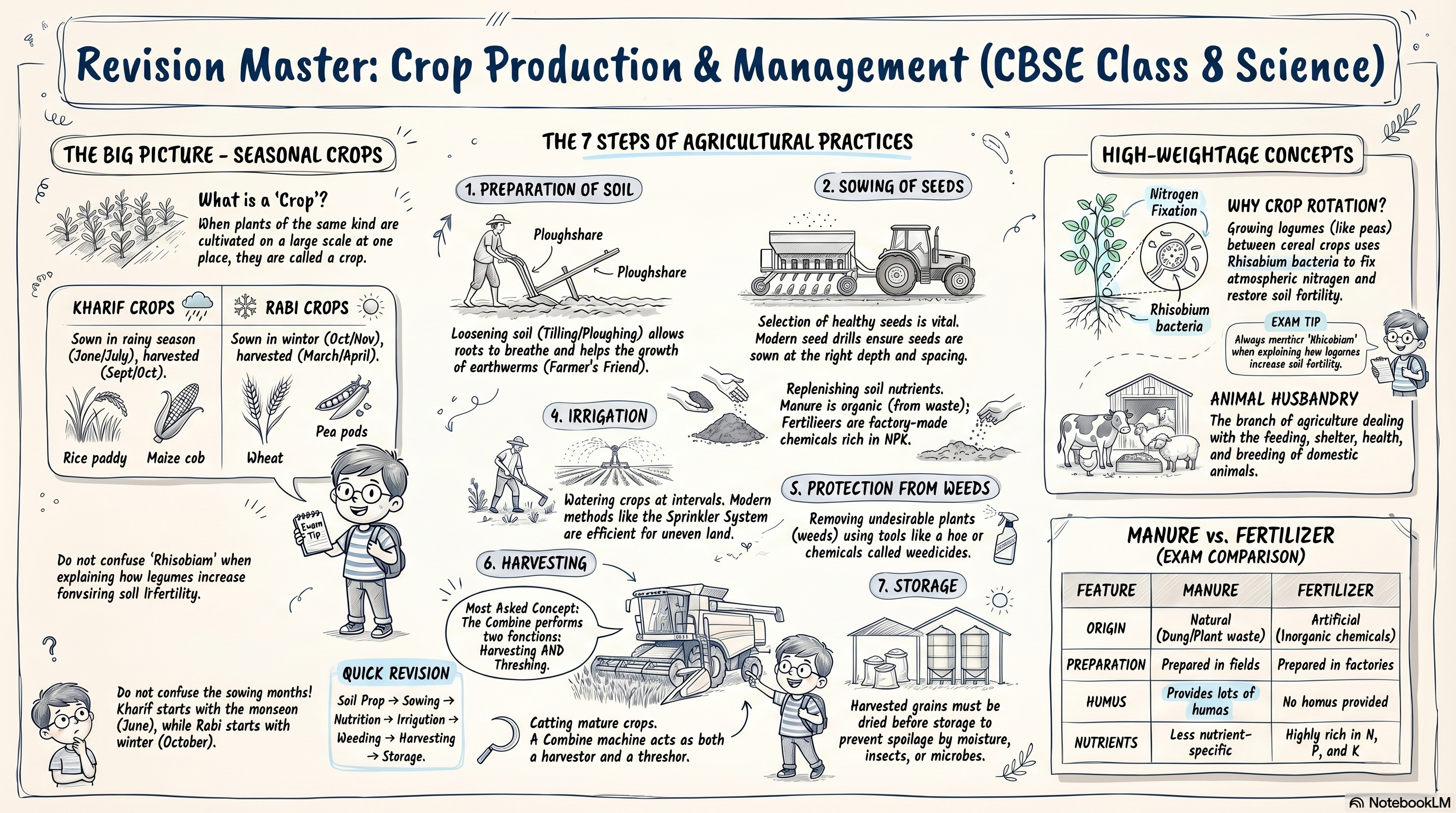
Agricultural Practices – Step-by-Step
Crop production follows a standard sequence of seven key agricultural practices:
Soil Preparation → Sowing → Adding Manure/Fertilizers → Irrigation → Weed Protection → Harvesting → Storage
A. Preparation of Soil
Soil preparation is the first and most critical step before any crop is grown. It involves:
1. Ploughing (Tilling) Ploughing is the process of loosening and turning the soil using a plough.
Why is tilling important?
- Lets roots penetrate deep into the soil.
- Allows easy breathing (aeration) of roots.
- Promotes growth of earthworms and helpful microbes that further loosen and enrich the soil.
- Adds humus by mixing organic matter.
- Brings nutrient-rich deeper soil to the surface.
2. Levelling After ploughing, the broken soil clumps are levelled using a wooden leveller (plank). Levelling:
- Prevents loose soil from being blown away by wind or washed away by rain.
- Helps in uniform water distribution during irrigation.
Agricultural Implements for Soil Preparation
| Implement | Description |
|---|---|
| Plough | Made of wood with a ploughshare (triangular iron strip) and a ploughshaft (wooden axis). Loosens soil. |
| Hoe | Long wooden/iron rod with a broad bent iron plate at one end. Driven by animals. Used for weeding and loosening. |
| Cultivator | Metal device attached to a tractor. Faster and saves labour compared to a manual plough. |
B. Sowing of Seeds
Sowing is the process of planting seeds into the prepared soil. Only healthy, good-quality, high-yielding seeds should be selected.
How to select good seeds?
Put seeds in water healthy seeds sink; damaged or hollow seeds float.
Methods of Sowing
| Method | Description | Advantage / Disadvantage |
|---|---|---|
| Broadcasting | Seeds scattered by hand across the field. | Quick but uneven spacing and depth. |
| Traditional Tool | A long pipe with a funnel at one end seeds pass through and get implanted in the soil. | Better than broadcasting but still limited. |
| Seed Drill | Machine attached to a tractor that sows seeds at uniform depth and spacing automatically. | Saves time and labour; ensures even germination. |
| Transplantation | Seedlings grown in nurseries are transferred to the main field. | Ensures only healthy plants are grown; better spacing. |
Crops grown by transplantation: Paddy (rice), tomato, onion, chilli, brinjal.
Advantages of proper seed spacing:
- Each plant gets sufficient sunlight, water, and nutrients.
- Reduces competition between plants.
- Prevents overcrowding that leads to disease.
C. Adding Manure and Fertilizers
When crops grow, they absorb nutrients from the soil. These nutrients must be replenished before the next crop cycle. This is done by adding manure or fertilizers.
Manure
Manure consists of organic products obtained by the decomposition of dead plants and animal waste. It is prepared naturally in fields.
Types of Manure:
| Type | Source / Description |
|---|---|
| Farmyard Manure (FYM) | Decomposed mixture of cattle dung, urine, litter, and leftover fodder. |
| Compost | Rotted organic matter from farm waste sugarcane trash, paddy straw, weeds. |
| Green Manure | Fresh, undecomposed green plants (mainly legumes like sunnhemp, dhaincha) ploughed back into the soil. |
| Vermicompost | Compost prepared with the help of earthworms. Earthworms digest organic waste and their castings are nutrient-rich. |
Advantages of Manure:
- Makes soil porous → improves gas exchange.
- Increases water-holding capacity.
- Adds humus and organic matter.
- Reduces soil erosion.
- Low cost; eco-friendly.
- Promotes beneficial microbes.
Disadvantages of Manure:
- Bulky and hard to transport in large quantities.
- Releases nutrients slowly not suitable for fast-growing high-yield crops.
- Not nutrient-specific.
Fertilizers
Fertilizers are inorganic chemical compounds manufactured in factories that provide specific plant nutrients rapidly.
Commonly used fertilizers: Urea, Ammonium Sulphate, Potash, NPK (Nitrogen–Phosphorus–Potassium).
Types of Chemical Fertilizers:
| Type | Nutrients Provided | Examples |
|---|---|---|
| Nitrogenous Fertilizers | Nitrogen (N) | Urea, Ammonium sulphate, Calcium ammonium nitrate |
| Phosphatic Fertilizers | Phosphorus (P) | Superphosphate (good for fruit production) |
| Potassic Fertilizers | Potassium (K) | Potassium chloride, Potassium sulphate |
| Complex Fertilizers | N + P + K (two or more) | DAP (Diammonium phosphate), NPK |
Advantages of Fertilizers:
- Water-soluble → rapidly absorbed by plants.
- Required in small quantities.
- Nutrient-specific target deficiencies precisely.
Disadvantages of Fertilizers:
- Cause eutrophication (excess nutrient runoff pollutes water bodies).
- Alter the chemical composition of soil.
- Cause water and soil pollution.
- Do not add humus to the soil.
Manure vs Fertilizer – At a Glance
| Feature | Manure | Fertilizer |
|---|---|---|
| Origin | Natural (organic decomposition) | Artificial (factory-made) |
| Humus content | Adds humus | No humus |
| Nutrient concentration | Low | High |
| Absorption rate | Slow | Fast (water-soluble) |
| Environmental impact | Eco-friendly | Can pollute water and soil |
| Nutrient specificity | Not specific | Specific (N, P, or K) |
| Cost | Low / free | Higher cost |
D. Irrigation
Irrigation is the artificial process of supplying water to crops in the field. Water is needed for germination, nutrient transport, and growth.
Common sources: Wells, tube wells, ponds, rivers, canals.
Traditional Methods of Irrigation
| Method | How It Works |
|---|---|
| Moat (Pulley) | Water lifted from wells using a container and pulley system. |
| Dhekli | Water drawn using a counterbalanced lever system with a rope and bucket. |
| Rahat | A wheel turned by a cow or buffalo draws water from the well. |
| Chain Pump | A container attached to a wheel draws water continuously. |
These methods are labour and time-intensive and often lead to water wastage.
Modern Methods of Irrigation
1. Sprinkler System
- Long perpendicular pipes with rotating nozzles spray water like a fountain.
- Suitable for uneven and sandy soil.
- Controls water wastage through limited, uniform outflow.
2. Drip System (Trickle / Micro-Irrigation)
- Water delivered drop by drop directly at the root zone via a network of pipes with small nozzles.
- Best suited for fruit plants, trees, and gardens.
- Most water-efficient method minimises evaporation and runoff.
Fallowing: Leaving soil uncultivated for one entire crop season to allow it to naturally recover its nutrients. This practice prevents soil exhaustion.
E. Protection from Weeds
Weeds are unwanted plants that grow alongside crop plants, competing for water, nutrients, space, and sunlight.
Examples of common weeds: Amaranthus, Chenopodium, Wild oat, Convolvulus, Xanthium.
The removal of weeds is called weeding. The best time to remove weeds is before they flower and produce seeds.
Methods of Weed Control
| Method | Description |
|---|---|
| Mechanical | Manual pulling by hand (khurpi/trowel), ploughing, or using a harrow. |
| Chemical | Spraying weedicides (herbicides) like 2,4-D, 2,4,5-T, MCPA, or Atrazine. Do not harm crops. |
| Biological | Using specific insects or organisms that feed on weeds. E.g., cochineal insects control prickly pear cactus (Opuntia). |
Precaution while using weedicides: Farmers must cover their nose and mouth and wash hands thoroughly. Fruits and vegetables must be washed before eating.
F. Harvesting
Harvesting is the process of cutting and gathering a crop after it reaches maturity.
Steps After Harvesting:
- Threshing – Separating grain seeds from the stalks and chaff. Done by:
- Beating the crop against a hard surface.
- Using farm animals to trample the crop.
- Using a thresher machine.
- Winnowing – Separating grain from husk using wind (natural or fan-generated). Heavier grains fall straight down while lighter husk blows away.
Tools and Machines Used:
| Tool / Machine | Purpose |
|---|---|
| Sickle | Manual harvesting — cuts crop stalks |
| Harvester | Machine for cutting standing crop |
| Thresher | Machine for separating grain from stalk |
| Combine | All-in-one machine — harvests AND threshes the crop |
| Winnowing Machine | Mechanically separates grain from husk |
Protection from pests during harvesting: Pests like rodents, locusts, weevils, and termites attack crops. They are controlled using pesticides rodenticides (for rodents), insecticides (for insects). Common insecticides: BHC (gammexane), Malathion, Disyston.
Plant Diseases:
- Rust and Smut of wheat → caused by fungi
- Blight of potato → caused by fungi
- Wilt disease → caused by bacteria
G. Storage
Storage is the process of safely preserving harvested grain from moisture, pests, rodents, and microorganisms.
Why store grains?
- To maintain food supply between two harvest seasons.
- Emergency reserves in case of crop failure.
- The government maintains a buffer stock managed by the Food Corporation of India (FCI).
Factors Causing Grain Loss During Storage:
| Category | Examples |
|---|---|
| Biotic | Insects, rodents, birds, mites |
| Abiotic | Excess moisture, improper temperature, high humidity |
Storage Methods:
| Scale | Method |
|---|---|
| Small Scale | Jute bags, metallic containers |
| Large Scale | Silos (tall cylindrical structures), Granaries (godowns with gunny bags) |
Preventive Measures:
- Dry grains below 10% moisture before storage.
- Keep storage houses clean, sealed, and dry.
- Use fumigation chemicals like aluminium phosphate to kill pests.
- Place gunny bags on wooden platforms (10–15 cm above ground, 60–70 cm from walls).
- Fruits and vegetables stored at 0°C–4°C in cold storage to prevent microbial growth.
Why neem leaves? Dried neem leaves have natural insecticidal properties and are placed in grain containers to repel insects a traditional, eco-friendly method.
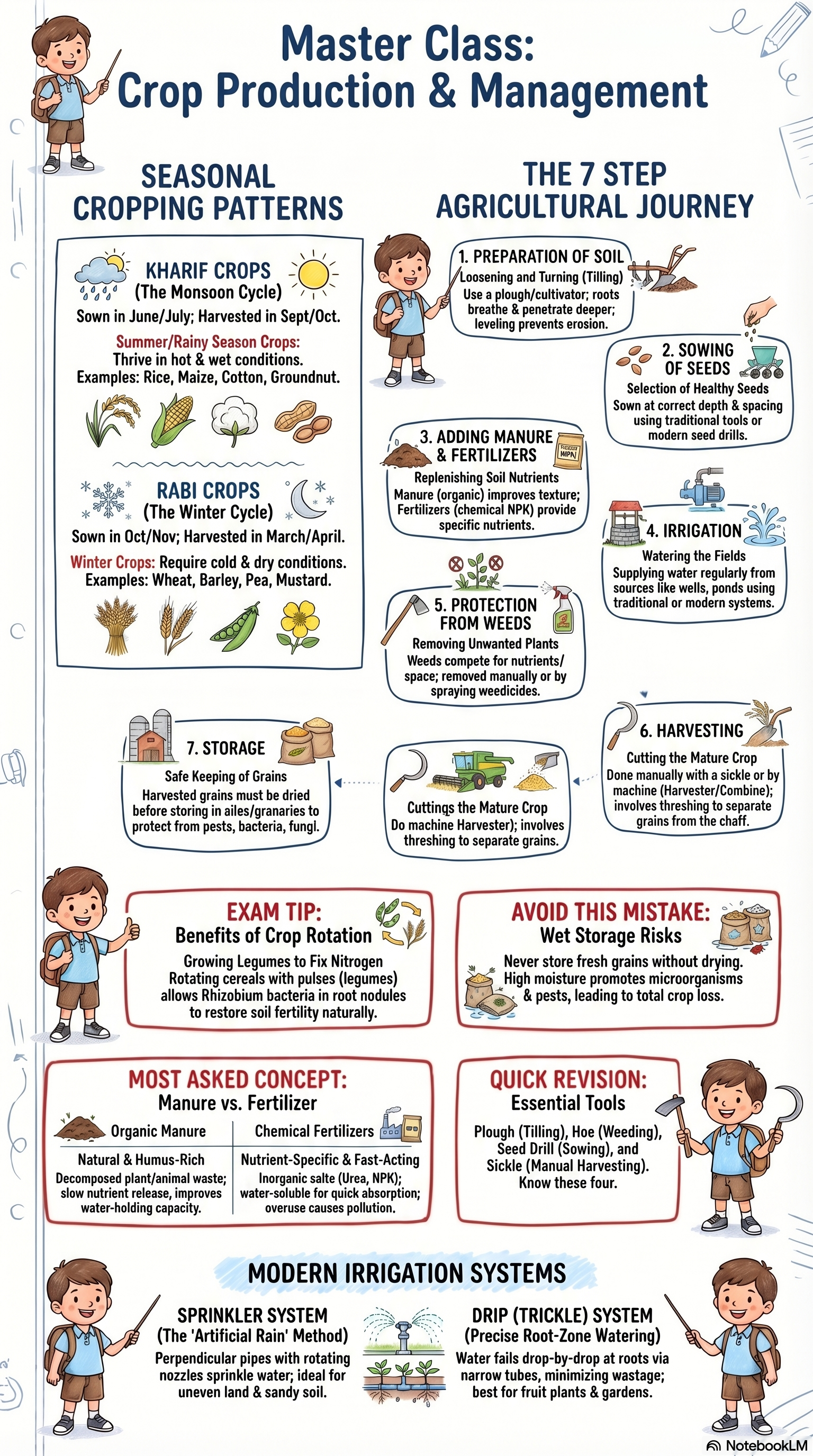
Cropping Patterns
1. Crop Rotation
Growing different crops alternately on the same piece of land across seasons to prevent soil nutrient depletion.
- A pulse/legume crop (beans, peas, dals) is grown between two cereal crops (wheat, rice).
- Legume roots have nodules containing Rhizobium bacteria that fix atmospheric nitrogen into the soil, increasing fertility.
Examples:
- Rice → Wheat
- Maize → Mustard
- Maize → Potato → Sugarcane → Pea
Benefits of Crop Rotation:
- Improves soil structure (deep roots break hardpan; fine roots bind surface).
- Increases soil fertility through nitrogen fixation.
- Controls weeds, pests, and diseases by breaking their life cycles.
- Produces diverse outputs, reducing economic risk.
- Reduces the need for expensive chemical fertilizers.
2. Intercropping
Growing two or more crops simultaneously on the same field in a definite row pattern.
Types:
- Row Intercropping: Two crops in alternate rows.
- Strip Cropping: Different crops in strips of uniform width.
Common Intercropping Combinations:
- Soybean + Maize
- Finger millet (Bajra) + Cowpea
- Sunflower + Groundnut
- Cotton + Moong bean
Advantages:
- Better utilisation of field area.
- Intervening rows prevent spread of pests and diseases.
- Maintains soil fertility even under maximum production.
3. Mixed Cropping
Growing two or more crops simultaneously on the same land without a fixed row pattern, seeds mixed before sowing.
Purpose: Reduces risk of total crop failure if one crop is damaged by a specific pest or disease, the other survives.
Common Mixed Cropping Combinations:
- Wheat + Gram
- Wheat + Mustard
- Groundnut + Sunflower
Intercropping vs Mixed Cropping
| Feature | Intercropping | Mixed Cropping |
|---|---|---|
| Purpose | Increase yield per unit area | Reduce risk of crop failure |
| Seed sowing | Seeds sown separately in rows | Seeds mixed together before sowing |
| Harvesting | Crops harvested separately | All crops harvested together |
| Examples | Soybean + Maize; Bajra + Cowpea | Wheat + Gram; Wheat + Mustard |
Hybridization and Increasing Crop Yield
Plant Breeding and Hybridization
Hybridization is the technique of developing new crop varieties by cross-breeding two different varieties to combine the best traits of both.
Process:
- Select a male plant (high yield) and a female plant (disease resistance).
- Remove anthers from the female plant at the bud stage to prevent self-pollination → this is called emasculation.
- Dust pollen from the male plant onto the stigma of the emasculated flower.
- Male and female gametes fuse → hybrid seeds are produced.
- The hybrid possesses both high yield and disease resistance.
Other ways to increase crop yield:
- Systematic agricultural practices (proper irrigation, fertilizers, pest control).
- Use of high-yield variety (HYV) seeds (developed during India's Green Revolution, 1967–1978).
- Use of advanced agricultural implements.
Animal Husbandry
Animal husbandry is the scientific practice of rearing, feeding, breeding, and managing farm animals on a large scale to produce food and other useful products.
| Branch | Focus |
|---|---|
| Cattle Farming | Rearing cows and buffaloes for milk, draught power |
| Poultry Farming | Rearing birds (hens, ducks) for eggs and meat |
| Pisciculture | Fish production (also includes prawns, crabs, shrimps) Blue Revolution |
| Apiculture | Rearing honey bees for honey and beeswax. The place where bees are kept is called an apiary. |
Important Agricultural Revolutions in India
| Revolution | Domain | Figure |
|---|---|---|
| Green Revolution | Wheat and rice production | Norman Borlaug; Dr. M.S. Swaminathan |
| White Revolution | Milk production (Operation Flood) | Dr. Verghese Kurien |
| Blue Revolution | Fish production | — |
| Yellow Revolution | Oil seed production | — |
| Golden Revolution | Fruits and honey | — |
| Silver Revolution | Egg/poultry production | — |
Important Terms
| Term | Meaning |
|---|---|
| Agriculture | Science and practice of cultivating crops and rearing animals |
| Crop | Plants of the same kind grown on a large scale |
| Tilling / Ploughing | Loosening and turning of soil before sowing |
| Sowing | Planting seeds in prepared soil |
| Manure | Organic fertiliser from decomposed plants/animals |
| Fertilizer | Inorganic chemical supplying specific nutrients |
| Irrigation | Supplying water to crops artificially |
| Weeds | Unwanted plants competing with crops |
| Weedicides | Chemicals used to kill weeds (herbicides) |
| Threshing | Separating grain from stalks/chaff |
| Winnowing | Separating grain from husk using wind |
| Combine | Machine that both harvests and threshes |
| Buffer Stock | Emergency food grain reserve maintained by the government |
| Fallowing | Leaving field uncultivated for one season to restore fertility |
| Crop Rotation | Growing different crops alternately on the same land |
| Intercropping | Growing two or more crops in definite rows simultaneously |
| Mixed Cropping | Growing two or more crops together without fixed rows |
| Rhizobium | Nitrogen-fixing bacteria in legume root nodules |
| Hybridization | Crossbreeding two varieties to produce a superior hybrid |
| Emasculation | Removal of anthers to prevent self-pollination in hybridization |
| Vermicompost | Compost prepared using earthworms |
| Eutrophication | Excess nutrient runoff from fertilizers causing algal bloom in water bodies |
| Animal Husbandry | Large-scale rearing of animals for food and other products |
| Apiculture | Rearing of honeybees for honey and beeswax |
| Pisciculture | Scientific rearing and production of fish |
Diagrams – Textual Descriptions
Agricultural Practice Flow
Soil Preparation (Ploughing + Levelling)
 ↓
Sowing of Seeds (Seed Drill / Transplantation)
 ↓
Adding Manure / Fertilizers
 ↓
Irrigation (Drip / Sprinkler / Traditional)
 ↓
Protection from Weeds & Pests
 ↓
Harvesting (Sickle / Combine Machine)
 ↓
Threshing → Winnowing
 ↓
Storage (Silos / Granaries / Cold Storage)
Winnowing Process
[Grain + Husk Mixture]
 ↓
[Tossed into the air from a height]
 ↓
Wind blows → Lighter husk carried away sideways
Gravity pulls → Heavier grain falls straight down
 ↓
[Clean Grain collected at the base]
Cropping Pattern Comparison (Simplified)
Mixed Cropping: ●△●△●△ (mixed randomly)
Intercropping: ●●●|△△△|●●● (separate rows)
Crop Rotation: Jan: ●●● → June: △△△ (different seasons)
Enhanced Study Notes & Mnemonics
Quick Revision Summary
| Agricultural Step | Key Tool / Method | Key Fact |
|---|---|---|
| Soil Prep | Plough, Hoe, Cultivator | Loosens soil; brings nutrients to surface |
| Sowing | Seed Drill, Transplantation | Seed drill ensures uniform depth + spacing |
| Nutrients | Manure + Fertilizers | Manure = organic; Fertilizer = inorganic |
| Irrigation | Drip system (best) | Drip = most water-efficient method |
| Weed Control | Weedicides, Khurpi | Remove before flowering |
| Harvesting | Combine, Sickle | Combine = harvests + threshes |
| Storage | Silos, Granaries | Buffer stock = emergency food reserve |
Mnemonics
- Rabi vs Kharif: Rabi = Resting monsoon (winter); Kharif = Kept in monsoon (rains)
- Manure advantages: P-H-W-M-L → Porous soil, Humus added, Water holding, Microbes increased, Low cost
- Agricultural practices order: Some Students Always Imagine What Happens Soon → Soil prep, Sowing, Adding nutrients, Irrigation, Weeding, Harvesting, Storage
- NPK: "Nitrogen = leafy growth; Phosphorus = root & fruit; Kalium (K) = overall health"
Solved Examples (20 Questions)
Section 1: Conceptual / Short Answer Questions
Q1. What is agriculture? Define it with its etymology.
Agriculture comes from Latin ager (field) + cultura (cultivation). It is the applied biological science that deals with the production of plants and the raising of animals useful to humans, involving soil cultivation, plant breeding, and management of crops and livestock.
Q2. What is the difference between a Rabi crop and a Kharif crop? Give two examples of each.
| Feature | Rabi | Kharif |
|---|---|---|
| Season | Winter (Oct–Nov) | Monsoon (June–July) |
| Harvested | March–April | September–October |
| Examples | Wheat, pea, barley, mustard | Rice, maize, cotton, soybean |
Q3. Why is tilling of soil important before sowing seeds?
Solution: Tilling (ploughing) is essential because:
- It loosens the soil so roots can penetrate easily.
- It allows aeration — roots need oxygen to breathe.
- It brings nutrient-rich deep soil to the surface.
- It promotes earthworms and microbes that further improve soil quality.
- It adds humus to the soil by mixing organic matter.
Q4. What is the seed drill method? State three advantages over traditional sowing.
The seed drill is a tractor-driven machine that sows seeds at uniform depth and spacing simultaneously.
Advantages:
- Seeds are sown at the correct depth — improving germination.
- Uniform spacing prevents overcrowding of plants.
- Seeds get automatically covered by soil, protecting them.
- Saves time and reduces labour cost significantly.
Q5. Name and describe the four types of manure.
- Farmyard Manure (FYM): Decomposed mixture of cattle dung, urine, and leftover feed.
- Compost: Rotted organic waste from farm materials like paddy straw and sugarcane trash.
- Green Manure: Fresh green plants (usually legumes) ploughed back into the soil before they decompose.
- Vermicompost: Compost produced using earthworms. Earthworms digest organic waste and their castings are highly nutritious for soil.
Q6. What is eutrophication? How do fertilizers cause it?
Eutrophication is the excessive growth of algae in water bodies due to high levels of nutrients (especially nitrogen and phosphorus). When chemical fertilizers are used in excess, rainwater washes them into rivers, lakes, and ponds. This nutrient overload causes algal blooms, reducing oxygen in the water and killing aquatic life.
Q7. Distinguish between the sprinkler system and drip system of irrigation.
| Feature | Sprinkler System | Drip System |
|---|---|---|
| Mechanism | Rotating nozzles spray water like rain | Water drips directly at plant roots |
| Suitable For | Uneven/sandy soil, large fields | Fruit plants, trees, gardens with scarce water |
| Water Efficiency | Good | Best — minimal wastage |
| Also Known As | — | Trickle or micro-irrigation |
Q8. What is fallowing and why is it practised?
Solution: Fallowing is the practice of leaving agricultural land uncultivated for one complete crop season. It allows the soil to rest and naturally replenish its nutrients. Without fallowing, continuous cropping can deplete essential minerals and make the soil infertile.
Q9. Explain crop rotation and its benefits.
Solution: Crop rotation is the practice of growing different crops alternately on the same piece of land across seasons. A pulse/legume crop is typically grown between two cereal crops.
Benefits:
- Legume roots add nitrogen to the soil via Rhizobium bacteria.
- Different root depths improve soil structure.
- Breaks the life cycle of pests and diseases.
- Reduces the need for chemical fertilizers.
- Diversifies farm output, reducing economic risk.
Q10. What is the difference between intercropping and mixed cropping?
Solution:
| Feature | Intercropping | Mixed Cropping |
|---|---|---|
| Purpose | Increase productivity | Reduce risk of crop failure |
| Sowing | Separate rows | Seeds mixed together |
| Harvesting | Crops harvested separately | All crops harvested together |
| Example | Soybean + Maize | Wheat + Gram |
Section 2: Long Answer Questions
Q11. Describe the process of harvesting, threshing, and winnowing.
Solution:
Harvesting is the cutting and gathering of mature crops. It is done manually with a sickle or mechanically with a harvester or combine machine.
Threshing is the separation of grains from the stalks and chaff. Methods:
- Striking the crop against a hard surface.
- Farm animals trampling the crop.
- Mechanical thresher machine.
- The combine machine does both harvesting and threshing together.
Winnowing is the separation of lighter husk from heavier grain using wind. The grain mixture is tossed into the air wind carries away the husk while grain falls straight to the ground. A winnowing machine can also be used.
Q12. What is hybridization? Describe the mechanism with an example.
Solution: Hybridization is the scientific technique of crossing two different plant varieties to produce a new variety (hybrid) that possesses desirable traits of both parents.
Mechanism:
- One plant is selected as the male parent (e.g., high yield) and another as the female parent (e.g., disease resistance).
- The anthers of the female plant are removed at the bud stage to prevent self-pollination this is called emasculation.
- Pollen grains from the male plant are dusted onto the stigma of the emasculated flower.
- Pollination leads to fertilisation, producing hybrid seeds.
- These seeds carry traits of both parents high yield AND disease resistance.
Section 3: Assertion-Reason Questions
Q13. Assertion (A): Leguminous crops are grown in between cereal crops during crop rotation.
Reason (R): Leguminous plants have root nodules containing Rhizobium bacteria that fix atmospheric nitrogen.
Solution:
Both A and R are correct, and R is the correct explanation of A. Legumes are used in rotation specifically because Rhizobium in their root nodules converts atmospheric nitrogen gas (N₂) into nitrates that enrich the soil making it fertile for the next cereal crop without chemical nitrogen fertilizer.
Q14. Assertion (A): The drip irrigation system is considered the most efficient.
Reason (R): Water is delivered directly to the root zone, drop by drop, minimising evaporation and runoff.
Solution:
Both A and R are correct, and R is the correct explanation of A. The drip system delivers water precisely where plants need it at the roots. This prevents water loss through evaporation (unlike sprinklers) and runoff (unlike flood irrigation), making it the most water-efficient method.
Q15. Assertion (A): Overuse of chemical fertilizers is harmful to the environment.
Reason (R): Excess fertilizers cause eutrophication and alter the chemical composition of the soil.
Solution:
Both A and R are correct, and R is the correct explanation of A.
Section 4: Case-Based Questions
Q16. Read the following and answer:
Ramesh has been growing wheat on his farm every year for the past five years. He has noticed that despite using the same amount of fertilizers, the yield has been decreasing each year. His neighbour, who alternates between wheat and chickpeas, maintains consistent yield.
(a) What mistake is Ramesh making?
(b) What practice does his neighbour follow?
(c) How does growing chickpeas between wheat help the soil?
Solution:
(a) Ramesh is practising monoculture growing the same crop year after year, which depletes specific nutrients from the soil and encourages pest build-up.
(b) His neighbour practises crop rotation.
(c) Chickpeas are legumes. Their roots have nodules containing Rhizobium bacteria that fix atmospheric nitrogen into the soil, naturally replenishing nitrogen and increasing soil fertility without chemical input.
Q17. A student wants to set up a small vegetable garden. She wants to:
- Grow tomatoes
- Use an efficient irrigation method
- Protect plants from weeds without chemicals
(a) How should she grow tomatoes by direct sowing or transplantation?
(b) Which irrigation method should she use for maximum water efficiency?
(c) What biological method can she use to control weeds?
Solution:
(a) Transplantation tomato seedlings are grown in a nursery first and then transferred to the garden, ensuring only healthy plants are planted with proper spacing.
(b) Drip irrigation — it delivers water directly to plant roots with minimal wastage, ideal for a small garden.
(c) Biological weed control — introducing specific insects or organisms that feed on the weed species. Alternatively, using mulching (organic material covering soil) suppresses weed growth naturally.
Q18. Priya's mother bought a packet of seeds for gardening. Before sowing, she put some seeds in a bowl of water. She found that some seeds floated and some sank. She only used the seeds that sank.
(a) Why did some seeds float?
(b) Why are only the sinking seeds used?
(c) What is the next step after selecting the seeds?
Solution:
(a) Seeds that float are hollow, dried out, or damaged they are not viable for germination.
(b) Seeds that sink are healthy, fully-formed, and dense with stored food for germination. They have a higher probability of successful germination and yield.
(c) The next step is sowing planting the selected seeds in well-prepared soil at the appropriate depth and spacing.
Section 5: Higher-Order Thinking Questions
Q19. Why should weedicides not be used close to harvest time, and why must farmers wear protective clothing while spraying them?
Solution:
- Close to harvest time: Crops are near maturity and weedicide residue on fruits/grains could enter the food chain, posing health risks to consumers. The chemical cannot break down before harvest.
- Protective clothing: Weedicides are toxic chemicals. Skin contact can cause dermatitis, rashes, or absorption of harmful chemicals into the bloodstream. Inhalation can damage the respiratory system. Protective masks, gloves, and clothing minimize exposure risks.
Q20. Compare manure and chemical fertilizers in terms of their effect on long-term soil health. Which is more sustainable and why?
Solution:
- Manure adds organic matter (humus) to the soil, improving its texture, water retention, and microbial population over the long term. It improves soil structure and does not cause pollution.
- Chemical fertilizers provide quick nutrition but do not add humus. Over time, they can acidify the soil, kill beneficial microbes, and cause chemical imbalances. Excess use leads to eutrophication of nearby water bodies.
Conclusion:Manure is more sustainable in the long run because it improves soil health holistically, promotes biodiversity in the soil, is renewable, and does not cause environmental pollution. A combination of both using fertilizers only when specifically needed while relying primarily on manure — is the most balanced approach, as practised in organic farming.
FAQs about Crop Production and Management
Rabi crops are grown in winter (sown October–November, harvested March–April). Examples: wheat, barley, pea. Kharif crops are grown in the monsoon season (sown June–July, harvested September–October). Examples: rice, maize, cotton.
Leguminous plants have root nodules containing Rhizobium bacteria that fix atmospheric nitrogen into nitrates, naturally replenishing soil nitrogen without chemical fertilizers.
The drip (trickle/micro) irrigation system is the most efficient it delivers water drop by drop directly to the root zone, minimising evaporation and runoff.
A combine machine performs both harvesting (cutting the standing crop) and threshing (separating grain from the stalk) in one operation.
Chemical fertilizers cause eutrophication (algal bloom in water bodies), alter soil chemistry, reduce beneficial microbes over time, and cause water and soil pollution when overused.
Vermicompost is compost produced using earthworms. Earthworms digest organic waste and excrete nutrient-rich castings. The earthworms break down plant and animal refuse faster than natural decomposition, producing compost rich in nitrogen, phosphorus, and potassium.
Emasculation is the removal of the anthers (male parts) from the female parent plant at the bud stage to prevent self-pollination. This ensures that only the pollen from the selected male parent fertilises the female plant, producing a controlled hybrid.
Proper storage prevents grain loss due to biotic factors (insects, rodents, birds, mites) and abiotic factors (moisture, temperature, humidity). Techniques like fumigation, proper drying (below 10% moisture), and elevated storage (on wooden platforms) protect grains. The government's buffer stock ensures food security year-round.
Animal husbandry is the scientific management of farm animals for food and useful products. Its main branches are: cattle farming (milk, draught), poultry farming (eggs, meat), pisciculture (fish production Blue Revolution), and apiculture (beekeeping for honey and beeswax).
The Green Revolution (1967–1978) transformed India from a food-deficient nation to a leading agricultural producer. It was achieved through expansion of farming areas, double-cropping, and development of High Yield Variety (HYV) seeds mainly wheat and rice. Dr. Norman Borlaug is the father of the global Green Revolution; Dr. M.S. Swaminathan led it in India.