





Introduction
Every living thing on Earth from the tallest tree in a rainforest to the tiniest insect in a pond plays a role in keeping nature balanced. Yet today, thousands of species are disappearing faster than ever before, largely due to human activities.
Conservation of Plants and Animals is the practice of protecting wildlife and their natural habitats so that biodiversity is preserved for future generations. For Class 8 students, this chapter is not just important for exams it teaches you why the natural world matters and what we can do to protect it.
"Earth provides enough to satisfy every man's needs but not every man's greed." Mahatma Gandhi
Why This Chapter Matters
- It is a high-weightage chapter in the CBSE Class 8 Science exam.
- Concepts like deforestation, endangered species, biosphere reserves, and the Red Data Book appear regularly in board-level and competitive exam questions.
- Understanding conservation helps you become a responsible, informed citizen.
CBSE Class 8 Science Notes Chapter-wise
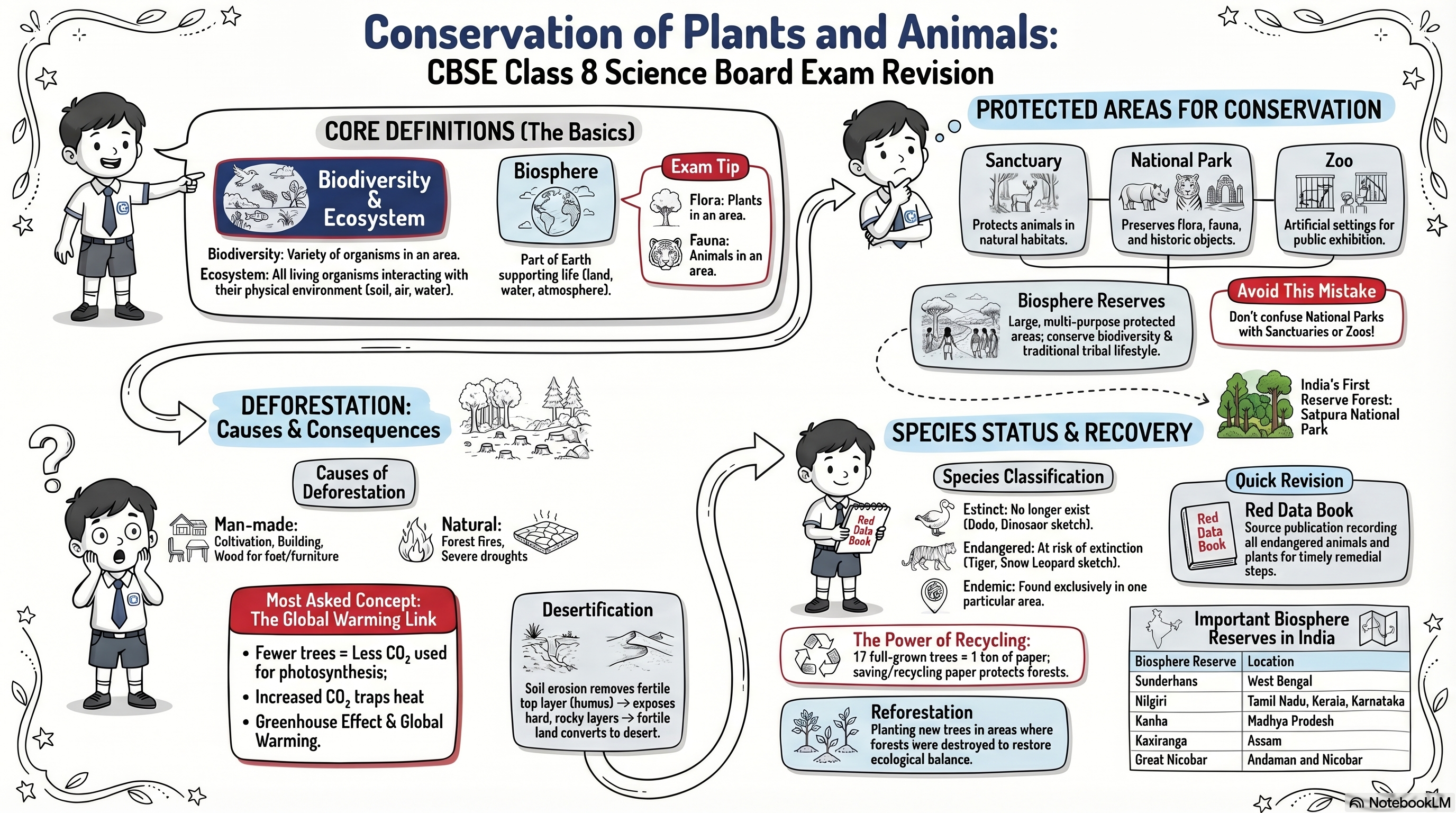
Important Concepts & Definitions
1. Conservation
Conservation means the planned protection and management of natural resources including plants, animals, forests, and ecosystems to prevent their exploitation, pollution, and destruction, and to ensure they remain available for future use.
2. Biosphere
The biosphere is that part of the Earth in which living organisms exist. It includes:
- The land surface (lithosphere)
- The atmosphere (air)
- Water bodies rivers, ponds, lakes, and oceans (hydrosphere)
3. Wildlife
Wildlife refers to all animals and plants found naturally in forests and other natural habitats. Though it technically includes wild plants, the term is most commonly used for wild animals and birds.
4. Biodiversity
Biodiversity is the variety of living organisms plants, animals, and micro-organisms found in a particular area or habitat. High biodiversity means a healthier, more resilient ecosystem.
5. Ecosystem
An ecosystem is a system that includes all the living organisms (plants, animals, and micro-organisms) of an area and the physical environment (soil, air, and water) in which they live. It is a self-sustaining functional unit of the biosphere.
6. Deforestation
Deforestation is the reckless or large-scale cutting of trees for unnecessary reasons. It is identified as the biggest threat to the survival of wildlife.
7. Desertification
Desertification is the process by which fertile land gradually becomes a desert due to soil erosion caused by deforestation. Hot deserts and semi-desert regions already cover about one-fifth of the world's land surface.
8. Flora and Fauna
| Term | Meaning | Example (Pachmarhi) |
|---|---|---|
| Flora | All plant life found in a particular area | Sal, Wild Mango, Teak |
| Fauna | All animal life found in a particular area | Bison, Leopard, Indian Giant Squirrel |
9. Species
A species is a group of organisms that share common characteristics and can interbreed to produce fertile offspring. Examples: Tiger, Dog, Human.
10. Endemic Species
Endemic species are plants or animals found exclusively in one particular geographic area and nowhere else naturally. Example: Sal and Wild Mango (flora), Bison and Indian Giant Squirrel (fauna) of the Pachmarhi Biosphere Reserve.
11. Extinct Species
Extinct species are those that no longer exist anywhere on Earth. A species becomes extinct when its last living member dies. Examples: Dinosaur, Dodo, Cave Lion, Annularia (plant), Sigillaria (plant).
12. Endangered Species
Endangered species are populations at serious risk of becoming extinct due to adverse environmental conditions, habitat loss, or predation. Examples: Tiger, Snow Leopard, Great Indian Rhinoceros, Asiatic Lion, Kashmir Stag.
13. Vulnerable Species
Vulnerable species exist in sufficient numbers today but may become endangered if unfavorable conditions continue. Examples: Crab-eating Macaque, Black Buck, Chinkara Deer.
14. Rare Species
Rare species are neither endangered nor vulnerable but are still at risk due to small populations. Examples: Indian Egg-eating Snake, Indian Pied Hornbill, Golden Cat.
15. Migration
Migration is the process by which birds or animals move from one place to another according to the season and return in a different season. It is an adaptation to escape harsh winter conditions.
16. Reforestation
Reforestation is the planting of trees in an area where forests were previously destroyed.
17. Red Data Book
The Red Data Book is a publication that keeps a record of all endangered animals, plants, and other species. It helps authorities take timely steps to prevent extinction.
Detailed Explanation of Concepts
Causes of Deforestation
Deforestation happens due to both human activities and natural events.
Man-Made Causes:
- Clearing land for agriculture and cultivation
- Building houses, factories, roads, and dams
- Using wood as fuel (firewood)
- Making furniture and other wood products
- Overgrazing by domestic animals, which destroys ground-level vegetation
Natural Causes:
- Forest fires wildfires can destroy entire stretches of forest
- Severe drought prolonged lack of water kills trees
Consequences of Deforestation
Deforestation has a chain of devastating effects on nature:
| Consequence | Explanation |
|---|---|
| Shortage of forest products | Less wood, honey, gum, wax, and resins available |
| Global warming | Fewer trees absorb less CO₂ → CO₂ builds up → greenhouse effect → rising temperatures |
| Soil erosion | Tree roots bind soil particles; without trees, wind and rain wash the topsoil away |
| Desertification | Eroded topsoil exposes infertile rocky layers → fertile land turns to desert |
| Flooding | Tree roots absorb rainwater; without trees, water rushes into rivers causing floods |
| Decreased rainfall | Forests are major transpiration zones; fewer trees means less moisture in the atmosphere |
| Species extinction | Wild animals lose their habitat, food, and shelter, and face death or hunting |
How Deforestation Causes Both Drought AND Floods
This is a commonly asked question and seems contradictory at first. Here is the explanation:
- Drought: Forests contribute water vapour to the atmosphere through transpiration. Without trees, this moisture disappears, rainfall decreases, and groundwater levels drop causing drought.
- Floods: Tree roots normally absorb and slow down rainwater, letting it percolate into the ground. Without trees, rainwater rushes rapidly into rivers, causing floods.
Both effects are real and can occur in the same region at different times.
Conservation of Forests and Wildlife
Three key measures for conservation are:
- Ban poaching hunting or capturing wild animals must be prohibited by law.
- Stop reckless tree-felling enforce strict regulations on logging.
- Establish protected areas create zones where wildlife can flourish safely.
The Government of India has established three types of protected areas:
Biosphere Reserves
A Biosphere Reserve is a large, protected area meant for the conservation of wildlife, biodiversity, and the traditional lifestyle of tribal communities living in the area.
Three Zones of a Biosphere Reserve:
[Outermost] TRANSITION ZONE
 → Human settlements, crop cultivation allowed
[Middle] BUFFER ZONE
 → Research, environmental education, tourism allowed
[Innermost] CORE ZONE
 → Strictly protected; NO human activity allowed; wildlife only
Tourists may visit up to the buffer zone only. The core zone is off-limits to the public.
Key Facts:
- India has 14 Biosphere Reserves
- A biosphere reserve can contain wildlife sanctuaries and national parks within it
- Example: Pachmarhi Biosphere Reserve (Madhya Pradesh) contains Bori Sanctuary, Pachmarhi Sanctuary, and Satpura National Park
Important Biosphere Reserves of India:
| Name | Location |
|---|---|
| Great Nicobar Biosphere Reserve | Andaman & Nicobar Islands |
| Kaziranga Biosphere Reserve | Assam |
| Sunderbans Biosphere Reserve | West Bengal |
| Kanha Biosphere Reserve | Madhya Pradesh |
| Nilgiri Biosphere Reserve | Tamil Nadu, Kerala, Karnataka |
| Gulf of Mannar Biosphere Reserve | Tamil Nadu |
| Nokrek Biosphere Reserve | Meghalaya |
| Simlipal Biosphere Reserve | Odisha |
Roles of Biosphere Reserves:
- Maintain biodiversity of the region
- Preserve natural ecological conditions and ecosystems
- Protect the lifestyle and culture of tribal communities
- Provide platforms for scientific research, environmental education, and eco-tourism
Wildlife Sanctuaries
A Wildlife Sanctuary is a protected area created specifically for the protection of wild animals in their natural environment (forests). Human activities that disturb wildlife or their habitat are not permitted.
- India has more than 500 Wildlife Sanctuaries
- Some are specifically called Bird Sanctuaries
Important Wildlife Sanctuaries of India:
| Name | Location |
|---|---|
| Sanjay Gandhi Wildlife Sanctuary | Maharashtra |
| Mudumalai Wildlife Sanctuary | Tamil Nadu |
| Nagarjunsagar Wildlife Sanctuary | Andhra Pradesh |
| Bharatpur Bird Sanctuary | Rajasthan |
| Sultanpur Lake Bird Sanctuary | Haryana |
| Dandeli Wildlife Sanctuary | Karnataka |
| Thattekad Bird Sanctuary | Kerala |
National Parks
A National Park is a relatively large, scenic area maintained by the government to preserve flora, fauna, landscapes, and places of historical/scientific interest. National Parks also serve recreational and educational purposes for the public.
- India has more than 80 National Parks
- Satpura National Park (Madhya Pradesh) is the first Reserve Forest of India
- Corbett National Park (Uttarakhand) is the first National Park of India
Important National Parks of India:
| Name | Location |
|---|---|
| Corbett National Park | Uttarakhand |
| Kanha National Park | Madhya Pradesh |
| Ranthambore National Park | Rajasthan |
| Gir National Park | Gujarat |
| Kaziranga National Park | Assam |
| Sunderbans National Park | West Bengal |
| Bandipur National Park | Karnataka |
| Dachigam National Park | Jammu & Kashmir |
| Sariska National Park | Rajasthan |
| Satpura National Park | Madhya Pradesh |
Comparison Tables
Wildlife Sanctuary vs Zoo:
| Feature | Wildlife Sanctuary | Zoo |
|---|---|---|
| Animal environment | Natural habitat (forests) | Artificial (cages/enclosures) |
| Animal origin | Local wildlife | Animals from across the world |
| Public access | Restricted; only with forest guards | Open daily at fixed hours |
| Animal comfort | Very comfortable | Less comfortable |
Biosphere Reserve vs Wildlife Sanctuary:
| Feature | Biosphere Reserve | Wildlife Sanctuary |
|---|---|---|
| Area | Very large | Comparatively smaller |
| Purpose | Biodiversity + economic development | Protection of wild animals |
| Tribal/local people | Integral part | Not included |
| Human activities | Allowed in outermost zone | Not allowed |
Wildlife Sanctuary vs National Park:
| Feature | Wildlife Sanctuary | National Park |
|---|---|---|
| Scenic beauty | May or may not be scenic | Must be an area of great scenic beauty |
| Purpose | Protect wild animals only | Protect wildlife + landscape + history + science |
| Public recreation | Not the primary purpose | Specifically for recreation and education |
| Visitor access | Usually restricted | Easy access for visitors |
Project Tiger
Project Tiger is a wildlife conservation programme launched by the Government of India in 1972 to protect the dwindling tiger population in the country.
- Objective: Ensure the survival and maintenance of tigers in specially designated Tiger Reserves
- India currently has 28 Tiger Reserves governed under Project Tiger
- Satpura Tiger Reserve (inside Satpura National Park) is one such reserve
Red Data Book
The Red Data Book is an international and national publication that lists all species endangered with extinction.
- Separate Red Data Books exist for plants, animals, and other organisms
- India has its own Red Data Book of India
Some endangered animals listed in the Red Data Book of India: Flying Squirrel, Indian Giant Squirrel, Barasingha, Black Buck, Himalayan Musk Deer, Great Indian Rhinoceros, Snow Leopard, Tiger
Advantage: It alerts governments and conservationists about which species need urgent protection, enabling timely action.
Migration
Migration is the seasonal movement of birds or animals from one region to another and back again. It is an adaptation to survive extreme weather conditions.
Example Siberian Crane:
- When Siberia becomes extremely cold in winter, the Siberian Crane flies thousands of kilometres to warmer locations in India.
- It visits: Bharatpur (Rajasthan), Sultanpur (Haryana), and wetlands in North-East India.
- When Siberian winter ends and conditions improve, the cranes fly back to Siberia.
Recycling of Paper
Paper is made from wood pulp derived from forest trees. It is estimated that 17 fully grown trees are needed to produce 1 tonne of paper.
Recycling paper helps by:
- Saving forest trees from being cut
- Conserving water used in paper manufacturing
- Reducing energy (electricity) consumption
- Minimising harmful chemicals released during paper production
Paper can be recycled 5 to 7 times before the fibres become too short for reuse.
Reforestation
Reforestation = Planting trees in areas where forests have been destroyed.
Benefits of Reforestation:
- Reduces global warming by absorbing CO₂ from the atmosphere
- Increases rainfall, raises groundwater levels, and prevents drought
- Prevents soil erosion and reduces the risk of flooding
Important Terms for Exam
| Term | One-Line Definition |
|---|---|
| Conservation | Protecting natural resources from damage |
| Deforestation | Reckless cutting of trees |
| Desertification | Conversion of fertile land into desert |
| Biodiversity | Variety of organisms in a habitat |
| Biosphere | Part of Earth that supports life |
| Endemic species | Species found only in a specific region |
| Endangered species | Species at risk of extinction |
| Extinct species | Species no longer found on Earth |
| Vulnerable species | Stable now but at future risk |
| Migration | Seasonal movement of animals |
| Reforestation | Replanting trees in destroyed areas |
| Red Data Book | Record of threatened/endangered species |
| Project Tiger | Government programme to protect tigers (1972) |
| Flora | Plants of a particular area |
| Fauna | Animals of a particular area |
Enhanced Study Notes & Memory Tricks
Quick Revision Points
- The biggest threat to wildlife is deforestation.
- Biosphere Reserves have 3 zones: Core → Buffer → Transition (remember CBT).
- India has 14 Biosphere Reserves, 500+ Wildlife Sanctuaries, 80+ National Parks.
- Project Tiger was launched in 1972.
- The Siberian Crane is a famous migratory bird that visits India every winter.
- 17 trees = 1 tonne of paper recycle to save forests!
- The Satpura National Park is the first Reserve Forest of India.
- Corbett National Park is the first National Park of India.
Mnemonics
Types of species status (from safest to most threatened):
Vulnerable → Rare → Endangered → Extinct Remember: "Very Rare Elephants Exit"
Three zones of Biosphere Reserve (inside to outside):
Core → Buffer → Transition Remember: "Can Bears Travel?"
Causes of deforestation (man-made):
Procuring land → Building → Fuel → Furniture → Overgrazing Remember: "Please Build For Future Outcomes"
Summary Table
| Protected Area | Size | Main Purpose | Tribal People | Human Activity |
|---|---|---|---|---|
| Biosphere Reserve | Largest | Biodiversity + tribal culture | Included | Allowed in transition zone |
| Wildlife Sanctuary | Medium | Protect wild animals | Not included | Restricted |
| National Park | Large | Wildlife + scenery + education | Not included | Allowed for tourism |
| Zoo | Smallest | Public education & recreation | N/A | Open daily |
Solved Examples (Minimum 20)
Conceptual Questions
Q1. What is conservation? Why is it important?
Answer: Conservation is the planned management of natural resources including plants, animals, and ecosystems to prevent exploitation, pollution, and destruction. It ensures these resources remain available for future generations. Conservation is important because:
- Many species are disappearing at an alarming rate due to human activities.
- Biodiversity loss disrupts ecological balance and food chains.
- Future generations have the right to experience and benefit from wildlife.
Q2. Define deforestation and list its four main man-made causes.
Answer: Deforestation is the reckless cutting of trees for unnecessary reasons, which threatens ecosystems and wildlife.
Four main man-made causes:
- Clearing land for agriculture/cultivation
- Constructing houses, factories, roads, and dams
- Using wood as fuel (firewood)
- Manufacturing furniture and wood products
Q3. Explain why deforestation leads to global warming.
Answer: Trees absorb carbon dioxide (CO₂) during photosynthesis. When large numbers of trees are cut down, fewer trees are available to absorb CO₂. As a result, CO₂ levels in the atmosphere rise. CO₂ is a greenhouse gas it traps heat rays from escaping Earth's atmosphere, raising temperatures. This is the greenhouse effect, which leads to global warming.
Q4. How does deforestation cause soil erosion and desertification?
Answer:
- Tree roots bind soil particles together, preventing them from being washed or blown away.
- When trees are removed during deforestation, the binding effect is lost.
- Strong winds and rainwater carry away the unprotected topsoil this is soil erosion.
- The removal of the fertile topsoil exposes the rocky, infertile lower layers.
- Plants cannot grow in this infertile soil, and the land gradually becomes a desert this is desertification.
Q5. Can deforestation reduce rainfall and cause floods at the same time? Explain.
Answer: Yes, this seems contradictory but both effects are scientifically valid:
- Decreased rainfall: Forests release water vapour into the atmosphere through transpiration. This moisture forms clouds and brings rainfall. Without forests, less moisture enters the atmosphere, so rainfall decreases and droughts may occur.
- Increased flooding: Tree roots absorb rainwater and allow it to slowly percolate into the ground. Without trees, rainwater flows rapidly over the surface and rushes into rivers, causing floods.
These two effects can occur in the same region at different times or under different conditions.
Q6. What is a Biosphere Reserve? Describe its three zones.
Answer: A Biosphere Reserve is a large, protected area of land set aside for the conservation of wildlife, biodiversity, and the traditional lifestyle of tribal communities.
Its three zones are:
- Core Zone (innermost): Strictly protected area; no human activity is allowed; only wildlife lives here.
- Buffer Zone (middle): Allows research, environmental education, and limited tourism. Tourists may visit this zone.
- Transition Zone (outermost): Human settlements and crop cultivation are permitted here.
Q7. What is the difference between endemic and endangered species? Give one example of each.
Answer:
| Feature | Endemic Species | Endangered Species |
|---|---|---|
| Definition | Found exclusively in one specific region | At serious risk of becoming extinct |
| Presence | Only in that one area naturally | May be found in multiple areas but numbers are very low |
| Example | Indian Giant Squirrel (Pachmarhi) | Tiger |
Q8. What is the Red Data Book? What are its advantages?
Answer: The Red Data Book is a publication (national or international) that records all species animals, plants, and others that are endangered or threatened with extinction. Separate Red Data Books exist for plants and animals.
Advantages:
- Informs governments and conservation organisations which species are at risk.
- Enables timely and targeted conservation actions.
- Raises public and scientific awareness about threatened biodiversity.
Q9. What is Project Tiger? When was it launched and what is its objective?
Answer: Project Tiger is a wildlife conservation programme launched by the Government of India in 1972. The objective was to ensure the survival and long-term maintenance of the tiger population in specially designated Tiger Reserves across India. Currently, there are 28 Tiger Reserves in India governed under this project.
Q10. What is migration? Why do birds migrate? Give one example.
Answer: Migration is the seasonal movement of birds or animals from one place to another and back again. Birds migrate primarily to escape harsh winter conditions in their natural habitat and survive in warmer climates.
Example Siberian Crane: When Siberia becomes bitterly cold in winter, the Siberian Crane flies thousands of kilometres to warmer parts of India (like Bharatpur in Rajasthan and Sultanpur in Haryana). When winter ends in Siberia, the cranes return home.
Q11. Explain how recycling paper helps conserve forests.
Answer: Paper is manufactured from the wood pulp of trees. Approximately 17 fully grown trees are required to produce just 1 tonne of paper. By recycling used paper:
- Fewer trees need to be cut to meet paper demand.
- Forest cover is preserved, protecting wildlife habitats.
- Water and energy used in paper production are conserved.
- Harmful chemicals from paper factories are reduced.
Paper can be recycled 5–7 times, making it a highly efficient conservation tool.
Q12. How can killing snakes harm food grain production?
Answer:
- Snakes are natural predators of rats and mice in crop fields.
- When snakes are killed in large numbers (e.g., for their skin), the snake population drops significantly.
- With fewer predator snakes, the population of rats and mice increases rapidly.
- These pests destroy standing crops, leading to a significant loss in food grain production.
This is an example of how disrupting one part of a food chain harms the entire ecosystem, and ultimately human food security.
Short Answer Questions
Q13. Name three types of protected areas in India established for wildlife conservation.
Answer: The three types are:
- Biosphere Reserves
- Wildlife Sanctuaries
- National Parks
Q14. What are the advantages of reforestation?
Answer:
- Reduces global warming by absorbing excess CO₂ from the atmosphere.
- Increases rainfall, raises groundwater levels, and prevents droughts.
- Prevents soil erosion by binding soil particles with tree roots.
- Reduces the risk of flooding by absorbing and slowing rainwater.
Q15. Name the first Reserve Forest of India. In which state is it located?
Answer: Satpura National Park is the first Reserve Forest of India. It is located in Madhya Pradesh. It is home to Tiger, Gaur (Indian Bison), Sloth Bear, Cheetah, Hyena, and Rhesus Monkey, and contains the finest Indian teak.
Q16. Distinguish between extinct species and endangered species.
Answer:
| Extinct Species | Endangered Species |
|---|---|
| No longer exist anywhere on Earth | Still exist but at serious risk of extinction |
| All members of the species have died | Population has drastically reduced |
| Cannot be recovered | Can be saved through conservation efforts |
| Example: Dinosaur, Dodo | Example: Tiger, Snow Leopard |
Assertion–Reason Questions
Q17. Assertion (A): Biosphere Reserves allow human settlements in their outermost zone.Reason (R): The transition zone of a Biosphere Reserve permits cultivation and human habitation.
Answer:(a) Both A and R are true, and R is the correct explanation of A.
The outermost zone of a Biosphere Reserve is the transition zone, where human settlements and agricultural activities are permitted.
Q18. Assertion (A): A Wildlife Sanctuary does not allow human recreational activities.Reason (R): Wildlife Sanctuaries are dedicated solely to protecting wild animals in their natural habitat.
Answer:(a) Both A and R are true, and R is the correct explanation of A.
Unlike National Parks (which also serve educational and recreational purposes), Wildlife Sanctuaries exist exclusively to protect wild animals. Visitor access is restricted.
Q19. Assertion (A): Deforestation can increase both drought and flood risk in the same area.Reason (R): Trees regulate both the water cycle (transpiration → rainfall) and water absorption (roots → groundwater).
Answer:(a) Both A and R are true, and R is the correct explanation of A.
Trees perform two functions simultaneously: they release moisture into the air (supporting rainfall) and their roots absorb excess rainwater. Removing trees disrupts both, causing drought and flood risk simultaneously.
Case-Based Question
Q20. Read the following scenario and answer the questions:
A forest in central India was cleared to build a new highway. Within two years, farmers in the surrounding region reported that their wells were running dry during summer, but floods destroyed crops every monsoon. Dust storms became frequent, and many birds no longer visited the area.
(a) What human activity caused these problems?
(b) Name any three consequences visible in the scenario.
(c) What two steps could reverse these effects?
(d) Which migratory bird associated with this region might stop visiting as a result?
Answer:(a) The human activity is deforestation clearing forest to build a highway.
(b)Three visible consequences:
- Decreased groundwater/drought wells running dry in summer (disrupted water cycle)
- Flooding during monsoon reduced water absorption by soil without tree roots
- Soil erosion dust storms indicating loss of topsoil
(c) Two steps to reverse the effects:
- Reforestation planting trees in and around the cleared area
- Establishing a protected zone preventing further clearing and allowing natural forest regeneration
(d) If the area is near Bharatpur or similar wetlands, the Siberian Crane might stop visiting due to habitat destruction.
FAQs about Conservation of Plants and Animals
Both involve planting trees, but:
- Afforestation = Planting trees on land that has never had a forest before (converting bare land to forest).
- Reforestation = Replanting trees specifically in areas where forests previously existed but were destroyed.
- Biosphere Reserves: 14
- National Parks: More than 80
- Wildlife Sanctuaries: More than 500
The endemic fauna of Pachmarhi includes: Bison, Indian Giant Squirrel, Flying Squirrel, Leopard, Cheetal (Spotted Deer), and Wolf. Its endemic flora includes Sal and Wild Mango.
The red colour is symbolic it signals danger and urgency, much like a red traffic light. It is a visual reminder that the species listed within it are in serious danger and need immediate attention and protection.
The main differences:
- A National Park is larger and protects wildlife, scenic beauty, historical objects, and places of scientific interest. It is open for public recreation and education.
- A Wildlife Sanctuary is dedicated only to protecting wild animals in their natural habitat. Recreation is not its primary purpose, and visitor access is usually restricted.
Siberian Cranes migrate to India every winter to escape the extremely cold temperatures of Siberia. They fly thousands of kilometres to warmer wetlands in India (Bharatpur in Rajasthan, Sultanpur in Haryana, and parts of North-East India), stay for a few months, and return when Siberian winter ends.
- A population is a group of organisms of the same species living in the same area at the same time.
- A species is a broader category all organisms that share common traits and can interbreed with each other to produce fertile offspring. A species may consist of multiple populations across different regions.
Small animals often have smaller population sizes, more specific habitat requirements, and are more easily overlooked in conservation planning. Large animals like tigers receive dedicated projects (Project Tiger), while smaller species may not receive the same level of attention or legal protection. Additionally, small animals are more vulnerable to changes in their immediate environment.
Soil erosion strips away the topsoil, which is rich in organic matter (humus) and nutrients. Once the topsoil is gone, only the hard, rocky, infertile subsoil remains. Plants struggle to grow in this degraded soil. Over time, with no vegetation cover to protect the land, the area receives less rainfall, dries out, and gradually transforms into a desert this process is called desertification.
A Biosphere Reserve can contain other protected areas within its boundaries. For example, the Pachmarhi Biosphere Reserve in Madhya Pradesh contains:
- Bori Wildlife Sanctuary
- Pachmarhi Wildlife Sanctuary
- Satpura National Park
- Tawa Reservoir
This shows how protected areas can be nested within each other for layered conservation.