




Combustion and Flame
Combustion is a chemical process where a substance reacts with oxygen to produce heat and light. It's a fundamental concept in chemistry that explains how fuels burn, engines work, and even how our body generates energy from food.
Why This Topic Matters
- Exam Relevance: Frequently asked in CBSE Board exams with 3-5 mark questions
- Real-Life Applications: Cooking, vehicle engines, heating systems, fire safety
- Foundation Concept: Essential for understanding energy, chemical reactions, and environmental science
Important Concepts & Definitions
1. Combustion
The chemical process in which a substance reacts with oxygen to release heat energy. It may or may not produce light.
Example: When magnesium burns in air:
Magnesium + Oxygen → Magnesium oxide + Heat + Light
2. Fuel
Any substance that burns in air to produce heat energy.
Examples:
- Solid fuels: Coal, wood, charcoal
- Liquid fuels: Petrol, diesel, kerosene
- Gaseous fuels: Natural gas, LPG, CNG
3. Combustible Substance
Materials that can catch fire and burn easily.
Examples: Wood, paper, kerosene, LPG, coal
4. Non-Combustible Substance
Materials that do not catch fire.
Examples: Iron nails, glass, stone, water
5. Supporter of Combustion
The substance that helps burning. Air (specifically oxygen) is the most common supporter of combustion.
6. Ignition Temperature (Kindling Temperature)
The lowest temperature at which a substance catches fire and starts burning.
Example: Phosphorus has an ignition temperature of 35°C, which is why it can catch fire at room temperature if the air is warm enough.
7. Inflammable Substances
Substances with very low ignition temperature (generally less than 100°C) that can catch fire easily.
Examples: Petrol, alcohol, LPG, acetone
Note: Despite the prefix "in-", inflammable means "easily flammable," not "non-flammable."
8. Flame
A region of burning gases where combustion takes place with production of light and heat.
9. Calorific Value
The amount of heat energy produced on complete combustion of 1 kg of fuel. It is measured in kilojoules per kilogram (kJ/kg).
Formula:
Calorific Value = Total Heat Produced / Mass of Fuel Burnt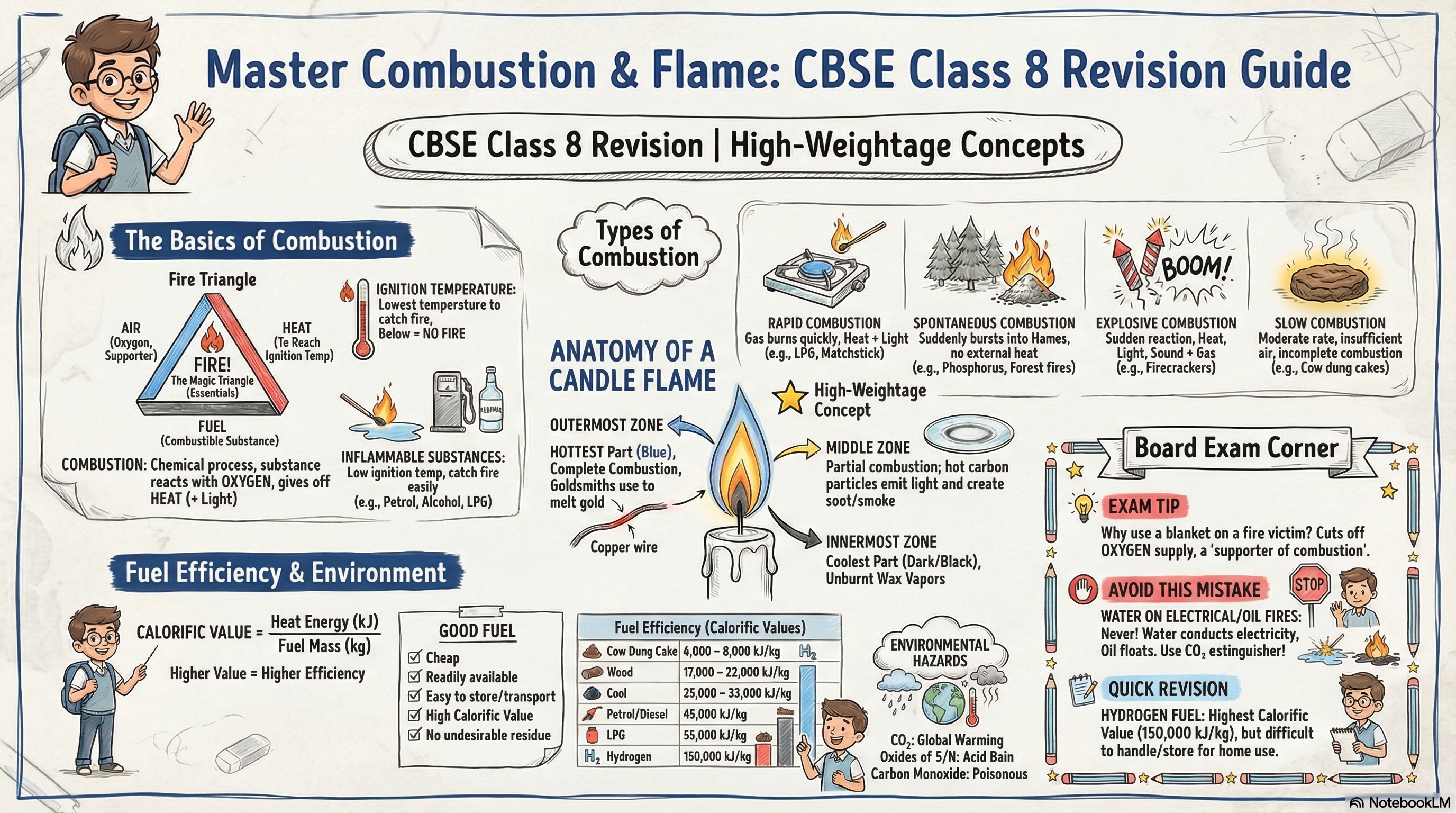
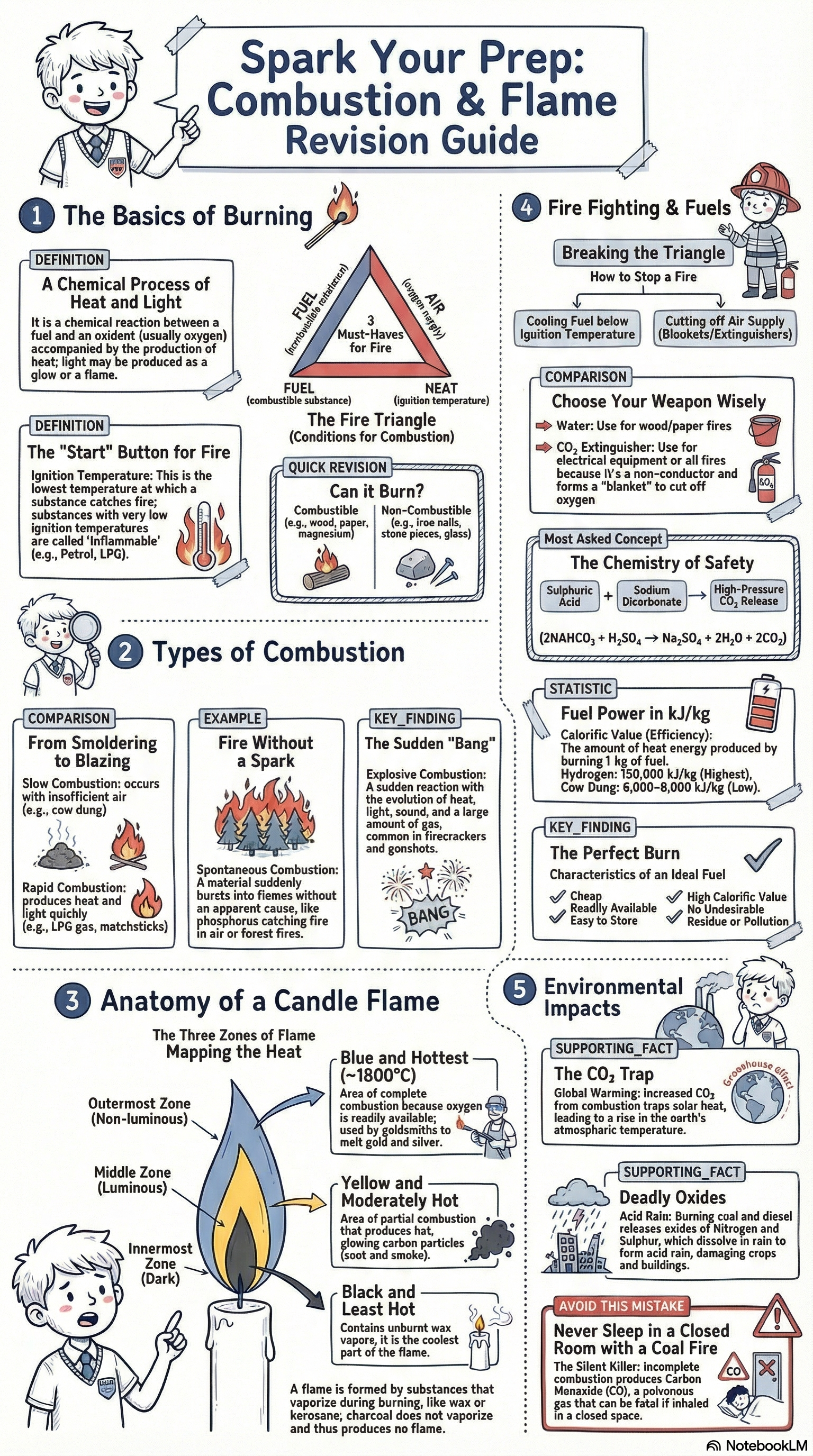
Types of Combustion
1. Slow Combustion
- Burns at a slow or moderate rate
- Insufficient air supply
- Incomplete combustion
- Produces harmful gases
Examples: Burning of cow dung cakes, wood in traditional stoves
2. Rapid Combustion
- Burns quickly with sufficient air supply
- Complete combustion
- Produces large amount of heat and light
- Generally involves gaseous fuels
Examples: Burning of LPG, CNG, matchstick, dry grass
3. Spontaneous Combustion
- Substance suddenly bursts into flames
- No external heat source needed
- Material forms oxides that produce heat
- Temperature rises above ignition point
Examples:
- White phosphorus catching fire in air
- Sodium metal in water
- Forest fires (organic matter decomposition)
4. Explosive Combustion
- Very rapid combustion in closed space
- Large amount of gas released suddenly
- Produces heat, light, sound, and pressure
Examples: Bursting of crackers, firing of bullets, bomb explosions
CBSE Class 8 Science Notes Chapter-wise
Conditions Necessary for Combustion
For combustion to occur, three conditions must be met simultaneously:
| Condition | Description |
|---|---|
| 1. Combustible Substance | Material that can burn must be present |
| 2. Supporter of Combustion | Oxygen or air must be available |
| 3. Ignition Temperature | Temperature must reach or exceed the ignition point |
Fire Triangle: These three conditions form the "fire triangle" - remove any one element and fire cannot exist.
Structure of a Candle Flame
A candle flame has three distinct zones, each with different characteristics:
Zone 1: Innermost Zone (Dark Zone)
- Location: Near the wick at the bottom
- Color: Black/dark
- Temperature: Least hot (coolest zone)
- Composition: Unburnt wax vapors
- Combustion: No combustion occurs here
Zone 2: Middle Zone (Luminous Zone)
- Location: Middle portion (largest zone)
- Color: Yellow/bright yellow
- Temperature: Moderately hot
- Composition: Partially burnt carbon particles
- Combustion: Partial combustion
- Note: Hot carbon particles emit light, making this zone luminous
Zone 3: Outermost Zone (Non-Luminous Zone)
- Location: Outer edge of flame
- Color: Blue (almost invisible)
- Temperature: Hottest zone (around 1800°C)
- Combustion: Complete combustion
- Note: This is why goldsmiths use this zone to melt gold and silver
Practical Application: When heating something in a lab, place it in the outermost zone for maximum heat.
Fire Extinguishers and Fire Fighting
Principle of Fire Fighting
To extinguish fire, remove one or more conditions from the fire triangle:
- Remove combustible material
- Cut off oxygen supply
- Cool below ignition temperature
Types of Fire Extinguishers
1. Water-Based Extinguisher
Use: Fires involving wood, paper, cloth, etc.
How it works:
- Cools the burning material below ignition temperature
- Water vapor forms a blanket that cuts off air supply
Limitations:
- Cannot be used for electrical fires (water conducts electricity)
- Cannot be used for oil fires (oil floats on water)
2. Soda-Acid Fire Extinguisher
Composition:
- Cylinder contains sodium bicarbonate (NaHCO₃) solution
- Glass tube contains concentrated sulfuric acid (H₂SO₄)
Working Mechanism:
When the plunger is struck:
- Glass tube breaks
- Acid mixes with sodium bicarbonate
- Chemical reaction produces CO₂
Chemical Reaction:
2NaHCO₃ + H₂SO₄ → Na₂SO₄ + 2H₂O + 2CO₂↑
- CO₂ pressure builds up
- Wax seal breaks
- Solution + CO₂ sprays out
- CO₂ blanket cuts off oxygen supply
Use: Fires caused by solid combustible materials (wood, paper, cloth)
Limitations:
- Not for oil/petrol fires (solution sinks below oil)
- Not for electrical fires (solution conducts electricity)
3. Carbon Dioxide (CO₂) Extinguisher
Why CO₂ is excellent:
- Does not conduct electricity
- Being a gas, it leaves no residue
- Heavier than air (forms blanket over fire)
- When released, it expands and cools down rapidly
Use:
- Electrical fires
- Oil and petrol fires
- Sensitive equipment fires
Fuels: Types and Characteristics
What Makes a Good Fuel?
An ideal fuel should have these characteristics:
| Characteristic | Why It Matters |
|---|---|
| High calorific value | More energy per kg |
| Easily available | Cost-effective and accessible |
| Easy to store | Safe and convenient |
| Safe to transport | Reduces accidents |
| Low ignition temperature | Easy to ignite |
| Controlled burning rate | Safe and manageable |
| Minimum residue | Less ash and waste |
| No harmful gases | Environmentally friendly |
Calorific Values of Common Fuels
Solid Fuels
| Fuel | Calorific Value (kJ/kg) |
|---|---|
| Cow dung cake | 6,000 - 8,000 |
| Wood | 17,000 - 22,000 |
| Coal | 25,000 - 33,000 |
| Charcoal | 30,000 - 35,000 |
Liquid Fuels
| Fuel | Calorific Value (kJ/kg) |
|---|---|
| Kerosene | 45,000 |
| Petrol | 45,000 |
| Diesel | 45,000 |
Gaseous Fuels
| Fuel | Calorific Value (kJ/kg) |
|---|---|
| Biogas | 35,000 - 40,000 |
| Methane | 50,000 |
| CNG | 50,000 |
| LPG (Butane) | 55,000 |
| Hydrogen | 150,000 |
Hydrogen has the highest calorific value, but it's not commonly used as a domestic fuel due to safety concerns (highly inflammable and explosive).
Environmental Effects of Combustion
1. Global Warming
Cause: Increased concentration of CO₂ in the atmosphere
Mechanism:
- CO₂ acts as a greenhouse gas
- Traps heat radiated back from Earth
- Causes average temperature to rise
Effects:
- Melting of polar ice caps
- Rising sea levels
- Flooding of coastal areas
- Climate change
- Disruption of rain patterns
Impact: Scientists estimate a potential 2°C rise in global temperature by the end of the century.
2. Acid Rain
Formation Process:
- Coal and diesel contain sulfur as impurity
- Burning releases SO₂ (sulfur dioxide)
- SO₂ combines with oxygen → SO₃ (sulfur trioxide)
- SO₃ reacts with water in clouds → H₂SO₄ (sulfuric acid)
- Petrol engines release nitrogen oxides (NOₓ)
- NOₓ + water → Nitric acid (HNO₃)
- These acids dissolve in rain → Acid rain
Effects:
- Damages crops and plants
- Makes soil acidic and infertile
- Corrodes buildings and monuments (marble cancer)
- Pollutes lakes and rivers
- Harmful for aquatic life
3. Air Pollution from Incomplete Combustion
| Product | Effect |
|---|---|
| Unburnt carbon particles | Respiratory diseases like asthma |
| Carbon monoxide (CO) | Poisonous gas, can cause death |
| Sulfur dioxide (SO₂) | Suffocating and corrosive |
| Nitrogen oxides | Respiratory problems |
Solutions
- Replace petrol/diesel with CNG (Compressed Natural Gas)
- Use LPG instead of wood/coal for cooking
- Implement emission control measures
- Use cleaner fuels with lower pollution
Enhanced Study Notes
Quick Revision Points
Combustion Basics
- Combustion = Oxidation process producing heat
- Three requirements: Fuel + Oxygen + Ignition temperature
- Can occur without air (e.g., chlorine atmosphere, explosives with internal oxygen)
Types to Remember (SRSE)
- S - Slow
- R - Rapid
- S - Spontaneous
- E - Explosive
Flame Zones (DIL - Dark, Inside, Light)
- Dark zone (innermost) - coolest
- Inside yellow zone (middle) - moderate
- Light blue zone (outermost) - hottest
Fire Extinguisher Formula
2NaHCO₃ + H₂SO₄ → Na₂SO₄ + 2H₂O + 2CO₂
Calorific Value Memory Trick
Increasing Order: Cow dung < Wood < Coal < Petrol/Diesel < CNG < LPG < Hydrogen
Quick Numbers (approximate):
- Cow dung: 7,000 kJ/kg
- Wood: 20,000 kJ/kg
- Coal: 30,000 kJ/kg
- Petrol: 45,000 kJ/kg
- CNG: 50,000 kJ/kg
- LPG: 55,000 kJ/kg
- Hydrogen: 150,000 kJ/kg
Common Mistakes to Avoid
- Inflammable ≠ Non-flammable (it means easily flammable)
- Fire extinguisher works by removing heat only (it also cuts oxygen)
- All combustion produces flame (charcoal doesn't produce flame)
- Water can be used for all fires (not for electrical or oil fires)
Solved Examples
Conceptual Questions
Example 1: What is combustion? Give one example.
Solution:
Combustion is a chemical process in which a substance reacts with oxygen to release heat energy. It may or may not produce light.
Example: When magnesium ribbon burns in air:
2Mg + O₂ → 2MgO + Heat + Light
Magnesium oxide is formed along with heat and light.
Example 2: Differentiate between combustible and non-combustible substances with examples.
Solution:
| Combustible Substances | Non-Combustible Substances |
|---|---|
| Can catch fire and burn | Cannot catch fire |
| React with oxygen when heated | Do not react with oxygen easily |
| Examples: Wood, paper, LPG, coal, petrol | Examples: Stone, glass, iron nails, water |
Example 3: What is ignition temperature? Why is it important?
Solution:
Ignition temperature is the lowest temperature at which a substance catches fire and starts burning.
Importance:
- Determines fire safety measures
- Helps classify substances as inflammable or not
- Essential for proper fuel storage
- Critical in fire prevention strategies
Example: Phosphorus has an ignition temperature of 35°C, so it must be stored in water to keep it cool and prevent spontaneous combustion.
Example 4: Why is water not used to extinguish fires caused by burning oil?
Solution:
Water cannot be used for oil fires because:
- Density difference: Water is denser than oil, so it sinks below the burning oil
- No contact: Water doesn't come in contact with the burning surface
- Ineffective cooling: Cannot cool the oil effectively
- Spread risk: Water can cause burning oil to spread
- Better alternatives: CO₂ or foam extinguishers should be used
Example 5: Explain why wood has a lower ignition temperature than paper, yet paper catches fire more easily.
Solution:
While wood has a slightly lower ignition temperature than paper, paper catches fire more easily due to:
- Surface area: Paper has much larger surface area exposed to air
- Thickness: Paper is thinner, heats up faster
- Oxygen access: More oxygen can reach all parts of paper simultaneously
- Heat distribution: Heat spreads quickly through thin paper
Ignition temperature alone doesn't determine ease of catching fire; physical properties matter too.
Short Answer Questions
Example 6: List three conditions necessary for combustion to take place.
Solution:
The three essential conditions for combustion are:
- Presence of combustible substance - Material that can burn (fuel)
- Presence of supporter of combustion - Oxygen or air must be available
- Attainment of ignition temperature - Temperature must reach or exceed the kindling point
If any one condition is removed, combustion will stop. This principle is used in fire fighting.
Example 7: What are inflammable substances? Give three examples.
Solution:
Inflammable substances are materials that have very low ignition temperature (generally below 100°C) and can catch fire easily with a flame.
Examples:
- Petrol - Used as vehicle fuel
- Alcohol - Used in laboratories and industries
- LPG (Liquefied Petroleum Gas) - Used for cooking
Safety Note: These should be stored away from heat sources and handled with care.
Example 8: Describe the three zones of a candle flame.
Solution:
Zone 1 - Innermost (Dark) Zone:
- Appears black/dark
- Contains unburnt wax vapors
- Coolest zone
- No combustion occurs
Zone 2 - Middle (Luminous) Zone:
- Bright yellow color
- Largest zone
- Partial combustion occurs
- Carbon particles get heated and emit light
- Moderately hot
Zone 3 - Outermost (Non-Luminous) Zone:
- Blue in color
- Complete combustion occurs
- Hottest zone (~1800°C)
- Used by goldsmiths for melting metals
Example 9: Why is LPG considered a better fuel than wood?
Solution:
| Aspect | LPG | Wood |
|---|---|---|
| Calorific value | 55,000 kJ/kg (high) | 17,000-22,000 kJ/kg (low) |
| Pollution | Minimal smoke and pollutants | Produces lot of smoke |
| Storage | Easy in cylinders | Requires large space |
| Combustion | Complete, efficient | Often incomplete |
| Residue | No ash | Leaves ash behind |
| Ignition | Easy to light and control | Difficult to ignite |
| Environmental impact | Less deforestation | Causes deforestation |
Conclusion: LPG is more efficient, cleaner, and environmentally friendly compared to wood.
Example 10: How does a soda-acid fire extinguisher work?
Solution:
Components:
- Metallic cylinder with sodium bicarbonate (NaHCO₃) solution
- Glass tube containing concentrated sulfuric acid (H₂SO₄)
- Nozzle sealed with wax
Working Mechanism:
Step 1: When the plunger is hit, the glass tube breaks
Step 2: Acid reacts with sodium bicarbonate:
2NaHCO₃ + H₂SO₄ → Na₂SO₄ + 2H₂O + 2CO₂↑
Step 3: CO₂ gas builds pressure inside the cylinder
Step 4: Pressure breaks the wax seal
Step 5: Solution mixed with CO₂ sprays out through the nozzle
Step 6: CO₂ forms a blanket over fire, cutting oxygen supply
Step 7: Solution cools the burning material below ignition temperature
Numerical Problems
Example 11: If 4.5 kg of fuel produces 180,000 kJ of heat energy, calculate its calorific value.
Solution:
Given:
- Mass of fuel = 4.5 kg
- Heat produced = 180,000 kJ
Formula:
Calorific Value = Total Heat Produced / Mass of Fuel
Calculation:
Calorific Value = 180,000 kJ / 4.5 kg
Calorific Value = 40,000 kJ/kg
Answer: The calorific value of the fuel is 40,000 kJ/kg.
Identification: This matches the calorific value of biogas.
Example 12: A family uses 12 kg of LPG in 30 days. Calculate the average energy consumed per day. (Calorific value of LPG = 55,000 kJ/kg)
Solution:
Given:
- Total LPG used = 12 kg
- Time period = 30 days
- Calorific value of LPG = 55,000 kJ/kg
Step 1: Calculate total energy produced
Total Energy = Mass × Calorific Value
Total Energy = 12 kg × 55,000 kJ/kg
Total Energy = 660,000 kJ
Step 2: Calculate average energy per day
Average Energy per day = Total Energy / Number of days
Average Energy per day = 660,000 kJ / 30 days
Average Energy per day = 22,000 kJ/day
Answer: The family consumes 22,000 kJ of energy per day.
Example 13: Which fuel is more efficient: Fuel A with calorific value 30,000 kJ/kg or Fuel B with calorific value 45,000 kJ/kg? Why?
Solution:
Fuel B is more efficient because it has a higher calorific value.
Explanation:
- Fuel A produces 30,000 kJ of energy per kg
- Fuel B produces 45,000 kJ of energy per kg
- Fuel B produces 15,000 kJ more energy per kg than Fuel A
- Higher calorific value means more energy from same amount of fuel
- This means less fuel is needed to produce the same amount of energy
Practical Implication:
- Fuel B is more economical
- Requires less storage space
- Produces less residue per unit energy
Assertion-Reason Questions
Example 14:
Assertion (A): Water is not used to extinguish electrical fires.
Reason (R): Water is a good conductor of electricity.
Options:
- (a) Both A and R are true, and R is the correct explanation of A
- (b) Both A and R are true, but R is not the correct explanation of A
- (c) A is true but R is false
- (d) A is false but R is true
Solution:(a) Both A and R are true, and R is the correct explanation of A
Explanation:
- Water conducts electricity (R is true)
- Using water on electrical fires can cause electric shock (A is true)
- The conductivity of water is the exact reason why it's dangerous for electrical fires
- Therefore, R correctly explains A
Example 15:
Assertion (A): Carbon dioxide is an excellent fire extinguisher.
Reason (R): Carbon dioxide is heavier than oxygen.
Options:
- (a) Both A and R are true, and R is the correct explanation of A
- (b) Both A and R are true, but R is not the correct explanation of A
- (c) A is true but R is false
- (d) A is false but R is true
Solution:(a) Both A and R are true, and R is the correct explanation of A
Explanation:
- CO₂ is heavier than air/oxygen (R is true)
- CO₂ is an excellent fire extinguisher (A is true)
- Being heavier allows CO₂ to form a blanket over fire
- This blanket cuts off oxygen supply
- Additionally, CO₂ doesn't conduct electricity and leaves no residue
- The weight property directly explains its effectiveness
Example 16:
Assertion (A): The outermost zone of a candle flame is the hottest.
Reason (R): Complete combustion takes place in the outermost zone.
Solution:(a) Both A and R are true, and R is the correct explanation of A
Explanation:
- Complete combustion occurs in the outermost zone (R is true)
- This zone has maximum temperature around 1800°C (A is true)
- Complete combustion releases maximum energy as heat
- Oxygen is readily available in this zone
- Therefore, complete combustion is the reason for highest temperature
Case-Based Questions
Example 17:
Case Study: During a science exhibition, students demonstrated different types of combustion. They showed:
- A candle burning slowly
- LPG gas burning rapidly
- A piece of white phosphorus suddenly catching fire when exposed to air
- A firecracker bursting with a loud sound
Questions:
(a) Identify the type of combustion in each case.
Solution:
- Candle burning - Slow combustion (controlled, steady burning)
- LPG burning - Rapid combustion (quick burning with flame)
- White phosphorus - Spontaneous combustion (no external heat needed)
- Firecracker - Explosive combustion (sudden, with sound and pressure)
(b) Why does white phosphorus catch fire spontaneously?
Solution:
White phosphorus catches fire spontaneously because:
- Its ignition temperature is only 35°C
- Room temperature (especially in warm conditions) can exceed this
- It reacts with oxygen in air without external heating
- Heat released during initial oxidation raises temperature further
- This causes it to burst into flames
Storage Solution: White phosphorus should be stored under water to keep it below ignition temperature.
(c) What safety precaution should be taken while storing LPG?
Solution:
LPG safety precautions:
- Store in well-ventilated areas
- Keep away from heat sources and flames
- Check for leaks regularly (gas companies add smell for detection)
- Don't store in basements (LPG is heavier than air, accumulates below)
- Keep cylinder upright
- Don't expose to direct sunlight
- Turn off valve when not in use
Example 18:
Case Study: A student performed an experiment with a candle. She placed a glass plate in different zones of the candle flame for a few seconds and observed the following:
- In the innermost zone: No mark on the plate
- In the middle zone: Black soot deposited
- In the outermost zone: Plate became very hot but no soot
Questions:
(a) Why was black soot deposited only in the middle zone?
Solution:
Black soot (carbon particles) is deposited in the middle zone because:
- This zone has partial combustion
- Insufficient oxygen reaches this zone
- Wax vapors don't burn completely
- Unburnt carbon particles form
- These hot carbon particles stick to the cooler glass plate
This demonstrates that the middle zone contains unburnt carbon, which is why it appears yellow (hot carbon emits yellow light).
(b) Why was there no soot in the outermost zone despite being very hot?
Solution:
No soot in the outermost zone because:
- Complete combustion occurs here
- Sufficient oxygen is available
- All carbon is completely burnt to CO₂
- No unburnt carbon particles remain
- Carbon dioxide is a gas and doesn't deposit
The plate became hot because this is the hottest zone (~1800°C), confirming complete combustion releases maximum energy.
(c) What conclusion can be drawn about the innermost zone?
Solution:
The innermost zone contains:
- Unburnt wax vapors (not even partially burnt)
- No combustion occurs here
- It's the coolest zone
- Wax vapors are in gaseous state but haven't started reacting with oxygen yet
This zone acts as a "fuel reserve" that feeds the flame above it.
Example 19:
Case Study: In a village, people traditionally used wood for cooking. The government introduced LPG under a subsidy scheme. Here's a comparison after one year:
| Aspect | Wood | LPG |
|---|---|---|
| Cost per month | ₹800 | ₹900 |
| Time to cook meal | 45 minutes | 20 minutes |
| Respiratory issues | 35% families | 5% families |
| Kitchen maintenance | High (soot cleaning) | Low |
Questions:
(a) Why did respiratory issues decrease with LPG?
Solution:
Respiratory issues decreased because:
With Wood:
- Incomplete combustion produces smoke
- Smoke contains unburnt carbon particles
- Also produces carbon monoxide (CO)
- These pollutants cause breathing problems
- Indoor air quality is poor
- Continuous exposure damages lungs
With LPG:
- Complete combustion occurs
- Minimal smoke production
- No unburnt carbon particles
- Cleaner burning
- Better indoor air quality
Health Impact: The reduction from 35% to 5% shows significant health benefits of using cleaner fuels.
(b) Explain why cooking time reduced with LPG.
Solution:
Cooking time reduced because:
- Higher calorific value:
- LPG: 55,000 kJ/kg
- Wood: 17,000-22,000 kJ/kg
- LPG produces nearly 3 times more heat
- Better heat transfer:
- LPG flame directly contacts vessel
- Wood flame spreads, less focused heat
- Controlled flame:
- LPG flame intensity is adjustable
- Wood takes time to reach optimal temperature
- Continuous heat:
- LPG provides steady heat
- Wood needs constant attention
(c) Is LPG economically and environmentally better despite higher cost? Justify.
Solution:
Yes, LPG is better overall.
Economic Analysis:
- Only ₹100 more per month (12.5% increase)
- Saves 25 minutes per cooking session
- If cooking twice daily: saves ~15 hours per month
- Less maintenance and cleaning costs
- Reduced healthcare costs (fewer respiratory issues)
Environmental Benefits:
- No deforestation
- Lower carbon footprint
- Cleaner burning
- Reduced indoor pollution
- Less smoke emission
Social Benefits:
- Better health (35% → 5% respiratory issues)
- Time saved can be used for other activities
- Improved quality of life
Conclusion: The slightly higher cost is offset by health, environmental, and time-saving benefits, making LPG the better choice.
Long Answer Questions
Example 20: Explain global warming. What are its causes and effects?
Solution:
Global warming is the gradual increase in the average temperature of Earth's atmosphere due to increased concentration of greenhouse gases, particularly carbon dioxide.
Mechanism:
- CO₂ in atmosphere traps heat radiated back by Earth
- Acts like a greenhouse glass, letting sunlight in but preventing heat escape
- This natural greenhouse effect is essential for life
- However, excess CO₂ causes excessive warming
Causes:
- Combustion of fossil fuels:
- Coal, petrol, diesel burning releases CO₂
- Power plants, vehicles, industries are major sources
- Deforestation:
- Trees absorb CO₂
- Cutting trees increases atmospheric CO₂
- Industrial emissions:
- Factories release greenhouse gases
- Cement production, chemical industries
Effects:
Environmental:
- Melting of polar ice caps
- Rise in sea levels (coastal flooding)
- Glaciers retreating
- Ocean temperature increase
Climatic:
- Unpredictable weather patterns
- Extreme weather events (hurricanes, droughts)
- Change in rainfall patterns
- Longer, hotter summers
Ecological:
- Habitat loss for polar animals
- Coral bleaching
- Species extinction
- Disruption of ecosystems
Human Impact:
- Displacement of coastal populations
- Agricultural disruptions
- Water scarcity
- Spread of diseases
Solutions:
- Use cleaner fuels (CNG, LPG)
- Increase use of renewable energy
- Afforestation programs
- Reduce fossil fuel consumption
- Energy conservation
Example 21: Describe the process of acid rain formation and its harmful effects.
Solution:
Formation Process:
Step 1: Fuel Combustion
- Coal and diesel contain sulfur as impurity
- Burning releases sulfur dioxide (SO₂)
- Petrol engines produce nitrogen oxides (NOₓ)
Step 2: Atmospheric Reactions
For Sulfur:
S + O₂ → SO₂ (Sulfur dioxide)
2SO₂ + O₂ → 2SO₃ (Sulfur trioxide)
SO₃ + H₂O → H₂SO₄ (Sulfuric acid)
For Nitrogen:
N₂ + O₂ → 2NO (in engines at high temperature)
2NO + O₂ → 2NO₂
4NO₂ + 2H₂O + O₂ → 4HNO₃ (Nitric acid)
Step 3: Precipitation
- Acids dissolve in rain water
- pH of rain drops below 5.6 (normal rain pH)
- This acidic rain falls as "acid rain"
Harmful Effects:
1. On Agriculture:
- Makes soil acidic
- Reduces soil fertility
- Damages crops
- Affects crop yield
- Leaches nutrients from soil
2. On Buildings and Monuments:
- Corrodes marble and limestone
- Taj Mahal suffering from "marble cancer"
- Historical monuments degrading
- Metal structures rust faster
- Economic loss in maintenance
3. On Water Bodies:
- Lakes and rivers become acidic
- pH drops below livable range for fish
- Aquatic life affected
- Food chain disrupted
- Biodiversity loss
4. On Forests:
- Tree leaves damaged
- Soil acidification affects roots
- Forest degradation
- Wildlife habitat loss
5. On Human Health:
- Respiratory problems
- Skin irritation
- Eye problems
- Contaminated water sources
Prevention Measures:
- Use low-sulfur fuels
- Install scrubbers in chimneys
- Use catalytic converters in vehicles
- Switch to cleaner fuels (CNG, electric vehicles)
- Reduce fossil fuel consumption
- Use renewable energy sources
Chemical Neutralization:
- Add lime (CaO) to acidic water bodies
- Liming of agricultural fields
- Though this is temporary solution
Example 22: Compare and contrast complete and incomplete combustion with examples.
Solution:
Complete Combustion: Process where fuel burns completely in sufficient oxygen, producing CO₂, H₂O, heat and light.
Incomplete Combustion: Process where fuel burns in limited oxygen, producing CO, unburnt carbon, less heat.
Detailed Comparison:
| Aspect | Complete Combustion | Incomplete Combustion |
|---|---|---|
| Oxygen Supply | Sufficient | Insufficient |
| Flame Color | Blue (clean) | Yellow/Sooty |
| Products | CO₂ + H₂O + Heat | CO + C + Less Heat |
| Heat Produced | Maximum | Less |
| Smoke | No smoke | Smoky flame |
| Efficiency | High | Low |
| Safety | Safe | Dangerous (CO poisoning) |
| Examples | LPG in gas stove, CNG | Wood in chulha, Candle |
Chemical Equations:
Complete Combustion of Methane:
CH₄ + 2O₂ → CO₂ + 2H₂O + Heat (Maximum)
Incomplete Combustion of Methane:
2CH₄ + 3O₂ → 2CO + 4H₂O + Heat (Less)
or
CH₄ + O₂ → C + 2H₂O + Heat (Least)
Detailed Examples:
Example 1: LPG Stove (Complete)
- Burner provides adequate air mixing
- Blue flame indicates complete combustion
- No soot deposition on vessels
- Maximum heat output
- Clean burning
Example 2: Candle (Incomplete)
- Limited oxygen in middle zone
- Yellow luminous flame
- Black soot forms (hold glass plate over flame)
- Some carbon particles escape as smoke
- Less efficient heat production
Why Incomplete Combustion is Harmful:
- Health Hazards:
- CO is poisonous (binds with hemoglobin)
- Unburnt carbon causes respiratory issues
- Indoor air pollution
- Energy Loss:
- Fuel not utilized completely
- Economic waste
- Environmental Impact:
- More pollutants released
- Contributes to air pollution
- Practical Problems:
- Soot deposits on cooking vessels
- Requires more cleaning
- Blocks burner holes
How to Ensure Complete Combustion:
- Provide adequate air supply
- Use proper burner design
- Regular cleaning of air holes
- Choose appropriate fuel
- Maintain equipment properly
Frequently Asked Questions about Combustion and Flame
Combustion is the scientific term for the chemical process where a substance reacts with oxygen to produce heat. Burning is the common term used for the same process. They are essentially the same, but "combustion" is more precise and includes cases where light may not be produced (like food combustion in our body), while "burning" typically implies visible flame.
Example: Food "combusts" in our body producing energy, but we don't say it "burns."
Yes, combustion can occur without oxygen in specific cases:
- Alternative oxidizers: Substances like chlorine can support combustion
- Example: Sodium burns in chlorine gas
- Self-contained oxygen: Some substances have internal oxygen supply
- Example: Explosives like KNO₃, KClO₃ decompose to release oxygen
- Fireworks contain oxidizers within them
- Reactive metals: Some metals react with other substances
- Example: Sodium and potassium burn in water
However, most common combustion processes require oxygen from air.
This is extremely dangerous due to carbon monoxide (CO) poisoning:
Reasons:
- Incomplete combustion: Coal burning in limited oxygen produces CO
- CO is poisonous: Binds with hemoglobin more strongly than oxygen
- Prevents oxygen transport: Blood cannot carry oxygen to body cells
- Causes suffocation: Brain and heart don't get oxygen
- Can cause death: Even small amounts can be fatal
- CO is silent killer:
- Colorless (invisible)
- Odorless (cannot smell)
- Tasteless (cannot detect)
Safety Measure: If using coal for heating, always keep doors and windows open for ventilation to ensure complete combustion and CO escape.
Substances that vaporize during burning produce flames.
With Flame:
- Requirement: Substance must release vapors/gases when heated
- Examples:
- Candle (wax melts, vaporizes, vapors burn)
- LPG (already gaseous)
- Kerosene (evaporates easily)
- Paper (cellulose decomposes to gases)
Without Flame:
- Reason: Substance doesn't vaporize, burns directly in solid state
- Examples:
- Charcoal (pure carbon, doesn't vaporize)
- Coal (burns with minimal vaporization)
- Wood (mostly glows, little flame)
Scientific Explanation:
A flame is a zone of burning gases. If no gases are produced, there's no flame just glowing combustion.
Although hydrogen has an exceptional calorific value (150,000 kJ/kg), it's not used domestically due to:
Safety Concerns:
- Extremely inflammable - Catches fire very easily
- Explosive nature - Burns explosively when mixed with air
- Low ignition temperature - Can ignite spontaneously
- Difficult storage - Being lightest gas, difficult to contain
- Expensive storage - Requires special high-pressure cylinders
- Colorless flame - Difficult to see if it's burning
- Wide explosive range - 4% to 75% mixture with air is explosive
- High diffusion rate - Leaks easily through tiny gaps
Historical Evidence:
The Hindenburg disaster (1937) where a hydrogen-filled airship exploded, killing 36 people, showed the dangers of hydrogen.
Current Use:
Hydrogen is being explored for fuel cells and vehicles with proper safety mechanisms, but not for open-flame domestic use.
The middle zone is yellow due to incandescence of hot carbon particles.
Detailed Explanation:
Step 1: Partial combustion occurs in this zone
- Insufficient oxygen reaches here
- Wax doesn't burn completely
Step 2: Unburnt carbon particles form
- Incomplete combustion produces carbon
Step 3: Carbon particles get heated
- Temperature rises to very high levels
- Carbon particles become "red hot," then "white hot"
Step 4: Hot carbon emits light
- This phenomenon is called incandescence
- Hot carbon glows with yellow-orange light
- Similar to how a light bulb filament glows
Proof:
Hold a glass plate in this zone for 2-3 seconds. You'll see black soot (carbon) deposited on it.
Color Science:
When carbon is heated to ~1000-1200°C, it emits yellow light. The hotter it gets, the brighter the yellow glow.
The fire triangle represents the three essential elements needed for fire:
- Fuel (combustible substance)
- Heat (ignition temperature)
- Oxygen (supporter of combustion)
Principle:
Remove ANY ONE element, and fire cannot exist or will be extinguished.
Fire Fighting Methods Based on This:
Method 1: Remove Fuel
- Clear combustible materials from fire path
- Example: Creating firebreaks in forest fires
Method 2: Remove Heat
- Cool below ignition temperature
- Example: Pouring water on burning wood
Method 3: Remove Oxygen
- Cut off air supply
- Example: Covering fire with blanket, using CO₂ extinguisher
Practical Application:
| Fire Type | Method Used | Element Removed |
|---|---|---|
| Cloth fire | Cover with blanket | Oxygen |
| Wood fire | Pour water | Heat |
| Forest fire | Clear vegetation | Fuel |
| Electrical fire | CO₂ extinguisher | Oxygen |
Modern Concept:
The fire triangle is now updated to "fire tetrahedron" (4-sided) adding "chemical chain reaction" as the 4th element.
CNG (Compressed Natural Gas) is superior to petrol for several reasons:
Environmental Benefits:
| Pollutant | Petrol | CNG |
|---|---|---|
| Carbon monoxide | High | Very low |
| Unburnt hydrocarbons | Significant | Minimal |
| Particulate matter | Present | Absent |
| Nitrogen oxides | High | Lower |
| Sulfur oxides | Present | Absent (sulfur-free) |
1. Cleaner Burning:
- Complete combustion
- No residue left in engine
- Lower emissions
2. Cost-Effective:
- Cheaper than petrol
- Better fuel efficiency
- Lower maintenance costs
3. Safety:
- Lighter than air (disperses quickly if leaked)
- Higher auto-ignition temperature
- Stored safely in type-approved cylinders
4. Engine Benefits:
- No lead, no knocking
- Less wear and tear
- Oil stays cleaner longer
5. Renewable:
- Can be produced from organic waste (biogas)
- Sustainable option
Challenges:
- Limited filling stations
- Slightly reduced boot space (cylinder)
- Initial conversion cost
Government Initiative:
Many cities have mandated CNG for public transport (buses, auto-rickshaws) to reduce air pollution.
Principle:
Produces carbon dioxide through chemical reaction between acid and base, which then extinguishes fire by cutting oxygen supply.
Working:
Components:
- Sodium bicarbonate (NaHCO₃) solution in cylinder
- Concentrated sulfuric acid (H₂SO₄) in glass bottle
- Plunger with sharp end
- Wax-sealed nozzle
Reaction:
2NaHCO₃ + H₂SO₄ → Na₂SO₄ + 2H₂O + 2CO₂↑ (Sodium (Sulfuric (Sodium (Water) (Carbon bicarbonate) acid) sulfate) dioxide)
Mechanism:
- Activation: Hit plunger → Glass bottle breaks
- Reaction: Acid + base → CO₂ gas forms
- Pressure: CO₂ pressure builds up
- Release: Wax seal breaks, mixture sprays out
- Extinguishing:
- CO₂ forms blanket (cuts oxygen)
- Water cools below ignition temperature
When to Use:
Suitable for:
- Paper fires (Class A)
- Wood fires
- Cloth/textile fires
- General solid combustible fires
NOT suitable for:
- Electrical fires (water conducts electricity)
- Oil/petrol fires (solution sinks below oil)
- Chemical fires (may react dangerously)
Safety Note:
For electrical fires, use CO₂ extinguisher. For oil fires, use foam or powder extinguisher.
Calorific value is a critical factor in choosing the right fuel for specific purposes.
Definition Reminder:
Calorific value = Heat energy produced by complete combustion of 1 kg of fuel (measured in kJ/kg)
Impact on Fuel Selection:
1. For Vehicle Engines:
- Need high calorific value for compact energy
- Choice: Petrol (45,000 kJ/kg) or Diesel (45,000 kJ/kg)
- Why: Limited fuel tank space requires maximum energy density
2. For Domestic Cooking:
- Balance between calorific value, cost, and convenience
- Choice: LPG (55,000 kJ/kg)
- Why: High energy, clean burning, convenient
- Not chosen: Hydrogen (150,000 kJ/kg) - too dangerous despite highest value
3. For Industrial Heating:
- Cost-effectiveness is priority
- Choice: Coal (25,000-33,000 kJ/kg)
- Why: Cheap, abundantly available, sufficient heat for industries
4. For Space Heating:
- Moderate heat requirement
- Choice: Biogas (35,000-40,000 kJ/kg) or LPG
- Why: Sufficient calorific value, can be controlled
5. For Rural Areas:
- Availability more important than calorific value
- Traditional: Wood (17,000-22,000 kJ/kg)
- Modern: LPG under subsidy schemes
Practical Example:
Suppose you need 100,000 kJ of energy for cooking:
| Fuel | Calorific Value | Amount Needed | Cost Implications |
|---|---|---|---|
| Wood | 20,000 kJ/kg | 5 kg | Bulky, smoky |
| Coal | 30,000 kJ/kg | 3.33 kg | Ash handling |
| LPG | 55,000 kJ/kg | 1.82 kg | Convenient, clean |
Conclusion:
Higher calorific value means:
- Less fuel needed
- Less storage space
- More economical (if price per kJ is considered)
- Usually cleaner burning
However, final choice depends on: availability, cost, safety, convenience, and environmental impact.