





Coal and petroleum are two of the most important energy sources in our modern world. These fossil fuels power our vehicles, generate electricity, and provide raw materials for countless industries.
Understanding coal and petroleum is crucial because:
- They are exhaustible natural resources that will run out one day
- They play a major role in India's economy
- They are frequently asked topics in Class 8 exams
- Knowledge of these fuels helps us understand energy conservation
This chapter covers the formation, types, extraction, processing, and uses of coal and petroleum, along with their environmental impact and conservation methods.
Important Concepts & Definitions
1. Fuel
A fuel is any substance that produces heat or energy when burned. Common examples include wood, coal, kerosene, petrol, diesel, and natural gas.
2. Natural Resources
Natural resources are materials obtained from nature. Examples: air, water, soil, minerals, forests.
Natural resources are classified into:
| Type | Definition | Examples |
|---|---|---|
| Inexhaustible Resources | Present in unlimited quantity; unlikely to be exhausted | Sunlight, air, wind |
| Exhaustible Resources | Limited in nature; can be exhausted by human activities | Coal, petroleum, natural gas, minerals, forests |
3. Fossil Fuels
Fossil fuels are fuels formed from the dead remains of plants and animals buried under the earth millions of years ago.
fossil fuels:
- Coal
- Petroleum
- Natural gas
4. Fossils
The remains of dead plants and animals buried under rocks millions of years ago are called fossils.
5. Coal
Coal is a combustible black or brownish-black sedimentary rock found in layers called coal beds or coal seams. It is composed primarily of carbon along with hydrogen, sulfur, oxygen, and nitrogen.
6. Carbonisation
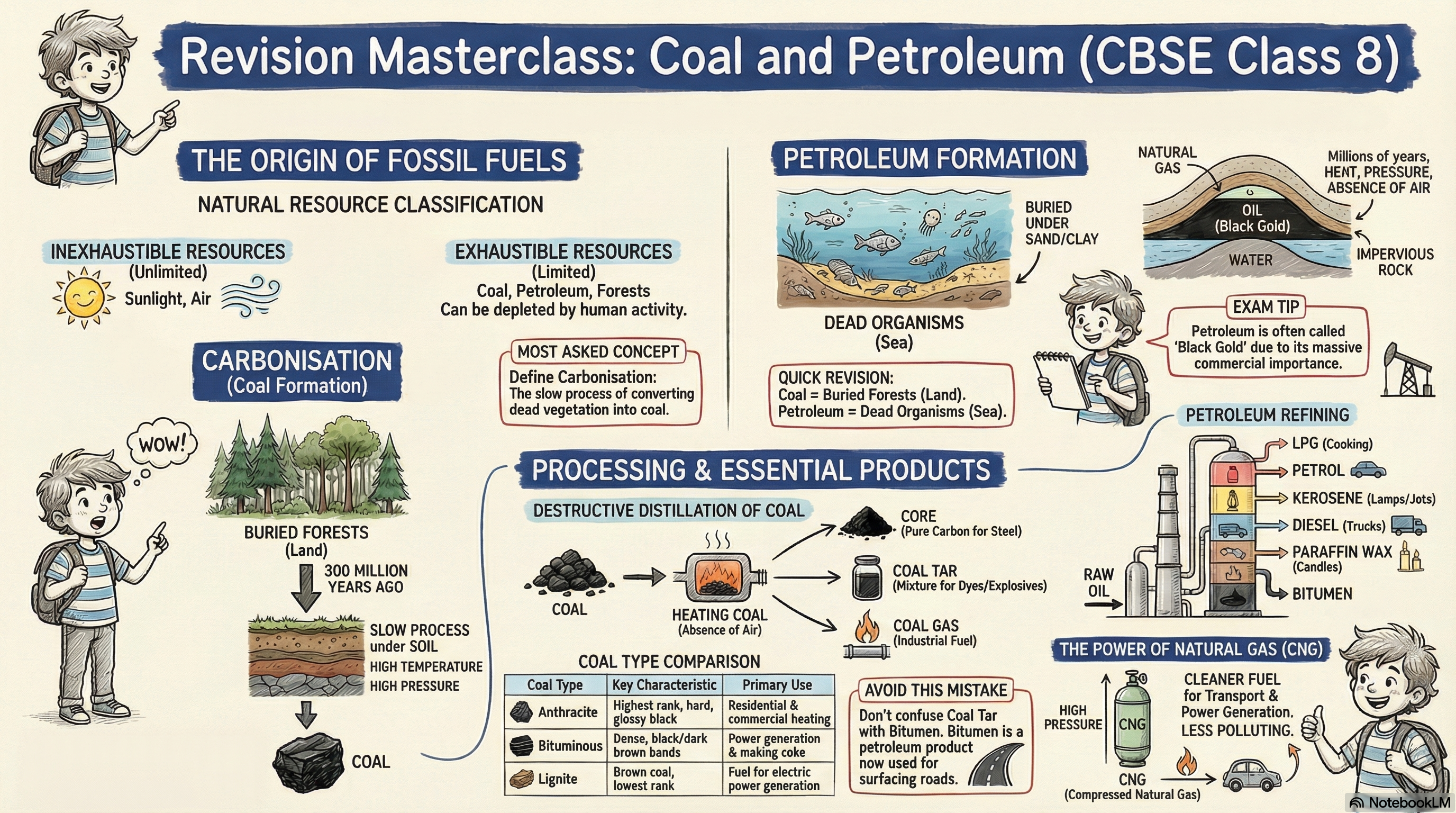
Carbonisation is the slow process of conversion of dead vegetation into coal under high pressure and temperature. Since coal contains mainly carbon, this process is named after it.
7. Petroleum
Petroleum is a naturally occurring yellow-to-black liquid found beneath the Earth's surface. It consists of hydrocarbons of various molecular weights and other organic compounds.
The name "petroleum" covers both:
- Naturally occurring unprocessed crude oil
- Refined petroleum products
8. Refining
Refining is the process of separating various constituents (fractions) of petroleum. It is carried out in a petroleum refinery using fractional distillation.
9. Petrochemicals
Petrochemicals are useful substances obtained from petroleum and natural gas, used to manufacture products like detergents, synthetic fibers, plastics, and fertilizers.
10. Natural Gas
Natural gas is a fossil fuel consisting primarily of methane (>90%) with traces of ethane and propane. It is found above petroleum deposits.
11. CNG (Compressed Natural Gas)
CNG is natural gas stored under high pressure. It is used as a cleaner fuel for vehicles and power generation.
12. LPG (Liquefied Petroleum Gas)
LPG is petroleum gas that has been liquefied by subjecting it to high pressure at room temperature. It is mainly composed of butane, propane, and ethane.
Detailed Explanation of Concepts
Formation of Coal
Timeline: About 300 million years ago
Process:
- Ancient forests: Dense forests existed in low-lying wetland areas
- Natural burial: Due to natural processes like flooding, these forests got buried under soil
- Compression: As more soil deposited over them, the plant remains were compressed
- Heat and pressure: Temperature rose as they sank deeper
- Transformation: Under high pressure and temperature, dead plants slowly converted to coal
Important Point: Coal cannot be prepared in the laboratory because this natural process takes millions of years.
CBSE Class 8 Science Notes Chapter-wise
Types of Coal
Coal is classified based on carbon content and formation stage:
| Type | Carbon Content | Characteristics | Uses |
|---|---|---|---|
| Peat | ~50-60% | Precursor of coal; formed from decaying vegetation | Industrial fuel in some regions (Ireland, Finland) |
| Lignite (Brown Coal) | ~60-70% | Lowest rank; soft; brownish-black | Fuel for electric power generation |
| Bituminous Coal | ~70-85% | Dense sedimentary rock; usually black | Fuel for steam-electric power, making coke |
| Anthracite | ~85-95% | Highest rank; harder, glossy black | Residential and commercial space heating |
Carbon content increases: Peat → Lignite → Bituminous → Anthracite
Destructive Distillation of Coal
Destructive distillation is heating coal in the absence of air to break down its molecules.
Products obtained:
1. Coke
- Appearance: Tough, porous, black substance
- Composition: Almost pure carbon
- Uses:
- Manufacturing steel
- Extraction of metals from their oxides
- Industrial fuel
Gaseous fuels from coke:
(a) Water Gas:
C + H₂O → CO + H₂
(Carbon + Steam → Carbon monoxide + Hydrogen)
(b) Producer Gas:
2C + O₂ + 4N₂ → 2CO + 4N₂
Both gases are used as industrial fuels.
2. Coal Tar
- Appearance: Black, thick liquid with unpleasant smell
- Composition: Mixture of about 200 substances
- Uses: Starting material for:
- Synthetic dyes
- Drugs and explosives
- Perfumes and plastics
- Paints and photographic materials
- Roofing materials
- Naphthalene balls (moth repellent)
Note: Bitumen (a petroleum product) has now replaced coal tar for road surfacing.
3. Coal Gas
- Formation: Obtained during coal processing to get coke
- Uses:
- Fuel in industries near coal processing plants
- Street lighting (historically - London 1810, New York 1820)
- Now mainly used as heat source
4. Ammonium Compounds
- Formation: Mixture of compounds released during distillation
- Formation of ammoniacal liquor: When dissolved in water
- Uses: Manufacture of fertilizers
Formation of Petroleum
Timeline: Millions of years ago
Process:
- Marine organisms: Large quantities of zooplankton and algae lived in seas
- Death and burial: When they died, their bodies settled at the sea bottom
- Sediment covering: Got covered with layers of sand and clay
- Transformation: Over millions of years, absence of air + high temperature + high pressure transformed them into petroleum and natural gas
Locations in India:
- Assam (first oil discovered at Makum in 1867)
- Gujarat
- Mumbai High
- River basins of Godavari and Krishna
Historical note: World's first oil well was drilled in Pennsylvania, USA, in 1859.
Refining of Petroleum
What is crude petroleum?
Petroleum in its natural form is a dark, oily liquid with an unpleasant odor. It is a mixture of various constituents.
Fractional Distillation Process:
Petroleum is heated in a refinery, and different fractions are separated based on their boiling points:
| Fraction | Boiling Range | Properties | Uses |
|---|---|---|---|
| Petroleum Gas | <25°C | Small molecules, low boiling point, very volatile | LPG for home and industry |
| Petrol (Gasoline) | 40-180°C | Light, flows easily, ignites easily | Motor fuel, aviation fuel, dry cleaning solvent |
| Naphtha | 60-180°C | Medium molecules | Making chemicals |
| Kerosene | 150-250°C | Medium weight | Fuel for stoves, lamps, jet aircraft |
| Diesel Oil | 250-350°C | Heavier molecules | Fuel for heavy vehicles, electric generators |
| Fuel Oil | >350°C | Large molecules, high boiling point | Fuel for ships, power stations |
| Lubricating Oil | >350°C | Thick, viscous | Lubrication of machinery |
| Paraffin Wax | Residue | Solid at room temperature | Ointments, candles, vaseline |
| Bitumen | Residue | Very thick, black | Paints, road surfacing |
Fact: Lighter fractions with smaller molecules rise to the top; heavier fractions settle at the bottom.
Natural Gas (CNG)
Composition:
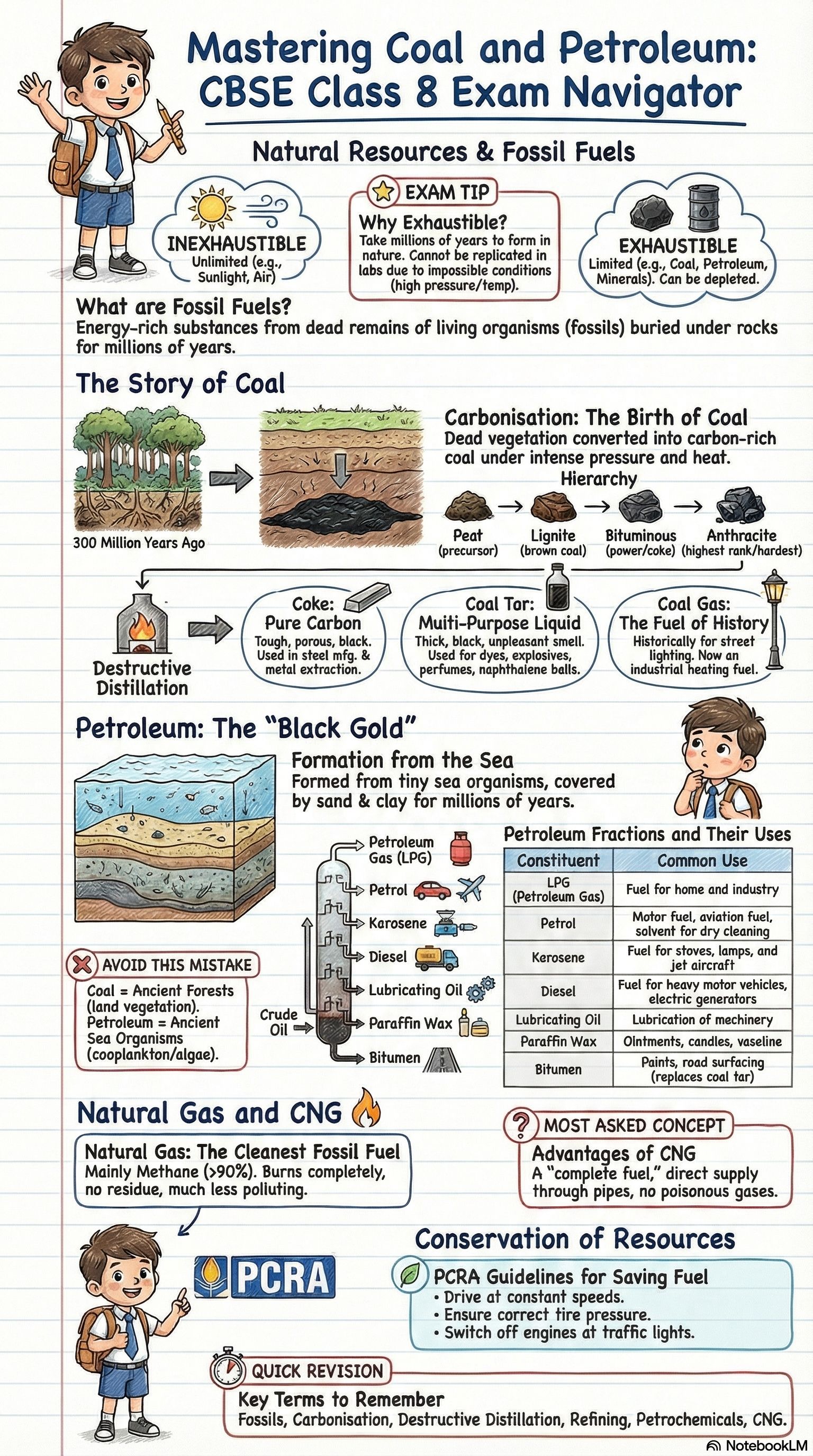
- Primary component: Methane (>90%)
- Minor components: Ethane, propane, carbon dioxide, nitrogen, hydrogen sulfide
Properties:
- Colorless and odorless in pure form
- Highly combustible
- High calorific value (50,000 kJ/kg)
Storage: Natural gas is stored under high pressure as Compressed Natural Gas (CNG).
Advantages of CNG:
- Clean burning: Burns with smokeless flame, no air pollution
- No poisonous gases: Does not produce harmful emissions
- No residue: Leaves no solid residue after burning
- High efficiency: Complete fuel, needs no additives
- Direct supply: Can be supplied through underground pipelines
- Convenient: No need for storage and transport
Uses:
- Power generation
- Transport fuel (buses, cars)
- Heating in homes and industries
- Raw material for chemicals and fertilizers
Locations in India:
- Tripura
- Rajasthan
- Maharashtra
- Krishna-Godavari delta
Pipeline networks exist in:
- Vadodara (Gujarat)
- Parts of Delhi
- Other select cities
Liquefied Petroleum Gas (LPG)
Formation: Petroleum gas obtained during fractional distillation is subjected to high pressure at room temperature, causing it to liquefy.
Composition:
- Main component: Butane (C₄H₁₀)
- Other components: Propane (C₃H₈), Ethane (C₂H₆)
Properties:
- Naturally odorless
- Ethyl mercaptan (C₂H₅SH) is added to detect leakage
- Forms explosive mixture with air
- Toxic if inhaled in large quantities
Advantages of LPG:
- High calorific value: Produces large amount of heat
- Complete combustion: Burns completely
- Clean fuel: No residue, smoke, or pollutants
- Low ignition temperature: Easy to ignite
- No preheating required: Burns easily and instantly
Safety Precautions:
During normal use:
- Close cylinder valve and stove knob when not in use
- Keep away from open flames and electric/kerosene stoves
- Regularly check rubber pipes for wear and tear
When leakage is detected:
- Open all windows and doors immediately
- Do NOT operate any electrical switch
- Do NOT open refrigerators or exhaust fans
- Find the source of leakage
- Disconnect cylinder and close cap/regulator
- Inform local LPG emergency service
Synthetic Petroleum and Natural Gas
Synthetic Petroleum:
Preparation:
Powdered coal + Hydrogen → [High temp/High pressure] → Synthetic Petroleum
(Dissolved in solvents)
Products: On fractional distillation:
- Petrol
- Diesel
- Heavy oil (used as solvent)
Synthetic Natural Gas:
Preparation:
Powdered coal + Hydrogen → [High temp/High pressure/Catalyst] →
Synthetic Petroleum + Residue (mainly CH₄)
Significance: These processes help avert energy crisis by producing fuels artificially.
Conservation of Natural Resources
Why Conservation is Necessary
- Limited availability: Fossil fuels are exhaustible and will run out
- Increasing demand: Energy needs are growing rapidly
- Future generations: We must preserve resources for them
- Energy crisis prevention: Avoid shortage situations
- Environmental protection: Reduce pollution from excessive burning
Methods of Conservation
At Home:
- Switch off lights, fans, and appliances when not in use
- Use CFL bulbs and tube lights instead of incandescent bulbs
- Reduce flame size while cooking
- Use pressure cookers to save cooking time and fuel
- Cover vessels while cooking
- Soak pulses before cooking
- Use efficient smokeless chulhas (in rural areas)
- Operate coolers, ACs, heaters, and geysers only when needed
Transportation:
- Use public transport instead of private vehicles
- Walk or cycle for short distances
- Carpool when possible
PCRA Tips (Petroleum Conservation Research Association)
PCRA advises the following while driving:
- Maintain constant speed: Drive at moderate and constant speed
- Switch off at stops: Turn off engine at traffic lights or waiting areas
- Check tire pressure: Ensure correct tire pressure regularly
- Regular maintenance: Keep vehicle well-maintained
These tips help save petrol/diesel significantly.
Important Terms and Queries
| Term | Definition |
|---|---|
| Carbonisation | Slow conversion of dead vegetation into coal |
| Destructive Distillation | Heating coal in absence of air to break down molecules |
| Fractional Distillation | Separating petroleum into fractions based on boiling points |
| Fossil Fuels | Fuels formed from dead remains of organisms |
| Calorific Value | Amount of heat produced by burning unit mass of fuel |
| Petrochemicals | Chemicals derived from petroleum and natural gas |
| Black Gold | Petroleum (due to its commercial importance) |
| Exhaustible Resources | Resources that can run out |
| Inexhaustible Resources | Resources that won't run out |
Diagrams Explained
1. Petroleum and Natural Gas Deposits (Underground)
Structure from top to bottom:
- Drilling rig at surface level
- Earth's crust - outer layer
- Shale layer - impervious rock
- Natural gas trapped at the top (lightest)
- Petroleum/Oil layer in the middle
- Water layer at the bottom (heaviest)
- Impervious rock below - prevents further seepage
Why this arrangement?
- Natural gas is lightest, rises to top
- Petroleum is lighter than water, floats above it
- Water is heaviest, settles at bottom
- Impervious rocks trap all three layers
2. Fractional Distillation Tower
Structure:
- Bottom (hot, ~350°C): Crude oil is heated
- Rising vapors: Different fractions condense at different heights
- Top (cool, ~25°C): Lightest fractions collected
Order from top to bottom:
- Petroleum gas (refinery gases)
- Gasoline (petrol)
- Naphtha
- Kerosene
- Diesel oil
- Fuel oil
- Residue (lubricating oil, bitumen)
3. Coal Mine
Features:
- Underground tunnels
- Miners with safety equipment
- Support structures to prevent collapse
- Coal extracted from seams (layers)
Enhanced Study Notes
Quick Revision Points
Coal:
- Black, hard, sedimentary rock
- Formed from dead plants (300 million years ago)
- Process: Carbonisation
- Types: Peat → Lignite → Bituminous → Anthracite
- Products: Coke, coal tar, coal gas, ammonium compounds
Petroleum:
- Yellow to black liquid
- Formed from marine organisms (zooplankton, algae)
- Called "black gold"
- Process: Refining (fractional distillation)
- Products: Petrol, diesel, kerosene, LPG, etc.
Natural Gas:
- Mainly methane (>90%)
- Stored as CNG (Compressed Natural Gas)
- Cleanest fossil fuel
- Used in vehicles, power plants, homes
LPG:
- Mainly butane
- Liquefied petroleum gas
- Ethyl mercaptan added for smell
- Used for cooking
Memory Tricks
Types of Coal (Increasing Carbon):Mnemonic: "Please Let Big Aunty"
- Peat
- Lignite
- Bituminous
- Anthracite
Products of Coal:Mnemonic: "Cool Cats Can't Argue"
- Coke
- Coal tar
- Coal gas
- Ammonium compounds
Petroleum Products (Top to Bottom):Mnemonic: "Please Get New Keys Don't Forget Lubricants"
- Petroleum gas
- Gasoline
- Naphtha
- Kerosene
- Diesel
- Fuel oil
- Lubricating oil
Quick Comparison Table
| Feature | Coal | Petroleum | Natural Gas |
|---|---|---|---|
| State | Solid | Liquid | Gas |
| Origin | Dead plants | Dead marine organisms | Dead organisms |
| Main element | Carbon | Hydrocarbons | Methane |
| Color | Black | Yellow to black | Colorless |
| Formation time | 300 million years | Millions of years | Millions of years |
| Processing | Destructive distillation | Fractional distillation | Compression |
| Cleanest? | No | No | Yes |
Solved Examples
Q: What are fossil fuels? Give two examples.
Solution: Fossil fuels are fuels formed from the dead remains of plants and animals that were buried under the earth millions of years ago.
Examples:
- Coal
- Petroleum
Q: Classify the following as exhaustible and inexhaustible resources:Air, Coal, Petroleum, Sunlight, Natural Gas, Wind, Minerals
Solution:
| Exhaustible | Inexhaustible |
|---|---|
| Coal | Air |
| Petroleum | Sunlight |
| Natural Gas | Wind |
| Minerals |
Q: Explain the process of formation of coal.
Solution:
Formation of coal (Carbonisation):
Step 1: About 300 million years ago, Earth had dense forests in low-lying wetland areas.
Step 2: Due to natural processes like flooding, these forests got buried under soil.
Step 3: As more soil deposited over them, the plant remains were compressed.
Step 4: Temperature rose as they sank deeper and deeper.
Step 5: Under high pressure and high temperature, dead plants slowly converted to coal.
Time taken: Millions of years
Q: Name the products obtained when coal is processed in industry.
Solution:
When coal is heated in the absence of air (destructive distillation), the following products are obtained:
- Coke - Almost pure carbon, used in steel manufacturing
- Coal tar - Black thick liquid, used to make dyes, drugs, plastics
- Coal gas - Used as fuel in industries
- Ammonium compounds - Used in fertilizer manufacturing
Q: What is the difference between CNG and LPG?
Solution:
| Basis | CNG | LPG |
|---|---|---|
| Full form | Compressed Natural Gas | Liquefied Petroleum Gas |
| Source | Natural gas | Petroleum |
| Main component | Methane (>90%) | Butane |
| State | Gas (compressed) | Liquid (at high pressure) |
| Storage | High-pressure cylinders | Pressurized cylinders |
| Use | Vehicles, power plants | Cooking, heating |
| Pollution | Less polluting | Relatively more polluting |
Q: Why is petroleum called "black gold"?
Solution:
Petroleum is called "black gold" because:
- Commercial importance: It has tremendous economic value
- Valuable products: Yields many useful products (petrol, diesel, kerosene, etc.)
- Industrial raw material: Used to make plastics, fertilizers, medicines
- Energy source: Powers vehicles, industries, and homes
- Color: It is black or dark brown in color
Just like gold is precious, petroleum is extremely valuable for modern civilization.
Q: Identify the type of coal with the following characteristics:
- Glossy black appearance
- Highest rank
- Used primarily for heating homes
Solution:
Answer: Anthracite
Explanation:
- Anthracite is the highest rank of coal
- It has a harder, glossy black appearance
- Contains highest carbon content (85-95%)
- Burns with little smoke
- Primarily used for residential and commercial space heating
Q: What precautions should you take when you detect LPG leakage?
Solution:
Immediate actions when LPG leakage is detected:
- Open windows and doors - Allow fresh air to enter
- Do NOT operate any electrical switch - Can cause spark and explosion
- Do NOT light matches or flames
- Do NOT open refrigerator, exhaust fan, or any electrical appliance
- Find the source of leakage - Check cylinder valve, rubber tube, stove connection
- Disconnect cylinder - Close the valve and cap/regulator
- Inform LPG emergency service - Call for professional help
Why these precautions?
LPG forms an explosive mixture with air. Any spark can cause fire or explosion.
Q: Write the chemical equations for: (a) Formation of water gas (b) Formation of producer gas
Solution:
(a) Water gas formation:
C + H₂O → CO + H₂
Carbon + Steam → Carbon monoxide + Hydrogen
(b) Producer gas formation:
2C + O₂ + 4N₂ → 2CO + 4N₂
Carbon + Oxygen + Nitrogen → Carbon monoxide + Nitrogen
Note: Both are used as industrial fuels.
Q: Why is naphthalene obtained from coal tar used in homes?
Solution:
Use: Naphthalene is used to make naphthalene balls (mothballs).
Purpose:
- Repel moths and other insects
- Protect clothes from damage
- Prevent insect infestation in stored items
How it works:
- Naphthalene slowly sublimes (converts from solid to gas)
- The vapor repels insects
- Has characteristic strong smell
Source: Coal tar (obtained from destructive distillation of coal)
Q: State whether True or False. Justify your answer. "Fossil fuels can be made in the laboratory."
Solution:
Answer: False
Justification:
- Fossil fuels require millions of years to form
- They need specific conditions: high pressure, high temperature, absence of air
- The natural geological processes cannot be replicated in a laboratory timeframe
- Dead organisms must be buried under layers of sediment for millions of years
- Coal takes about 300 million years to form
- Therefore, it is impossible to make fossil fuels in the laboratory
Q: Match Column A with Column B:
| Column A | Column B |
|---|---|
| (i) Coke | (a) Moth repellent |
| (ii) Coal tar | (b) Cooking fuel |
| (iii) CNG | (c) Metal extraction |
| (iv) Naphthalene | (d) Making synthetic dyes |
Solution:
| Column A | Column B |
|---|---|
| (i) Coke | (c) Metal extraction |
| (ii) Coal tar | (d) Making synthetic dyes |
| (iii) CNG | (b) Cooking fuel |
| (iv) Naphthalene | (a) Moth repellent |
Q: Why does petroleum occur above water in underground deposits?
Solution:
Petroleum occurs above water because of two main properties:
- Lower density: Petroleum is less dense than water, so it floats on top
- Immiscibility: Petroleum does not mix with water
Underground arrangement (from top to bottom):
- Natural gas (lightest)
- Petroleum/Oil (medium)
- Water (heaviest)
Analogy: Just like oil floats on water in a glass, petroleum floats above water underground.
Additional reason: Both are trapped between impervious rock layers that prevent mixing or escape.
Q: Suggest three ways to conserve petrol/diesel while driving.
Solution:
Three PCRA-recommended methods:
- Drive at constant moderate speed
- Avoid frequent acceleration and braking
- Maintains fuel efficiency
- Reduces unnecessary fuel consumption
- Switch off engine at traffic lights
- When waiting for more than 30 seconds
- Prevents fuel wastage during idling
- Reduces air pollution
- Maintain correct tire pressure
- Under-inflated tires increase fuel consumption
- Check tire pressure regularly
- Improves vehicle efficiency by 3-4%
Bonus tip: Ensure regular vehicle maintenance (air filters, spark plugs, etc.)
Q: In the fractional distillation of petroleum, which product is obtained at the top of the tower and why?
Solution:
Product at top: Petroleum gas (LPG)
Reasons:
- Lowest boiling point: Petroleum gas has the lowest boiling point (<25°C)
- Smallest molecules: Contains small hydrocarbon molecules (butane, propane)
- Most volatile: Evaporates easily and rises to the top
- Temperature gradient: The tower is coolest at the top (~25°C) and hottest at the bottom (~350°C)
- Condensation principle: Vapors condense when they reach their boiling point temperature
Order of products (top to bottom): Petroleum gas → Petrol → Naphtha → Kerosene → Diesel → Fuel oil → Residue
Q: Fill in the blanks:
(a) Fossil fuels are _______, _______ and _______
(b) The process of separation of different constituents from petroleum is called _______
(c) The least polluting fuel for vehicles is _______
Solution:
(a) Fossil fuels are coal, petroleum, and natural gas
(b) The process of separation of different constituents from petroleum is called refining (or fractional distillation)
(c) The least polluting fuel for vehicles is CNG (Compressed Natural Gas)
Q: Two statements are given - one labelled Assertion (A) and the other labelled Reason (R). Choose the correct answer:
Assertion (A): Natural gas is considered a cleaner fuel compared to petrol.
Reason (R): Natural gas burns without producing smoke and leaves no residue.
Options:
(a) Both A and R are true, and R is the correct explanation of A
(b) Both A and R are true, but R is not the correct explanation of A
(c) A is true, but R is false
(d) A is false, but R is true
Solution:
Answer: (a) Both A and R are true, and R is the correct explanation of A
Explanation:
- Assertion is true: Natural gas (CNG) is indeed cleaner than petrol
- Reason is true: Natural gas burns completely without smoke and residue
- R explains A: The reason WHY natural gas is cleaner is BECAUSE it burns without smoke/residue
- Therefore, R correctly explains A
Q: Read the passage and answer:
"Rohan's father bought a new car that runs on CNG instead of petrol. Rohan asked why CNG is better. His father explained that CNG is cheaper, cleaner, and better for the environment."
(i) What does CNG stand for?
(ii) Name the main component of CNG
(iii) Give two advantages of CNG over petrol.
Solution:
(i) CNG stands for Compressed Natural Gas
(ii) The main component of CNG is Methane (CH₄), which makes up more than 90% of natural gas
(iii) Two advantages of CNG over petrol:
- Cleaner burning:
- Produces less air pollution
- Burns with smokeless flame
- Does not produce poisonous gases
- No residue left after burning
- Cost-effective:
- Cheaper than petrol and diesel
- More economical for daily use
- Higher fuel efficiency
Additional advantages:
- Better for environment (reduces greenhouse gases)
- Longer engine life (cleaner combustion)
Q: Coal reserves are enough to last for another 100 years. Should we still worry about their conservation? Give reasons.
Solution:
Answer: Yes, we should definitely worry about coal conservation even if reserves last 100 years.
Reasons:
- Limited resource:
- Coal is an exhaustible resource
- Once depleted, it cannot be renewed
- 100 years is not a long time in geological terms
- Future generations:
- We must preserve resources for our children and grandchildren
- They have equal right to natural resources
- Responsible consumption is our duty
- Environmental concerns:
- Burning coal causes air pollution
- Releases CO₂ (greenhouse gas)
- Contributes to global warming and climate change
- Alternative development:
- Conservation allows time to develop renewable alternatives
- Solar, wind, and hydroelectric power need time to scale up
- Transition to clean energy requires decades
- Economic stability:
- Sudden depletion would cause economic crisis
- Better to reduce consumption gradually
- Helps maintain energy security
Conclusion: Conservation is essential regardless of how long reserves last.
Q: Ramesh's family always turns off lights and fans when leaving a room. His friend Suresh says this saves very little energy and is not worth the effort. What values does Ramesh's family demonstrate? Why is their action important?
Solution:
Values demonstrated by Ramesh's family:
- Responsibility: Taking ownership of energy conservation
- Environmental consciousness: Understanding impact on nature
- Social awareness: Thinking about collective welfare
- Discipline: Following good habits consistently
- Future thinking: Preserving resources for future generations
Importance of their action:
- Individual impact:
- Small savings add up over time
- A single family saving 1 unit daily = 365 units yearly
- Multiplied by millions of families = huge national saving
- Environmental benefit:
- Less electricity generation needed
- Reduced fossil fuel consumption
- Lower carbon emissions
- Economic benefit:
- Lower electricity bills
- National savings on fuel imports
- More resources for development
- Setting example:
- Children learn good habits
- Influences others to conserve
- Creates awareness in community
Counter to Suresh's argument: "Small drops make an ocean" - Individual efforts collectively create massive impact.
Q: The diagram shows petroleum and water layers underground. Explain why petroleum is found above water.
Solution:
Reason: Density difference and immiscibility
Detailed explanation:
- Density comparison:
- Water density: ~1.0 g/cm³
- Petroleum density: ~0.7-0.9 g/cm³
- Lighter substance floats on heavier substance
- Immiscibility:
- Petroleum and water don't mix
- They form separate layers
- Similar to oil and water in a glass
Underground arrangement:
Top → Natural gas (lightest, ~0.0007 g/cm³) Middle → Petroleum/Oil (~0.8 g/cm³) Bottom → Water (heaviest, ~1.0 g/cm³)- Trapping mechanism:
- Both trapped between impervious rock layers
- Cannot escape or mix
- Maintain separate layers for millions of years
Real-life analogy: Like vinegar and oil salad dressing - oil always floats on top.
Q: If a car consumes 5 liters of petrol to travel 50 km, and CNG costs 40% less than petrol while giving 20% better mileage, calculate the savings per 100 km if petrol costs ₹100 per liter.
Solution:
Given:
- Petrol consumption: 5 liters for 50 km
- Mileage with petrol: 50 km ÷ 5 L = 10 km/L
- Petrol cost: ₹100/L
- CNG costs 40% less: ₹100 - ₹40 = ₹60/kg
- CNG gives 20% better mileage: 10 + (20% of 10) = 12 km/kg
For 100 km:
With Petrol:
- Fuel needed: 100 km ÷ 10 km/L = 10 liters
- Cost: 10 L × ₹100 = ₹1000
With CNG:
- Fuel needed: 100 km ÷ 12 km/kg = 8.33 kg
- Cost: 8.33 kg × ₹60 = ₹500
Savings per 100 km: ₹1000 - ₹500 = ₹500
Percentage saving: (500/1000) × 100 = 50%
Frequently Asked Questions about Coal and Petroleum
Coal cannot be prepared in the laboratory because:
- Time requirement: Coal formation takes millions of years (about 300 million years)
- Natural processes: Requires specific geological conditions - burial under layers of sediment, high pressure, high temperature
- Scale: The process occurs over vast areas with massive amounts of vegetation
- Complexity: Involves complex chemical changes under natural conditions that cannot be replicated artificially
While we can create synthetic petroleum from coal, we cannot create coal from plant matter in a laboratory timeframe.
| Aspect | Coal Gas | Natural Gas |
|---|---|---|
| Source | Obtained during destructive distillation of coal | Found naturally above petroleum deposits |
| Composition | Mixture of H₂, CO, CH₄, and other gases | Primarily methane (>90%) |
| Production | Man-made in coal processing plants | Natural occurrence |
| Purity | Less pure, contains impurities | Relatively pure |
| Uses | Industrial fuel near coal plants | Domestic fuel (CNG), power generation |
| Availability | Limited to areas with coal processing | Can be supplied through pipelines |
CNG is considered superior because:
Environmental benefits:
- Burns with smokeless flame (no particulate pollution)
- Does not produce poisonous gases like CO in significant amounts
- Leaves no residue after burning
- Lower carbon emissions per unit of energy
Economic benefits:
- Cheaper than petrol and diesel (40-60% less expensive)
- Better mileage and fuel efficiency
- Lower running costs for vehicles
Engine benefits:
- Cleaner combustion extends engine life
- No oil contamination
- Less frequent maintenance required
Safety:
- Lighter than air, disperses quickly if leaked
- Lower fire risk compared to liquid fuels
| Property | Coal | Petroleum |
|---|---|---|
| Physical state | Solid | Liquid |
| Color | Black/brownish-black | Yellow to black |
| Origin | Dead land plants | Dead marine organisms |
| Composition | Mainly carbon | Hydrocarbons (C and H) |
| Processing | Destructive distillation | Fractional distillation |
| Main use | Electricity generation, steel making | Transportation fuels |
| Location | Coal mines (underground beds) | Oil wells (underground deposits) |
| Common name | None | Black gold |
Immediate dangers:
- Explosion risk: LPG forms explosive mixture with air (4-15% concentration)
- Fire hazard: Any spark from electrical switches, appliances, or static electricity can ignite it
- Suffocation: In high concentrations, displaces oxygen and can cause suffocation
- Toxicity: Prolonged exposure causes dizziness, headache, and nausea
Why LPG is dangerous:
- Heavier than air: Unlike natural gas, LPG settles at ground level and accumulates
- High volatility: Rapidly evaporates and spreads
- Odorless naturally: Ethyl mercaptan is added so we can detect leaks by smell
Emergency actions:
- Open all doors and windows immediately
- Evacuate the room
- Do NOT operate any electrical switches or appliances
- Call emergency services from outside
No, fossil fuels cannot be renewed in a practical timeframe.
Reasons:
- Formation time:
- Coal takes about 300 million years to form
- Petroleum and natural gas also take millions of years
- Human lifespan or even civilization's span is insignificant compared to this
- Geological conditions:
- Require specific burial, pressure, and temperature conditions
- These conditions occurred during specific geological periods
- Cannot be artificially created at large scale
- Classification:
- Therefore, fossil fuels are classified as exhaustible or non-renewable resources
- Once depleted, they're gone forever from a human perspective
- Alternative approach:
- Instead of renewal, we focus on:
- Conservation (using less)
- Efficiency (using better)
- Alternatives (renewable energy like solar, wind)
- Instead of renewal, we focus on:
Petroleum is nicknamed "liquid gold" (or "black gold") because:
Economic value:
- Extremely valuable commodity in global markets
- Prices comparable to or exceeding gold in economic impact
- Countries with oil reserves become wealthy
Multiple uses:
- Produces numerous valuable products (petrol, diesel, kerosene, plastics, medicines)
- Essential for modern transportation, industry, and daily life
- Raw material for thousands of products
Limited availability:
- Non-renewable resource
- Taking millions of years to form
- Finite reserves increasing its value
Strategic importance:
- Nations depend on it for energy security
- Cause of geopolitical conflicts and alliances
- Controls economic power globally
Color:
- Crude petroleum is black or dark brown
- Combined with its precious value, led to the term "black gold"
Petrochemicals are chemicals derived from petroleum and natural gas.
Examples:
- Plastics (polyethylene, PVC, polystyrene)
- Synthetic fibers (polyester, nylon, acrylic)
- Synthetic rubber
- Detergents and soaps
- Fertilizers (using hydrogen from natural gas)
- Medicines and pharmaceuticals
- Paints and dyes
- Cosmetics
Importance:
- Modern life dependency:
- Almost everything we use contains petrochemicals
- From clothes to furniture to electronics
- Industrial raw materials:
- Foundation of chemical industry
- Enable manufacturing of countless products
- Agricultural support:
- Fertilizers increase crop production
- Pesticides protect crops
- Plastic films for greenhouses
- Economic contribution:
- Major industry employing millions
- Significant GDP contributor
- Export earnings
- Quality of life:
- Affordable products
- Improved healthcare (medicines, medical devices)
- Better infrastructure
Concern: Over-dependence on petroleum-based products raises environmental and sustainability issues.
Principle: Separation based on different boiling points of components.
Process step-by-step:
Step 1: Heating
- Crude petroleum is heated to about 400°C
- It vaporizes into a mixture of gases
Step 2: Rising vapors
- Hot vapors enter the fractionating tower (column)
- Tower is hotter at bottom, cooler at top
Step 3: Condensation
- As vapors rise, they cool down
- Each fraction condenses when its boiling point is reached
- Fractions are collected at different levels
Step 4: Collection
- Each level has a tray to collect condensed liquid
- Lighter fractions (low boiling point) rise higher
- Heavier fractions (high boiling point) condense lower
Temperature zones:
Top (~25°C): Petroleum gas ↑ 100-150°C: Petrol/Gasoline ↑ 150-250°C: Kerosene ↑ 250-350°C: Diesel oil ↑ Bottom (>350°C): Fuel oil, residue
Why this works:
- Small molecules (like butane) have weak intermolecular forces → low boiling point → rise to top
- Large molecules (like bitumen) have strong intermolecular forces → high boiling point → stay at bottom
We should conserve fossil fuels even with 100 years of reserves because:
1. Limited and non-renewable:
- 100 years seems long but passes quickly in civilization's timeline
- Once finished, they're gone forever
- Cannot be replenished in human timeframe
2. Future generations:
- Our children and grandchildren need energy too
- Moral responsibility to leave resources for them
- Sustainable development requires intergenerational equity
3. Environmental impact:
- Burning fossil fuels causes:
- Air pollution (PM2.5, SO₂, NOₓ)
- Greenhouse gas emissions (CO₂)
- Climate change and global warming
- Acid rain
- Reducing consumption helps protect environment
4. Time for transition:
- Need time to develop and scale renewable energy
- Solar, wind, hydroelectric need decades to replace fossil fuels
- Conservation buys us this transition time
5. Energy security:
- Many countries (including India) import fossil fuels
- Dependence on imports affects economy and security
- Conservation reduces import dependency
6. Economic reasons:
- Fossil fuel prices keep rising
- Conservation reduces costs for individuals and nations
- Promotes energy efficiency and innovation
7. Setting precedent:
- Teaches responsible resource use
- Creates culture of sustainability
- Influences future policies and behaviors
Just because you have food for 100 days doesn't mean you should waste it. Planning and conservation ensure smooth continuation and better alternatives.