





The chapter class 8 chemical effects of electric current is an important part of basic science that helps students understand how electricity can cause chemical changes in different substances. These chemical effects of electric current class 8 revision notes are designed to make learning simple and clear for students. In this topic, we study how electric current passes through liquids, what is a conducting solution, and how chemical reactions take place during the flow of current.
These notes on chemical effects of electric current class 8 also explain key concepts like electrolysis, electrodes, and deposition of metals in an easy way. Students often find this chapter little confusing at first, but with proper revision notes and examples, it becomes easier to understand and remember.
For CBSE Board Class 8 exam preparation, students can also practice class 8 chemical effects of electric current questions and answers to test their knowledge and improve problem-solving skills. Many learners also prefer downloading chemical effects of electric current class 8 revision notes pdf so they can revise anytime.
Overall, this chapter builds a strong base for higher classes and helps students understand real-life applications of electricity in chemistry, although some concepts may need more practice to fully understand it.
Introduction to Chemical Effects of Electric Current
When electric current flows through certain liquids and solutions, it produces chemical changes. This phenomenon is called the chemical effect of electric current. Understanding this concept is crucial for Class 8 students as it forms the foundation for electrochemistry and has numerous real-world applications.
Why is This Topic Important?
- Exam Relevance: Frequently tested in CBSE, ICSE, and state board exams
- Real-Life Applications: Electroplating, metal purification, battery technology
- Foundation Concept: Essential for higher chemistry and physics studies
- Practical Knowledge: Understanding how batteries work, why water conducts electricity
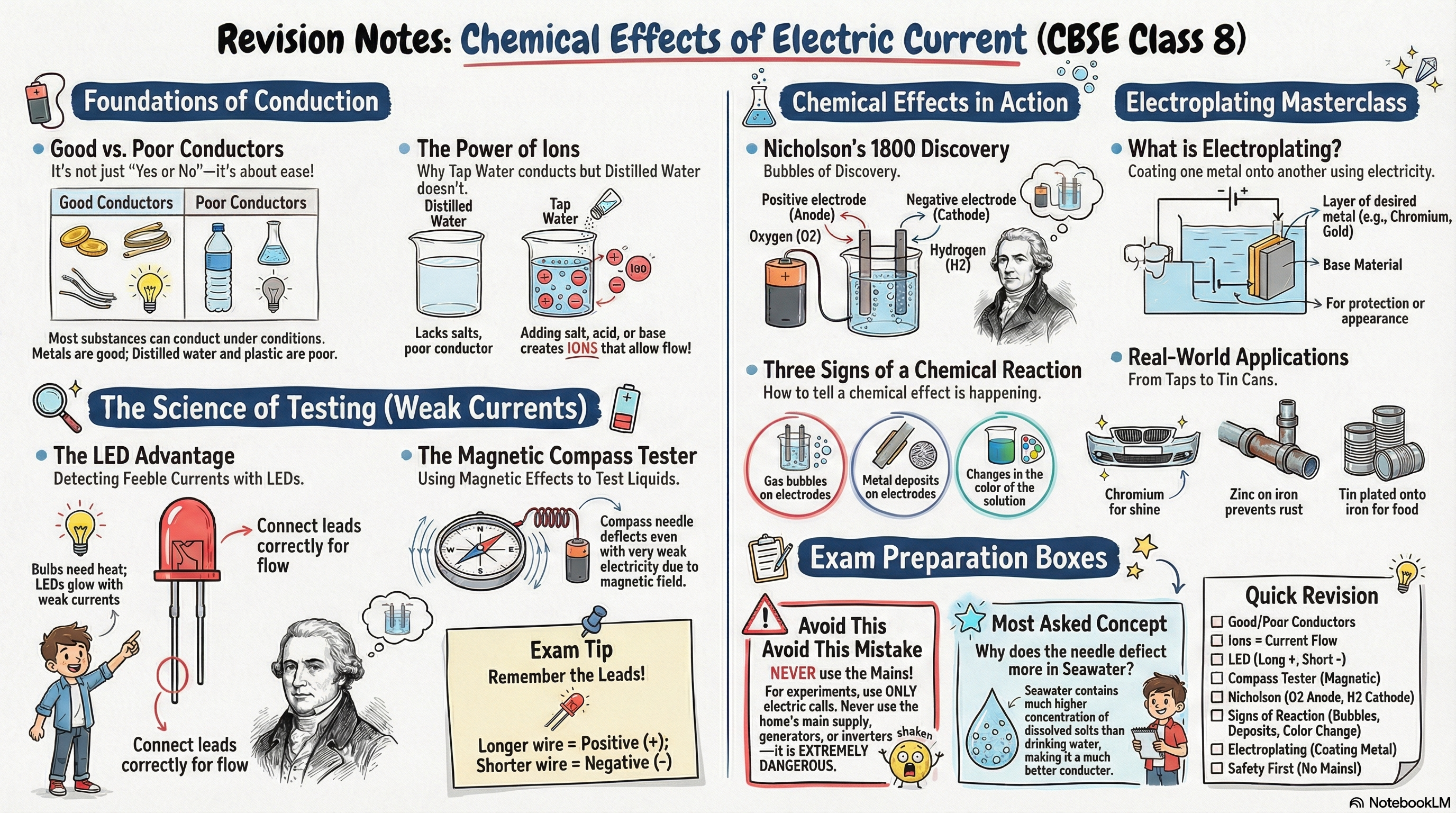
Concepts & Definitions
1. Electric Current
The flow of electrons from a region of excess electrons (negative charge) to a region of deficit electrons (positive charge).
2. Conductor
Substances that allow electricity to pass through them easily.
Examples: Silver, gold, copper, aluminum, acidic solutions, salt solutions
3. Insulator
Substances that do not allow electric current to pass through them.
Examples: Plastic, rubber, wood, glass
4. Good Conductor vs Bad Conductor
- Good Conductor: Allows electric current to pass easily (metals like copper, silver)
- Bad Conductor: Allows very little current to pass (wood, weak salt solutions)
Important Note: Most substances conduct electricity under certain conditions, so we use "good" and "bad" conductors rather than "conductor" and "insulator."
5. Electrolysis
The process of chemical decomposition of a substance when electric current is passed through its solution or molten state.
Example: Water splits into hydrogen and oxygen during electrolysis
6. Electroplating
The process of depositing a thin layer of one metal over another metal using electric current.
Purpose:
- Protection from corrosion
- Enhancing appearance
- Preventing rust
7. Electrode
Metal rods or plates through which current enters or leaves an electrolyte.
- Anode: Positive electrode (connected to positive terminal)
- Cathode: Negative electrode (connected to negative terminal)
8. Electrolyte
A liquid or solution that conducts electricity due to the presence of ions.
Examples: Salt solution, acid solution, copper sulphate solution
Understanding Atomic Structure & Current Flow
Basic Atomic Structure
All matter is made of atoms, which consist of:
- Protons (positive charge) - in the nucleus
- Neutrons (no charge) - in the nucleus
- Electrons (negative charge) - revolve around nucleus in orbits
How Current Flows
- Outermost electrons are responsible for electrical conduction
- Electrons flow from negative (excess electrons) to positive (deficit electrons)
- In other words: electrons flow from negatively charged body to positively charged body
CBSE Class 8 Science Notes Chapter-wise
Conduction Testers - How to Test Electrical Conductivity
A conduction tester is a device used to determine whether a substance is a good or poor conductor of electricity.
Type 1: Torch Bulb Tester
Components:
- Electric cell (battery)
- Torch bulb
- Connecting wires
- Two free ends for testing
How it Works:
- If material is a good conductor → Bulb glows brightly
- If material is a poor conductor → Bulb does not glow
Safety Note: Never use mains electricity (220V). Always use electric cells only.
Type 2: LED Tester
Why LED is Better:
- Glows even with weak current
- More sensitive than torch bulb
- Detects poor conductors that bulb cannot
LED Connection:
- Longer lead → Connect to positive terminal
- Shorter lead → Connect to negative terminal
Full Form: LED = Light Emitting Diode
Type 3: Magnetic Compass Tester
Principle: Electric current produces a magnetic effect
How it Works:
- Magnetic compass placed near a wire
- When current flows → magnetic needle deflects
- Detects even very weak current
- Most sensitive method
Electrical Conductivity of Different Materials
Conductivity of Solids
Conductivity of Liquids
Important Point: Solutions of acids, bases, and salts are good conductors of electricity.
Why Do Some Liquids Conduct Electricity?
Salt Solutions as Conductors
Experiment Observation:
- Distilled water → Does NOT conduct electricity (poor conductor)
- Distilled water + Salt → CONDUCTS electricity (good conductor)
Reason:
- Salt dissolves in water and forms ions
- Ions are charged particles that carry electric current
- Tap water, seawater, pond water contain dissolved salts → good conductors
Important Discovery (William Nicholson - 1800)
William Nicholson, a British chemist, demonstrated:
- When electrodes immersed in water and current passed
- Oxygen bubbles form at positive electrode (anode)
- Hydrogen bubbles form at negative electrode (cathode)
Chemical Effects of Electric Current
When electric current passes through a conducting solution, chemical reactions occur.
Effect 1: Decomposition of Water (Electrolysis)
Process:
- Water (H₂O) splits into hydrogen (H₂) and oxygen (O₂)
- Hydrogen deposited at negative pole (cathode)
- Oxygen deposited at positive pole (anode)
- Visible as bubbles
Chemical Reaction:
2H₂O → 2H₂ + O₂ (Water) → (Hydrogen) + (Oxygen)
Battery Requirement: 9-12V battery
Effect 2: Metal Deposition
Example: Copper sulphate solution
- When current passed through copper sulphate solution
- Copper metal deposits at negative pole (cathode)
- Reason: Copper is positively charged (Cu²⁺ ions)
Effect 3: Color Change
Sometimes the color of the solution changes when electric current passes through it.
Electrolysis of Water - Detailed Process
Setup Requirements:
- Two electrodes (carbon or platinum)
- Water with small amount of acid/base (to make it conducting)
- 9-12V battery
- Collection tubes for gases
Process:
At Cathode (Negative Terminal):
- Hydrogen gas (H₂) is released
- Appears as bubbles
- Twice the volume of oxygen
At Anode (Positive Terminal):
- Oxygen gas (O₂) is released
- Appears as bubbles
- Half the volume of hydrogen
Volume Ratio: Hydrogen : Oxygen = 2 : 1
Electroplating - Detailed Explanation
What is Electroplating?
The process of depositing a thin layer of desired metal on another material using electric current.
Electroplating Process - Step by Step
Example: Copper Plating
Setup:
- Electrolyte: Acidified copper sulphate solution
- Anode (+ve terminal): Copper strip (pure copper)
- Cathode (-ve terminal): Object to be plated
- Battery: Connected to complete circuit
Process:
- Current passes through the solution
- Copper from anode dissolves into solution
- Copper ions (Cu²⁺) move through solution
- Copper deposits on cathode (object)
- Thin, uniform layer of copper forms on object
Chemical Process:
- At anode: Cu → Cu²⁺ + 2e⁻ (copper dissolves)
- At cathode: Cu²⁺ + 2e⁻ → Cu (copper deposits)
Why Electroplating is Done
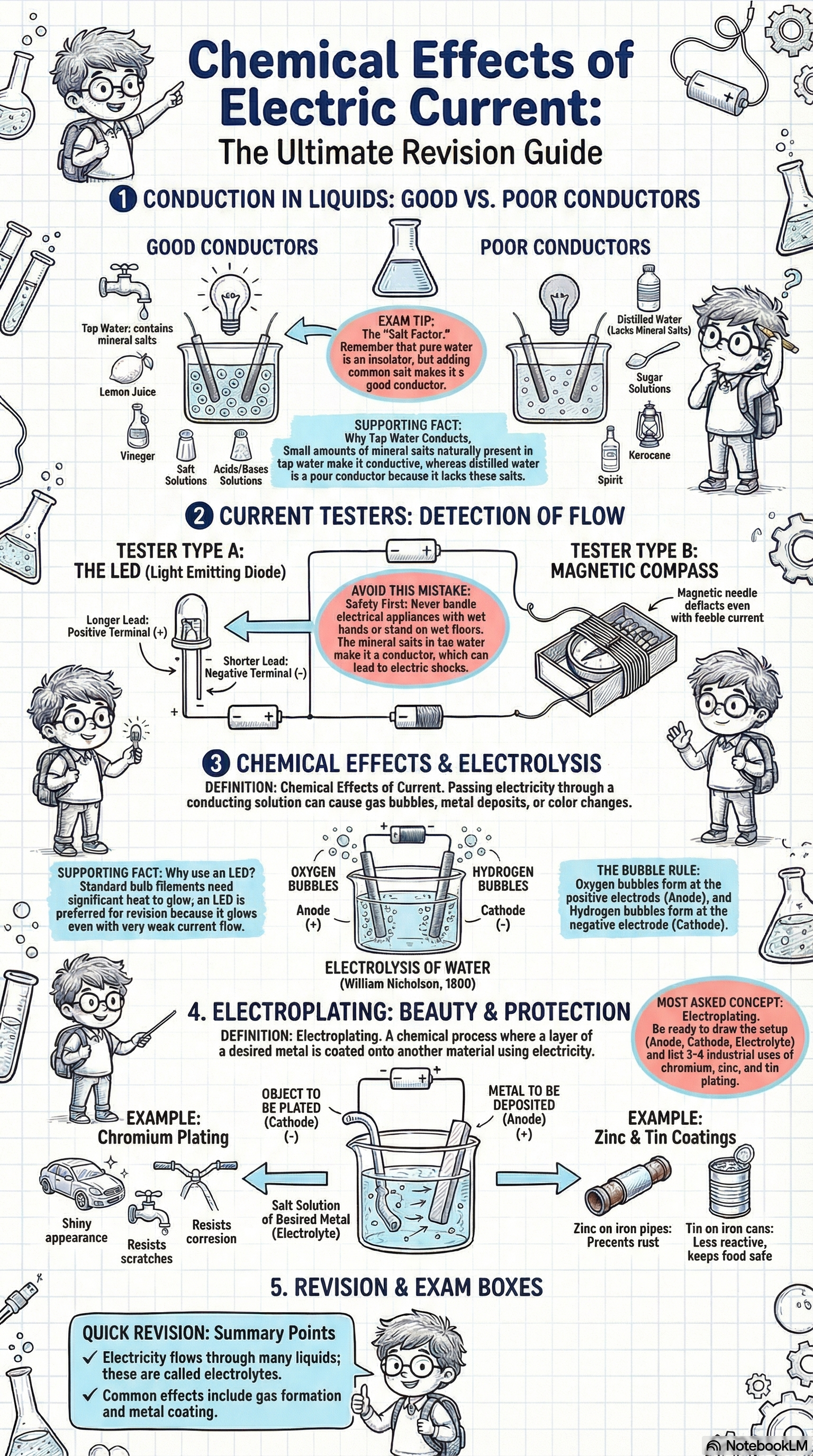
Benefits of Electroplating
- Corrosion Protection
- Zinc plating on iron prevents rust
- Zinc is less reactive than iron
- Enhanced Appearance
- Chromium plating gives shiny, attractive look
- Used on bathroom fittings, automobile parts
- Cost Reduction
- Gold plating on cheap metal gives gold appearance
- Much cheaper than solid gold
- Food Safety
- Tin plating on iron prevents food contamination
- Tin is less reactive, doesn't corrode easily
Important Safety Precautions
Electrical Safety
- Never use mains electricity (220V) for experiments
- Always use dry cells (1.5V or batteries up to 12V)
- Never handle electrical appliances with wet hands
- Don't stand on wet floor when operating electrical devices
Why Water Makes Electricity Dangerous
- Tap water contains dissolved salts
- Salts make water a good conductor
- Electric current can flow through body via wet hands
- Can cause severe electric shock
Remember: Small amounts of mineral salts in water are beneficial for health but make water conducting.
Firefighting Safety
Why do firemen shut off electricity before using water?
- Water conducts electricity
- Spraying water on electrical fire without cutting power
- Can cause electric shock to firemen
- Electricity can flow through water stream
Environmental Considerations
Electroplating Waste Disposal
Problem: Electroplating factories produce chemical waste
Concerns:
- Chemical solutions are polluting waste
- Cannot be dumped in rivers, ponds, or fields
- Can contaminate water sources
- Harmful to aquatic life and soil
Solution:
- Follow disposal guidelines of local authorities
- Treat waste before disposal
- Use approved waste management facilities
ENHANCED STUDY NOTES
Quick Revision Points
Conductors & Insulators
- Good conductors: Metals (Cu, Ag, Au, Al), salt solutions, acids, bases
- Poor conductors: Distilled water, sugar solution, oil
- Insulators: Plastic, rubber, wood, glass
Conduction Testers
- Bulb tester: Works for good conductors only
- LED tester: Works for weak currents too
- Magnetic compass: Most sensitive, detects weakest current
Chemical Effects
- Electrolysis: Water → Hydrogen + Oxygen
- At cathode (-ve): Hydrogen, metals deposit
- At anode (+ve): Oxygen, non-metals deposit
Electroplating
- Anode: Metal that dissolves
- Cathode: Object to be plated
- Electrolyte: Salt solution of plating metal
- Purpose: Protection, shine, decoration
Memory Tricks & Mnemonics
- LED Connection: "Long lead to Positive" (LP)
- Electrolysis Products: "Hydrogen is Negative, Oxygen is Positive" (HNOP)
- Good Liquid Conductors: "Salt Acid Base" (SAB solutions conduct)
- Electroplating: "Anode Dissolves, Cathode Deposits" (AD-CD)
Anode/Cathode:
- Anode = Adds electrons (becomes positive)
- Cathode = Collects electrons (becomes negative)
Quick Revision
SOLVED EXAMPLES
Section A: Conceptual Questions
Q1. Why does a bulb glow when connected to a conducting solution?
Solution:
When electric current flows through a conducting solution:
- Current passes from battery through solution
- Solution contains ions that carry charge
- Current flows through bulb filament
- Filament heats up due to resistance
- Hot filament emits light → bulb glows
Answer: The bulb glows because the conducting solution allows current to flow, which heats the bulb's filament, producing light.
Q2. Pure water does not conduct electricity, but tap water does. Explain why.
Solution:
Pure (Distilled) Water:
- Contains only H₂O molecules
- No ions present
- Cannot carry electric current
- Poor conductor
Tap Water:
- Contains dissolved salts (NaCl, MgCl₂, etc.)
- Salts dissociate into ions
- Ions carry electric charge
- Good conductor
Answer: Tap water conducts electricity because it contains dissolved salts that form ions, while pure water has no ions to carry current.
Q3. Why should we not touch electrical appliances with wet hands?
Solution:
- Water (especially tap/hand water) contains dissolved salts
- Salts make water a good conductor of electricity
- Wet hands create a conducting path
- Electric current can flow through body
- Can cause severe electric shock or even death
Answer: Wet hands conduct electricity due to dissolved salts in water, creating a dangerous path for current to flow through the body.
Q4. Which electrode (anode or cathode) is connected to the positive terminal of the battery?
Solution:
- Anode is always connected to the positive terminal
- Cathode is always connected to the negative terminal
Answer: Anode is connected to the positive terminal of the battery.
Q5. During electrolysis of water, which gas is collected at the negative electrode?
Solution:
During water electrolysis:
- Water splits: 2H₂O → 2H₂ + O₂
- Hydrogen (H₂) is collected at cathode (negative electrode)
- Oxygen (O₂) is collected at anode (positive electrode)
Reason: Hydrogen ions (H⁺) are attracted to negative electrode where they gain electrons to form H₂ gas.
Answer: Hydrogen gas is collected at the negative electrode (cathode).
Section B: Assertion-Reason Questions
Q6. Assertion (A): LED is preferred over bulb in conduction testers.
Reason (R): LED glows even when weak current flows through the circuit.
Solution:
- Assertion is TRUE: LED is preferred in testers
- Reason is TRUE: LED detects weak currents
- Reason correctly explains Assertion
When testing poor conductors:
- Very little current flows
- Bulb may not glow (needs more current)
- LED glows even with weak current
- Makes LED more useful
Answer: Both A and R are true, and R is the correct explanation of A.
Q7. Assertion (A): Chromium plating is done on objects like car parts and taps.
Reason (R): Chromium is cheaper than iron.
Solution:
- TRUE: Chromium plating is commonly done
- FALSE: Chromium is actually more expensive than iron
Correct Reason: Chromium plating is done because:
- Gives shiny, attractive appearance
- Prevents corrosion and scratches
- Highly resistant to tarnishing
Answer: A is true but R is false.
Q8. Assertion (A): Distilled water is a poor conductor of electricity.
Reason (R): Distilled water contains dissolved salts.
Solution:
- TRUE: Distilled water is a poor conductor
- FALSE: Distilled water does NOT contain dissolved salts
Correct Reason:
- Distilled water is pure H₂O
- No ions/salts present
- Cannot carry electric charge
- Therefore poor conductor
Answer: A is true but R is false.
Section C: Short Answer Questions
Q9. What is the difference between a good conductor and a bad conductor?
Solution:
Answer: Good conductors allow electricity to pass easily (like metals), while bad conductors allow very little current to pass (like wood or rubber).
Q10. List three liquids that are good conductors of electricity.
Solution:
Good liquid conductors include:
- Salt solution (NaCl in water)
- Common salt dissolves, forms ions
- Lemon juice/Vinegar
- Contains citric acid/acetic acid
- Acidic solutions conduct well
- Tap water
- Contains dissolved minerals and salts
Other examples: Acid solutions (HCl), base solutions (NaOH), copper sulphate solution
Answer: Salt solution, lemon juice/vinegar, and tap water are good conductors of electricity.
Q11. Why is a layer of zinc coated on iron pipes?
Solution:
Zinc coating (galvanization) on iron serves important purposes:
Reason 1: Prevent Rusting
- Zinc is less reactive than iron
- Forms protective layer
- Prevents contact of iron with moisture and oxygen
Reason 2: Sacrificial Protection
- Even if zinc layer scratches
- Zinc corrodes first (being more reactive with air)
- Protects underlying iron
Method: Electroplating or hot-dip galvanization
Answer: Zinc coating protects iron pipes from rusting by forming a protective layer and being less reactive than iron.
Q12. What is meant by electroplating? Give one example.
Solution:
Definition:
Electroplating is the process of depositing a thin layer of one metal over another metal using electric current.
Process:
- Object to be plated → Cathode (negative terminal)
- Plating metal → Anode (positive terminal)
- Electrolyte → Salt solution of plating metal
Example:
Chromium plating on car bumpers
- Iron bumper at cathode
- Chromium plate at anode
- Chromium sulphate solution as electrolyte
- Result: Shiny, rust-resistant bumper
Answer: Electroplating is depositing a metal layer on another metal using electricity. Example: Chromium plating on iron car parts for shine and protection.
Section D: Long Answer Questions
Q13. Describe an activity to show that acids, bases, and salts are good conductors of electricity.
Solution:
Materials Required:
- Electric cell (battery)
- LED or bulb
- Connecting wires
- Beaker or glass
- Different solutions: salt water, lemon juice, soap solution, sugar solution
Procedure:
Step 1: Set up the circuit
- Connect one terminal of battery to LED
- Connect other terminal to a wire (free end)
- Connect other LED terminal to another wire (free end)
Step 2: Test salt solution (NaCl)
- Pour salt solution in beaker
- Dip both free wire ends in solution
- Observation: LED glows brightly
Step 3: Test acid (lemon juice - citric acid)
- Clean and dry the setup
- Pour lemon juice in beaker
- Dip wire ends
- Observation: LED glows
Step 4: Test base (soap/detergent solution)
- Clean setup
- Pour soap solution in beaker
- Dip wire ends
- Observation: LED glows
Step 5: Test sugar solution (non-electrolyte)
- Clean setup
- Pour sugar solution
- Dip wire ends
- Observation: LED does NOT glow
Conclusion:
- Salt, acid, and base solutions conduct electricity (LED glows)
- Sugar solution does not conduct (LED doesn't glow)
- Acids, bases, salts form ions in solution
- Ions carry electric charge
Answer: By testing different solutions with an LED circuit, we observe that salt, acid, and base solutions make LED glow (good conductors), while sugar solution doesn't (poor conductor).
Q14. Explain the process of electroplating with a labeled diagram (describe in text).
Solution:
Electroplating Copper on an Iron Key - Step by Step
Setup Components:
- Electrolyte: Acidified copper sulphate solution (CuSO₄ + H₂SO₄)
- Anode (+ve): Pure copper plate
- Cathode (-ve): Iron key (object to be plated)
- Battery: 6-9V DC source
- Container: Glass beaker
Circuit Description:
Battery (+) terminal → Copper plate (anode) ↓ [Immersed in CuSO₄ solution] ↓ Iron key (cathode) → Battery (-) terminal
Process - What Happens:
At Anode (Copper Plate):
- Copper atoms lose electrons
- Cu → Cu²⁺ + 2e⁻
- Copper dissolves into solution as Cu²⁺ ions
- Copper plate gradually becomes thinner
In Solution:
- Cu²⁺ ions move through solution
- Attracted towards negative cathode
- Concentration remains constant
At Cathode (Iron Key):
- Cu²⁺ ions gain electrons
- Cu²⁺ + 2e⁻ → Cu
- Copper deposits as a thin layer
- Layer gradually becomes thicker
Result:
- Uniform copper coating on iron key
- Coating thickness increases with time
- Key becomes copper-colored and shiny
Why Acidified Solution?
- Dilute H₂SO₄ increases conductivity
- Makes process faster and more uniform
- Prevents contamination
Answer: Electroplating deposits metal from anode onto cathode through an electrolyte using electric current. Copper from copper plate (anode) dissolves and deposits on the iron key (cathode) when current flows.
Q15. What are the chemical effects of electric current? Explain with three examples.
Solution:
When electric current passes through a conducting solution, it produces chemical changes. This is called the chemical effect of electric current.
Example 1: Electrolysis of Water
Setup: Water with small amount of acid/base
Process:
- Pass current through water
- Chemical reaction: 2H₂O → 2H₂ + O₂
- Water decomposes into gases
Observations:
- Hydrogen bubbles at cathode (negative)
- Oxygen bubbles at anode (positive)
- Ratio H₂:O₂ = 2:1
Chemical Change: Compound (water) breaks into elements
Example 2: Copper Deposition from Copper Sulphate
Setup: Copper sulphate solution with carbon electrodes
Process:
- Current passes through blue CuSO₄ solution
- Copper ions (Cu²⁺) move to cathode
Observations:
- Reddish-brown copper deposits on cathode
- Solution becomes less blue (concentration decreases)
- Cathode becomes copper-coated
Chemical Change: Copper ions convert to copper metal
Example 3: Color Change in Solutions
Setup: Potassium iodide solution Process:
- Pass current through solution
- Chemical reactions occur at electrodes
Observations:
- Solution color changes
- Brown color appears near anode (iodine released)
Chemical Change: Colorless ions convert to colored substances
Common Factors in All Examples:
- Conducting solution (electrolyte) required
- Chemical decomposition occurs
- New substances formed
- Reaction type depends on electrolyte used
Answer: Chemical effects of electric current include decomposition of compounds (water to H₂ and O₂), metal deposition (copper from CuSO₄), and color changes in solutions.
Section E: Case-Based Questions
Q16. Case Study: Firemen and Electrical Safety
During a fire in an electrical shop, firemen arrived at the scene. Before using water hoses, they first contacted the electricity department to shut off the main power supply to the building. Only after confirming power was off, they started spraying water.
Questions: a) Why did firemen shut off electricity before using water? b) What property of water makes this necessary? c) What could happen if they used water without cutting power?
Solutions:
a) Why shut off electricity?
- Water is a good conductor of electricity (contains dissolved salts)
- If water sprayed on live electrical wires
- Current can flow through water stream
- Firemen holding hose can get electric shock
- Safety measure to prevent electrocution
b) Property of water:
- Tap water contains dissolved minerals and salts
- Salts dissociate into ions
- Ions make water electrically conductive
- Can carry electric current from source to person
c) Consequences without cutting power:
- Electric current flows through water
- Reaches firemen through hose
- Severe electric shock
- Potential fatal injury
- Fire can spread due to electrical sparking
Answer: a) To prevent electric shock through water b) Water's conductivity due to dissolved salts/ions c) Electric shock, injury, or death to firemen
Q17. Case Study: Coastal Region Water Testing
Rohan lives in a coastal area. He tested two water samples with a conduction tester having a magnetic compass:
- Sample A: Drinking water from his home
- Sample B: Seawater from nearby beach
He observed that the compass needle deflected more when testing Sample B.
Questions: a) Why did the needle deflect more for seawater? b) What makes both samples conduct electricity? c) Which sample is a better conductor and why?
Solutions:
a) Greater deflection for seawater:
- Seawater contains much higher salt concentration
- More dissolved salts → more ions
- More ions → higher current flows
- Higher current → stronger magnetic effect
- Stronger magnetic effect → greater needle deflection
b) Why both conduct:Sample A (Drinking water):
- Contains small amounts of dissolved minerals
- Minerals provide ions for conduction
Sample B (Seawater):
- Very high salt content (mainly NaCl)
- High concentration of Na⁺ and Cl⁻ ions
- Excellent conductor
Both have ions → both conduct
c) Better conductor:
- Seawater is better conductor
- Reason: Much higher concentration of dissolved salts
- More charge carriers (ions) available
- Lower electrical resistance
- Allows more current to flow
Scientific Explanation:
- Conductivity ∝ Ion concentration
- Seawater ≈ 3.5% salt
- Drinking water ≈ 0.05-0.1% minerals
- Seawater has ~35 times more ions
Answer:
a) More salt content in seawater causes stronger current and greater deflection
b) Both contain dissolved salts that form ions
c) Seawater is better due to much higher salt concentration
Q18. Case Study: Electroplating Factory
A small town has an electroplating factory that plates chromium on bicycle parts. The factory produces 500 liters of waste solution daily containing chromium compounds. The factory owner wants to dispose of this waste.
Questions: a) Can he dump this waste in the nearby river? Why? b) What environmental problems could this cause? c) What should be the proper disposal method?
Solutions:
a) Can dump in river?NO - Absolutely not permitted
Reasons:
- Chemical waste is highly toxic
- Contains heavy metals (chromium)
- Violates environmental laws
- Pollutes water sources
- Harmful to aquatic life
- Dangerous for humans using river water
b) Environmental problems:
Water Pollution:
- Chromium compounds contaminate water
- Makes water toxic for drinking
- Kills fish and aquatic plants
Soil Contamination:
- If dumped on land, seeps into soil
- Contaminates groundwater
- Makes soil infertile
Health Hazards:
- Chromium is carcinogenic (cancer-causing)
- Affects people using contaminated water
- Skin diseases, organ damage
- Bioaccumulation in food chain
Ecosystem Damage:
- Disrupts aquatic ecosystem
- Reduces biodiversity
- Long-term environmental harm
c) Proper disposal:
Legal Requirements:
- Follow local authority disposal guidelines
- Get necessary permits
Treatment Process:
- Chemical Treatment:
- Neutralize acidic/basic waste
- Precipitate heavy metals
- Separate solid waste
- Professional Disposal:
- Use authorized waste management companies
- Transport to approved disposal sites
- Proper documentation
- Recycling (if possible):
- Recover valuable metals
- Reuse treated water
- Reduce waste generation
Answer:
a) No, chemical waste dumping in river is illegal and harmful
b) Water pollution, soil contamination, health hazards, ecosystem damage
c) Follow disposal guidelines, use chemical treatment, and authorized waste management
Section F: Application-Based Questions
Q19. Why are LED lights preferred over bulbs in modern devices?
Solution:
Advantages of LED over Bulb:
1. Energy Efficiency:
- LED consumes much less electricity
- Bulb wastes energy as heat
- LED: ~90% efficient
- Bulb: ~10% efficient
2. Sensitivity:
- LED glows even with weak current
- Useful in low-power circuits
- Bulb needs stronger current
3. Longer Lifespan:
- LED lasts 25,000-50,000 hours
- Bulb lasts 1,000-2,000 hours
- Less frequent replacement needed
4. Durability:
- LED is solid-state (no filament)
- Doesn't break easily
- Bulb has fragile glass and filament
5. Size and Design:
- LED is compact
- Various colors available
- Flexible design options
In Conduction Testers:
- Detects even poor conductors
- More accurate testing
- Better for weak currents
Answer: LEDs are preferred because they consume less electricity, last longer, work with weak currents, are more durable, and are more efficient than traditional bulbs.
Q20. A student wants to check if rainwater is a good conductor. Design an experiment for this.
Solution:
Experiment: Testing Conductivity of Rainwater
Aim: To test whether rainwater is a conductor of electricity
Materials Required:
- Clean glass beaker
- Freshly collected rainwater
- LED conduction tester (battery, LED, wires)
- Distilled water (for comparison)
- Salt (for another comparison)
Procedure:
Step 1: Setup
- Prepare LED tester with battery and LED
- Keep two free wire ends for testing
- Ensure all connections are tight
Step 2: Collect Sample
- Collect fresh rainwater in clean beaker
- Ensure no contamination
- Use sufficient quantity (50-100 ml)
Step 3: Test Rainwater
- Dip both wire ends in rainwater
- Keep them apart (don't touch)
- Observe LED
Expected Observation:
- LED glows (dimly or brightly)
- Indicates rainwater conducts electricity
Step 4: Compare with Distilled Water
- Clean and dry electrodes
- Test distilled water
- LED should NOT glow
- Distilled water is poor conductor
Step 5: Compare with Salt Water
- Add pinch of salt to rainwater
- Test again
- LED glows brighter
- Confirms salt increases conductivity
Observations Recorded:
Explanation:
- Pure rainwater (in atmosphere) is like distilled water
- As it falls, dissolves atmospheric gases
- Picks up dust, pollutants, minerals
- Contains dissolved ions by the time it reaches ground
- These ions make it conducting
Conclusion:
- Rainwater collected on ground conducts electricity
- Contains dissolved impurities and salts
- Not as pure as distilled water
- Conductivity depends on dissolved substances
Safety:
- Use only battery (not mains)
- Keep hands dry
- Work in well-lit area
Answer: Test rainwater with LED tester - LED glows showing it conducts electricity due to dissolved impurities, unlike distilled water which doesn't conduct.
Q21. Tin cans are used for food storage. Explain why iron is coated with tin and not vice versa.
Solution:
Why Tin on Iron (not Iron on Tin)?
Reason 1: Reactivity
- Tin is less reactive than iron
- Protects food from contamination
- Iron is more reactive, can rust easily
- Rust can contaminate food
Reason 2: Corrosion Resistance
- Tin doesn't corrode easily
- Resistant to food acids
- Maintains food quality
- Iron corrodes, especially with acidic foods
Reason 3: Non-toxic Nature
- Tin is food-safe
- Doesn't react with food contents
- No harmful compounds formed
- Iron oxide (rust) is undesirable in food
Reason 4: Structural Strength
- Iron provides strength to container
- Tin provides protective coating
- Iron as base → strong can
- Tin as coating → protection
What if Iron on Tin?
- Tin is soft metal
- Cannot provide structural strength
- Can gets weak easily
- Expensive (more tin needed for base)
- Defeats the purpose
Process Used:
- Electroplating tin onto iron sheets
- Thin uniform coating
- Cost-effective
- Durable
Answer: Tin is coated on iron (not reverse) because tin is less reactive, corrosion-resistant, food-safe, and provides protection, while iron provides structural strength.
Q22. Why do electricians wear rubber gloves while working with electrical circuits?
Solution:
Purpose of Rubber Gloves in Electrical Work:
Reason 1: Insulation
- Rubber is an excellent insulator
- Does not conduct electricity
- Prevents current from flowing through body
- Blocks electrical circuit through electrician
Reason 2: Protection from Shock
- Even if electrician touches live wire
- Current cannot pass through rubber
- No electric shock occurs
- Ensures safety
Reason 3: High Resistance
- Rubber has very high electrical resistance
- Resists flow of electrons
- Acts as barrier between conductor and body
- Reduces risk dramatically
Other Safety Equipment:
- Rubber-soled shoes (ground insulation)
- Insulated tools (rubber-coated handles)
- Safety goggles (eye protection)
Scientific Principle:
- For current to flow: Need complete circuit
- Rubber breaks the circuit
- No path for electrons to flow to ground
- Body remains safe
Why Not Other Materials?
Important Note:
- Gloves must be dry
- Wet rubber can conduct slightly
- Regular inspection for damage
- Replace if torn or worn
Answer: Electricians wear rubber gloves because rubber is an excellent insulator that prevents electric current from flowing through the body, protecting them from electric shock.
Q23. Compare the conductivity of the following: copper wire, saltwater, distilled water, and plastic. Arrange in order of decreasing conductivity.
Solution:
Analysis of Each Material:
1. Copper Wire (Metal - Best Conductor)
- Free electrons in metal structure
- Electrons move easily
- Very low resistance
- Excellent conductor
- Used in electrical wiring
- Conductivity: Highest
2. Saltwater (Electrolyte - Good Conductor)
- Contains Na⁺ and Cl⁻ ions
- Ions carry electric charge
- Good conductor (but less than metals)
- Used in electroplating
- Conductivity: High
3. Distilled Water (Poor Conductor)
- Pure H₂O molecules
- Very few ions
- Extremely high resistance
- Almost doesn't conduct
- Conductivity: Very low
4. Plastic (Insulator)
- No free electrons
- No ions
- Extremely high resistance
- Does not conduct electricity
- Used as insulator
- Conductivity: None
Order of Decreasing Conductivity:
1. Copper wire (Best) 2. Saltwater 3. Distilled water 4. Plastic (Worst/None)
Comparison Table:
Why This Order?
Metals > Electrolytes > Pure liquids > Insulators
- Metals have abundant free electrons
- Electrolytes have mobile ions
- Pure liquids have very few charge carriers
- Insulators have no charge carriers
Answer: Order of decreasing conductivity: Copper wire > Saltwater > Distilled water > Plastic. Copper conducts best (free electrons), while plastic doesn't conduct at all.
Q24. During electrolysis of acidified water, 20 mL of hydrogen gas is collected. How much oxygen gas would be collected?
Solution:
Given:
- Volume of hydrogen (H₂) collected = 20 mL
Chemical Reaction:
2H₂O → 2H₂ + O₂ (Water) → (Hydrogen) + (Oxygen)
From the Equation:
- 2 molecules of water produce
- 2 molecules of hydrogen
- 1 molecule of oxygen
Volume Ratio:
- Volume of H₂ : Volume of O₂ = 2 : 1
- Hydrogen volume is twice the oxygen volume
Calculation:
H₂ : O₂ = 2 : 1 If H₂ = 20 mL Then O₂ = 20 ÷ 2 = 10 mL
Verification:
- Ratio = H₂/O₂ = 20/10 = 2/1
- Matches theoretical ratio
Why This Ratio?
- Water formula: H₂O
- Contains 2 hydrogen atoms, 1 oxygen atom
- Same ratio maintained in products
- Volume ratio = molecule ratio (at same T and P)
General Formula:
Volume of O₂ = (Volume of H₂) ÷ 2
Answer: 10 mL of oxygen gas would be collected. The volume ratio of hydrogen to oxygen during water electrolysis is always 2:1.
Q25. A student set up a circuit with a bulb and battery to test liquids. The bulb didn't glow for any liquid. List 4 possible reasons.
Solution:
Possible Reasons for Circuit Failure:
Reason 1: Battery Issues
- Battery may be discharged/dead
- No voltage/current available
- Cannot power the circuit
- Solution: Replace with fresh battery
- Test: Use voltmeter to check battery
Reason 2: Bulb Problems
- Bulb filament may be fused/broken
- Cannot light up even with current
- Needs replacement
- Solution: Replace bulb
- Test: Test bulb with known working circuit
Reason 3: Loose Connections
- Wires not properly connected
- Poor contact at terminals
- Circuit incomplete
- Solution: Check and tighten all connections
- Test: Wiggle wires to check
Reason 4: Testing Poor Conductors
- All liquids tested might be poor conductors
- Examples: distilled water, sugar solution, oil
- Not enough current to light bulb
- Solution: Test with salt solution
- Alternative: Use LED instead of bulb (more sensitive)
Additional Possibilities:
Reason 5: Wrong Bulb Rating
- Bulb may need higher voltage than battery provides
- Battery: 3V, Bulb rated for: 6V
- Won't glow with insufficient voltage
Reason 6: Faulty Wires
- Internal wire breakage
- Appears connected but doesn't conduct
- Test: Use continuity tester
Systematic Troubleshooting:
Step 1: Check battery → Replace if needed
Step 2: Check bulb → Test/Replace
Step 3: Check connections → Tighten all
Step 4: Test with known conductor (salt water)
Step 5: If still doesn't work → Check wires
How to Verify Each:
Answer: Four possible reasons:
- Battery is dead/discharged
- Bulb filament is fused
- Connections are loose
- All tested liquids are poor conductors
Conclusion
Understanding the chemical effects of electric current opens doors to numerous applications from industrial electroplating to battery technology. This chapter forms a crucial foundation for advanced chemistry and physics concepts.
FAQs about Chemical Effects of Electric Current
Distilled water is pure H₂O with no dissolved ions, so it cannot carry electric current effectively. Rainwater, however, dissolves atmospheric gases (CO₂, SO₂), dust particles, and minerals as it falls, forming ions that enable it to conduct electricity. The more impurities rainwater collects, the better it conducts.
A conductor is any material that allows current flow (metals have free electrons). An electrolyte is a specific type of conductor a liquid or solution that conducts electricity through ion movement, not electrons. Example: Copper wire (conductor), salt solution (electrolyte).
Electric current produces a magnetic field around the wire. This magnetic field interacts with the Earth's magnetic field and the compass needle's magnet, causing deflection. This principle is called the magnetic effect of electric current, discovered by Hans Christian Oersted.
No. Bulb testers only work with good conductors that allow sufficient current to heat the filament. For poor conductors (like dilute salt solutions), the current is too weak to light the bulb. In such cases, use an LED tester or magnetic compass, which detect even weak currents.
The object to be plated must be connected to the cathode (negative terminal). The plating metal is connected to the anode (positive terminal). Metal ions from the anode dissolve into the electrolyte and deposit on the cathode (object).
Pure water is a very poor conductor. Adding a small amount of dilute sulfuric acid or sodium hydroxide increases the number of ions in water, making it a better conductor. This allows sufficient current to flow for effective electrolysis. The acid itself doesn't get electrolyzed only water does.
Absolutely NOT. Water in bathrooms contains dissolved minerals and salts, making it a good conductor. If an electrical appliance falls into water or you touch it with wet hands, electric current can flow through your body via the water, causing severe electric shock or even death. Always keep electrical devices away from water.
Although silver is the best conductor, it is extremely expensive and not practical for large-scale wiring. Copper is the preferred choice because it:
- Has excellent conductivity (second only to silver)
- Is much cheaper
- Is abundantly available
- Is durable and easy to work with
Aluminum is also used where weight is a concern.
The concentration remains approximately constant during electroplating because:
- Metal dissolves from anode into solution (increases concentration)
- Metal deposits on cathode from solution (decreases concentration)
- Both processes balance each other
However, the solution may need periodic replacement due to impurity buildup.
Electroplating waste contains:
- Heavy metals (chromium, nickel, cadmium) - toxic and carcinogenic
- Acids and bases - corrosive chemicals
- Chemical compounds - harmful to environment
These can:
- Contaminate water sources
- Kill aquatic life
- Cause serious health problems in humans
- Persist in environment for years
Proper disposal through authorized channels is mandatory to prevent environmental damage.